Working Summary of Ideas, Plans and Practice

Monday, 5 October 2026

Excerpt from Terrill Welch MA Fine Art Journal

Tuesday, 29 October – Wednesday, 30 October 2024

Working Summary of Ideas, Plans and Practice

Ideas: 

I am currently exploring the possibility of increasing peace through a sustained engagement with the land at the edge of the sea where the land is revealed and covered by the changing tides in what I am tentatively calling a macro landscape sea floor series of paintings. This series will aim to connect us with nature’s quiet yet profound rhythms, offering a visual meditation on the resilience and grace found within the sea and along its shores.

The paintings in this series will reflect the intimate gaze of observing the sea floor while the tide is low. I am searching to see if this new series will deepen my understanding of how our observation and connection with nature can contribute to a broader understanding of how peace is derived. If I hold the objective of understanding peace in my thoughts and as a direct intent of my painting process will this desire and learning be discernible and available to viewers?

My working definition of peace is best summarised in a quote from Etty Hillesum. 

“Ultimately, we have just one moral duty: to reclaim large areas of peace in ourselves, more and more peace, and to reflect it towards others. And the more peace there is in us, the more peace there will be in our troubled world.” (Hillesum, 2002, p. 535)

Hillesum was born January 15, 1914 in Middelburg, Netherlands. She died in Auschwitz concentration camp on November 30, 1943 at the age of 29. 

For this series, I am working with a rough definition of nature which includes flora and fauna in its natural state and the activities of humans who live and work respectfully in harmony with their natural environment, specifically as observed on Mayne Island in British Columbia, Canada where I live.

Plans: 

My best guess is that I will likely have at least twenty of these small painting sketches for my project over the next two years and I hope to have about twelve larger paintings tentatively in the size of 48 x 40 inches completed in oil on canvas. I have ordered some 12 x 10 inch canvas for the smaller painting sketches and studies and I will also likely complete some medium size paintings that are 24 x 20 inches. To answer some of my questions about impact of this work I will also want to create a viewer feedback opportunity. I am not sure how this will be designed yet or how formal or informal the process will be. 

A few of my draft questions in relation to this body of work include –

How will I know if my focused intention on peace during my painting process creates a change in the areas of peace within me and/or in the amount of peace that is reflected and received by the viewers of the artwork?

Is there any noticeable difference in the paintings in this series from my previous work?

Could this work be powerful enough to impact both myself as the creator of the paintings and the viewers of the paintings by enhancing our ongoing experience of peace over time?

This completed body of work can then be shown together in a suitable public gallery or venue space or in part in my own gallery. It will also be possible to place it in a virtual gallery for online viewing using something like Kunstmatrix art spaces :

https://artspaces.kunstmatrix.com/en

Practice: 

Separation between my act of living and my art practice are fleeting and microscopic at best. Sitting and walking in nature is accomplished within a flow of activities such as getting groceries, picking up the mail, car picnics, daily walks and providing primary care for my husband, David, who had a severe stroke fifteen years ago. As his cognitive abilities become more compromised, he can no longer stay on his own overnight and is finding it difficult to travel away from the island. My art practice exists within this tension of daily living and responsibilities. My studio is within our living space and painting breaks are used for putting such things the laundry in the dryer and getting potatoes into the oven to bake. The business side of my art practice is its own creature with a gallery space at our front gate that is open daily for walk-in self-browsing supported by an online gallery, social media posts and a monthly newsletter to art collectors and serious fans. Then there are the galleries and venues that represent my work that require less time but not none.

Since 2020, I have less ability to spend whole days traversing the shores and seaside trails. I have extremely limited ability to explore shores and trails off of our island. It is simply a fact. The constraint has meant taking my practice deeper into this specific place. I call it “thriving in place” and I completed a year of artwork in 2022 – 2023 with this intention. In fact, these constraints are what led me to examining and considering the sea floor as a subject of study. 

Several times a week, I wander down to the sea shores around Mayne Island at various times of day to gather inspiration and photographic sketches for later reference in the studio. In my reference gathering of these photographic sketches, I often take a child’s view and get low to the earth’s surface. I have found this releases a kind of inner curiosity and strengthens my ability to observe without having to know what I am observing. It is a way of framing by shape and texture in those moments before my brain begins the naming of things. This allows me a more fuller multiple sensory experience and memory. 

Once back in the studio, I edit and keep these photographic sketches in an album of references for my sea floor series painting project. I then take the images that resonate the most and decide how I might use them individually or together in a composition. From there, I choose a surface and set my intension of rendering the essence of peace as I worked from memory, references and intuition. I tend to work my surfaces wet-into-wet in a wholistic way building up passages in overall layers while standing at the easel and moving repeatedly back and forward from the surface.

Context: 

What other painters and artists have approached this subject of peace through history and in contemporary art?

Historical – 

Monet’s Waterlilies panels at the Musée de l’Orangerie Paris, France that were a gift to France. These are of particular interest for their all over painting quality. 

Rothko’s Chapel in Houston, Texas, U.S.A 

Matisse’s Chapel in Vence, south of France

Richard Diebenkorn, U.S.A and his series of work that moved between abstract and figurative landscapes.

Contemporary – This I am still researching though the work of Lois Dodd, Alex Katz, and Peter Doig seems like a possible place to start. 

What artists and writers have a strong influence on my painting practice?

Since January 2010, when I made a commitment to develop a full-time painting practice, there have been many painters, poets and writers who have figuratively and sporadically sat with me as I worked. However, so far there are just two individuals and three books that have provided me enduring company during my journey. My frequent visits to these three books is evident in their tattered covers, pencil and pen marked pages and frequent bent over sticky notes. In no particular order, they are The Zen of Creativity: Cultivating Your Artistic Life by John Daido Loori (2007) and New Selected Poems, Volume One (1992) and Two (2006) by Mary Oliver. Both Loori’s book and Oliver’s two volumes of poems bring me back to how I want to approach nature and my art practice. There is an emphasis on observing, noticing while at times waiting for permission to access what the land and sea have to offer. There is an underpinning of honesty and respect that is devoid of naivety and false reverence.

Reference list

Hillesum, E. (2002) Etty the Letters and Diaries of Etty Hillesum, 1941-1943. Edited by K.A.D. Smelik. Translated by A.J. Pomerans. Grand Rapids, Mich. Eerdmans.

Loori, J. (2007) The Zen of Creativity: Cultivating Your Artistic Life. New York: Ballantine Books.

Meiers, A. (2020) How the Rothko Chapel Creates Spiritual Space, JSTOR Daily. Available at: https://daily.jstor.org/how-the-rothko-chapel-creates-spiritual-space/ (Accessed: 30 October 2024).

Monet, C., Kendall, R. and Marzo, B. (2000) Monet by himself : paintings, drawings, pastels, letters. Boston ; London: Little, Brown.

Oliver, M. (1992) New and Selected Poems, Volume One. Boston, Massachusetts: Beacon Press.

Oliver, M. (2006) New and Selected Poems, Volume Two. Boston, Massachusetts : Beacon Press.

Rothko Chapel (no date) http://www.rothkochapel.org. Available at: https://www.rothkochapel.org/learn/about/ (Accessed: 30 October 2024).

The Silence of Mark Rothko: Documentary – YouTube (2016) Youtu.be. YouTube Movies & TV. Available at: https://youtu.be/VT8tvCCbmYI?si=uhhIeQ5jArycfV9o (Accessed: 30 October 2024).

Virtual galleries for art | present your art in 3D‎ | art.spaces | KUNSTMATRIX (no date) artspaces.kunstmatrix.com. Available at: https://artspaces.kunstmatrix.com/en (Accessed: 30 October 2024).

Additional notes from lecture:

Thursday, October 31, 2024

Has the group session broadened or challenged your thinking in relation to your field of practice? How and why?

There are several observations worth noting: 

I appreciated the reminder that we live in a globally influenced world where artists create discussion and discourse. 

I am intrigued by the work of Dorothy Hood and her “Homage to Gorky” 1969, oil on canvas, Overall: 70 1/8 × 60in. (178.1 × 152.4 cm) that is currently held in the Whitney Museum of American Art collection. I am assuming that she means Arshile Gorky whose work and life I have recently been studying. Out of curiosity, I will do some further research to see where their work intersects. 

New Materialism – read more about:

The Arts and New Materialism: A Call to Stewardship through Mercy, Grace, and Hope by Nicholas Leonard

Art and Design Education, Northern Illinois University, DeKalb, IL 60115, USA

Humanities 2020, 9(3), 84; https://doi.org/10.3390/h9030084

Submission received: 24 June 2020 / Revised: 7 August 2020 / Accepted: 13 August 2020 /Published: 17 August 2020

https://www.mdpi.com/2076-0787/9/3/84

I am always fascinated with how artists use their bodies within their art, not just in the making of a art but how bodies can become part of the work such as that of Joseph Beuys in his 1974 “I like America and America Likes me” and also Florence Peake “The Keeners” performance, 2015. The idea of art being temporary in its physical form where only imperfect and partial residue is left behind in memory, photographs and video. Could this be true of all art, that in the process of creating, the work is already dissolving because the artist has changed, the viewer has changed and the art product has changed?

The Story About My Making Practice

Saturday, 2 November 2024

There are stories we tell ourselves about ourselves. There are stories we tell others about ourselves. Then there are stories others tell about us. All these stories are predominantly fictional with a skeletal structure of facts. It is not that we intend these stories about ourselves to be fictional. Rather, in the process of flawed remembering and telling and retelling, they come to be this way. With this acknowledgment, I have done my best to concisely tell others about my making process.

In my art practice, I make a conscious effort to remove myself as the hero in the work and allow my subject to hold this central role in conversation with the viewer, with the first intimate viewer being me. 

This is the story I tell others about my making of a painting in 297 words:

When painting, I do most of my exploring before I start through incessant internal iterations developed from my reference gathering practice of photographic sketches and small plein air studies. Once an idea holds my sustained excitement, I begin. 

I squeeze oil pigments in my left-handed, muscle memory order onto palette paper. I quickly mix a few colours knowing that I will make refinements later, sometimes right on the painting. 

I begin with two brushes, one each for light and dark. The specific brushes are decided by the size and material quality of the surface and the marks I want to make.

I lightly hold an intention for the work and then start with minimal lines in paint or pencil to guide my process on the dry, often complementary coloured, ground or underpainting. 

Developing the whole surface in rhythmic motion, I stand to paint and settle deeply into the core of my body rather than painting from my wrist or arm. At regular intervals, I move back and forth about six feet from the easel. There is no music playing. I prefer to work in silence allowing my subject to take up most of my internal and external meditative attention.

Eventually, the surface is loosely covered in paint. At this point, my reference materials are of little value and I set them aside. I again breathe into my intention. With soft focused eyes, I continue somewhere between my full-sensory memory for the work and fragments of information from other experiences. My brush-to-canvas movements are equally spontaneous and considered. After a while, I step back and pause. My critical thinking fully engages. I review what is left behind on the surface. Does it work? Is it asking for anything more? Have I said all I can say for now? 
BRIEF THOUGHTS ON IDEAS, PLANS AND PRACTICE

Sunday, 4 October 2026

Excerpt from Terrill Welch MA Fine Art Journal,

Thursday, 24 October 2024

Personal context:

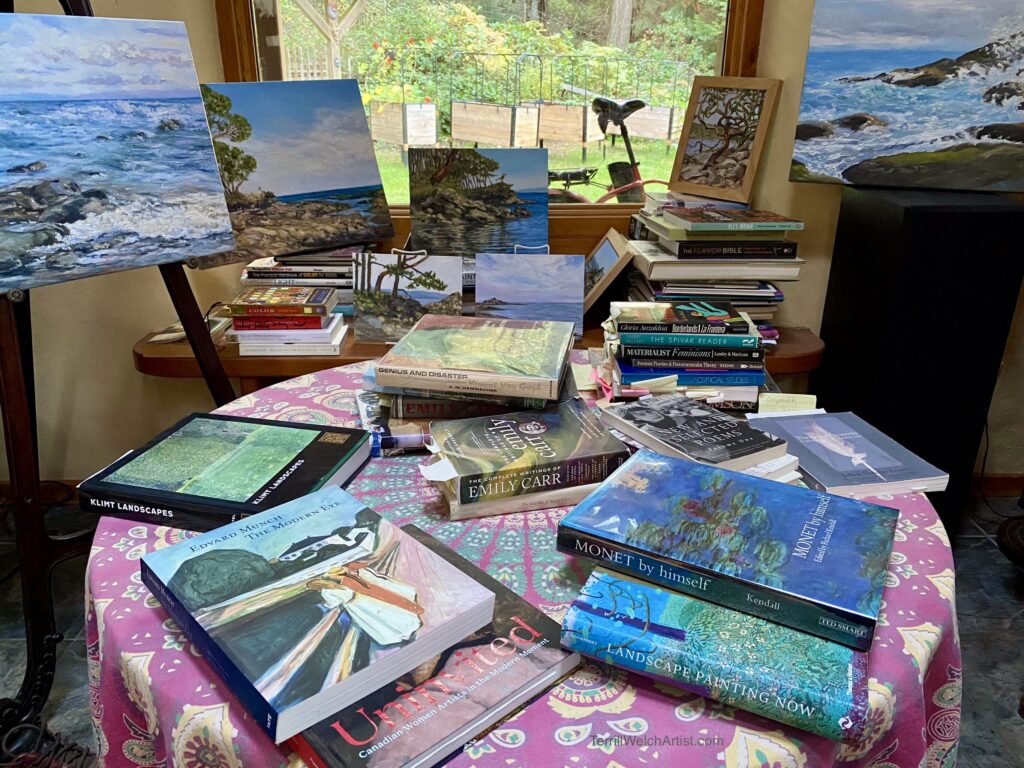
Several hours have passed since our MA in Fine Art early morning group introduction. I thought I would settle by now and that my bullet train thoughts would slow to a human saunter. Alas, this has not yet occurred. Instead, I have pulled reference books from shelves and stack them on the table in the great room for companionship and comfort.


These rather tattered and marked up books, along with a few newer friends, cannot stay here as this is shared space. But for now, it will be fine. I have the top of a sideboard in my loft office to bring them to for ongoing easy access. Now to briefly explore the questions of my ideas, plans and practice.

I have touched on these questions in my first post on October 10, 2024 before beginning. This morning’s introduction breaks open further possibilities around what to consider in my practice. What influences my practice? Has it changed over the years? If so, in what ways? How has and does this shape my ideas for what it is I want to explore now? How are my plans influenced and formed by my current practice? Let’s start here.

Integrating living within my art practice:

Separation between my act of living and my art practice are fleeting and microscopic at best. Sitting and walking in nature are accomplished within a flow of activities such as getting groceries, picking up the mail, car picnics, daily walks and providing primary care for my husband who had a severe stroke fifteen years ago. As his cognitive abilities become more compromised, he can no longer stay on his own overnight and is finding it difficult to travel away from the island. My art practice exists within this tension of daily living and responsibilities. My studio is within our living space and painting breaks are used for putting such things as the laundry in the dryer and getting potatoes into the oven to bake. The business side of my art practice is its own creature with a gallery space at our front gate that is open daily for walk-in self-browsing supported by an online gallery, social media posts and a monthly newsletter to art collectors and serious fans. Then there are the galleries and venues that represent my work that require less of my time but not none. Which reminds me the island fall studio tour is two weeks away! And I need to order my husband’s new prescription! Where was I? Yes, I integrate living within my well honed art practice.

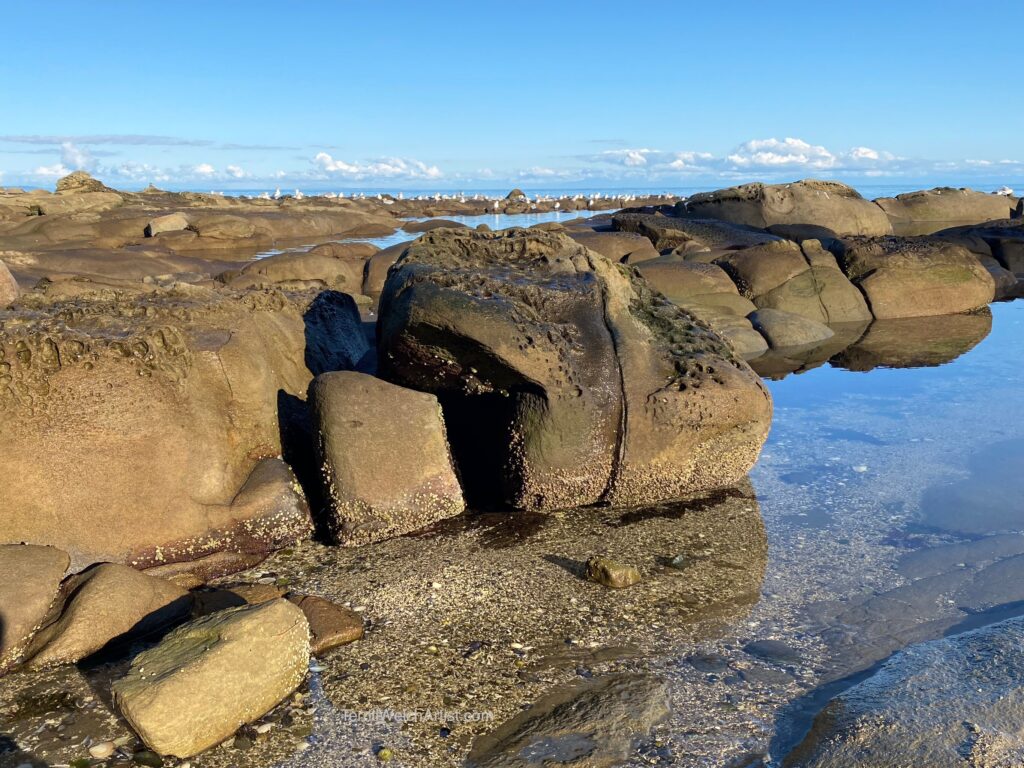
I find moments to slip deeply into the place of waiting to be invited by nature to receive her gifts. I never seem to tire of this Mayne Island small bay.

Tuesday, October 22, 2024 4:13 PM Reef Bay, Mayne Island, British Columbia.

Reef Bay is its colonial name given for the sandstone reefs angling out into the Salish Sea along the Strait of Georgia on our small island, accessed by ferry, private boat or float plane with a full-time population of about 1,200 people, located between the mainland of British Columbia and Vancouver Island. The view is to the southeast and, on a good day, Mount Baker in Washington State of the United States of America is visible. Standing here purposely breathing, I recognize and acknowledge that I am on the unceded lands of the Coast Salish People. Stolen lands. An issue that I likely will need to uncomfortably endure for my lifetime.

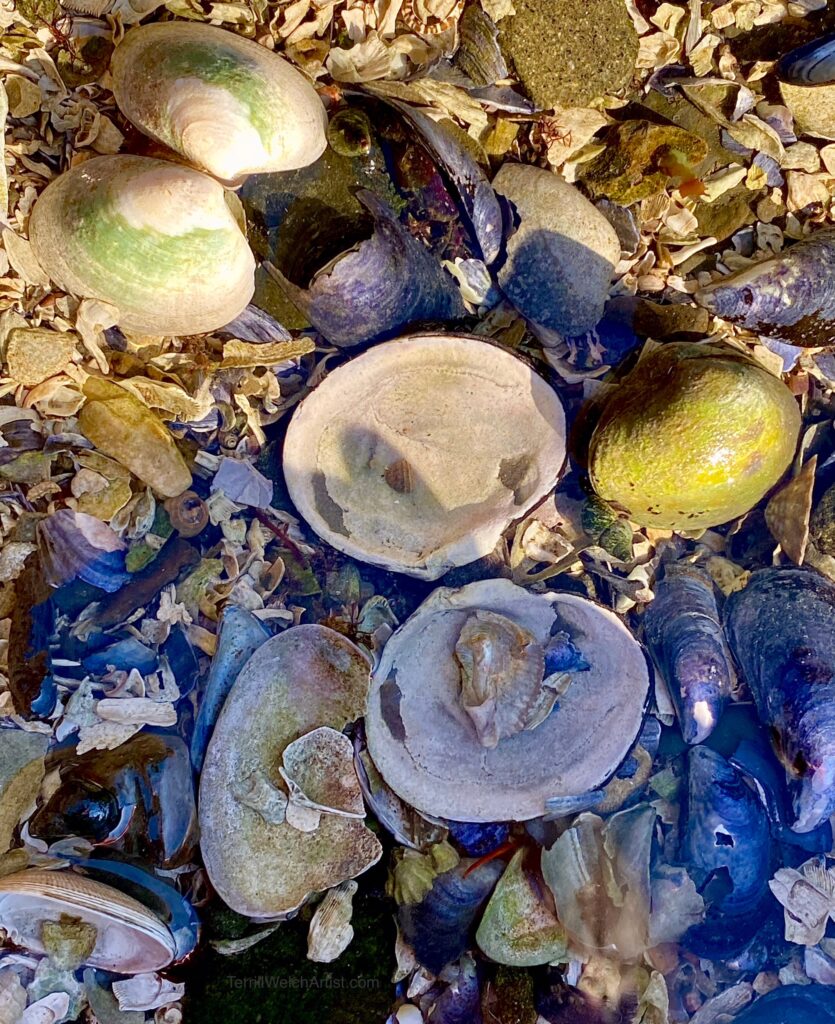
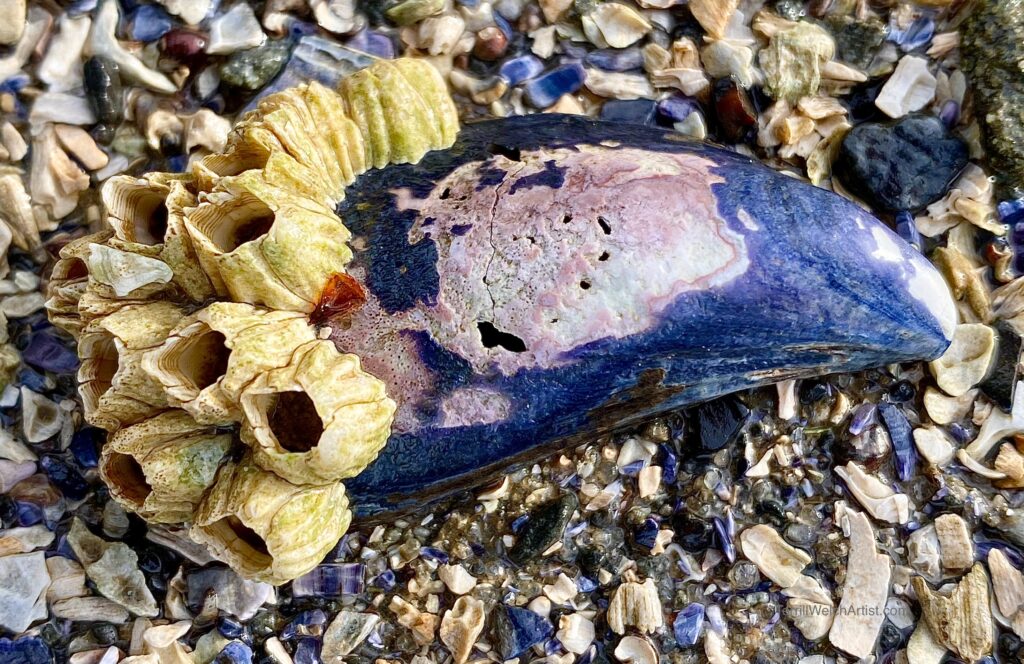
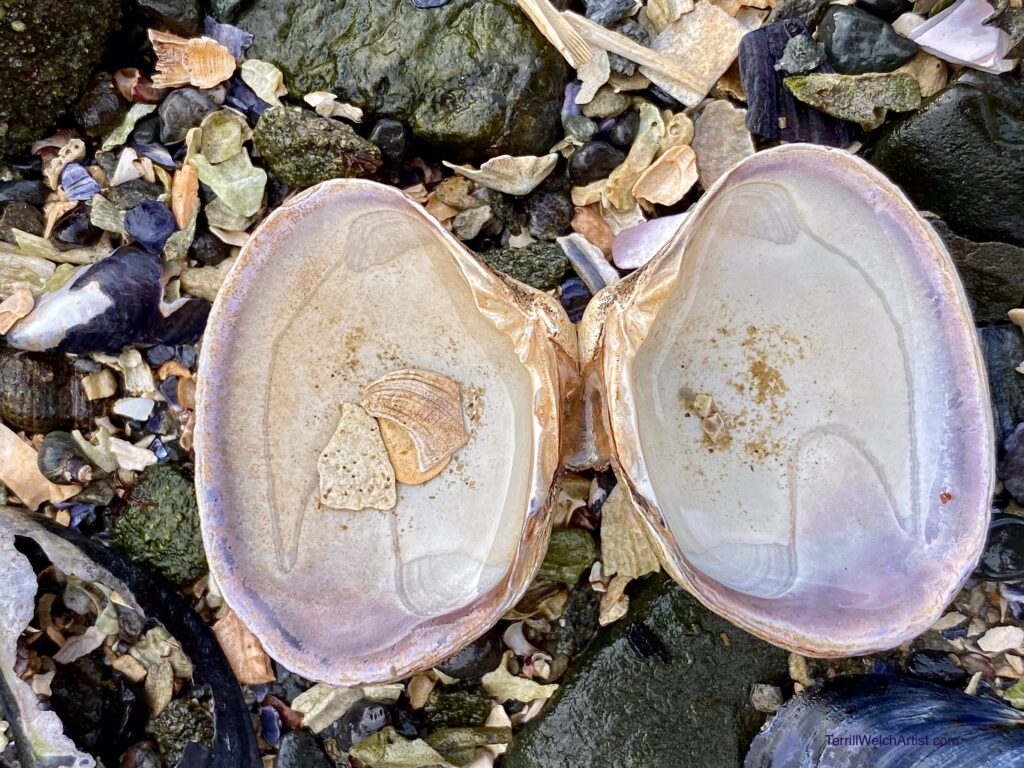
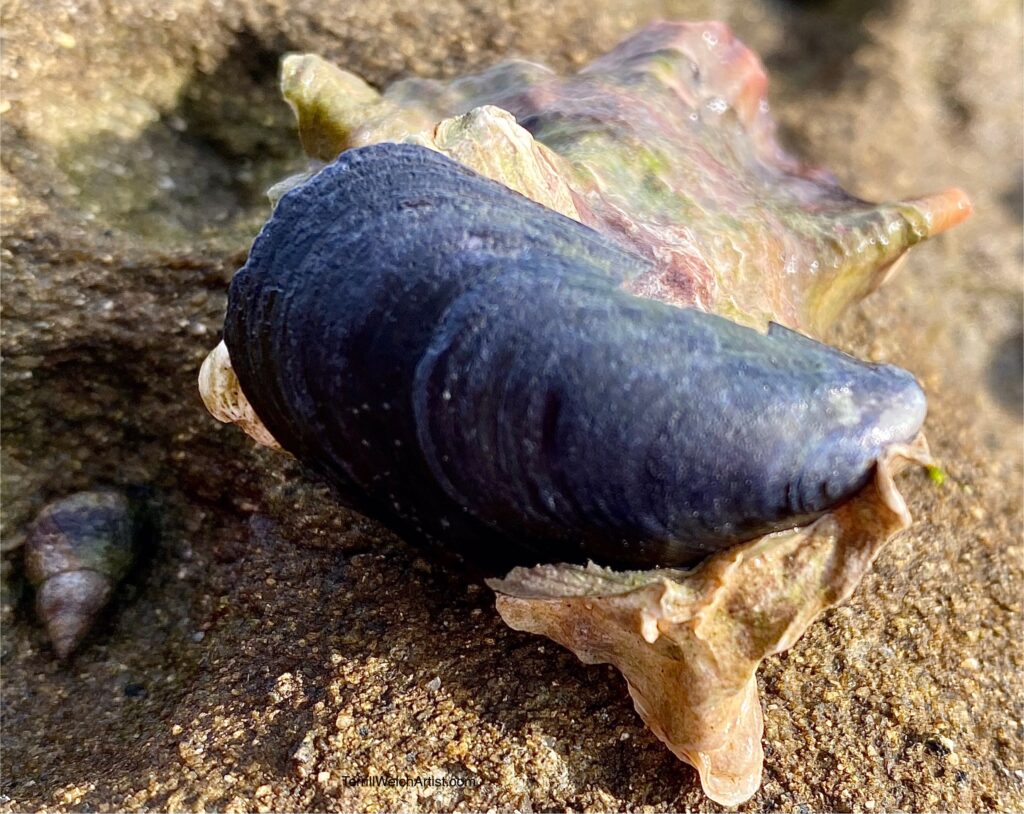
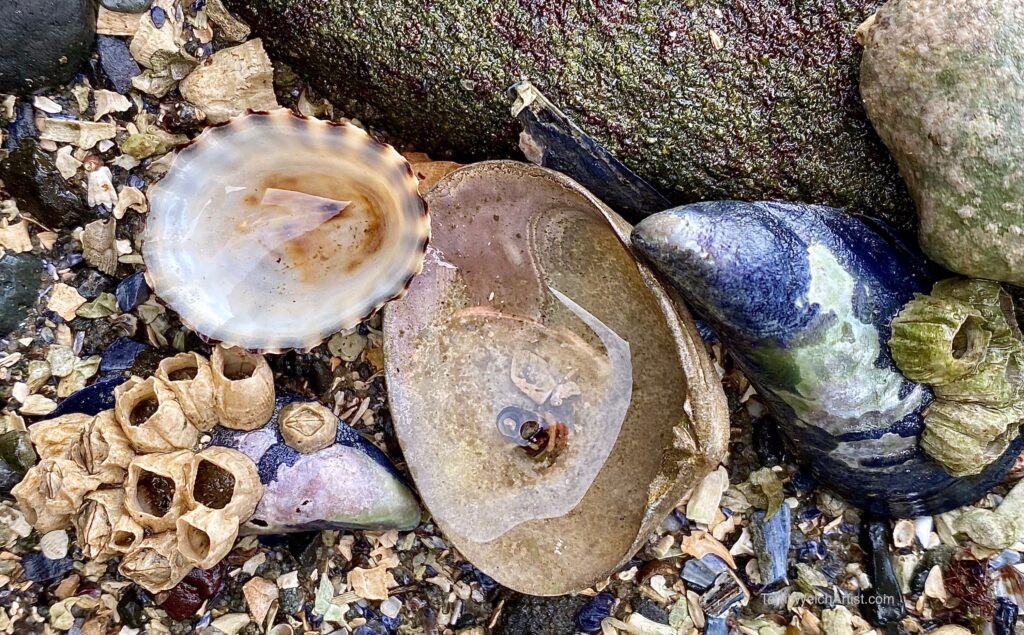
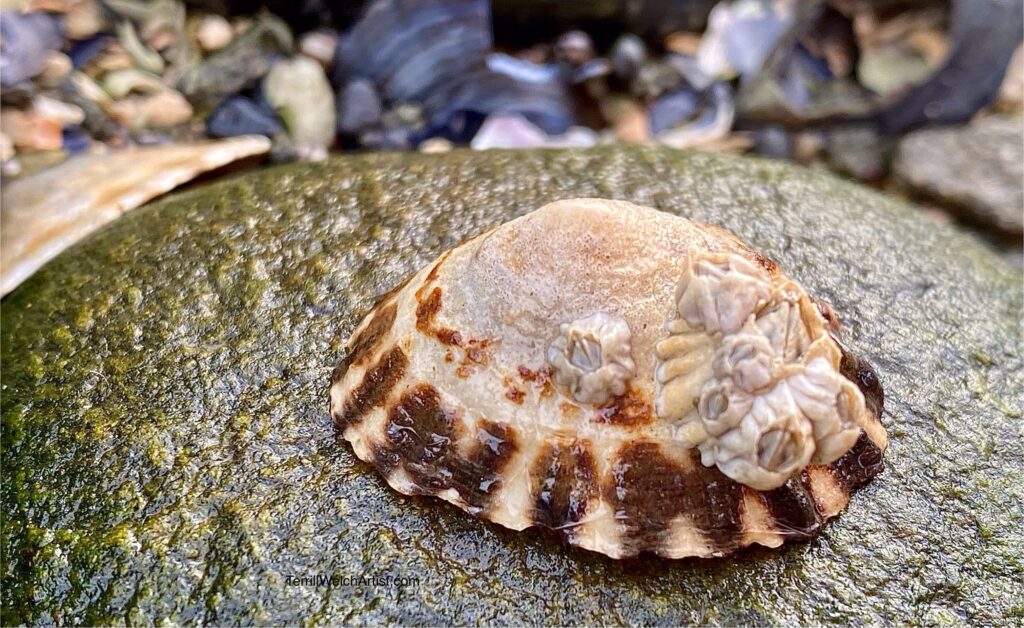
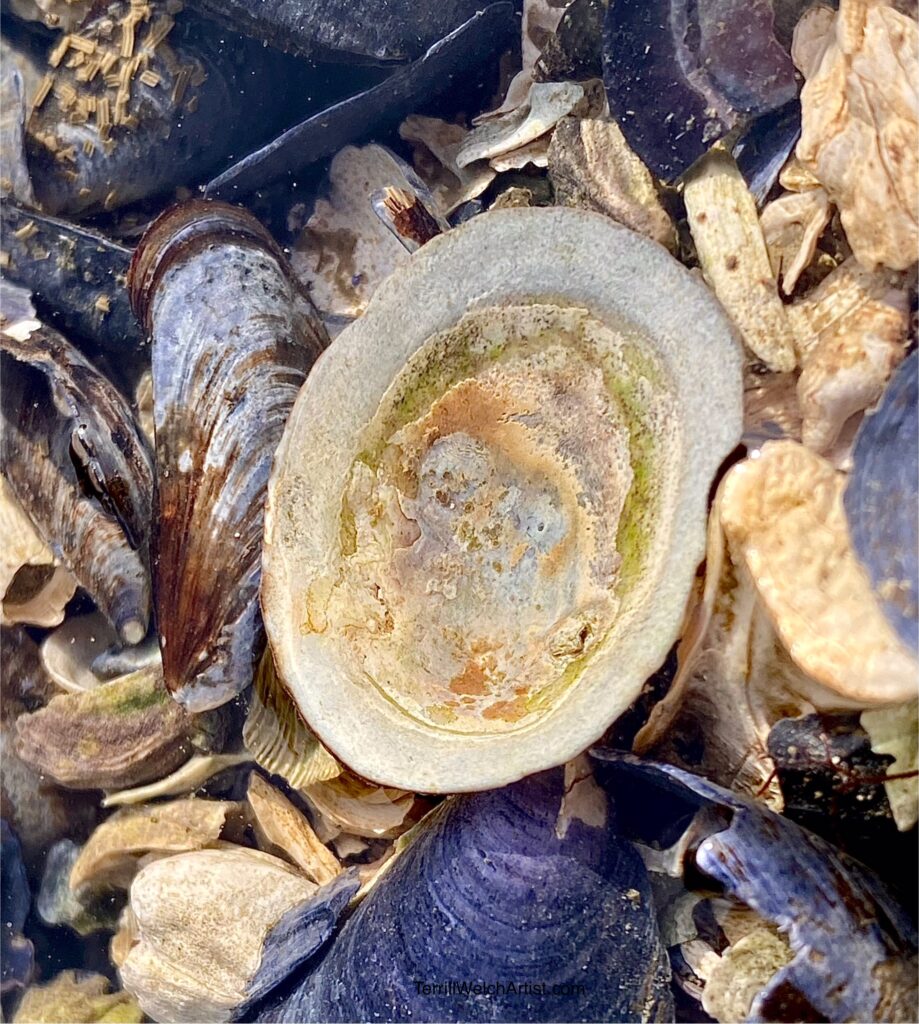
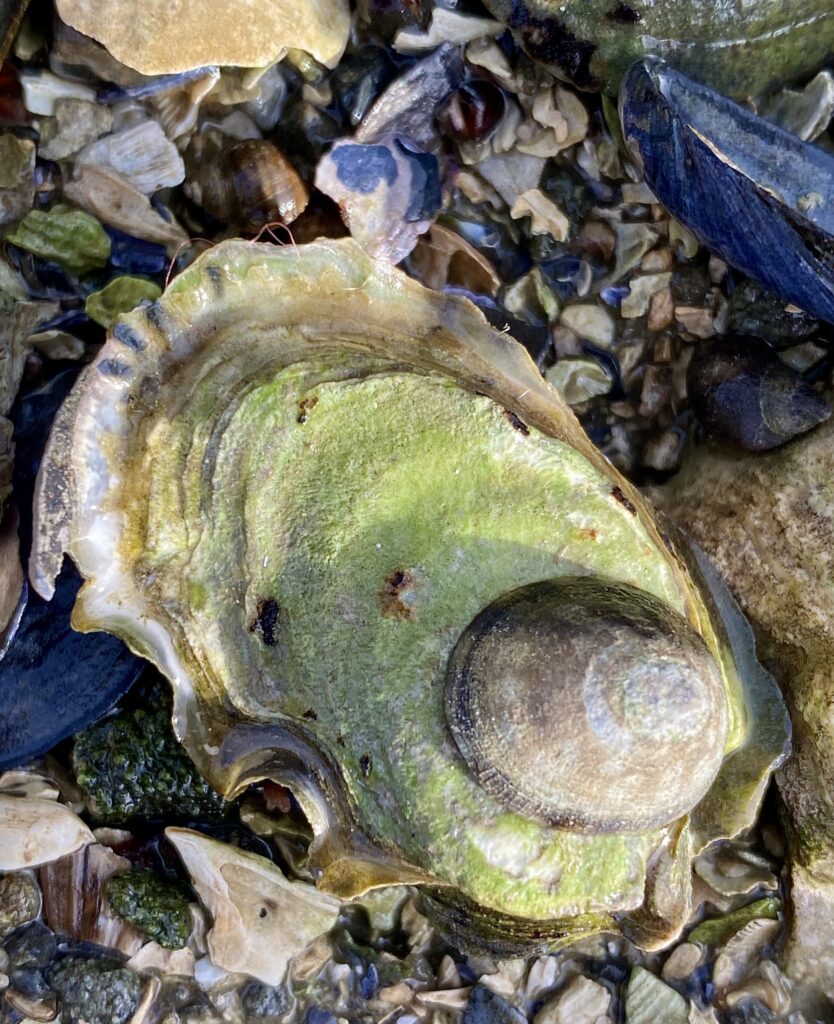
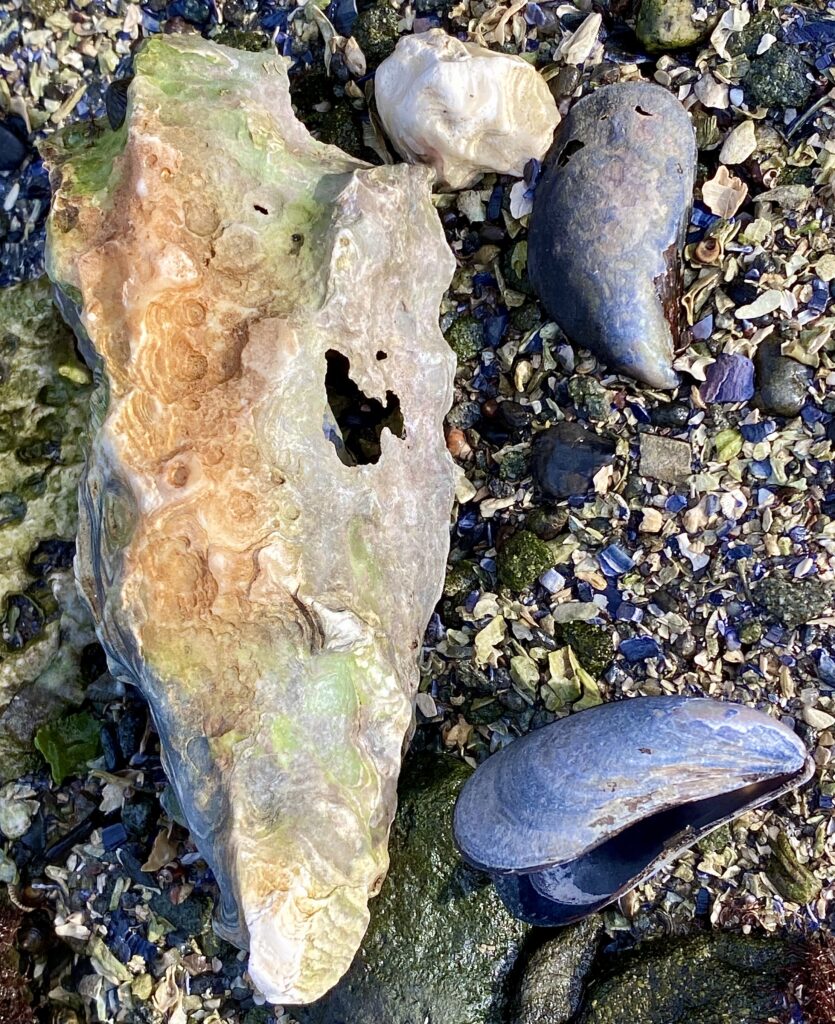
My husband is comfortably waiting in the car. He will watch my progress along the shore with a patience I cannot match. I pause and scrunch down close to the water just looking and half listening to the seagulls and the soft rolling waves farther out towards the strait. I am not looking for anything in particular in the soup of life at the tide’s edge. I first grasp overall shapes and colours. Then shadows and forms begin to gain meaning as I recall and name my observations. Shells. Clamshells. Mussel shells. Snail shells. Broken shells. Bits of barnacles. And do you see the wee crab at the top middle?

Tuesday, October 22, 2024 4:14 pm Sea floor at Reef Bay, Mayne Island in British Columbia, Canada.

I wander a bit further but on this day, not out of sight of the car where my husband is waiting. Yes, my art practice has changed in how I gather reference and sink into and meander through the landscape. Since 2020, I have less ability to spend whole days traversing the shores and seaside trails. I have extremely limited ability to explore shores and trails off of our island. It is simply a fact. The constraint has meant taking my practice deeper into this specific place. I call it thriving in place and I completed a year of artwork in 2022 – 2023 with this intention. In fact, these constraints are what led me to examining and considering the seafloor as a subject of study. My plans are influenced and formed by what is available to me. I choose to take the paths that are open to me without complaint or regret. I recognize this time as precious and accept it with sacred grace, a gift.

Now, I had better move those reference books up to the loft. But before I do, a few lines from ‘Wild Geese’ by Mary Oliver on page 110 of New and Selected Poems, Volume One to take with us into the day…

…Whoever you are, no matter how lonely,

the world offers itself to your imagination,

calls to you like the wild geese, harsh and exciting—

over and over announcing your place

in the family of things.

Monday, October 28, 2024

Before I begin a summary of notes for my latest painting sketch, let’s get these notes from my research on another artist’s specific body of work, Mark Rothko’s Chapel, that may be of interest in painting an intension to enhance our sense of inner peace.

Pockets of Silence and Mark Rothko Chapel 

“Many who are driven to this life are desperately searching for those pockets of silence where they can root and grow.” 

“The struggle is beyond painting, not with painting.”

“There is more power in telling little than telling all. Silence is so accurate.” 

Marc Rothko, The Silence of Mark Rothko, YouTube Movies & TV, released 2016. Documentary narrated by his son.

Within silence is a contemplation propelling bold action.

How the Rothko Chapel Creates Spiritual Space by Allison Meier, March 2, 2020 JSTOR 

https://daily.jstor.org/how-the-rothko-chapel-creates-spiritual-space/

“In the stillness of the Rothko Chapel, all are invited to have peace or silence, with the paintings providing an enigmatic portal to contemplation.”

About the Rothko Chapel https://rothkochapel.org/learn/about/


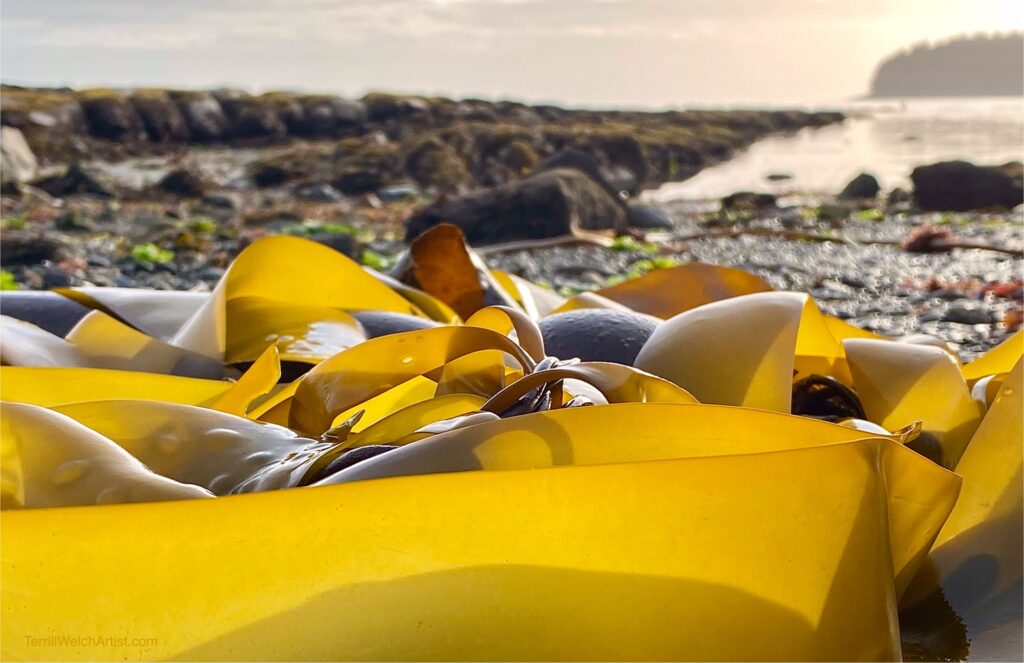
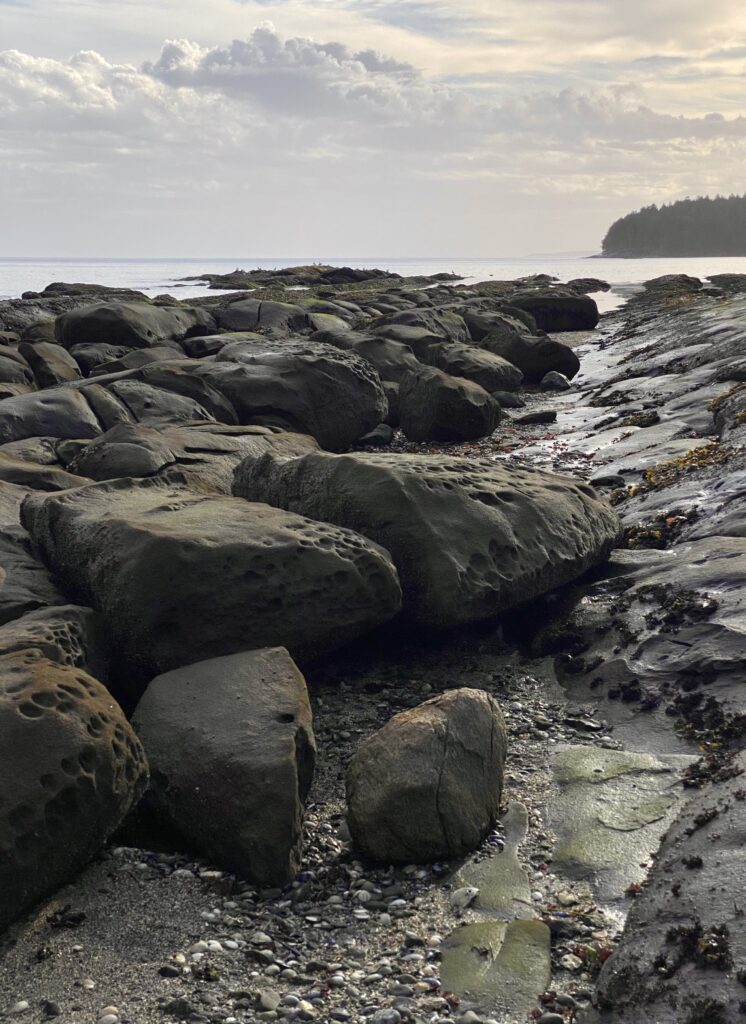
Saturday morning, October 26, 2024 at 9:40 am, finds me again on the beach at Reef Bay. The storm from the night before mostly missed us but not the Salish Sea which has tossed up large bull kelp seaweed along the shore.

Saturday, October 26, 2024 9:40 am. Reef Bay, Mayne Island, British Columbia, Canada. Looking East.

In my reference gathering of photographic sketches, I often take a child’s view and get low to the earth’s surface. I have found this releases a kind of inner curiosity and strengthens my ability to observe without having to know what I am observing. It is a way of framing by shape and texture in those moments before my brain begins the naming of things. This allows me a more fuller multiple sensory experience and memory.


The day has intermittent sun through hazy mist and the overall light feels a little flat. Knowing that what I seek will still be intriguing, I slowly walk along the bottom of the reef.

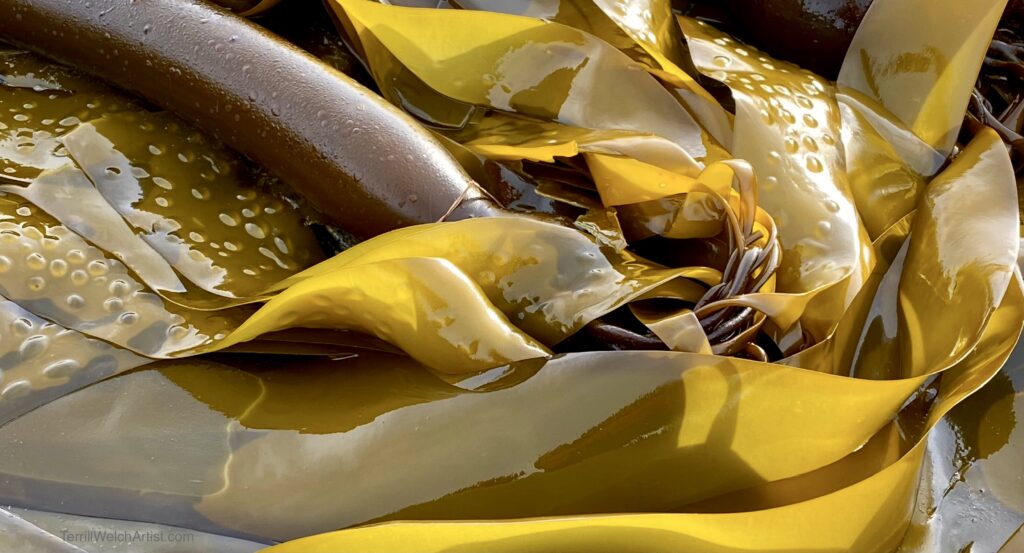
Saturday, October 26, 2024 10:05 am. Reef Bay, Mayne Island, British Columbia, Canada. Looking East.

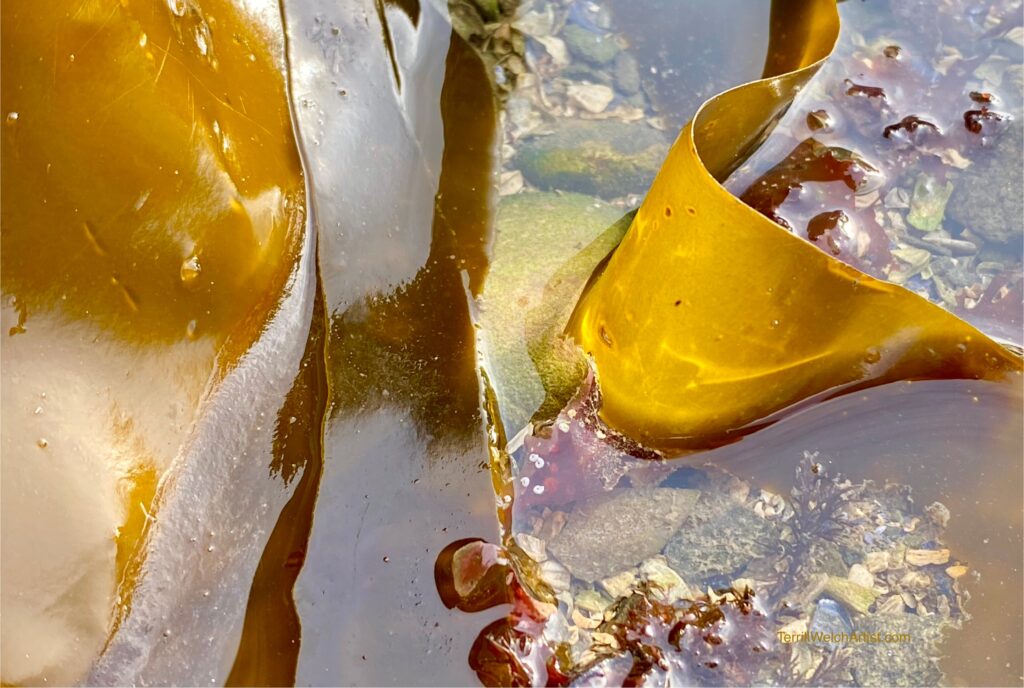
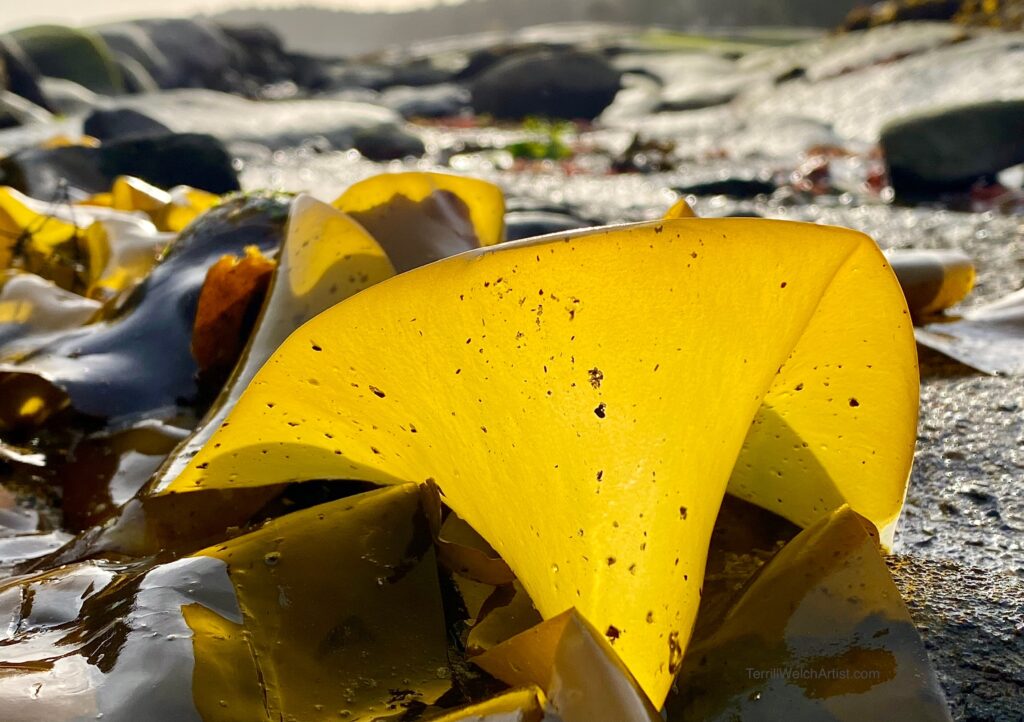
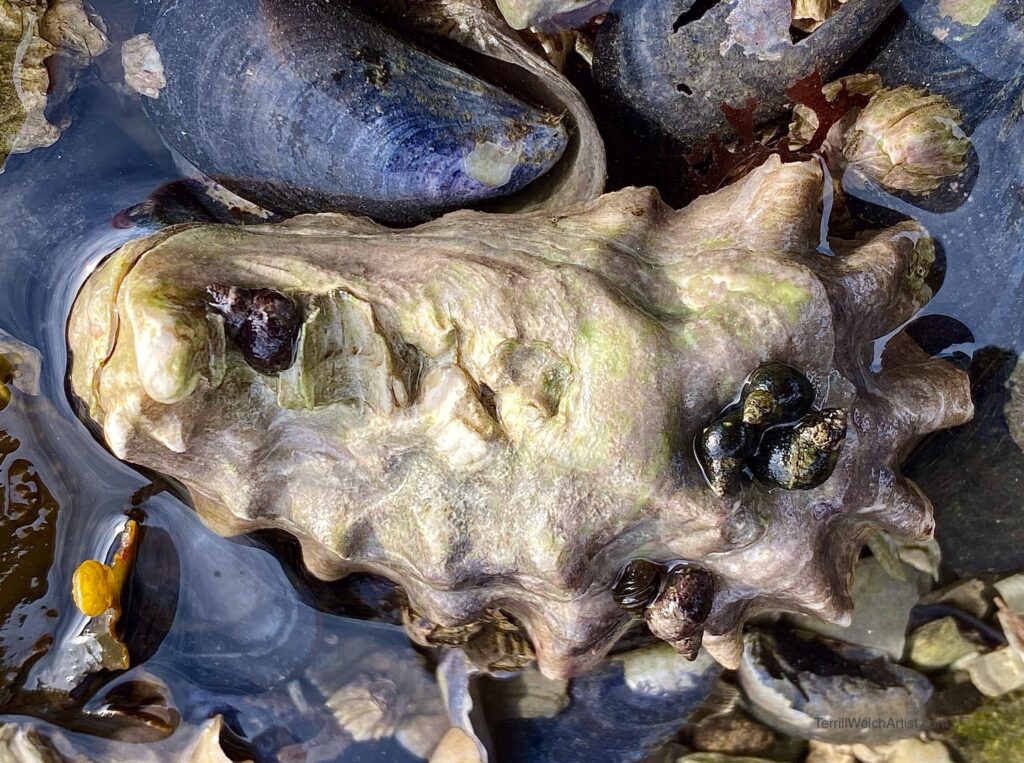
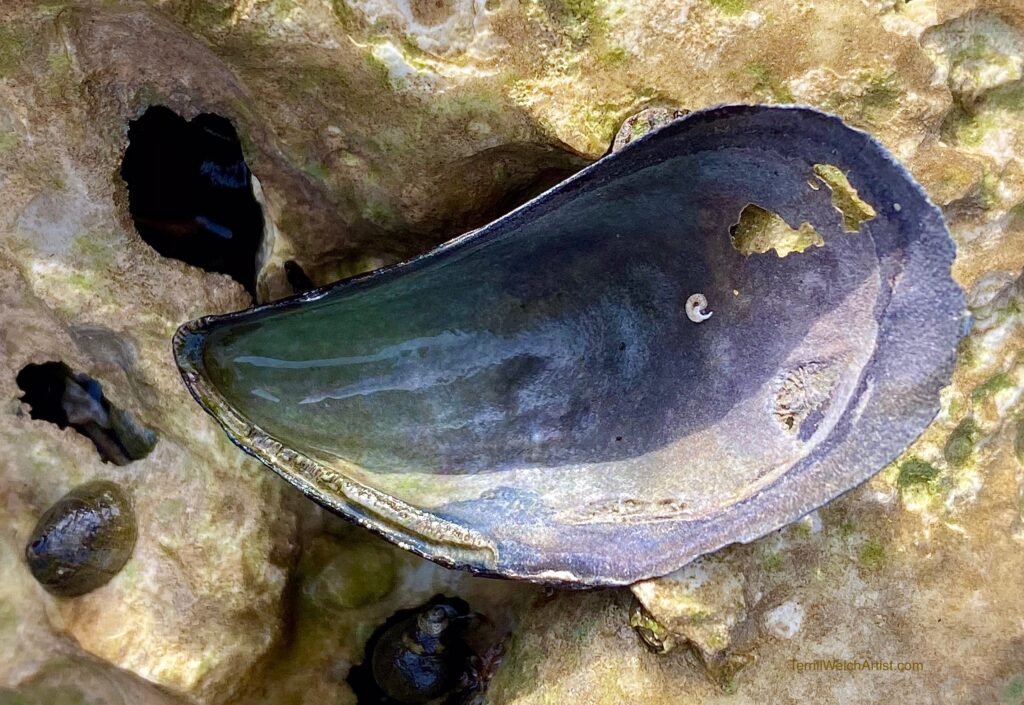
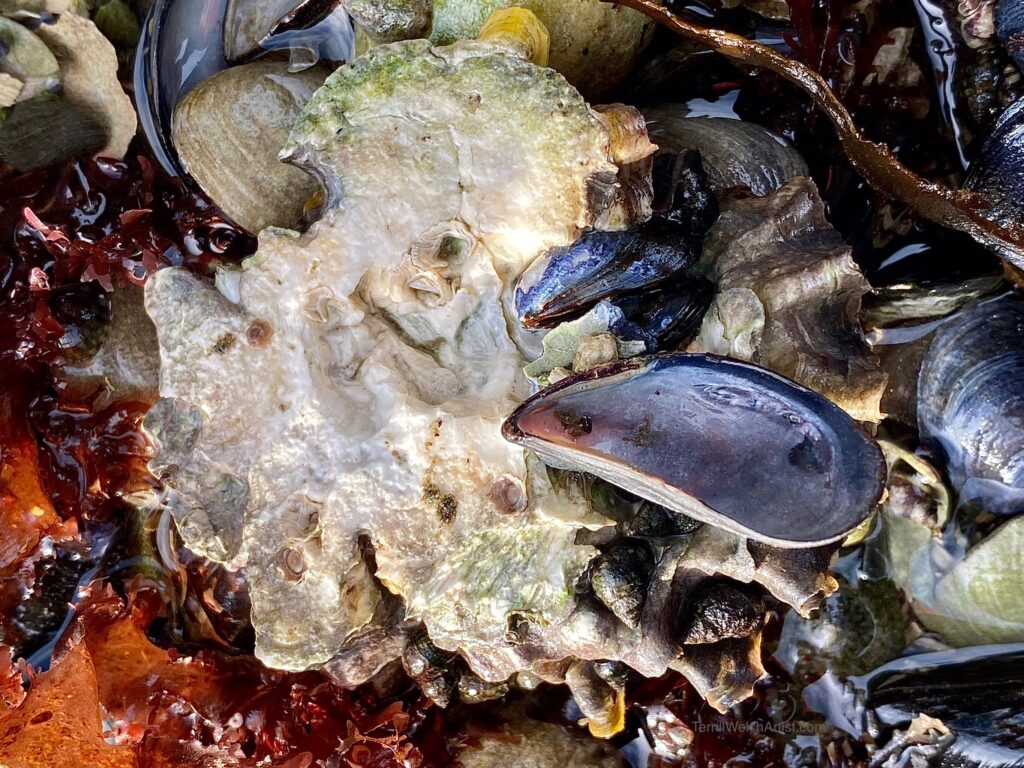
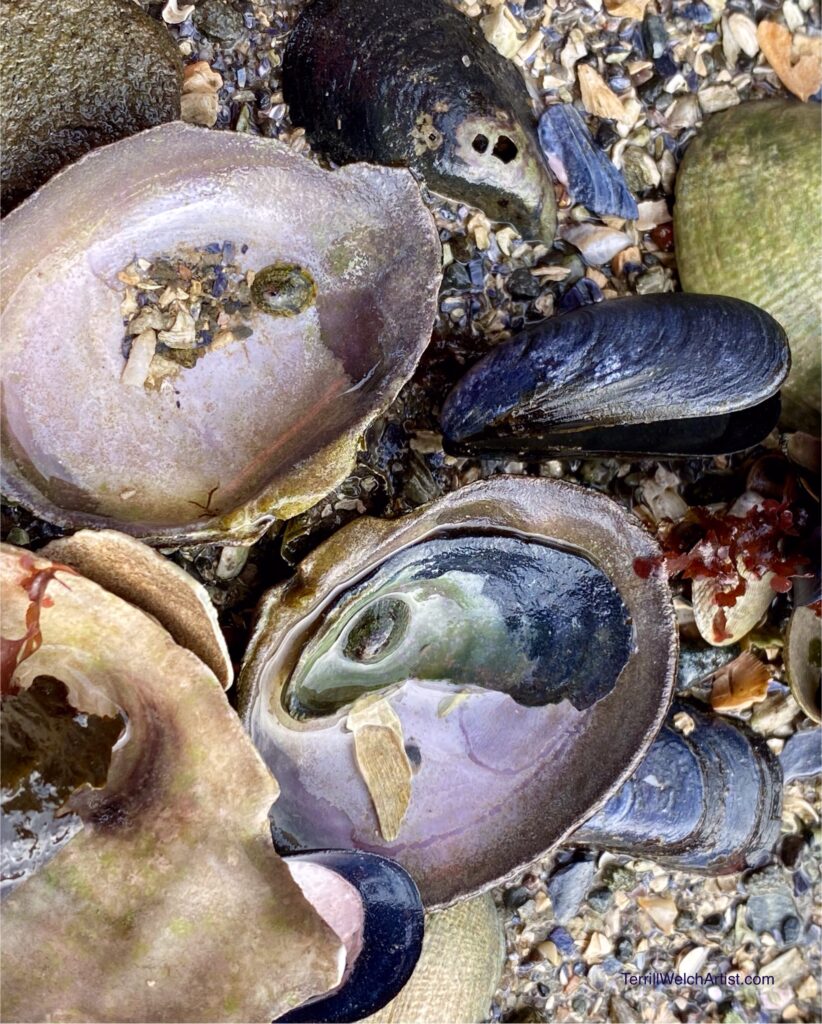
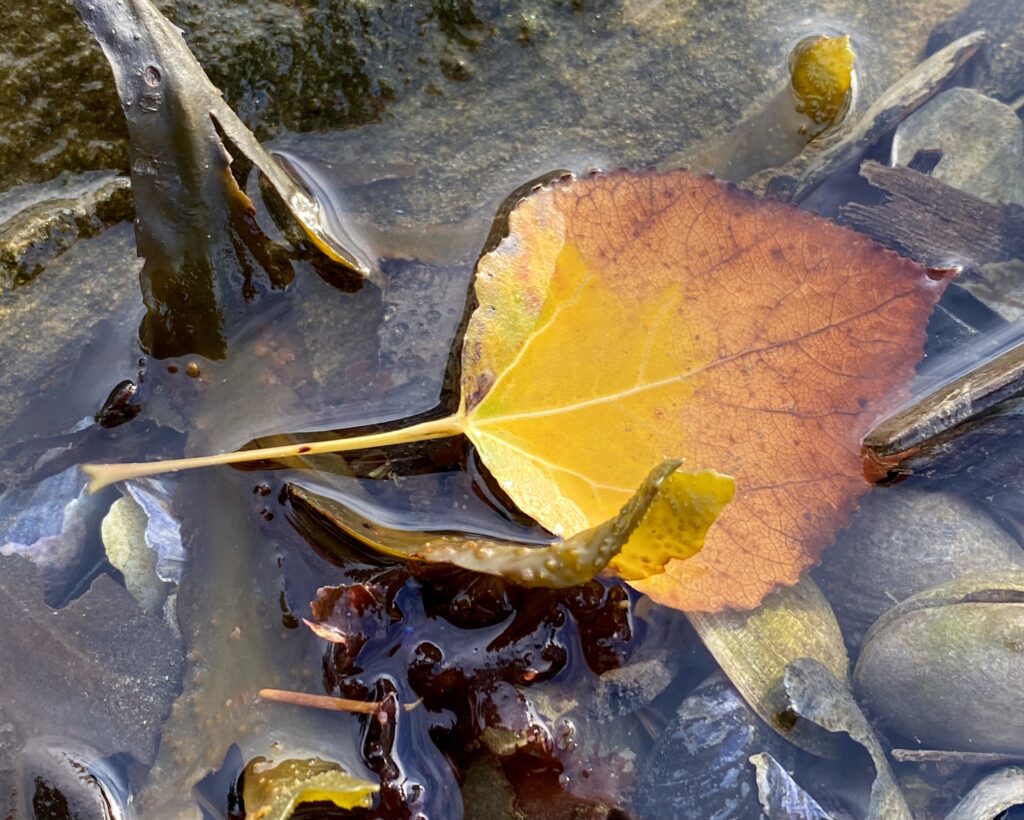
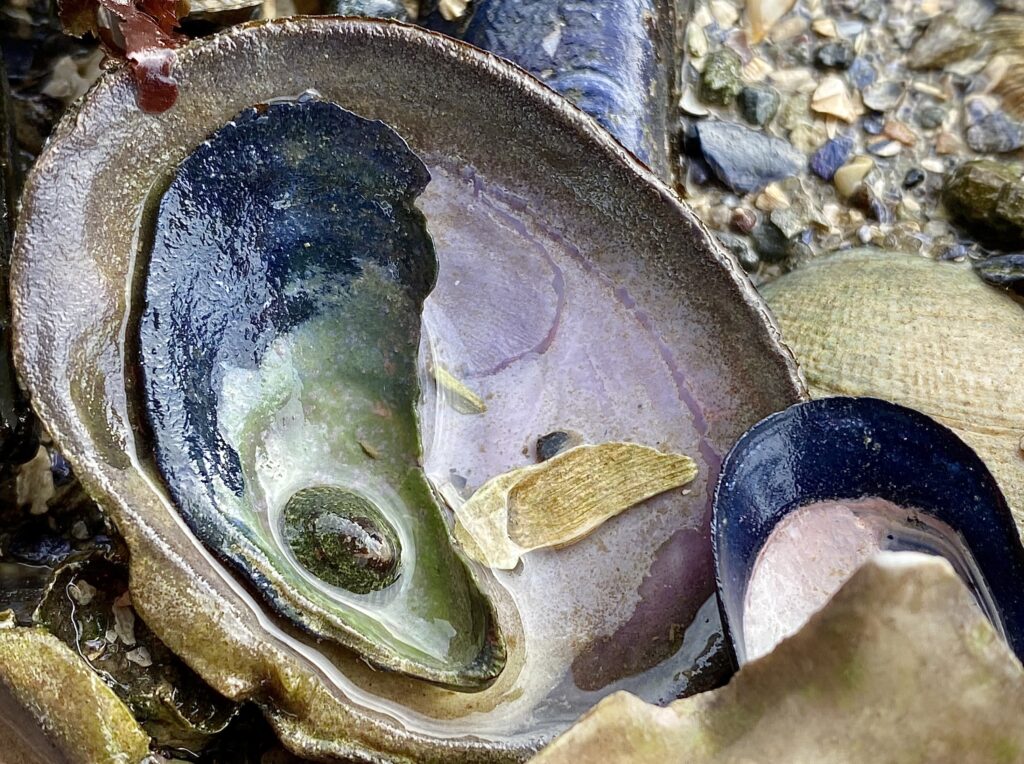
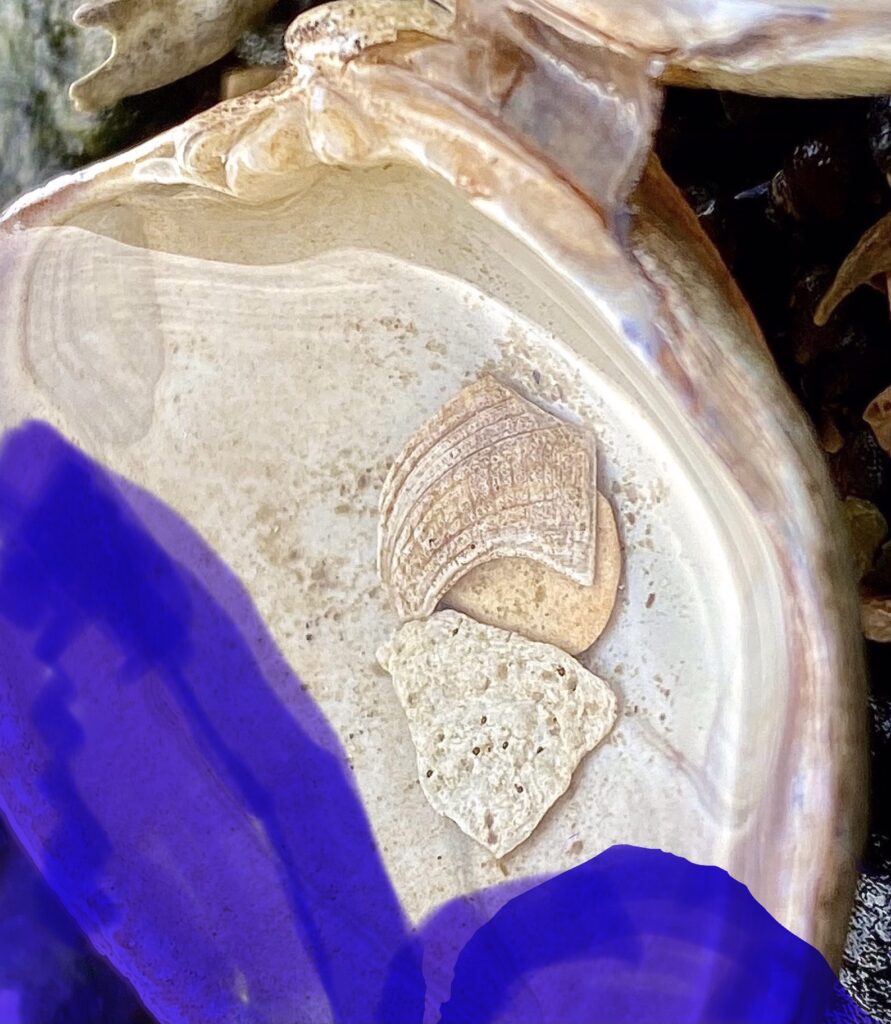
I wasn’t disappointed. In this tile of image are a few of my photographic reference sketches that have been added to my album of materials for later use in the studio.


Though I have a large DSL camera, I primarily collect my photographic sketches with my 11 plus pro iPhone. I find the immediacy of this tool most relevant for my needs.

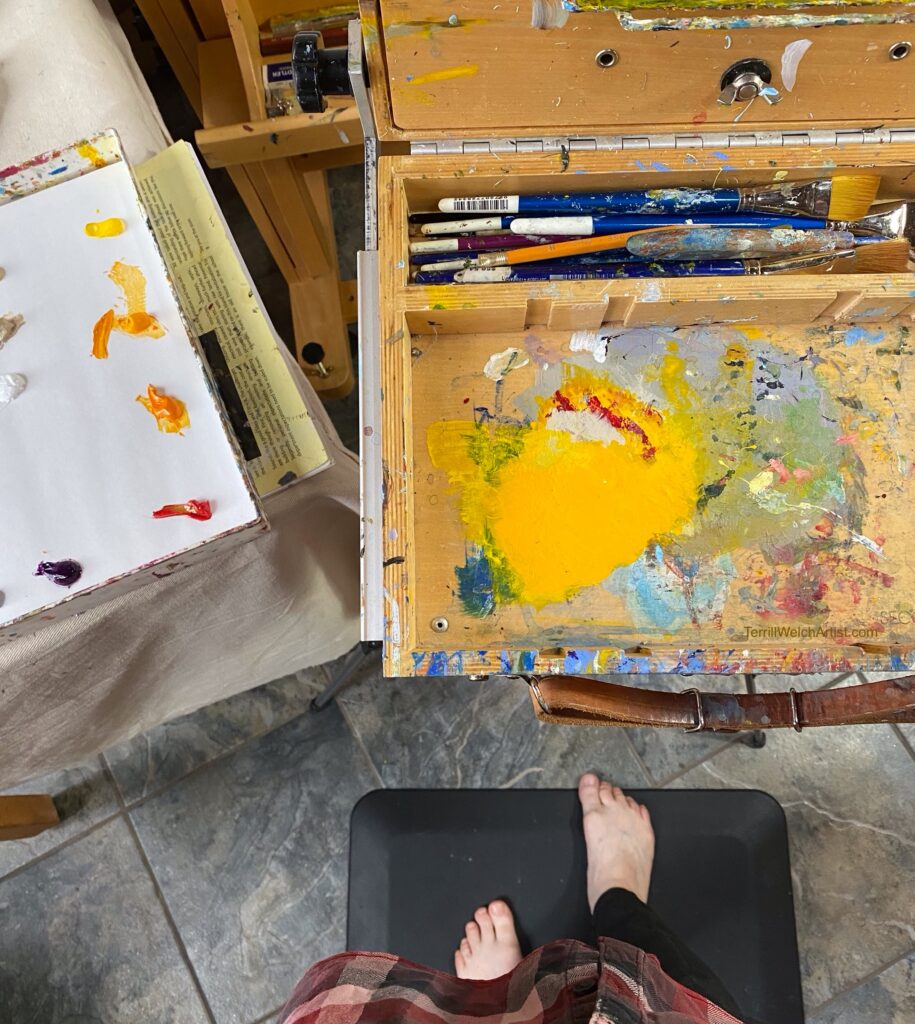
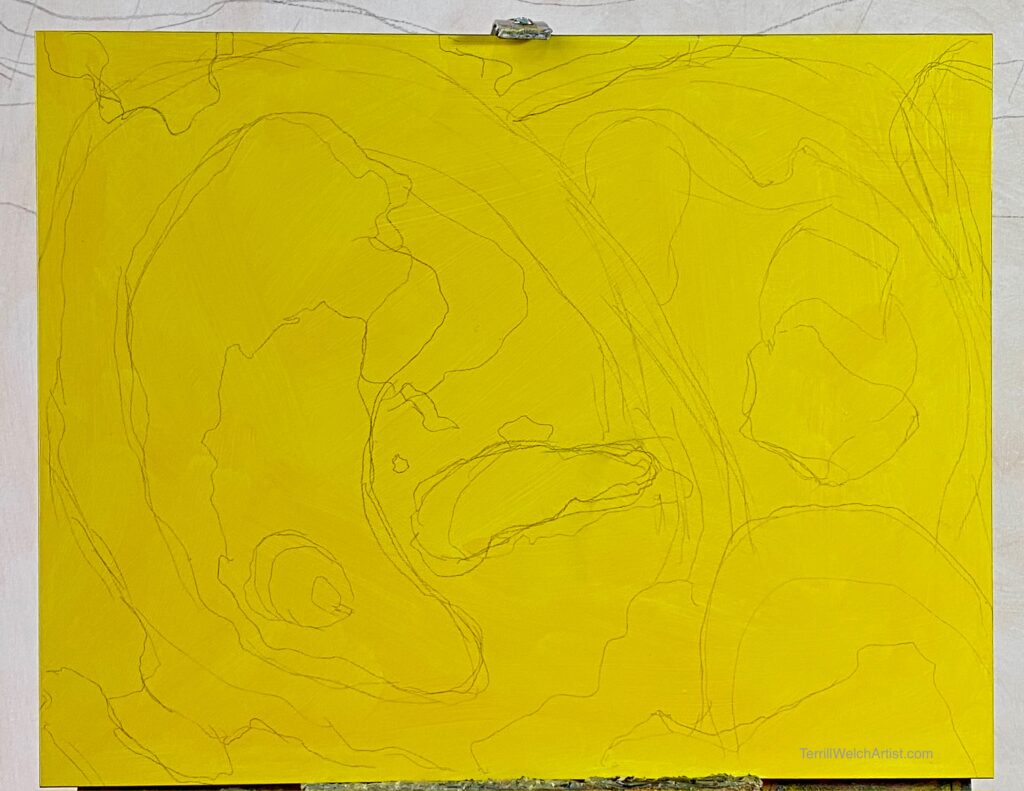
On Sunday morning, I pull an 11 x14 inch gessobord with a yellow acrylic ground from the studio shelf and I set up my small easel. As my 66 year old hips demand, I lay the anti-fatigue mat down onto the hot water-heated floor that is warm under my bare feet.


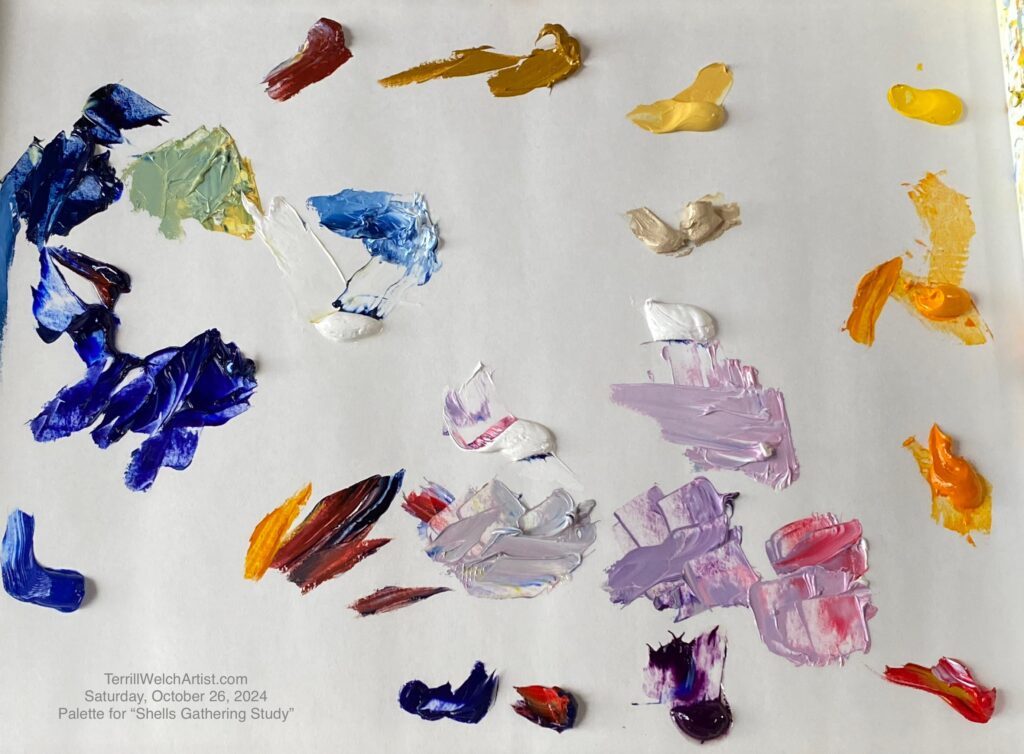
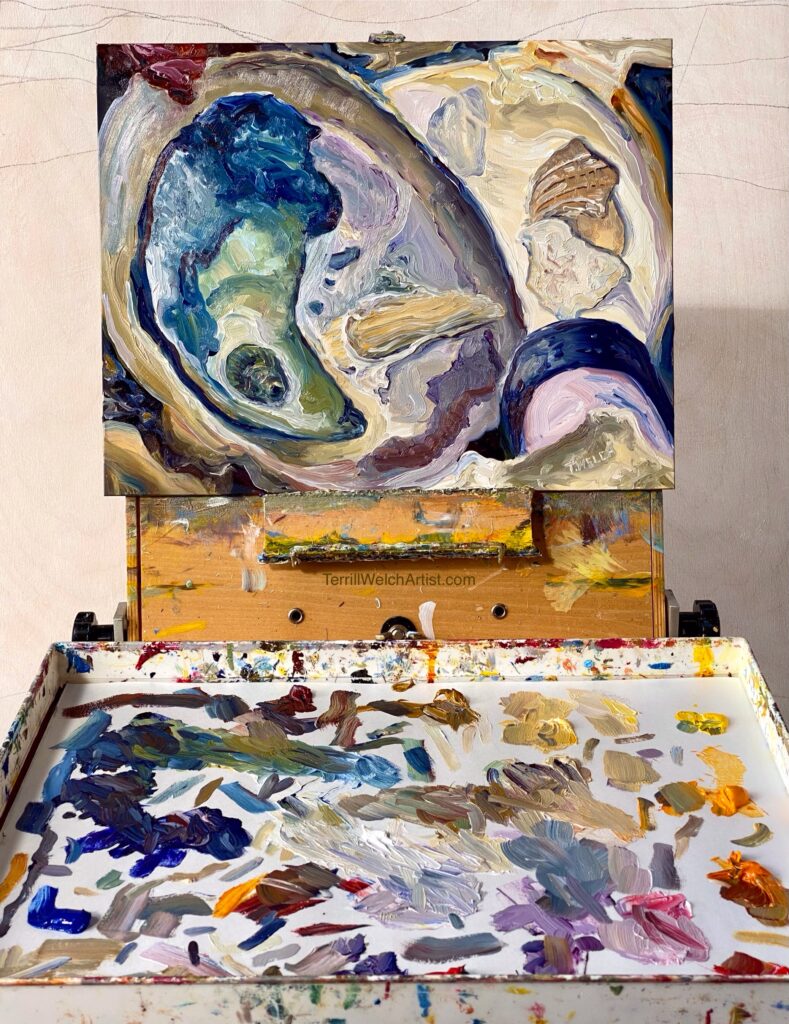
I squeeze out the various M.Graham walnut oil based pigments in my tailor-made, left-handed, muscle memory order, onto disposable palette paper and then quickly mix a few starting colours while knowing that as I work, more and more of my paint will be mixed and adjusted right in the painting surface.


I have chosen two images to turn and collage together for this painting sketch and study. I use my Apple Pencil to guide my eye in the second image rather than physical or digitally merging the photographs into one composition. I trust my intuitive ability to later scale and adjust the composition as necessary onto the painting surface.


I save the two primary images so I can easily move between them on my iPad, similarly to how they are shown above.

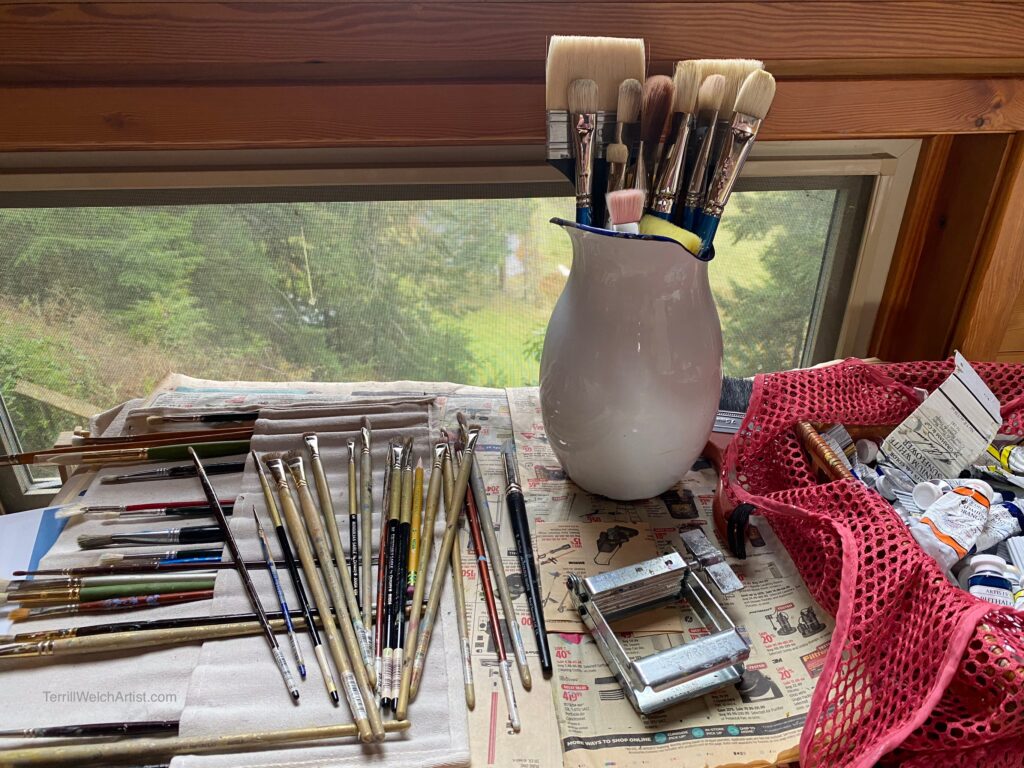
I go to where my brushes rest next to south window overlooking the valley.


I pick out two angle quarter inch brushes and two small rounds. One each for painting light and dark. It is a small surface and I want the ability to add lines to my usual wet-into-wet painting process. I will save the large brushes for larger surfaces later on.

I have few consistent approaches to painting a painting. The grounds or underpaintings are often in complementary colours to the over paintings. The surfaces range from canvas, linen on wood, wood and gessobord. I sometimes start by roughing in with paint or, like in this painting, a few minimal pencil lines to guide my process.


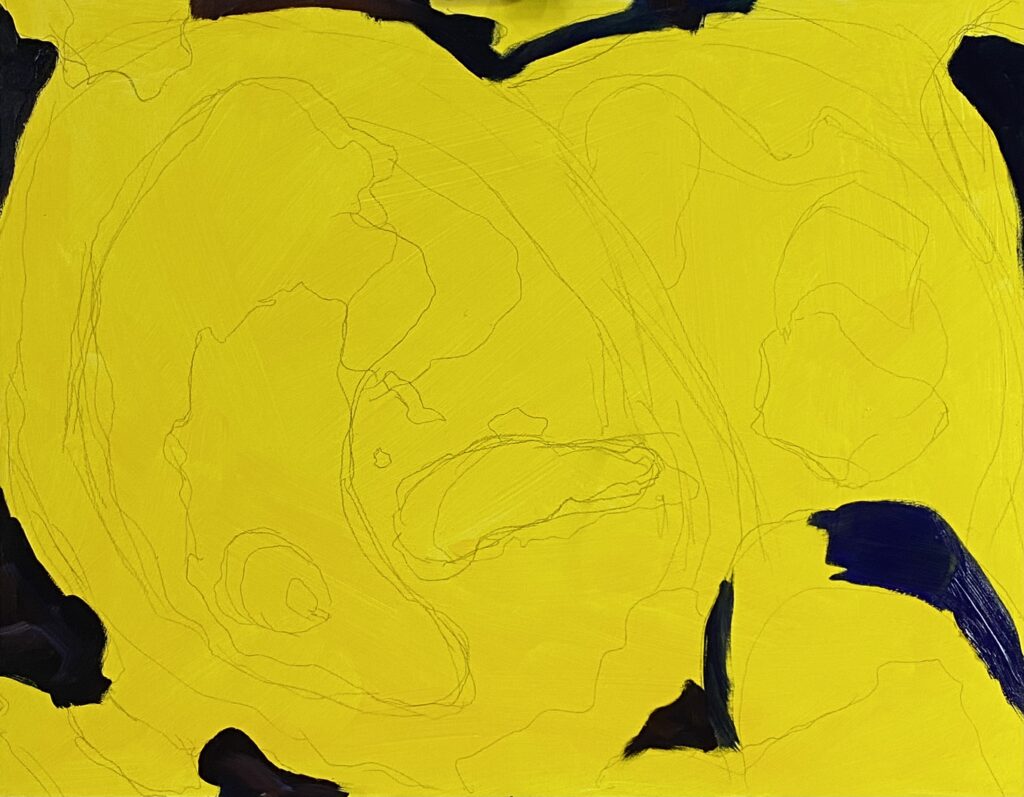
I tend to work my surfaces in a wholistic way building up passages in overall layers. In this case I started from the outside-in with my darkest colours.


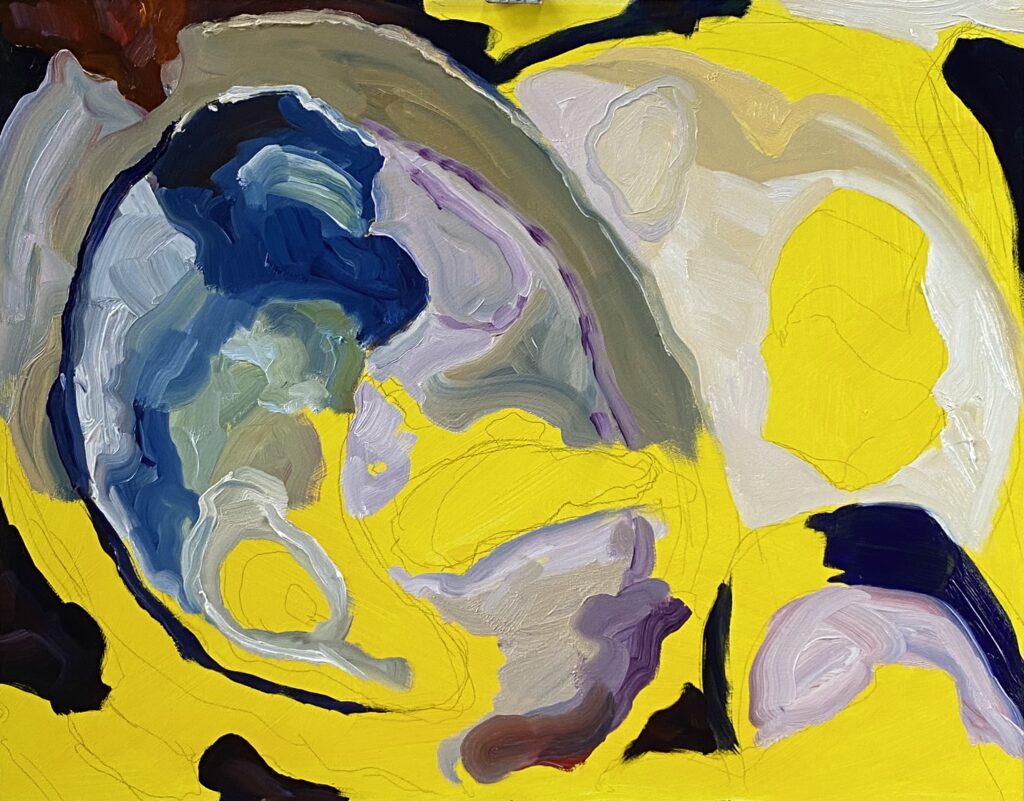
From there, I continued to develop the painting by working with my dark and light areas in rhythmic motion while reminding myself that my intention for this work is inner peace. Even on this small surface, I stand to paint and settle deeply into the core of my body rather than painting from my wrist or arm. I move back and forth about six feet from the surface at regular intervals. There is no music playing. I prefer to work in silence with only the natural sounds in the room surrounding me. In this case, the rain on our tin roof is most prominent. Light breaks and recedes behind the rolling clouds in my less-than-ideal south exposure studio. However, it is what I have and I make it work. Thankfully the southwest coast of Canada is part of a northern rainforest and we have many overcast days, particularly in the winter.


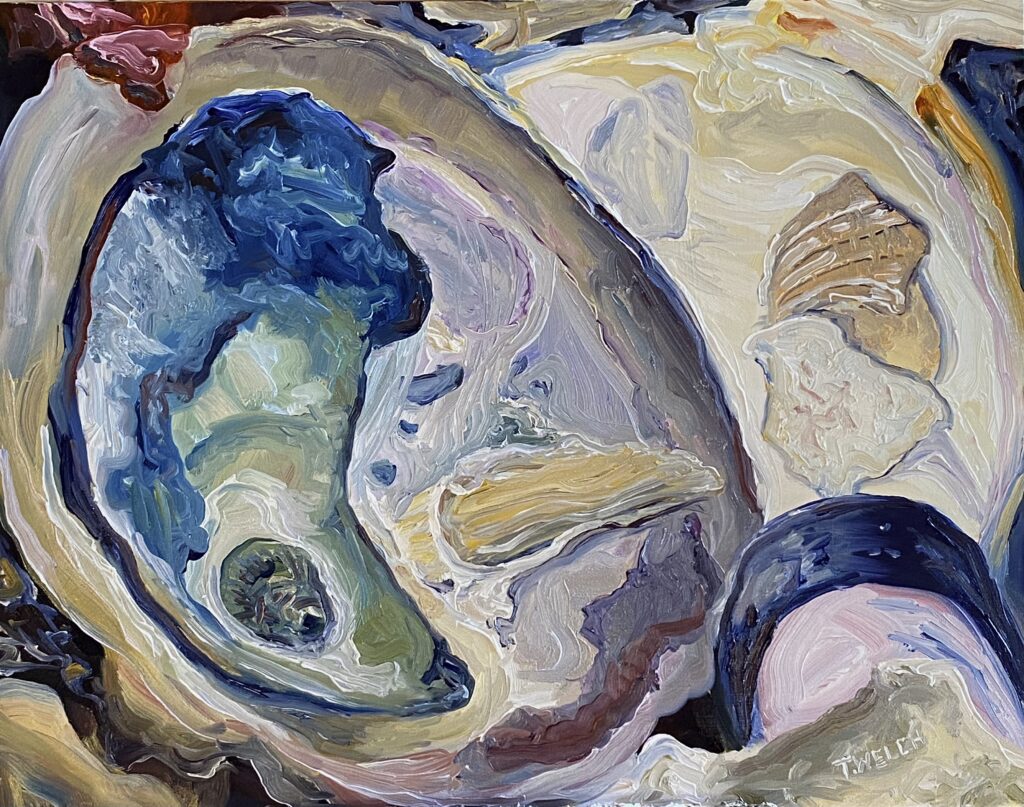
Eventually, the surface is covered and the painting is what I refer to as blocked in. At this point, my reference material is of little value and I set it aside. The painting must now stand on its own through to completion. I breathe into my memory. I am deeply embedded in the painting process somewhere between what I have witnessed and fragments of information from other experiences. I am drifting between the tides and flouncing over and between the stones and seaweed. My brush-to-canvas requires no thought as sensations and intuition guide my mark making. After a while, I step back and pause.


I am having trouble seeing where I need to go next or even if I need to go anywhere. I have been painting for a little over two hours. It is almost 1:00 pm. I take a break and we go out for a late lunch. I take photograph of the painting sketch before leaving so I can glance at it if I choose. I am not completely disengaged from my creative process and will come back to in my mind’s eye frequently and occasionally check my phone image to see what is currently on the painting surface. This process is familiar to David and he reads his book while we wait for our lunch to be served and is quietly indulgent.

When we return home, it is getting close to 4:00 pm. The light is heavy as more rain threatens. I go straight to the studio and begin painting again. Within an hour, the painting sketch is complete and resting. The light is now terrible for taking a photograph but I do it anyway.


This way, during the evening while we watch a show, I can look at it, if I wish – and I almost always wish, without physically getting up and going to the studio.

In the morning, I get up and study the painting sketch. I pull open the palette box just in case.


I can find no way in. There is no brush mark insisting to be made. The small study is complete. There is nothing more I can say for now. Though it is still too shiny and wet for a decent photograph, for better or worse, it is finished.

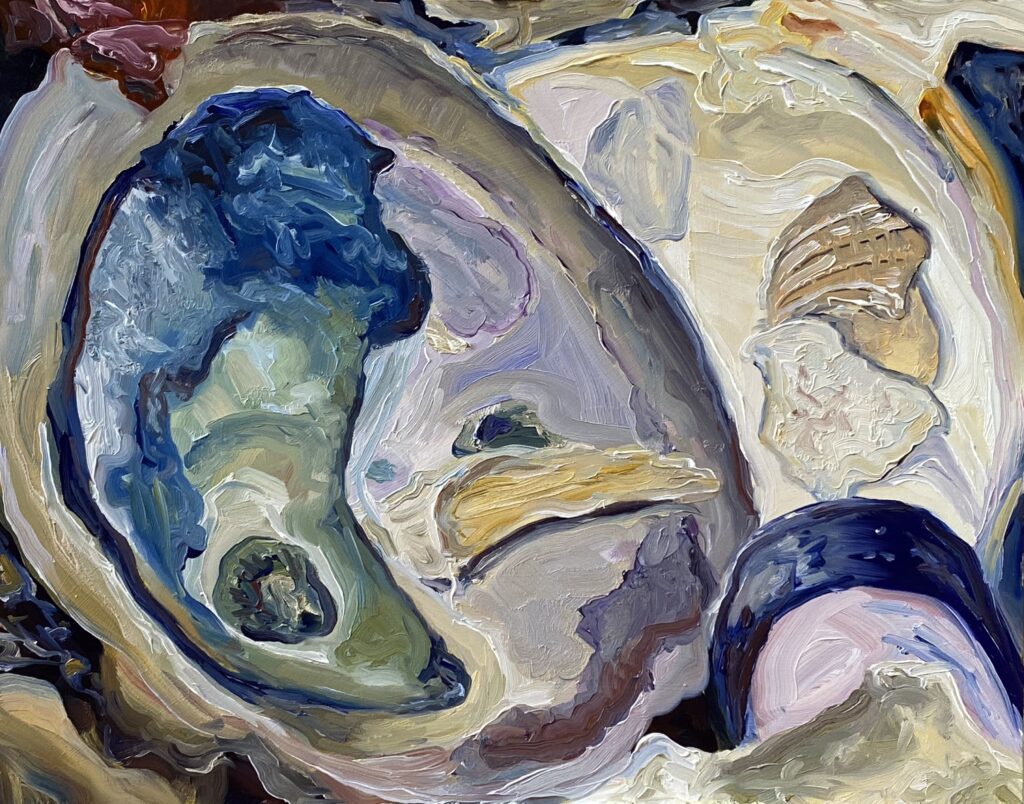
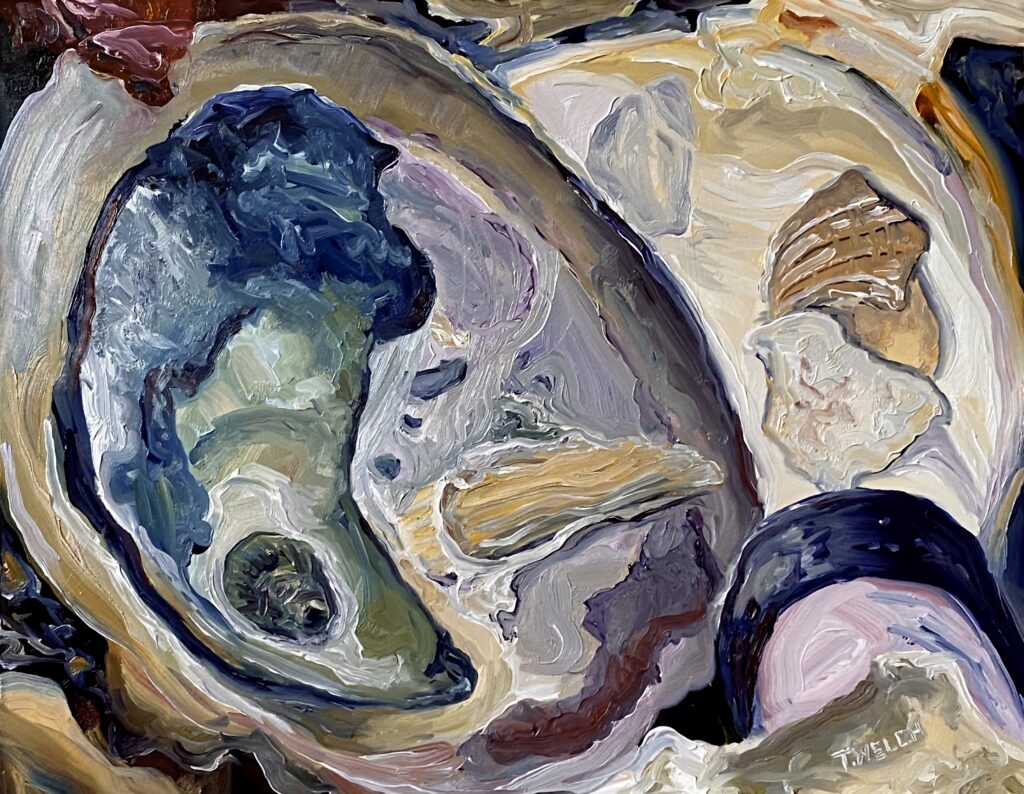
“Shells Gathering Study” by Terrill Welch 11 x 14 inch walnut oil on gessobord. Completed Sunday, October 27, 2024. Artist notes: After the storm, interesting broken and worn bits on the sea floor at Reef Bay were arranged by the Salish Sea. I accepted nature’s invitation to explore and discover their shapes and patterns in a delicate collage of reference materials that only become integrated under my brush.

I will not likely always journal my painting process in such detail unless there is something specific I have done differently that I want to remember. My guess is that I will likely have at least twenty of these small painting sketches for my project over the next two years and I hope to have about twelve larger paintings tentatively in the size of 48 x 40 inches completed in oil on canvas. But we shall see. For now, I have started.