Defining “Close to Home” as a focus within my nature-centric, reparative painting practice

Monday, 17 August 2026

“Close to home” at first, brings up familiarity, safety and comfort. It is where I live my daily life most of the time. Geographically, these days “close to home” is usually limited to within a day’s drive in any direction which gives the concept physical parameters. There is an ordinariness that comes with these sustained intimately observed passages of time in one place doing “the usual” things such as getting groceries, hanging laundry on the line, grinding the morning coffee beans, paying bills online, going to the dentist, getting the car serviced, working in the yard, hugging my partner, children, grandchildren and friends between taking long hikes, painting in the studio and promoting the gallery and artworks. I ask myself, why is this focus on “Close to Home” in my painting practice important? 

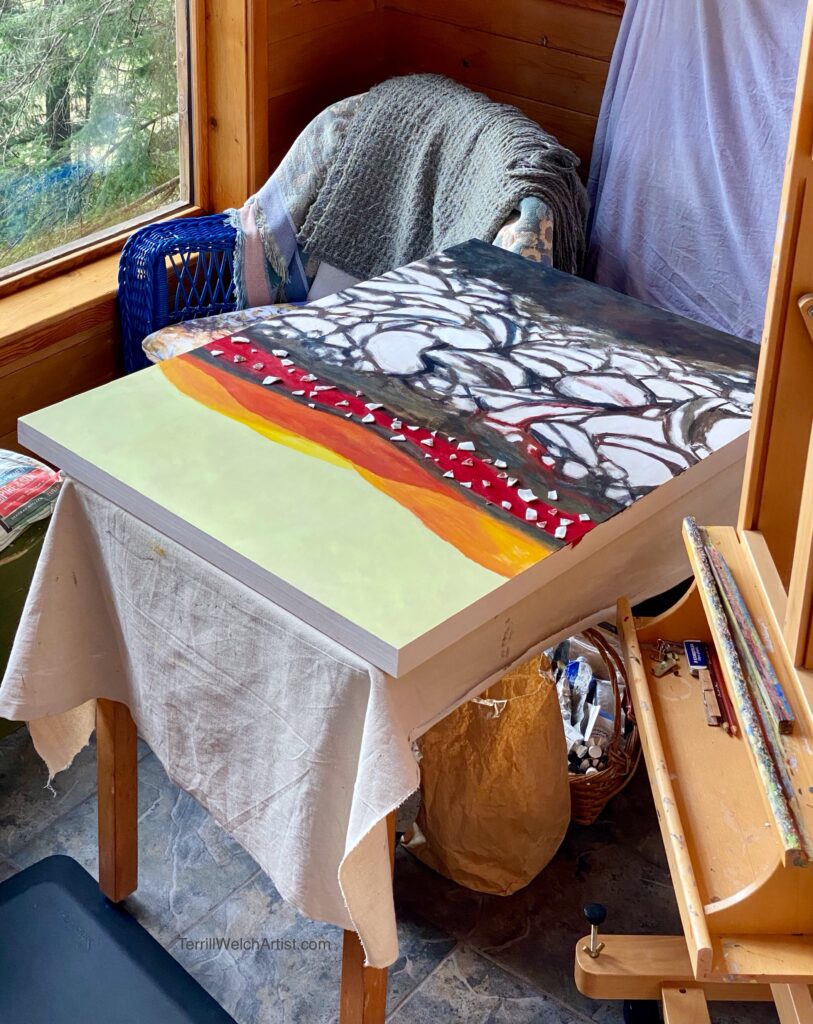
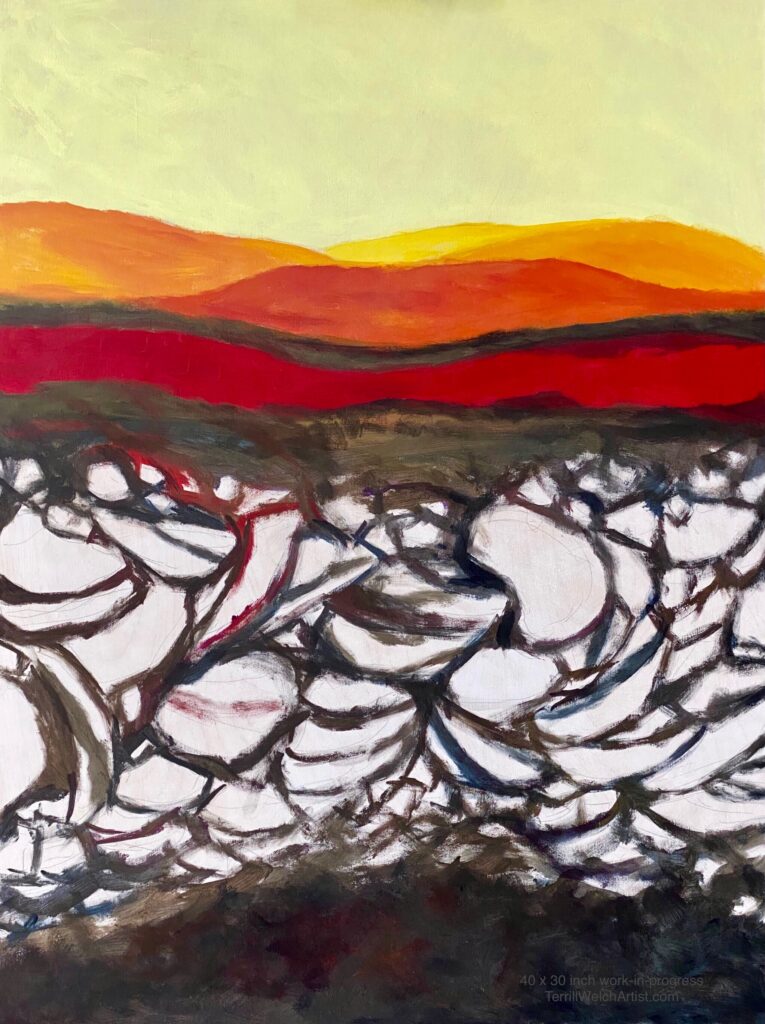
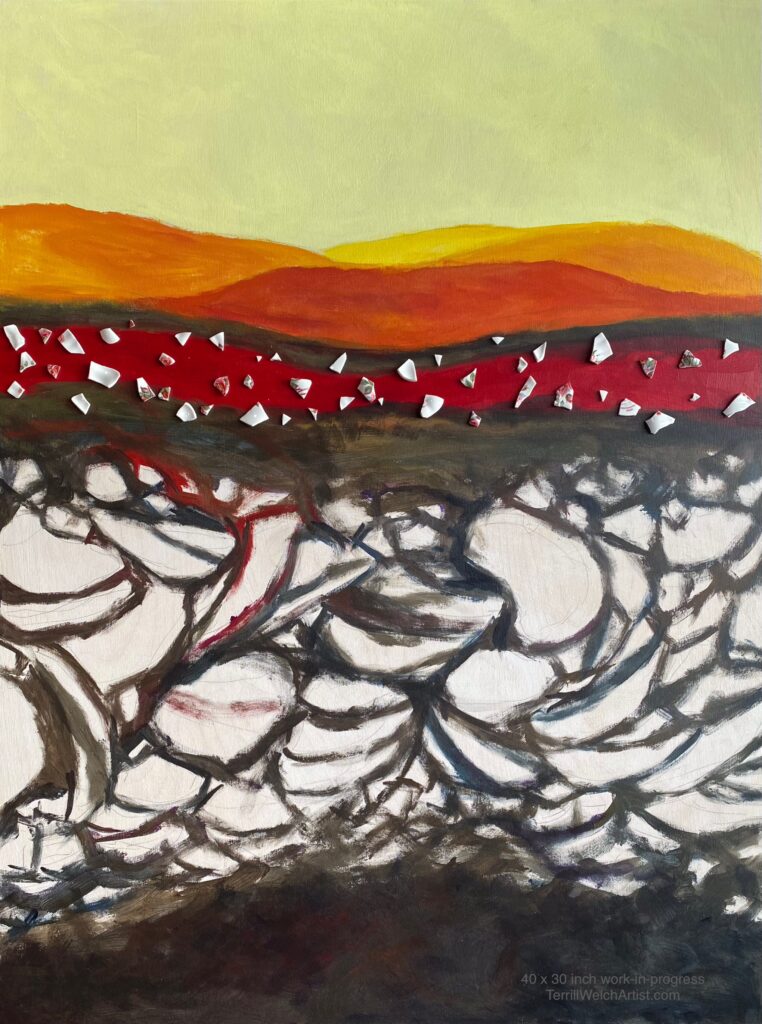
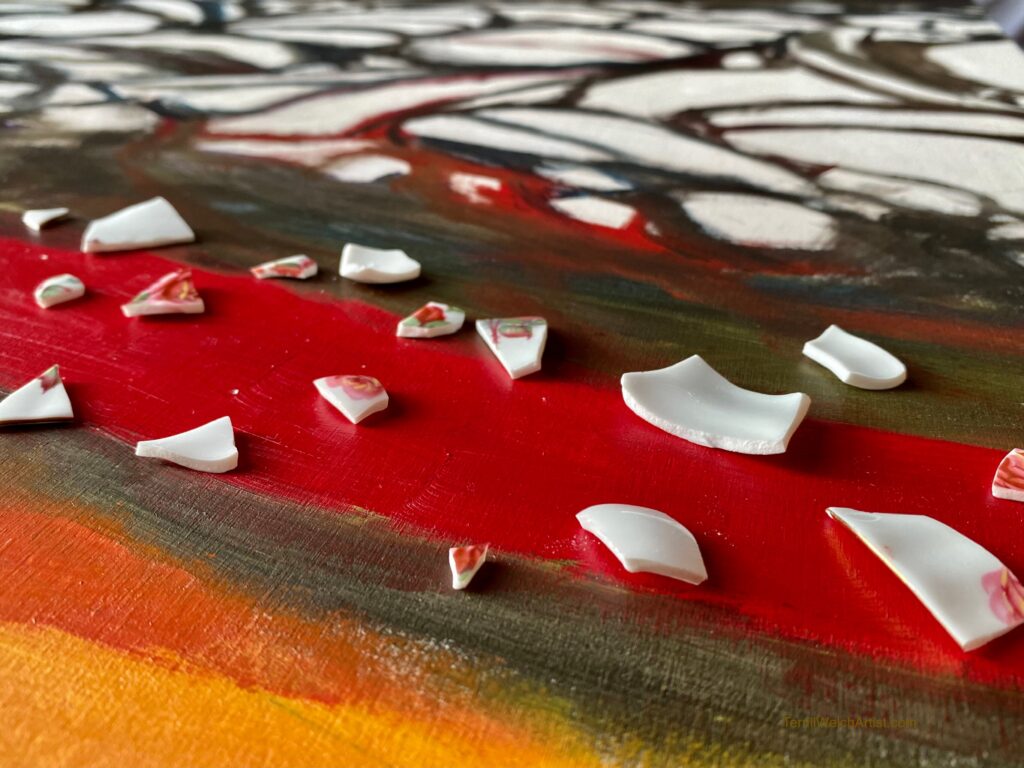
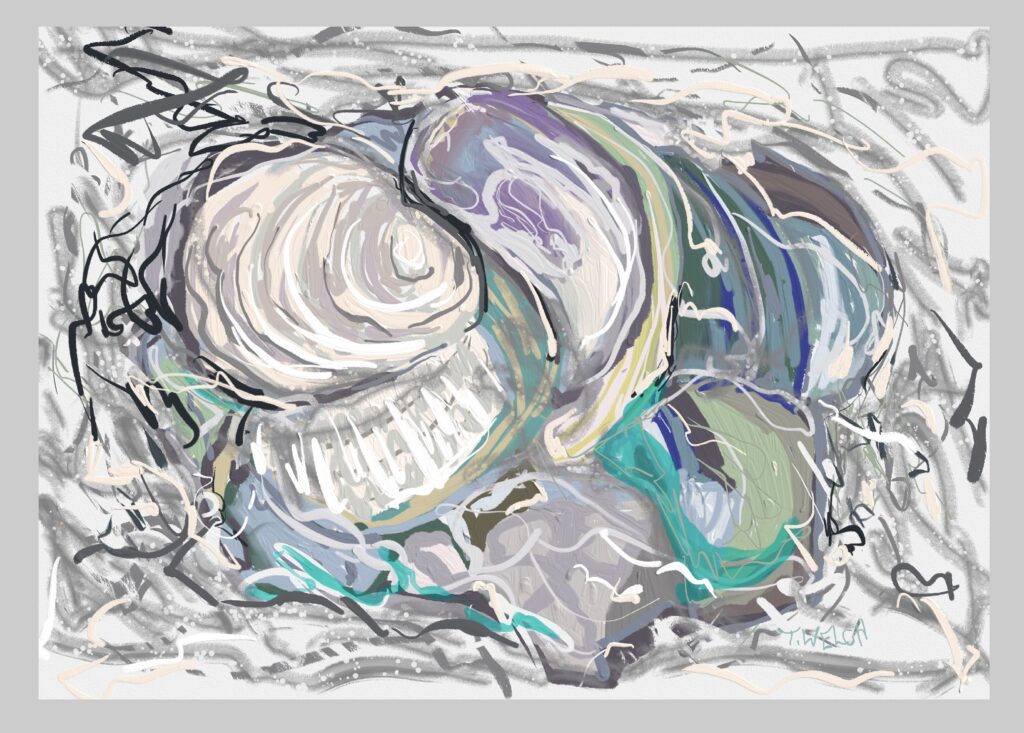
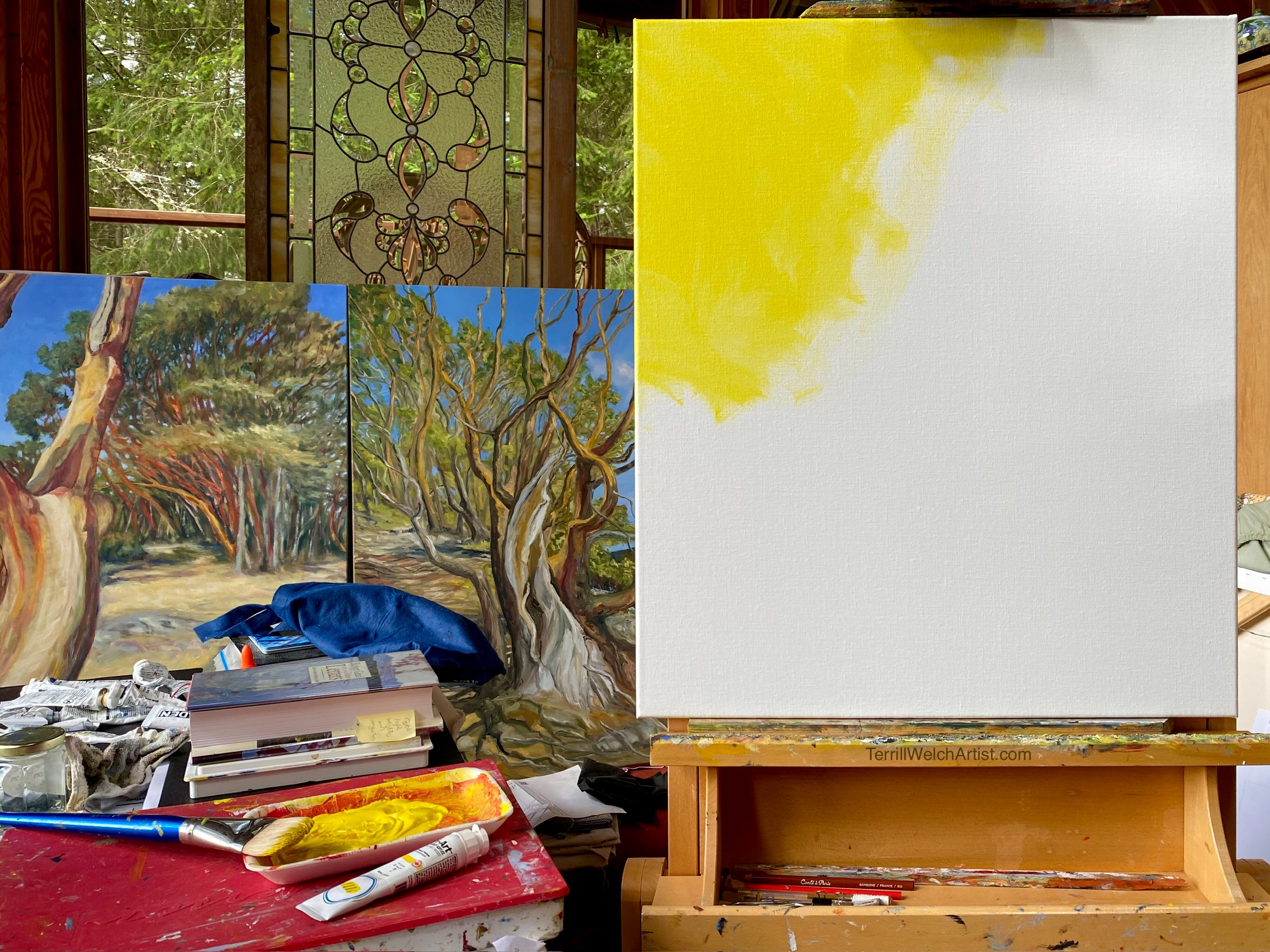
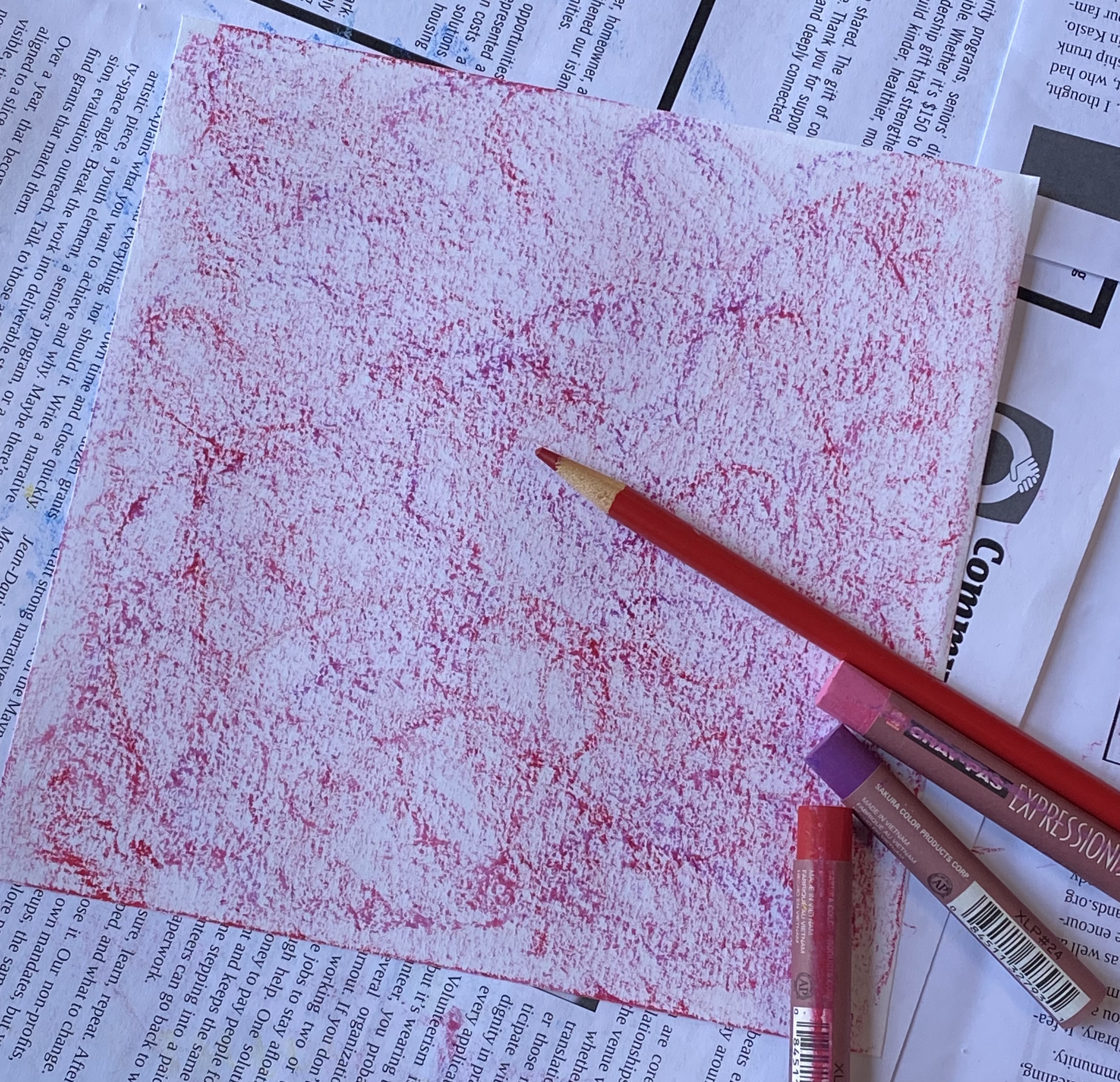
Developing red collage paper by Terrill Welch. August 8, 2026.

To answer this question is to first observe aspects of my contextualized autoethnographic references. The first and most obvious factor is that I am a full-time, primary caregiver for a partner that can quite happily no longer go further than the geographical territory mentioned above. I remain close to home because, to provide the best care for someone else, I must. The alternatives are to place my special human in respite care or to have someone come to stay with them. Neither of these options are easily workable in practice. By the time I get someone or someplace up to speed on this special being’s needs and them familiar with something they don’t want to do, the brief break becomes more of a traumatic ordeal for both of us than an actual opportunity. At least, this has been our experience so far. Eventually when regular weekly respite breaks become necessary, we will then have someone familiar providing additional support on ongoing. This might then present some opportunities for longer breaks for me to be able to at least go see my elderly parents which is a 7-10 day round trip visit away. For now, primary caregiving responsibilities take a central role, as a wife and as the human that is closest to the person in need. There are children. But the personal care needs and ongoing vascular dementia monitoring and prompting have gone well beyond their comfort levels and therefore not an option except possibly during a short term emergency until other care could be put in place. Community health home support services have been limited and expensive for what is provided. This leaves just me for now. We muddle through as best we can together which for now is pretty well. As an almost 68 year old white woman of settler ancestry, living on a rural small island on the southwest coast of Canada, I am resourceful, resilient, organized and pragmatic with a strong work ethic. I will face poverty level cash flows if/when the time comes to manage only on my own pensions. For now, there is enough to comfortably support both of us. But this reality is partly why I spent the past two years completing my MA Fine Art degree. It is a way to recognize the seriousness with which I take my painting practice that then might possibly lead to my artwork offering a small financial buffer if it is needed in the future. Global instability may make this a difficult proposition to realize but it would be even less of a possibility as an older woman artist without doing this degree. 

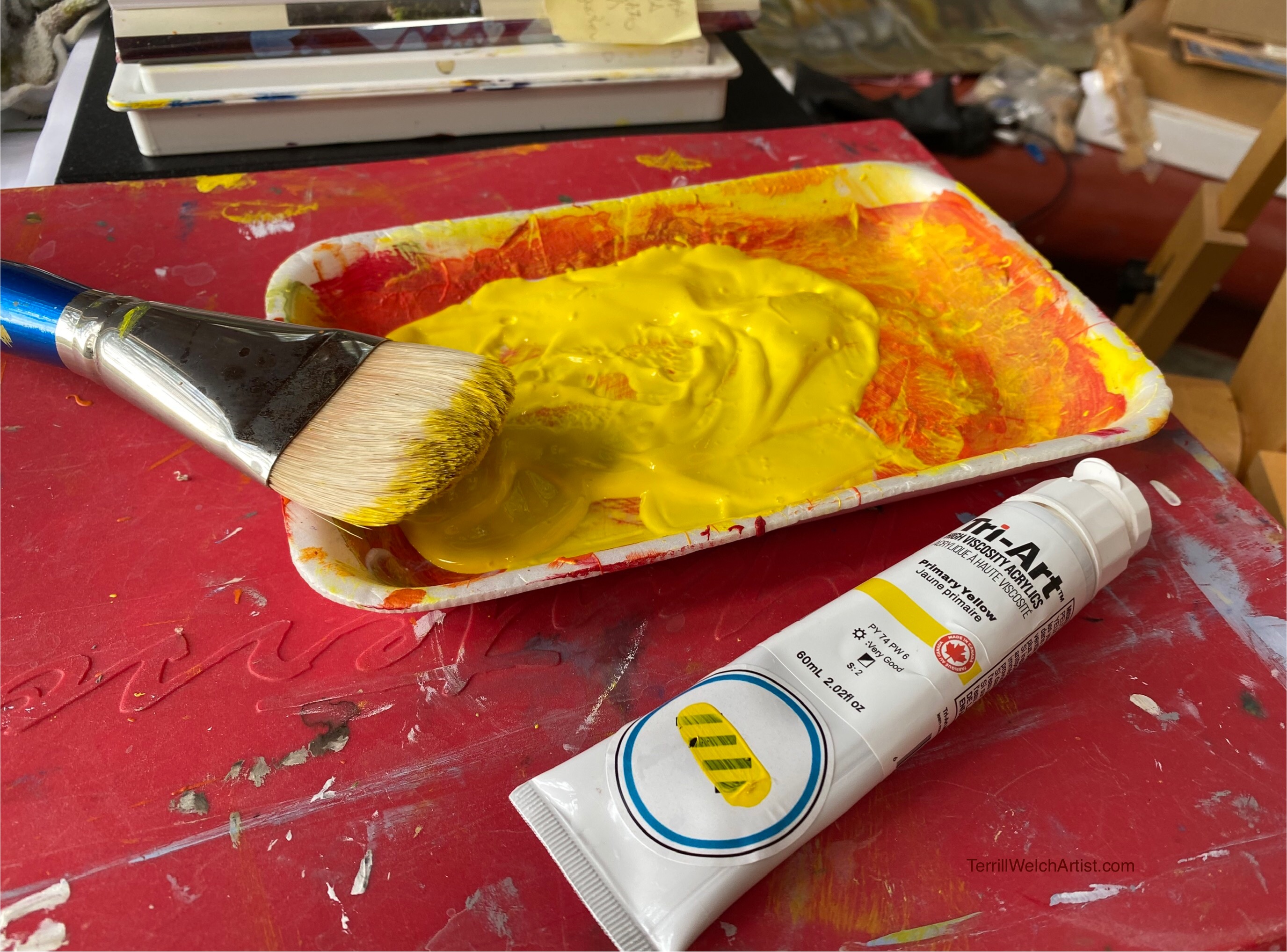
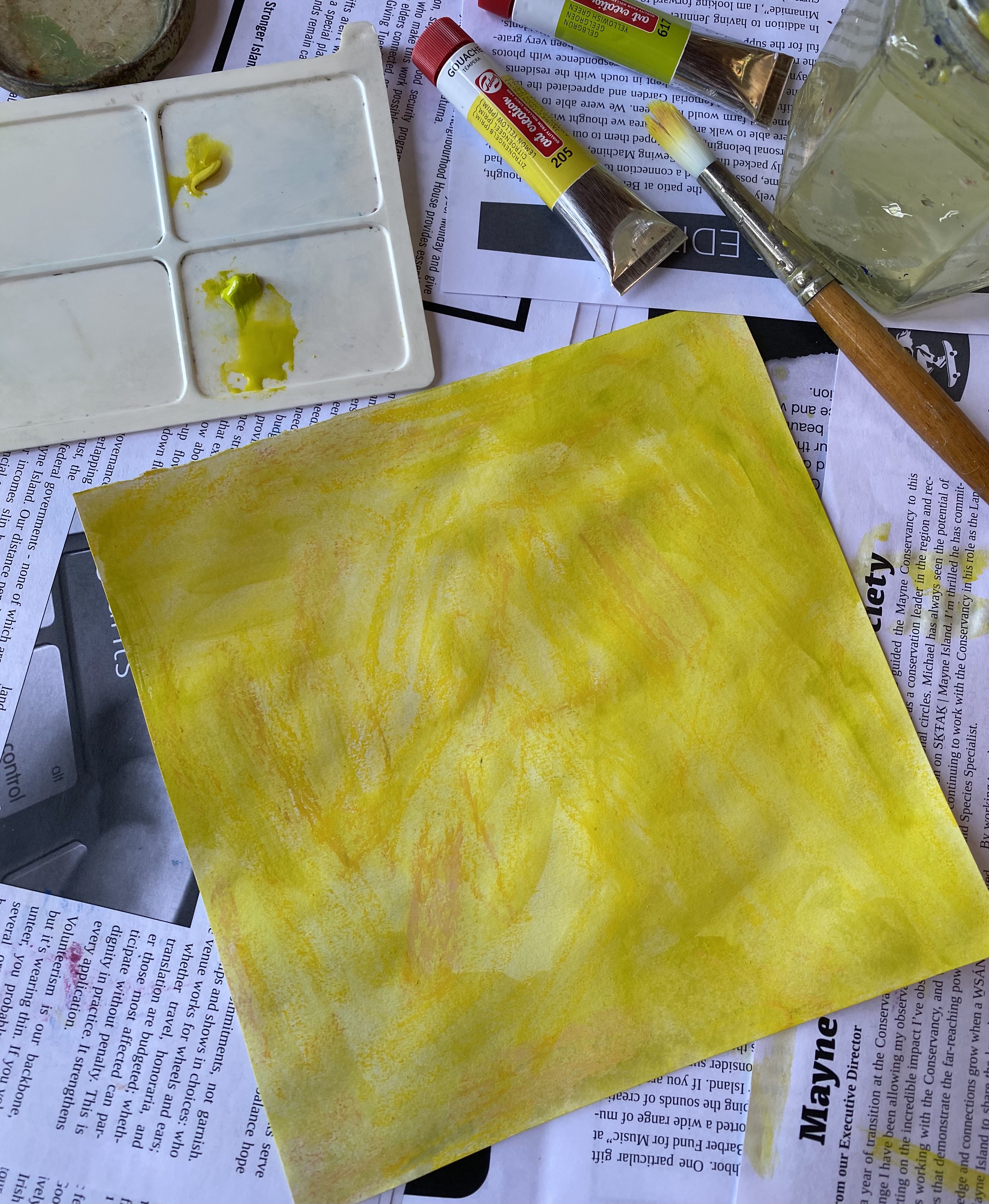
Yellow gauche covered collage paper by Terrill Welch. August 8, 2026.

This brings up other aspects about being “Close to Home” including a sense of loss of freedom, of heavy sadness/grief about slowly losing someone to their disease, as well as facing my own limitations and mortality. How long can I reasonably keep up with these responsibilities? How long can I manage living on this rural island as the only person who is able to drive?

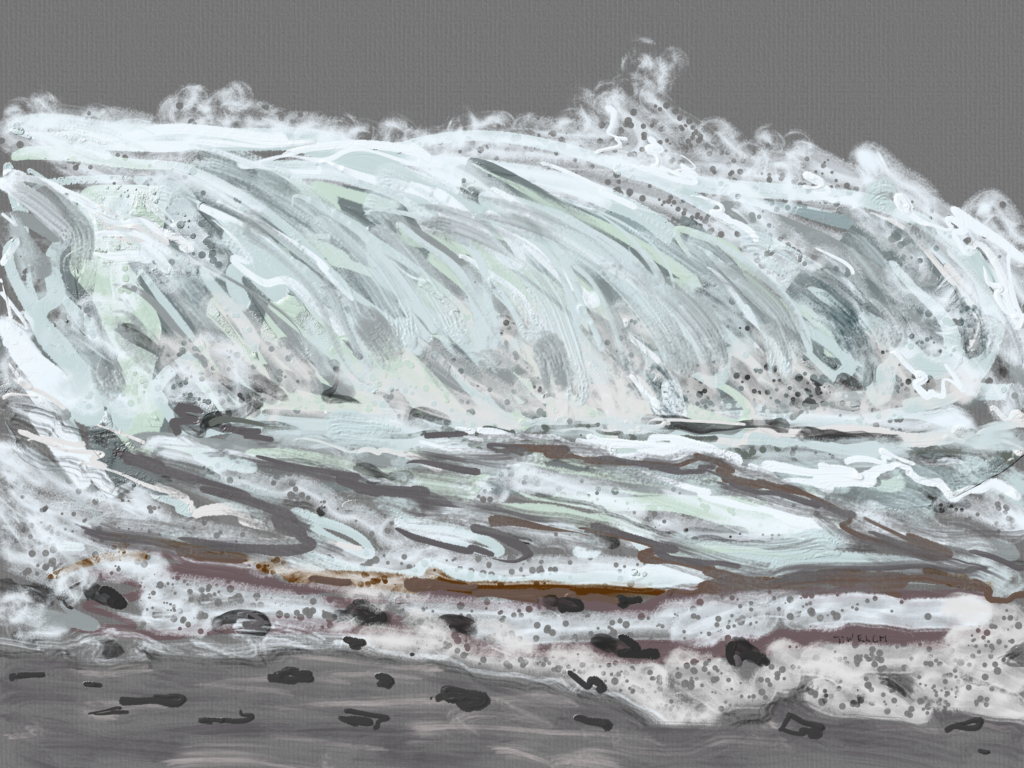
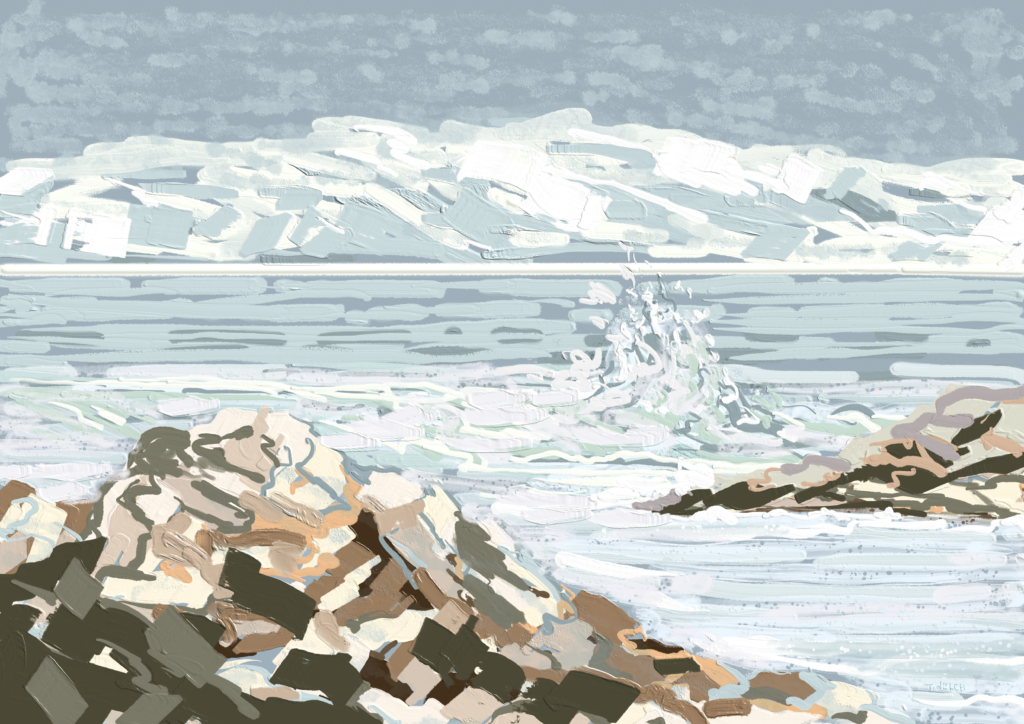
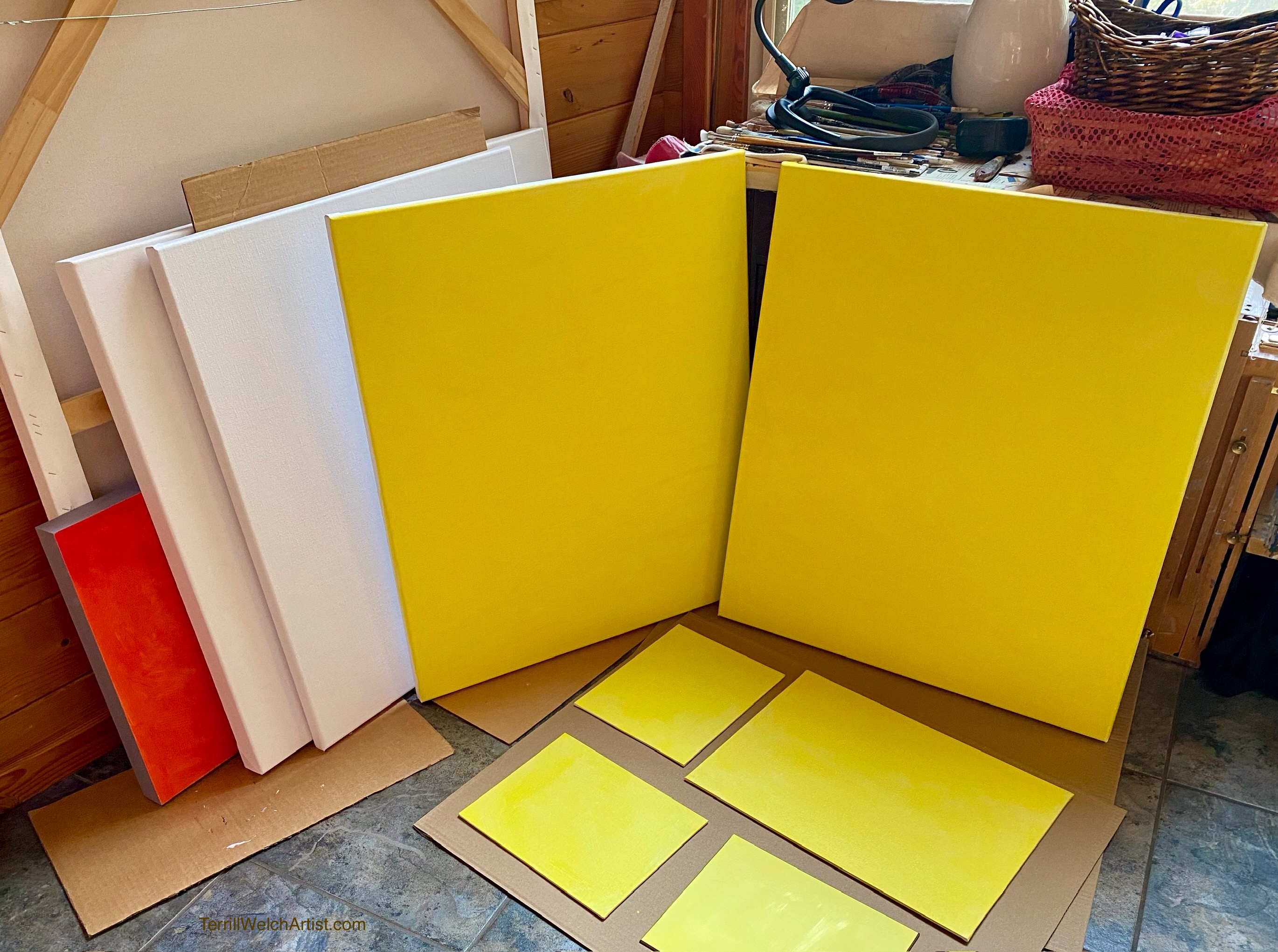
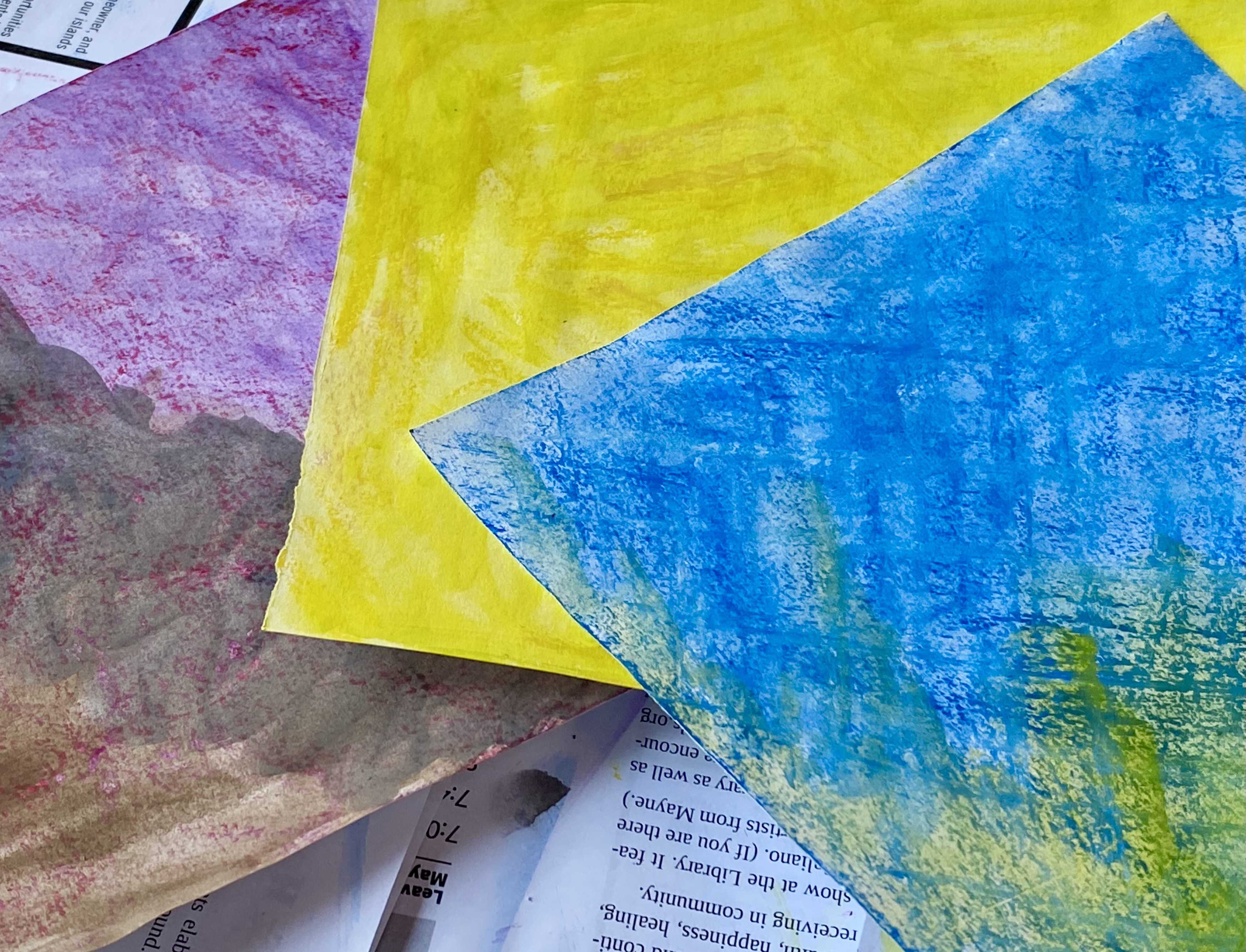
Three sheets of collage paper created by Terrill Welch. August 8, 2026.

Then I return again to my painting practice and its central role in making all challenging situations much more possible, pleasurable and endurable. This is especially true if I turn my painting practice directly towards what is challenging. In doing this, I seem to find my footing and my strength as well as my joy and pleasure with simply being alive.

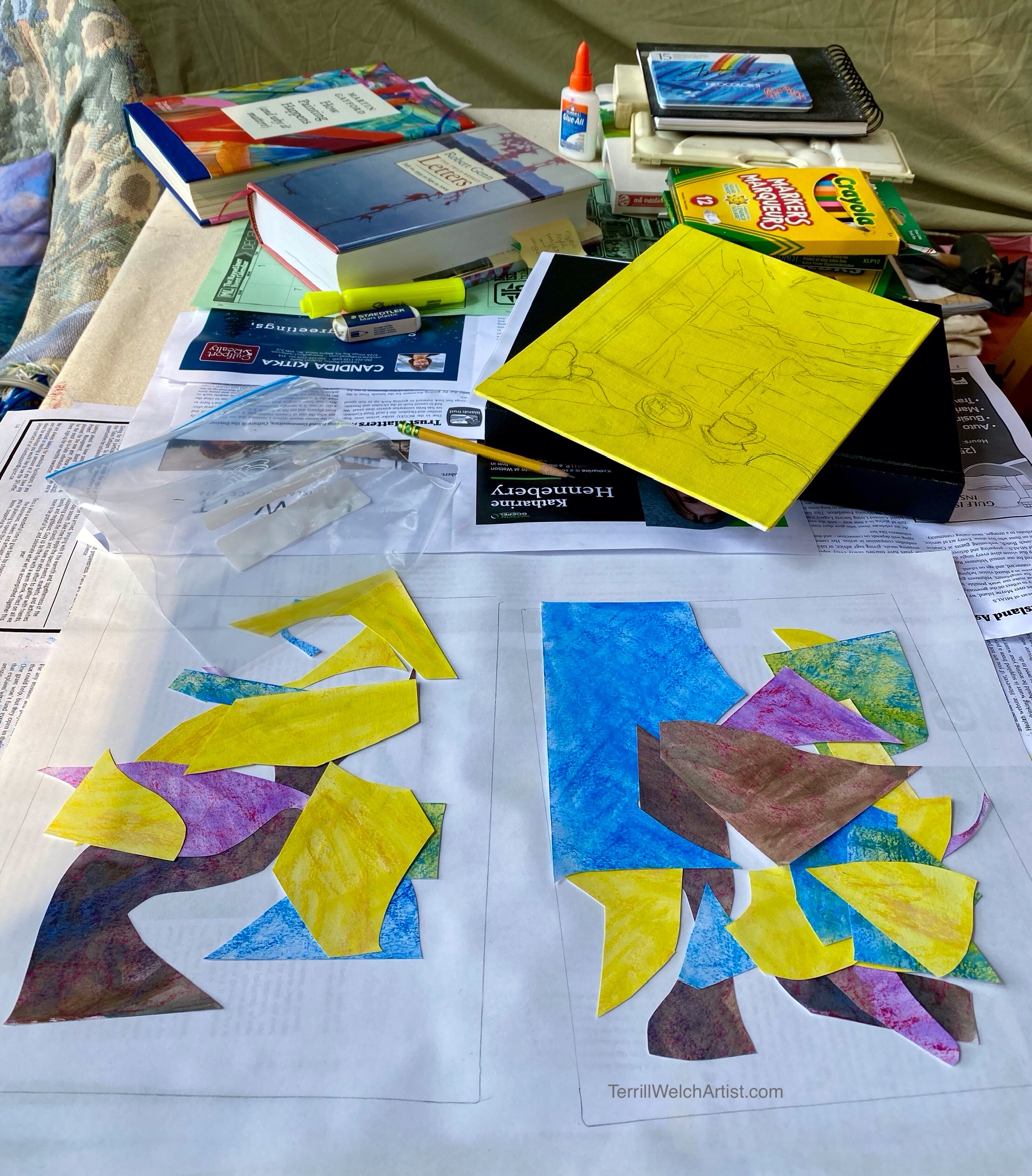
These are the thoughts that came to mind as I created the collage paper, cut it up and then decided I wanted to paint instead. So, I packed up the paper cuttings and put them in a bag for another day.

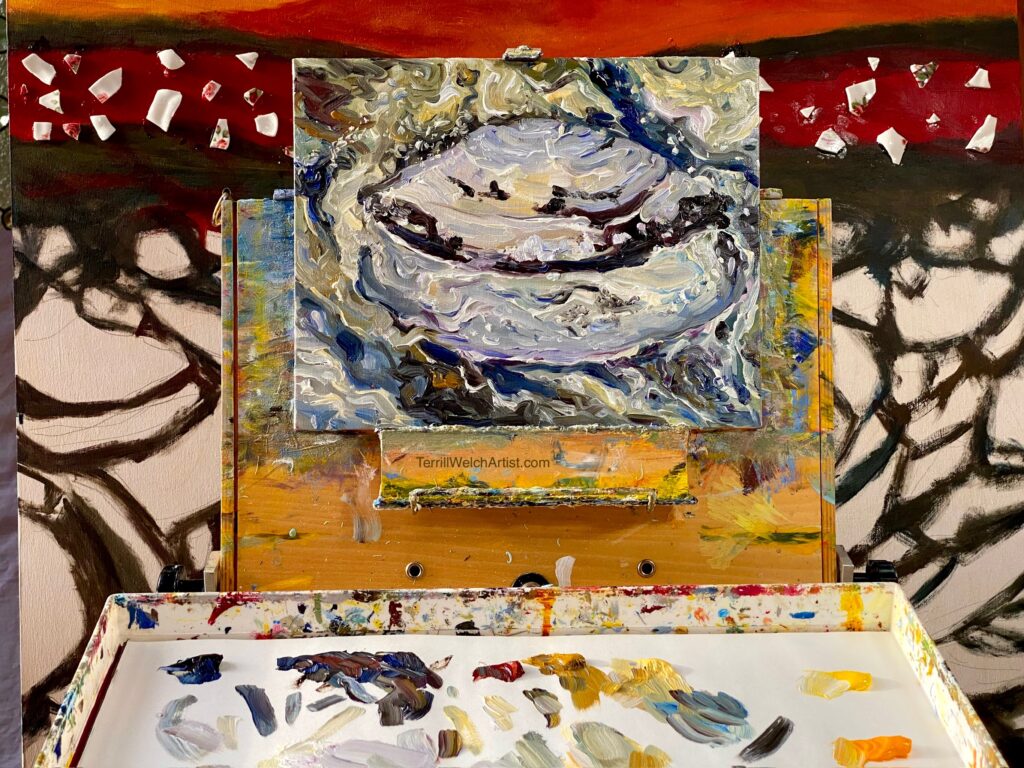
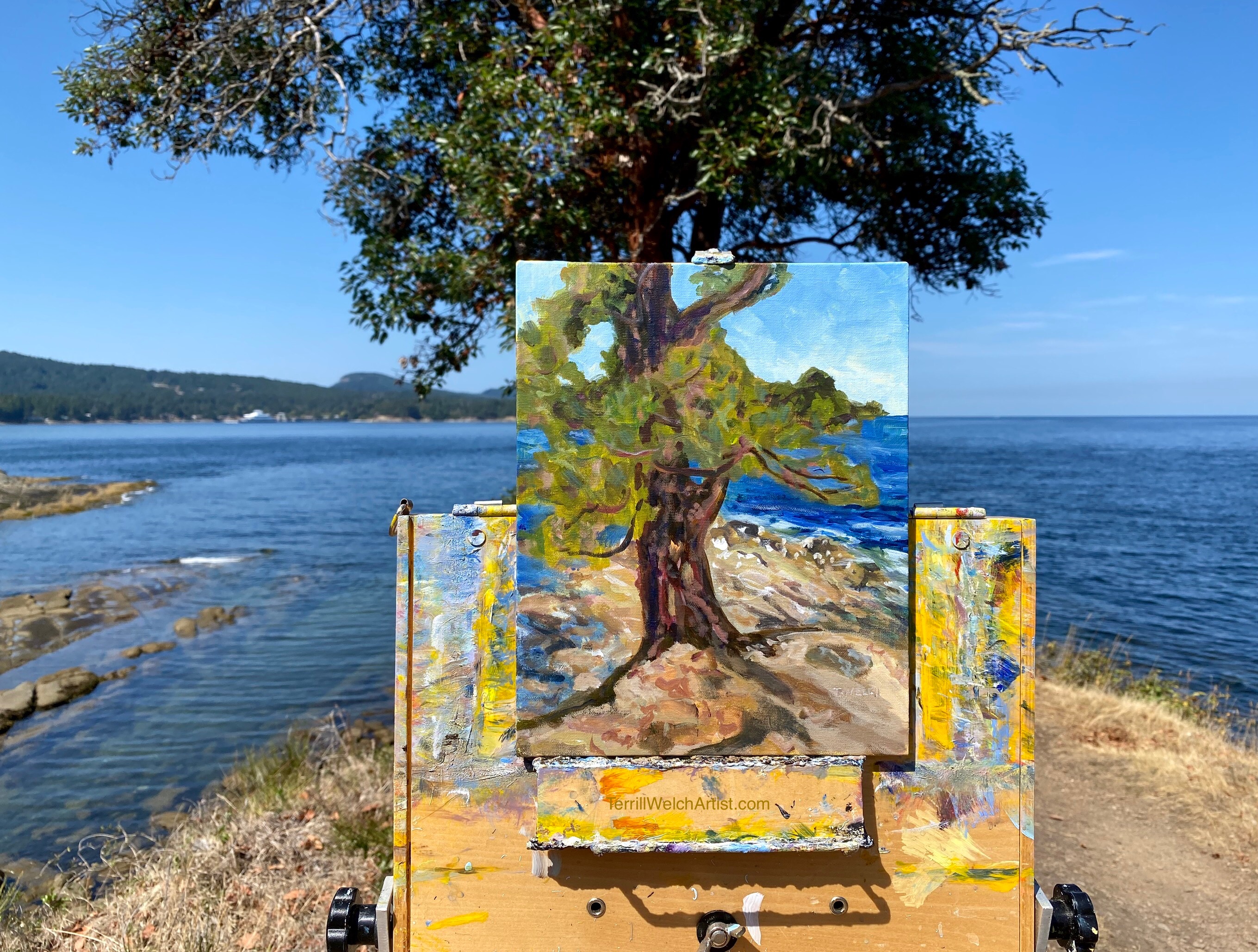
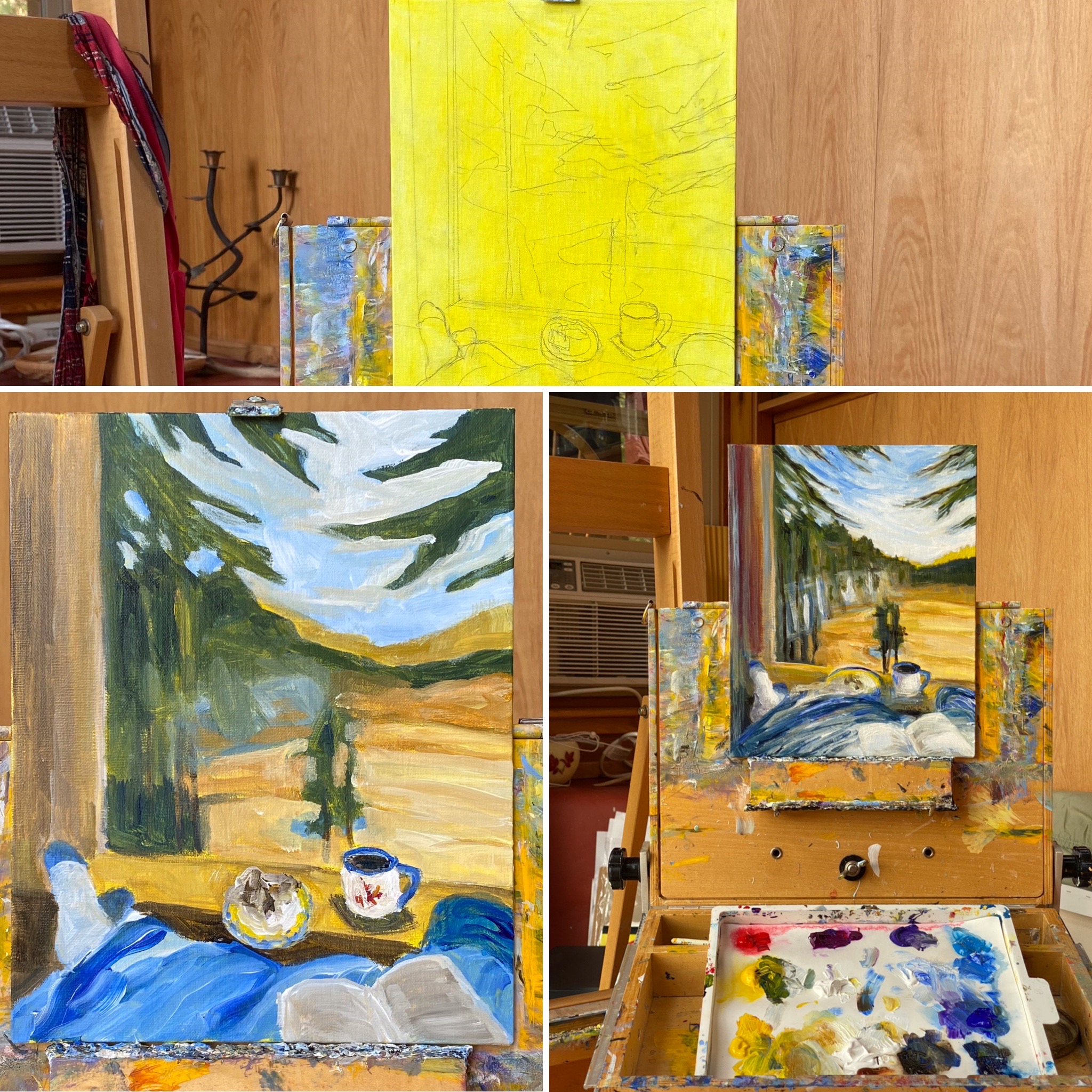
Collage paper cuttings and a sketched ready to paint in Terrill Welch’s art studio.

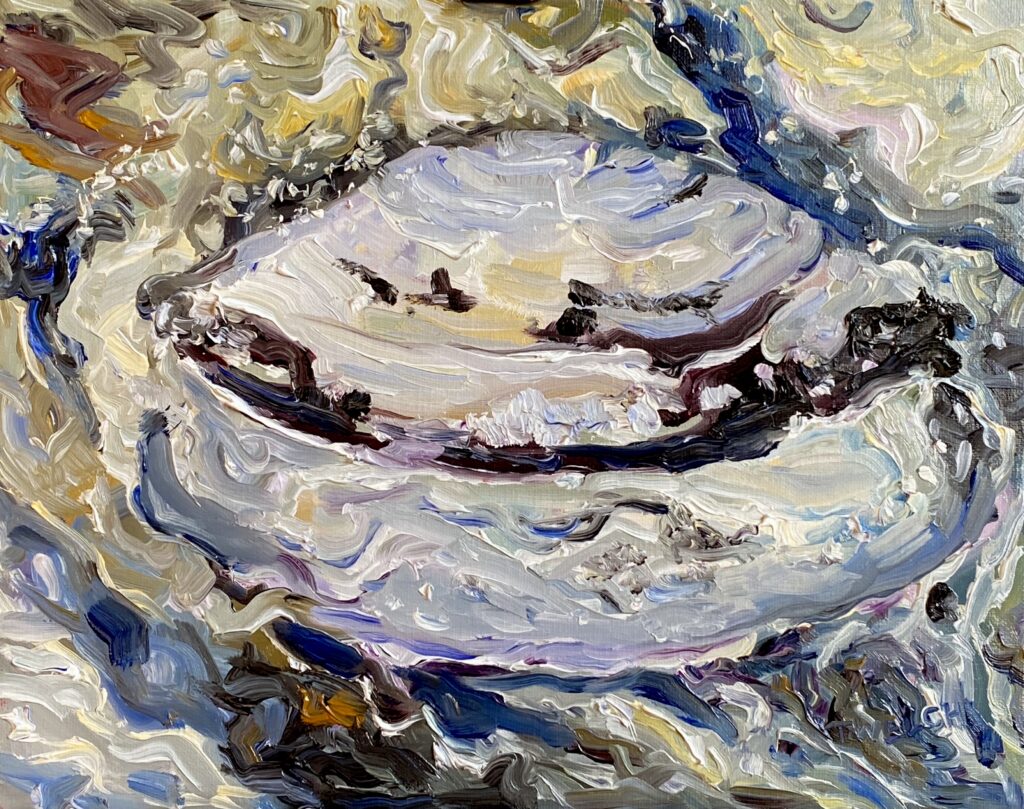
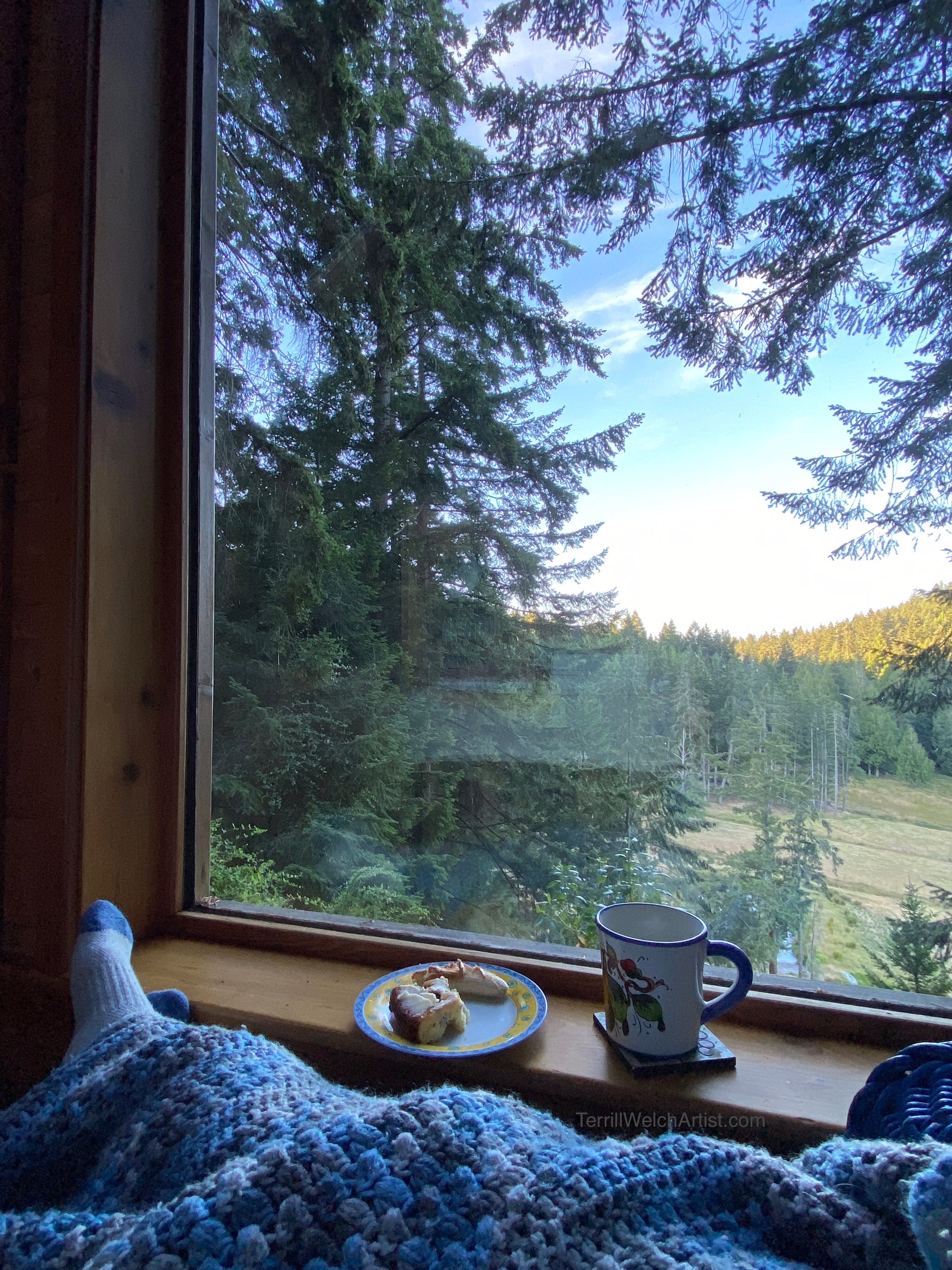
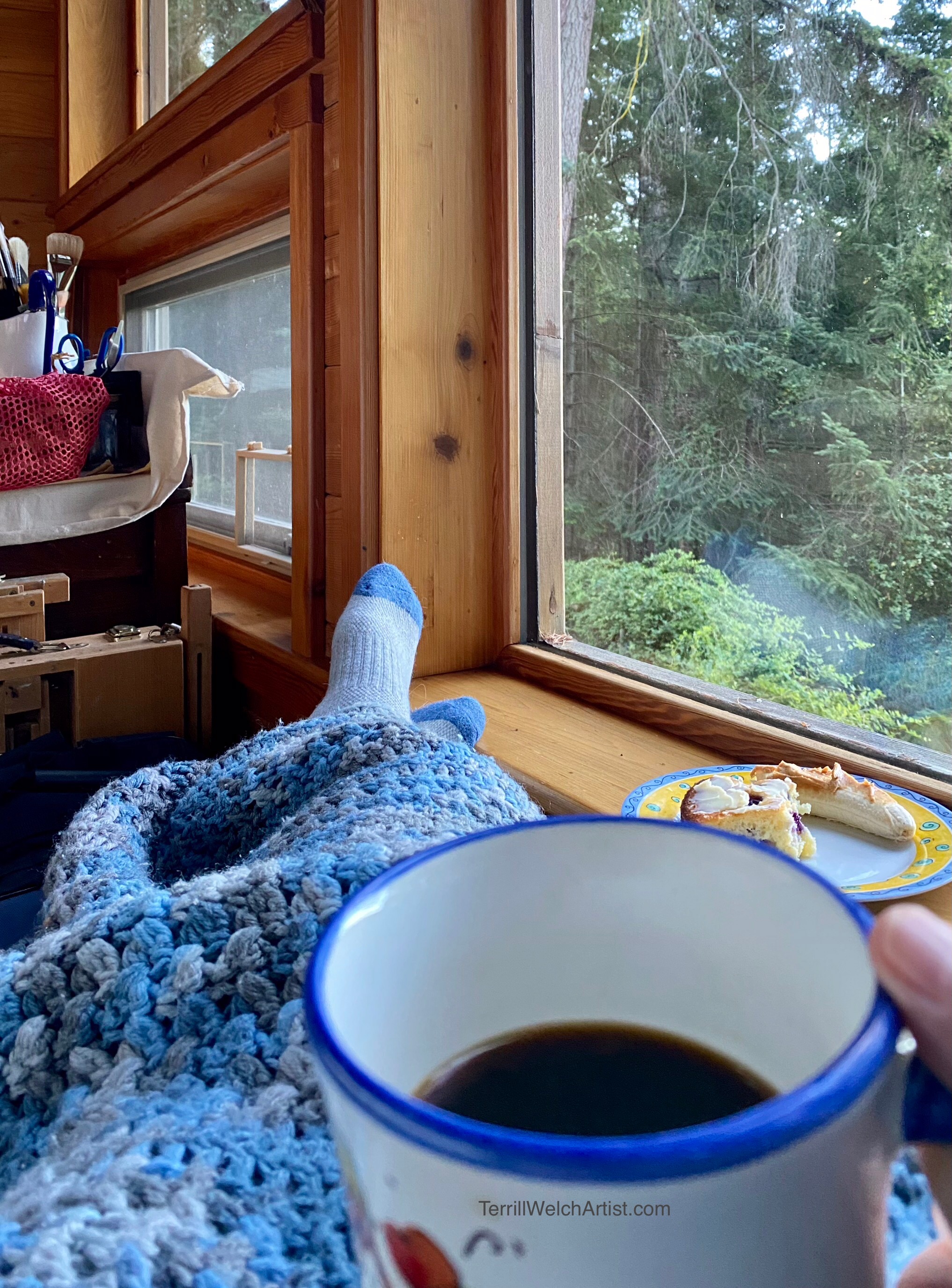
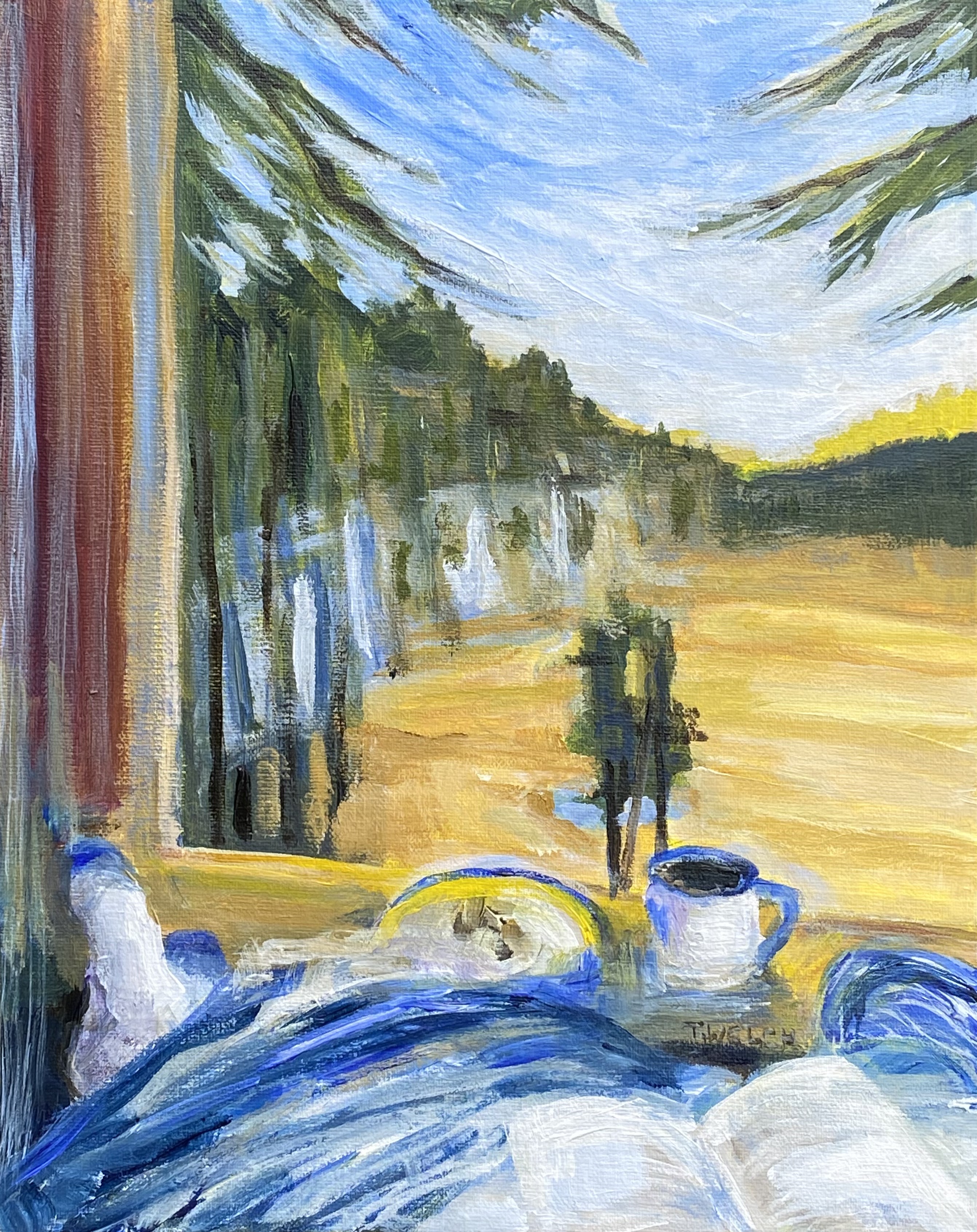
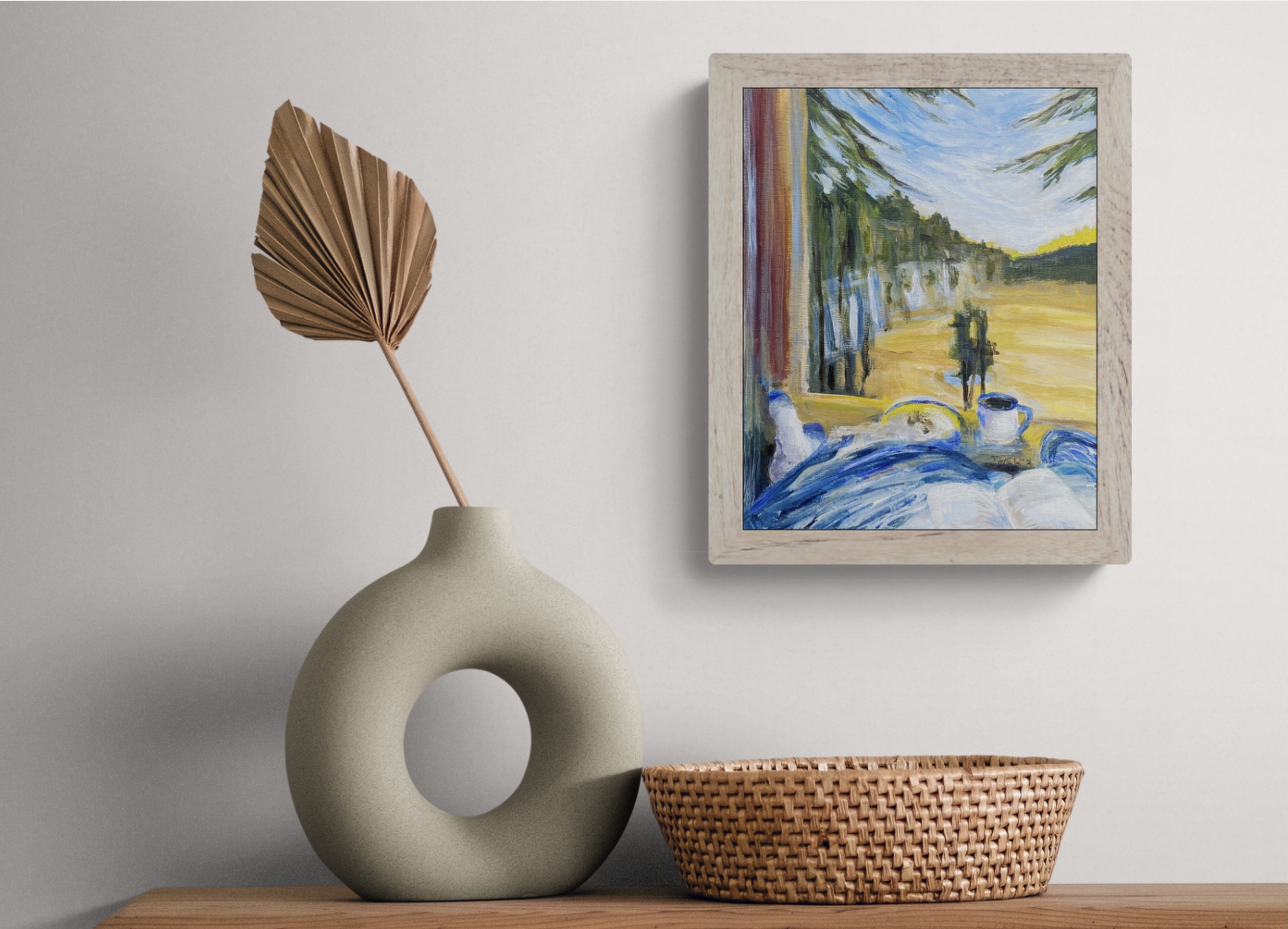
I expect to have much more to discover about my focus on “Close to Home” as I proceed but for now, it is time to work on a small painting sketch featuring morning coffee in my studio chair.

Lady Arbutus Painting Data Collection

Painting Data Collection 

Title: Lady Arbutus Date Completed: Wednesday, 5 August 2026
Materials: oil on linen covered birch wood
Size: 14 x 11 inches (36 x 28 cm)

Figurative/Abstract Self Assessment Band-Scale Rating between 1-10: 4-7 

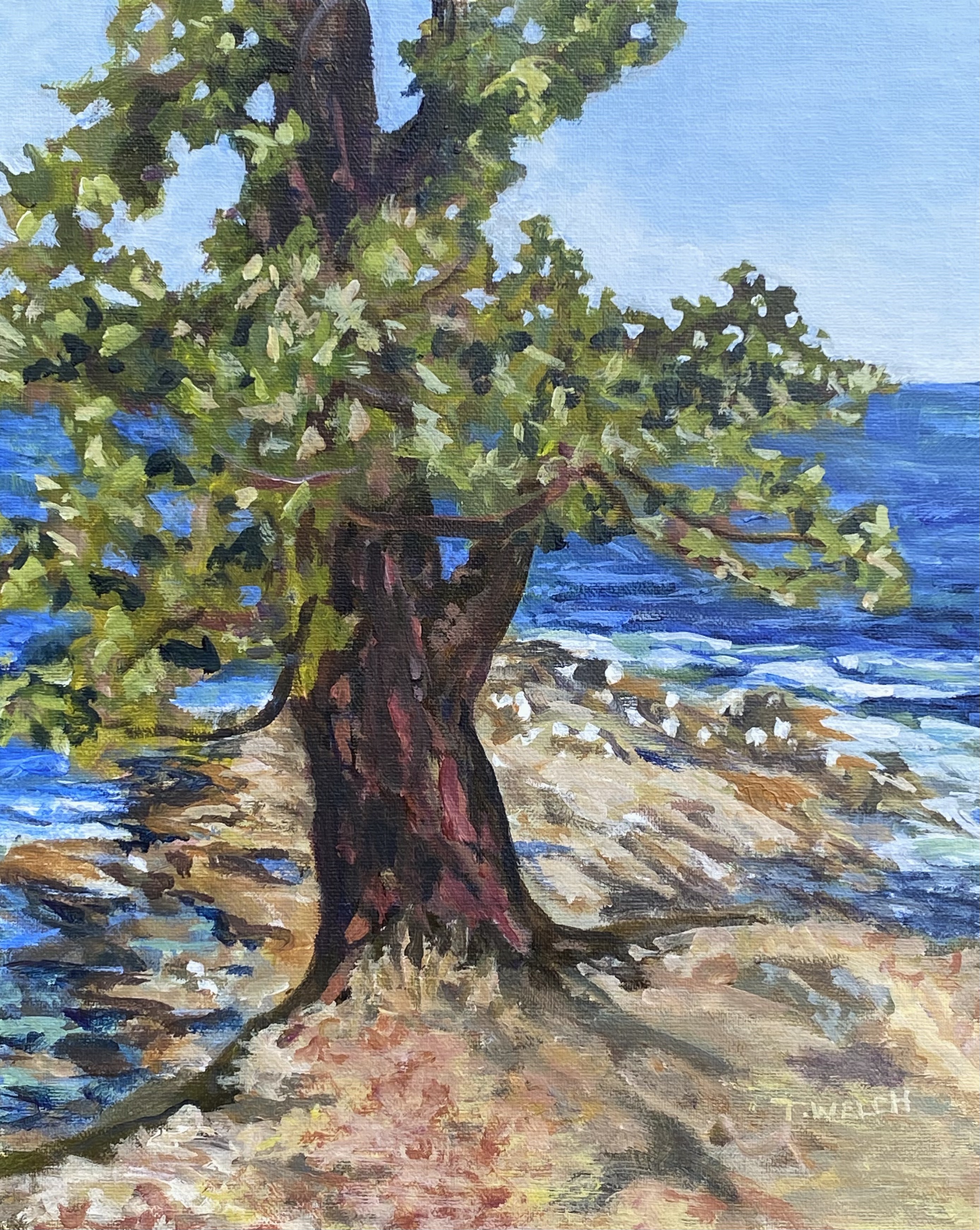
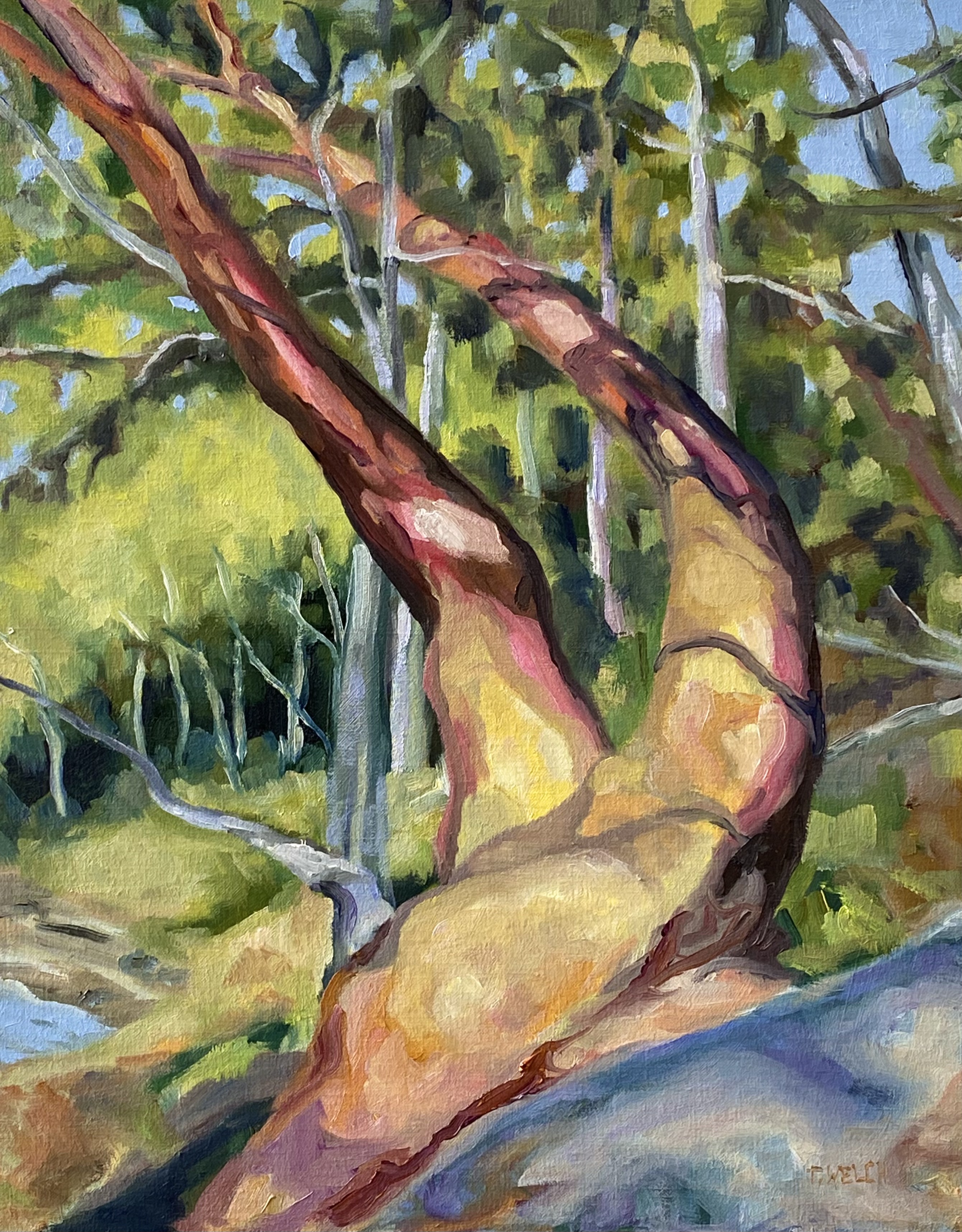
The background offers a loose abstract network of brushmarks while the tree is given figurative prominence with large shapes holding the composition within a visual space of warm morning summer light. 

Reference Gathering: 

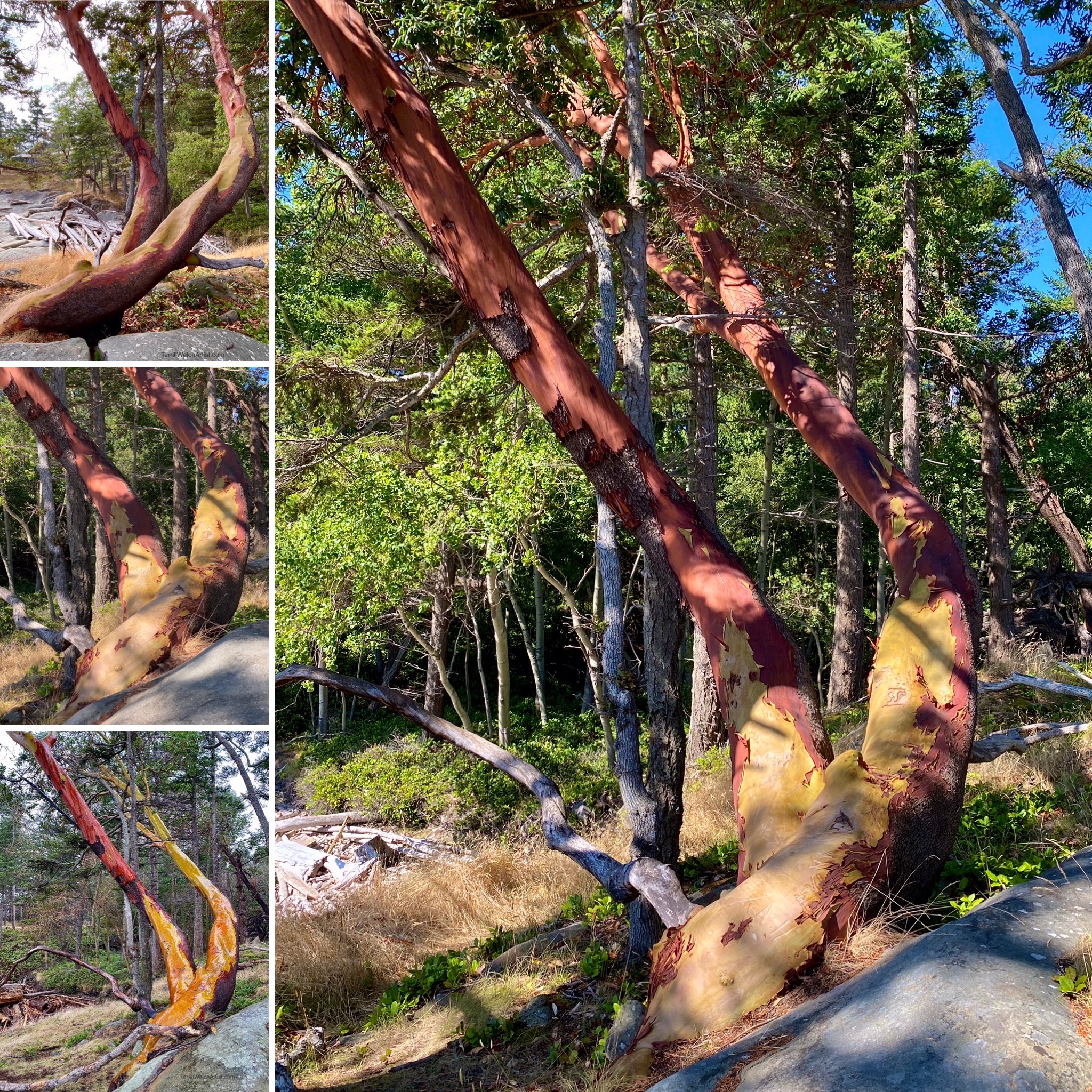
This is a commissioned work and stems from an art collector’s shared love of this specific arbutus tree that resembles the long legs of a woman elegantly reaching for the sky. I have references going back years but chose just a few, between August 2023 and August 2025.

Collection of reference images between August 30, 2023 and August 20, 2025 by Terrill Welch in preparation for painting “Lady Arbutus” in August 2026.

Making Process:

My studio making process proceeded over a few days in 2-3 hour painting sessions. I required pauses to really listen to the painting and what it was asking of me. I also mentally invited the art collector into my musings with nature so that I could draw on the abundance of influences between us three. The focus is on a portrait of the arbutus tree while keeping a sense of context and hints of the ocean behind and beside the viewer. I have a special relationship with not just the arbutus tree but also the polar trees on the middle left. There are very few on Mayne Island but they grew in abundance around my childhood home. 

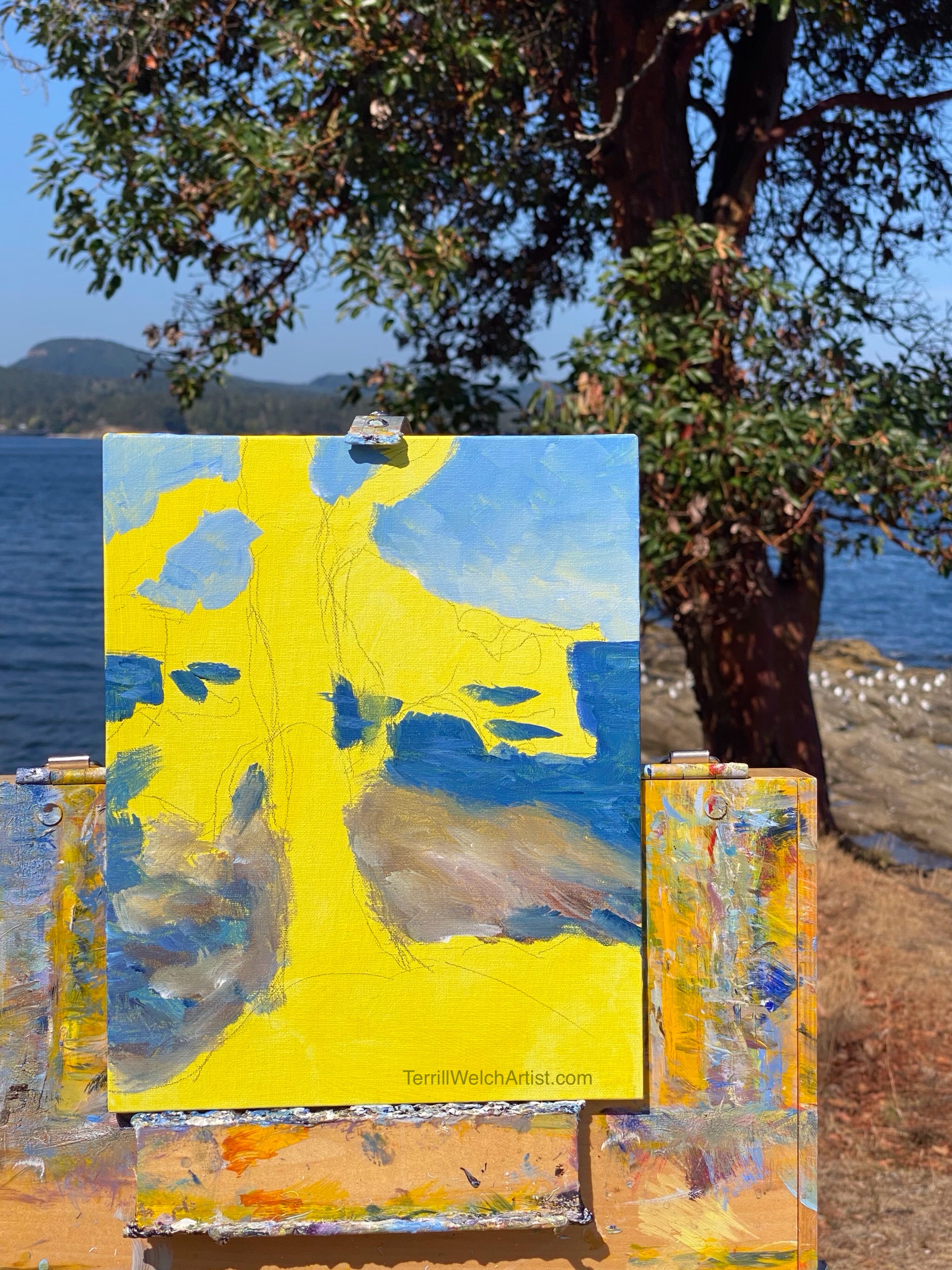
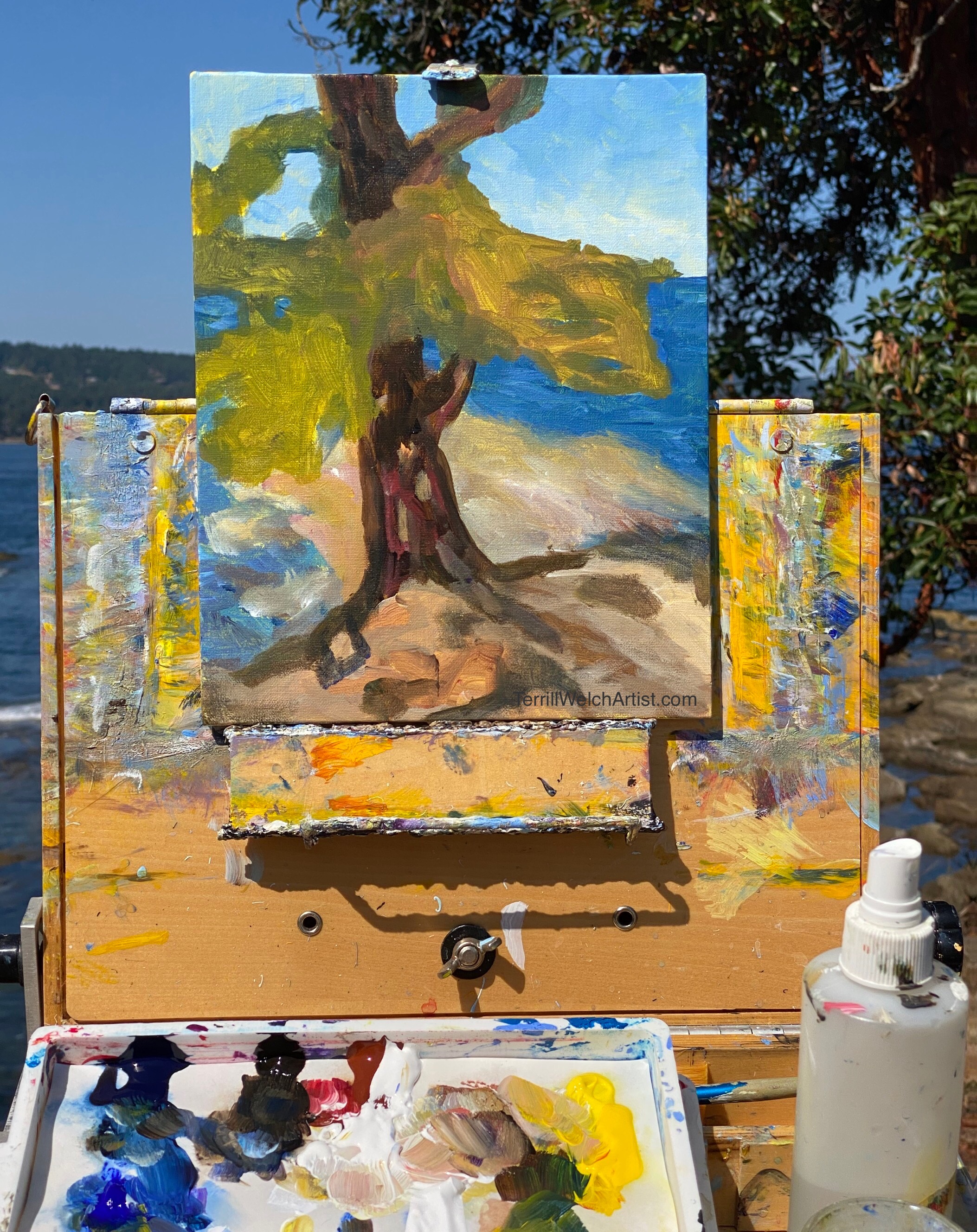
Collage of work-in-progress images for Lady Arbutus by Terrill Welch 14 x 11 inch oil on linen covered birch wood.

Finished Painting:

“Lady Arbutus” by Terrill Welch, 14 x 11 inch oil on linen covered birch wood. Completed Wednesday, 5 August 2026.

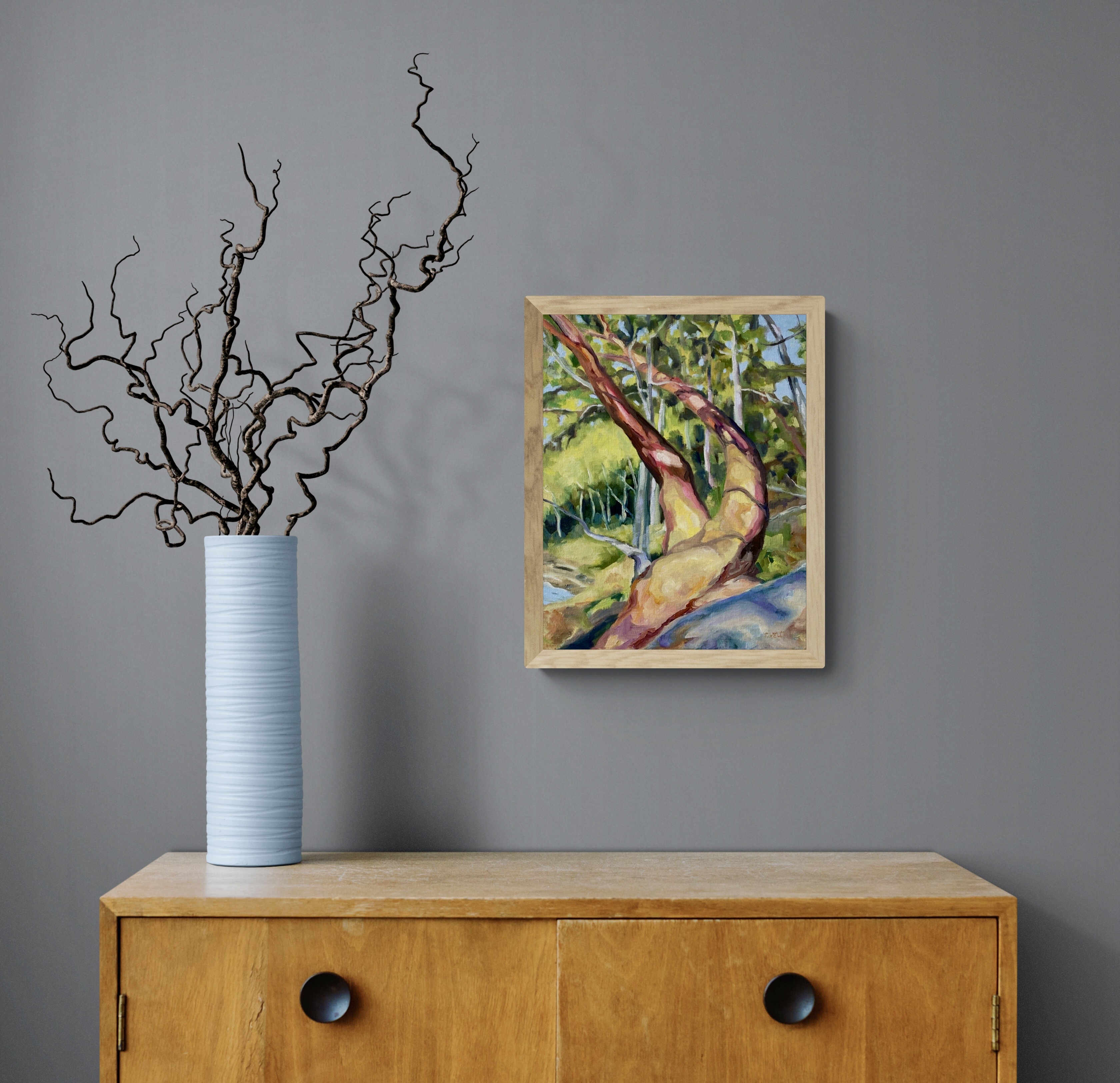
For scale, here is the painting in a digital viewing room.

Digital room view – Lady Arbutus by Terrill Welch, 14 x 11 inch oil on linen covered birch wood.

Making Notes:

A ferry whistles in Active Pass on the other side of the island and echoes a response to the August sun pressing towards it through the trees. The calm ocean behind me pools at the bottom of the ridge next to a group of scrubby polar trees. Deep shadows offer a counterbalance to the bright trunks of the arbutus trees and rich soft greens of the grove. What would it like to be this arbutus tree tucked in next to a few strong firs beside the Salish Sea? I can feel the effort of stepping up on the weathered sandstone beside it as I traverse the narrow trail from the point. I like to pause for a few moments and just share its company before moving on. The artwork is a complex interconnected view to render in paint between dancing sunlight and thick growth reaching for the skies. Much is left to interpretation in an integrated network of suggestive figurative to abstract mark making.

Reflective Analysis:

For this painting, the complexity of vegetation and terrain was demanding to navigate into paint on a surface without over simplifying or offering so much information that the poetry of the moment is lost. I held significant pauses as I worked in order to make decisions about the order of things and then worked in a flurry for a while only to pause again to consider. The types of brushstrokes were decided by subject as I was mindful of only offering just enough to bring the work to life and present the essence of being this specific arbutus tree on this specific day. 

Reflexive Analysis: 

Commissions are different from work that is solely decided by my commitment and curiosity. I do have a formal process that allows maximum artistic freedom but it is still unique from my self-directed body of work. With my commission process, the art collector chooses the subject and size and a price is determined. I gather my own references and then paint the subject as I see fit. The art collector then decides if the work is to their satisfaction. If not, the work goes into my inventory and I try again. Payment for an artwork happens once a final decision to accept a painting has been made. This gives me maximum freedom as the painter and is the lowest risk for the art collector. Over the years this has been a win-win for everyone. That said, I only accept a very few commissions each year as they frequently take me away from whatever I am working in my studio practice. Not this painting though. It fits nicely into my current focus. 

For this painting, I am aware that there is an alignment between how I approach my work and the lived experience of the art collector. So there is the Lady Arbutus tree and her immediate environment on this specific day that is then enriched by around nineteen years of my having walked and sat next to her in all kinds of weather and throughout the seasons. Then there is my awareness of the art collector’s numerous similar experiences and her many conversations with me over about half as many years. The art collector has entrusted me to bridge these various experiences and bring them to the surface of the painting in as much of an unencumbered way as I can imagine. But influences are like seed burs. They sink their hooks into my  experiences and come along for the ride every time I dip my brush into the paint. It is something I must notice and also make peace with in order to bring the best I have to whatever work I am creating. Like all experiences, painting is not a pure isolated practice. The process is embedded in a multitude of interrelated and related variables. From this sea of information, a painting comes to rest uneasily on a surface as if by some alchemical, divine intervention. Even though the brushstrokes are made by my own hand, from my own observations and study, no one really owns these results in a lineage sort of way. It would be like saying that the dried thyme added to a stew was the only ingredient that mattered. It is important but, as with the painting, it wouldn’t be much without everything else. 

Key Findings: 

This painting was a great reminder to trust my creative process and stick with it, even when small doubts creep in around the edges. 

Anything else: 

The directness of working on this painting reminds me that I can benefit from creating without direct canvas and paint contact, even if it does not result in finished work. While I finished this painting, I also made some painted paper to cut up for collage puzzles. These never seem to amount to anything but they do offer a sort of different texture to my practice. Now that I have finished this work, I have set my paints aside to further explore these bits of hand coloured paper while I think about my overall research question and working definitions for this next body of work – Close To Home. 

The Everyday Beauty of Art: Reflections on ‘Lady Arbutus’

Monday, 3 August 2026

I am standing at the easel this morning and decided I would write while taking a teabreak. The painting catches the glare from the late morning sun outside the art studio window. I leave it and the brushes where they were put down and glance at the finished painting with almost dry edges that I thankfully had remembered to cover before I started. 

An early August morning in the art studio of Terrill Welch with work-in-progress.

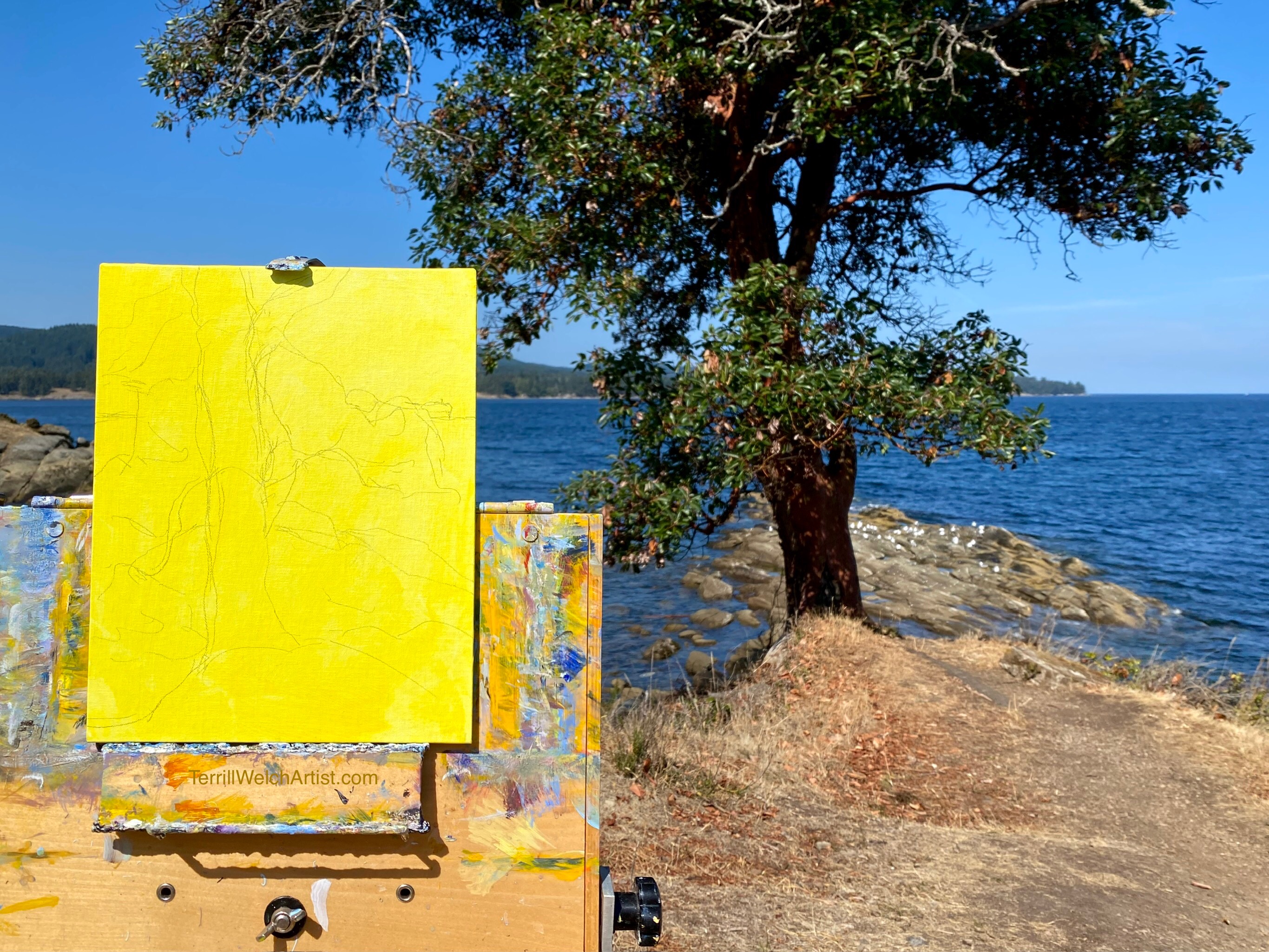
A rough sketch had been completed yesterday and set up on my old French Box easel so that I could settle right into painting this morning. 

A rough sketch by Terrill Welch, on a 14 x 11 inch linen covered birch board surface, is set on a French Box easel with the palette below Sunday evening in preparation for the next morning’s painting session.

This is a commissioned work and stems from an art collector’s shared love of this specific arbutus tree that resembles the long legs of a woman elegantly reaching for the sky. I have references going back years but chose just a few, between August 2023 and August 2025. It seems fitting that I would begin painting it in August 2026.

Collection of reference images between 30 August 2023 and 20 August 2025 by Terrill Welch in preparation for painting “Lady Arbutus” in August 2026.

While I am painting, I do not think of much but rather focus on what I am remembering and feeling about this specific tree and this specific place which is no longer publicly accessible since much of the land around it was purchased as part of a conservation land use agreement. I cherish and I am deeply grateful for the vision of the landowners and those that worked to acquire the lands for this reason. It is a small price to pay to respect the request to stay off of the very point of Edith Point that is still held as private land. This aside, I lean into my memories again. 

work-in-progress on the easel of “Lady Arbutus” by Terrill Welch, 14 x 11 inch oil on linen covered birch board.

There is a ferry whistle in Active Pass on the other side of the island that echoes a response to the August sun pressing towards it through the trees. A calm ocean behind me pools in the bottom left of the painting. It isn’t there in the reference. This won’t matter and it might not even stay to the finish line. For now it needs to be there. Deep shadows offer a counterbalance to the bright trunks of the arbutus trees and rich soft greens of stunted poplar trees in the grove. What would it like to be this arbutus tree tuck in next to a few strong firs next to the Salish Sea? Answering this question is a significant part of the job of this painting. Though it may indeed capture a beautiful moment, that is not its purpose. It is a working painting and will bring a sense of being close to home and all that this means. This is true for most of my paintings. They are not collected as decorative objects or for status or for their uniqueness but rather for good company! 

This brings me to a book I am reading and a question. Can paintings have an everyday use, like a hand turned pottery mug or a hand knit sweater? The Japanese philosopher, art historian, aesthete and poet, Soetsu Yanagi (1889 – 1961), proposes that true beauty does not come from straining to be remarkable. It comes from a kind of forgetting. Mingei or “crafts of the people”, is used to describe an approach and an object that “must be wholesomely and honestly made for practical use” (Yanagi, 2019, p. 5). These objects have been made without a need to be special or important and without grasping for attention. Further, the objects grow in beauty by their daily use. They are objects that have been made well and keep us company as we move through our ordinary lives. Yanagi in his book The Beauty of Everyday Things is speaking about anonymous folk craft and something that is different from what we understand as aristocratic contemporary fine art. However, I want to consider how my paintings might be and most often are acquired for their use value — not for decoration, not for spectacle or status but rather for daily company. This daily company is of course the underlying practice in which my brush touched the canvas in the first place. The paintings are the result of my conversation with nature that then invites the viewer into these exchanges. Skill, practice, the quality of the materials matter, just like they do for the craft worker making a mug or weaving a basket. The  works are not about being unique, though this over time happens without this being the intent. I mostly want to examine how a painting, as a crafted object, has a use value in our ordinary day, beyond an exploration of an idea that would lend itself to being considered contemporary art which, for the most part, is less interested in skill mastery or material quality. More importantly, can a painting hold both these philosophical and practical frameworks at the same time – humble usefulness for daily company and the successful exploration of a unique idea or concept? These are the questions I am asking as I read while knowing that my work does not have a physical use, definitely is not anonymous, and often it is not, broadly speaking, unique enough to fit easily into contemporary art sensibilities (presuming contemporary art can genuinely claim such a thing as sensibility). 

Well, teabreak is over. It is time I set this musing aside and get back to the easel and see where this painting takes me next.

Work-in-progress on “Lady Arbutus” by Terrill Welch, 14 x 11 inch oil on linen covered birch board.

Reference list:

Yanagi, S. (2019). The Beauty of Everyday Things. Penguin Books.

Solace Between Sea and Sky Painting Data Collection

Painting Data Collection 

Title: Solace Between Sea and SkyDate Completed: Saturday, July 25, 2026
Materials: oil on canvas
Size: 31.5 x 27.5 inches (80 x 70 cm)

Figurative/Abstract Self Assessment Band-Scale Rating between 1-10: 

This work sits primarily at “4” with Camille Corot and April Gornik (Impressionism is a five and in the middle between figurative at 1 and full abstraction at 10). Yet it is a closer more intimate view that has us crouched next to the arbutus tree for company. The foliage above and below is abstracted but not noticeably so. The rest is clearly a figurative tree, sandstone shore, sea, sky and distant shoreline.

Reference Gathering: 

My references are from an early morning walk that saw me at this location on Edith Point at just before 7:00 am on Monday, July 6 2026. The sun had risen a couple of hours earlier but there were still hints of warm morning light. There is the arbutus tree of course but it was the totality of the morning’s walk that will later resonate in a more complete memory onto the canvas. The sandstone shore wasn’t just viewed. It was walked on and sat on while I ran my fingers over its sandpaper-like surface. The sea sounds were as soft as warm morning air flickering across my cheeks. There were other trees close by but I chose the arbutus and in the end its company is outside of our view. 

Reference inspiration for Solace Between Sea and Sky by Terrill Welch.

Making Process:

My painting process begins with a few composition lines. I have the notion of painting the tree “From the Ground Up” so that I can feel the forest overhead as well as under my feet. Yet, how will I create such a feeling? I also wanted to be standing “with” the arbutus tree rather than looking “at” it. I am listening to the arbutus tree tell me its story of time in what is a long and meaningful conversation. The painting process takes place over 12 days with moments of pause so layers can dry. But also pauses for the painting to decide what it needed from me. The last image in the collage is not the final painting yet but all significant decisions had been made at this point. My simplifications and exaggerations are in full view. Memory is often like that. We leave things out and make up other things to capture the inner resonance of what we want to convey. 

Painting process for Solace Between Sea and Sky by Terrill Welch.

Finished Painting:

Solace Between Sea and Sky by Terrill Welch, 31.5 x 27.5 inch oil on canvas. Completed July 25, 2026.

Making Notes:

Early in the morning I hiked along the outside trail early of the Edith Point Conservation Lands next to Strait of Georgia. During the summer the sun rises far enough north to slam this shore in brilliant sunlight for the first view hours of a day. The receding tide leaves small pools of seawater along the lower parts of the sandstone shore. Low clouds on the horizon still have a bit of an orange popsicle hue. What might it be like to be this specific arbutus tree rooted deeply along the high part of the bank and stretching day after day for every casual ray of sunlight? It is a quiet determined striving that I can take solace in. I soak up the moment for as long as it can last. Seconds really. Or maybe an eternity. Each brushstroke contains purpose and random execution at once. It is not the mystery of discover so much as knowing where I am and wanting it stay. This painting opens up under my first viewer’s gaze. I can feel the grandness of expanse filled with early morning’s comfort and possibilities just as I remembered it during my hike. 

Digital Room View for size reference:

Digital room view using the Canvy app showing at scale “Solace Between Sea and Sky” by Terrill Welch.

Reflective Analysis:

At this specific time, I am beginning a new thematic body of work that I have yet to form into a rigorous research question. I just know, I want to be with the trees and look down onto the seafloor where I have spent the past two years at the tideline painting close up work that I composed primarily vertically into “landscapes of the small” or “child’s view” compositions. One must hold the expanse of the shoreline above one’s head doing this work. I want to hold a grand view perspective again, even if I still crouch close to the earth. 

Reflexive Analysis: 

The title has the “solace” as a primary reference. I find in a moment of solace, as here in the company of the arbutus tree and taking in the sea and sky, there is also acknowledgment of pain or grief. The desire or need for solace necessarily describes the other. From my first viewer’s gaze, maybe due to my own painter’s hand, I can fully sense both of these halves that make a whole. I was raw and tired as I pushed hard to get the last of my assignment materials ready for assessment. We had lost our home support services due to retirement so my partner and I were working out how we were going to best do his showers together, just the two of us. We found a way but new routines are harder, for both of us, when someone has dementia. But in the end we came up with an even better solution than how he was showering before and a method that allowed him more independents under my prompts and supervision. So this arbutus tree is not just comfort but also a symbol or inner strength, perseverance and resilience. Standing with this tree, I have company during my most challenging doubts and fears and exhaustion. I come away from the view and the easel ready to continue and step just a little lighter from the warmth of such an early morning expanse and the recognition that all things are interconnected and whole, for this brief moment. 

Key Findings: 

I had the desire to keep a wide range of brush marks between figurative and abstract but that isn’t what the painting asked for and I knew better than to question its lead. The process from inspiration to completion of the work took 19 days plus another two days to organize my thoughts and data collection to write about the process. So if anyone asks how long it took, the answer is 50 years of a nature-centric, reparative painting practice plus 21 days of focused attention. This work doesn’t come easy. The paintings are moulded out of the blood flow that makes up my full sensory life and contemplated experiences. 

Anything else: 

The solution to an attempt that falls short of my intention is to try again. Keep painting, I tell myself. Just keep painting. 

What might you do to continue with something that you haven’t quite yet succeeded in accomplishing?

Answering the Painter’s Questions

Monday, July 20 2026

Oftentimes, a painting doesn’t proceed in a straightforward momentum from start to finish. I need pauses to listen clearly to what the canvas is asking. Then the paint becomes tacking in the dry summer air and I must let it completely dry to the touch before continuing. Such was the case last Wednesday. I left it sitting in an awful awkwardness as if caught in an elaborate pose of painter’s frozen tag.

Work-in-progress of a new arbutus tree portrait on a 31.5 x 27.5 inch oil on canvas work by Terrill Welch shown on the easel in her studio. Wednesday, July 15, 2026.

I went to Reef Bay and couldn’t help myself but to gather a few random compositions of the seafloor. It is like picking berries. I don’t want to just let the ripe ones fall to the ground and forever lost. Instead, I collected them up in reference images and tucked them in the folder for “Close to Home”.

Nothing may come of them but they stilled something restless within me. 

David had a birthday on Sunday and on Saturday family came to celebrate. That meant Friday was used for preparation and Thursday is still school for a few more weeks. So here we are with a dry to the touch painting late Monday morning. 

The work-in-progress oil on canvas by Terrill Welch has now dried to the touch. She is ready to continue. Monday, July 20 2026.

I had about an hour available to me to paint. I took it! The linseed oil softened to the consistency of butter in the midday heat. I focused and then drifted on the gentle blue sea that has yet to come alive in the painting. I didn’t get far but still. It is something.

work-in-progress oil on canvas by Terrill Welch. Monday, July 20 2026.

We then went for a drive to get David a mocha and then stopped at a farm stand for the first of the blackberries and some sweet yellow plums. The deep warm of the sun kisses the air with their fragrance.

Local Mayne Island Blackberries and Yellow Plums. Photograph by Terrill Welch. Monday, July 20 2026.

As I drive, I am still thinking about the painting. It needs more paint I decide. And the arbutus tree really needs to pop as the star if it is going to be a portrait. Do I want to abstract the foliage both at the top of the tree and on the ground? Painting is a process of endless decisions and often there are no right answers but there might be better answers and one decision usually affects (undoes) several others that have already been made. But this is all the answering I am going to do for today. 

Kitchen Table Studio Day

Singular drifting snowflakes on this Monday afternoon hint at the forecast for the week ahead. I paid no notice as I prepared three new paintings for release.


The second leaf was still in the kitchen table from a family visit on Sunday. Great! This will work perfectly to prepare a show frame or two and get new work into the inventory while also preparing an online private viewing room by special request for consideration of a specific landscape in a particular size range. Done! Plus, the work is also now set up the gallery pod for physical viewing over the next couple of days.

Next, it is time to pack up another painting for shipping to art collectors for a trial hang before they make a final decision.


And Done! “China Beach in Late February” 20 x 30 inches is now ready for travel. I might make it to the post office later today but my guess is that it will be tomorrow morning. I am still waiting for gallery visitors to arrive yet this afternoon. Still, overall a fairly productive Monday for the last week of November. This is the final day of the “For Love of Trees” show. Starting tomorrow, the gallery pod will host a flow-show and be open only by arrangement until sometime in February. In the meantime, I will be focusing on creating new work in my home studio. Therefore, I am mostly close by and can go out and turn the lights on easily in the gallery pod upon your request. Please feel free to ask. It is no trouble at all. Honest.

Tomorrow will hopefully be the start of another painting day. The ground is dry and if I can just squeeze out a couple dedicated hours, I shall make it happen. With two of the latest three releases already on hold, I am feeling like it might be a good idea to spend some time with the paint brushes in front of a canvas.

This is all from your landscape painter in woods on a small island off the southwest coast of Canada. All the best to you as always!

Terrill 🙂 👩‍🎨🎨❤️

ONLINE GALLERIES include –

ArtWork Archive original paintings and acrylic sketches currently available

Redbubble painting and photography prints and merchandise

Website: TerrillWelchArtist.com 

Winter Light is a Painter’s Light

Though the daylight hours are limited, it is the winter light that is most promising to my painter’s aesthetic. It is that moody warmth and abundance of soft edges that grasp my brushes into its clutches.

From morning to the end of the afternoon, there are days that only seem to have a glow through the fog.

This was my yesterday. I did work in the studio but by 3:30 not even the studio lamp helped much. It is on my to-do list to make arrangements for a track lighting bar to be installed. Soon I tell myself. Soon. In the meantime, I was painting a night scene from a late ferry ride on our much loved Mayne Queen on Monday. The Mayne Queen will be retired from service on November 20, 2022. There is a farewell gathering at the terminal but I am not sure I will go. In fact, I am pretty sure I won’t. Public goodbyes are really close to being beyond my capacity at the best of times. So instead, I put all my memories into one quick painting sketch from our last ride starting with a few swift brush marks to find my way into the composition.

And here is “Last Ride on the Mayne Queen” by Terrill Welch, 11 x 14 inch acrylic on gessobord.

Artist notes: We got our own private goodbye with the Mayne Queen this evening. There was no cake but the Big Dipper was present and the steady rumble of that diesel engine gently lulling us across the calm water. I will miss this old gal and the views she offered up with humble assurance. Good night she whispers softly just ahead of the crackling of the announcement – This is Village Bay Mayne Island, Village Bay… and the deck lights come on. Safely home on this sturdy old ferry boat for the final ride. Thank you for your many years of service Mayne Queen as your November 20th 2022 retirement day draws near. ❤️🥂🍾

This reminds me to tell you about a stormy winter day when the wind was whistling a wild tune. All the big ferries were holding and waiting out the weather. We didn’t think we were going to make it home. But after a slight delay, we were loaded on the Mayne Queen. The deck hands told us to put on our parking breaks and go upstairs and sit down. After a few minutes the captain came on the loud speaker and repeated the same message. Make sure the parking break is on. Stay up stairs and do not walk around unless it is necessary. To say the least, that was some ride!

But getting back to painting, in order to sympathetically render such winter day or night light, one must be a colourist. This is because all of the greys and darks are leaning towards some other colour and it is not the same colour they are leaning towards everywhere. Once a painter starts to understand this, and paints with this in mind, then the paintings seem to come alive on their own within the directional brushstrokes. Yes, painting takes practice but also study, knowledge, applied understanding and then finally forgetting so that the painter can work intuitively from a solid foundation. Rendering a subject in paint is not particularly challenging. A painter can be like a copy printer from life or some photographic image. Yes, you still have to understand colour and composition to make a decent replica but it is usually not particularly difficult and requires limited investment of the painter’s vulnerable self. However, to render a subject with vitality and inner feeling racing across the surface in a way that engages a viewer who has no experience with the subject, that there is magic! There is a barely controlled expressive rawness to such work. Even quiet peaceful paintings can have this. It is the secret something that allows a work to stand strongly on its own once it comes off of the easel and is removed from its creative context. The moodiness of soft winter light gives a painter an advantage in being able to access this special magic. At least, this is how I experience winter light.

ONLINE GALLERIES include –

ArtWork Archive original paintings and acrylic sketches currently available

Redbubble painting and photography prints and merchandise

Website: TerrillWelchArtist.com 

Painting Unusual Skies

This past week has seen me at the easel rendering two very different paintings. Let’s start with the last one first because it is freshest in my mind and still resting in the easel.

This amazing mackerel sky and with breaking rain clouds comes from the Cotswolds curtesy of one of my art collectors that asked if I would be willing to do a painting of it for them. After negotiating a few small composition changes, I said yes. This is extremely rare for me but sometimes a project is just so compelling there is no other answer than – YES.

The paintings is “resting” and needs my fresh eyes tomorrow but it is close and the feel of it is there.

“resting” Cotswolds Memories by Terrill Welch 20 x 24 inch walnut oil on canvas

Artist notes: This painting is a rare collaboration starting with an art collector’s image. Much research, my own memories of painting in England and plain imagination went into this homage to a fascinating mackerel sky.

So a second look at this painting will be part of my work for tomorrow.

The second painting is another that belongs in the red line series…

Fog and Smoke Reef Bay by Terrill Welch, 8 x 10 inch walnut oil on linen board.

Artist notes: with the change in the weather fog had rolled in over the sea mixing with thick smoke from wildfires across the border. The combination is as eery and unsettling as it is beautiful. This painting belongs in the red line series even though the red line itself is missing and hidden from view. Within sadness there are still incredibly beautiful moments, if one is open to noticing.

This painting too is still shiny and wet but feels like it is complete and will be set aside to dry before taking a final image and then being added to inventory.

The week ahead has edges to paint on the large canvas of the Arbutus tree and paperwork to file the twice a year Provincial Sales Tax. These are definitely not my favourite tasks but they will be done with good cheer after having focused on painting for the past few days.

All the best of the week ahead!

ONLINE GALLERIES include –

ArtWork Archive original paintings and acrylic sketches currently available

Redbubble painting and photography prints and merchandise

Website: TerrillWelchArtist.com 

Collecting, Gathering and Arranging

The weather has stayed unusually dry and warm for this first part of October. It is suppose to change in the next few days. The trees and shrubs will be happy with a little rain and hopefully it will take some of the summer’s accumulated dust off of our car that we do not wash during the dry spells to conserve water. There has been a lot of wildfire smoke in the air recently leaving us with hoarse raspy voices to watch eery sunsets.

One of my favourite Arbutus trees is looking stressed but still holds up its corner along the shore at Georgina Point.

I put together two yellow cedar planters that I ordered from a Canadian company to go with the two of the the three ollas I purchased in the early summer from a local potter.

I had always thought that it was lack of sun that made things difficult to grow in my garden. Though this is definitely a contributing factor, I believe it is mostly that the big trees that take all of the nutrients and water from my garden beds which is the real issue. I discovered this by putting my first olla in one of my big clay pots. The mint and a few other things thrived even in the less than ideal amount of sunlight.

So we are going to try the cedar planters next year to add to my kitchen garden with a few salad greens and edible flowers. We shall see. The worst that will happen is that I will have to find new homes with more sunshine for the cedar planters. That I can do if necessary. This is not a cost effect plan really because it will take about five years of salads to pay for the supplies. But there will be much less waste and the salads will be fresh picked every day. I think it will be worth it.

On the painting side of things, I have been plein air painting…

It was a stunning afternoon and one that was way more delicious than the resulting painting on the canvas. Still, it might work.

I am also still doing the final review and corrections on the large “Arbutus Tree on Saint John Point” painting. It is close now. I only have one or two more brushstrokes to finally finish it.

“Arbutus on Saaint John Point” by Terrill Welch, 40 x 36 inch acrylic and oil painting. To be release soon.

Today, I will take down the rest of the still life show that I started to remove yesterday in ISLAND TIME ART. The gallery artists are dropping off new paintings and picking up the ones that came out of show later today. I will then get everything in the inventory and do the hanging before the end of the day tomorrow so it will all be ready for when the art room opens on Thursday. These change overs of shows are a bit of a push for me but I like curating and the end results always make me smile.

I also spent some time in the past few days pulling together and ordering a 2023 calendar for purchase. I think it will be the last year I do this, but who knows. Maybe I will grit my teeth and do it again. The product is expensive to purchase even wholesale and it has an expiration date which means hustling to get it out to customers before it loses its value. That said, I have dedicated fans who are terribly disappointed if I do not make this happen. So if you would like one, let me know and we shall figure it out get it to you. They are basically $42 CAD including tax and shipping within North America. If you pick them up from the ISLAND TIME ART room directly, you will save $2.00. I expect them to arrive early November if not before. Here is a bit of a sneak preview.

Well, this pretty much catches us up again for the moment. As you can see, I have been doing a lot of everything rather than settling in to just working in the studio or the art gallery spaces. It is sometimes just the way it goes. I admit to being a bit weary and wanting to conserve energy where I can but it is likely just the shorter days. I will simply be kind to myself and not push too hard until I can gather myself up again. It is a time that I consider to be “one foot in front of the other” until I arrive at some new place that is yet to be determined. Do you ever feel this way?

Hope you have a pleasant day and I shall check in again soon.

ONLINE GALLERIES include –

ArtWork Archive original paintings and acrylic sketches currently available

Redbubble painting and photography prints and merchandise

Website: TerrillWelchArtist.com 

Arbutus Tree as a Figurative Painting

There is a new painting on the easel. I love the curvy strength and elegance of Arbutus trees and I have my favourites. For now, this Arbutus tree rests on a larger canvas in the middle of my Mayne Island home studio. The last evening’s sun is stretching across the valley outside the window as the weariness of having stood at the easel for the past few days catches up with me. It is a good feeling.

The work may require a brushstroke here and there but mostly it is as it will be. At least, this is how I feel at the moment.

resting “Arbutus on Saint John Point” by Terrill welch, 40 x 36 inch oil on canvas

There are certain details that I particularly enjoyed painting.

There was a quiet, loose and easy flow of moving paint from the palette to the canvas as I was leaving marks softly behind in their purest form. This is an unhurried painting with lots of movement and freedom. I don’t think I need to say that this raw intuitive approach is one of my favourite ways to paint.

Artist notes: The portrait Arbutus tree seems to be saying “see, here we are. Just follow the trail and enjoy.” And I shall, after a long pause knowing this favourite Arbutus right at the tip of the point won’t be with us for many more years.

I have studied this tree since 2018 in all the season and various times of day. Only now has it had its first portrait painted. Painting Arbutus trees remind me of painting figures. The painter wants an interesting angle and intriguing light to work with. There is a sense of getting the tree weighted accurately so appears both supple and elegant. Then there are those sensual curves that should almost make us blush and wish the tree had more clothes on… or maybe that we were viewing them in private space as our eyes caress their length and limbs. When I walk amongst them, there is usually one hand or the other running across a nearby smooth cool surface of their trunk. Arbutus trees are just like that.

Let’s put this painting in a digital room view to give us just a bit more distance and scale as we take a longer look.

The painting isn’t ready for release yet. However, inquires are always welcome. I will look at the painting out of the corner of my eye for the next few days. Then I will make some final decisions on whether it needs anything more. For now, the painting needs to separate from the painting process and be seen for its own merit. This is the benefit of the “resting” period.

Next, I am preparing another 20 x 24 inch canvas for a commission received while art collectors were travelling in the English Cotswolds. It is one of those extremely rare times that I will combine my own experience of being in England with a reference starting point from the art collectors. This painting will be part concrete reference, part memory and part imagination. We have agreed on the elements of the painting and the general imaginative composition. Now, I just need to work my magic and create the painting.

I hope you have enjoyed this latest painting adventure and I shall catch up with you again very soon.

ONLINE GALLERIES include –

ArtWork Archive original paintings and acrylic sketches currently available

Redbubble painting and photography prints and merchandise

Website: TerrillWelchArtist.com