Oyster Bay Late August Painting Data Collection

Monday, 7 September 2026

Painting Data Collection 

Title: Oyster Bay Late AugustDate Completed: Friday, 28 August 2026
Materials: acrylic on linen board 
Size: 8 x 10 inches (20.32 x 25.4 x 0.51 cm)

Figurative/Abstract Self Assessment Band-Scale Rating between 1-10: 5

This is a plein air contemporary impressionist quick acrylic study to capture sensory information in the moment. 

Reference Gathering: 

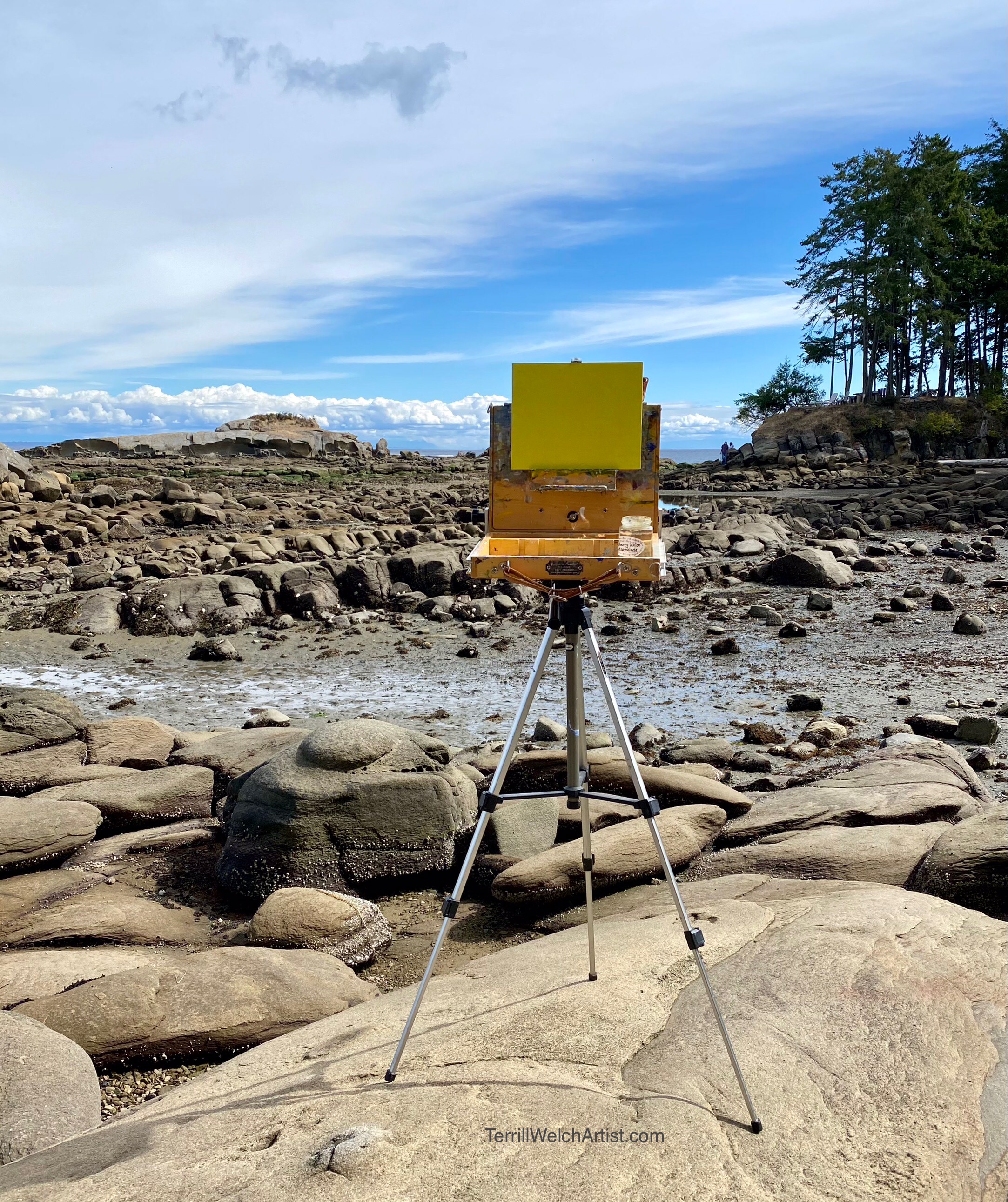
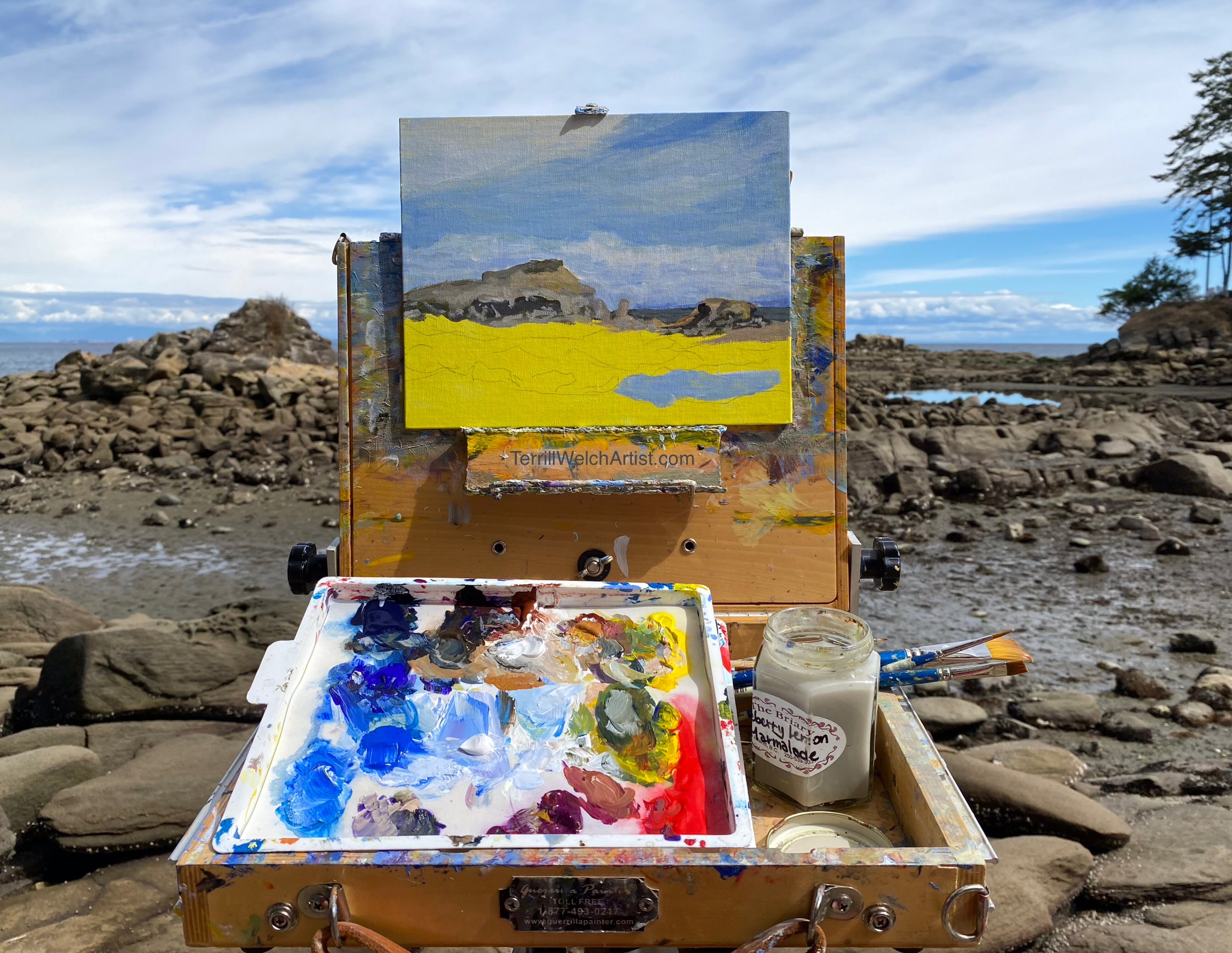
The references for this work were observations in the moment as I stood on the top of an exposed piece of sandstone in front of my easel in Oyster Bay on (what is now called) Mayne Island in British Columbia, Canada. 

Setting up to plein air paint at Oyster Bay in late August. Photograph by Terrill Welch, Friday, 28 August 2026.

When I began there was a couple making their way along the shoreline and a couple of construction workers building a bench up above them. Other than this, I had the place to myself for the painting session. 

Making Process:

The painting process was direct and immediate as I captured the light first and then began to build up the forms of the sandstone.

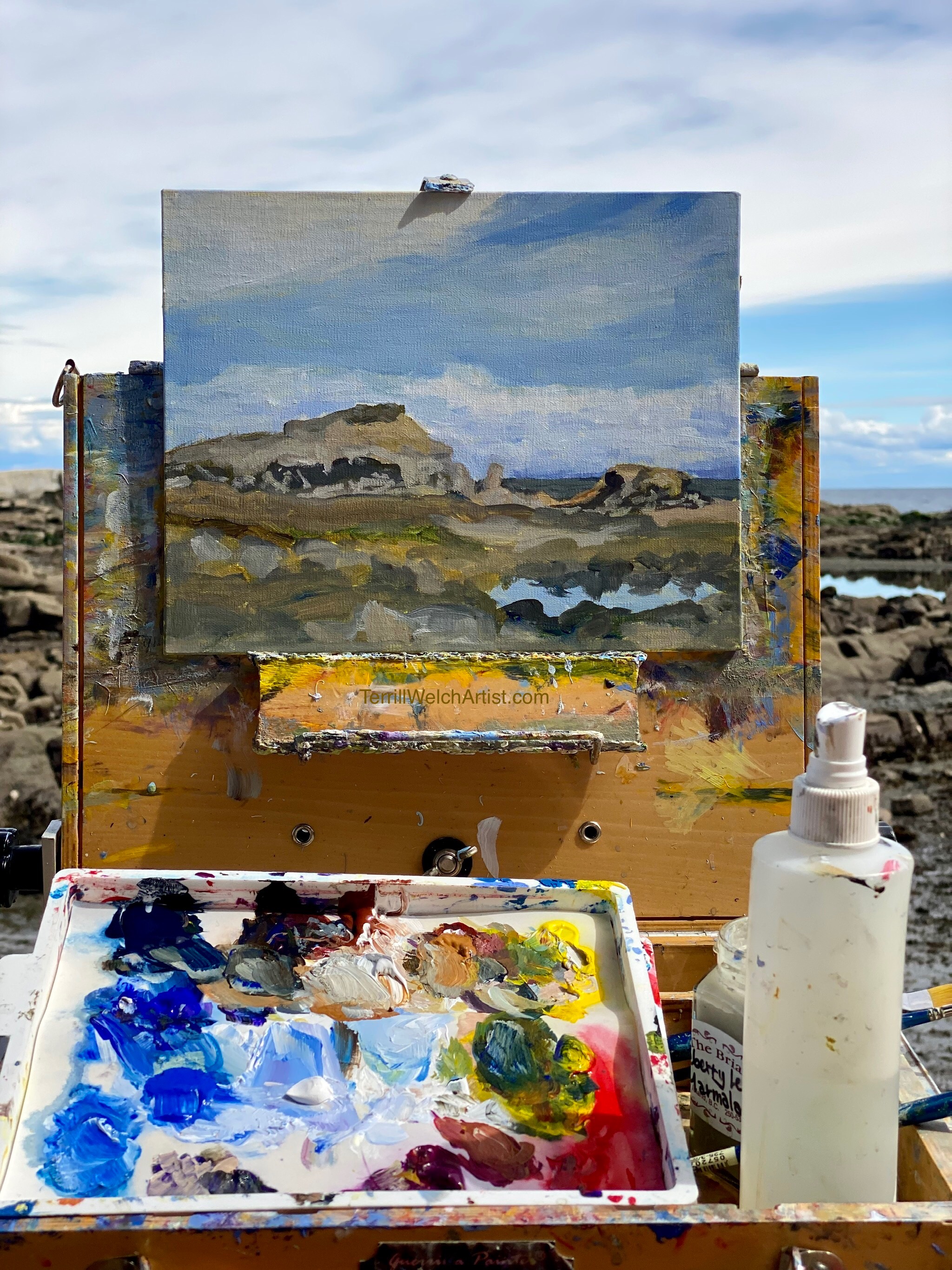
Work-in-progress — Oyster Bay Late August by Terrill Welch, 8 x 10 inch acrylic on linen board. Photograph by Terrill Welch. Friday, 28 August 2026.

I was working with an older palette from a previous painting sketch that had ran a bit from being tilted in my plein air backpack. But it worked.

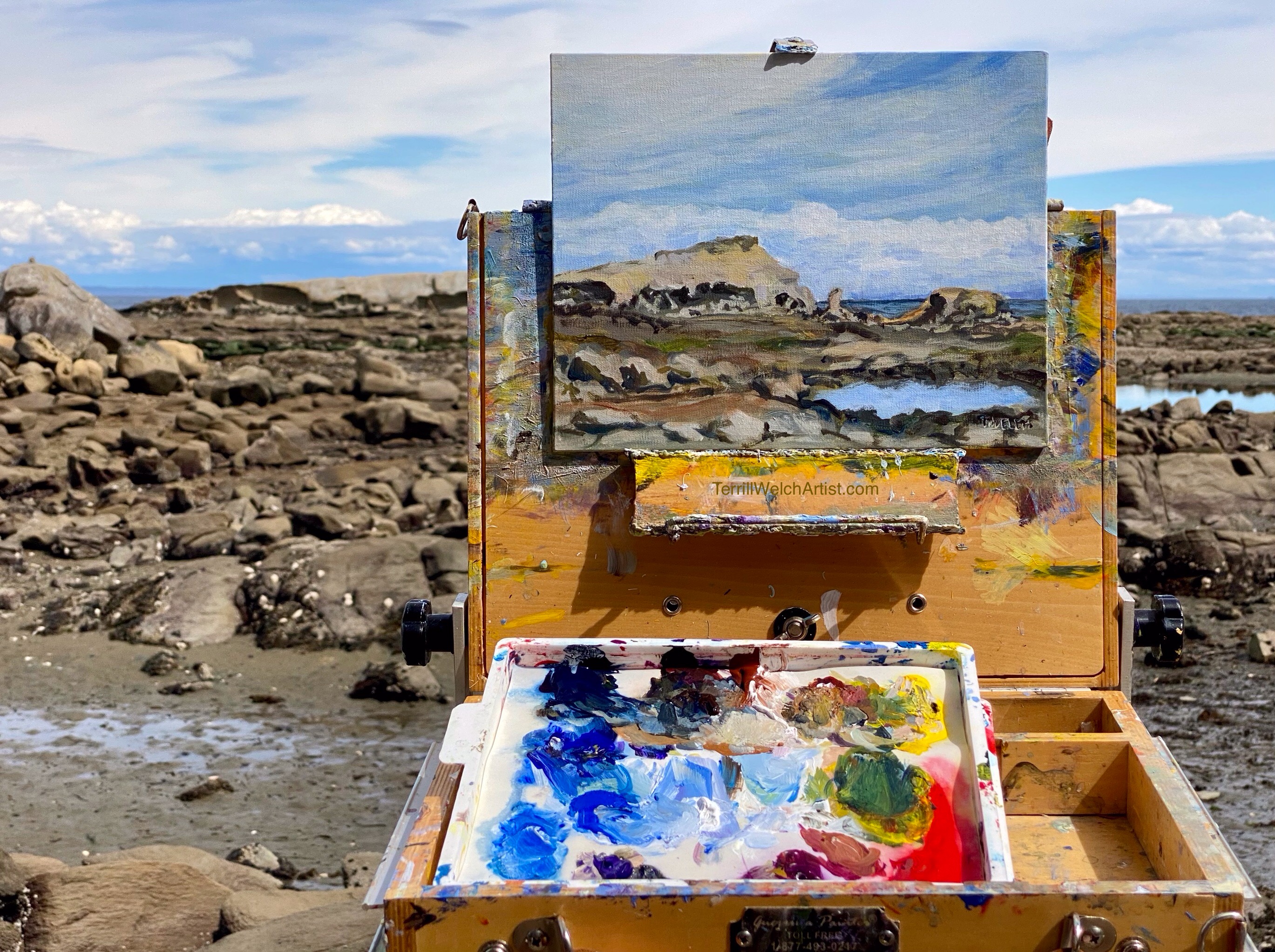
Work-in-progress 2 — Oyster Bay Late August by Terrill Welch, 8 x 10 inch acrylic on linen board. Photograph by Terrill Welch. Friday, 28 August 2026.

Eventually I managed to get everything blocked in and was able to slightly refine the piece before my available time came to an end.

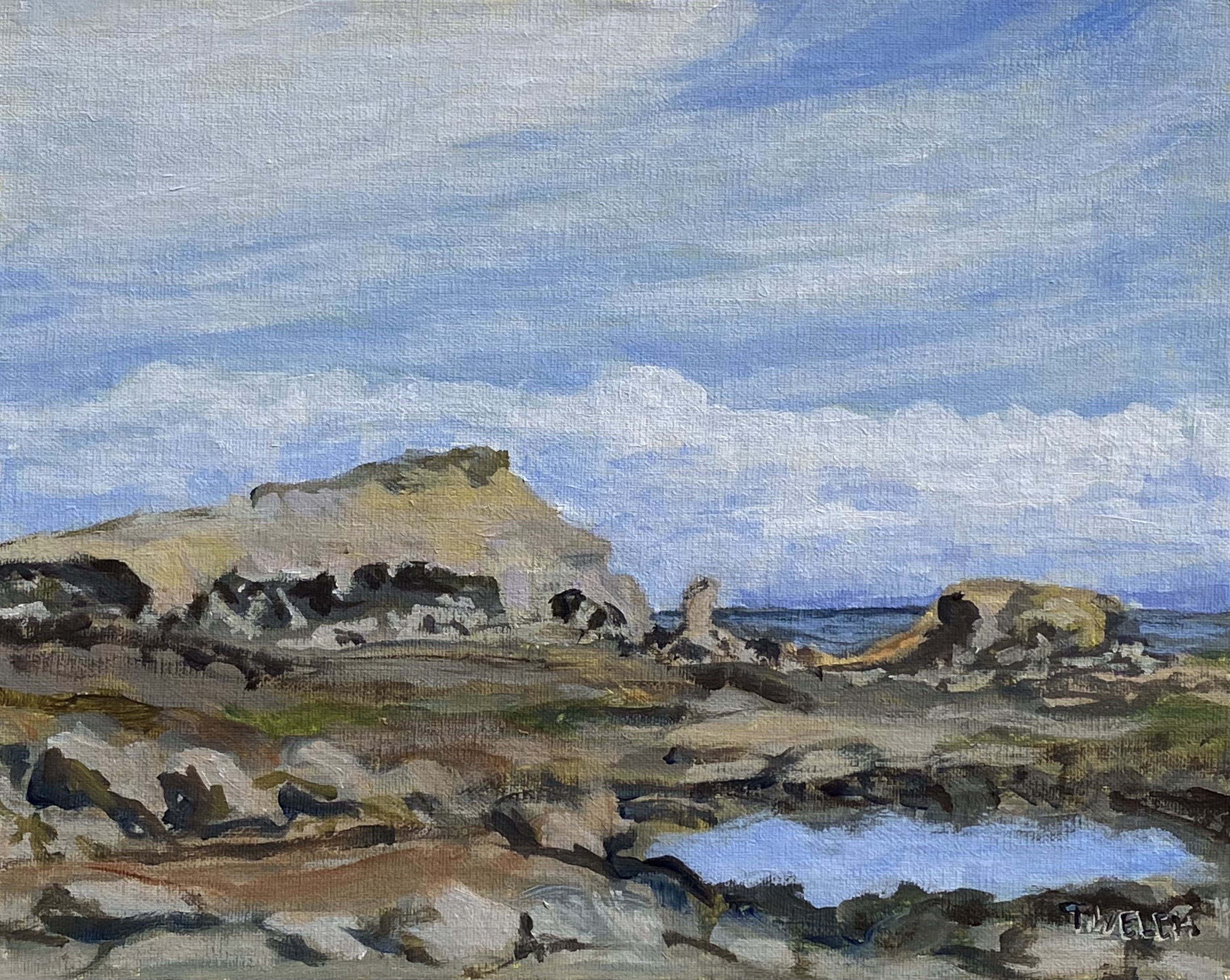
Still on the easel — Oyster Bay Late August by Terrill Welch, 8 x 10 inch acrylic on linen board. Photograph by Terrill Welch. Friday, 28 August 2026.

Finished Painting:

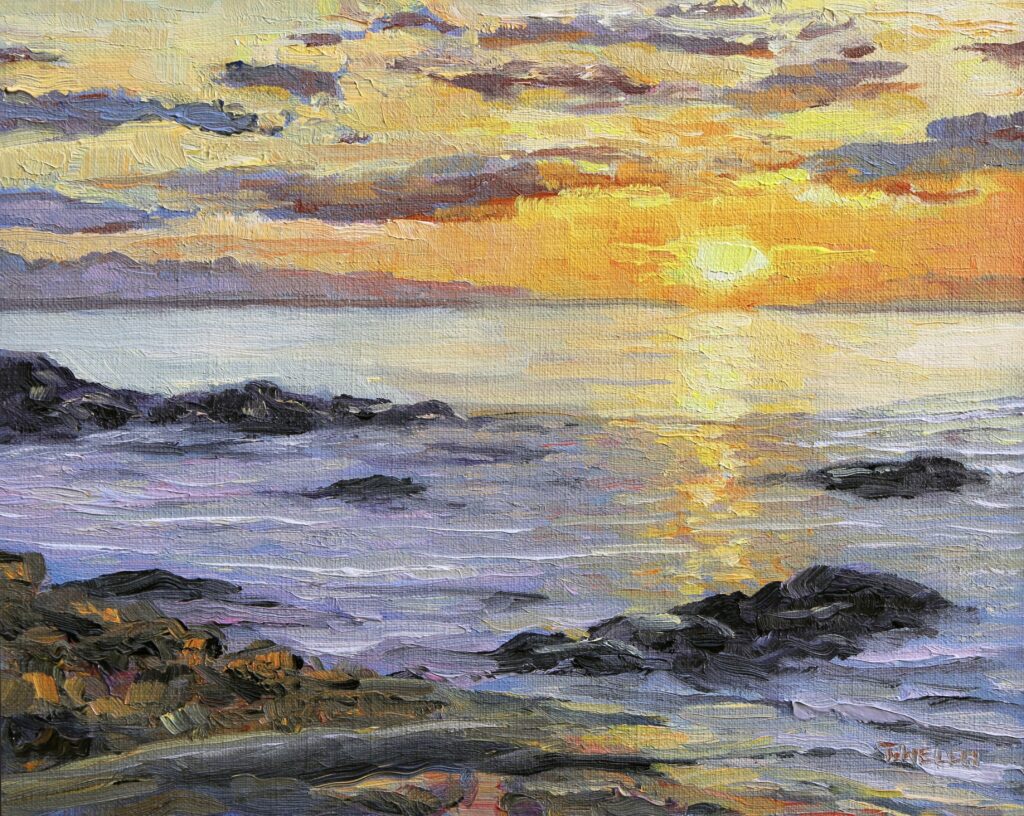
Oyster Bay Late August by Terrill Welch, 8 x 10 inch acrylic on linen board. Completed August 28, 2026.

Making Notes:

I set the plein air easel on top of the sandstone and looked east over to the rocks exposed in a low tide. The day is pleasant with blue skies holding shapely clouds in the late August sun. I stay for a while with my brush in hand and drift through an hour of painting. It is my birthday and this is my gift to me.

Reflective Analysis:

I had been offered a chance to go out on my own while knowing someone was with my partner who has dementia but still is able to stay by himself for a few hours at a time, if set up with a note to remind him when I will be back and where I have gone. But it is always more freeing if someone is with him. It was a generous offer. She thought I could go for lunch with a friend or something for my birthday. I responded that what I would like to do is go plein air painting because I already had family coming over to visit on several different days for my birthday. She laughed and replied — of course you want to go paint for your birthday! 

Reflexive Analysis: 

One of the odd things to me about being a full time caregiver is that I do not crave time with friends or other people so much. We go out for breakfast or lunch a couple of times a week and then there are the times I see people when getting groceries or picking up produce at the Saturday market plus, I engage daily online while presenting my work. I was invited to join a philosophers café that meets once a month and I accepted as a way to have meaningful deep discussions in-person on topics of interest. This complete package of in-person engagement with others always seems like enough socializing for me. What I crave most is just a few hours at a time on my own. I can still get this but it can’t be for very long at a time. Two hours is ideal and three is stretching my partner’s ability to feel confident on his own. So when given a choice to go for lunch or go plein air painting, the painting wins. This is because I am certain that my time at the easel will offer regeneration and delight. It fills my personal bucket like nothing else has ever been able to do. Just me and nature working together for a focused 45-60 minutes. This is all it takes. Hiking the trails alone does a similar thing but painting is the very best! I always come home filled with satisfaction and refreshed. This is the reparative element to my painting practice in action. 

Key Findings: 

I thought I would do more with this small study back in the studio. But as I spent the next few days glancing at it on the window ledge amongst various other small works, I decided nothing more I did would improve my impressions of this time beside the sea. So I have left it just how it was when I packed up to come home. 

Anything else: 

I am still considering what or if I will do anything on larger surfaces with these recent small painting sketches. I am in no rush to make a decision. The weather to best enjoy painting outside with the golden fall light is brief and will soon come to an end. I can decide once the rains keep me inside more. 

Memories of Mornings by the Studio Window Painting Data Collection

Painting Data Collection 

Title: Memories of Mornings by the Studio WindowDate Completed: Wednesday, 19 August 2026
Materials: Acrylic on linen board
Size: 8 x 10 inches (25.4 x 20.32 cm)


Figurative/Abstract Self Assessment Band-Scale Rating between 1-10: 5

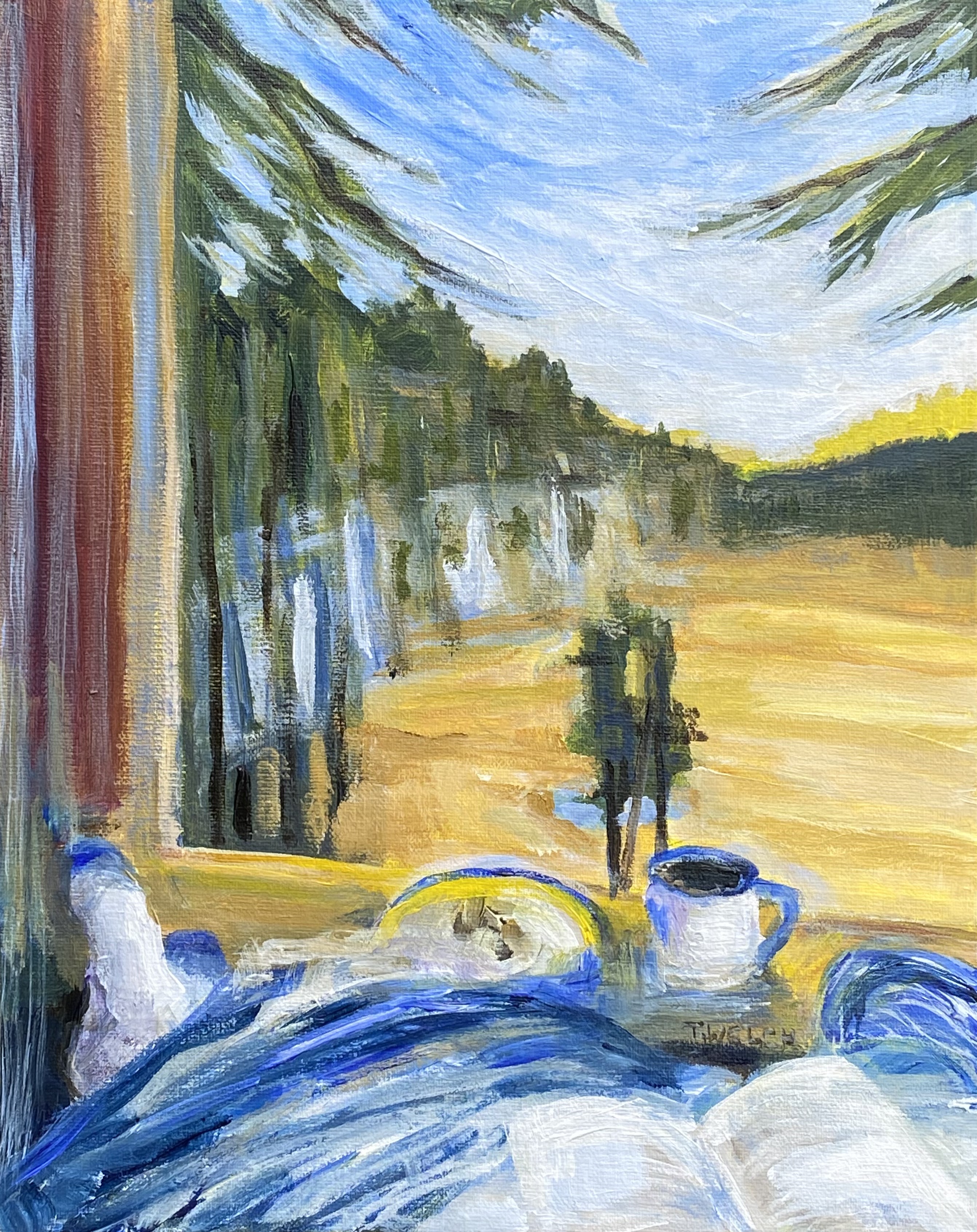
This work is a quick impressionist study. Attention has been paid to light, relationships between elements and sensory records of the fragrance of dark coffee, fresh morning air through an open window and the softens of wool socks cozying around bare feet sticking out from under the edge of a blanket. 

Reference Gathering: 

References for this study are minimal with most mark making relying on repeated mornings of similar moments that created a bank of memories. 

But there are two images that provide a starting point. 

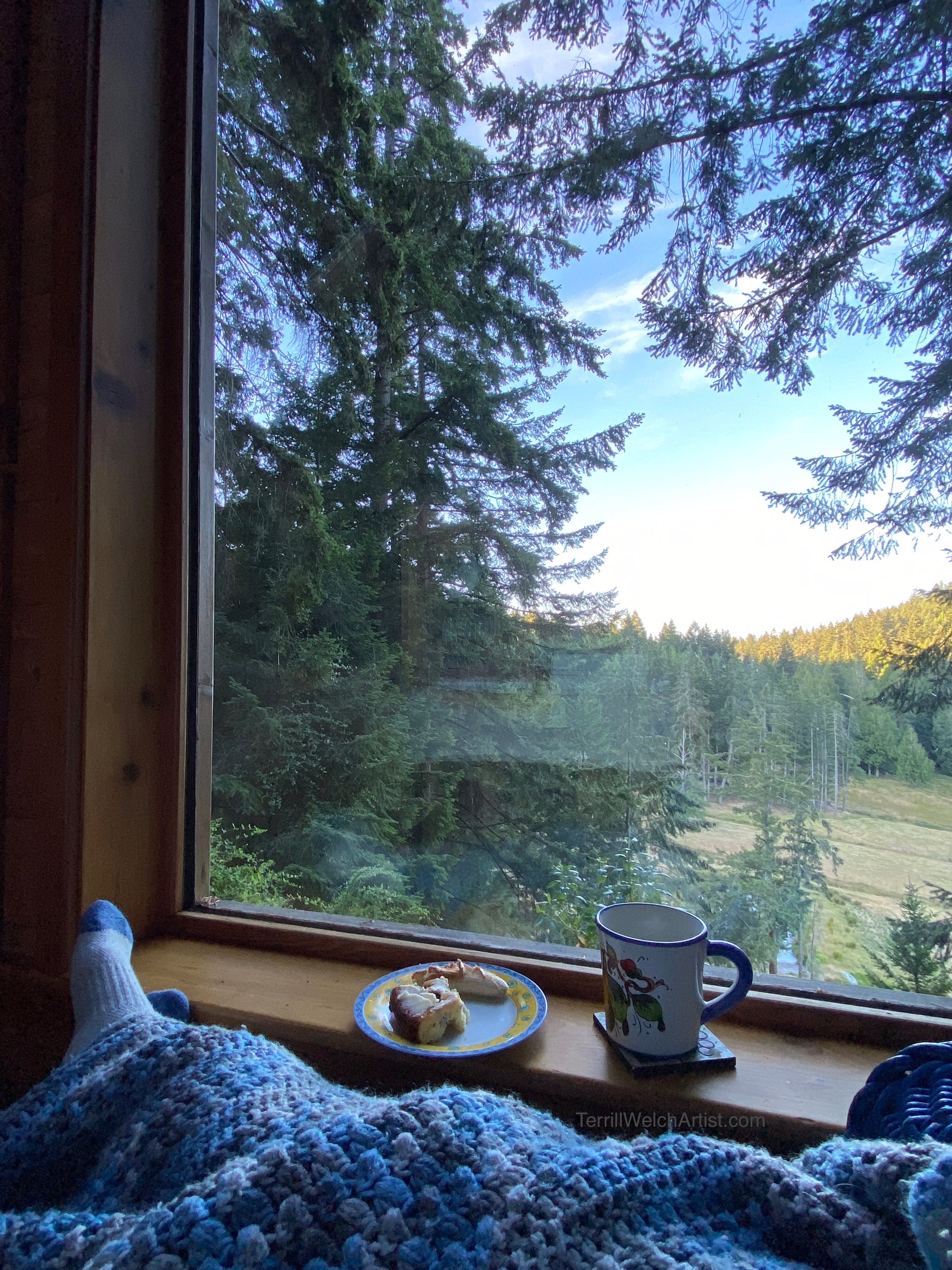
Sun catching the hill as seen from the chair beside the studio window. Photograph by Terrill Welch Sunday 28 June 2026.
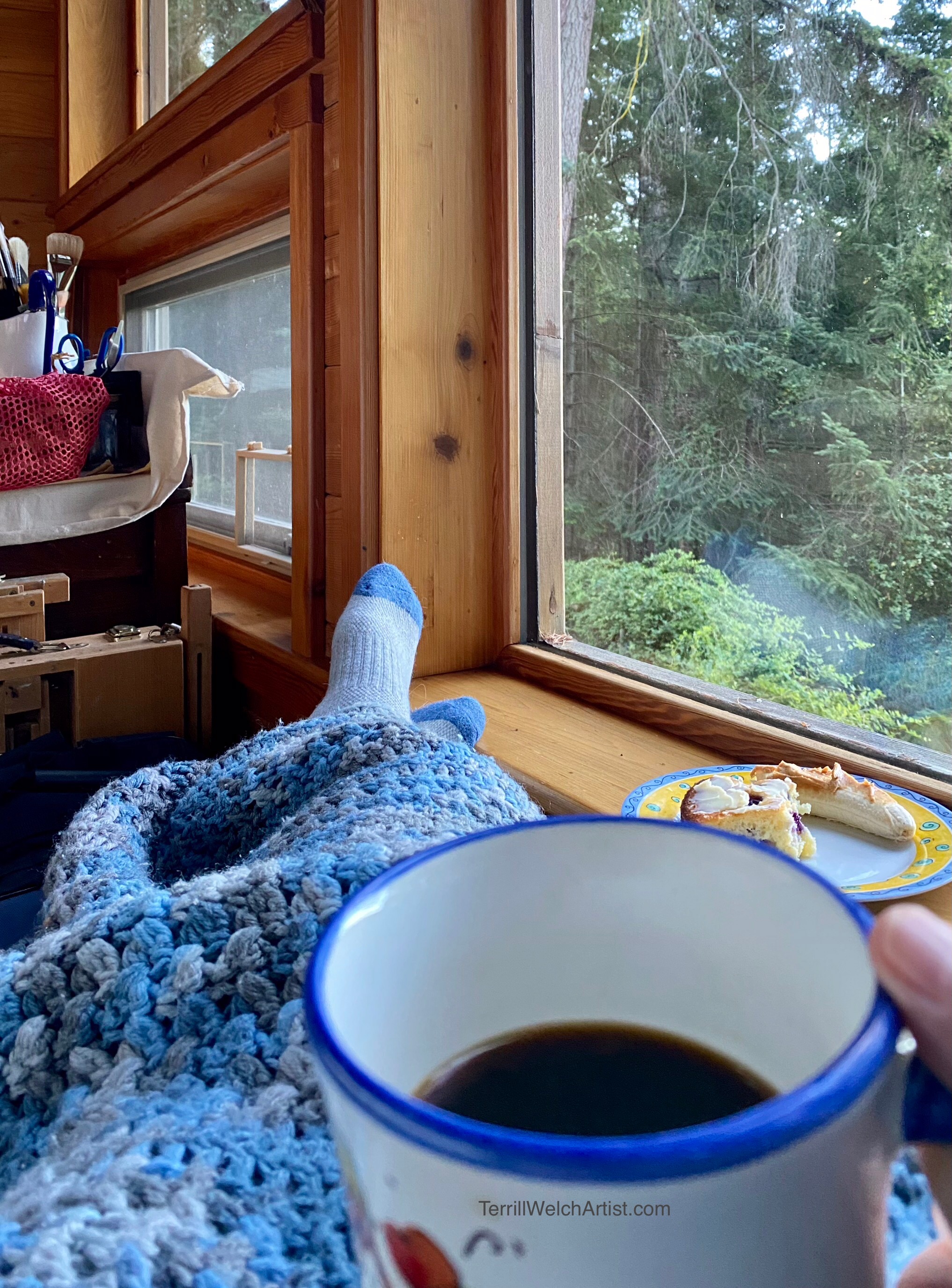
Mornings in the chair of the studio window. Photograph by Terrill Welch Sunday 28 June 2026.

Making Process:

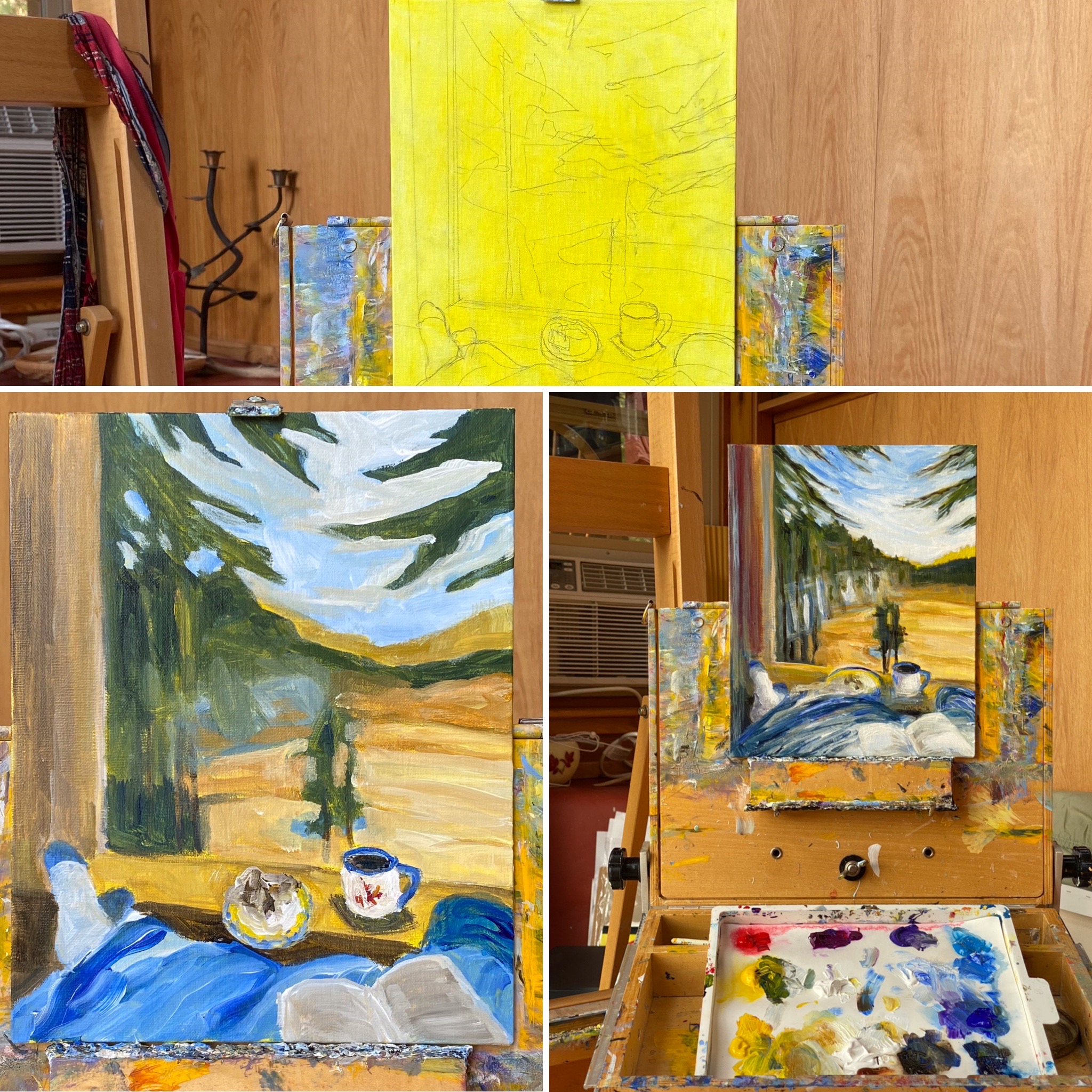
The making process is equally sparse because once I settled down to paint, I forgot to take many photographs as the work developed. But there are a few. 

Work-in-progress collage of images for Memories of Mornings by the Studio Window by Terrill Welch, 10 x 8 inch acrylic on linen board.

Finished Painting:

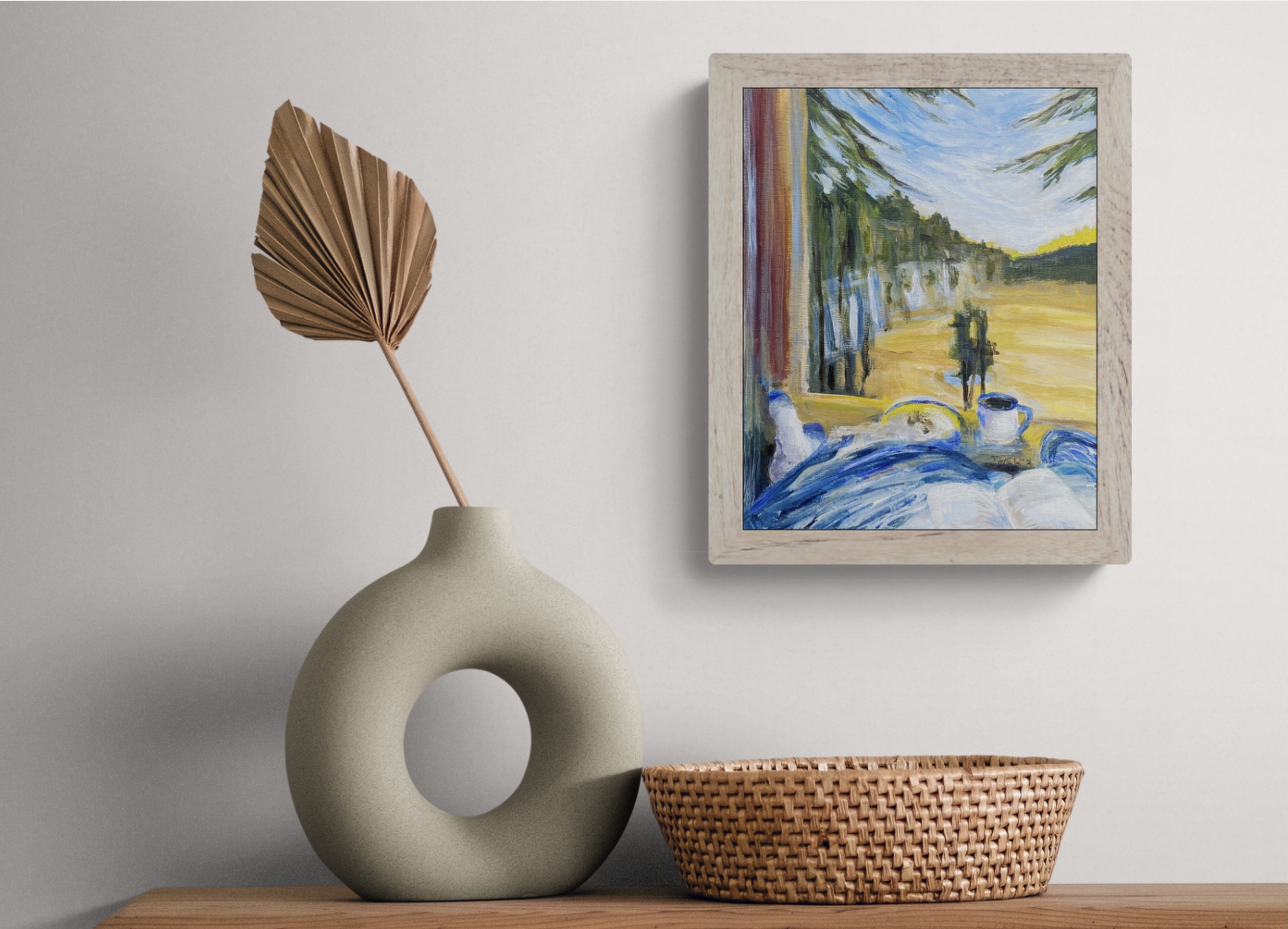
Memories of Mornings by the Studio Window by Terrill Welch, 10 x 8 inch acrylic on linen board. Completed Wednesday, 19 August 2026.

Making Notes:

So many mornings seated in the studio window with coffee and breakfast just like this morning. I worked from memory though there are references. My attention drifted from what I might be reading to the dark savoured bitterness of the coffee then over to where the rising sun is catching the far hill in the valley. The fields are cut and dry and a cool breeze is coming in the window next to the one I am sitting beside. There is a precious sense of optimism swinging on the branches of the fir trees. I sigh and blink my way into the day. This quick sketch is a brief reminder of something that as of yet has no words other than the importance of waking up.

Here is a digital room view for size context. 

Digital viewing room with Memories of Mornings by the Studio Window by Terrill Welch, 10 x 8 inch acrylic on linen board.

Reflective Analysis:

Mornings have always been an important part of my day and this appreciation has deepened over the years. Though I most often rise early it is not a busy time of day. I like to wake up before others can have any demands on my time or my thoughts. Sometimes, this is only a brief ten minutes. Other times I can be gifted a couple of hours. It all feels like the intervention of chance really. I used to swear that my young children heard my eyes flutter open and then they leaped out of bed so as not to miss out on anything. Now, my partner often does the same. But there is always a chance that everyone will sleep just a little longer and I can watch the day begin, wrapped up cozy, from one window or the other. 

Reflexive Analysis: 

Strong dark roast black coffee is my morning beverage of choice and comes with a whole ritual of hand grinding (by hand, no electric whirring noises for me) locally roasted coffee beans. The beans are coarsely ground for a 30 year old stainless steel insulated French press. Once brewed, a cup is poured into a favourite Italian mug and the rest is put into a heated stainless steel thermos that takes me most of the morning to drink. This ritual is a mix of childhood references of the practices of my parents and a west coast of Canada coffee culture that started developing around about the late 1980’s, early 1990’s, while I was going to the University of Victoria with two young children as a single parent, who also worked part time while going to school full time. Now, when I sit peacefully in the art studio chair by the window, still in my pajamas, drinking my whole first cup of coffee while it is hot, without having it answer questions, sign notes for school, add a child’s birthday party coming up on the weekend to my calendar, be reminded to pick someone up after school, I feel particularly blessed. I loved parenting and yet, I am still thrilled when my mornings begin by easing into the day instead of starting at full throttle. 

Key Findings: 

When I think back, I remember one of my high school principals who picked me up while hitchhiking in our small village to the place I was living a few miles away in the rural farmlands. He was very clear that, though I had graduated grade twelve, I was going to grow up to be poor white trash. I was unmarried, pregnant with my first child and not yet 19 years old. I mean — who says this to a young kid finding her way after having made some difficult choices!? I am ever-so-glad that I simply just didn’t believe him. I have always had a strong inner self-motivating pull to problem-solve around ways to achieve whatever is of most driving interest to me. These ritualized morning coffees are the foundation for my thinking and of my organizing structures. It is when I prioritize the items written into my calendar into the order that either must be done that day or that I have the most desire to complete. It is also where I look ahead over the coming weeks and months and see what needs to be refined and it is when I measure how well I am fulfilling any intentions I might have set. This small sketch holds all of this for me. 

Anything else: 

It is usually the case that we can accomplish far more than we and others think we can. There is a cost of course and this can’t be discounted. This isn’t usually what stops us from trying. More often than not it is a fear of failure or fear of something awful happening. I have learned to ask myself during my morning coffee — what is the worst that can happen and can I live with it? What is the worst that will happen if I do and what is the worst that will happen if I don’t? If I can live with the worst in relation to the decision I most want to make, that will generally be the route I will take. Who knew a small painting study of a person sitting in a window having a morning coffee could hold so much? 

Defining “Close to Home” as a focus within my nature-centric, reparative painting practice

Monday, 17 August 2026

“Close to home” at first, brings up familiarity, safety and comfort. It is where I live my daily life most of the time. Geographically, these days “close to home” is usually limited to within a day’s drive in any direction which gives the concept physical parameters. There is an ordinariness that comes with these sustained intimately observed passages of time in one place doing “the usual” things such as getting groceries, hanging laundry on the line, grinding the morning coffee beans, paying bills online, going to the dentist, getting the car serviced, working in the yard, hugging my partner, children, grandchildren and friends between taking long hikes, painting in the studio and promoting the gallery and artworks. I ask myself, why is this focus on “Close to Home” in my painting practice important? 

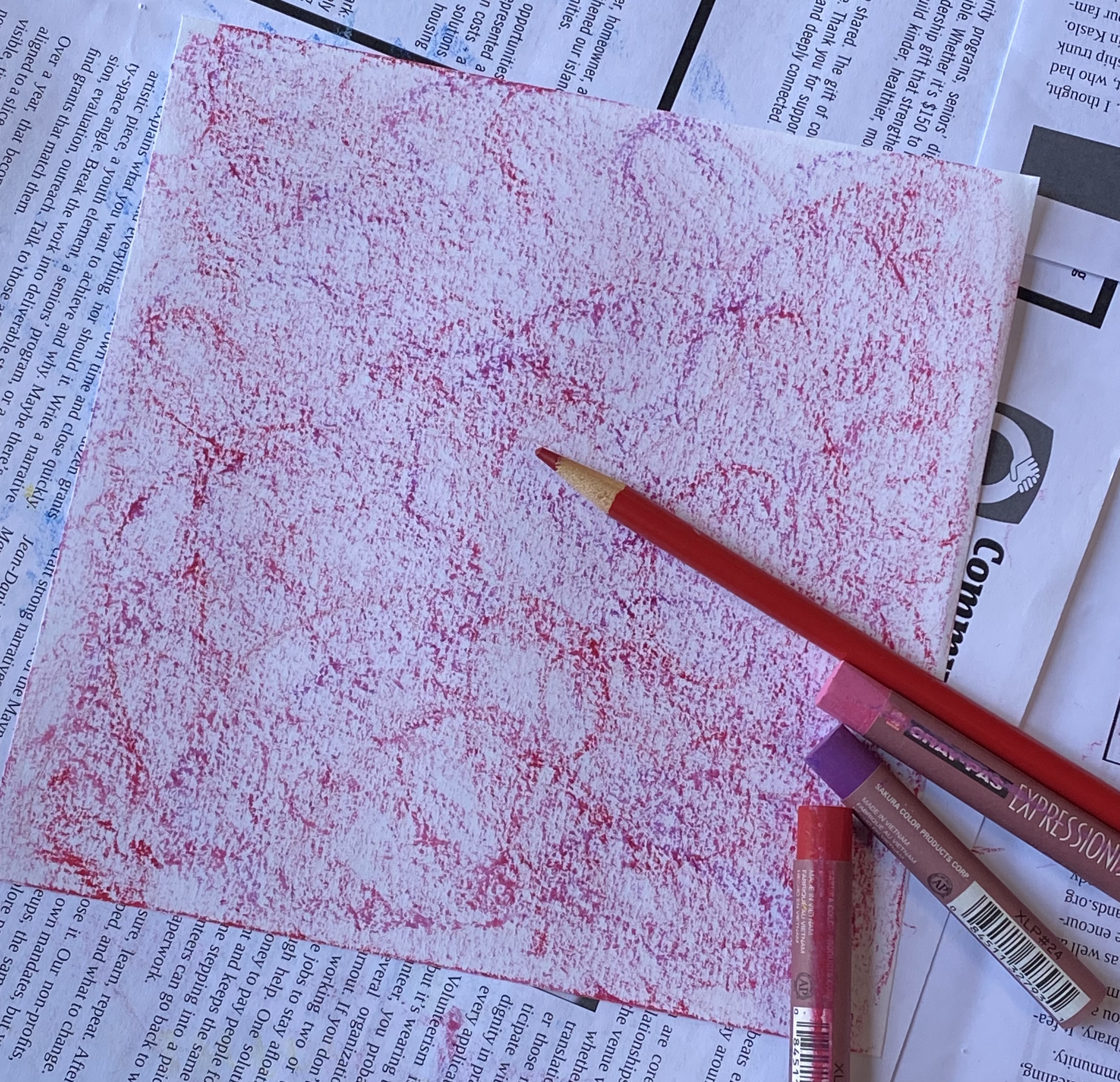
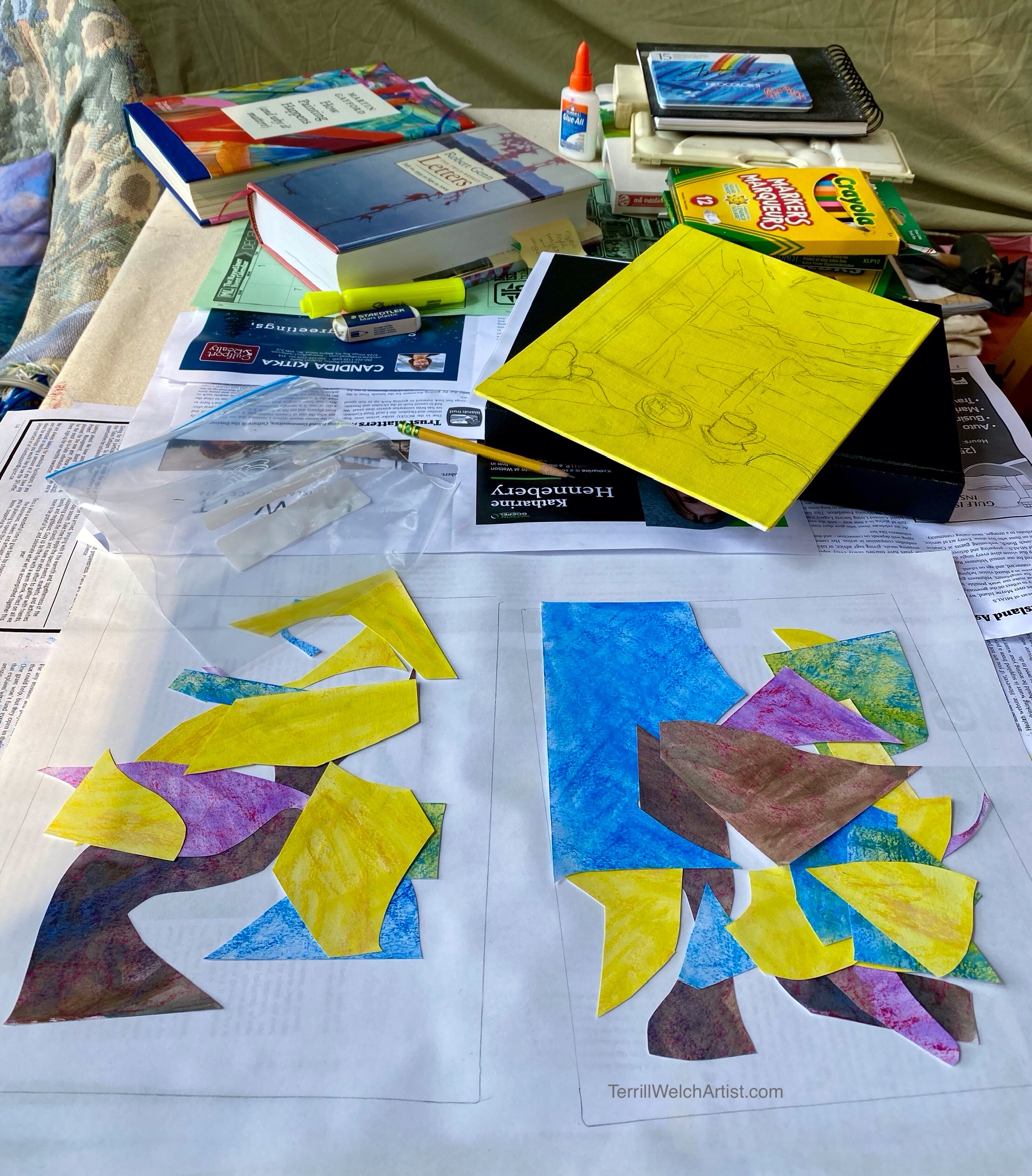
Developing red collage paper by Terrill Welch. August 8, 2026.

To answer this question is to first observe aspects of my contextualized autoethnographic references. The first and most obvious factor is that I am a full-time, primary caregiver for a partner that can quite happily no longer go further than the geographical territory mentioned above. I remain close to home because, to provide the best care for someone else, I must. The alternatives are to place my special human in respite care or to have someone come to stay with them. Neither of these options are easily workable in practice. By the time I get someone or someplace up to speed on this special being’s needs and them familiar with something they don’t want to do, the brief break becomes more of a traumatic ordeal for both of us than an actual opportunity. At least, this has been our experience so far. Eventually when regular weekly respite breaks become necessary, we will then have someone familiar providing additional support on ongoing. This might then present some opportunities for longer breaks for me to be able to at least go see my elderly parents which is a 7-10 day round trip visit away. For now, primary caregiving responsibilities take a central role, as a wife and as the human that is closest to the person in need. There are children. But the personal care needs and ongoing vascular dementia monitoring and prompting have gone well beyond their comfort levels and therefore not an option except possibly during a short term emergency until other care could be put in place. Community health home support services have been limited and expensive for what is provided. This leaves just me for now. We muddle through as best we can together which for now is pretty well. As an almost 68 year old white woman of settler ancestry, living on a rural small island on the southwest coast of Canada, I am resourceful, resilient, organized and pragmatic with a strong work ethic. I will face poverty level cash flows if/when the time comes to manage only on my own pensions. For now, there is enough to comfortably support both of us. But this reality is partly why I spent the past two years completing my MA Fine Art degree. It is a way to recognize the seriousness with which I take my painting practice that then might possibly lead to my artwork offering a small financial buffer if it is needed in the future. Global instability may make this a difficult proposition to realize but it would be even less of a possibility as an older woman artist without doing this degree. 

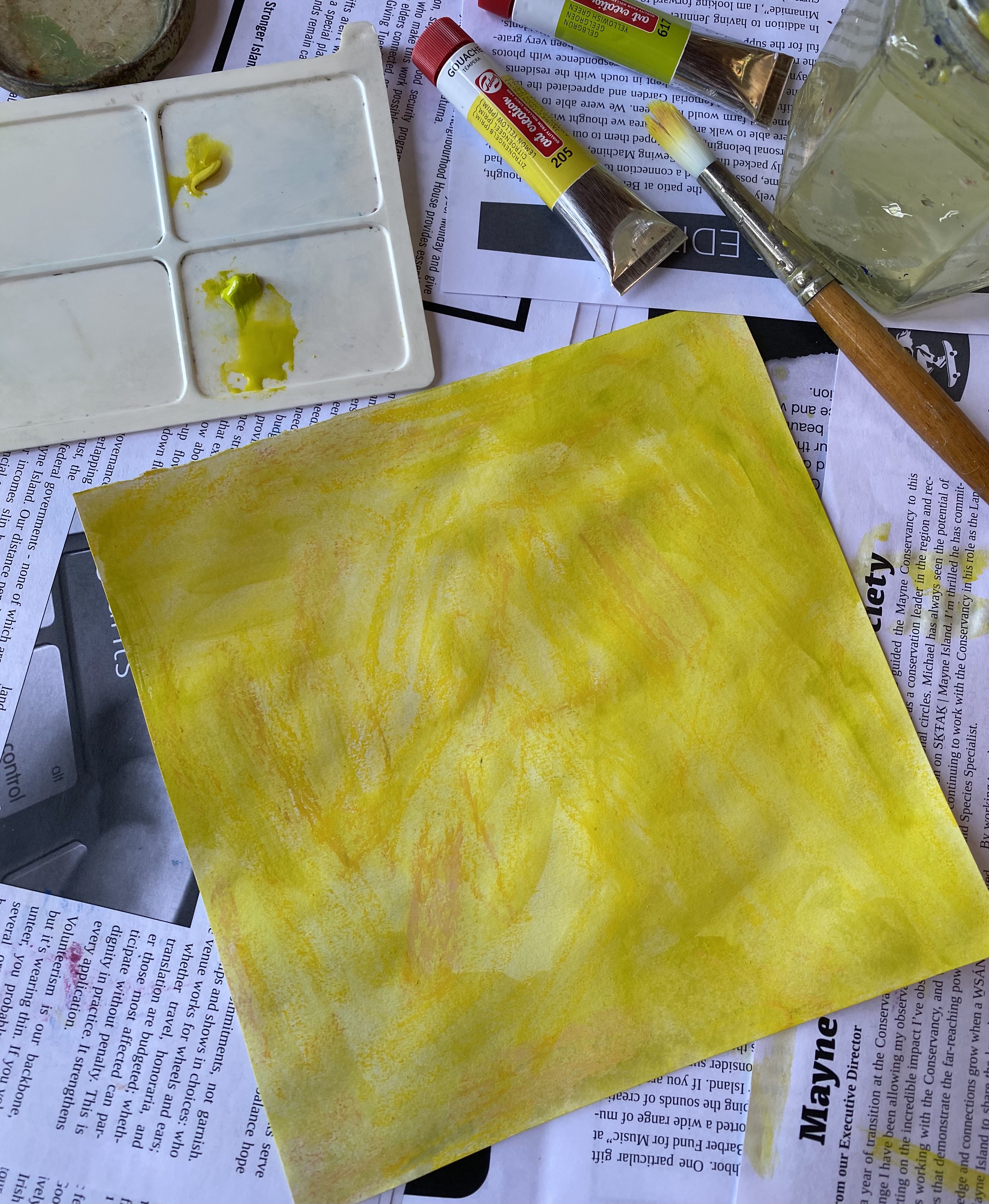
Yellow gauche covered collage paper by Terrill Welch. August 8, 2026.

This brings up other aspects about being “Close to Home” including a sense of loss of freedom, of heavy sadness/grief about slowly losing someone to their disease, as well as facing my own limitations and mortality. How long can I reasonably keep up with these responsibilities? How long can I manage living on this rural island as the only person who is able to drive?

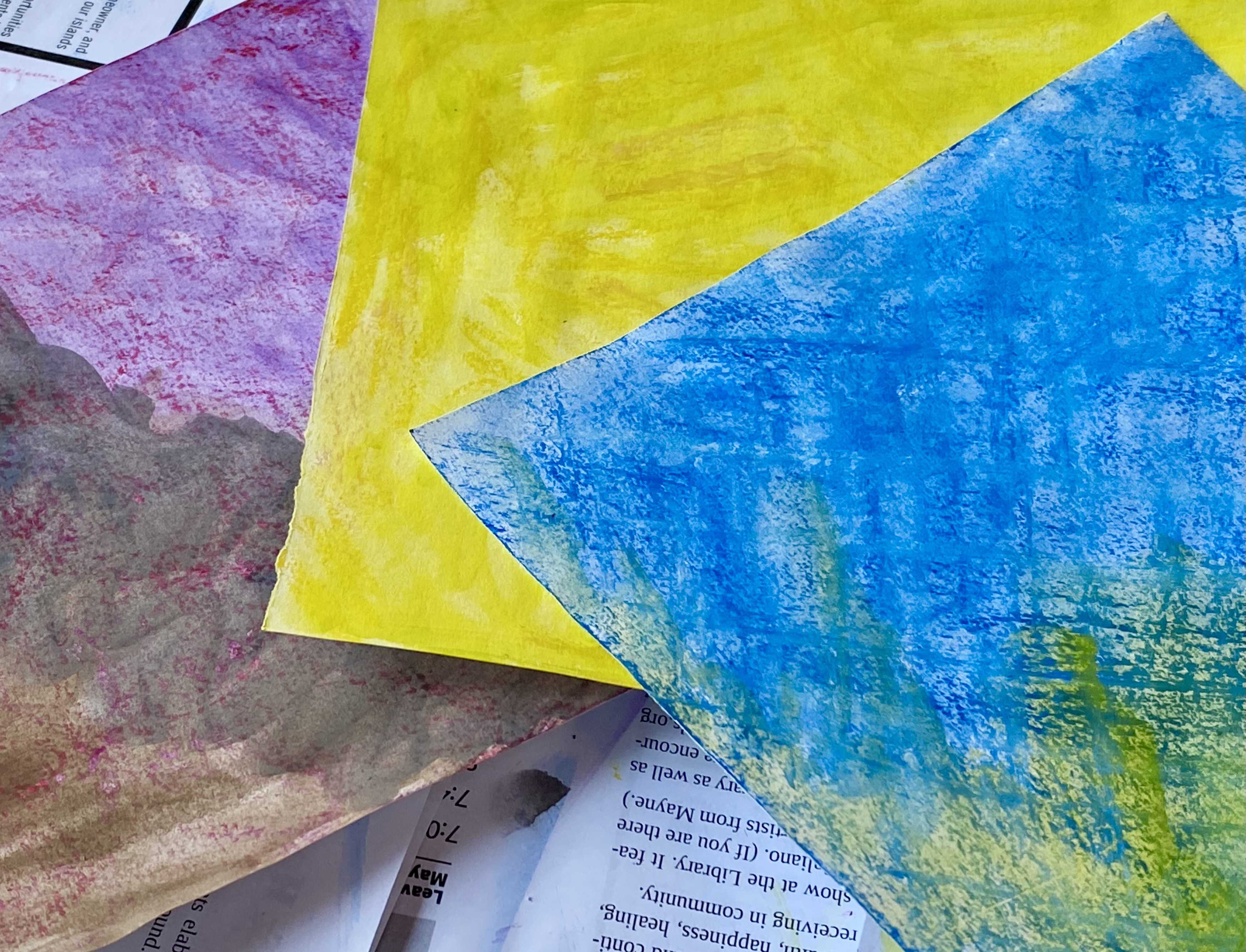
Three sheets of collage paper created by Terrill Welch. August 8, 2026.

Then I return again to my painting practice and its central role in making all challenging situations much more possible, pleasurable and endurable. This is especially true if I turn my painting practice directly towards what is challenging. In doing this, I seem to find my footing and my strength as well as my joy and pleasure with simply being alive.

These are the thoughts that came to mind as I created the collage paper, cut it up and then decided I wanted to paint instead. So, I packed up the paper cuttings and put them in a bag for another day.

Collage paper cuttings and a sketched ready to paint in Terrill Welch’s art studio.

I expect to have much more to discover about my focus on “Close to Home” as I proceed but for now, it is time to work on a small painting sketch featuring morning coffee in my studio chair.

The Everyday Beauty of Art: Reflections on ‘Lady Arbutus’

Monday, 3 August 2026

I am standing at the easel this morning and decided I would write while taking a teabreak. The painting catches the glare from the late morning sun outside the art studio window. I leave it and the brushes where they were put down and glance at the finished painting with almost dry edges that I thankfully had remembered to cover before I started. 

An early August morning in the art studio of Terrill Welch with work-in-progress.

A rough sketch had been completed yesterday and set up on my old French Box easel so that I could settle right into painting this morning. 

A rough sketch by Terrill Welch, on a 14 x 11 inch linen covered birch board surface, is set on a French Box easel with the palette below Sunday evening in preparation for the next morning’s painting session.

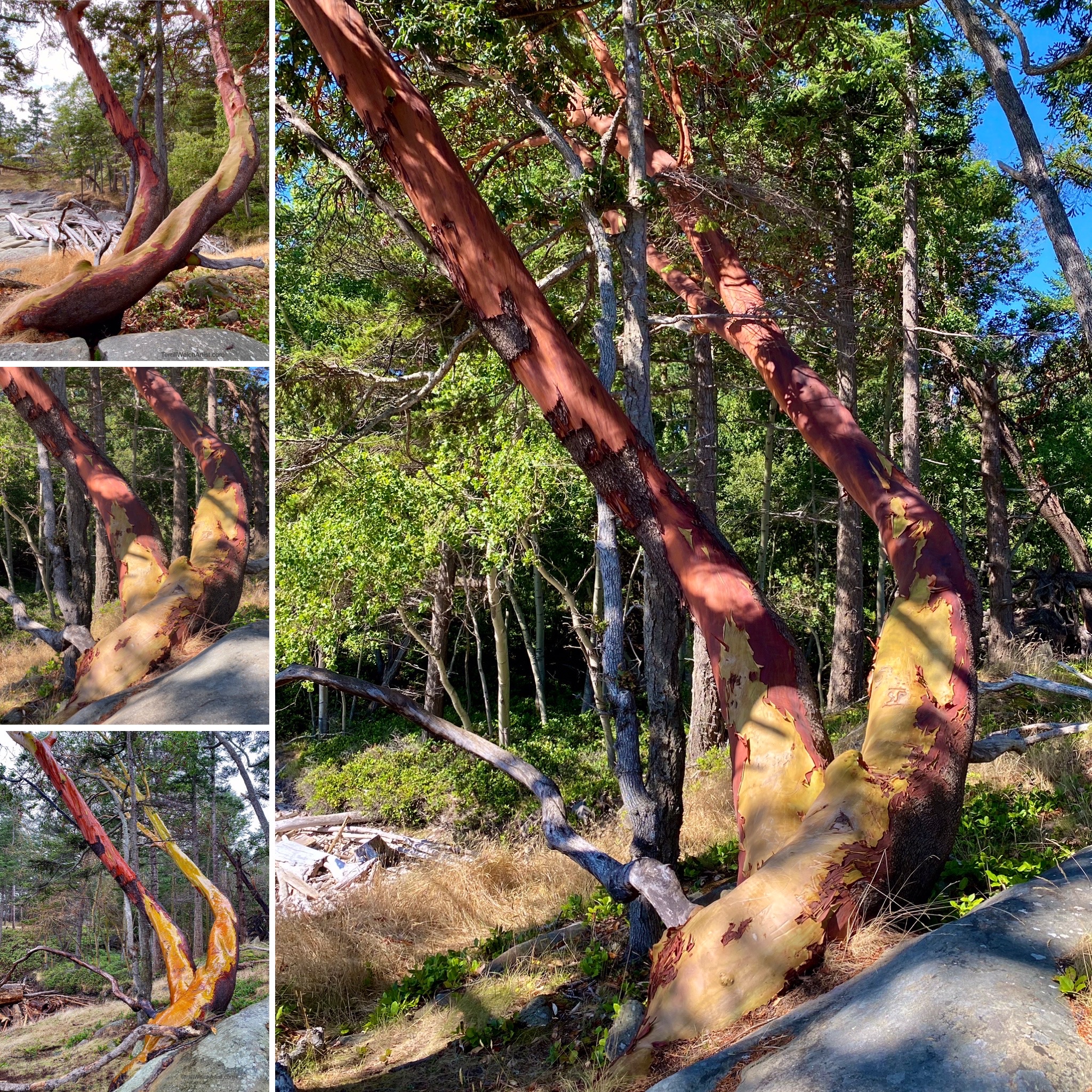
This is a commissioned work and stems from an art collector’s shared love of this specific arbutus tree that resembles the long legs of a woman elegantly reaching for the sky. I have references going back years but chose just a few, between August 2023 and August 2025. It seems fitting that I would begin painting it in August 2026.

Collection of reference images between 30 August 2023 and 20 August 2025 by Terrill Welch in preparation for painting “Lady Arbutus” in August 2026.

While I am painting, I do not think of much but rather focus on what I am remembering and feeling about this specific tree and this specific place which is no longer publicly accessible since much of the land around it was purchased as part of a conservation land use agreement. I cherish and I am deeply grateful for the vision of the landowners and those that worked to acquire the lands for this reason. It is a small price to pay to respect the request to stay off of the very point of Edith Point that is still held as private land. This aside, I lean into my memories again. 

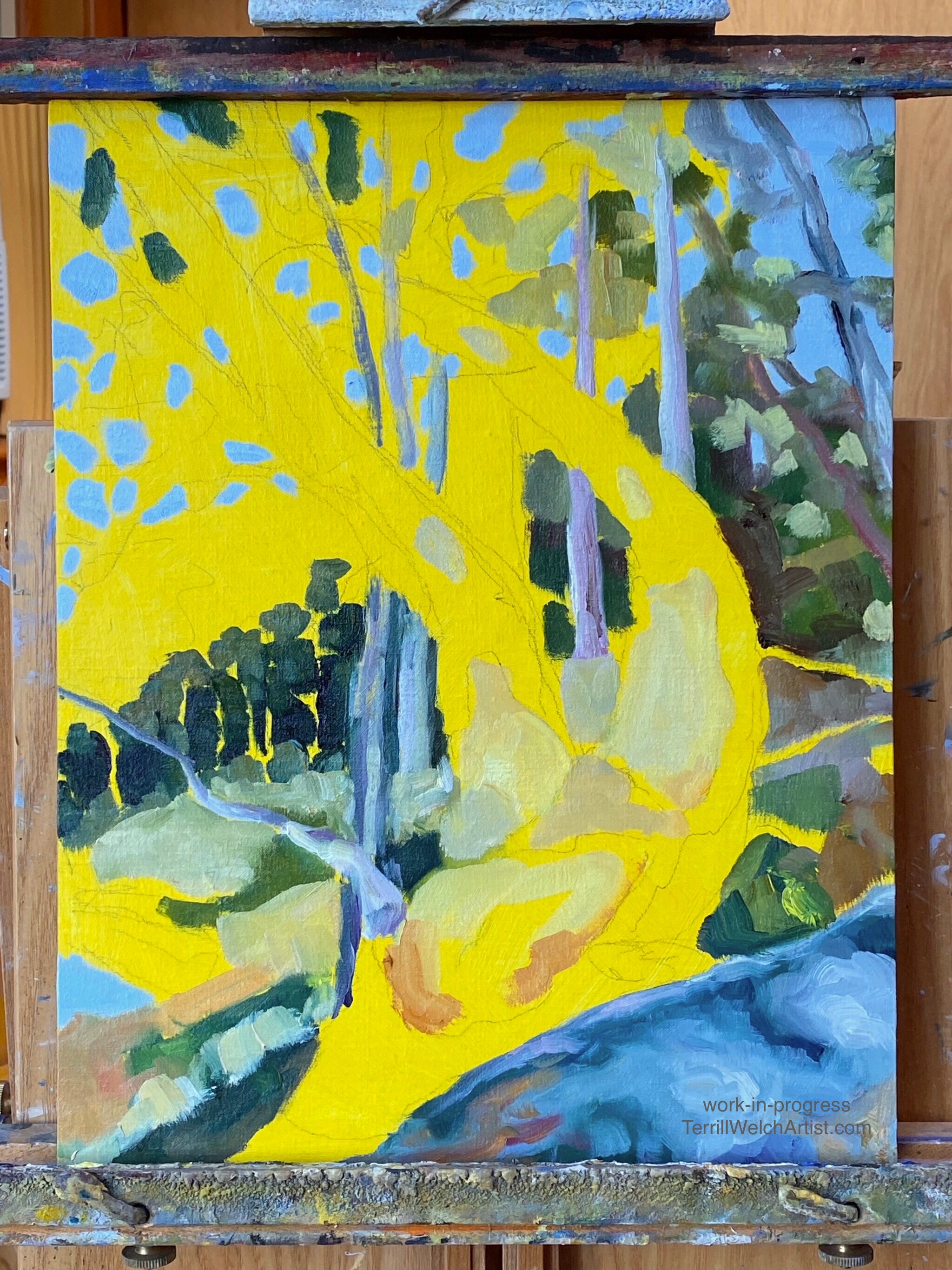
work-in-progress on the easel of “Lady Arbutus” by Terrill Welch, 14 x 11 inch oil on linen covered birch board.

There is a ferry whistle in Active Pass on the other side of the island that echoes a response to the August sun pressing towards it through the trees. A calm ocean behind me pools in the bottom left of the painting. It isn’t there in the reference. This won’t matter and it might not even stay to the finish line. For now it needs to be there. Deep shadows offer a counterbalance to the bright trunks of the arbutus trees and rich soft greens of stunted poplar trees in the grove. What would it like to be this arbutus tree tuck in next to a few strong firs next to the Salish Sea? Answering this question is a significant part of the job of this painting. Though it may indeed capture a beautiful moment, that is not its purpose. It is a working painting and will bring a sense of being close to home and all that this means. This is true for most of my paintings. They are not collected as decorative objects or for status or for their uniqueness but rather for good company! 

This brings me to a book I am reading and a question. Can paintings have an everyday use, like a hand turned pottery mug or a hand knit sweater? The Japanese philosopher, art historian, aesthete and poet, Soetsu Yanagi (1889 – 1961), proposes that true beauty does not come from straining to be remarkable. It comes from a kind of forgetting. Mingei or “crafts of the people”, is used to describe an approach and an object that “must be wholesomely and honestly made for practical use” (Yanagi, 2019, p. 5). These objects have been made without a need to be special or important and without grasping for attention. Further, the objects grow in beauty by their daily use. They are objects that have been made well and keep us company as we move through our ordinary lives. Yanagi in his book The Beauty of Everyday Things is speaking about anonymous folk craft and something that is different from what we understand as aristocratic contemporary fine art. However, I want to consider how my paintings might be and most often are acquired for their use value — not for decoration, not for spectacle or status but rather for daily company. This daily company is of course the underlying practice in which my brush touched the canvas in the first place. The paintings are the result of my conversation with nature that then invites the viewer into these exchanges. Skill, practice, the quality of the materials matter, just like they do for the craft worker making a mug or weaving a basket. The  works are not about being unique, though this over time happens without this being the intent. I mostly want to examine how a painting, as a crafted object, has a use value in our ordinary day, beyond an exploration of an idea that would lend itself to being considered contemporary art which, for the most part, is less interested in skill mastery or material quality. More importantly, can a painting hold both these philosophical and practical frameworks at the same time – humble usefulness for daily company and the successful exploration of a unique idea or concept? These are the questions I am asking as I read while knowing that my work does not have a physical use, definitely is not anonymous, and often it is not, broadly speaking, unique enough to fit easily into contemporary art sensibilities (presuming contemporary art can genuinely claim such a thing as sensibility). 

Well, teabreak is over. It is time I set this musing aside and get back to the easel and see where this painting takes me next.

Work-in-progress on “Lady Arbutus” by Terrill Welch, 14 x 11 inch oil on linen covered birch board.

Reference list:

Yanagi, S. (2019). The Beauty of Everyday Things. Penguin Books.

I am alive. I choose kindness. I have work to do.

Wednesday November 6, 2024

I woke to affirm that our earth has again turned to give us a rising sun. I am alive. I choose kindness. I have work to do. I choose kindness and hope while respecting the collective choices of others. However, this does not mean I agree or that I do not have serious concerns about these choices. 

I have no expectation that this living thing will be easy. 

I am alive. I choose kindness. I have work to do. 

I choose this grand, out of my control, adventure.

In doing so, I will start by borrowing a few lines from a poem by John Roedel that he shared on his Facebook profile, November 4, 2024. (Roedel, 2024)

“You are living on a spinning wet rock of a planet that resides next to a constantly exploding fireball in the middle of an ever-expanding universe that is filled with mysteries beyond your wildest imagination.”

“And on this planet that you are hurtling through the great expanse in – you are coexisting with billions of other people who have free-will and their own experiences that shape their perspectives and beliefs.”

“And while all this is going on your soul is residing in a physical body that is such a miracle of delicate engineering that at any given moment could produce its last heartbeat.”

The poem, written as a conversation between god and a human, goes on to say that we have two things we can control. The first is kindness towards others and the second is kindness towards ourselves. 
I have no expectation that this living thing will be easy. 

I am alive. I choose kindness. I choose hope. I have work to do.

“Sun is Up” by Terrill Welch, 8 x 10 inch walnut oil on linen board, January 1, 2024.

Artist notes: The light is just starting to hang itself on the tips of the tall fir branches outside our windows when I rise. I quickly grind the dark whole beans while the water is boiling and brew coffee to take with me to the beach at Reef Bay. Slipping unnoticed out the door, I am there by 5:30 am, perched and waiting to receive a renewable gift of resilience, hope and possibility in that spectacular phenomena, millions of years older than humanity – sunrise, mid May 2023. 

And before you consider this a lighthearted naivety, this painting was inspired by a few lines from Mary Oliver’s Goldfinches in her poem “Invitation” (p.107 Oliver, 2020)

believe us, they say,
it is a serious thing

just to be alive on this fresh morning in the broken world.

We will get through this time, as countries and as global citizens.

References:

Oliver, M. (2020) DEVOTIONS : the selected poems of Mary Oliver. Penguin Press.

Roedel, J. (2024) John RoedelFacebook.com. Available at: https://m.facebook.com/story.php?story_fbid=10169245051305276&id=862760275 (Accessed: 6 November 2024).

Welch, T. (2024) Sun is Up [walnut oil on linen board]. Available at: https://www.artworkarchive.com/profile/terrill-welch/artwork/sun-is-up (Accessed: 6 November 2024).

Winter Light is a Painter’s Light

Though the daylight hours are limited, it is the winter light that is most promising to my painter’s aesthetic. It is that moody warmth and abundance of soft edges that grasp my brushes into its clutches.

From morning to the end of the afternoon, there are days that only seem to have a glow through the fog.

This was my yesterday. I did work in the studio but by 3:30 not even the studio lamp helped much. It is on my to-do list to make arrangements for a track lighting bar to be installed. Soon I tell myself. Soon. In the meantime, I was painting a night scene from a late ferry ride on our much loved Mayne Queen on Monday. The Mayne Queen will be retired from service on November 20, 2022. There is a farewell gathering at the terminal but I am not sure I will go. In fact, I am pretty sure I won’t. Public goodbyes are really close to being beyond my capacity at the best of times. So instead, I put all my memories into one quick painting sketch from our last ride starting with a few swift brush marks to find my way into the composition.

And here is “Last Ride on the Mayne Queen” by Terrill Welch, 11 x 14 inch acrylic on gessobord.

Artist notes: We got our own private goodbye with the Mayne Queen this evening. There was no cake but the Big Dipper was present and the steady rumble of that diesel engine gently lulling us across the calm water. I will miss this old gal and the views she offered up with humble assurance. Good night she whispers softly just ahead of the crackling of the announcement – This is Village Bay Mayne Island, Village Bay… and the deck lights come on. Safely home on this sturdy old ferry boat for the final ride. Thank you for your many years of service Mayne Queen as your November 20th 2022 retirement day draws near. ❤️🥂🍾

This reminds me to tell you about a stormy winter day when the wind was whistling a wild tune. All the big ferries were holding and waiting out the weather. We didn’t think we were going to make it home. But after a slight delay, we were loaded on the Mayne Queen. The deck hands told us to put on our parking breaks and go upstairs and sit down. After a few minutes the captain came on the loud speaker and repeated the same message. Make sure the parking break is on. Stay up stairs and do not walk around unless it is necessary. To say the least, that was some ride!

But getting back to painting, in order to sympathetically render such winter day or night light, one must be a colourist. This is because all of the greys and darks are leaning towards some other colour and it is not the same colour they are leaning towards everywhere. Once a painter starts to understand this, and paints with this in mind, then the paintings seem to come alive on their own within the directional brushstrokes. Yes, painting takes practice but also study, knowledge, applied understanding and then finally forgetting so that the painter can work intuitively from a solid foundation. Rendering a subject in paint is not particularly challenging. A painter can be like a copy printer from life or some photographic image. Yes, you still have to understand colour and composition to make a decent replica but it is usually not particularly difficult and requires limited investment of the painter’s vulnerable self. However, to render a subject with vitality and inner feeling racing across the surface in a way that engages a viewer who has no experience with the subject, that there is magic! There is a barely controlled expressive rawness to such work. Even quiet peaceful paintings can have this. It is the secret something that allows a work to stand strongly on its own once it comes off of the easel and is removed from its creative context. The moodiness of soft winter light gives a painter an advantage in being able to access this special magic. At least, this is how I experience winter light.

ONLINE GALLERIES include –

ArtWork Archive original paintings and acrylic sketches currently available

Redbubble painting and photography prints and merchandise

Website: TerrillWelchArtist.com 

Early Autumn in the Japanese Garden

Sunshine and cooler temperatures are the perfect time for drifting between productive activity and leisurely strolls. I have sorted, cleaned and reclaimed my office space in the loft. I find it so refreshing to have it “in hand” so to speak. Now it is time to go for that stroll. 


I go off into the gorgeous early autumn weather with its warm sun and blue skies. One of my stops is our Mayne Island Japanese Memorial Garden. 


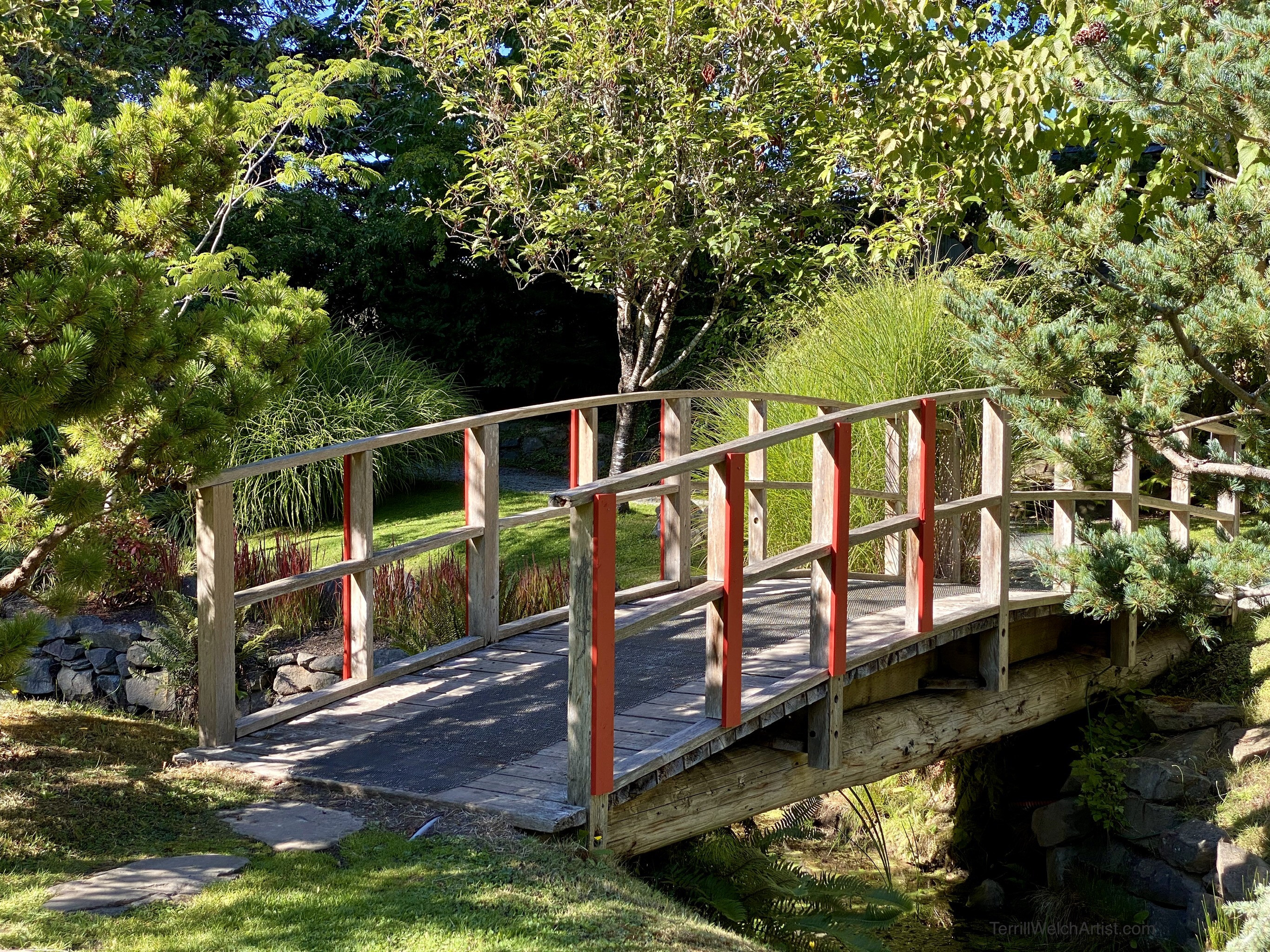
The bridge is looking more elegant than usual with its orange red boards. I smile to myself remembering bringing students to plein air paint in the garden. This bridge lovingly was referred to as “the dreaded bridge”. 


The bridge can be seen from almost anywhere in the circular walk around the garden.


It is a popular prop for photographing family and friends. 


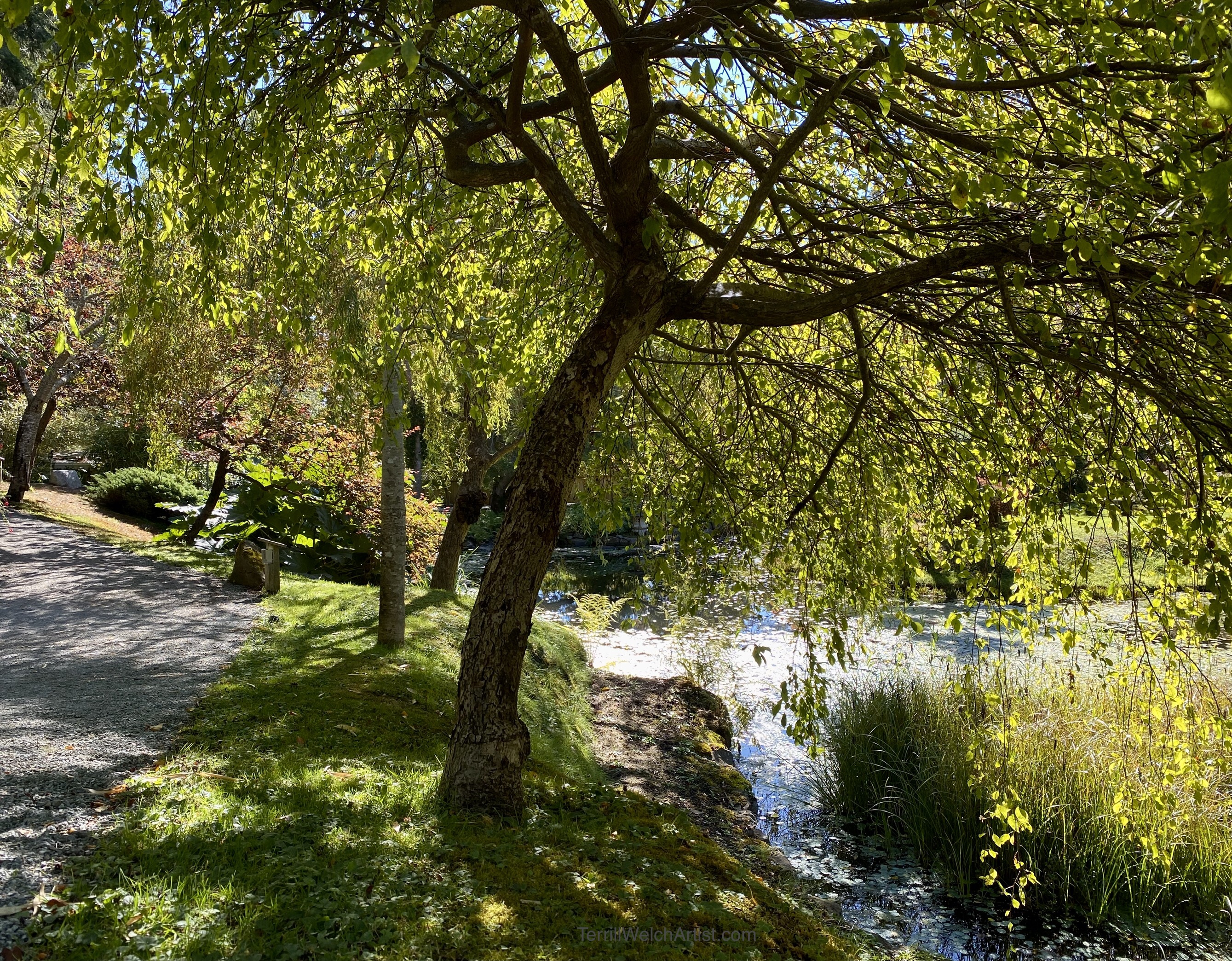
The Japanese maples are starting to turn red.


Samaras prepare to twirl off in a gust of wind. 


I find myself sitting in the ground beside the path even though there are many comfortable benches tucked into the garden. 


I am sitting next to the new bamboo shishi odoshi that translates as “deer frightening” in English. Thankful all the deer are fences out of this beautiful garden. 


I head home to prepare supper. Before I feel ready, the day is over. The sun is setting through the trees and creating magical light across the room. 


The time on my phone says that it is just seven in the evening. I am not ready yet for the fast shortening of the days in our northern hemisphere. I want to savour the last of our late summer’s warmth, even if it is shaking hands with early autumn before its annual departure. 

Meanwhile, Russia has announced a partial mobilization. First it was for 300 reservists. Now I hear possibly one million. Nuclear weapons are mentioned. Is it a bluff? Likely they say while failing to pause before insisting that we should take this threat seriously and prepare. How does one prepare for a Nuclear war? Is an animal really cornered if they very carefully constructed the corner themselves? The analogy doesn’t seem to work somehow. I listen to the UN security talks. I check with trusted YouTube analysts for updates about changes in the Ukrainian frontline. What shall I prepare in the face of possible war? A prayer for peace? A dedicated meditation on love? Possibly. I will go to garden for a powerful potion of fresh peppermint for my tea. I will watch the bright green leaves swirl in the hot water of my favourite mung and I shall breathe. I shall breathe slowly, purposefully and with an open heart, cradled in strength and a unrelenting force. 

Such are these days of this early autumn here on the southwest coast of Canada. 

What is it like this time of year in your  neighbourhood? 

ONLINE GALLERIES include –

ArtWork Archive original paintings and acrylic sketches currently available

Redbubble painting and photography prints and merchandise

Website: TerrillWelchArtist.com 

Warm Sun with Cool Shadows

I have my sweater tide around my waist and my cheeks are facing the later morning sun. But there is no mistaking that it is fall. A cool breeze drifts gently through the trees and tickles up the length of my spine.

*Please note: Reader warning about challenging material and painting reference sketch for possibly my next large painting are included near the end of this post.  

I want to not much of anything on days like this. It is a good thing I got the edges on four large paintings done yesterday before heading down to sit beside the sea. 

Autumn crocuses are in full bloom. I always feel like they are playing a great hoax on us, as if wanting us to believe it is spring. 

But it was Saint John Point where I wandered yesterday. This place is intimately familiar. Yet, if I learn into that closeness and seek out something more, it always delivers. 

Again…

And again…

The Arbutus woods, the sea and the sky are never the same twice. So I keep seeking with fresh eyes and a willing spirit. 

Every twist is assessed and acknowledged, sometimes with sadness because the end of a life is so near. Maybe one more season. Hopefully. 

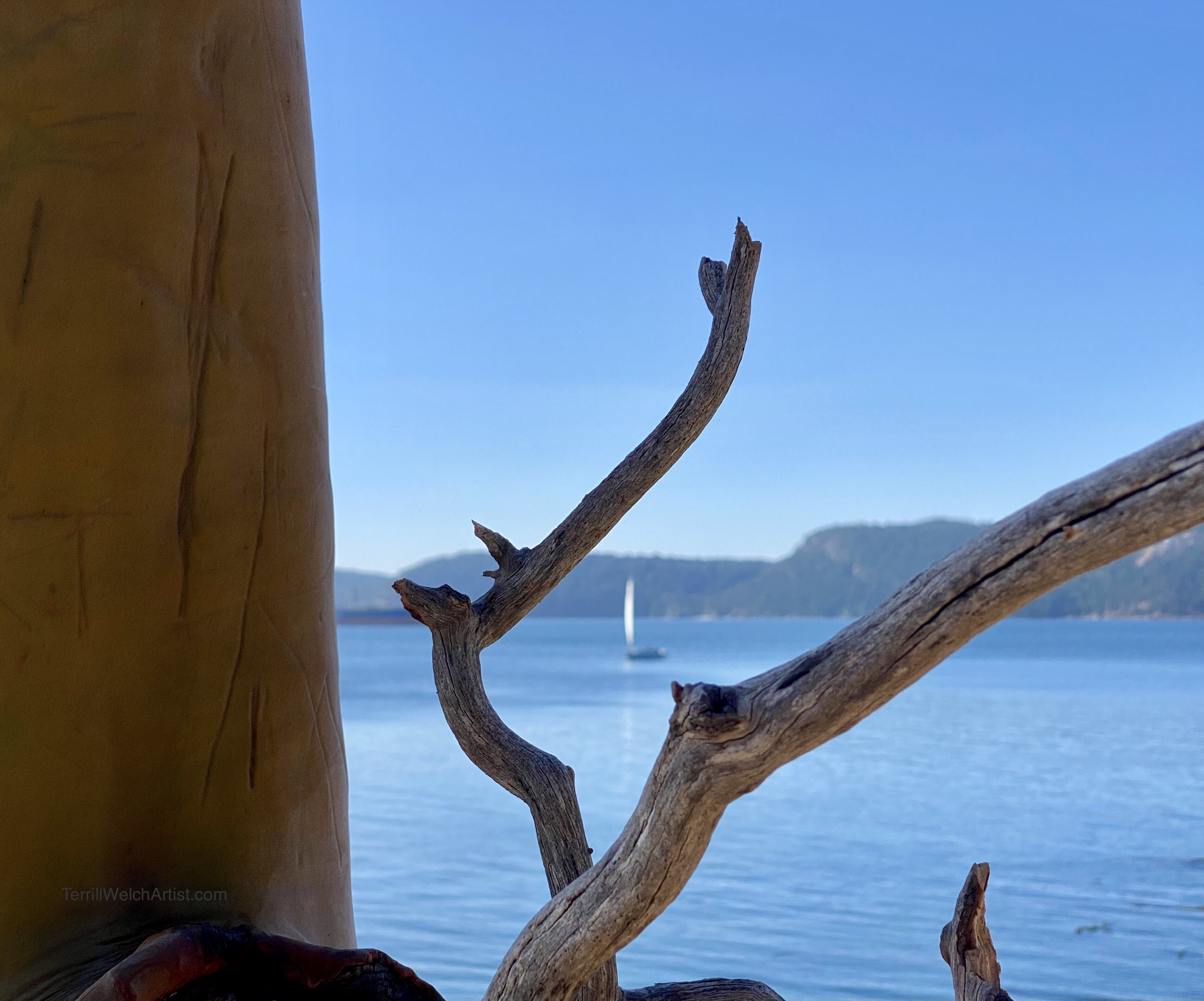
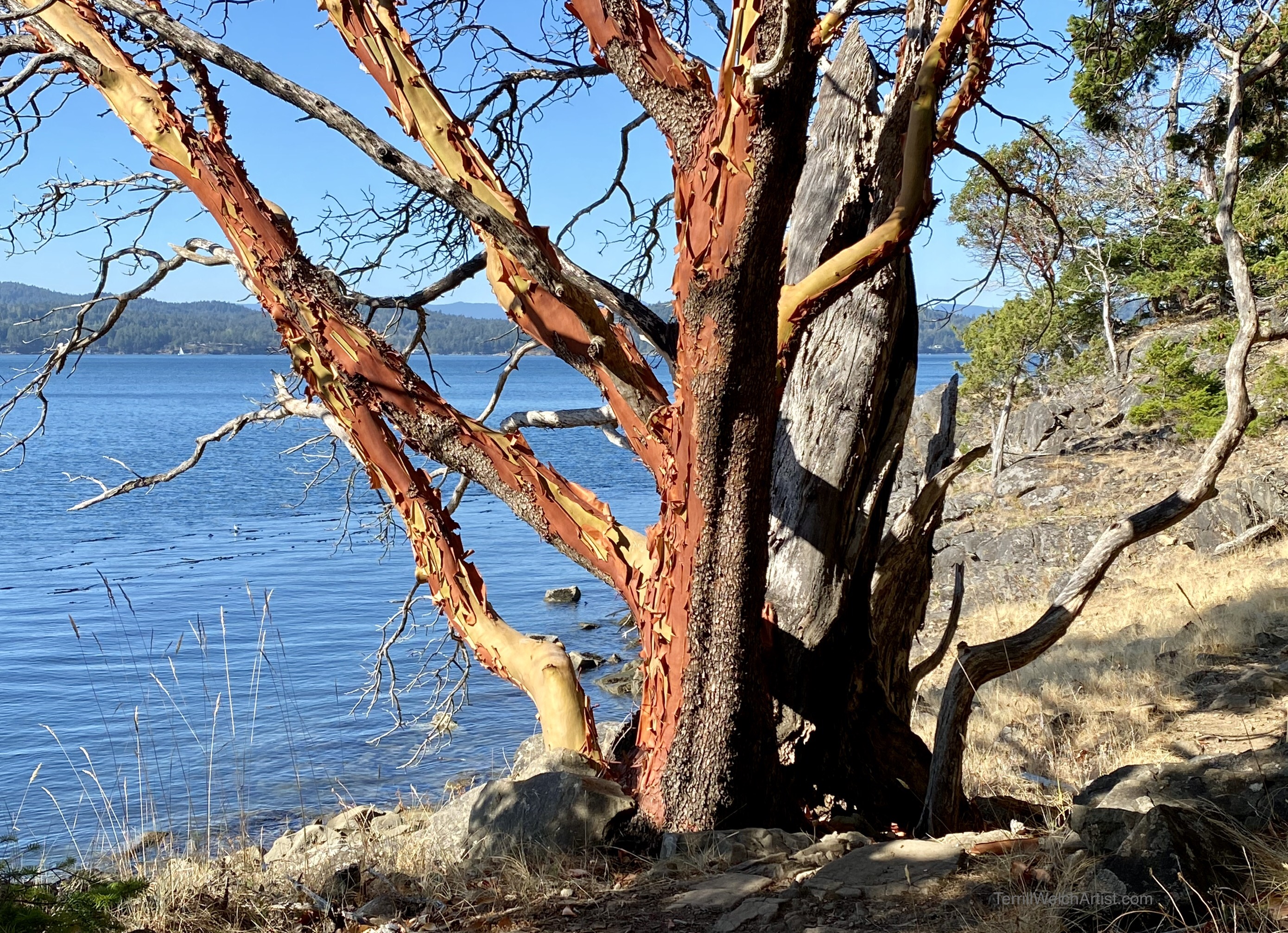
However, even in death Arbutus Trees seem to still have so much to offer with their elegant curves. 

I revel in the grand strength and endurance of the healthy giants. How do they do it when so many others are struggling?

At home the painting edges dry.

These three paintings have displaced us from our great room and dining table.

Not to worry, we have done this a few hundred times before. We have a temporary cozy and beautiful solution. The outside deck table is moved to the big windows in our bedroom. Now how fine is this!?

And in the evening if dinner is later, we slide everything over in front of the fireplace. One could hardly call this roughing it.

Today and tomorrow the Gallery Pod is closed. I have a friend and an art collector arriving for a day trip tomorrow though. I could start on a larger painting but I might wait. What I want to work on is dark and grim. I have a small study I did around five months ago about our tranquil place next to the Salish Sea with the devastation left behind by the Russians in the small village of Bucha village in Ukraine imposed in the foreground.

“One World, Two Places” by Terrill Welch is a small 8 x 10 inch acrylic sketch 

Artist notes: During mid April 2022 war photographers began releasing images of Bucha Ukraine following Russian retreat. The inhumane atrocities where nightmarishly haunting. I was overwhelmed by the graphic possibilities for sickly human behaviour. I went from our calm, warm, cozy home to the shores of the Salish Sea on the southwest coast of Canada where Mount Baker loomed across the waters in the United States. What if our neighbouring unit were to attack us in this way? What would we do? These lands too have witnessed atrocities by European settlers towards Indigenous communities. There is no place of virtue for how despicable humans can be to one another. The miracle might be that we have even moments of peace, compassion and caring at all. Yet, the seascape of my island home is tranquil and takes the edge off of my inner turmoil. I return home and paint “One World, Two Places” using several reference but with a specific image quote to Den Kazansky who risks his physical, mental, emotional and spiritual well-being to document the crimes in Bucha and the war in Ukraine. Kazansky’s tag line on Twitter is “For only in the grip of darkness we will shine amidst the brightest stars” This too could be the title of this painting sketch.


The subject deserves a large canvas. I am just not sure I have the stomach and the courage to paint it. I have a biting, teeth grinding and nightmare kind of concern for those civilians who are on the front lines of the war in Ukraine. I can hike the trails to take the edge off but this doesn’t change the situation. Somehow painting these experiences offers a concrete place outside of my head to record these horrors that contrast so starkly with our daily island life here on the Southwest Coast of Canada.

For now, I am going to make my coffee and see what I decide after that.

ONLINE GALLERIES include –

ArtWork Archive original paintings and acrylic sketches currently available

Redbubble painting and photography prints and merchandise

Website: TerrillWelchArtist.com 

Weaving Together A Weekend Through to Monday

After collecting our basket from the Farmers Market yesterday and spending most of the day putting up the harvest for winter while guests self browsed in person and online, today with the Gallery Pod open from 11-4, I am smiling. 

I am smiling AND painting edges. I would say this is almost a miracle. 😉

I think it is the second batch of oven roasted eggplant, tomatoes and peppers with herbs in olive oil.

Or maybe it is the third batch of rustic basil pesto?

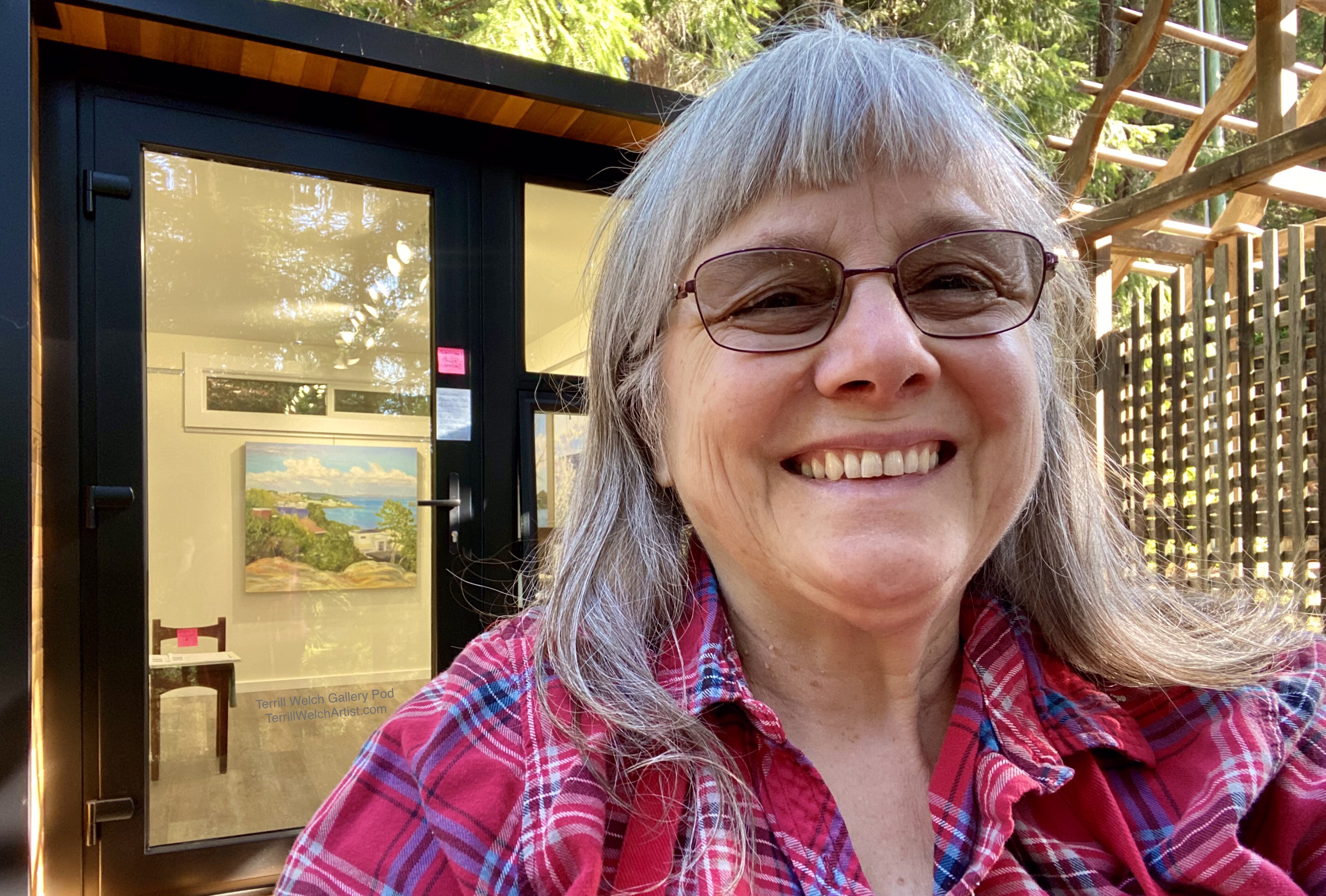
But it is likely the labeled serving sizes in the freezer that is doing it. This and the fall air. Either way, you are most welcome to come self browse in the Terrill Welch Gallery Pod and stop in and see the new show in ISLAND TIME ART both today and tomorrow. I shall be around between painting edges and strolling in the early autumn sun. Plus, there are fresh flowers in the Gallery Pod to welcome you.

If you are only able to visit and browse online this works well too.

Terrill Welch Gallery Pod Private Viewing Room is available HERE.

ISLAND TIME ART “Late Summer Gold” group show can be viewed in a collection HERE

ONLINE GALLERIES include –

ArtWork Archive original paintings and acrylic sketches currently available

Redbubble painting and photography prints and merchandise

Website: TerrillWelchArtist.com 

Breaking Blue and Gold

Starting with Monday, this has been a week of deep connection with nature, family and friends. Nature is at my doorstep. A friend made the trip to the island for a visit and my family has been connecting via telephone across many km from a different part of the province. There is a fragile, yet unrelenting, firmness that whisks itself across the carpet of our pending autumn.

Seagulls gather in rows on the reefs.

Hearing about the death of Queen Elisabeth II at 96 years old and a 70 year reign is a good reminder for me that mortality eventually has its way with us all. This confirmation, and a northwest wind facing down a clear sunny day, slices through any illusions I may have had. Without a doubt, summer has slipped on a sweater on over her light cotton dress and Canada, as part of the commonwealth, has a new King. King Charles III who is already a sprightly 73 years old. Just like that it seems, we have turned a page in time.

However, if we look closely enough, we will notice that endings and beginnings are woven together and when done well, the broken threads pass beside each other twisting to become stronger than just one thread by itself. It could be as simple as where the sea and the shore meet.

Or, in a grander flourish, we might catch the sea, mountains and sky cresting across the horizon.

The seagulls are still conferencing on the sandstone with hardly a ruffled feather.

The next day they have moved on. But the northwesterly wind has stayed.

I try to find a place to paint but I am chilled and shivering just getting references. Unlike our intuitive summer, I have left my warm sweater at home.

After a third attempt along our Mayne Island shores, I tuck up close to the brickworks dock during the morning low tide.

I lean into the crumbly structure and make a wish. Not a wish for something. Just a wish to be present. A wish to hold the space of today. In a wonky out-of-sorts-kind-of-way, everything seems to be as it should.

I’ll take it! That long breath in and then out and in again. In nature, connecting with family and friends. This is it. All that gives us a chance in life.

Low Tide at the Brickworks Dock by Terrill Welch, 10 x 8 inch acrylic on gessobord plein air.

Artist notes: An early September northwest wind was cool even in the late summer sun. I tucked up next to the brickworks dock for shelter and then started admiring its weathered features.

And so it has been for this first week of September. How about you? How has your week been?

ONLINE GALLERIES include –

ArtWork Archive original paintings and acrylic sketches currently available

Redbubble painting and photography prints and merchandise

Website: TerrillWelchArtist.com