We didn’t know what to expect in Narbonne France as we knew very little about the city. We knew it had been a port before the river changed course and silt made it an inland city. We knew it was a medieval city at its heart and that there were ancient Roman ruins and a University. This was about it.
We climbed or rather crawled up the spiral stairs hefting the largest of our suitcases which I am sure has crept over its 50 pound airline limit (it is a good thing it separates into two parts for the return trip). The spiraling white piece in the middle is the hand-railing.

I wonder about what we will discover during three-day visit. We are on the third floor of a sweet small apartment. The bathroom with its small blue tiles is separated by a white cotton curtain from the rest of the low-ceiling one room dwelling. A short kitchenette runs along part of one wall with its stoic folding table wedged into the remaining space between the bathroom and the old wooden door. The real bonus is two good-sized windows that open wide and look out onto the piazza. This and the warm ochre carpet splashed between milk-white walls combine to make for a most pleasing short-term residence.
We cautiously proceed back down the stairs to get groceries for morning. Then exhausted, eat the rest of the day’s lunch and call it an early evening.
At about 4:00 am the day is beginning in our little square in Narbonne. The Patisserie is opening up to set out its outdoor table and chairs directly out front and also in a corner of the square. The rolling up of metal storefront blinds and the rhythmic movement of a hand-trolley pulled by the storekeeper lull me back to sleep.
By seven in the morning it is raining – hard.
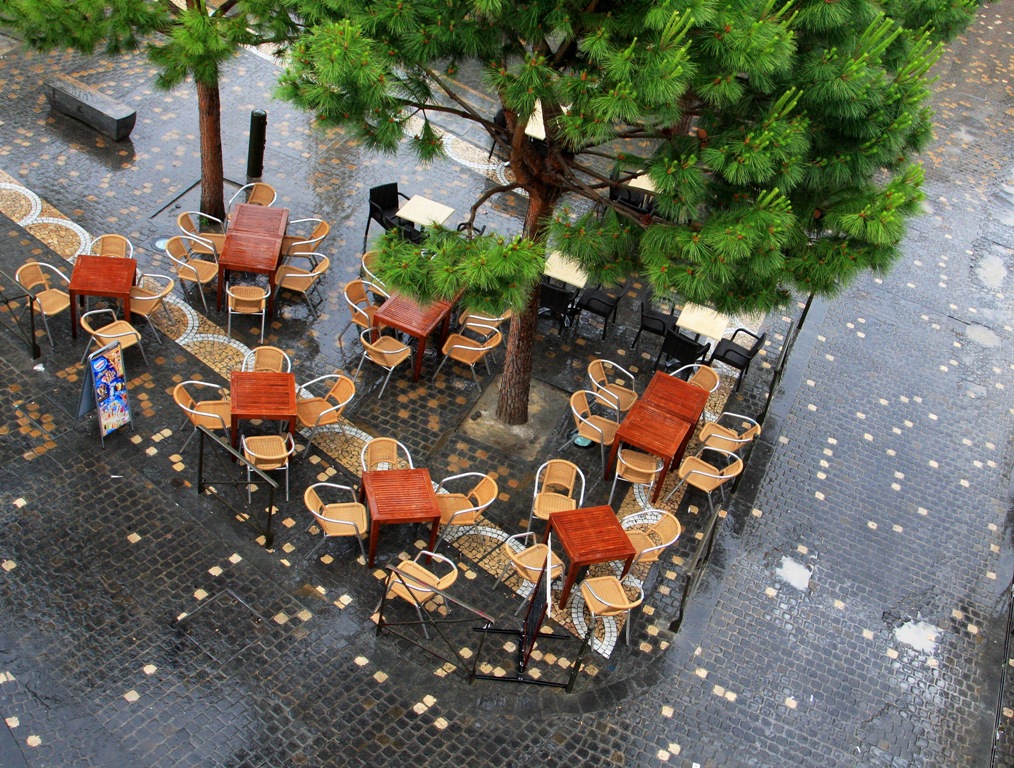
I feel bad for the Patisserie as his early morning start has been a wash. Only a few students brave the wet and huddle in the doorway waiting for a break in the downpour.

I decide to go exploring but David being of the cat temperament decides to wait for drier weather. The streets are empty.
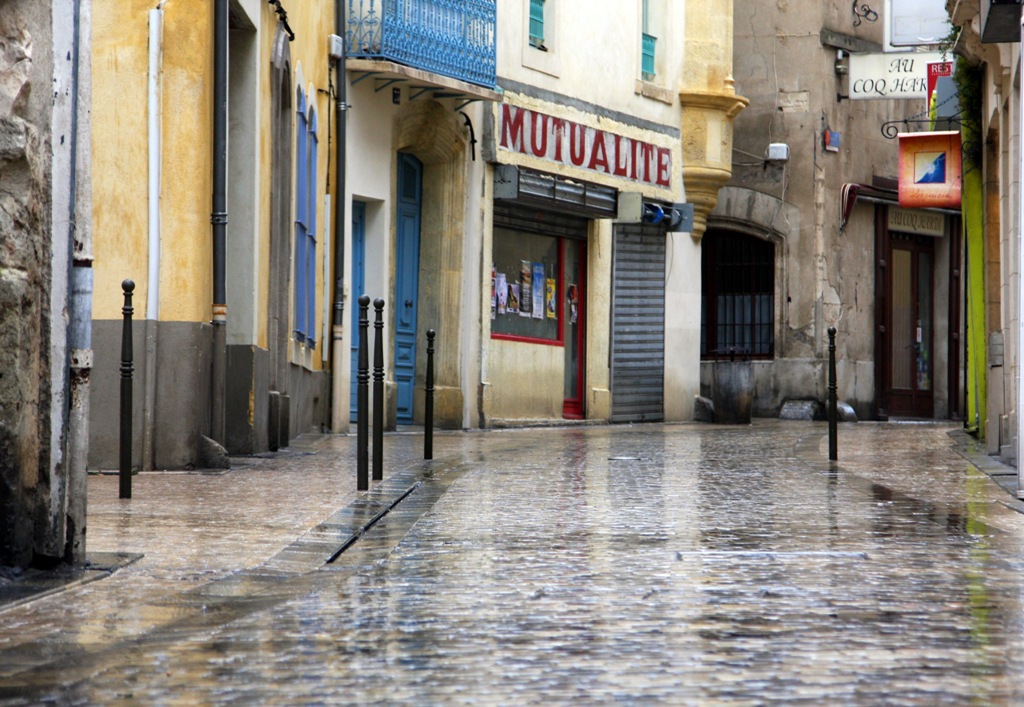
The late 12th century Cathedral Saint-Just et Saint-Pasteur with its flying buttresses is near so I decide to start there.
The inside is a no-photograph zone but it is so dark one almost needs a flashlight to see the aisle let alone anything on the walls. However, the courtyard is beautiful

and the roses along one of the walkways to enter the inner sanctum are not in the least put out by the rain.

Walking along the corridors of the courtyard it is easy to have hundreds of years slip away and find oneself in another time, one where meditative prayer and silence are common maybe.
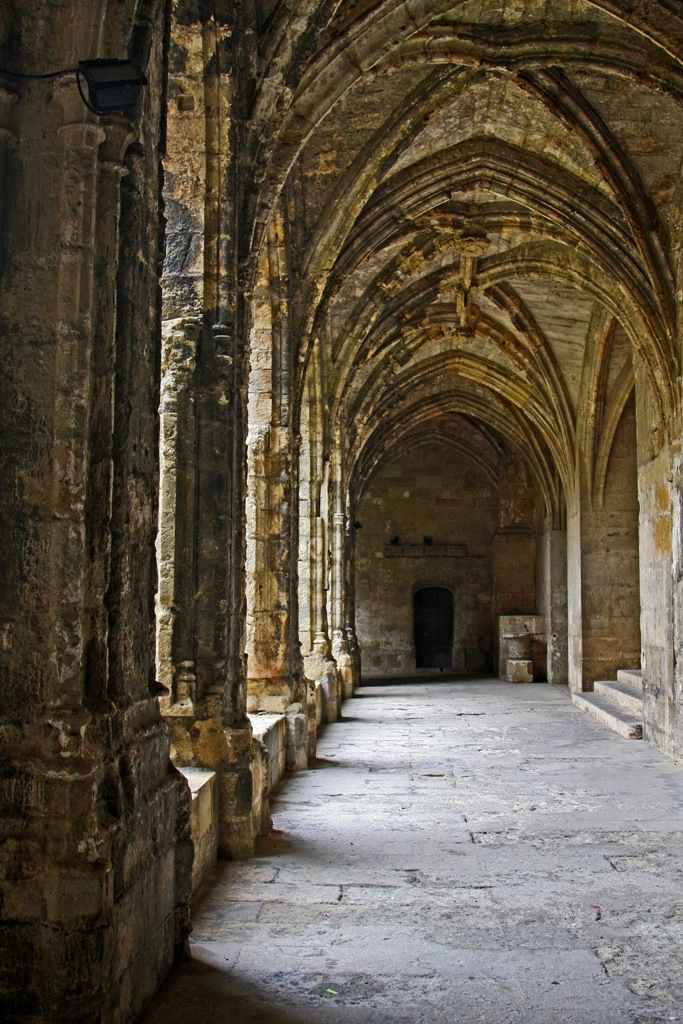
I like to look up in places like this. It is like something remembered but just out of reach of conscious articulation. Do ever get that feeling when you go new places?

Having found a most appropriate frame of reference for my visit in Narbonne I head out the side exit and across the narrow street into the wet marble courtyard leading to the Narbonne Museum of Art and History. A staff person tiptoed very carefully across the glistening surface. I took to the approach to heart and followed in the same manner.

There is a sad-looking angel on a pottery bowl at the top of the stairs

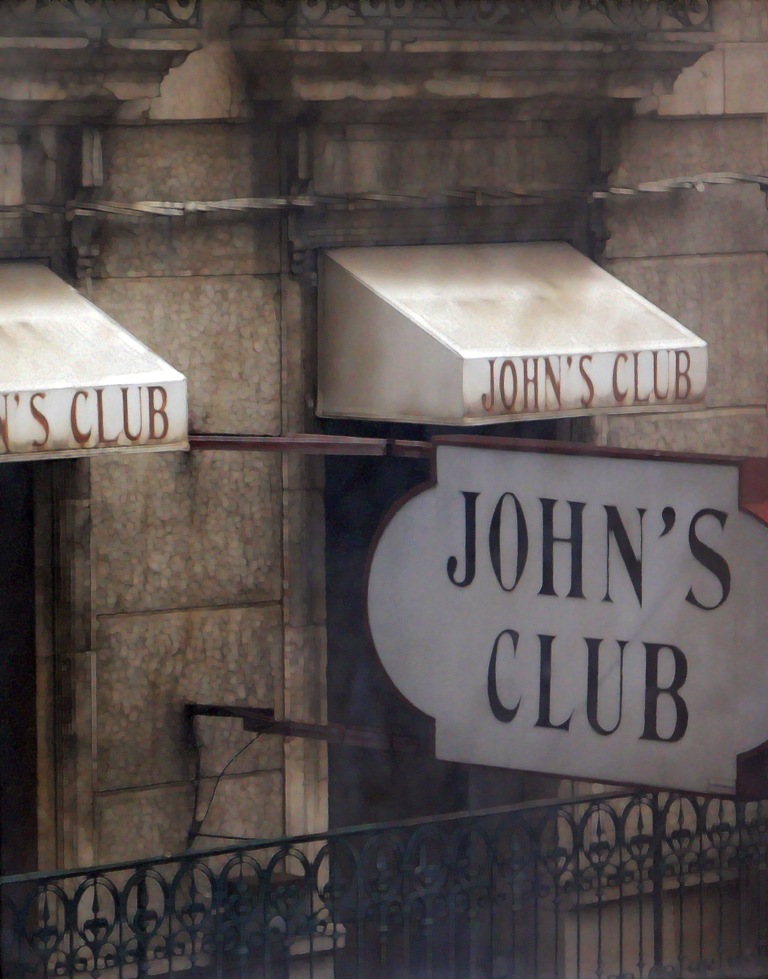
and I wonder what is John’s Club that can be seen out of the tall stairway windows that rattle loudly in wind from the storm outside.
The museum offered a pass for seven sites for nine Euros or it was four Euros for just the Art Museum. On a whim I purchased the pass to the seven sites and succeeded in setting the course of discovery for our time in Narbonne.
After a lengthy exploration of the excellent permanent and special exhibition including several rooms of 17 – 18 century dishes, including some in a most stunning pale green dinning room, I am ready to see if David wants to come back again for the afternoon and so he could get his seven site pass as well of course. There were many great works to see but there was one that I knew he would love as much as me. It isn’t a large painting but rather about a middle size at 55 x 68 cm. The work is by an Italian painter Gaspare Traversi (1732-1769) and is called Mendiant accroupi or A Beggar…

It is the emotion and compositional strength of this image as well as pure skill in foreshortening that had me coming back to this painting several times. Every centimeter of this canvas is in full use and allows you no room to shrink from the image. The beggar has seen us. We must respond in some way and whatever that way is he and the world will know. It is our human condition we are facing in this painting. This image, courtesy of the Narbonne art museum and published in La Tribune de l’Art does not really fully speak to the power of this piece of course. But it was the only image I could find to share with you. Other than that – off to Narbonne and the art museum with you!
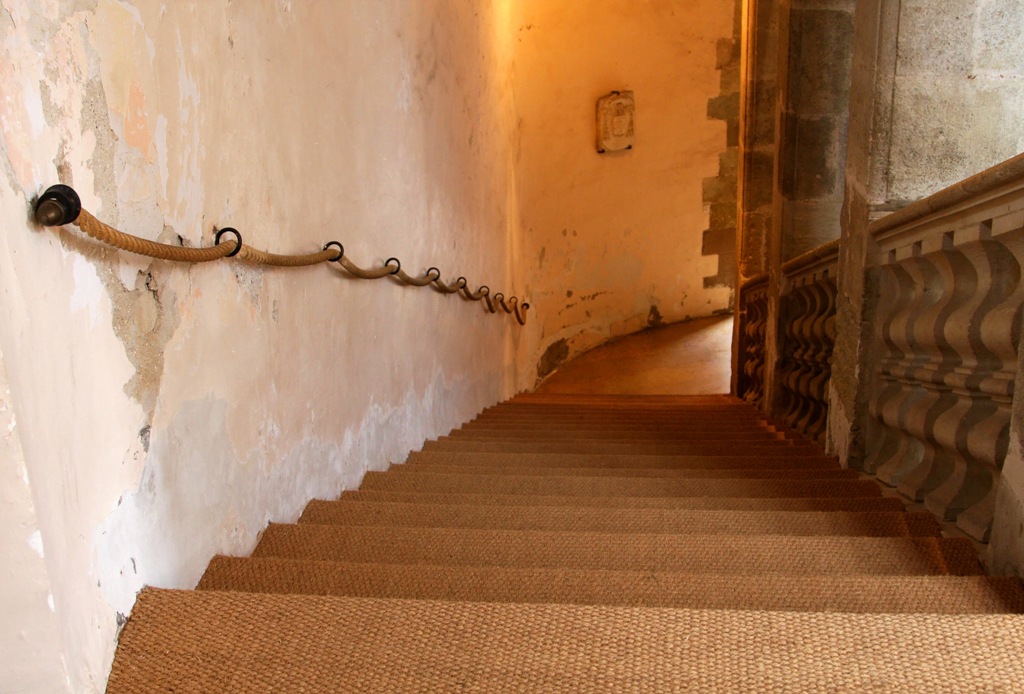
The weather is breaking and there is a warm glow in the jute carpeted stairway as I descend.
I wonder what the ruins will be like? Well, that is the next post and we shall get to see at least some of them because one of the sites allows photographs!
If it was a rainy day and you could be in any museum in the world, what painting would you want to be standing in front of with your inquiring gaze?
© 2014 Terrill Welch, All rights reserved.
Liberal usage granted with written permission. See “About” for details.
Creative Potager – Visit with painter and photographer Terrill Welch
From Mayne Island, British Columbia, Canada
For gallery and purchase information about Terrill’s photographs and paintings go to http://terrillwelchartist.com
 Creative Potager