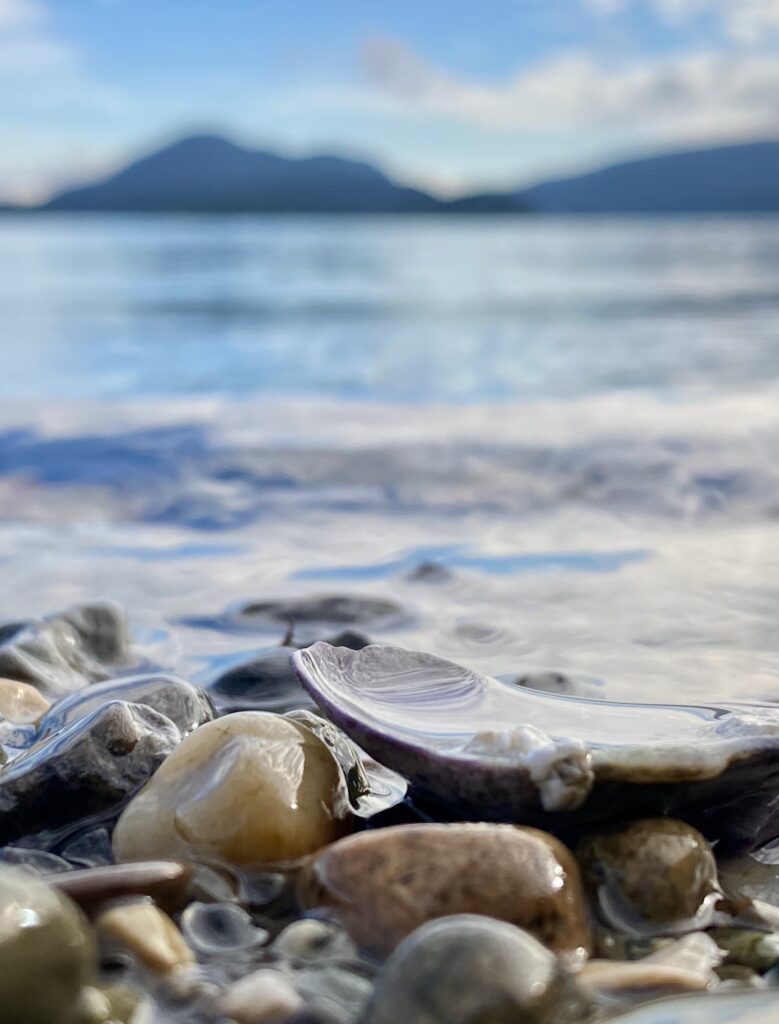
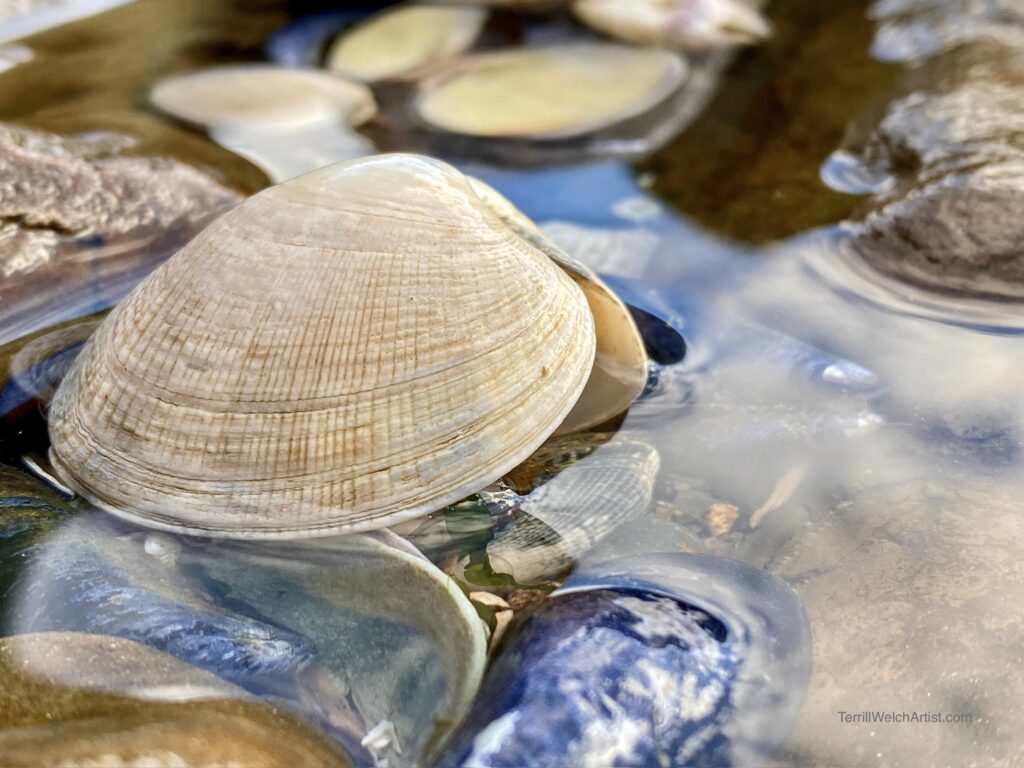
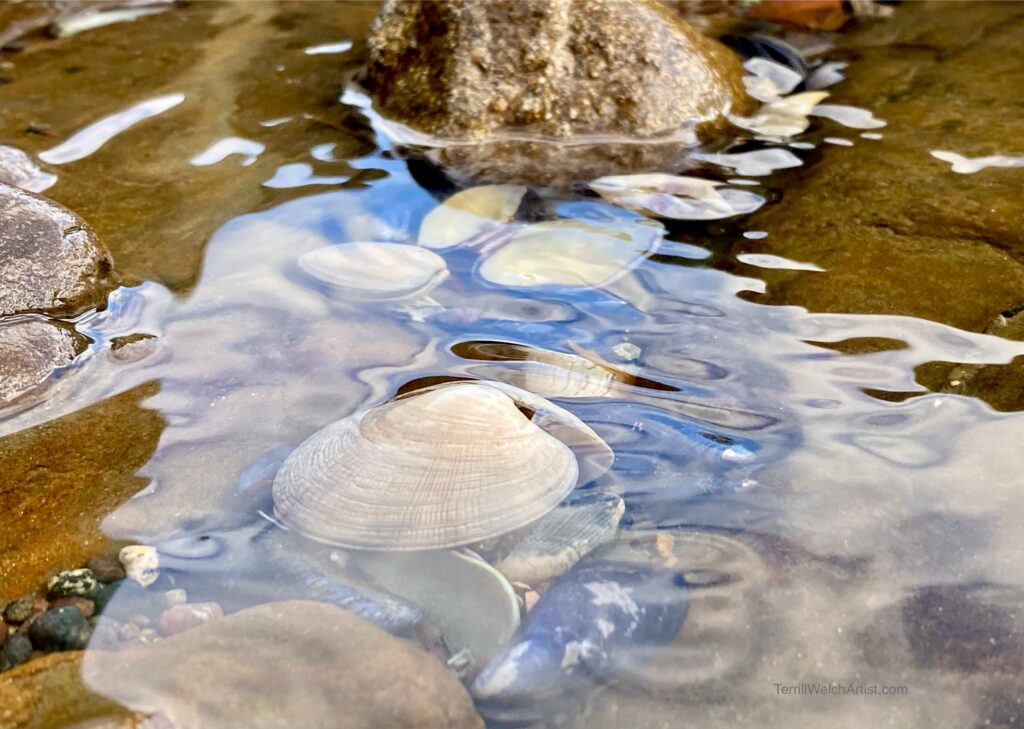
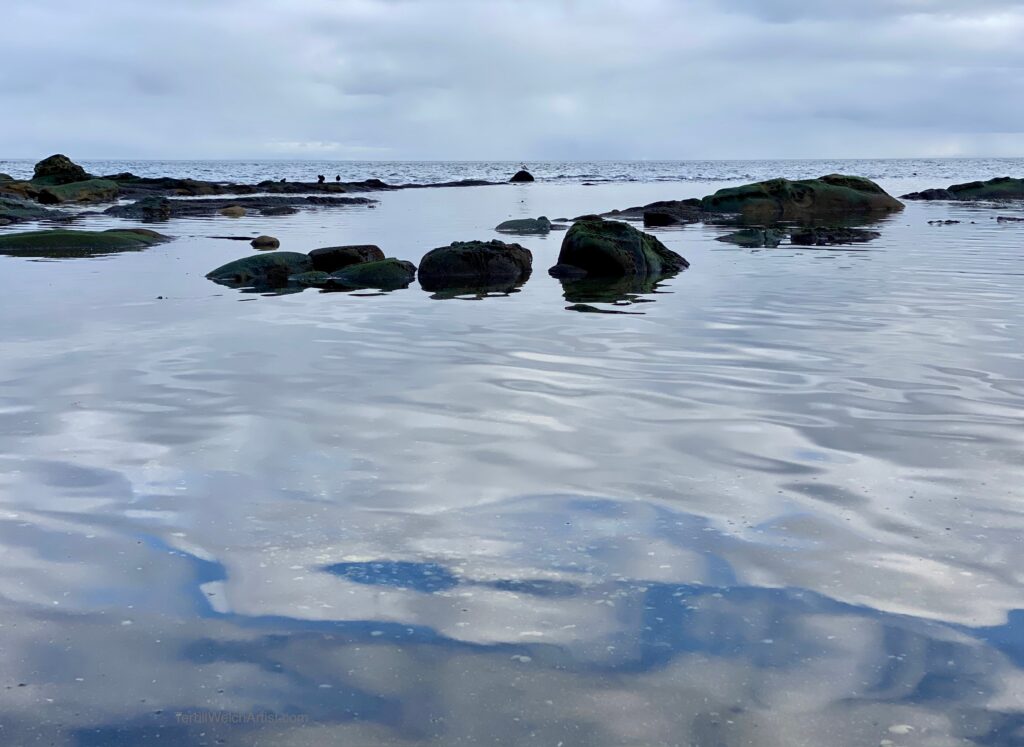
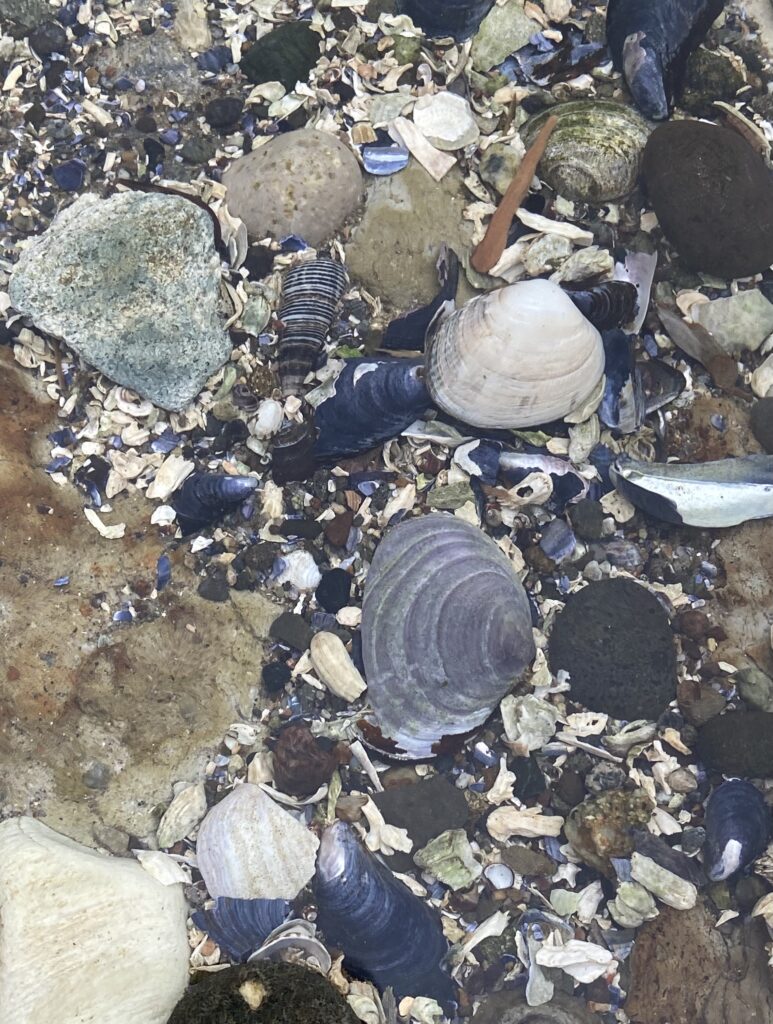
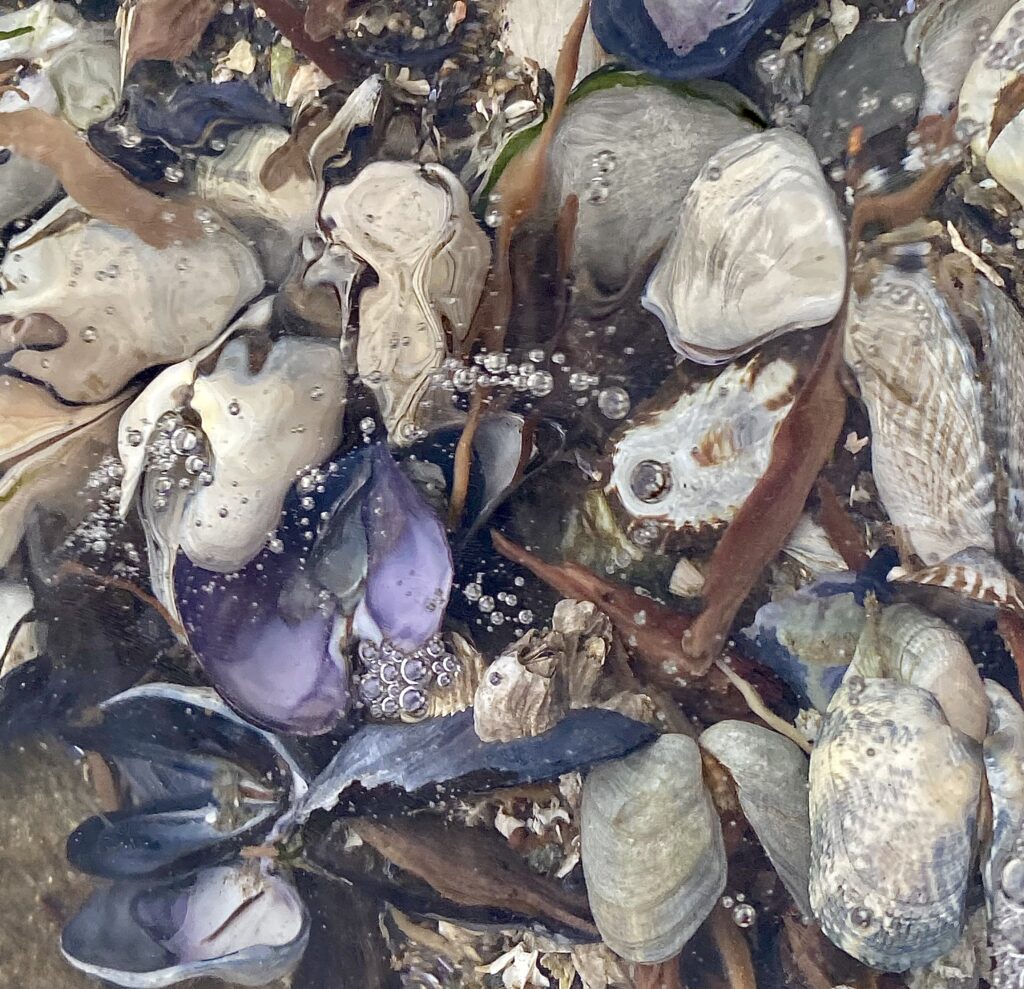
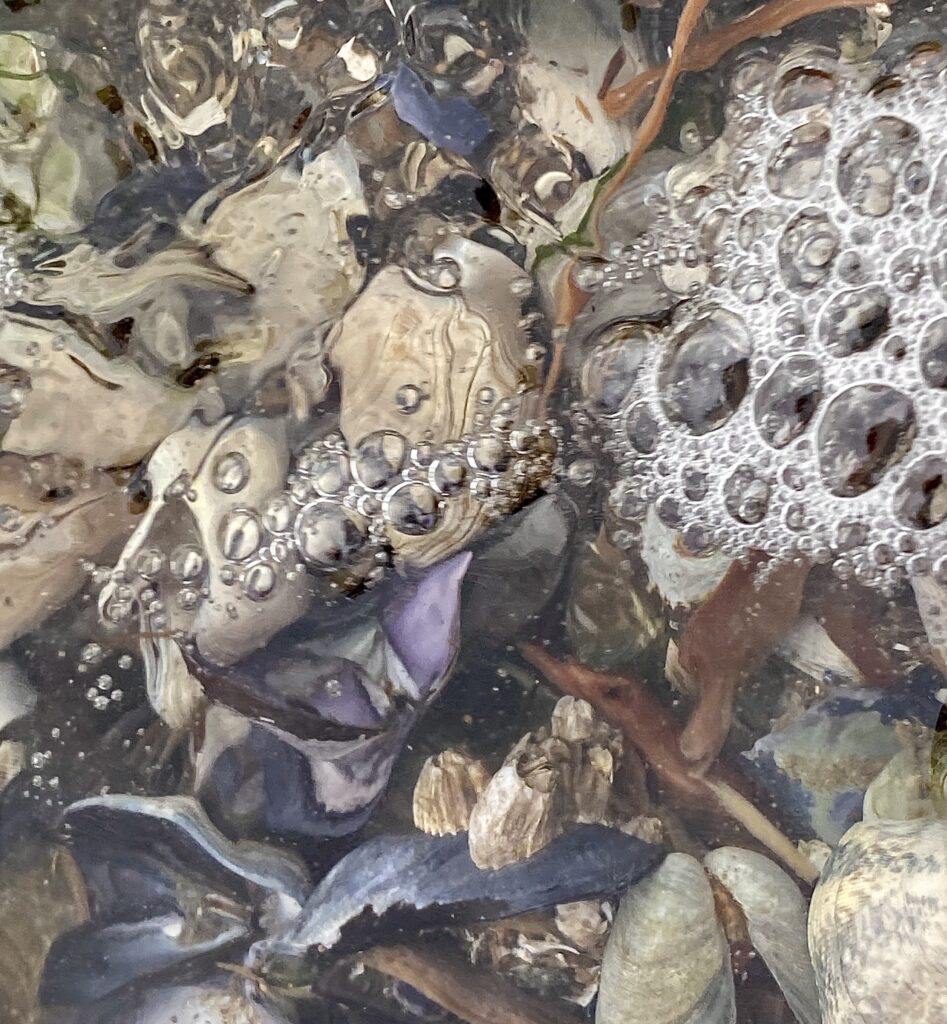
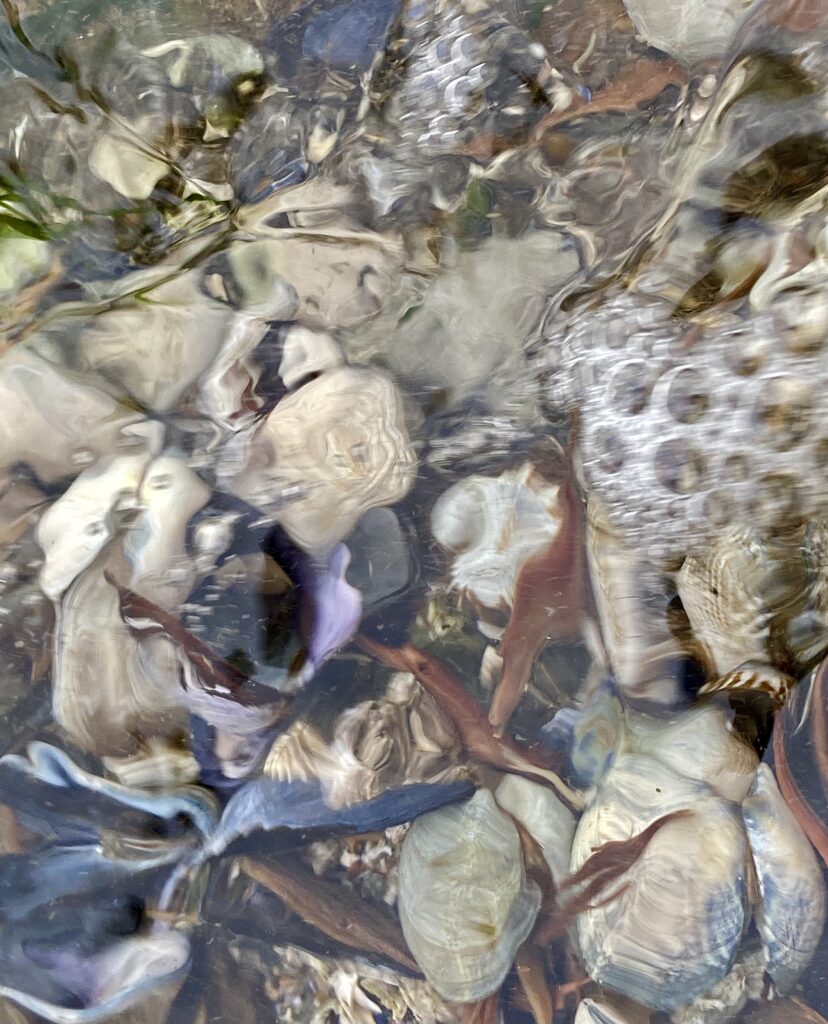
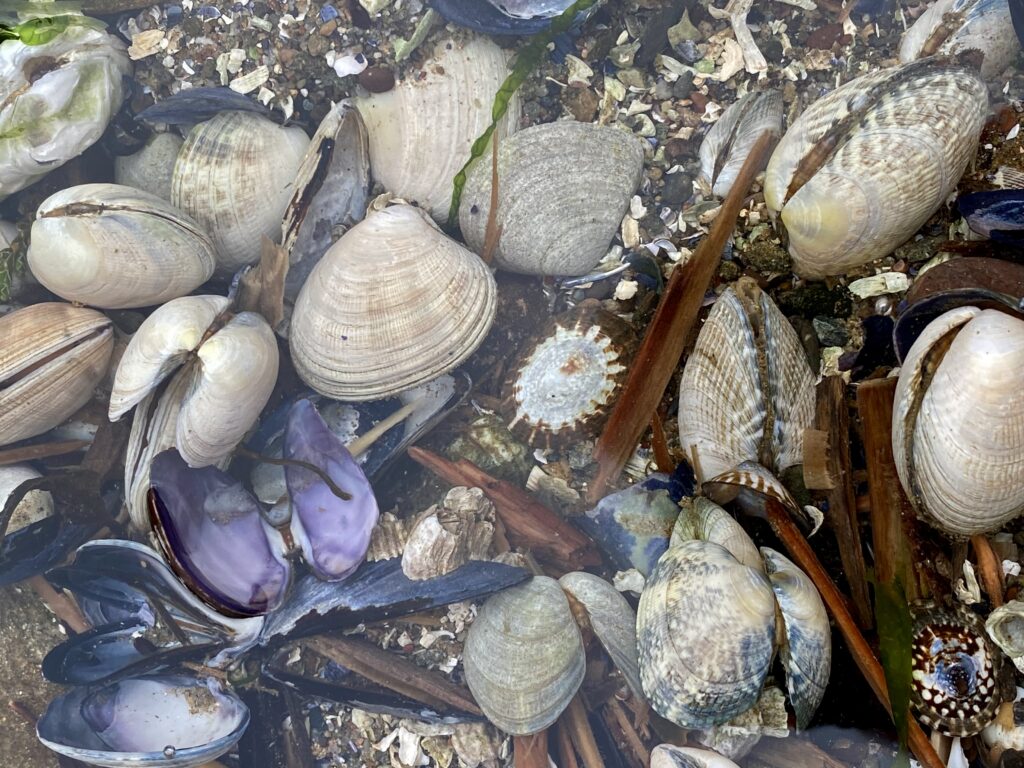
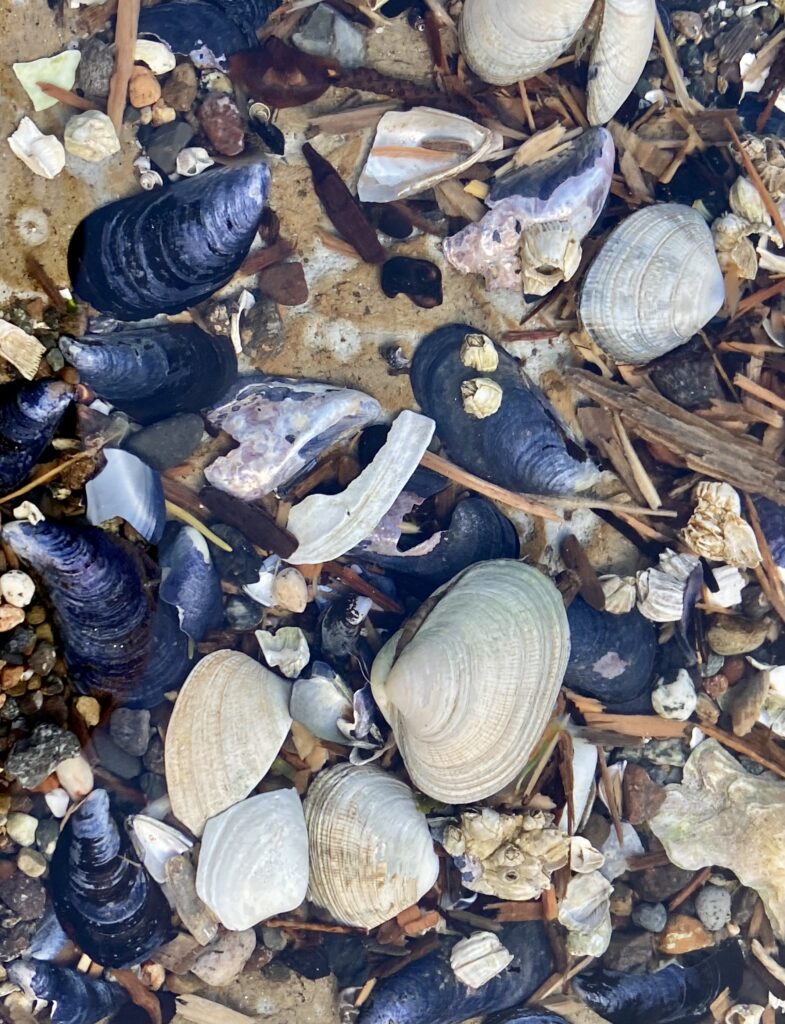
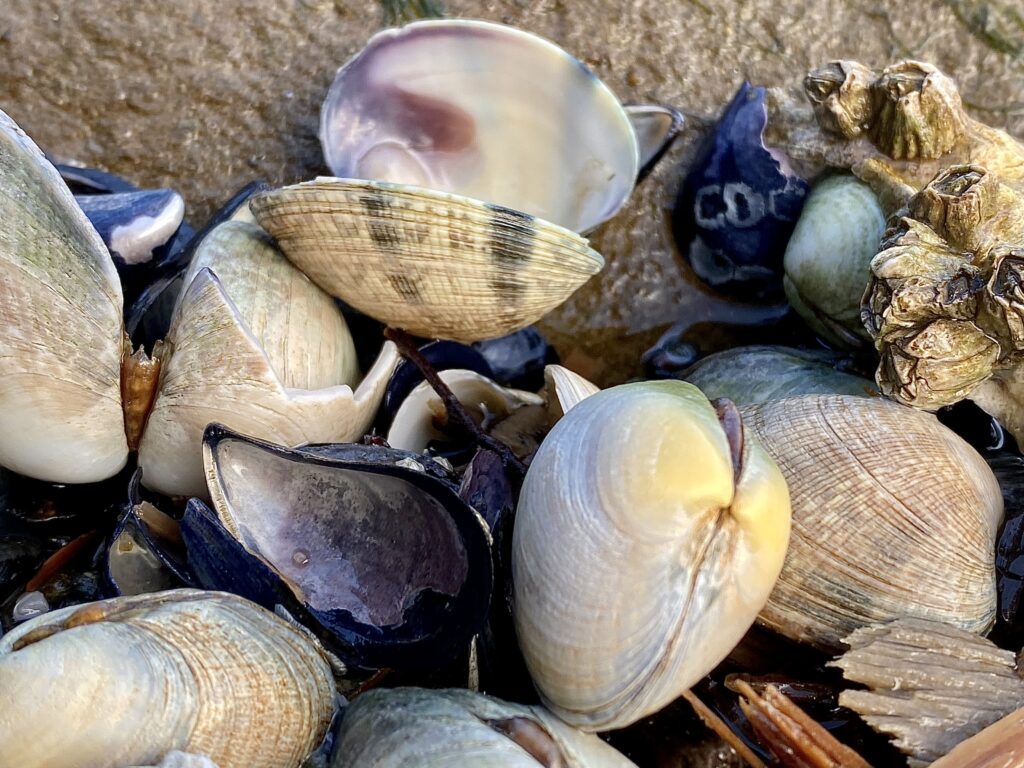
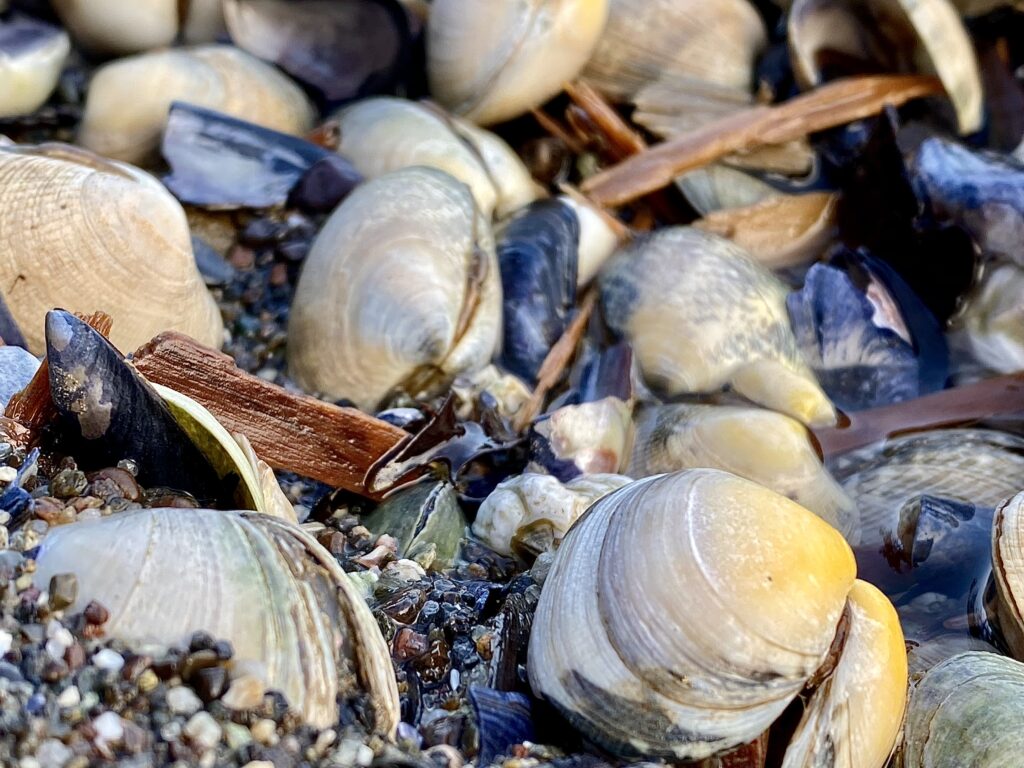
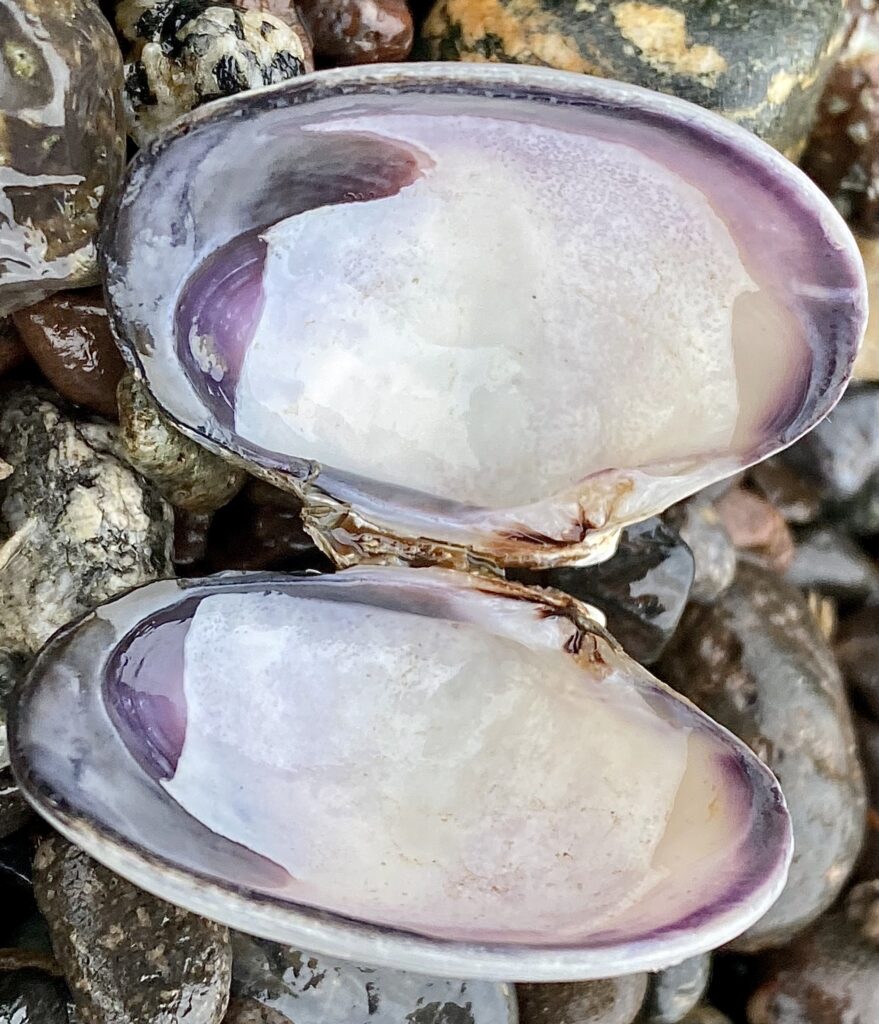
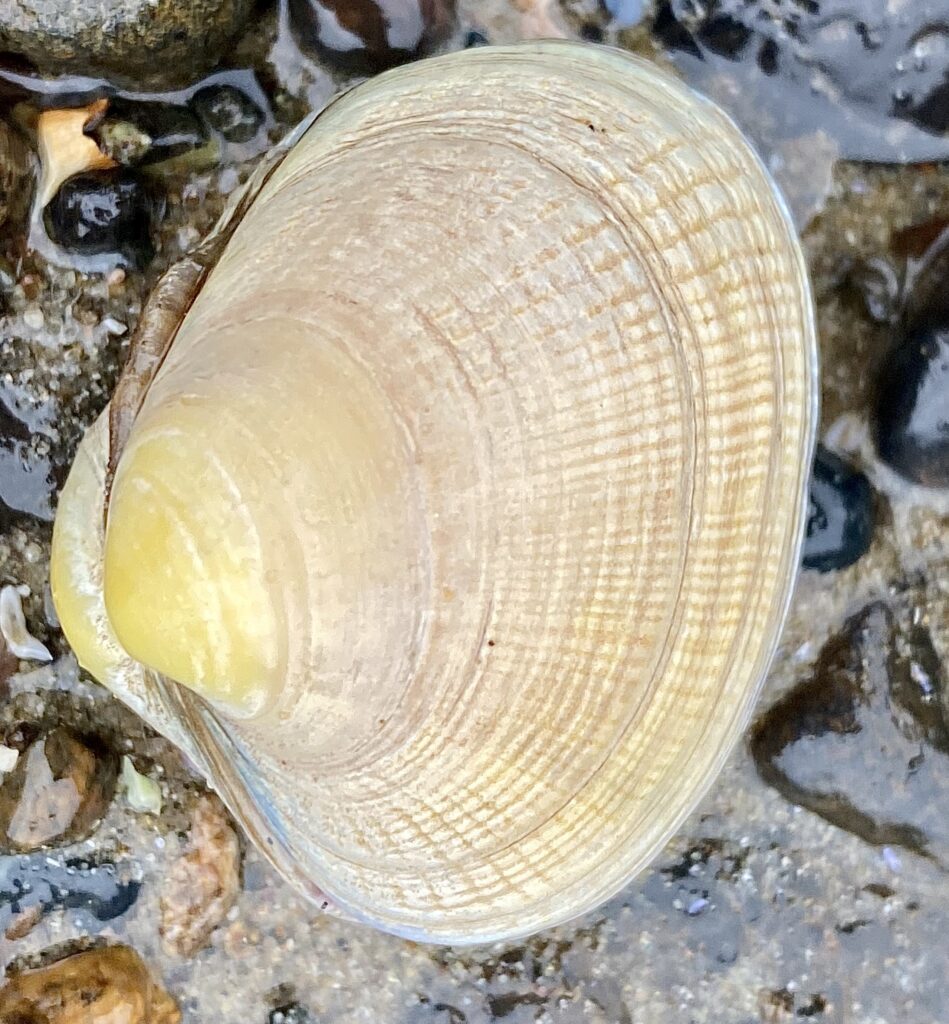
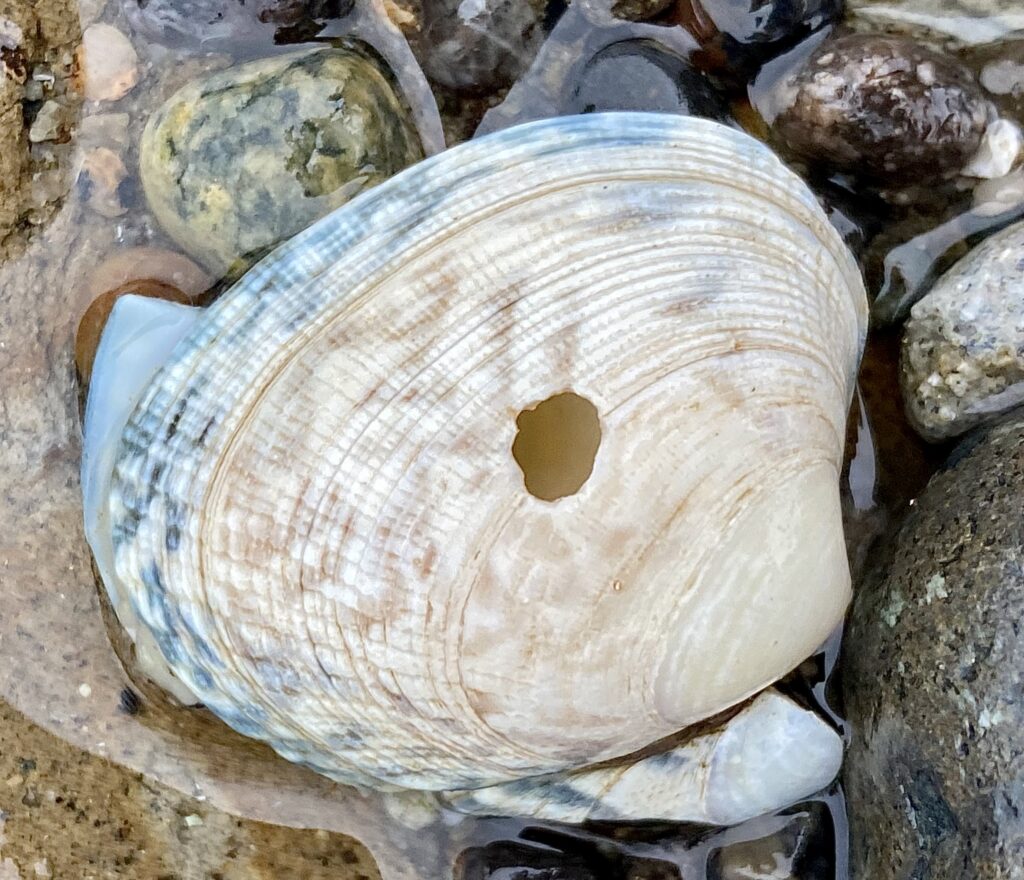
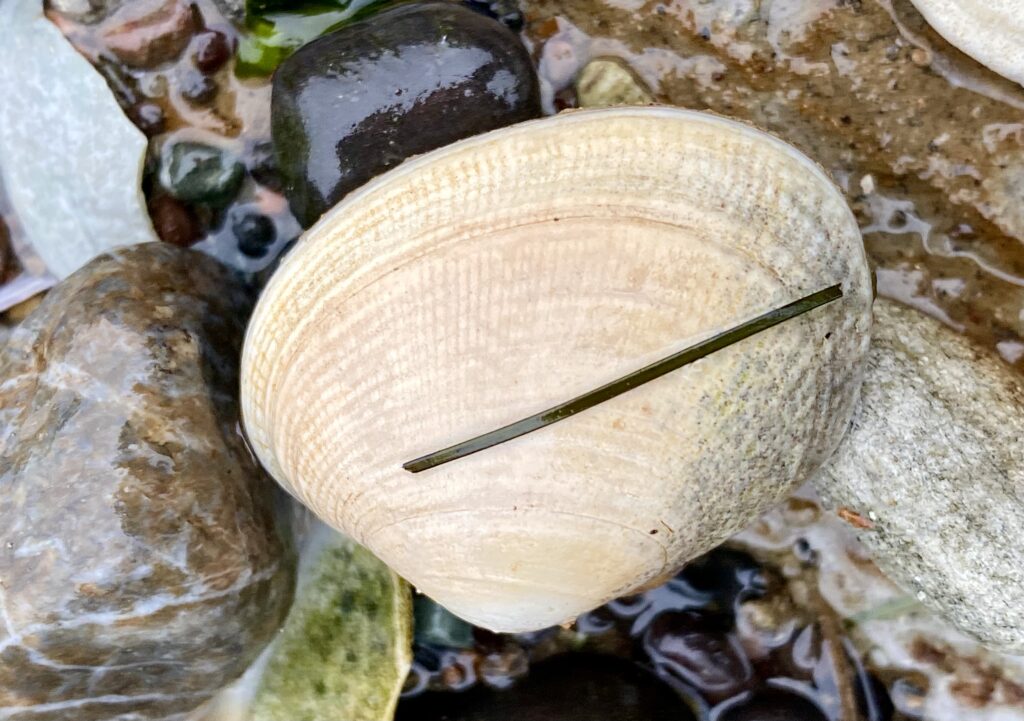
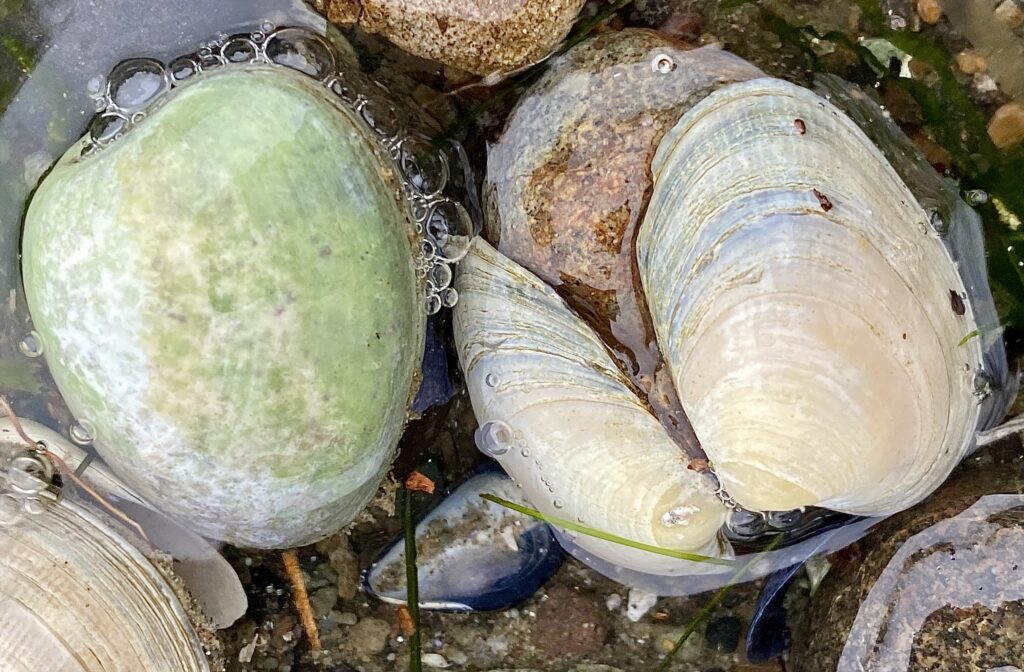
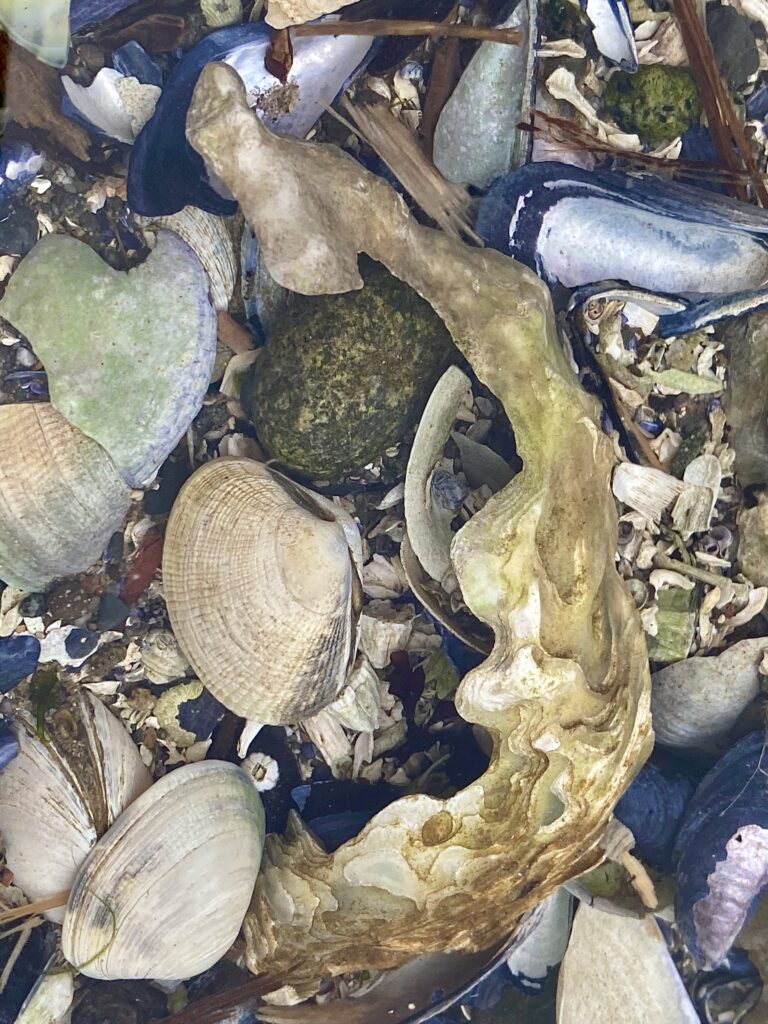
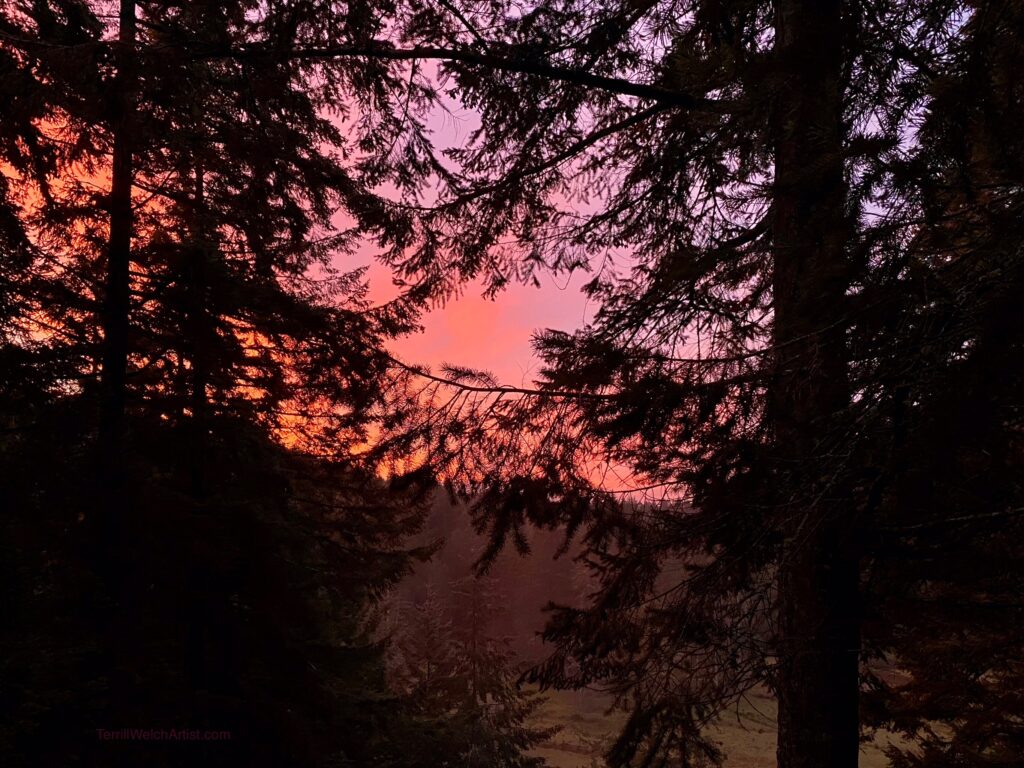
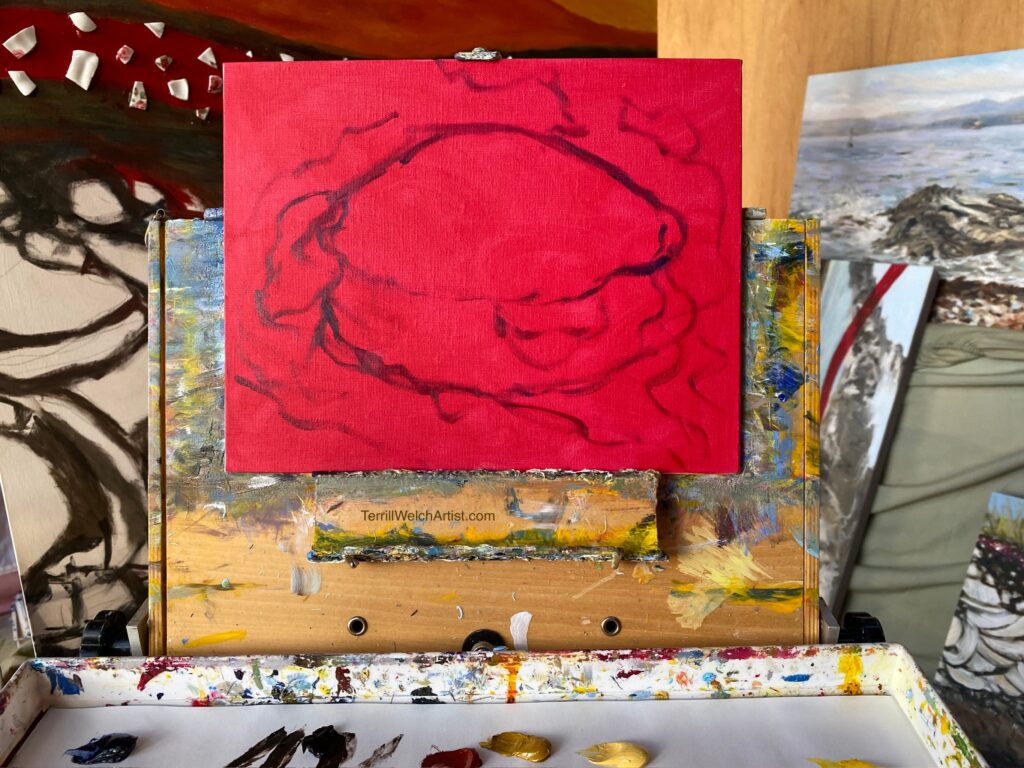
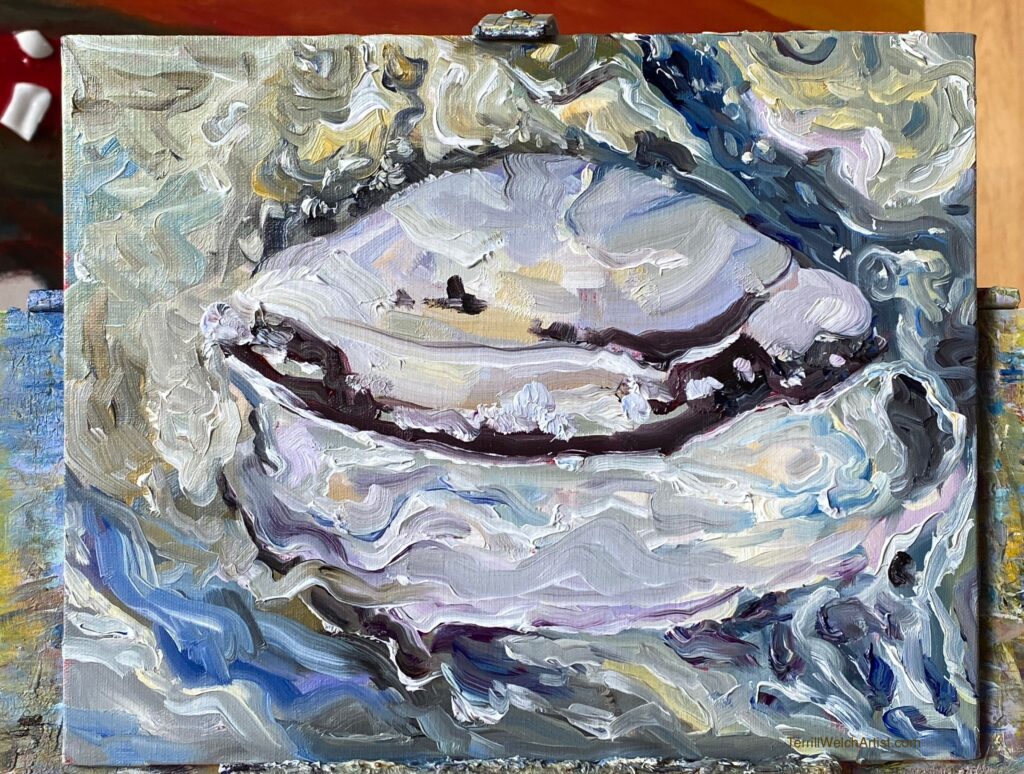
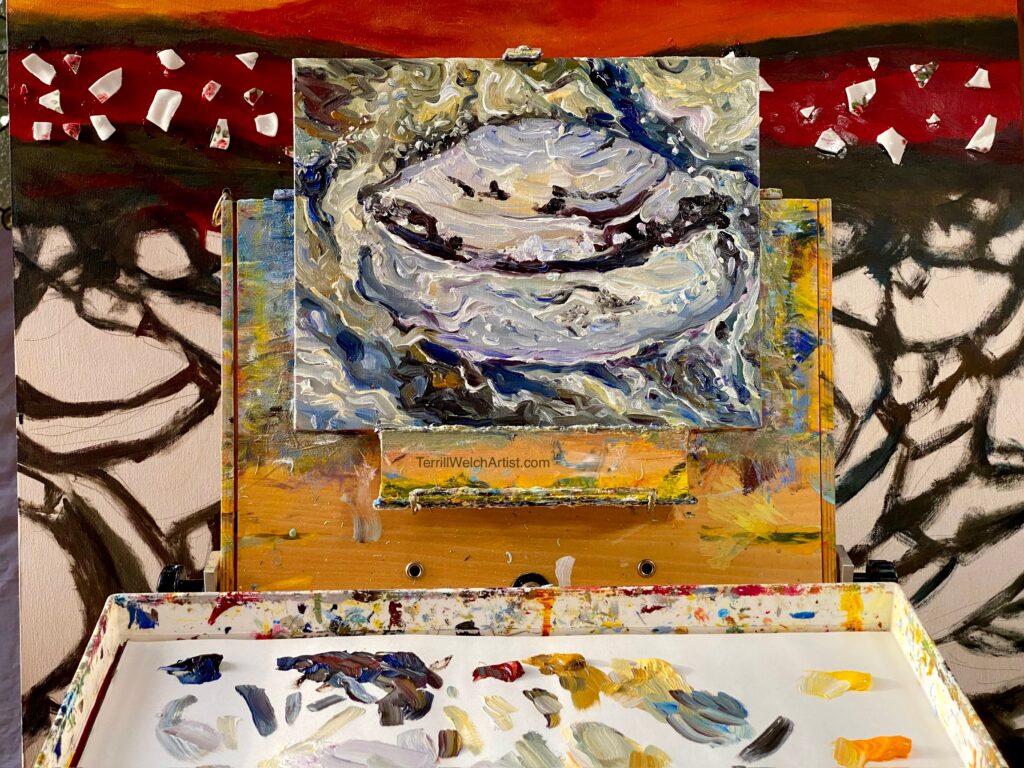
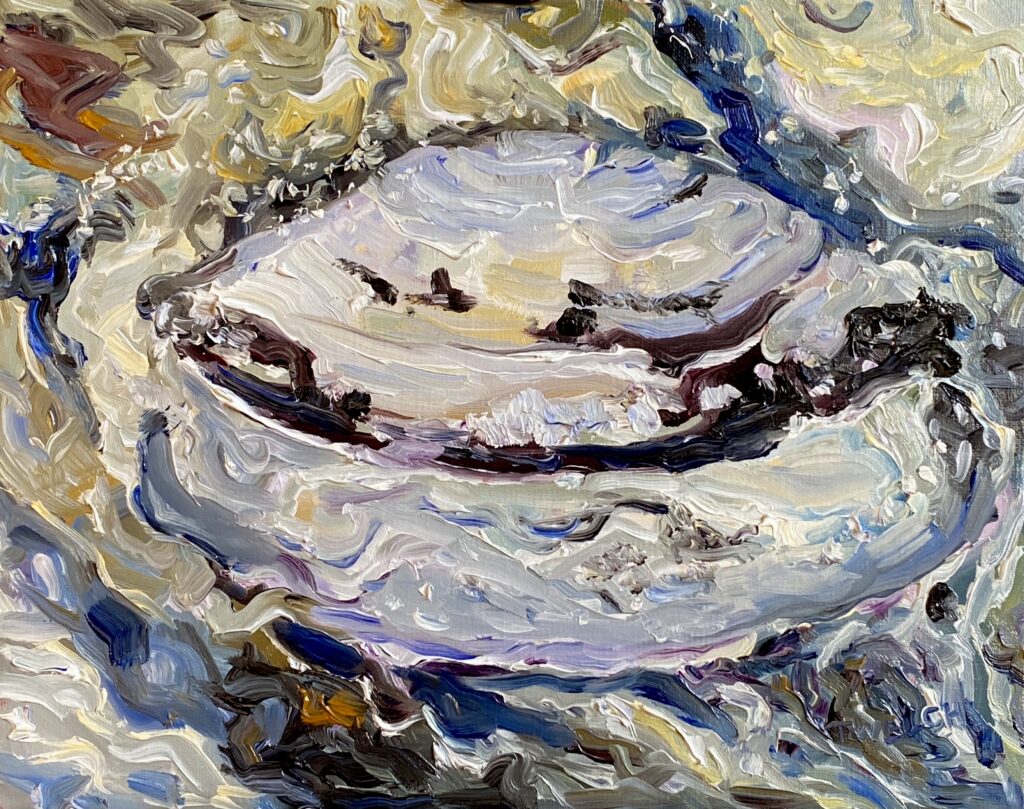
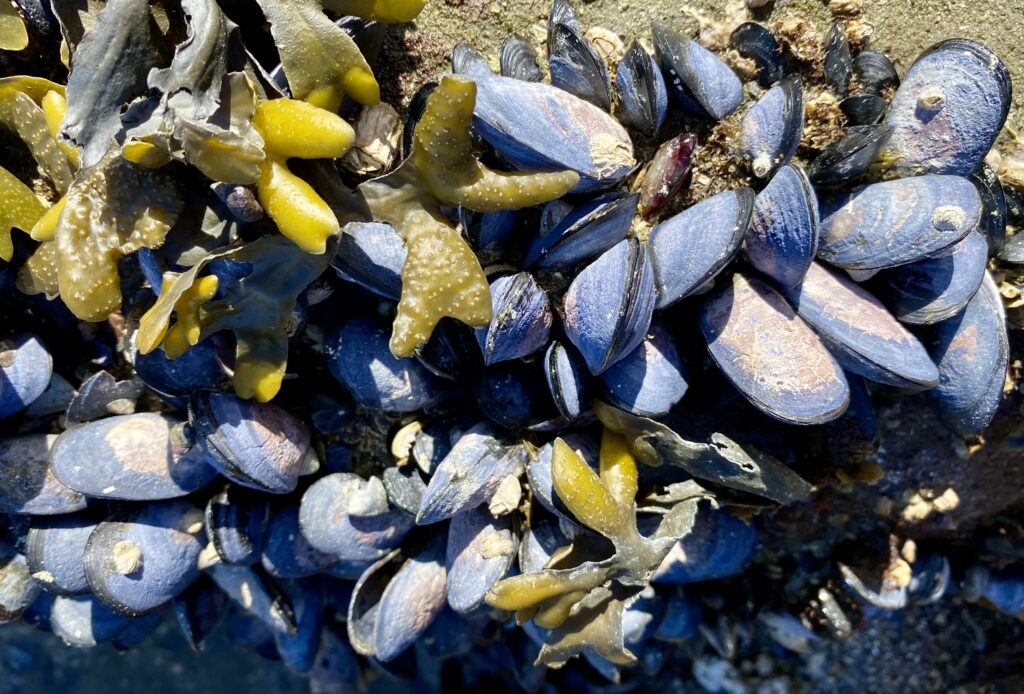
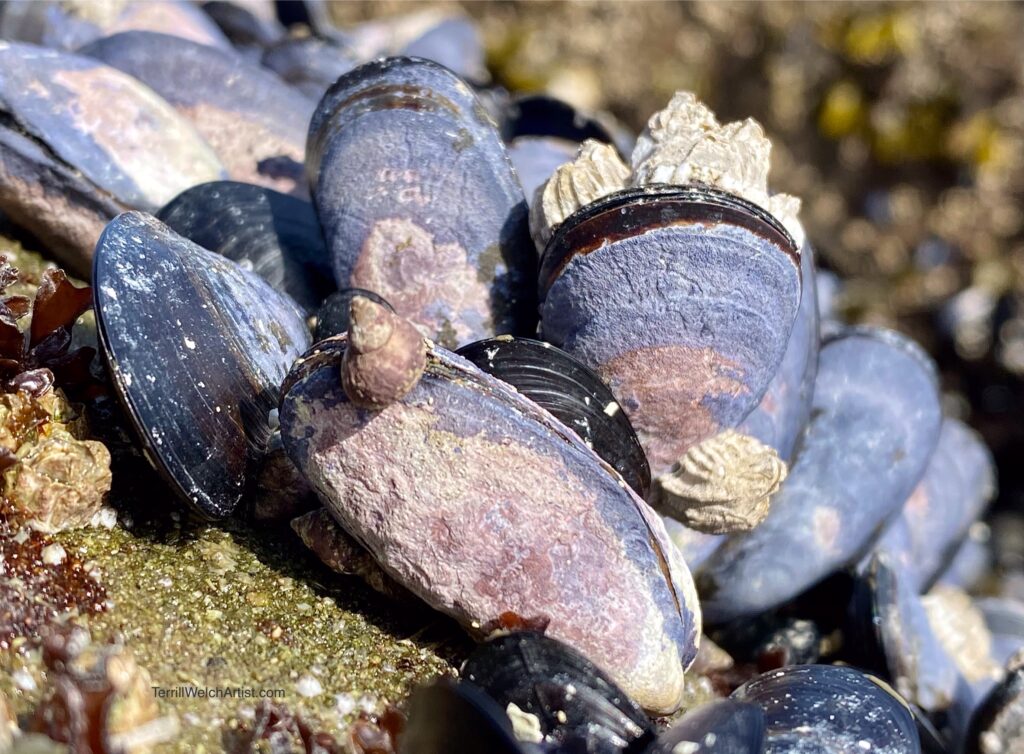
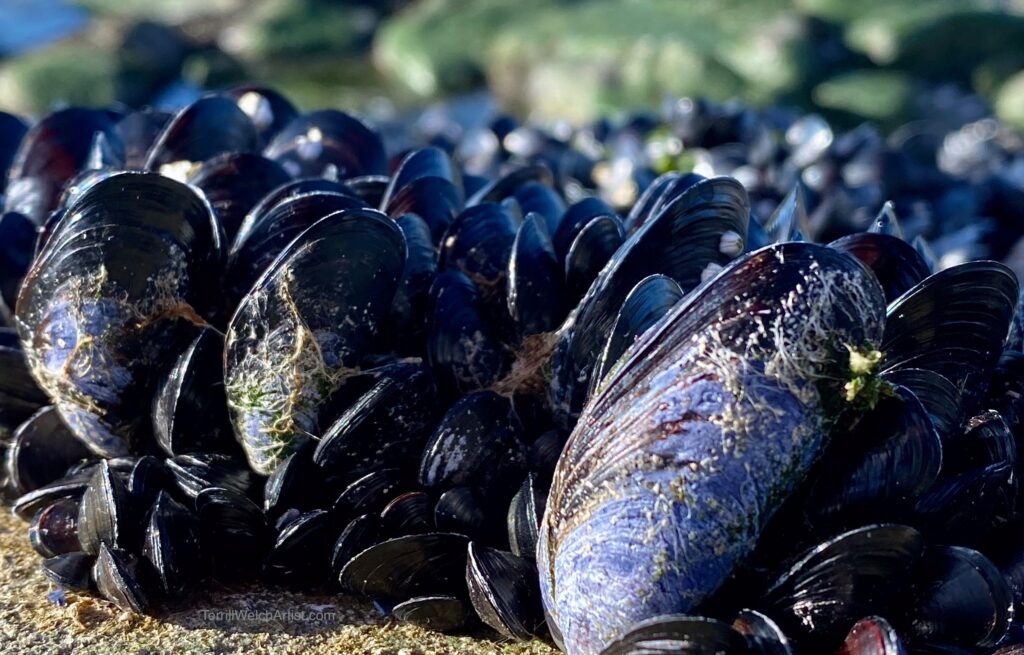
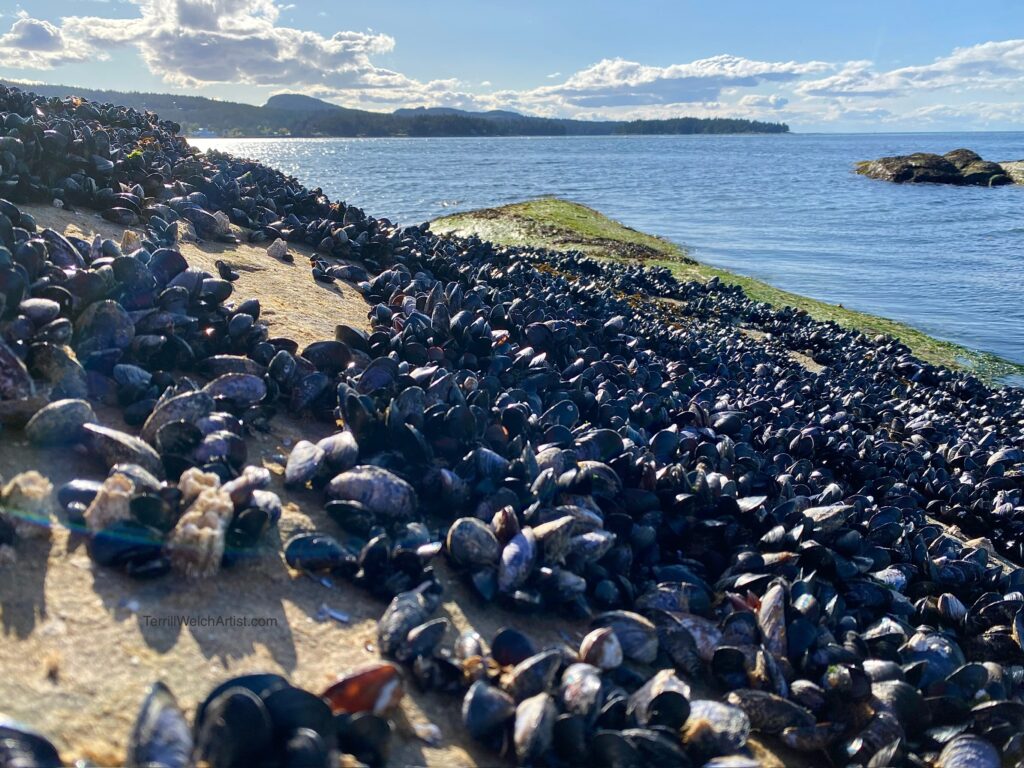
It is worth noting that when I make these copy posts from my art journal, the gallery images make it to the online version but not the email that is sent which seems to randomly gather images from the media section instead. Therefore, I highly recommend when you get the email to click the “view ion the blog” option top right. I have attempted to fix it this time by converting them to a list of single images rather than a collage arrangement but we shall see.
Excerpt from Terrill Welch MA Fine Art Journal
January 20, 2025
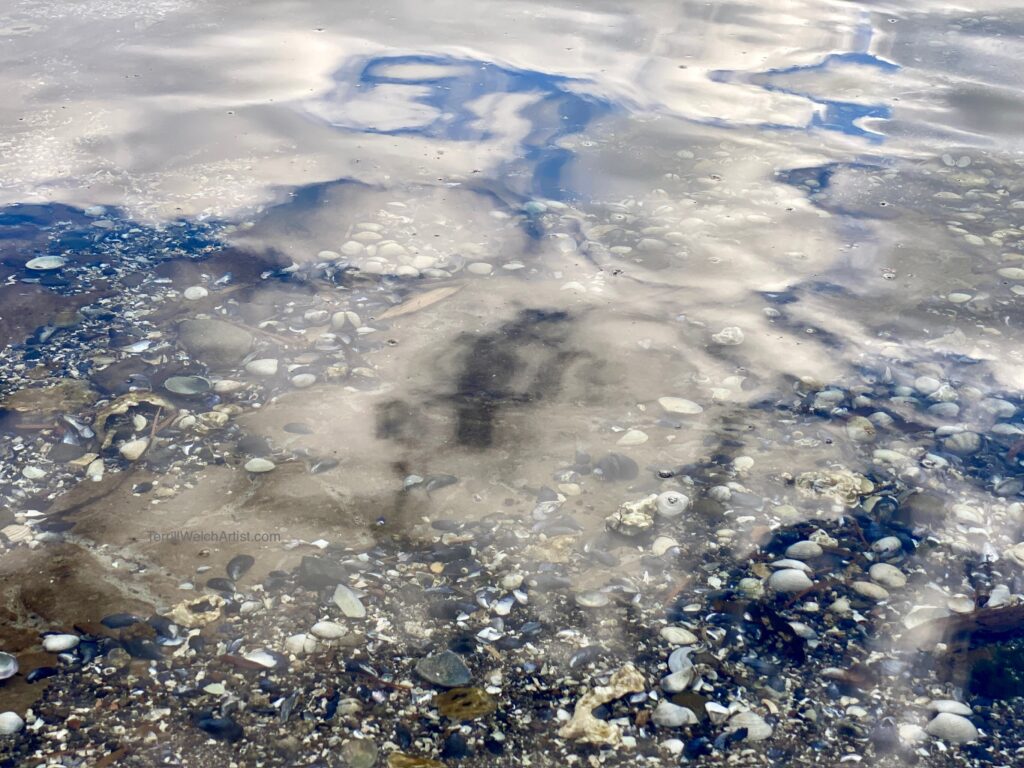
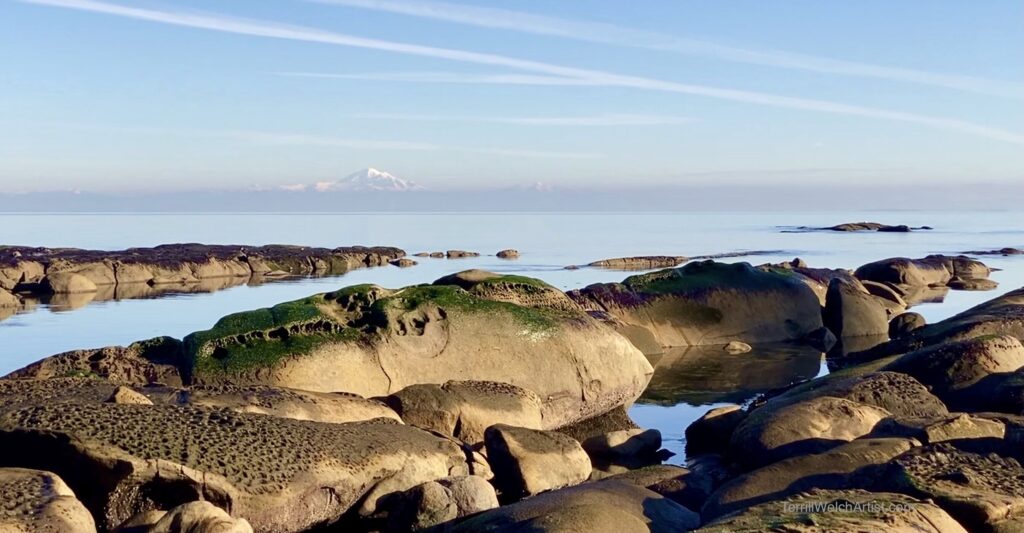
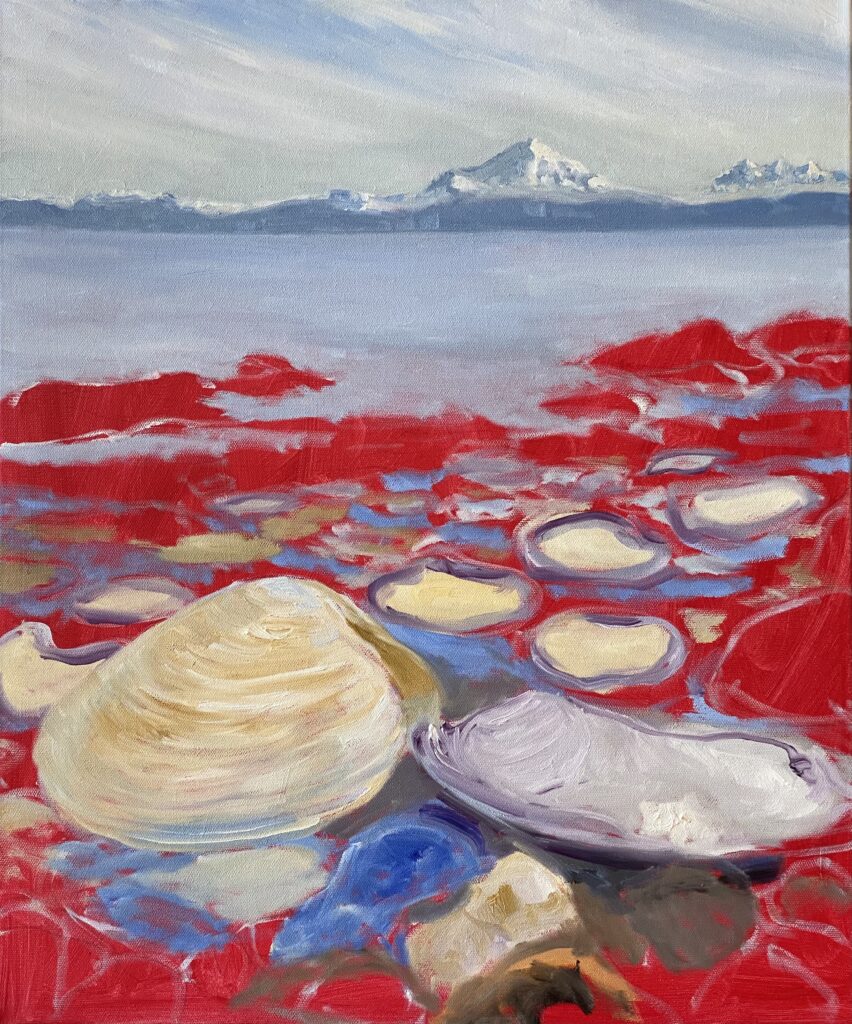
While I was finishing up the previous pair of paintings I began thinking about a way to get really low and do a landscape of the small at the water’s edge of the sea. I have been working most recently with the composition of all-over paintings of seashells and the sea floor by looking down rather than out. I started gathering a few references that I entangled together to come up with a workable composition.
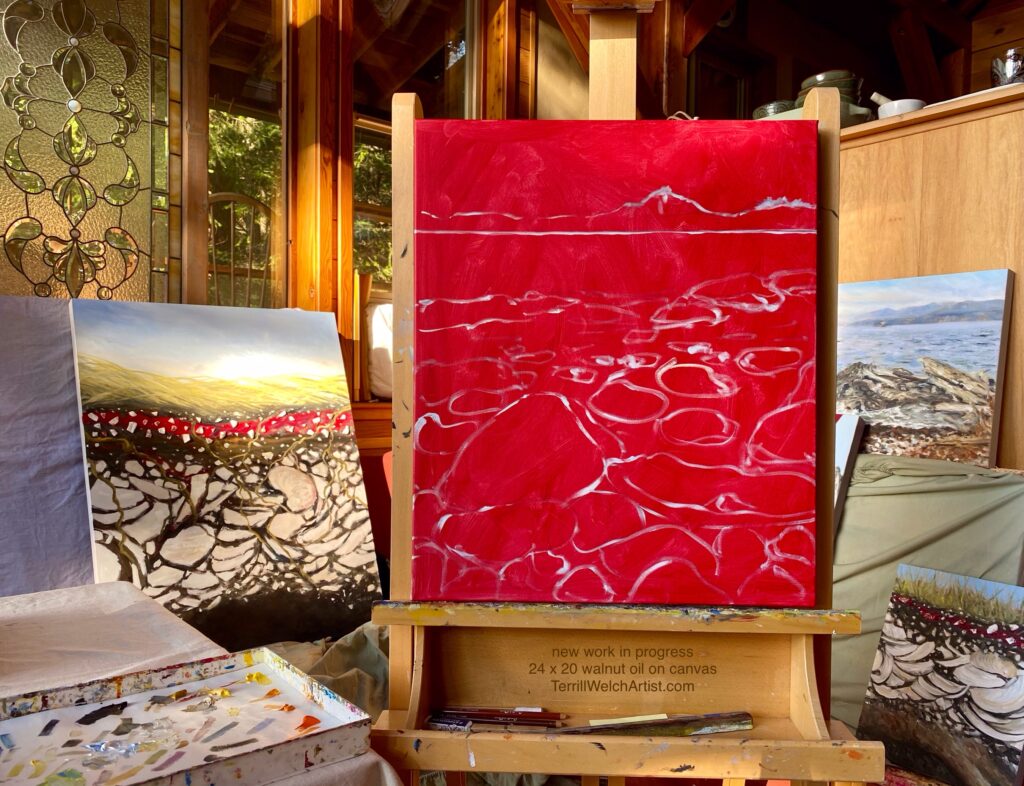
Then I spent the past week painting to see if I could get it to work. The canvas is 24 x 20 inches as I needed more elbow and visual room to test out this notion and as usual, I am working with walnut oils over a red acrylic ground.
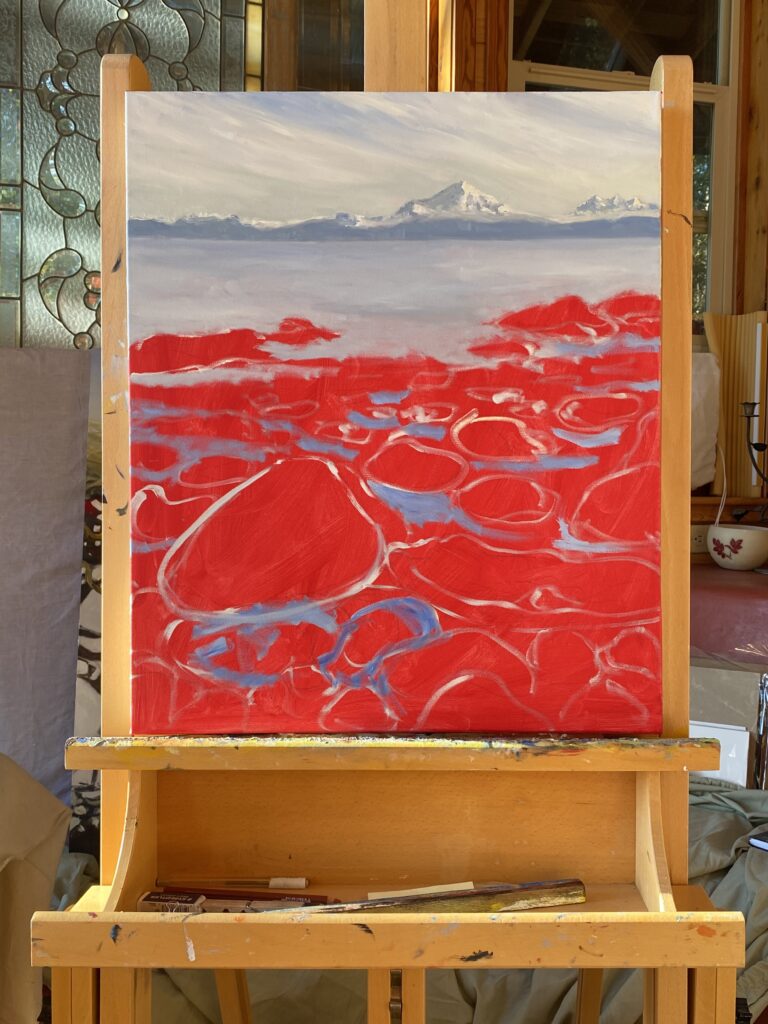
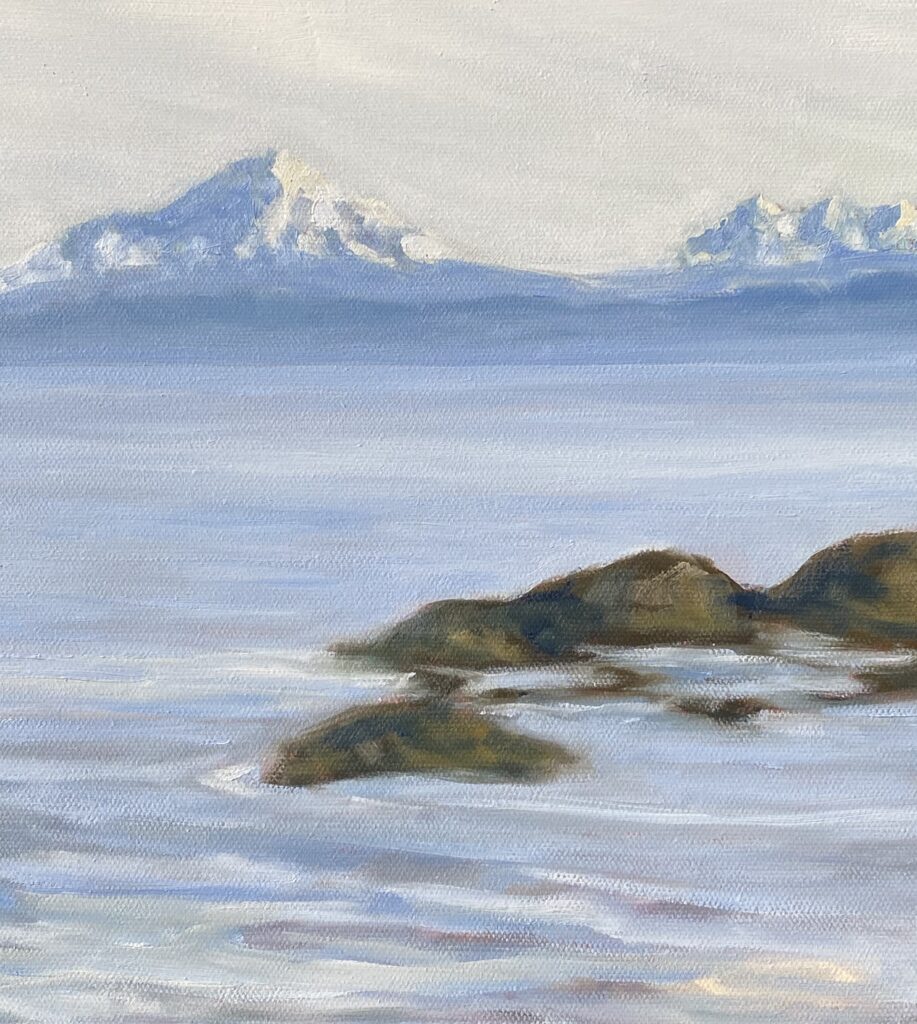
I started with the sky and distant mountains across the strait as these would hold the keys to the light for the rest of the painting.
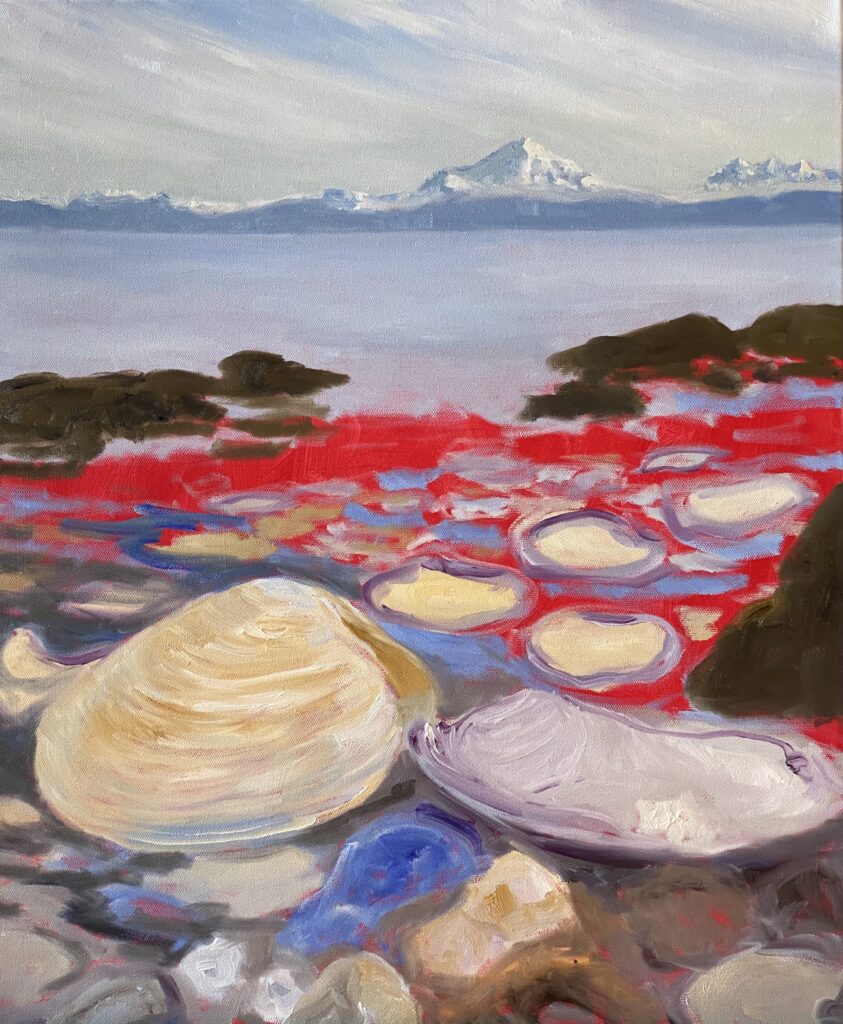
Then I moved to the foreground before putting the darks in. This is a little of a reverse in oil painting practice but I didn’t want to lose or be heavy handed with the subtle value shifts between the far back and what is up close.
Now I can slip in those darks in relation to the rest of the work.
I kept painting until I had the whole canvas roughed in but it has taken me a while and the work is getting tacky.
I will now have to let it completely dry to the touch before continuing.
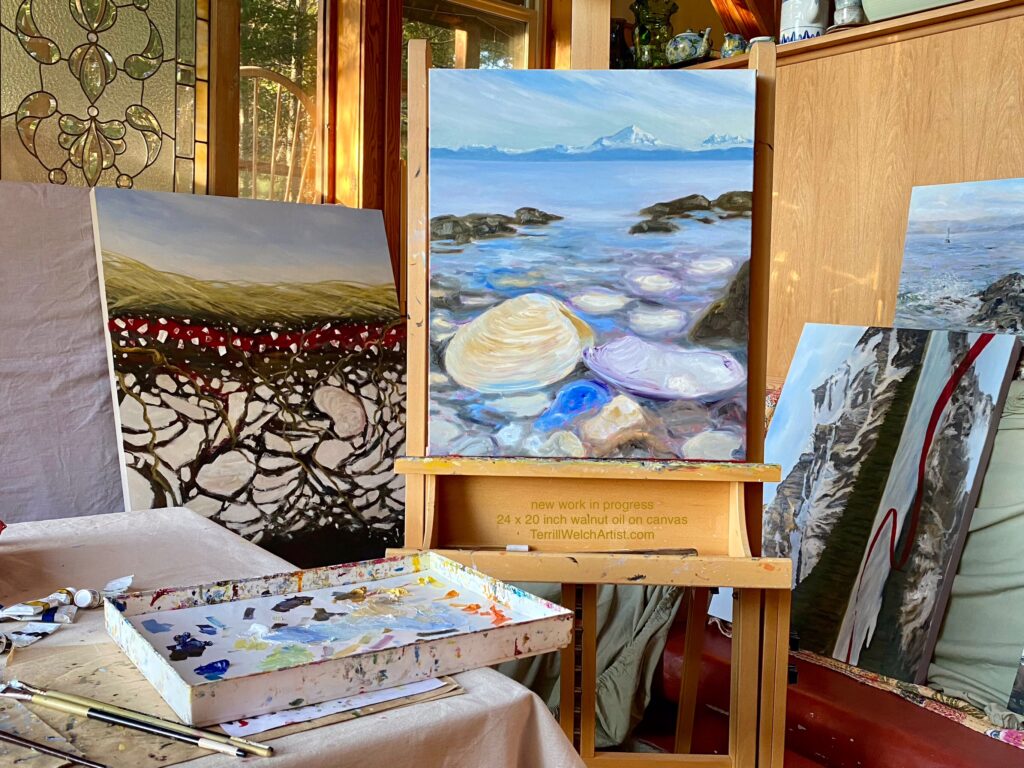
Several days later I settle in and work the whole canvas while making thoughtful changes including to the sky which was taking too much attention away from the foreground. Let’s start with a few details of the resting painting first.
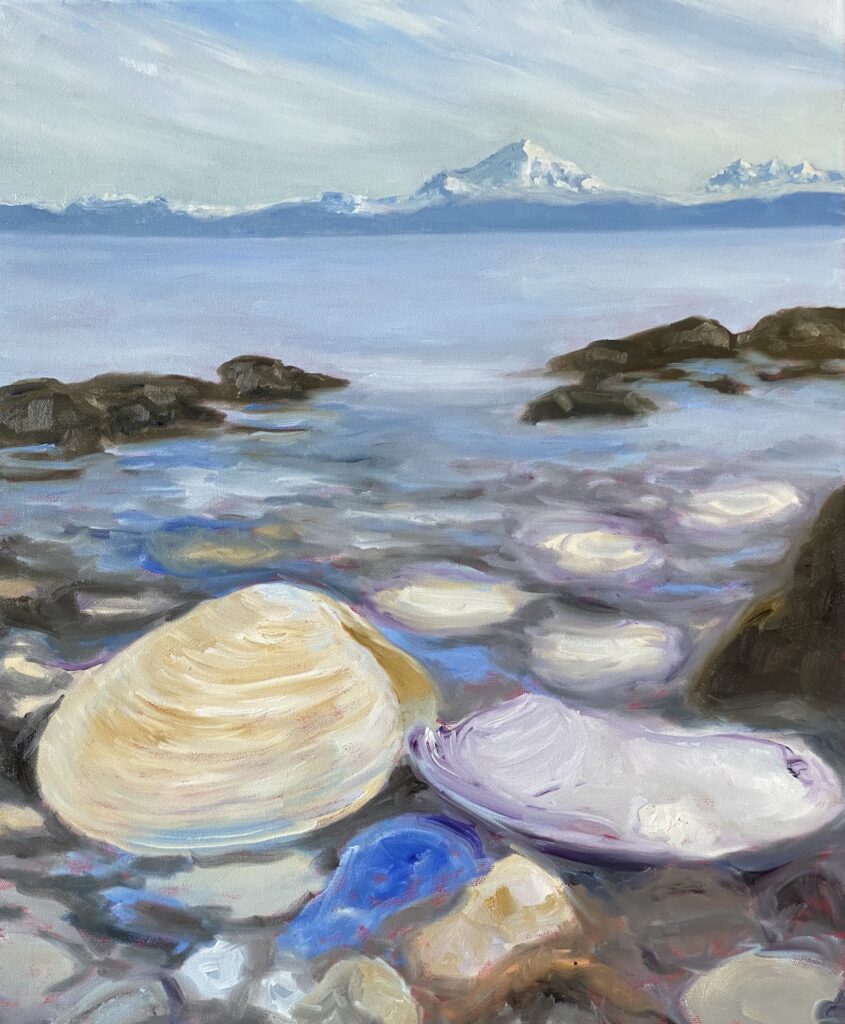
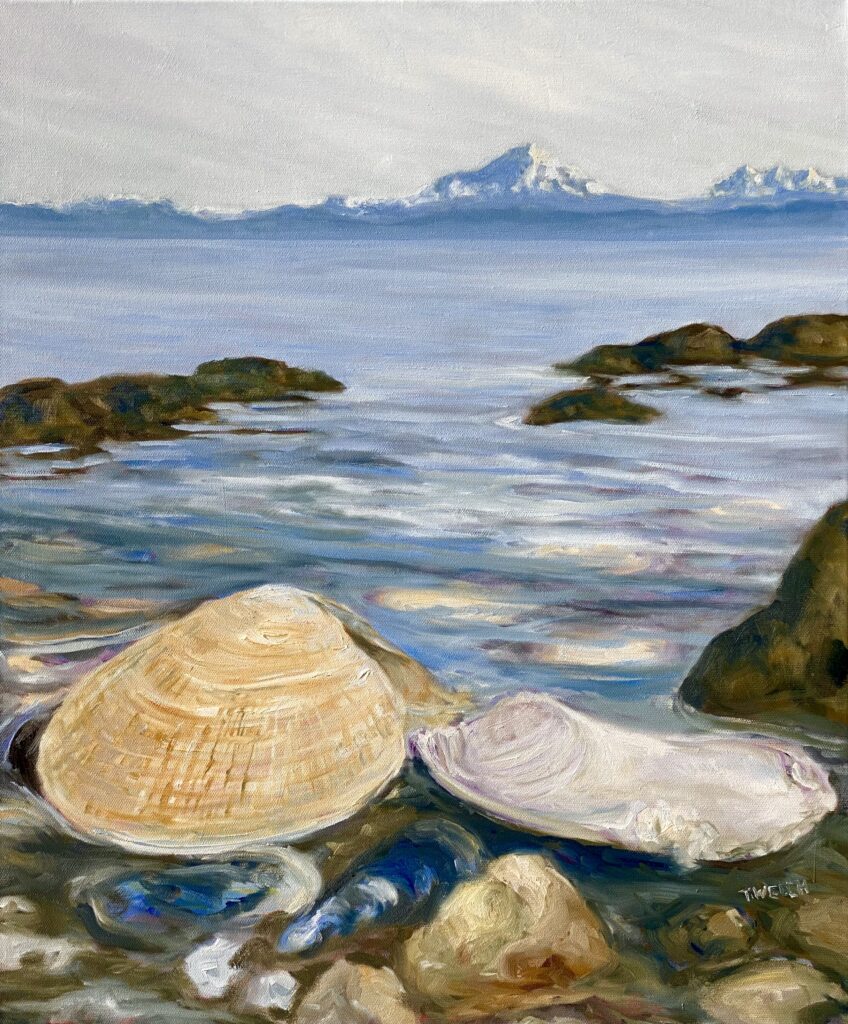
Here is the completed resting work but I am fairly confident that it is finished.
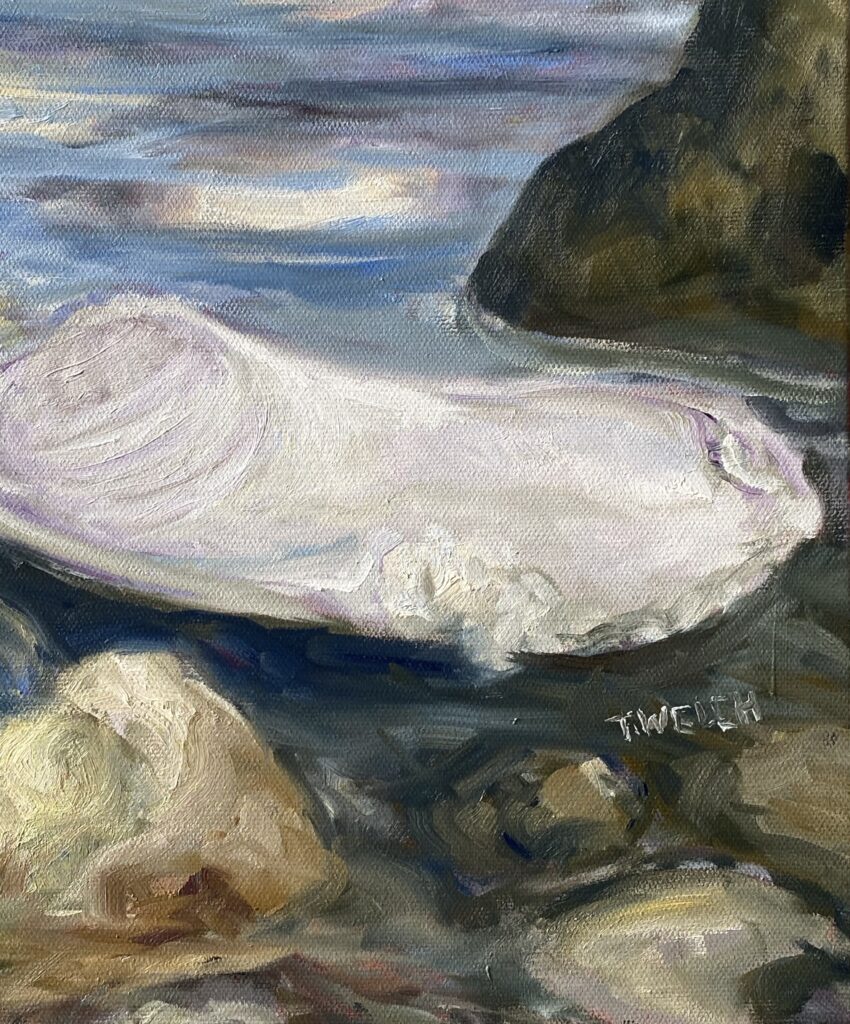
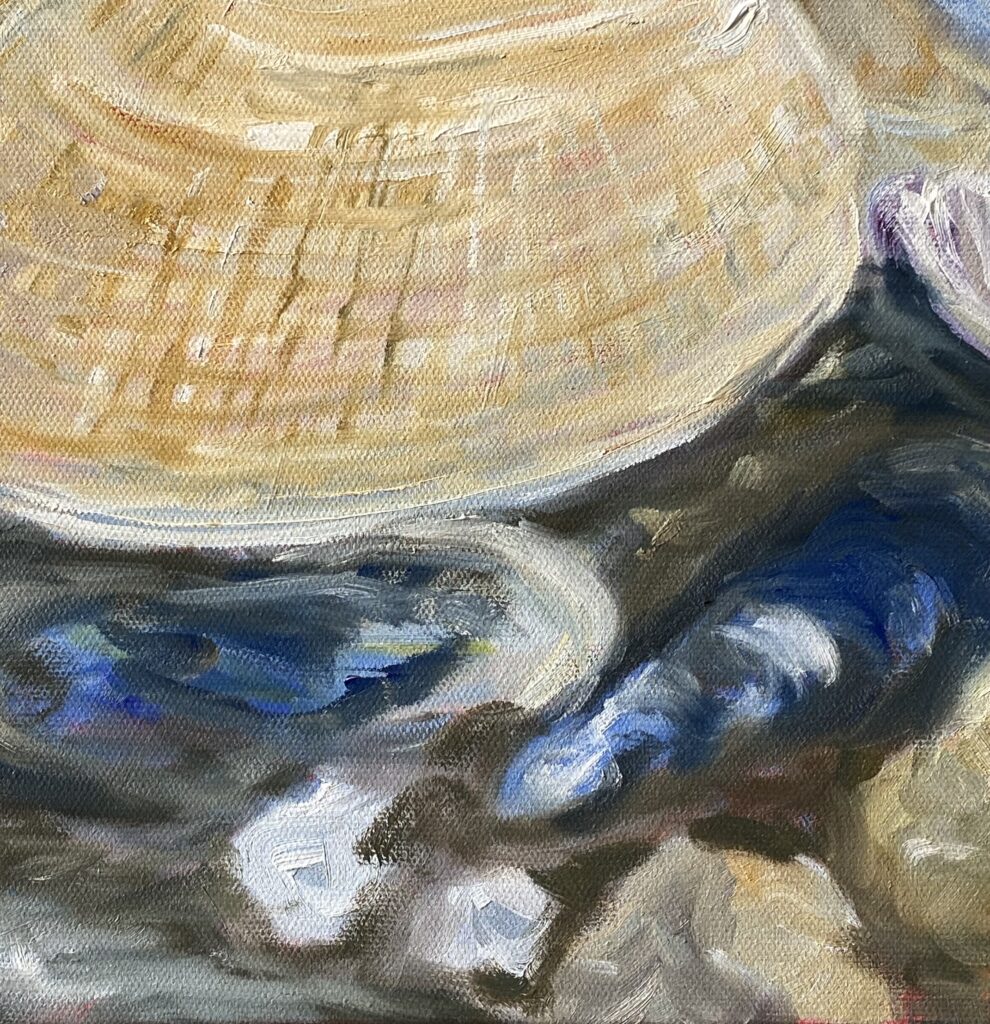
“Seashells Midday at Reef Bay” by Terrill Welch, 24 x 20 inch walnut oil on canvas. Completed Sunday, January 19, 2025.
Artist notes: I sink low to the shore and look out over a calm Salish Sea with mountains in the distance across the Strait of Georgia. When back in the studio, my brushes drift over the shapes and play with the colours while pulling the composition together in an imaginative way. It could be an actual moment in time but it isn’t really as memory and references are unreliable partners between artist and a canvas though the rhythms of the land, sea and sky remain constant.
I am satisfied that it makes a painting and is successful in this regard but I am not convinced that I have pushed the idea as far as it can go yet. I am going to try some further looser close ups to see if I can have us sitting small within a larger landscape. In this one, I feel we can still stand back and observe as a viewer and this isn’t what I want for the work.
So closer, let’s go closer. I have a sense that if I do this, the painting will feel more abstract even though it is figuratively based. However, these are going to be small studies so let’s be adventurous!
This post contains several excerpts from Terrill Welch MA Fine Art Journal because it is one steady flow of related notes in my painting practice for this time period.
Tuesday, 31 December 2025
I have only a short while to visit Reef Bay. A friend is staying with my husband so I can get groceries and come to gather references. Noon is not my favourite time of day but for the winter months it will work fine. The light is low. The sea is rough and the shells are plenty at the water’s edge. I took a short video and then settled into observing and waiting for moments to present themselves and, as always, they did…
I have my large Canon EOS 70D camera with a Canon zoom lens 70-200mm 1:2.8 IS II USM which in future will be called ”the big camera with the big lens”. My phone camera is an iPhone 11plus pro and is the tool I use most often when gathering references. Both cameras have their strengths and limitations. However, I find them excellent memory aids and an expressive art form all on their own.
I take a few images with both cameras for locational context and briskly walk back to the car.
On the 15 minute, slow 50 km drive home along windy forest-edged rolling roads, I think about how I only consider the physical context of my work for this project as being what is at the seashore. I do not include the drive or having left our strawbale timber frame constructed home with its in floor hot water heat and environmental friendly construction and living. The milk paint on the walls and seven skylights with large windows in three directions creating a seamless connection to the forests and fields around us remain invisible to the history of my work with the exception of my art studio that takes up the sunken room below the open kitchen. I wonder if these aspects of my creative environment matter. I know they matter to our life overall but do they have an impact on how I approach and do my making process? I write this to make this additional physical context visible.
Wednesday, 1 January 2025
Usually on the first day of the year, go out to the edge of the sea on the east side of the island to watch the sunrise. This year it wasn’t possible so I went to Reef Bay later in the day. The cold air caught in the wind and sliced into my forehead and bare hands. I knew I wasn’t going to last long but it was great to be there. It is a little later in the afternoon. On this day my husband has managed his walker around the soft ground of the house and out to the car that is parked beside the gallery pod at the gate. We have come to the beach with a mocha for him and a peppermint tea for me and along with muffins from the bakery. We are pleased to be back doing some of our favourite things such as car picnics that allow him to sit and view the water and me as I walk along the shore gathering references. I am getting more time to focus on work as he heals from a fractured hip and regains his mental clarity to his previous level following the trauma of the break, surgery, opioids for pain and the confusion of the hospital. His brain injury from a previous large stroke left us unsure if he could regain his baseline. We are relieved that it has come to pass. I am still required to provide additional support and do extra work overall. But it is much better now than the first few weeks and my wellbeing has returned where I can think and hold new information unrelated to David’s health needs. I can feel a new normal settling back into my art practice and studies.
I meander to the tidal edge and linger a little in the cold. It is good just to be alive and know that the people and places that I love are doing well. I settle low to the ground and gather just a few images with my phone.
Friday, 3 January 2025
I have been reading and thinking and thinking and reading for the past few days. Some of that thinking is in my previous post about the theories of Dōgen and Plato. I have gone from secondary sources to translations of primary texts in my literature review.
I go for a long hike down the central trail of Edith Point, a public conservation point that has the sea on each side with glimpses only on the north of the Strait of Georgia until the trail reaches the actual point. This is familiar land and shoreline to me.
I have been hiking the 4.5km return trails for just about 18 years.
Still, I pause to visit with special arbutus trees while mentally making inventories of previous paintings that have yet to include this beauty.
As I walk, I ponder. There is too much material to integrate immediately into my art practice and cover in a 3,000 word contextual study. I will have to choose and summarize the most important aspects for this point on my journey.
Saturday, 4 January 2025
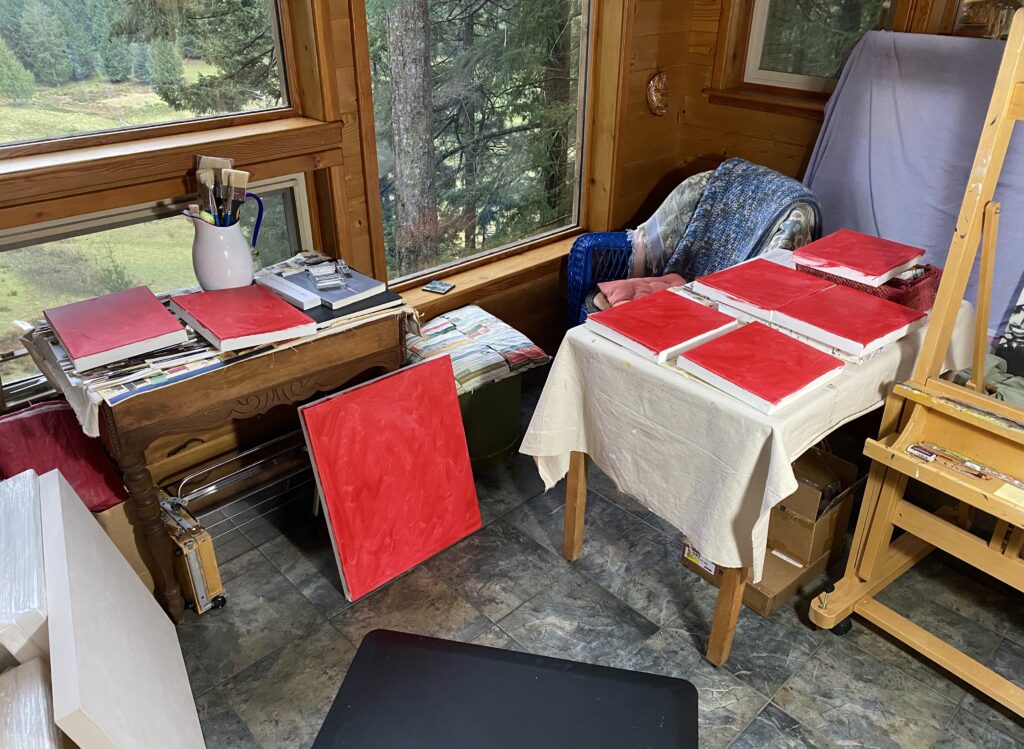
In the morning I paint red acrylic grounds on seven small 12 x 10 inch canvases for painting sketches and one larger 20 x 24 inch canvas. I have the beginnings of an idea to paint the seven smaller canvases as a series where one is a progression from the other. I am not exactly sure how this will work yet but I want the canvases ready regardless. I have again chosen the red ground for how it will provide depth under the overpainting of blues, violets and whites.
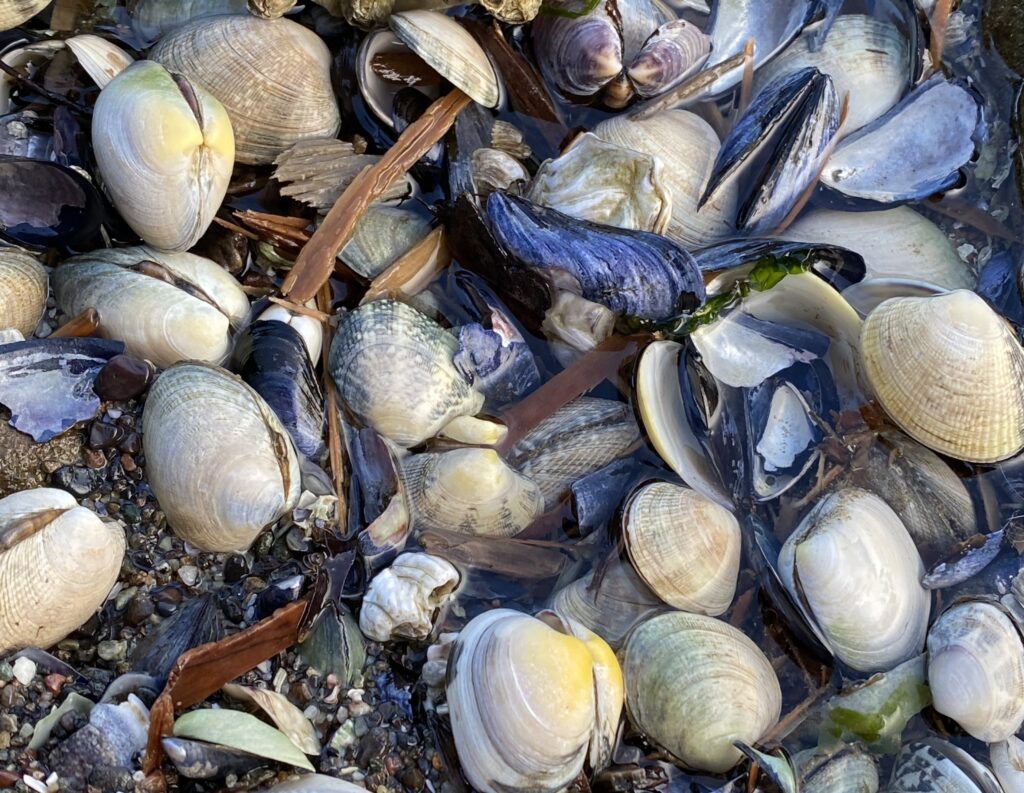
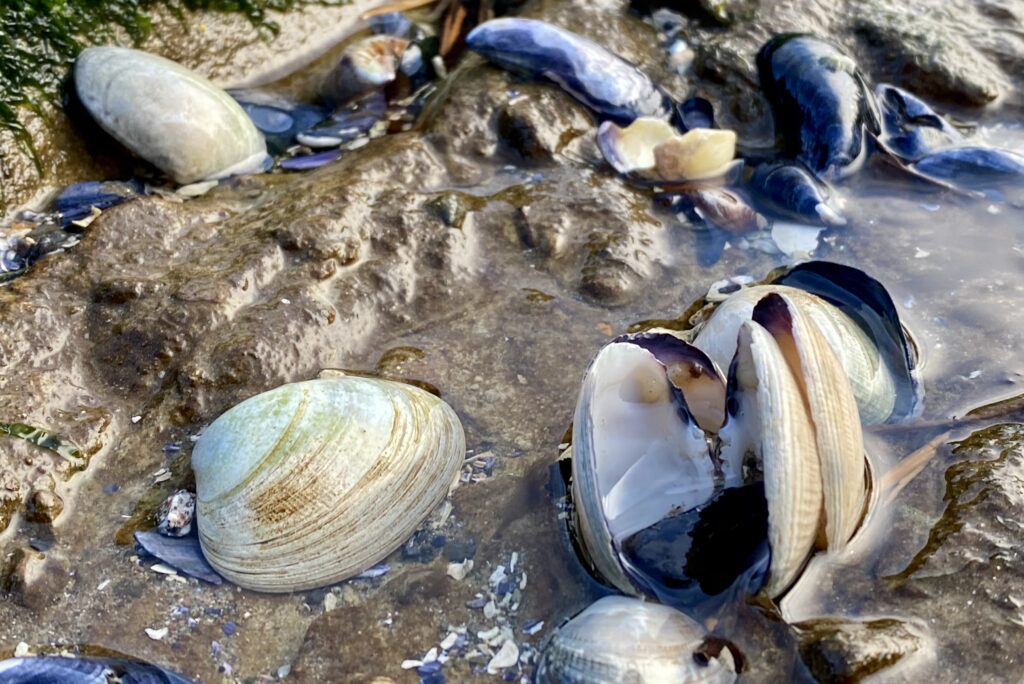
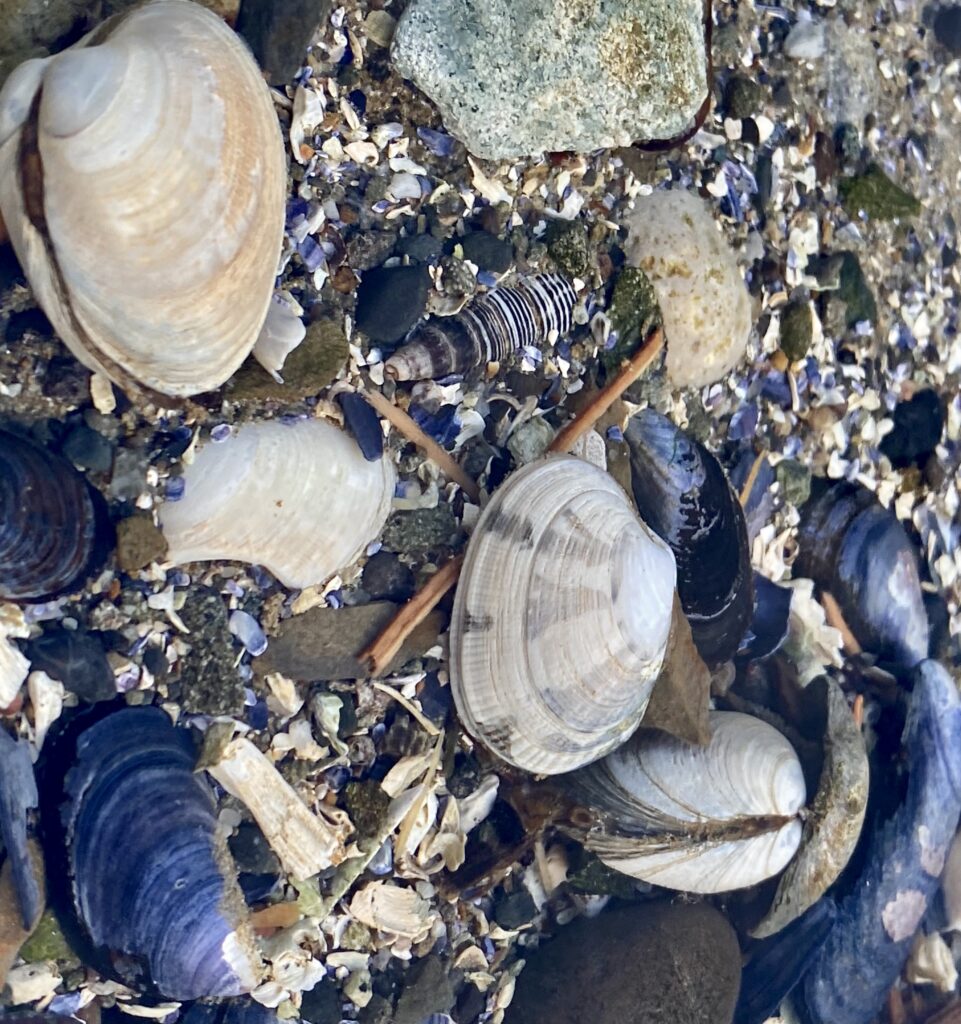
In the afternoon, we again go out and take the recycling to the nonprofit processing centre for the island’s extensive recycling efforts. After this, it is to the bakery for car picnic supplies and then to Reef Bay. I again step to the land and sea edge and squat low to the ground with my phone camera. This time I am invited to notice individual shells scattered along the edge of the tide line.
These references, gathered over these past few days, are what I call photographic sketches. They are collected as sensory and memory aids and for exploring possibilities as they present themselves in the immediate present. I have no illusions about their purity and acknowledge that they are deeply entangled within the limits of the devices and within my life experiences, context and past gatherings and my musings about what use they will be in the future. Still, I want to collect them and desire them for their own record keeping capacities.
Sunday, 6 January 2025
Today is a studio day. I decided to work flat on the table rather than the easel to do the painting sketches. This is an usual way for me to paint but it is also the most practical because these two surfaces are too small to easily secure side-by-side on my large easel and too large for my small easel. I move the easel around to the end of the table and paint in a direction in the studio I have never done before. It was perfect with the misty filtered light coming in the windows.
I am still able to stand to paint and use my whole body in the painting process. Taking one of my images as a starting point I begin.
While I am painting, I cannot help but think that Plato’s cautions about paintings being a copy of a copy that is further removed from his notion of ultimate reality by using my memory and photographic reference prompts. However, he would have the same criticism even if I was standing in front of my subject and painting. I keep thinking that his criticism about imitation and shadows of reality in relation to my inquiry into inner peace, wellbeing and resilience might have some merit. Still, I paint on while holding this intention. I curve the brush around the things we have named shells and feel the sea washing over them under my brush. I work the whole of both canvases.
Without conscious decision, I build up the paint and shapes on the left canvas.
Then I stopped. I have no reason for stopping. I just stopped. Something deep inside me has intervened. I walk away from the studio neither frustrated nor upset or even concerned. I wash my brushes, make a cup of peppermint tea and I start to ponder. What if I do not continue painting in the same manner? What if I try to expose the process of experiencing the sea floor from more than one perspective as if moving my eye and body alongside the rhythm of where the land and sea meet? What might this be like if I did this in a continuous manner with the seven small canvases?
Monday, 6 January 2025
Could the world views of Dōgen and Plato meet together with the land and sea and my intention for inner peace, wellbeing and resilience somewhere in this making process? What might happen if I do this? Once I get this post up, I shall go back to the studio and see.
Before I do this, I want to acknowledge to myself that I feel totally inadequate to the task at hand. I know little about philosophy and less about these two individuals and their work. I have only a sketchy understanding of both that has become coupled with a drive to bring what is ordinary in our natural environment to our collective consciousness as something of value to be cherished. Still, I will pick up my brushes and keep painting while I study and learn. I remind myself that new ideas and processes do not often come forth completely developed. They must brew in the rich soup of tidal half thoughts, partial ideas and incomplete processes. This is not only okay, it is necessary and the most useful way forward.
Too Much For A Painter
Tuesday, January 7, 2025
Too Much For A Painter
Morning came with a vibrant assault.
Deep cadmium and mineral violet
flung themselves carelessly across the sky-soaked trees.
Such promise!
I frittered it away…
going to the post office to ship a commissioned work to an art collector,
choosing almost ripe pears at the grocery store,
hanging a large painting in our local bakery,
visiting on zoom with a longtime artist friend in another country, and
reading passages by Plato and Dōgen.
Sadly, my brushes remain helpless on the studio table.
Regrettably,
ignored.
Maybe tomorrow
won’t begin with such brilliance.
~Terrill Welch, January 7, 2025
Research through Art Practice – reflection on lecture
Friday, 10 January 2025
In reflecting on the lecture by Dr. Michele Whiting, I find myself pausing at the youth of research and theory through art practice. My first thought was that my children, who are in their forties, are older than this discipline. There is a freshness and excitement that comes with this newness. Everything is still malleable and art research and theory can freely borrow and consider the best from other disciplines as well as developing and establishing its own nature. I remember this dynamic when I studied Sociology and Women’s Studies in the late 1980’s and then worked on a master’s degree in the 1990’s in Gender Studies. There were also smatterings of these same elements in the many positions of my various non-art careers where I repeatedly took on jobs without job descriptions and I later developed these positions through the process of doing so as to reach the desired outcomes. I find myself in a somewhat familiar place with research through art practice and I’m filled with great curiosity for what might be possible through rigorous exploration and critical thinking. I have no doubt that my painting practice will be the better for it, regardless of any other result, and this is the most important reason I am taking this MA of Fine Art.
Now to the reflective questions:
My position as a researcher and maker –
As a person with an established painting practice and who primarily works from my own references, imagination and inquiry, I am driven by a researcher’s attitude to making. What I am hoping for with this specific project is to create a formal structure for my inquiry that will result in a deeper understanding about how I get the results I endlessly seek and place them within the larger contemporary art field of research. Basically, I am seeking excellent company to propel my work forward! I sense that the approach of ‘Reflectivity and Reflection’ that is outlined in the lecture demonstrating a circular relationship between the studio and contextual and theoretical research is a particularly useful method of working for my inquiry and it is possibly the most natural fit with my personal sensibilities.
Has your understanding of research in a fine art context been changed, and if so, how?
Yes. Before starting this programme, I was only considering my actual making as my research and practice. I am now clear that my process of making needs to be considered from a much more inclusive perspective and take in my observation and reference gathering as well as the actual painting process.
How can you relate the lecture content to your own processes?
My endless iterations through reference gathering decisions in the field are where I have many chance encounters in my creative process occur. This process continues in the studio and then is taken back out to my field of inquiry and discoveries happen in my work through the wholeness of this process. Somehow, I had separated these two aspects as distinct processes and I have been considering only the later studio work as being valid a process and material for research inquiry.
What would you change or work towards and why?
I will be taking a more wholistic approach going forward.
Due to their importance, I have taken the liberty to gather together the references cited in Dr Michele Whiting’s recorded lecture ‘Research through Art Practice.’ There are a couple additions added from my research into the references and I did not include references to the quotes in the slides.
Selected and Important Works Referenced in presentation and Additions:
Dufourcq, Annabelle. “The Imaginary as Introduction to Ontology and Then as Fundamental Ontological Model.” Contributions to Phenomenology, 1 Jan. 2024, pp. 343–350, https://doi.org/10.1007/978-3-031-73826-5_21. Accessed 11 Jan. 2025. (Speaks to Maurice Merleau-Ponty “For an ontology of the Perceived World” 1954-55)
Time between studio and another sea floor painting process
Sunday, January 12, 2014
As new oil paintings rest on my easel, the passage of time and space between studio and sea seems to narrow with purpose. I have gathered some of this flow in my reference material and the resting point of the works in progress.
In an early post I shared where I had stopped with this loosely diptych pair of studies…
The week has transitioned between reading about theories of objects and things, human perception, Plato’s constant abstract true reality and Dōgen’s continuous change in the particulars of ordinary life combined with my driving need for immersive time beside the sea and in the studio where I bring my conversations with the sea with me to share on the canvases. There is no doubt about our flawed and limited sensory information. I will expand on the science and specifics of this later on. However, this process of exposing, defining and creating meaning around these observation flaws beside the sea is a mystery that continues to sustain my art practice. It is within this process that I find inner peace, wellbeing and resilience. Still, that act of thinking about sensory experience does, as you will see, have an impact on what perspective I choose and how I curate my conversations with the sea on the shores of Reef Bay onto my canvases.
The following are snippets of observations between the full stop in the studio and the completion to resting of two small studies. In my painting practice “resting” is the place where I have completed all I can in that moment and I am waiting to see if the work demands anything more. I keep the work where I can look at it from time to time out of the corner of my eye. I wait. Then I make a final decision to either change something or call it done/completed/resolved.
My next step after the full stop was to consider movement and the effects on what we observe and how my eyes try and catch glimpses of objects and shapes that can quickly be categorized and named… even if I get it wrong. My brain will make and hang onto a mistake until further information can refine my observations rather than leave a void. I develop the second canvas with this in mind.
I am disappointed. Now neither canvas works for me, either separate or together. What to do? I could still scrape them and start again. I decide against this and leave them to dry to the touch and return to the sea.
The sun softly lifted a heavy mist down at the bay. It had me thinking about how inner peace, wellbeing and resilience are something we put ourselves in a place to receive and then create from what is available. The three gifts from gratitude are always present and then form from our own making. This takes more effort if the materials are scarce but it is still possible and always necessary.
The midday winter tides are high and the long reef trenches of shells are outside of my reach.
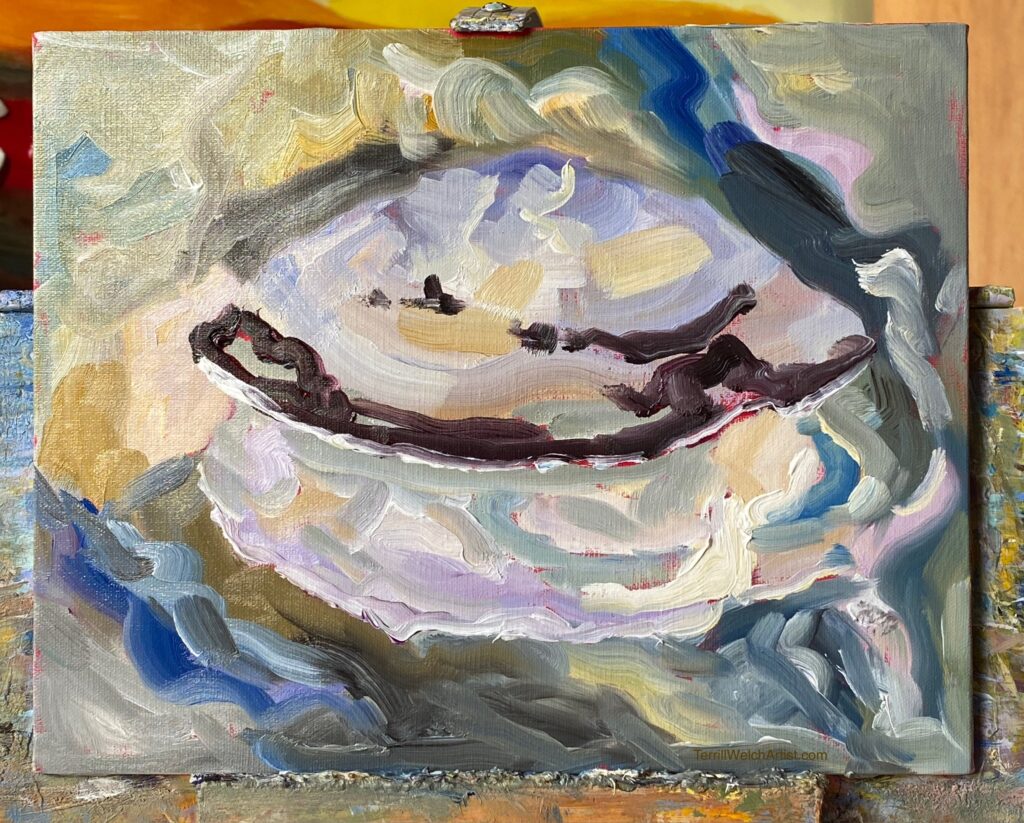
A few days later, I go to sleep in evening thinking about big movements and large landscapes of the sea depicting small areas, something close and intimate and yet grand. I have an idea for my third study and a notion about changing the sea floor perspective from above to beside just as I would with a more expansive geography composition. First, I work on the pair of studies that I had started and continue to paint them together. Now I am more satisfied with the conversation being shared in these two.
I had found a way to attach the two canvases securely together to my small easel. I found I didn’t like working flat on the table at all. My trifocal lenses made it difficult to see properly and there is a glare on the surface that interferes with being able to read the values as I am working. Finally, my lower back complained about being held in the new position for several hours at a time.
I leave the painting sketches and head for Reef Bay again in the hopes I might find something to practice my new perspective idea.
The tide is still higher than I would like but there are some interesting possibilities to explore.
At first I scan out from the shore.
A floating mussel shell catches my attention.
I drop the phone camera down as low as I can without getting it wet and wait as the sea wash moves back and forth.
Sometimes the seashell is completely covered providing more visual interaction between the sea and sky.
I move a little farther along to a collection of shells just close enough for me to reach. The seaweed flashes back forth with the movement of the tide.
I repeat the low angle perspective tilting the camera out towards an unseen horizon.
Hummm…. let’s go lower yet. There! Time and spacial relationships seem to entangle in the flawed camera rendering of a copy of the landscape depicting the small along the sea shore that is then further distorted in my own viewing as as my human eye and brain scramble to make meaning of what I observe.
This then, and a few close up captured cousins, will become my muse for my next painting study.
In the meantime, these two studies are resting together and a part.
They do seem to speak well together about my experience and conversation with the sea. Yet, they may need a little more space from each other as if they are two separate paragraphs in the same story rather than one long run on sentence.
“Butter Clamshells Near Shore I Study” by Terrill Welch, 12 x 10 inch walnut oil on canvas.
Artist notes: I stare into the winter sea tides and wonder at the rocking of the shells that shift with each incoming and outgoing wave.“Butter Clamshells Near Shore II Study” by Terrill Welch, 12 x 10 inch walnut oil on canvas.
Artist notes: I stare again into the winter sea tides and wonder at the rocking of the shells that shift with each incoming and outgoing wave.
I have no idea if this new line of inquire in perspective of the landscape of the small will be fruitful in my exploration of how nature can instil inner peace, wellbeing and resilience but it is exciting to consider and so I shall.
The making process begins with a few paint marks in walnut oils on an 8 x 10 inch linen on board surface with a solid oil red ground. I wanted the solid foundation this deep red will offer to the much lighter overpainting.
I have a short video from my field work and reference gathering that I play several times as I work. It is the shapes and movement balanced by the flashes of light sparkling in the water that most interesting me. I reach down into the soft ripples of water caressing the clamshell and set down the broadest of brush marks onto the surface.
My intention for this work is to instil a sense of inner peace, resilience and wellbeing. The work is a reminder of who I am after a stressful and tumultuous couple of weeks. I need this making process almost as much as I need to breathe. I can feel myself centre and my shoulders relax as I work.
I now sit writing these notes as the December afternoon low sun streams into the studio and across the kitchen beside where I am sitting. The house is quiet. A soft breeze moves the branches gently on the large for trees outside the window. I am grateful for this rural bounty. I am grateful for life. I am grateful for the technology that allows me to capture bits of my world and the tools to create passages of conversation with our surrounding environment, particularly the sea, the Salish Sea if I want to be more specific. Even when I cannot physically get there, the sea remains close to me as the tides move back and forth against the edges of my memory. The small work now rests in front of the larger painting I will continue working on before daylight tomorrow.
“Varnish Clamshell in the Flow” by Terrill Welch, 8 x 10 inch walnut oil on linen board. Completed December 10, 2024
Artist notes: I had gone to Bennett Bay and along the beach to where a season creek was flowing into the sea and washing over seashells along the way. They varnish clamshells created a light musical sound as the water passed over them. The beauty of the shapes and sounds created a textured resonance in my being. For those moments inner peace is held, in those shapes, in those colours and sounds. I find inner peace in the abstracted loosen of the brushstrokes, gifted to the linen surface without misgivings or hesitation. This is the full body experience I aim to capture in this small painting completed in oil, wet-in-wet, in the studio a month later.
It feels good to be back working in my physical studio again!
It is Canadian Thanksgiving today and I have begun a new painting about something that I do not already know how to do. It is an experiment, not unlike this early painting in my nature-centric, reparative Seafloor series.
Excerpt from Terrill Welch MA Fine Art Journal
Saturday, January 25, 2025
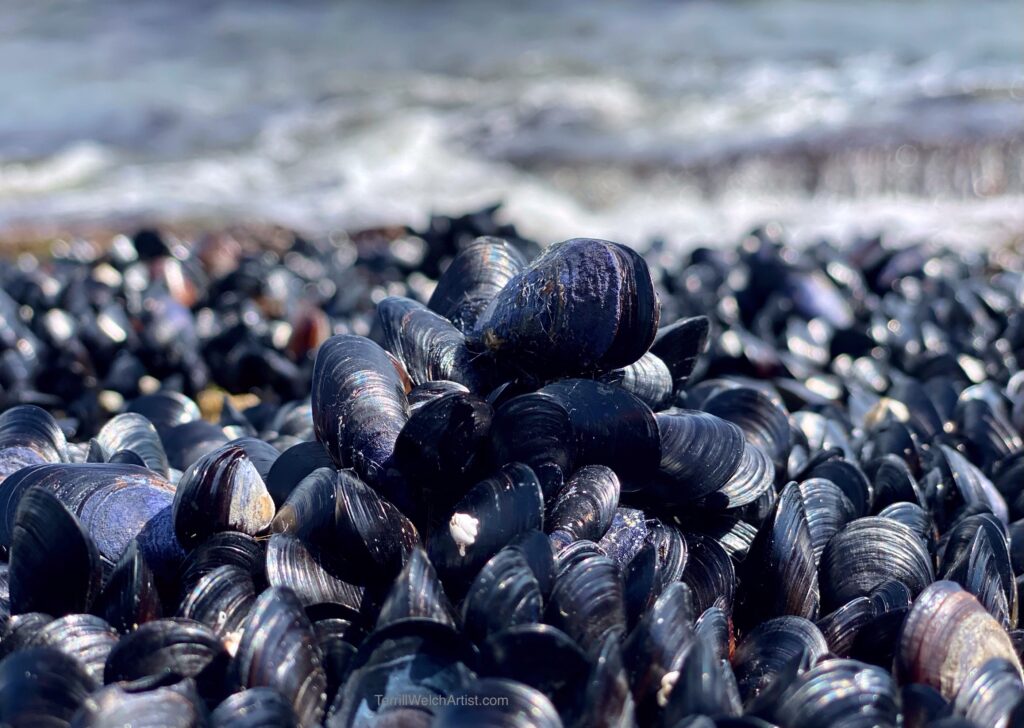
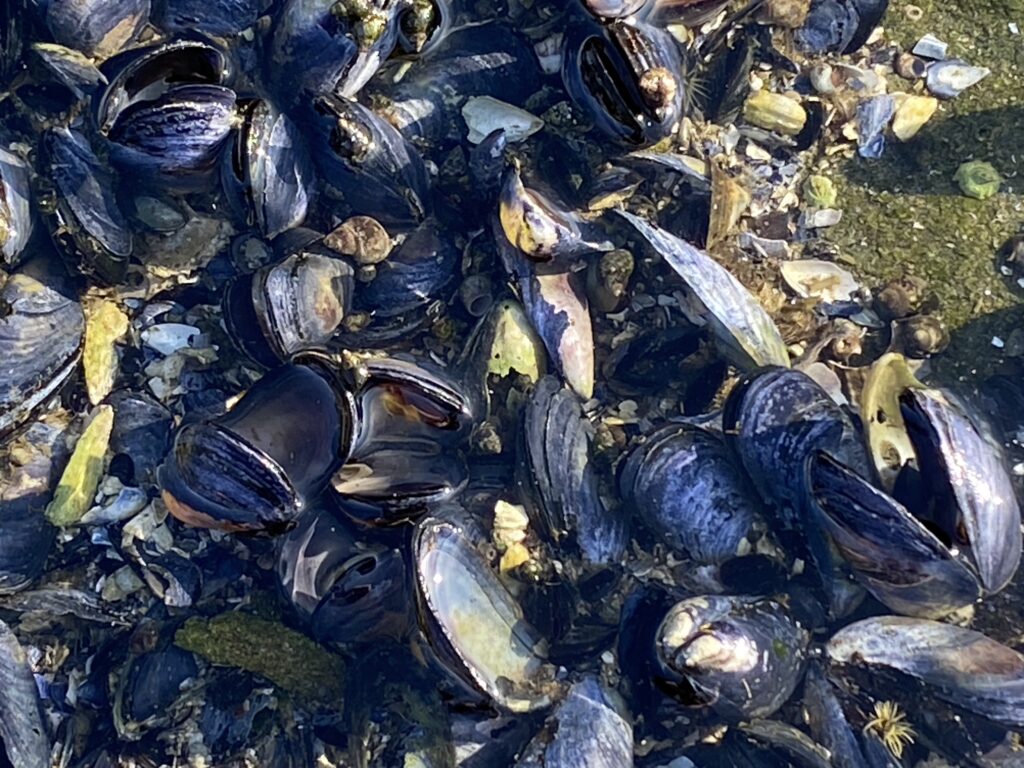
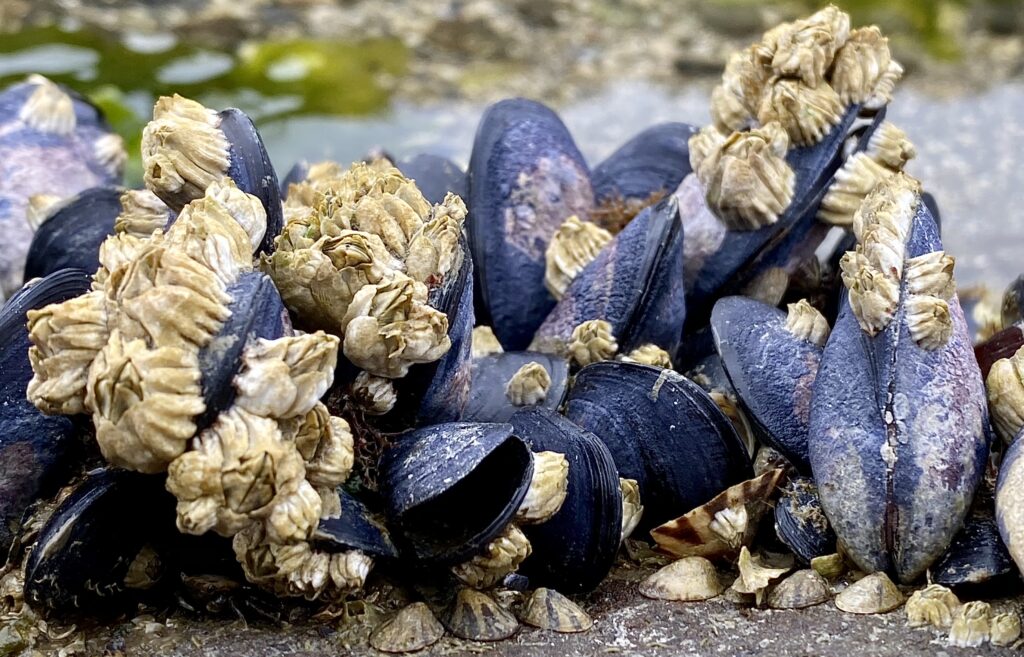
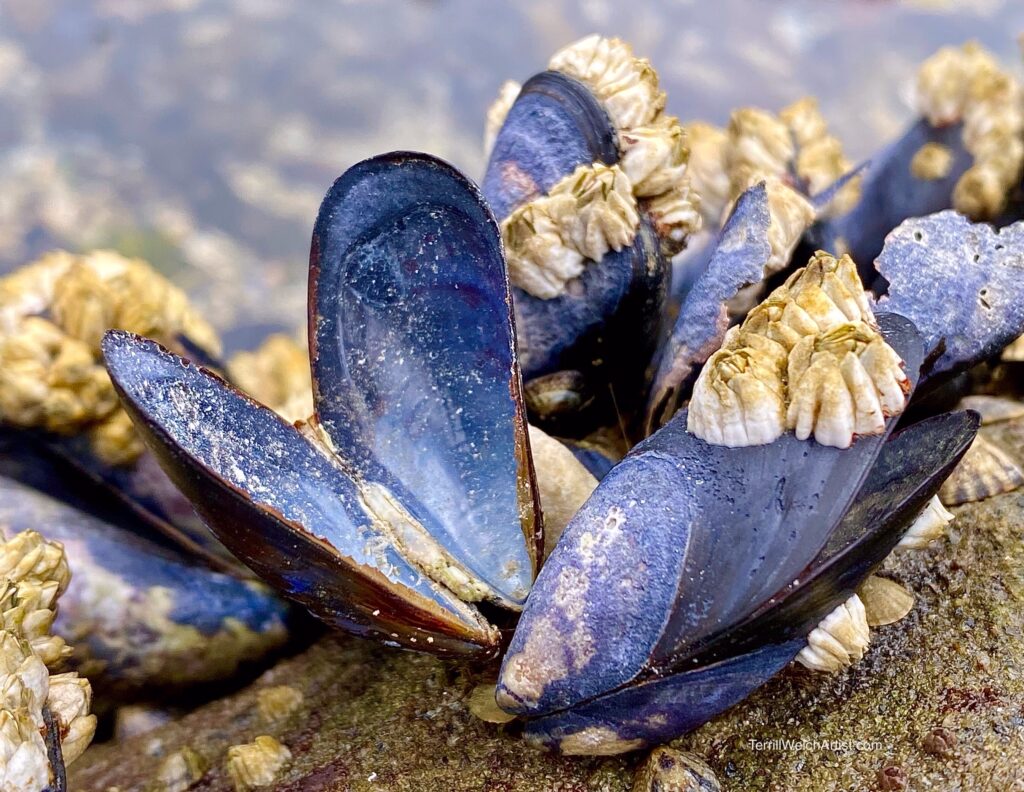
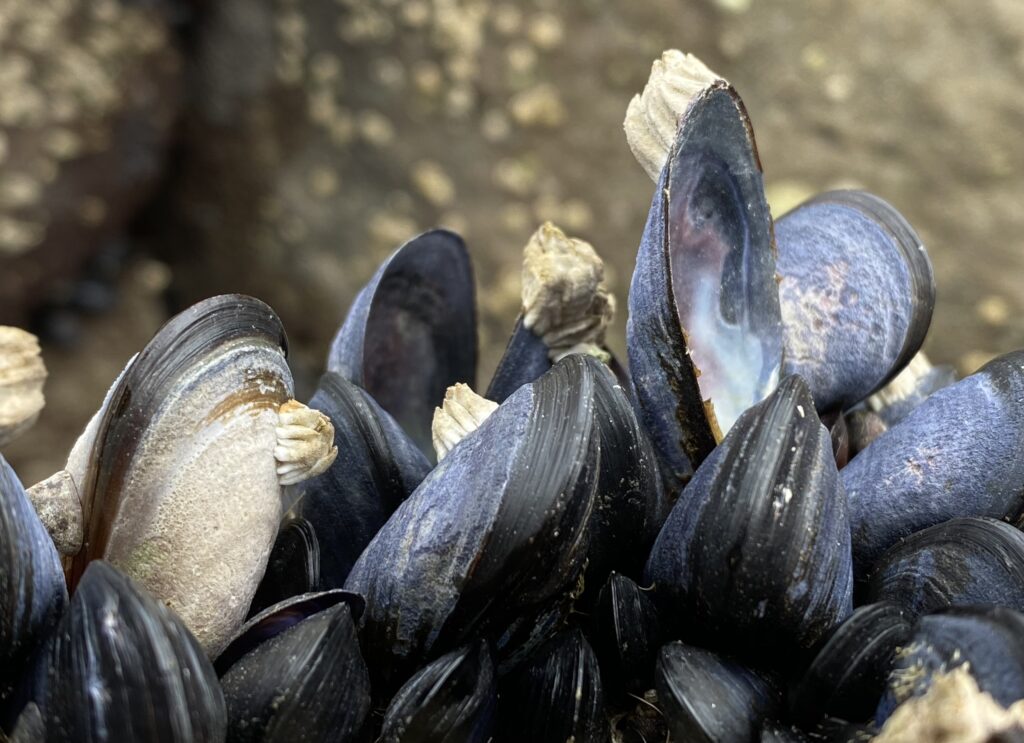
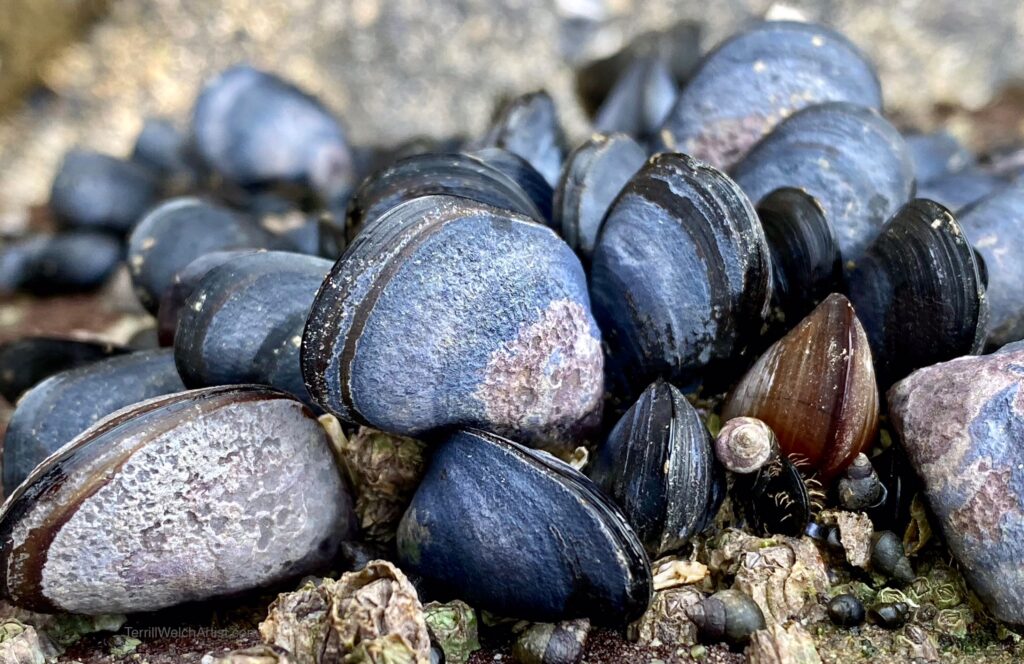
This week on Tuesday, January 21, 2025, I followed through in my commitment to go closer in my sea floor landscape series. I had several reference options and decided on mussels as my subject. I gathered together a few images from my observations, some from as recent as this week. There are hours and hours of pleasurable meanderings and sitting and observing behind this selection that spans a period over the last ten months.
In the end, I decided to pull from this image from the beginning of June as a primary source of inspiration. It is the outside reef along the Strait of Georgia in the Salish Sea at Reef Bay.
I can still feel the sun on my back and the sound of the rhythmic wash of the sea over the mussels that brushes the salty air towards me as I crouch low to the barnacle-covered sandstone.
I decide on a close intimate view and begin to shape it onto a 12 x 10 inch acrylic red ground.
The darks must go in first on this one. Even then, it will be a challenge to hold them to the end and round the forms while still keeping the life of the work.
The painting is blocked in swiftly on the small canvas.
I settle in painting while moving the easel around the studio, up onto the kitchen area and then around that room several times to stay out of the direct bright low midday winter sunlight. It didn’t seem to matter much. I used the adjustments as visual breaks and kept painting. The whole process from beginning to end took only a couple of hours.
I separate out and frame just the still shiny and wet painting to share to my social media followers along with my artist notes, as is my usual practice.
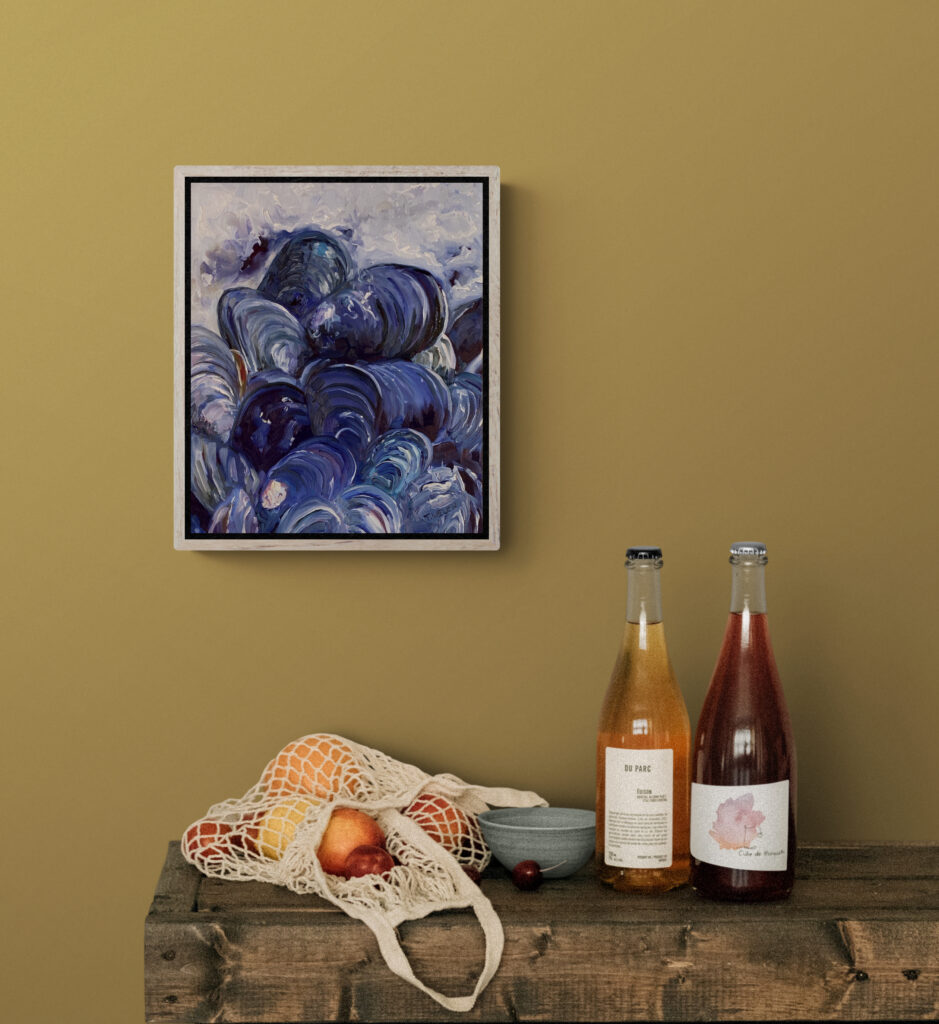
“Mussels and Waves” by Terrill Welch, 12 x 10 inch walnut oil on canvas.
Artist notes: Soft waves wash over the mussels and recede and then wash forward again to the tune of the Salish Sea. Sun sparkles like tiny bells of joy off the wet mussels. I am building inner peace, wellbeing and above all resilience. This unassuming painting is my protest against our collective darkness.
A significant U.S. art collector of my small paintings inquires and then purchases the painting the next morning. This is her comment that I share with her permission:
I really fell in love with this one. Even without reading your description, I understood the painting immediately. Somehow I connect into your spirit so easily and I am thankful for such a gift.
There is no greater honour than having the stewardship of one of my paintings be taken up by an art collector. However, the best and most significant piece of this feedback is knowing that my intention for the work reached through to the viewer.
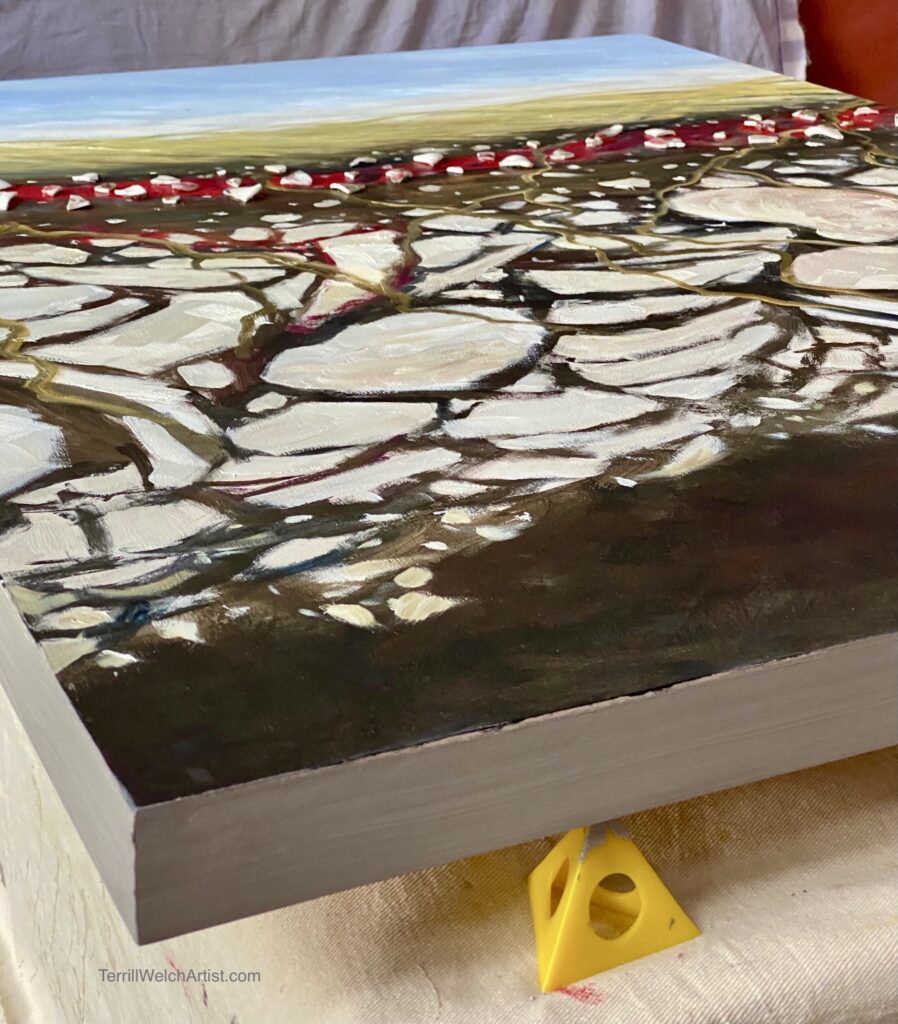
I now have the edges painted (and those of five other recent works) while I hustling to get this one ready to ship before February 1st and the risk of a 25% tariff being proposed by the new U.S. administration.
If this happens, it may possibly be the last painting of mine that is imported for a while. We shall see. Yes, sales are not everything as an artist. That said, I am a full-time independent artist with an art business that brings in revenue for living expenses and my continued education. This does not drive or even particularly influence my creative output… but it does fund it. Thankfully, the last few years have been reasonably good. There are no immediate concerns for now.
Let’s take one last look at this small study in a digital room view provided by Canvy before it is sent off on an adventure of its own!
Now, I am off to work on my contextual study for the week while painted edges dry.
Yes, this is still one of my least favourite painting task but it does get easier as the years go by.
Figurative/Abstract Self Assessment Band-Scale Rating between 1-10: 5-8
This painting still has strong impressionist leaning in the reflections but it also has an overall abstract sensibility to the shapes at the top of the painting.
Reference Gathering:
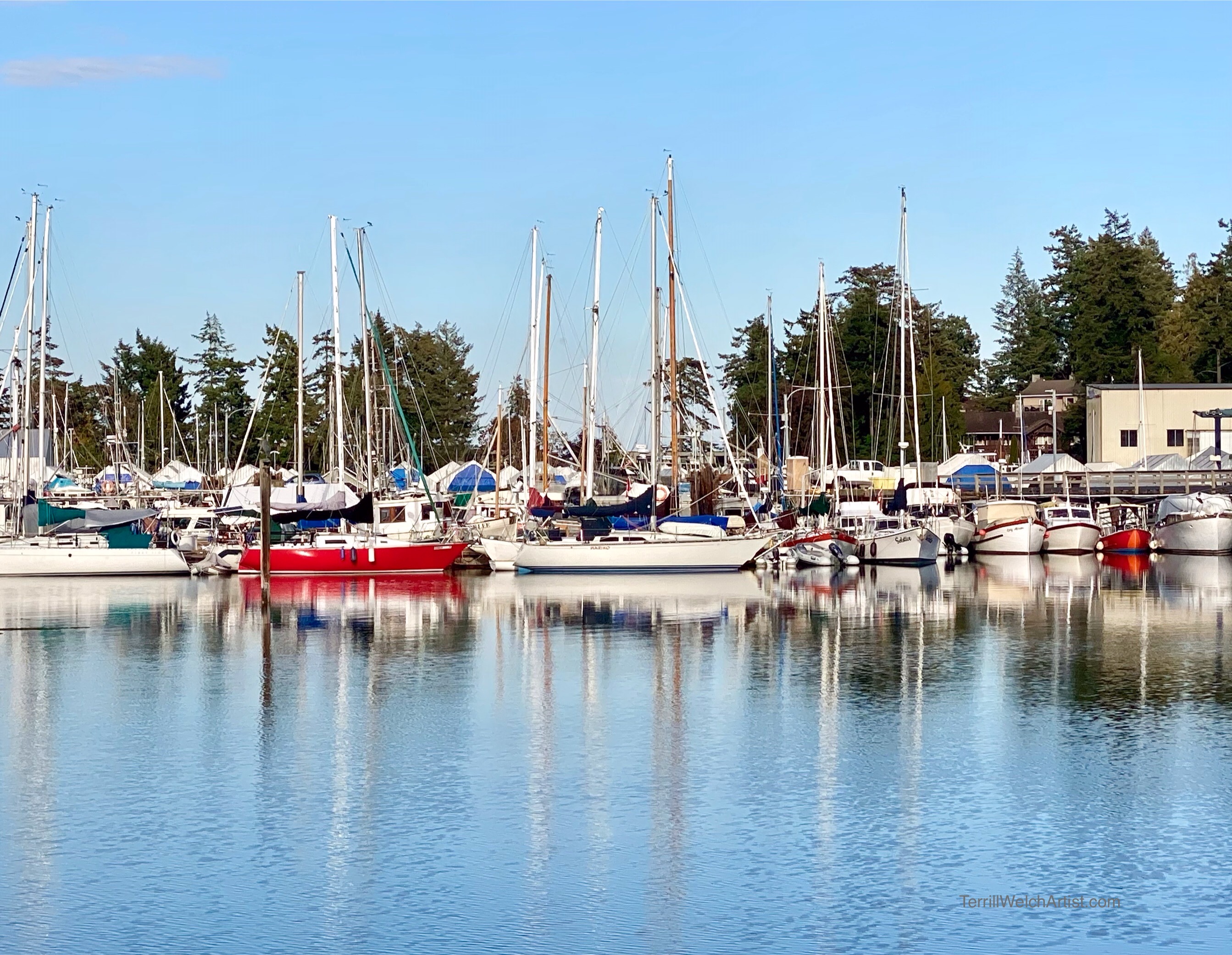
My reference gathering was thoughtful but cut short. I hadn’t planned on painting this scene. It was just an irresistible moment, like when a dog spots a squirrel. Their reaction is predictable and almost involuntary. My leash was that my husband David needing a bathroom and the ones in the park were closed. So we packed up and headed for the ferry with me turning back several times to look at the boats in the marina as we walked along the path back to the car. Their abstract shapes formed an enticing composition that wouldn’t let go of me.
Here is one of those reference images.
Marina at All Bay in Sidney, British Columbia mid September 2026. Photograph by Terrill Welch.
The next morning I pulled up the images and thought, if I just take this one small area here on the right, it will make a painting. That small suggestion from my mind to my heart was all it took. Now we have a painting!
Making Process:
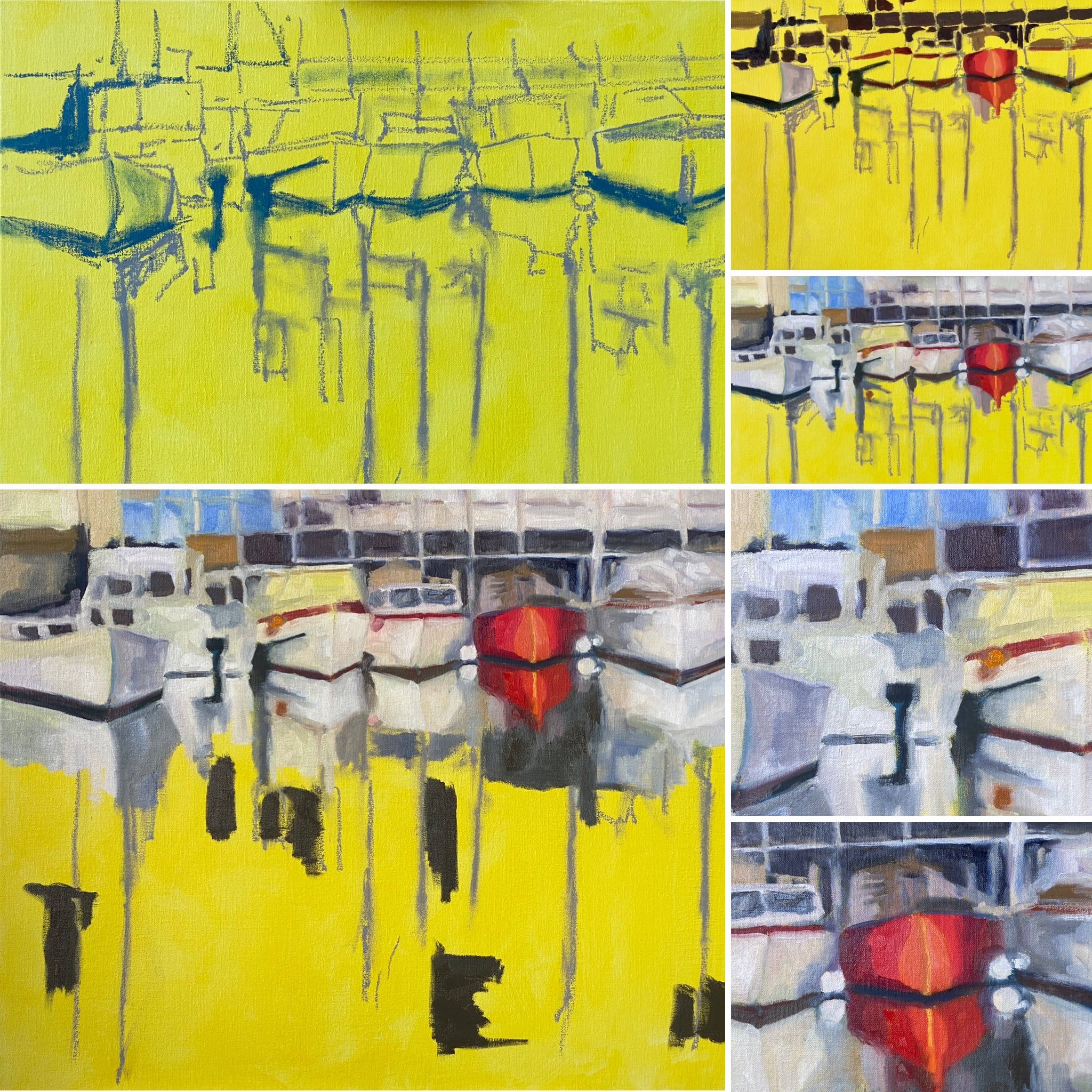
The making process was a process of simplifying to reach the core elements of my investigation and curiosity.
Work-in-progress on “Harbouring Hope” by Terrill Welch, 23.6 x 27.5 inches (60 x 70 cm) oil on linen. Sunday, 20 September 2026.
I took a step back and then leaned into the spaces between the shapes and the light. This gave breadth as well as depth for emotion and energy in the work. The painting took shape over a period of six days beginning with oil sticks over a yellow acrylic ground on stretched linen.
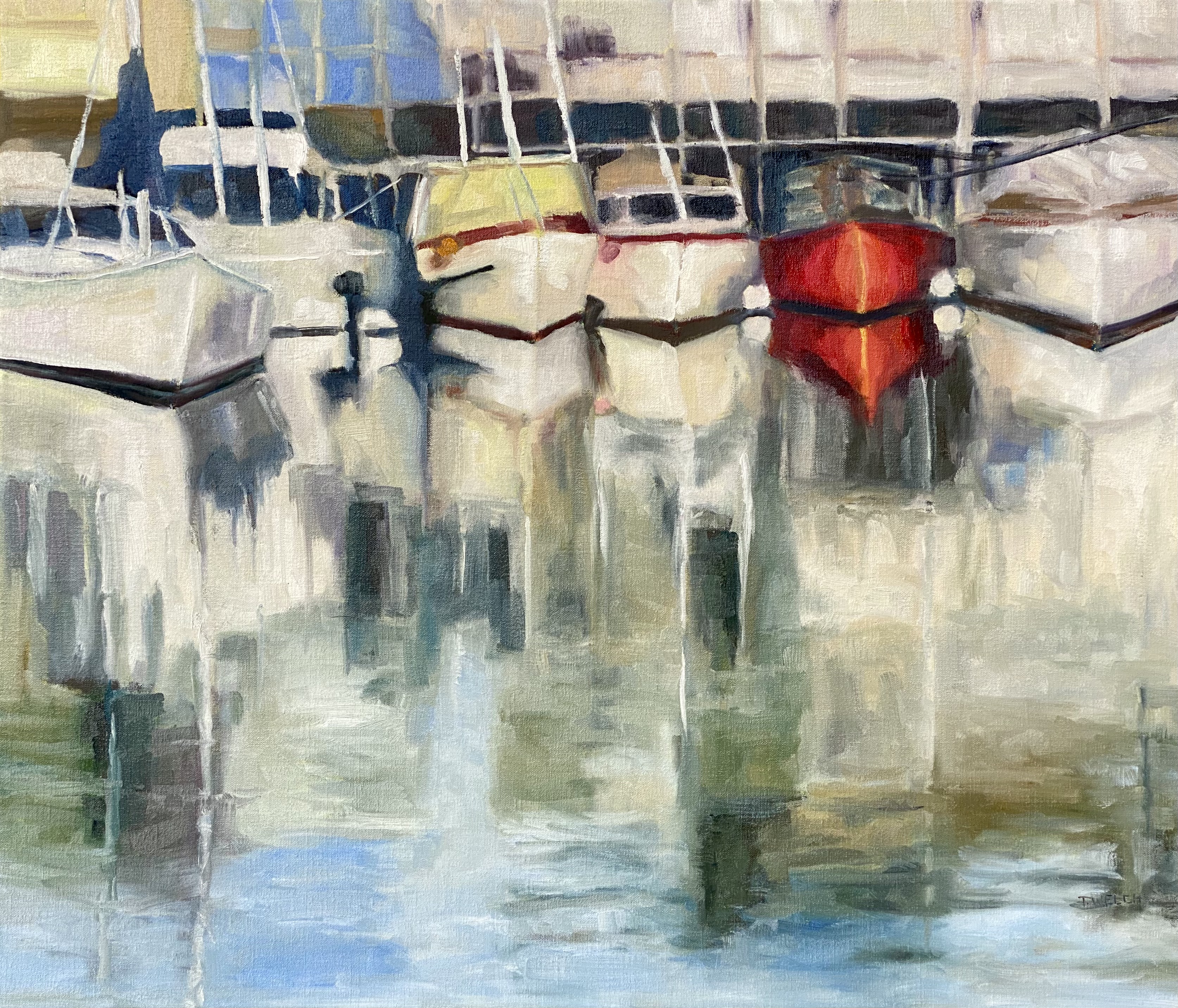
Finished Painting:
“Harbouring Hope” by Terrill Welch, 23.6 x 27.5 inches (60 x 70 cm) oil on linen. Monday, 21 September 2026.
Making Notes:
I had just come from visiting a friend in the hospital and we stopped to have a picnic dinner in the park beside the marina at (what is now called) All Bay in Sidney, British Columbia. I took some reference images because the shapes and colours felt hopeful and there was a peaceful, reflective, deep calm about munching on sandwiches and looking out into the bay. I want to investigate the big gestures and emotions in this moment without getting caught in the weeds of visual or thought preciseness.
Reflective Analysis:
The painting of boats in a harbour is an old subject and likely has been happening as long as there have been boats. The question is, can I offer something more or unique in my approach? I reach into the big abstract-like shapes of the boats to carry the emotion of the work through their soft reflections. I pushed the horizon line high and let the sea in the bay hold the sky for me. I focus on the feeling of the moment rather than the details which allows the structure of the work to read true without getting caught up in the weeds of specifics and my own thinking. To pull this off, my brushstrokes must be filled with concentration, intuition and repeatable, confident, decision making. No second guessing. Make a mark and leave it. Make another mark and leave it. Paint something out, then paint it back in with the same confidence. It is not about getting it right but knowing what must be left behind, from the first mark to the last mark. The relationship of the marks within the composition outweighs architectural accuracy. The boats may feel like they are floating in the painting but no boat maker would build them this way. The most important aspect is that the work, in my first viewer’s eyes, reads as emotionally and physically whole.
Reflexive Analysis:
I have been musing about how there are no shortcuts in painting as there is in life. I must bring my whole vulnerable self to the easel, every time. I must be willing to investigate and admit, at least to myself, why I paint what I paint. In this case, it is part of processing the illness and healing of a dear friend who is in the hospital. We have been friends for over thirty years and I feel we are somehow both too young to be faced with her circumstances. But in truth, age has nothing to do with it. Illness has no fixed criteria. The details are private and personal but the experience is universal to human kind. Again, my painting practice takes on an undeniable reparative or healing undercurrent that isn’t visible in either the painting process or the end result, unless I choose to share it. I don’t usually paint boats in a harbour. In fact, I know little about boating or marinas. But I do know the sun and the sea. The boats are simply supporting actors for using shapes, forms and colour to facilitate a harbouring of hope.
Key Findings:
There is an openness in the space offered in this paint through the boldness of the shapes. This reminds me of painting the seafloor and focusing on the close up views of the seafloor and allowing abstract elements to press against more figuratively mark making.
Anything else:
I like the freshness and the depth of this work. I couldn’t have stopped myself from painting this painting no matter the risks of the derivative nature of the subject. I am glad that critique didn’t create a barrier but was left as – duly noted, before I proceeded.
Figurative/Abstract Self Assessment Band-Scale Rating between 1-10: 4-7
The background offers a loose abstract network of brushmarks while the tree is given figurative prominence with large shapes holding the composition within a visual space of warm morning summer light.
Reference Gathering:
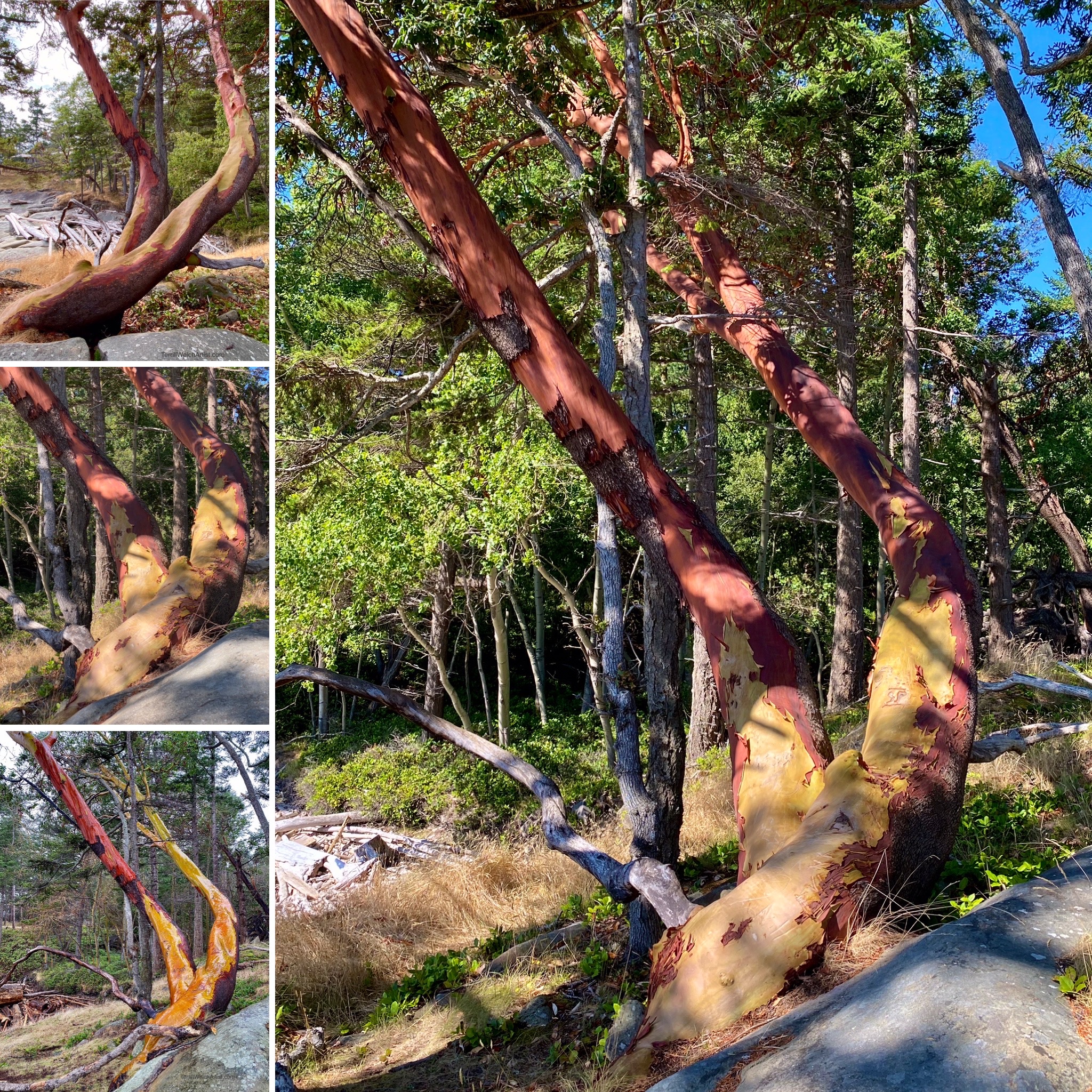
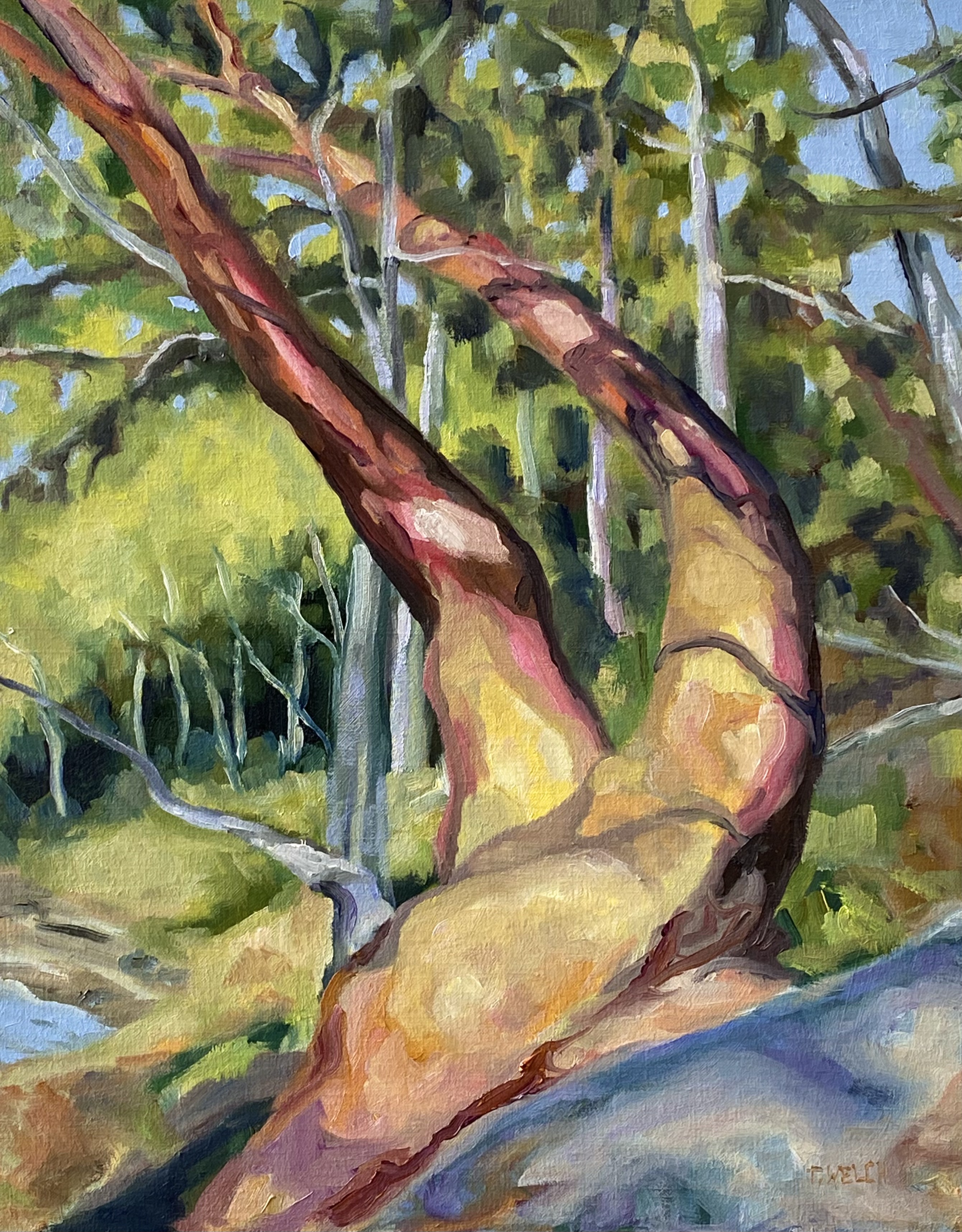
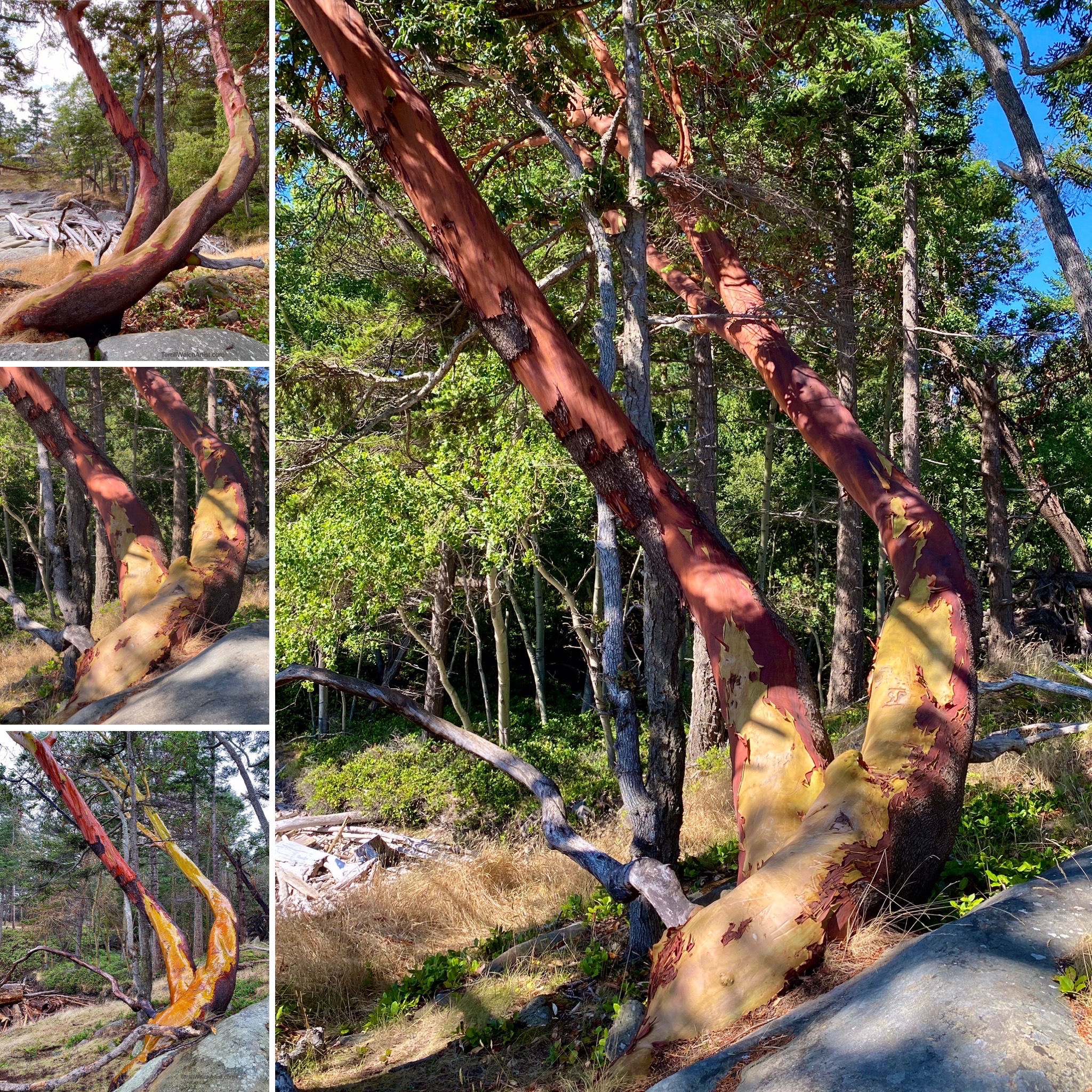
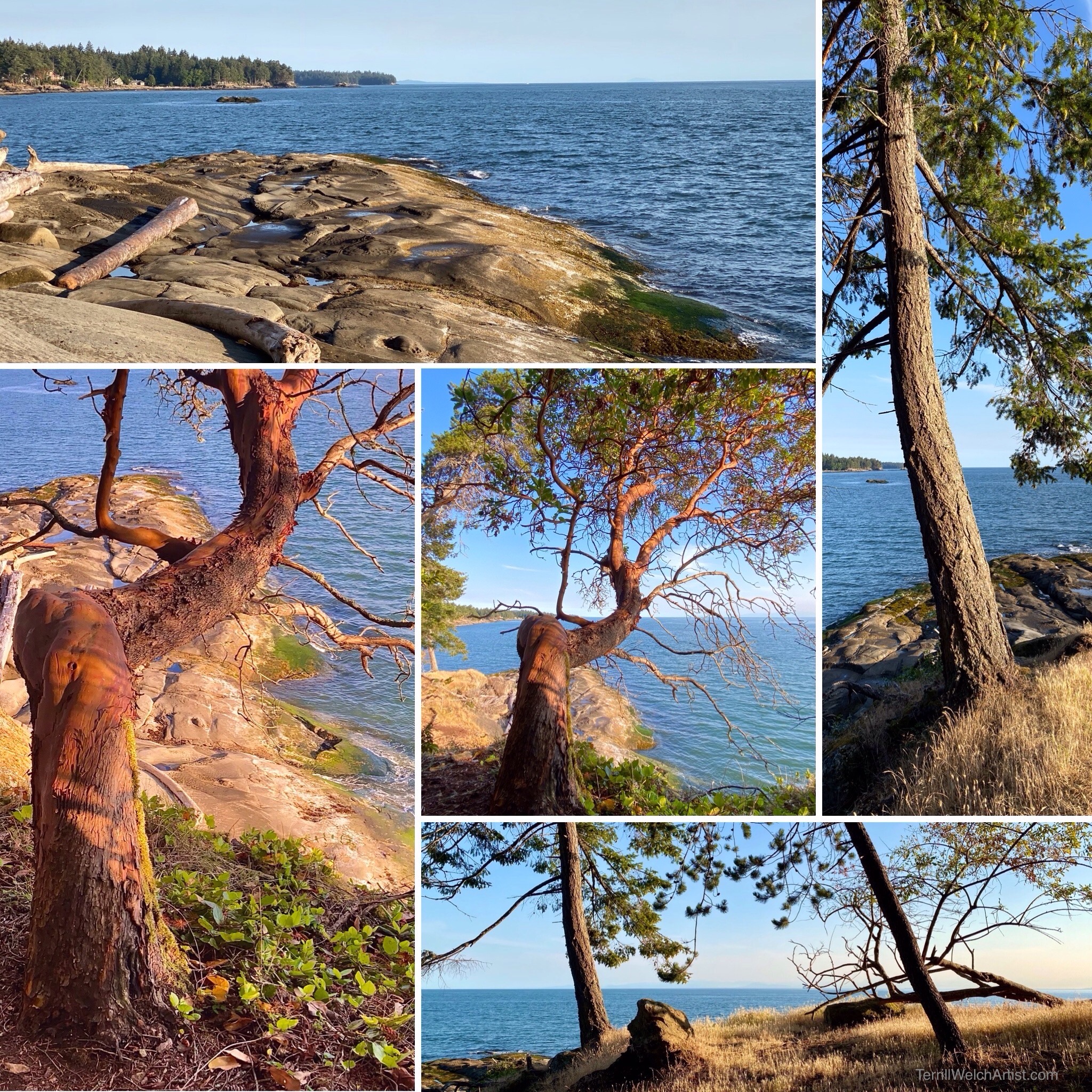
This is a commissioned work and stems from an art collector’s shared love of this specific arbutus tree that resembles the long legs of a woman elegantly reaching for the sky. I have references going back years but chose just a few, between August 2023 and August 2025.
Collection of reference images between August 30, 2023 and August 20, 2025 by Terrill Welch in preparation for painting “Lady Arbutus” in August 2026.
Making Process:
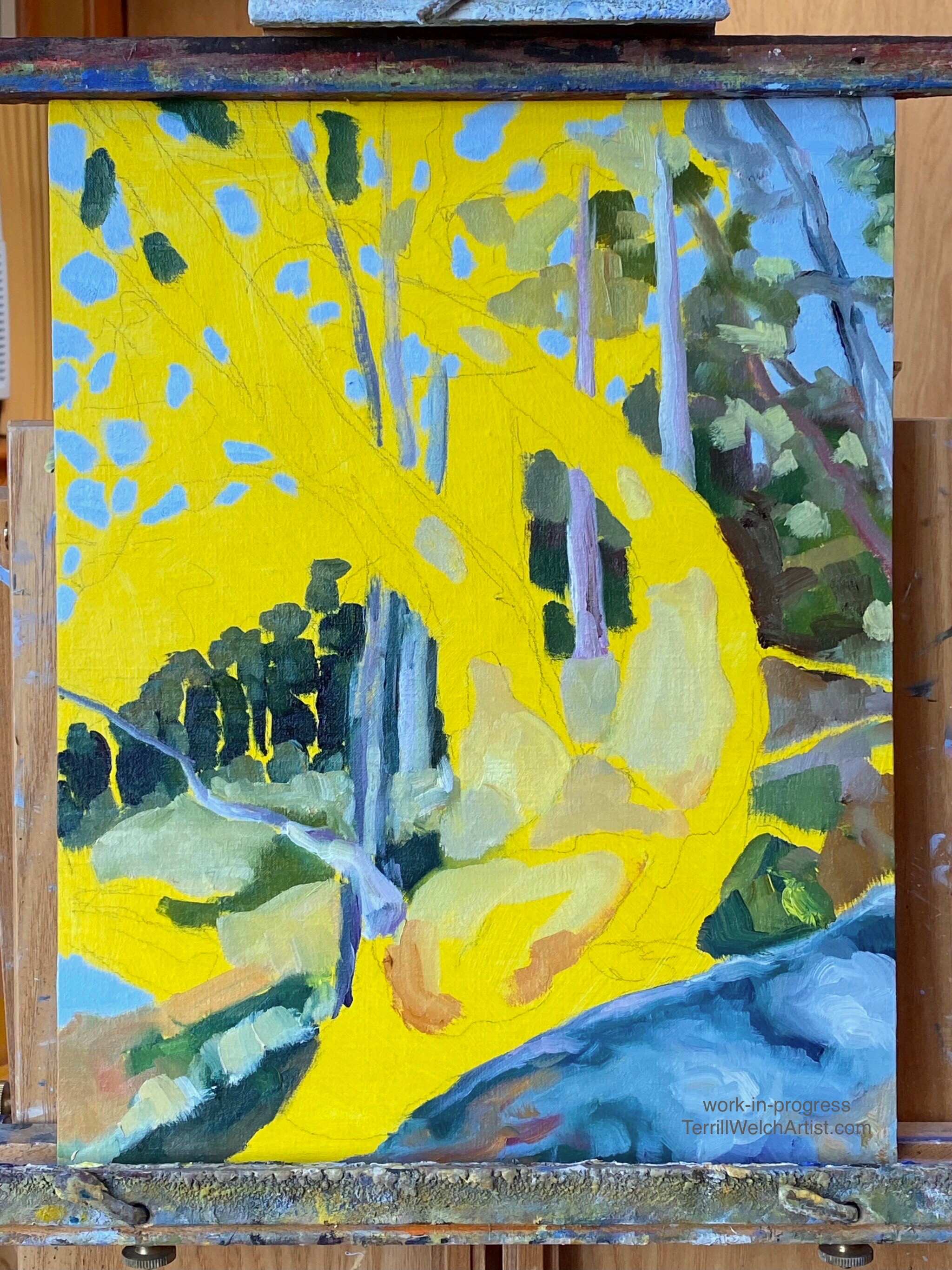
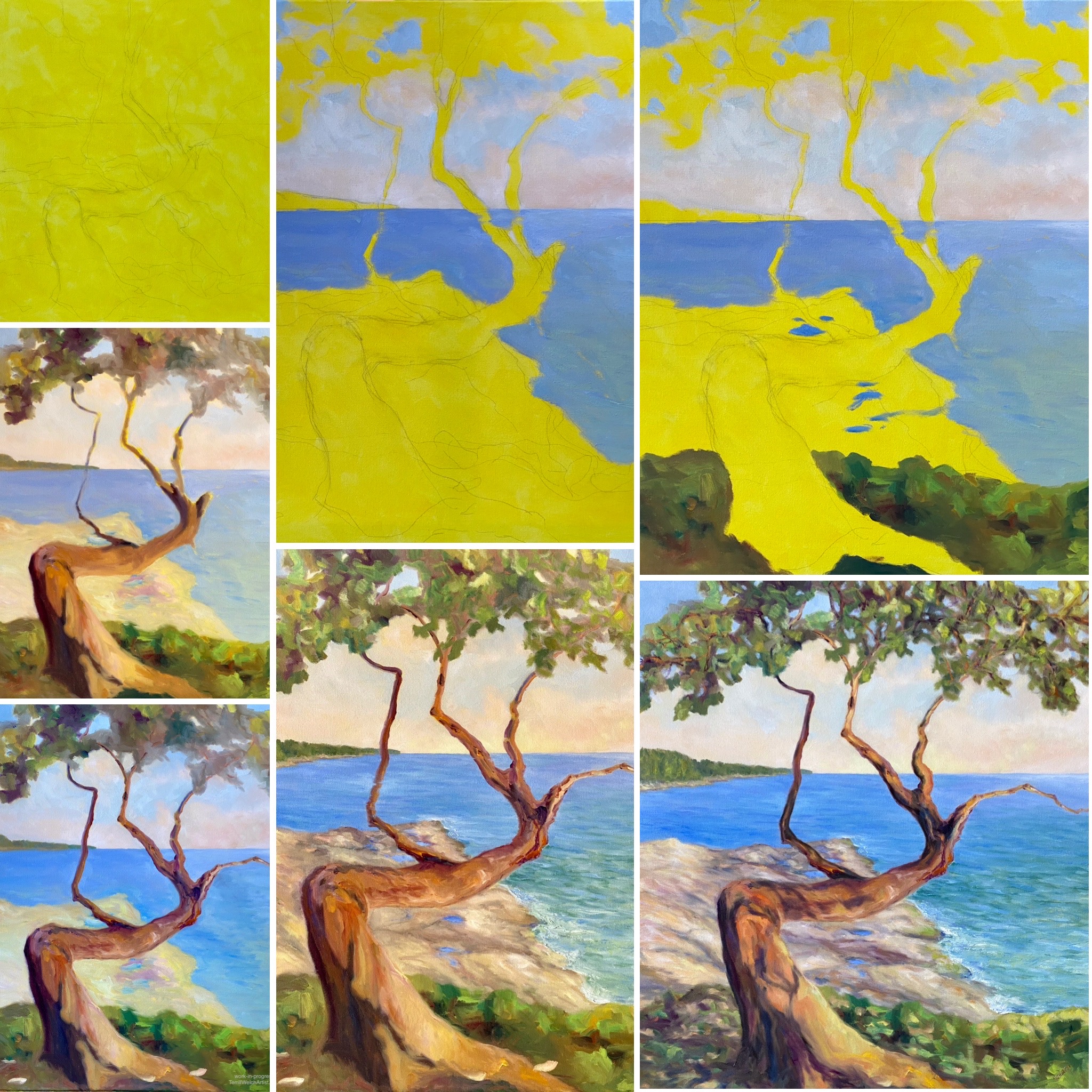
My studio making process proceeded over a few days in 2-3 hour painting sessions. I required pauses to really listen to the painting and what it was asking of me. I also mentally invited the art collector into my musings with nature so that I could draw on the abundance of influences between us three. The focus is on a portrait of the arbutus tree while keeping a sense of context and hints of the ocean behind and beside the viewer. I have a special relationship with not just the arbutus tree but also the polar trees on the middle left. There are very few on Mayne Island but they grew in abundance around my childhood home.
Collage of work-in-progress images for Lady Arbutus by Terrill Welch 14 x 11 inch oil on linen covered birch wood.
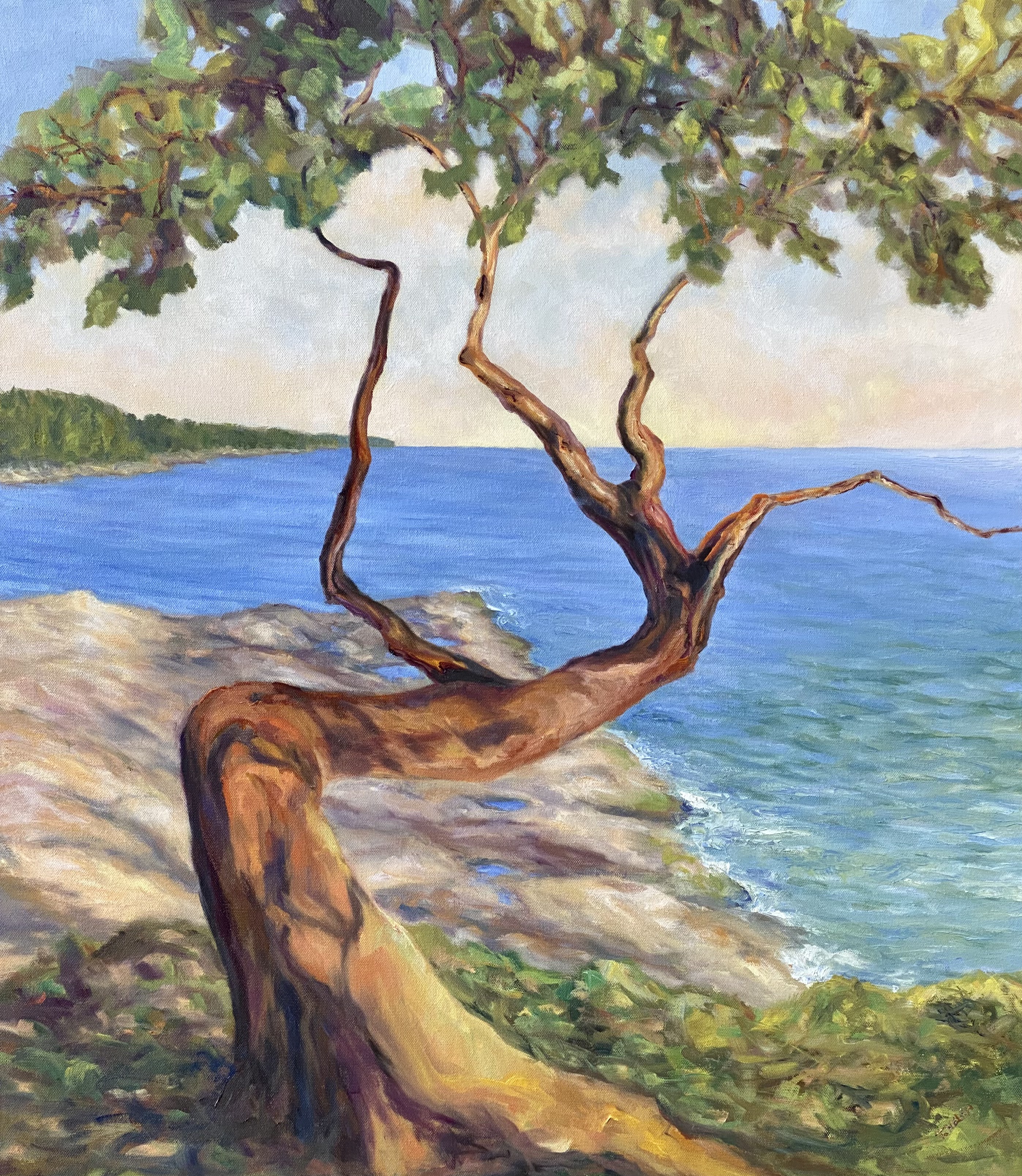
Finished Painting:
“Lady Arbutus” by Terrill Welch, 14 x 11 inch oil on linen covered birch wood. Completed Wednesday, 5 August 2026.
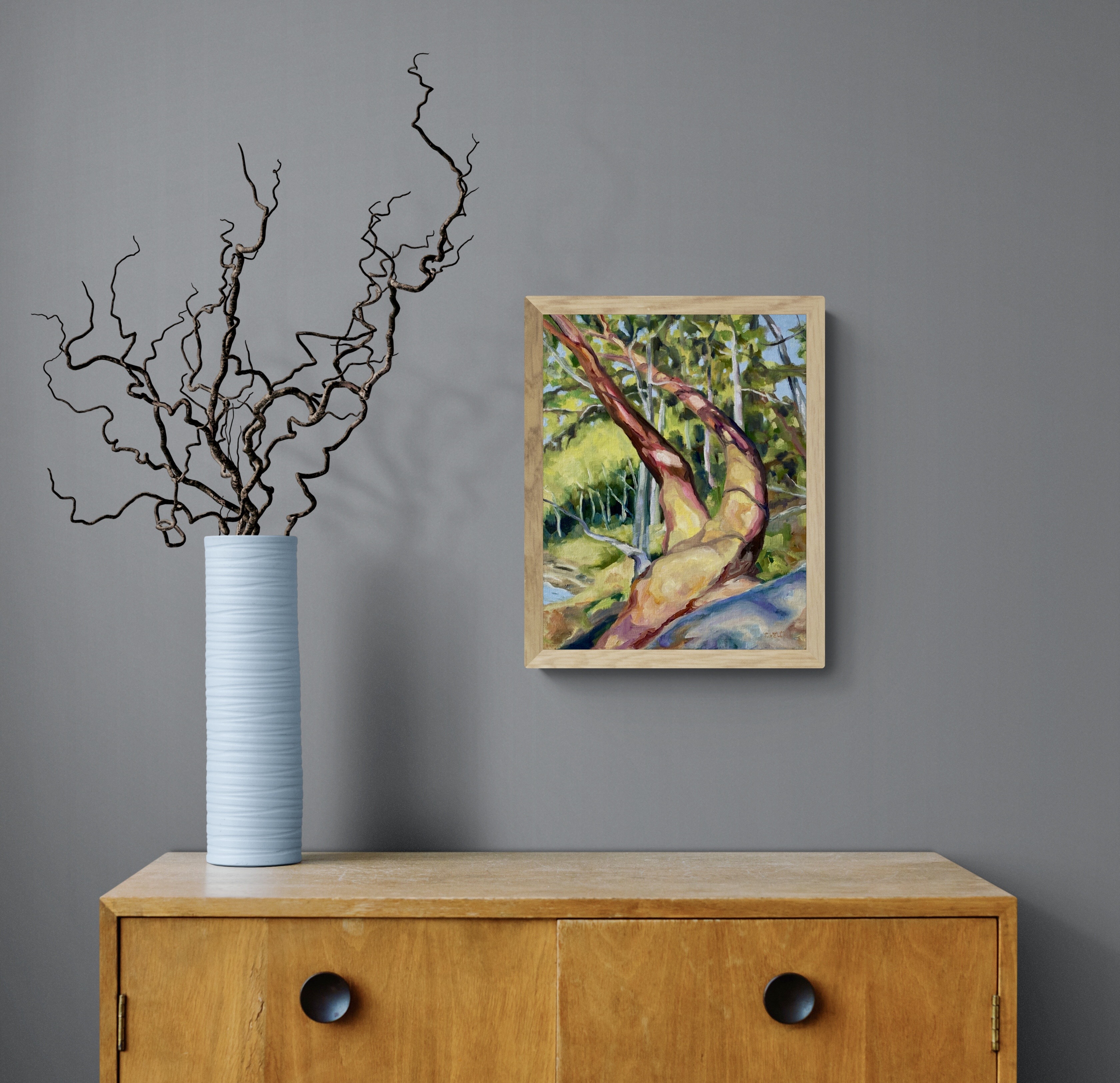
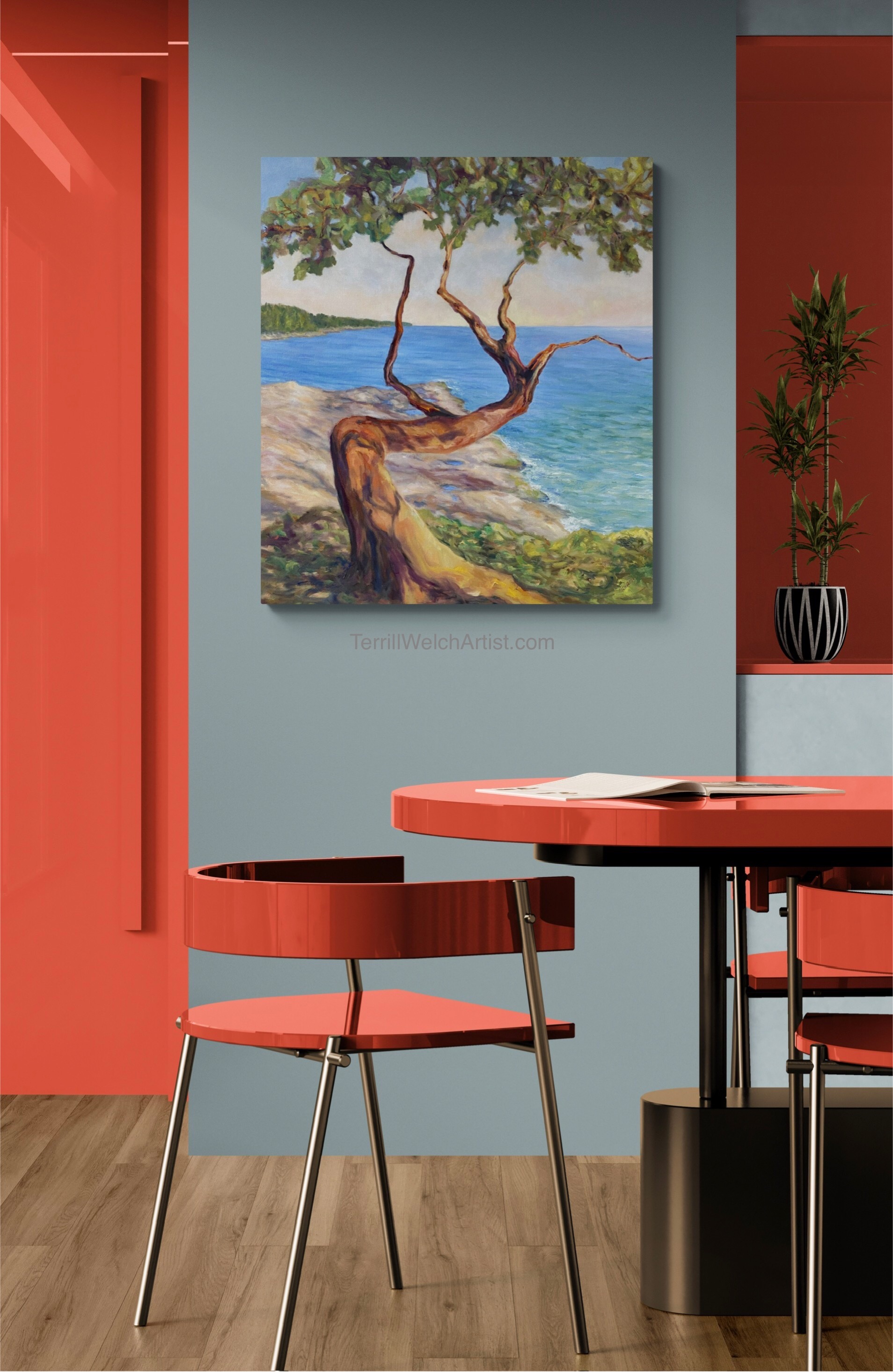
For scale, here is the painting in a digital viewing room.
Digital room view – Lady Arbutus by Terrill Welch, 14 x 11 inch oil on linen covered birch wood.
Making Notes:
A ferry whistles in Active Pass on the other side of the island and echoes a response to the August sun pressing towards it through the trees. The calm ocean behind me pools at the bottom of the ridge next to a group of scrubby polar trees. Deep shadows offer a counterbalance to the bright trunks of the arbutus trees and rich soft greens of the grove. What would it like to be this arbutus tree tucked in next to a few strong firs beside the Salish Sea? I can feel the effort of stepping up on the weathered sandstone beside it as I traverse the narrow trail from the point. I like to pause for a few moments and just share its company before moving on. The artwork is a complex interconnected view to render in paint between dancing sunlight and thick growth reaching for the skies. Much is left to interpretation in an integrated network of suggestive figurative to abstract mark making.
Reflective Analysis:
For this painting, the complexity of vegetation and terrain was demanding to navigate into paint on a surface without over simplifying or offering so much information that the poetry of the moment is lost. I held significant pauses as I worked in order to make decisions about the order of things and then worked in a flurry for a while only to pause again to consider. The types of brushstrokes were decided by subject as I was mindful of only offering just enough to bring the work to life and present the essence of being this specific arbutus tree on this specific day.
Reflexive Analysis:
Commissions are different from work that is solely decided by my commitment and curiosity. I do have a formal process that allows maximum artistic freedom but it is still unique from my self-directed body of work. With my commission process, the art collector chooses the subject and size and a price is determined. I gather my own references and then paint the subject as I see fit. The art collector then decides if the work is to their satisfaction. If not, the work goes into my inventory and I try again. Payment for an artwork happens once a final decision to accept a painting has been made. This gives me maximum freedom as the painter and is the lowest risk for the art collector. Over the years this has been a win-win for everyone. That said, I only accept a very few commissions each year as they frequently take me away from whatever I am working in my studio practice. Not this painting though. It fits nicely into my current focus.
For this painting, I am aware that there is an alignment between how I approach my work and the lived experience of the art collector. So there is the Lady Arbutus tree and her immediate environment on this specific day that is then enriched by around nineteen years of my having walked and sat next to her in all kinds of weather and throughout the seasons. Then there is my awareness of the art collector’s numerous similar experiences and her many conversations with me over about half as many years. The art collector has entrusted me to bridge these various experiences and bring them to the surface of the painting in as much of an unencumbered way as I can imagine. But influences are like seed burs. They sink their hooks into my experiences and come along for the ride every time I dip my brush into the paint. It is something I must notice and also make peace with in order to bring the best I have to whatever work I am creating. Like all experiences, painting is not a pure isolated practice. The process is embedded in a multitude of interrelated and related variables. From this sea of information, a painting comes to rest uneasily on a surface as if by some alchemical, divine intervention. Even though the brushstrokes are made by my own hand, from my own observations and study, no one really owns these results in a lineage sort of way. It would be like saying that the dried thyme added to a stew was the only ingredient that mattered. It is important but, as with the painting, it wouldn’t be much without everything else.
Key Findings:
This painting was a great reminder to trust my creative process and stick with it, even when small doubts creep in around the edges.
Anything else:
The directness of working on this painting reminds me that I can benefit from creating without direct canvas and paint contact, even if it does not result in finished work. While I finished this painting, I also made some painted paper to cut up for collage puzzles. These never seem to amount to anything but they do offer a sort of different texture to my practice. Now that I have finished this work, I have set my paints aside to further explore these bits of hand coloured paper while I think about my overall research question and working definitions for this next body of work – Close To Home.
I am standing at the easel this morning and decided I would write while taking a teabreak. The painting catches the glare from the late morning sun outside the art studio window. I leave it and the brushes where they were put down and glance at the finished painting with almost dry edges that I thankfully had remembered to cover before I started.
An early August morning in the art studio of Terrill Welch with work-in-progress.
A rough sketch had been completed yesterday and set up on my old French Box easel so that I could settle right into painting this morning.
A rough sketch by Terrill Welch, on a 14 x 11 inch linen covered birch board surface, is set on a French Box easel with the palette below Sunday evening in preparation for the next morning’s painting session.
This is a commissioned work and stems from an art collector’s shared love of this specific arbutus tree that resembles the long legs of a woman elegantly reaching for the sky. I have references going back years but chose just a few, between August 2023 and August 2025. It seems fitting that I would begin painting it in August 2026.
Collection of reference images between 30 August 2023 and 20 August 2025 by Terrill Welch in preparation for painting “Lady Arbutus” in August 2026.
While I am painting, I do not think of much but rather focus on what I am remembering and feeling about this specific tree and this specific place which is no longer publicly accessible since much of the land around it was purchased as part of a conservation land use agreement. I cherish and I am deeply grateful for the vision of the landowners and those that worked to acquire the lands for this reason. It is a small price to pay to respect the request to stay off of the very point of Edith Point that is still held as private land. This aside, I lean into my memories again.
work-in-progress on the easel of “Lady Arbutus” by Terrill Welch, 14 x 11 inch oil on linen covered birch board.
There is a ferry whistle in Active Pass on the other side of the island that echoes a response to the August sun pressing towards it through the trees. A calm ocean behind me pools in the bottom left of the painting. It isn’t there in the reference. This won’t matter and it might not even stay to the finish line. For now it needs to be there. Deep shadows offer a counterbalance to the bright trunks of the arbutus trees and rich soft greens of stunted poplar trees in the grove. What would it like to be this arbutus tree tuck in next to a few strong firs next to the Salish Sea? Answering this question is a significant part of the job of this painting. Though it may indeed capture a beautiful moment, that is not its purpose. It is a working painting and will bring a sense of being close to home and all that this means. This is true for most of my paintings. They are not collected as decorative objects or for status or for their uniqueness but rather for good company!
This brings me to a book I am reading and a question. Can paintings have an everyday use, like a hand turned pottery mug or a hand knit sweater? The Japanese philosopher, art historian, aesthete and poet, Soetsu Yanagi (1889 – 1961), proposes that true beauty does not come from straining to be remarkable. It comes from a kind of forgetting. Mingei or “crafts of the people”, is used to describe an approach and an object that “must be wholesomely and honestly made for practical use” (Yanagi, 2019, p. 5). These objects have been made without a need to be special or important and without grasping for attention. Further, the objects grow in beauty by their daily use. They are objects that have been made well and keep us company as we move through our ordinary lives. Yanagi in his book The Beauty of Everyday Things is speaking about anonymous folk craft and something that is different from what we understand as aristocratic contemporary fine art. However, I want to consider how my paintings might be and most often are acquired for their use value — not for decoration, not for spectacle or status but rather for daily company. This daily company is of course the underlying practice in which my brush touched the canvas in the first place. The paintings are the result of my conversation with nature that then invites the viewer into these exchanges. Skill, practice, the quality of the materials matter, just like they do for the craft worker making a mug or weaving a basket. The works are not about being unique, though this over time happens without this being the intent. I mostly want to examine how a painting, as a crafted object, has a use value in our ordinary day, beyond an exploration of an idea that would lend itself to being considered contemporary art which, for the most part, is less interested in skill mastery or material quality. More importantly, can a painting hold both these philosophical and practical frameworks at the same time – humble usefulness for daily company and the successful exploration of a unique idea or concept? These are the questions I am asking as I read while knowing that my work does not have a physical use, definitely is not anonymous, and often it is not, broadly speaking, unique enough to fit easily into contemporary art sensibilities (presuming contemporary art can genuinely claim such a thing as sensibility).
Well, teabreak is over. It is time I set this musing aside and get back to the easel and see where this painting takes me next.
Work-in-progress on “Lady Arbutus” by Terrill Welch, 14 x 11 inch oil on linen covered birch board.
Reference list:
Yanagi, S. (2019). The Beauty of Everyday Things. Penguin Books.
Figurative/Abstract Self Assessment Band-Scale Rating between 1-10:
This work sits primarily at “4” with Camille Corot and April Gornik (Impressionism is a five and in the middle between figurative at 1 and full abstraction at 10). Yet it is a closer more intimate view that has us crouched next to the arbutus tree for company. The foliage above and below is abstracted but not noticeably so. The rest is clearly a figurative tree, sandstone shore, sea, sky and distant shoreline.
Reference Gathering:
My references are from an early morning walk that saw me at this location on Edith Point at just before 7:00 am on Monday, July 6 2026. The sun had risen a couple of hours earlier but there were still hints of warm morning light. There is the arbutus tree of course but it was the totality of the morning’s walk that will later resonate in a more complete memory onto the canvas. The sandstone shore wasn’t just viewed. It was walked on and sat on while I ran my fingers over its sandpaper-like surface. The sea sounds were as soft as warm morning air flickering across my cheeks. There were other trees close by but I chose the arbutus and in the end its company is outside of our view.
Reference inspiration for Solace Between Sea and Sky by Terrill Welch.
Making Process:
My painting process begins with a few composition lines. I have the notion of painting the tree “From the Ground Up” so that I can feel the forest overhead as well as under my feet. Yet, how will I create such a feeling? I also wanted to be standing “with” the arbutus tree rather than looking “at” it. I am listening to the arbutus tree tell me its story of time in what is a long and meaningful conversation. The painting process takes place over 12 days with moments of pause so layers can dry. But also pauses for the painting to decide what it needed from me. The last image in the collage is not the final painting yet but all significant decisions had been made at this point. My simplifications and exaggerations are in full view. Memory is often like that. We leave things out and make up other things to capture the inner resonance of what we want to convey.
Painting process for Solace Between Sea and Sky by Terrill Welch.
Finished Painting:
Solace Between Sea and Sky by Terrill Welch, 31.5 x 27.5 inch oil on canvas. Completed July 25, 2026.
Making Notes:
Early in the morning I hiked along the outside trail early of the Edith Point Conservation Lands next to Strait of Georgia. During the summer the sun rises far enough north to slam this shore in brilliant sunlight for the first view hours of a day. The receding tide leaves small pools of seawater along the lower parts of the sandstone shore. Low clouds on the horizon still have a bit of an orange popsicle hue. What might it be like to be this specific arbutus tree rooted deeply along the high part of the bank and stretching day after day for every casual ray of sunlight? It is a quiet determined striving that I can take solace in. I soak up the moment for as long as it can last. Seconds really. Or maybe an eternity. Each brushstroke contains purpose and random execution at once. It is not the mystery of discover so much as knowing where I am and wanting it stay. This painting opens up under my first viewer’s gaze. I can feel the grandness of expanse filled with early morning’s comfort and possibilities just as I remembered it during my hike.
DigitalRoom View for size reference:
Digital room view using the Canvy app showing at scale “Solace Between Sea and Sky” by Terrill Welch.
Reflective Analysis:
At this specific time, I am beginning a new thematic body of work that I have yet to form into a rigorous research question. I just know, I want to be with the trees and look down onto the seafloor where I have spent the past two years at the tideline painting close up work that I composed primarily vertically into “landscapes of the small” or “child’s view” compositions. One must hold the expanse of the shoreline above one’s head doing this work. I want to hold a grand view perspective again, even if I still crouch close to the earth.
Reflexive Analysis:
The title has the “solace” as a primary reference. I find in a moment of solace, as here in the company of the arbutus tree and taking in the sea and sky, there is also acknowledgment of pain or grief. The desire or need for solace necessarily describes the other. From my first viewer’s gaze, maybe due to my own painter’s hand, I can fully sense both of these halves that make a whole. I was raw and tired as I pushed hard to get the last of my assignment materials ready for assessment. We had lost our home support services due to retirement so my partner and I were working out how we were going to best do his showers together, just the two of us. We found a way but new routines are harder, for both of us, when someone has dementia. But in the end we came up with an even better solution than how he was showering before and a method that allowed him more independents under my prompts and supervision. So this arbutus tree is not just comfort but also a symbol or inner strength, perseverance and resilience. Standing with this tree, I have company during my most challenging doubts and fears and exhaustion. I come away from the view and the easel ready to continue and step just a little lighter from the warmth of such an early morning expanse and the recognition that all things are interconnected and whole, for this brief moment.
Key Findings:
I had the desire to keep a wide range of brush marks between figurative and abstract but that isn’t what the painting asked for and I knew better than to question its lead. The process from inspiration to completion of the work took 19 days plus another two days to organize my thoughts and data collection to write about the process. So if anyone asks how long it took, the answer is 50 years of a nature-centric, reparative painting practice plus 21 days of focused attention. This work doesn’t come easy. The paintings are moulded out of the blood flow that makes up my full sensory life and contemplated experiences.
Anything else:
The solution to an attempt that falls short of my intention is to try again. Keep painting, I tell myself. Just keep painting.
What might you do to continue with something that you haven’t quite yet succeeded in accomplishing?
Oftentimes, a painting doesn’t proceed in a straightforward momentum from start to finish. I need pauses to listen clearly to what the canvas is asking. Then the paint becomes tacking in the dry summer air and I must let it completely dry to the touch before continuing. Such was the case last Wednesday. I left it sitting in an awful awkwardness as if caught in an elaborate pose of painter’s frozen tag.
Work-in-progress of a new arbutus tree portrait on a 31.5 x 27.5 inch oil on canvas work by Terrill Welch shown on the easel in her studio. Wednesday, July 15, 2026.
I went to Reef Bay and couldn’t help myself but to gather a few random compositions of the seafloor. It is like picking berries. I don’t want to just let the ripe ones fall to the ground and forever lost. Instead, I collected them up in reference images and tucked them in the folder for “Close to Home”.
Nothing may come of them but they stilled something restless within me.
David had a birthday on Sunday and on Saturday family came to celebrate. That meant Friday was used for preparation and Thursday is still school for a few more weeks. So here we are with a dry to the touch painting late Monday morning.
The work-in-progress oil on canvas by Terrill Welch has now dried to the touch. She is ready to continue. Monday, July 20 2026.
I had about an hour available to me to paint. I took it! The linseed oil softened to the consistency of butter in the midday heat. I focused and then drifted on the gentle blue sea that has yet to come alive in the painting. I didn’t get far but still. It is something.
work-in-progress oil on canvas by Terrill Welch. Monday, July 20 2026.
We then went for a drive to get David a mocha and then stopped at a farm stand for the first of the blackberries and some sweet yellow plums. The deep warm of the sun kisses the air with their fragrance.
Local Mayne Island Blackberries and Yellow Plums. Photograph by Terrill Welch. Monday, July 20 2026.
As I drive, I am still thinking about the painting. It needs more paint I decide. And the arbutus tree really needs to pop as the star if it is going to be a portrait. Do I want to abstract the foliage both at the top of the tree and on the ground? Painting is a process of endless decisions and often there are no right answers but there might be better answers and one decision usually affects (undoes) several others that have already been made. But this is all the answering I am going to do for today.
The weather has stayed unusually dry and warm for this first part of October. It is suppose to change in the next few days. The trees and shrubs will be happy with a little rain and hopefully it will take some of the summer’s accumulated dust off of our car that we do not wash during the dry spells to conserve water. There has been a lot of wildfire smoke in the air recently leaving us with hoarse raspy voices to watch eery sunsets.
One of my favourite Arbutus trees is looking stressed but still holds up its corner along the shore at Georgina Point.
I put together two yellow cedar planters that I ordered from a Canadian company to go with the two of the the three ollas I purchased in the early summer from a local potter.
I had always thought that it was lack of sun that made things difficult to grow in my garden. Though this is definitely a contributing factor, I believe it is mostly that the big trees that take all of the nutrients and water from my garden beds which is the real issue. I discovered this by putting my first olla in one of my big clay pots. The mint and a few other things thrived even in the less than ideal amount of sunlight.
So we are going to try the cedar planters next year to add to my kitchen garden with a few salad greens and edible flowers. We shall see. The worst that will happen is that I will have to find new homes with more sunshine for the cedar planters. That I can do if necessary. This is not a cost effect plan really because it will take about five years of salads to pay for the supplies. But there will be much less waste and the salads will be fresh picked every day. I think it will be worth it.
On the painting side of things, I have been plein air painting…
It was a stunning afternoon and one that was way more delicious than the resulting painting on the canvas. Still, it might work.
I am also still doing the final review and corrections on the large “Arbutus Tree on Saint John Point” painting. It is close now. I only have one or two more brushstrokes to finally finish it.
“Arbutus on Saaint John Point” by Terrill Welch, 40 x 36 inch acrylic and oil painting. To be release soon.
Today, I will take down the rest of the still life show that I started to remove yesterday in ISLAND TIME ART. The gallery artists are dropping off new paintings and picking up the ones that came out of show later today. I will then get everything in the inventory and do the hanging before the end of the day tomorrow so it will all be ready for when the art room opens on Thursday. These change overs of shows are a bit of a push for me but I like curating and the end results always make me smile.
I also spent some time in the past few days pulling together and ordering a 2023 calendar for purchase. I think it will be the last year I do this, but who knows. Maybe I will grit my teeth and do it again. The product is expensive to purchase even wholesale and it has an expiration date which means hustling to get it out to customers before it loses its value. That said, I have dedicated fans who are terribly disappointed if I do not make this happen. So if you would like one, let me know and we shall figure it out get it to you. They are basically $42 CAD including tax and shipping within North America. If you pick them up from the ISLAND TIME ART room directly, you will save $2.00. I expect them to arrive early November if not before. Here is a bit of a sneak preview.
Well, this pretty much catches us up again for the moment. As you can see, I have been doing a lot of everything rather than settling in to just working in the studio or the art gallery spaces. It is sometimes just the way it goes. I admit to being a bit weary and wanting to conserve energy where I can but it is likely just the shorter days. I will simply be kind to myself and not push too hard until I can gather myself up again. It is a time that I consider to be “one foot in front of the other” until I arrive at some new place that is yet to be determined. Do you ever feel this way?
Hope you have a pleasant day and I shall check in again soon.
ONLINE GALLERIES include –
ArtWork Archive original paintings and acrylic sketches currently available
Redbubble painting and photography prints and merchandise