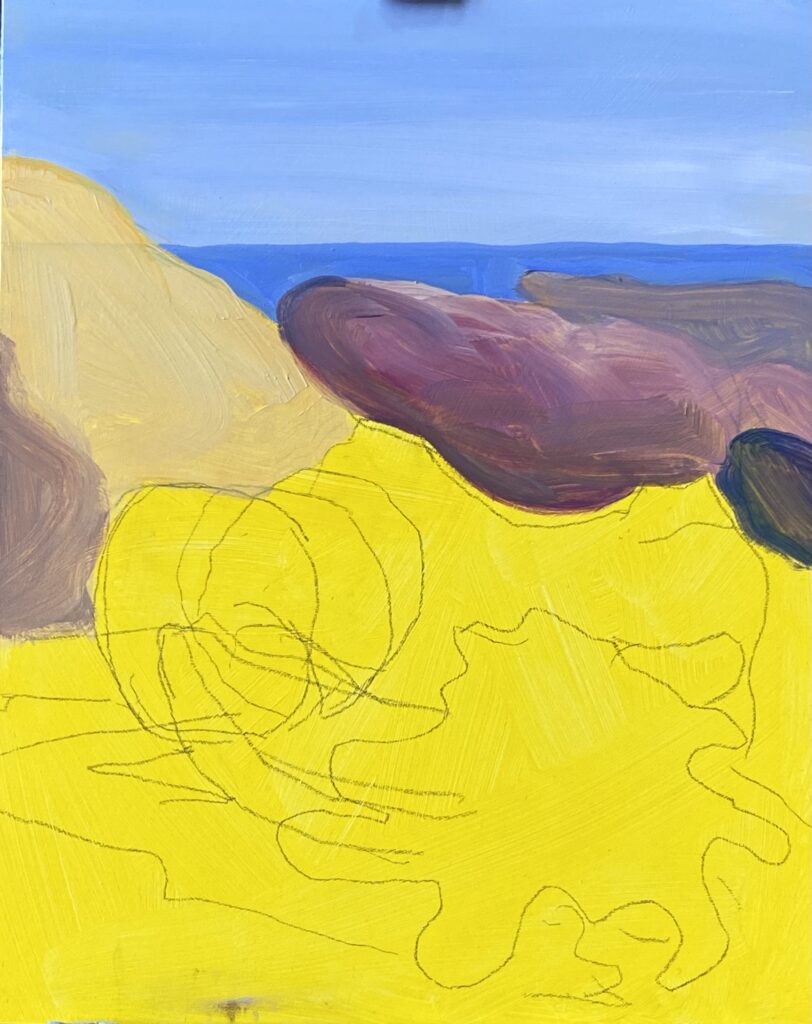
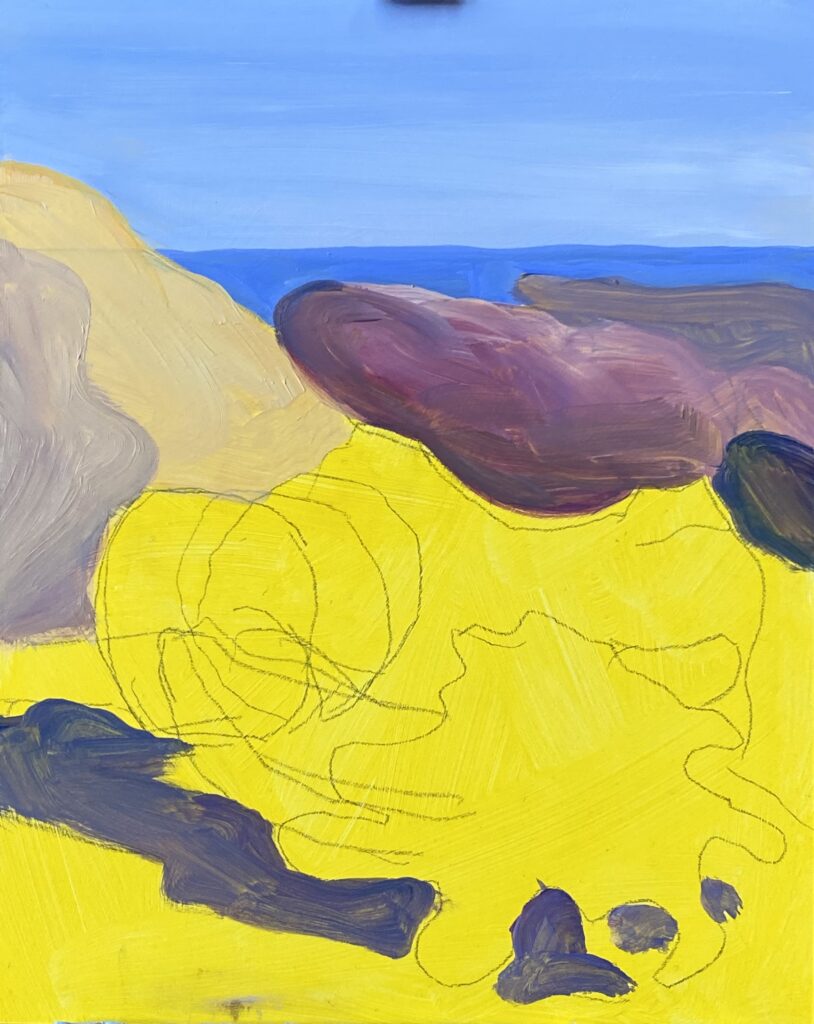
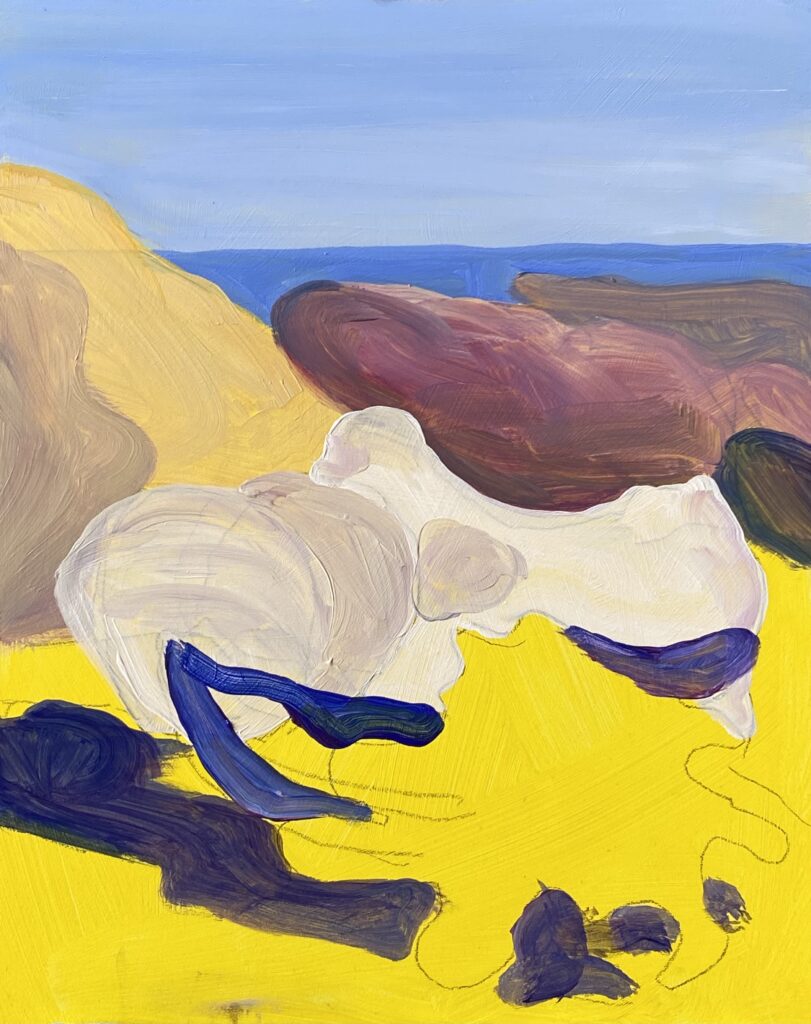
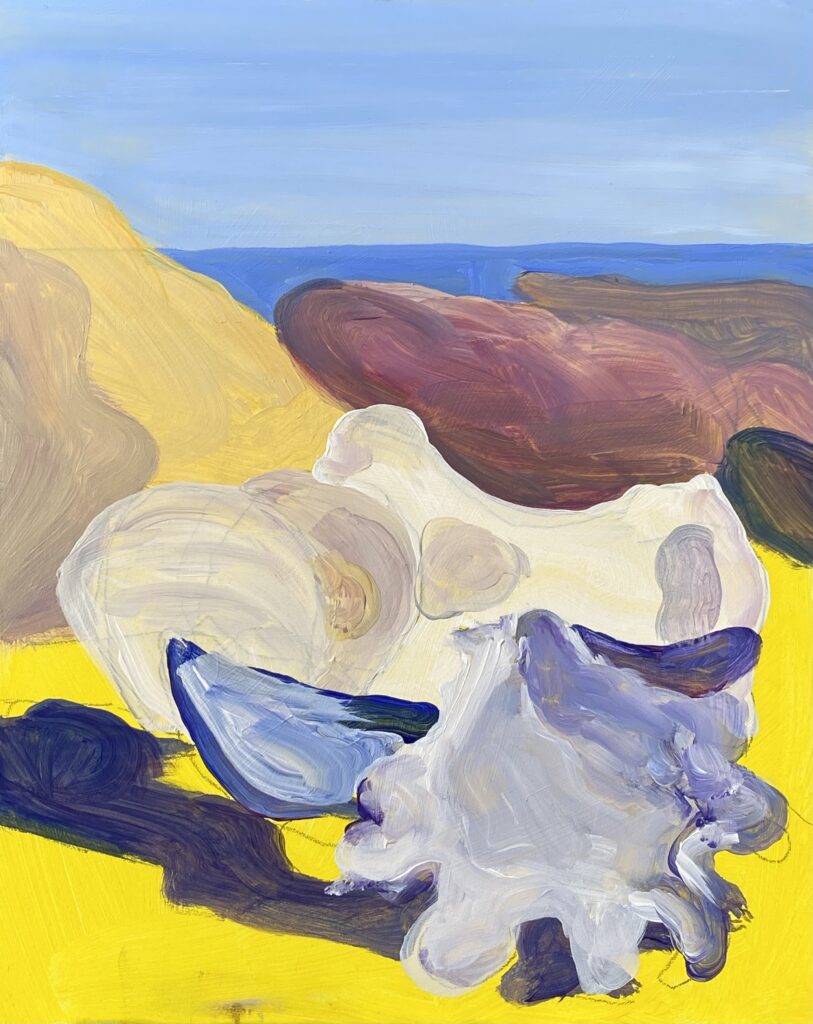
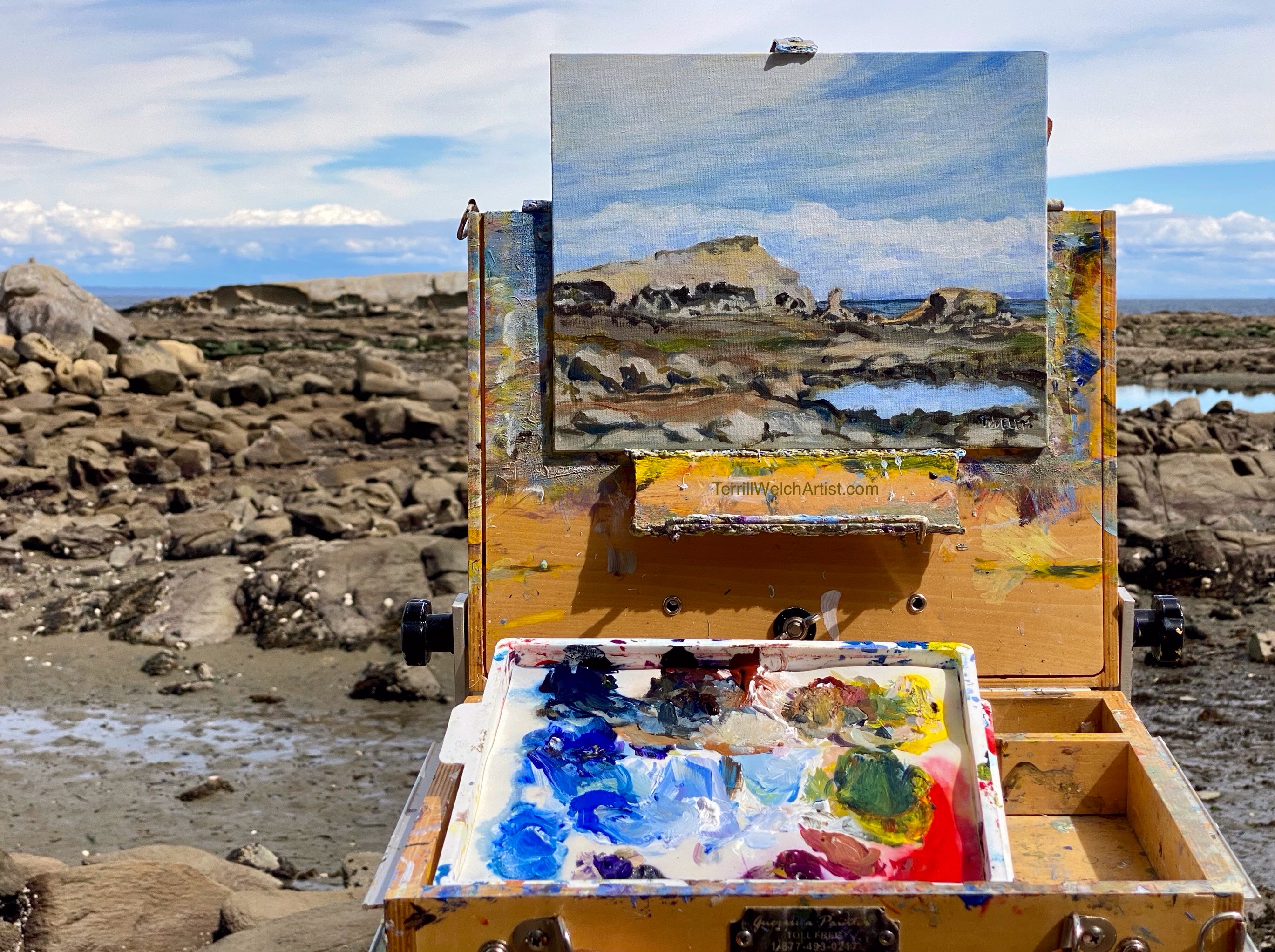
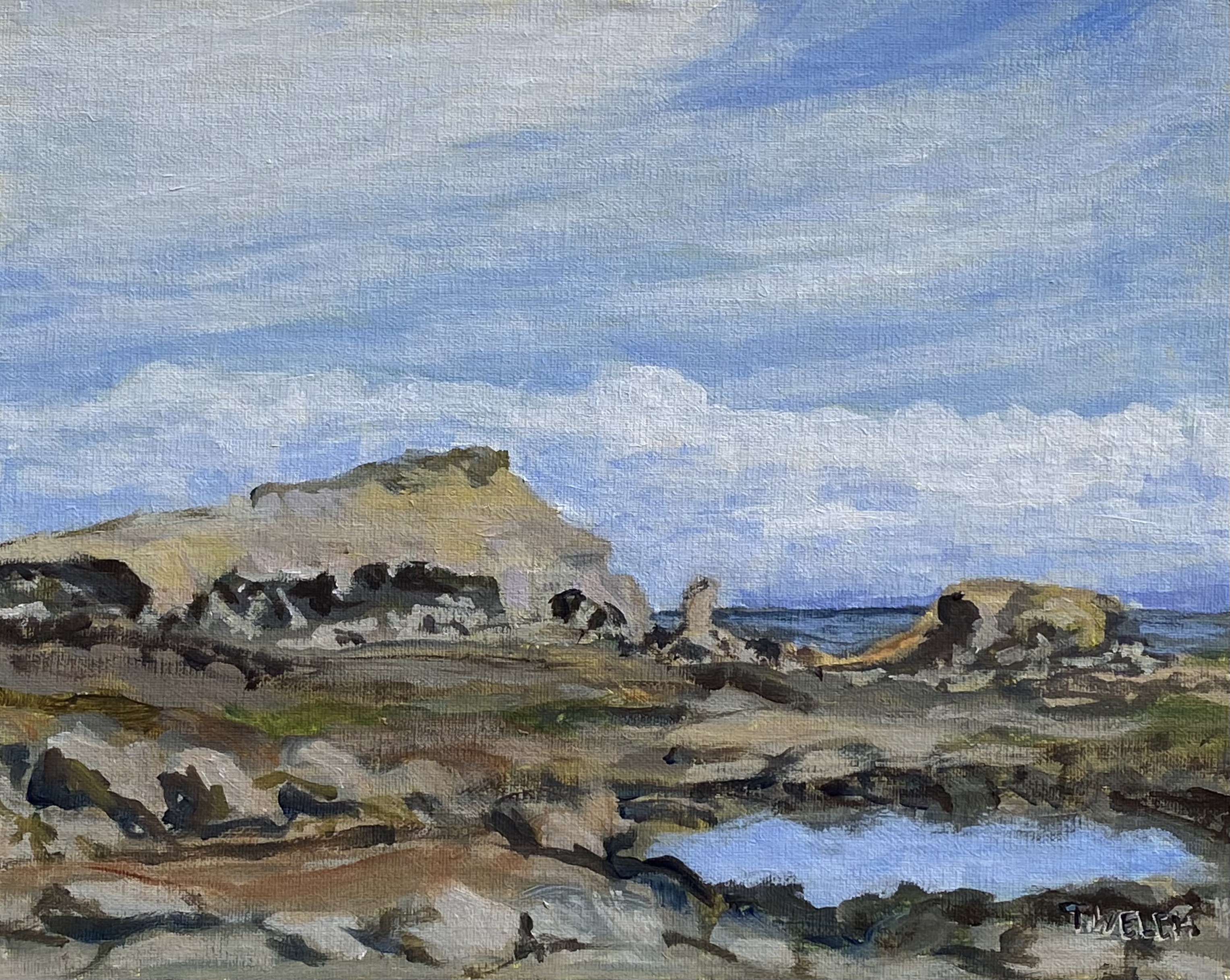
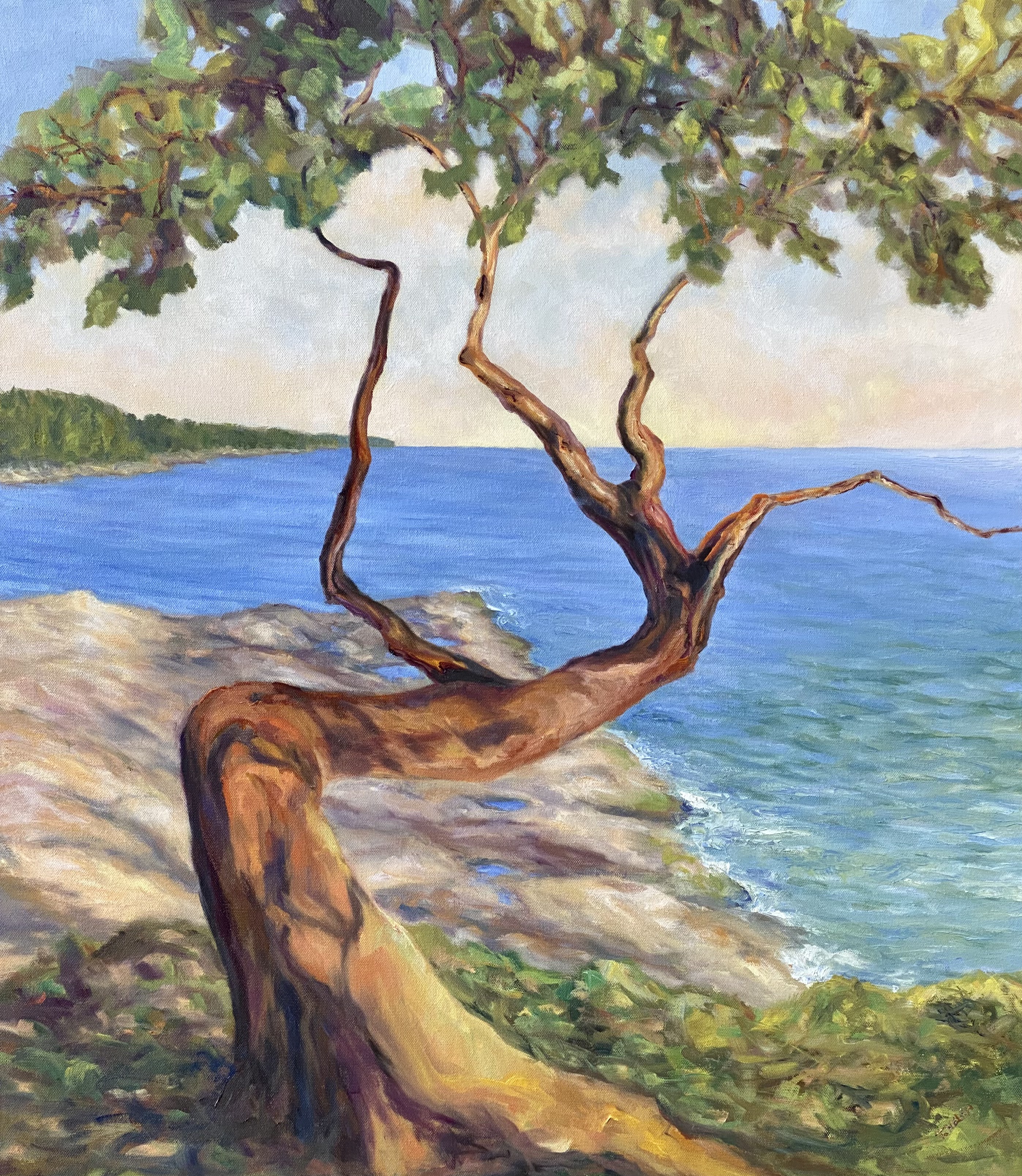
Seafloor Study within Time and Space

Tuesday, 10 November 2026

Now having completed the first Unit, “Research and Practice”, I begin the second of three units about “Contextual Perspectives”. This is a long post but definitely sets the direction for the next six months of studies.

Thursday, 11 April 2025

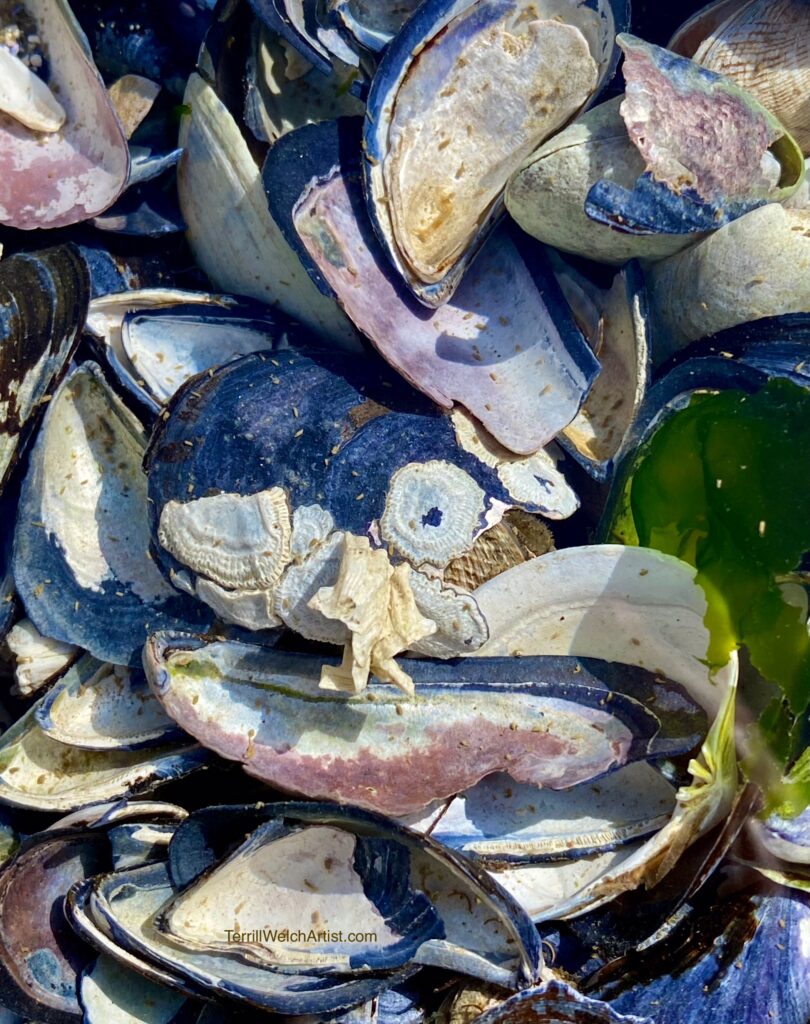
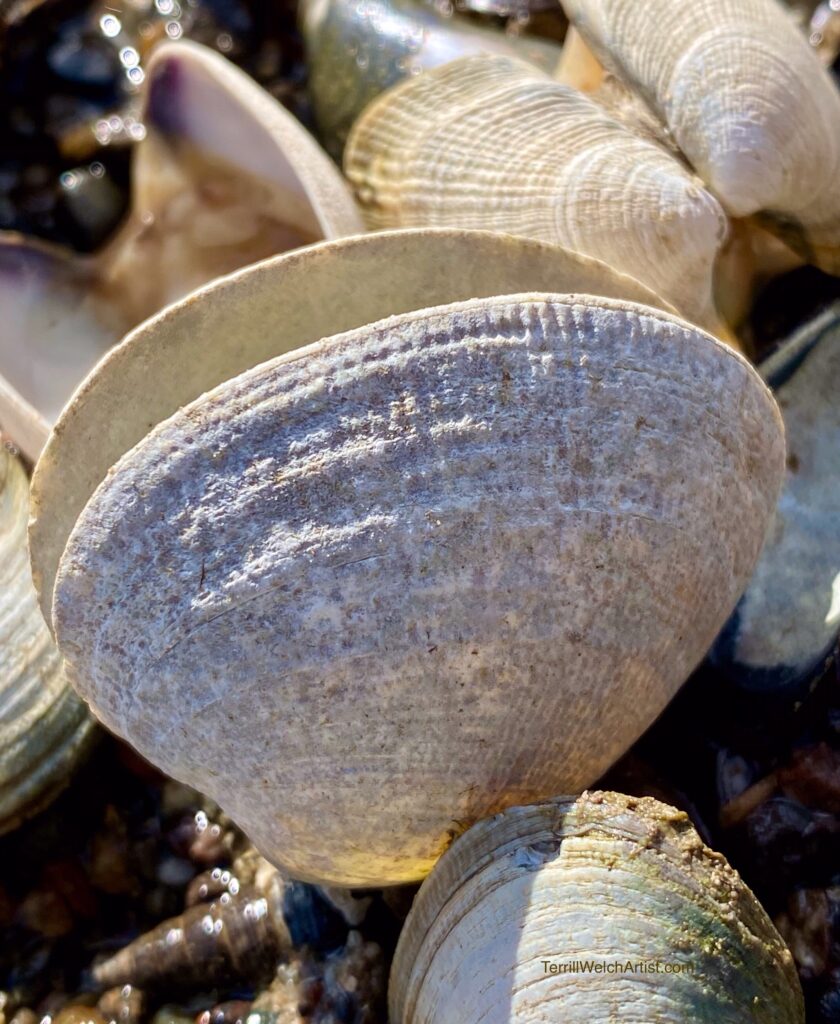
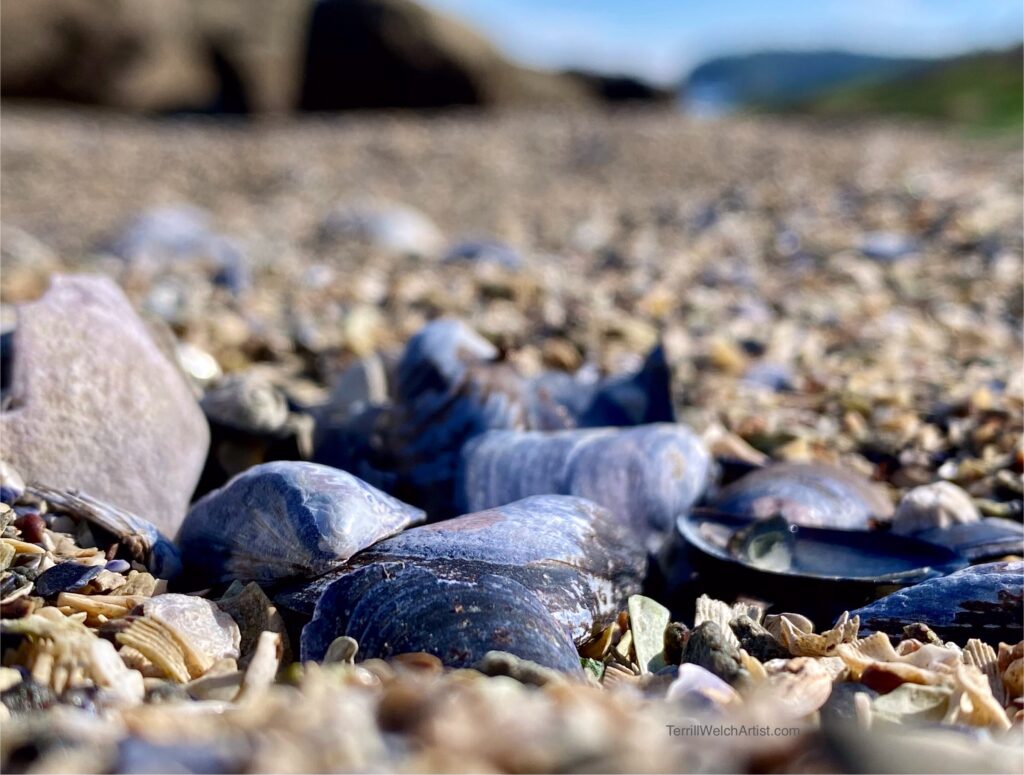
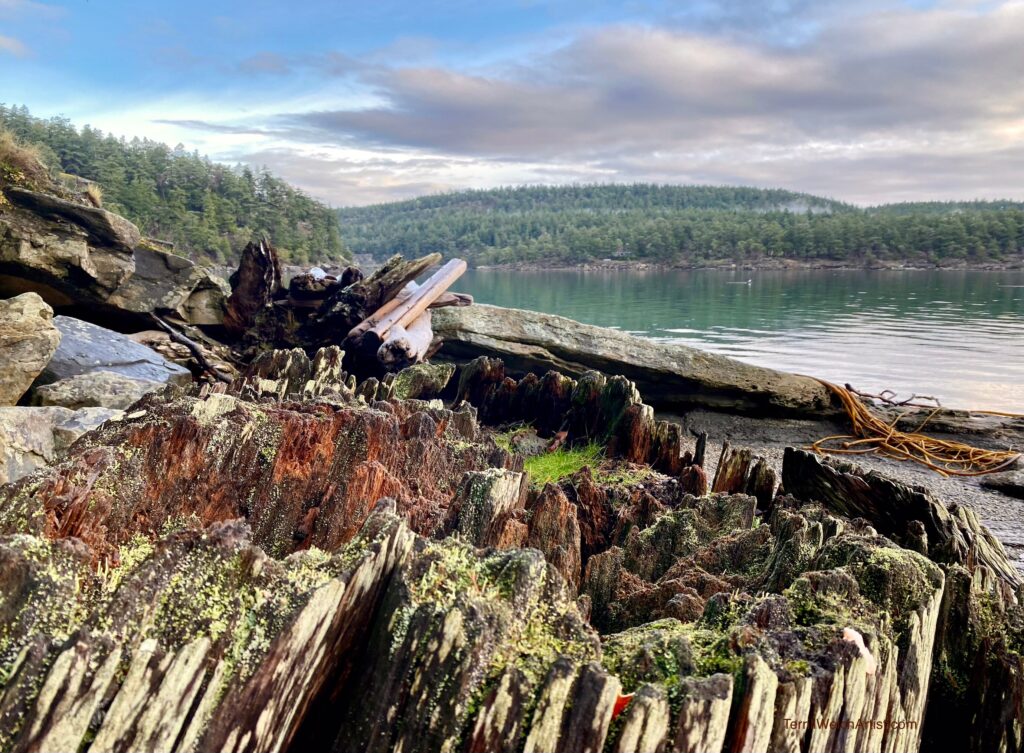
I was walking through the seaside trails the other day and thinking about how I came to be studying the seafloor. I didn’t just wake up on day and decide that seaweed, seashells and ‘landscape of the small’ would be the most amazing subject for painting. I could have maybe but I didn’t. Instead, it was an evolution of observation and restrictions that has brought me to this place. Let’s go through the day and see if we can learn more through reflection as I walk, live and explore.

I have always liked to photograph the spring and summer wild flowers. Today I cam across my first Calypso Orchids on the Saint John Point trails.

My close encounter with a the delicate Calypso orchids, Wednesday, 9 April 2025. What an early Spring beauty!

They are worth a close study both for their delicate structure and beautiful scent.

Single Calypso Orchid.

I have yet to paint these wildflowers. Maybe someday.

The arbutus trees out on the point is another story. They have come under my brush many times. When I walk among them, these works often map onto what I am seeing. Here is just one example.

‘Arbutus Grove West’ by Terrill Welch, 2020, oil on canvas, 16 x 20 x 1.5 in (40.64 x 50.8 x 3.81 cm).

Other times I notice a composition I had ‘t considered before. I ask myself, what might I beat.e to do with this?

The hike is only a little over 4 km long but by the time I amble over the uneven ground along the cliffs sitting and observing now and again, it generally takes me about 2 hours. On this day, I had my eye out for as many wildflowers as I could find. Down over the steep cliff side were sedum growing in locations where the deer couldn’t reach them. Hence, neither could I.

However, I did find some between the rocks that were safely within my reach.

Broad-leaved Stonecrop (Sedum spathulifolium) These will soon have vibrant yellow flower spikes.

The trail is not really the same each visit as the light is unique offering distinct formation to be pronounced in the landscape.


I continue on until I spot two more patches of small wildflowers.

Erodium cicutarium or common name Redstem Stork’s-Bill


Erythranthe alsinoides is a species of monkeyflower known by the common names wingstem monkeyflower and chickweed monkeyflower. It is native to western North America from British Columbia to the Klamath Mountains of far northern California, where it grows in moist and wet wooded habitat, such as moss beds and rocky stream banks.

Then finally a perfect yellow beauty that we all know…

Common Dandelion

You might be thinking, yes but what does this have to do with my study fi the seafloor? I wondered the same and have come to the conclusion that just as I observe both the landscape and the forest floor, it would make sense that eventually I would observe the seafloor as well as the seascape and shoreline.

I came home and made us current and orange scone biscuits.

These were served still warm with cheese and strawberries.

My stepson has been visiting and was staying with my husband so I could be gone for longer than I was usually comfortable leaving him alone these days. A special lunch seemed like a nice token of thank you.

It might seem odd to add in the making of lunch to my post about my creative practice but it is somehow thoroughly embedded as part of a complete representation of how I live and work with the best moment, the best materials and the best ingredients I am able to gather and experience. Making lunch is part of living purposefully in a considered way during the fullness of my making day.

I am still puzzling about how I came to be interested in the seafloor and asked my husband if he wants to come out to Reef Bay with me for a while. He was game and trundled his outside walker to the car in record speed. Reef Bay is ideal for us because I can drive right up to the edge of the beach where he can then stay in the car and still see what is going on and keep an eye on me as I clamber around on the sandstone reefs. The tide is still quite a way out but on its way in and the sea is still.

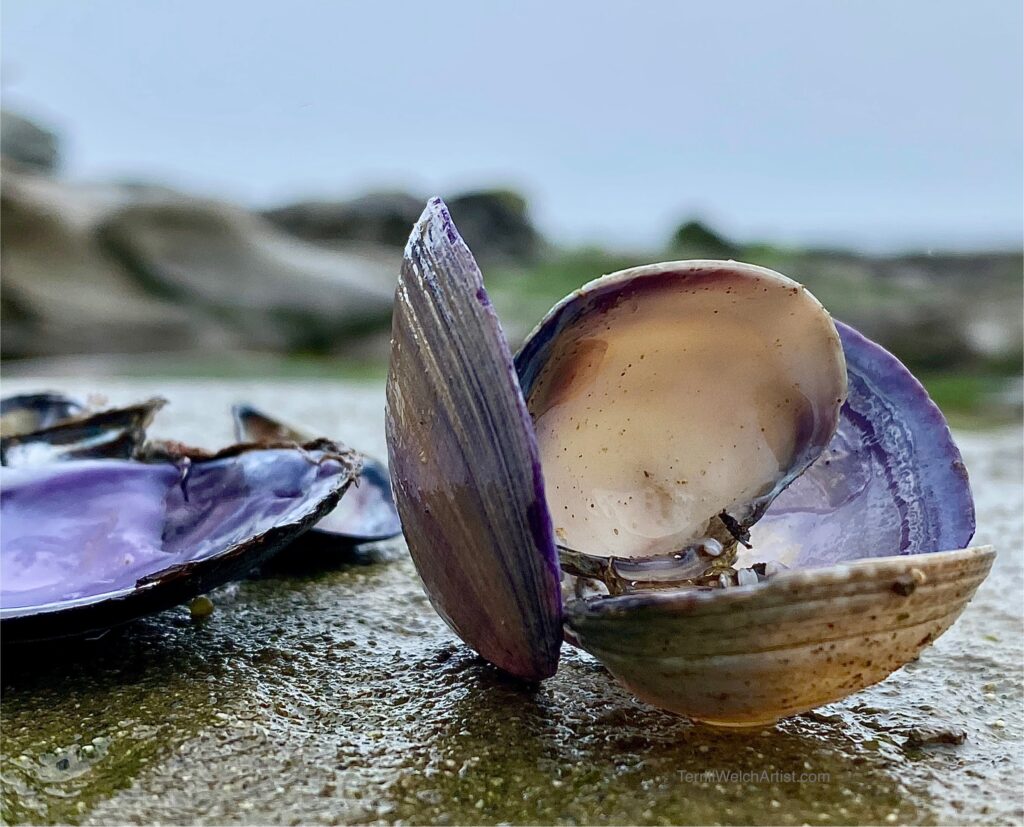
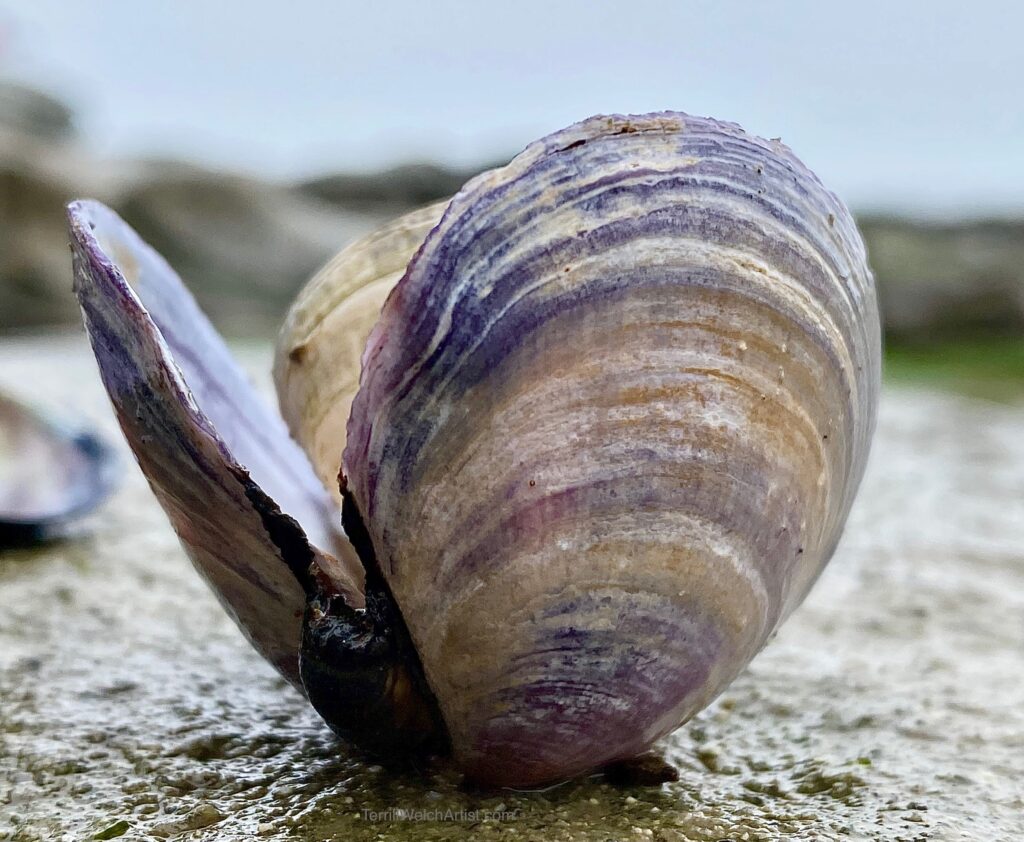
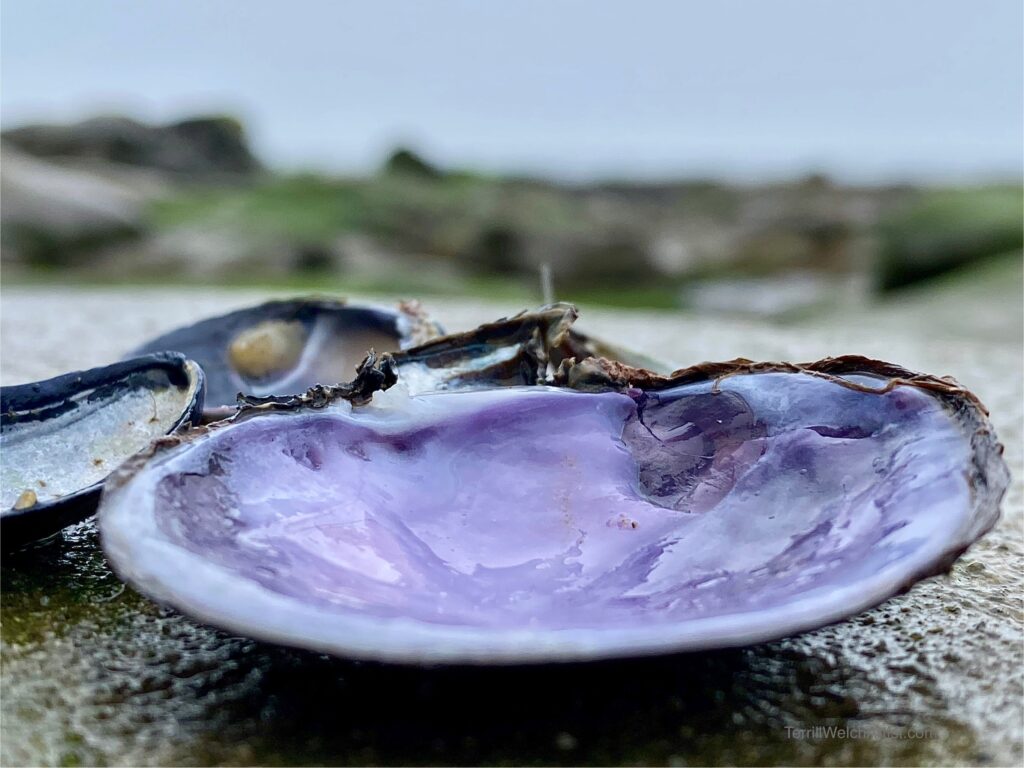
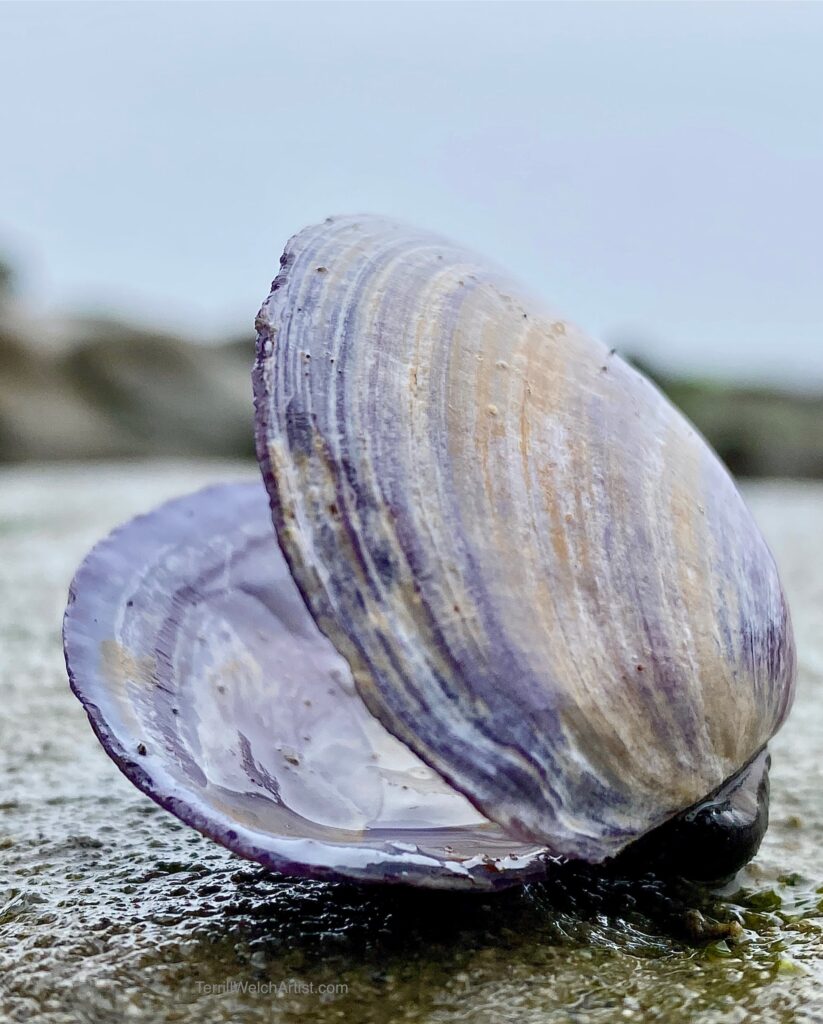
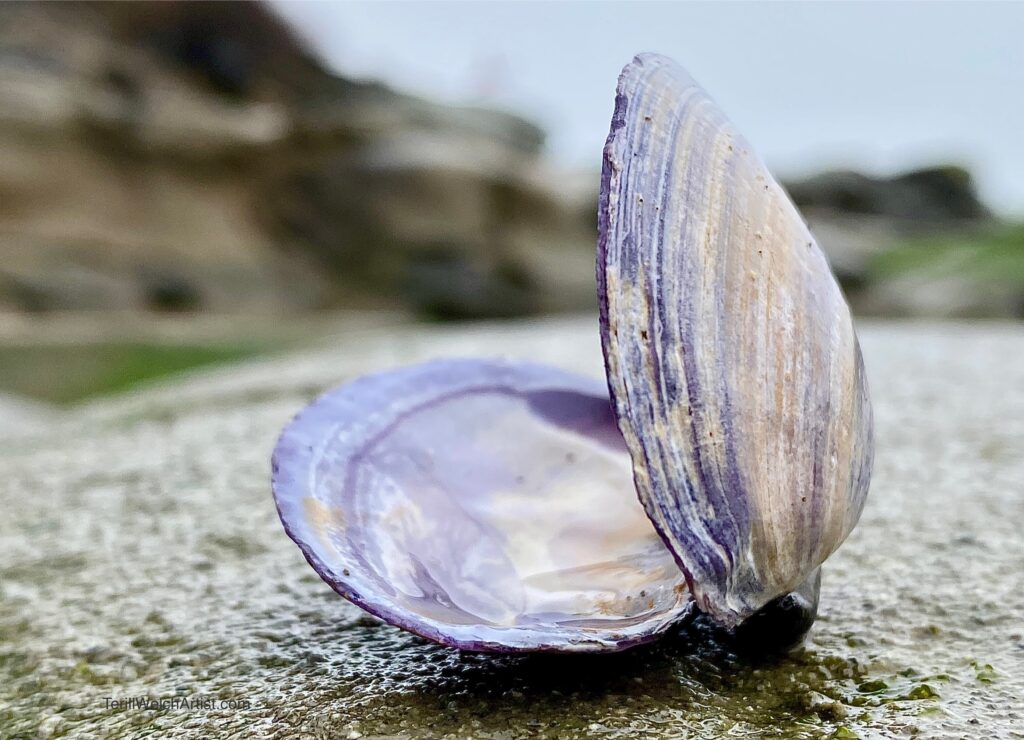
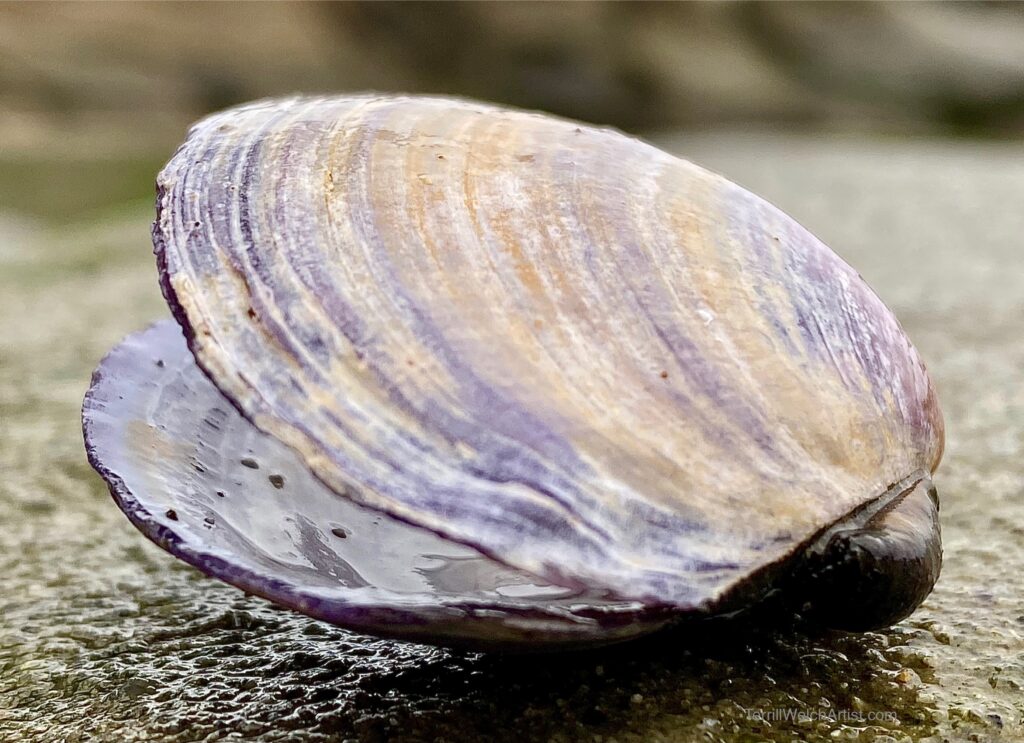
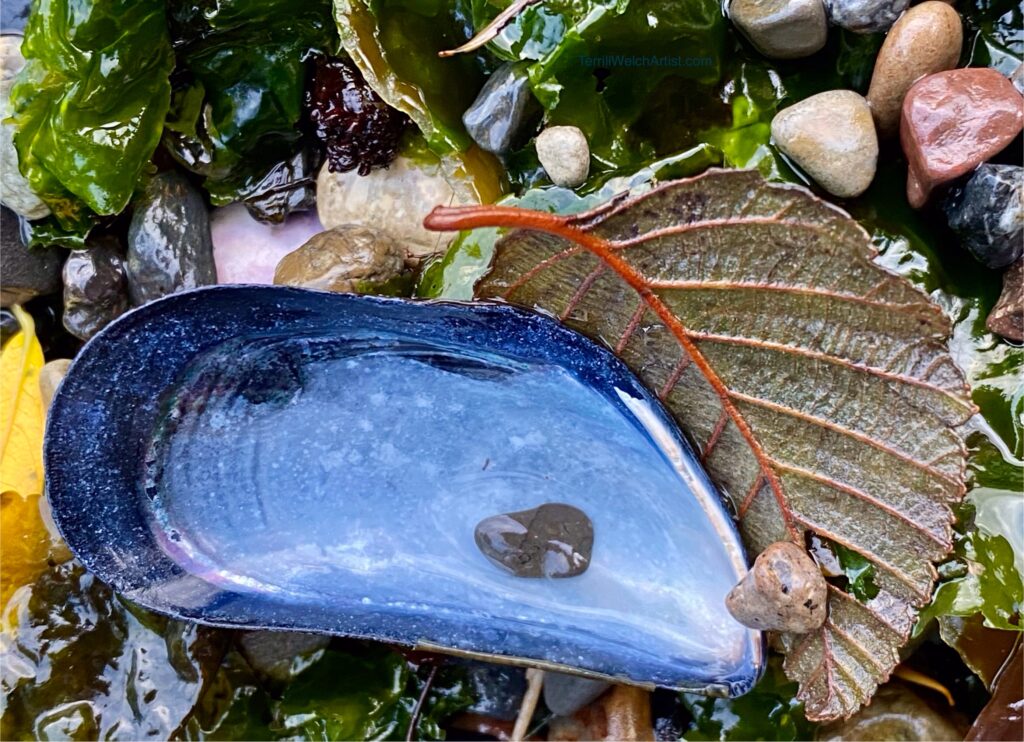
I start by gathering a few ‘child’s view’ photographic sketches of shells.

It is my way of warming up and settling into the moment.

Shapes and colours seem to frame themselves freely behind the lenses of my iPhone.

But then I begin to get lower yet and frame up a ‘landscape of the small’ that offers more contextual environment to the shells.

This reminds of the first painting I have done for the second Unit which as yet it be fully documented in my art journal.

Leaving Something Behind by Terrill Welch 12 x 10 inch walnut oil on canvas, Thursday, 27 March 2025.

Artist notes: The seashore was restless. There had been thunder and lightning with heavy rain the night before. It was as if the various weather events had not yet sorted themselves under the morning sun.


The top of the main reef has dried in the wind and sun that after a few Spring days clears it of slippery seaweed. I walk out as far as I can.

It is not far as we can see when I turn back towards the shore.

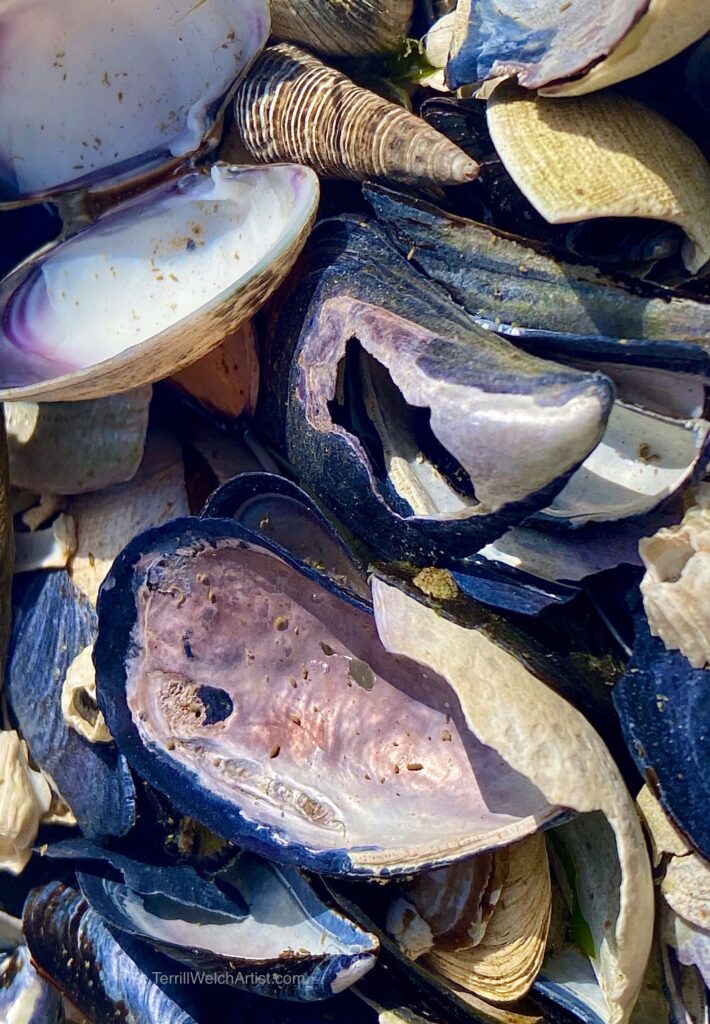
I gather photographic sketches of shells and seaweed in various small environments on both my way out and back.

An old oyster shell caught under the incoming tide.

Another oyster is a little farther below the surface of the sea in the cracks between the rocks.

These feel like half finished abstract works to me. I am not sure I can bring anything more to them with paint. Yet, they somehow record information that feels important even if it is never used directly.

I find that it is significant to capture this quieter process of sea and shore meeting… more of a slow caress than a heartbeat and breath rhythm of rolling waves.

Then I spot this cluster of shells floating in an immediately enthralling composition. This I can see putting to paint on a canvas! I have seen these before but never so visually and sensory complete and, most importantly, I can get close enough to document my discovery.

I have been working for months to capture something like this! Ta-da! It will be such a pleasure to unravel the mysteries of these shapes and the movement of the sea around the forms of the shells. This I can do something with!

I continue on, enjoying the colours do the limpid shells.

I notice layers and patterns of sandstone and sea with the rising tide.

Another old oyster shell captures briefly my attention.

However, I am still remembering that cluster of floating shells and thinking about what size of canvas I should use to paint it, maybe large so I can keep it longer.

Going back to my original question about how I have come to study and paint the seafloor, I have tentative answers. Since 2020, I have been required to stay close to home. First, because of the pandemic and second, because of my husband’s health. I deliberately decided early on to focus on what I can do rather than what is temporarily not easily possible. If I wasn’t going to be able to travel to paint then I was going to need to learn how to thrive in place. I challenged myself to go deeper rather than further. To this end, in late 2021 until near the end of 2023 I painted a series called ‘Thriving in Place’ that can be viewed at:

https://www.artworkarchive.com/profile/terrill-welch/collection/thriving-in-place

These physical restrictions in my life and meeting them with a thriving challenge has resulted in learning and living on the land beside the sea in new ways with an even greater appreciation. In hindsight, it seems obvious that I would eventually tackle painting the seafloor rather than just the seascape. What I have come to understand over these past few years is that deep learning and observation is as limitless and endless as travelling and gathering a breadth of understanding. In the end, thee is no great mystery to unveil in my decision to study the seafloor. Rather, it is a continuation of painting expression that captures my regard and respect for our earthly existence.
Investigating Shape in Landscapes of the Small through Three Acrylic Studies

Monday, 2 November 2026

Following is the final post I am sharing in my first unit of the three units of my MA Fine Art degree. There are other post but they are more administrative in nature rather than research based. Therefore, I have no need or desire to keep them. I also might have sorted out the image collage transfers but we shall see. It is still advisable to read these posts directly in the blog rather than in an email share. The third painting study in this post is still one of my personal favourites in the series… I know. I am not suppose to have favourites but I still do and usually they are different than other viewers.

Friday, 14 March 2025

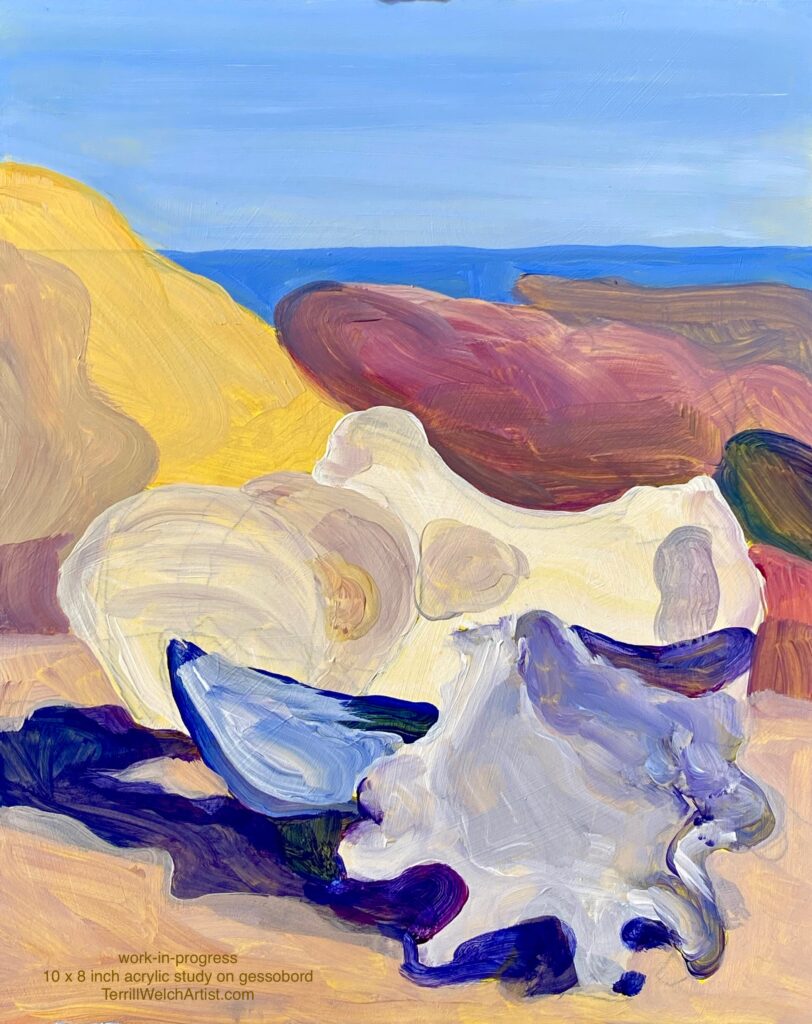
Back on Saturday, 22 February 2025, I completed the first of three explorative investigations of portrait oriented acrylic studies with shells in the foreground and land, sea and sky in the background. I had left this first study unfinished on Monday, 10 February 2025 for a few days while I thought about what I was wanting to accomplish with these acrylic studies as a method for propelling my work forward. In the previous three oil paintings, I had already decided to work in a portrait orientation with more context around my subject of the shells. Now I wanted to be able to change what I was doing easily on the surface to be able to test the usefulness of this approach without waiting for oil paint to dry or having to scrape an area it down to start again. Hence, the switch to acrylic and small 10 x 8 inch size. 

Each painting process, from observation to reference gathering it painting, use both the approach of seeing with the whole body and mind presented (Loori, 2005) and considered the limitation of our sensory information present (Plato and Jewett, 2994, Rudd 2022). The differences and tension between these two theories about art and painting seem to offer maximum freedom for me to work. I can observe with all of my senses as closely as possible while knowing that I will still fall short of everything that is available from the subject. This seems to offer greater room for exploration because I understand that the information I can discern is flawed from the beginning creating less need to get it right and more room to explore my interpretation of the essence or make the essential essence of my subject present.

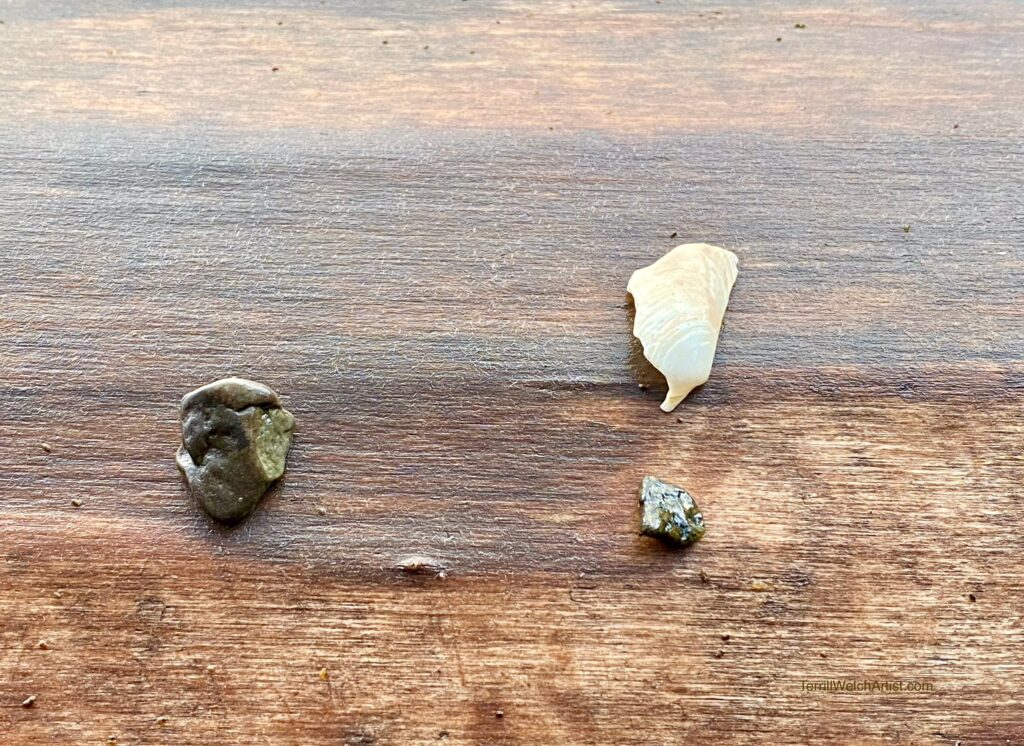
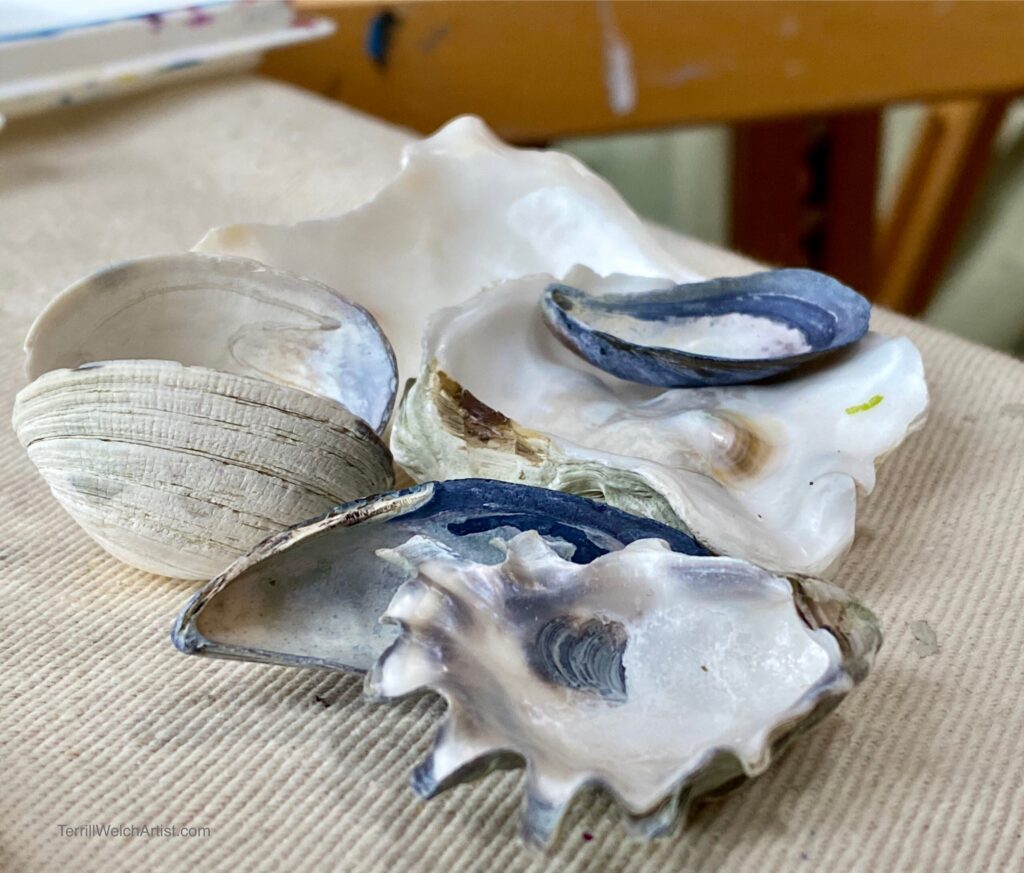
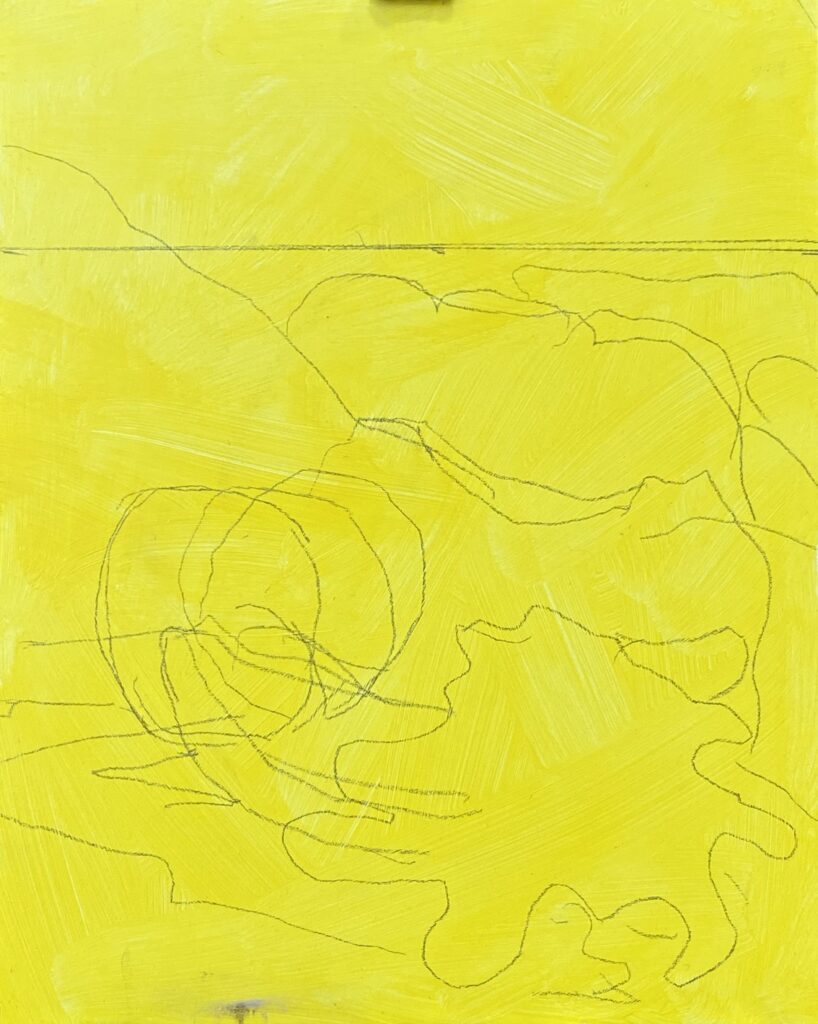
I had intended to take more images of this final stage of painting for ‘Shells on Sandstone Study’ but it didn’t happen. Instead I will share a collage of the work up to this point as a reminder to how it came about starting with the actual shells I had borrow from the beach (and will return) for a touch drawing exercise.


I settled in to paint and even after I reminded myself to take photos as I worked. I just kept painting! I didn’t even think of it again and then the painting was done. 

Shells on Sandstone Study by Terrill Welch, 10 x 8 inch acrylic on gessobord. Artist notes: Intrigued by the textures, shapes and rhythms, I let them have their way on the painting surface while still allowing a small amount of room for a few figurative details in the foreground. This painting is more about hearing and feeling first and then letting my eyes find the shapes and colours that connect to the other senses. When I stepped back, I couldn’t help myself from thinking about artists Giorgio Morandi, Georgia O’Keeffe, Lois Dodd and Maureen Gallace. It is the power of shape over form while still painting from life that they have in common.


The good news is that I get to try again.

Monday, 24 February 2025 

I started with a handful of references I had gathered midday in the rain a few days earlier on Friday, 21 February 2025. 


I set a 10 x 8 inch gessobord on the easel and drew in some basic lines to get started.

Beginning on the easel – “Clamshell in the Rain Midday” by Terrill Welch, 10 x 8 inch acrylic on gessobord.

First paint on the easel – “Clamshell in the Rain Midday” by Terrill Welch, 10 x 8 inch acrylic on gessobord.

Blocked in on the easel – “Clamshell in the Rain Midday” by Terrill Welch, 10 x 8 inch acrylic on gessobord.

Starting to build up paint and still on the easel – “Clamshell in the Rain Midday” by Terrill Welch, 10 x 8 inch acrylic on gessobord.


I could have stopped here.

Resting – Clamshell in the Rain Midday by Terrill Welch, 10 x 8 inch acrylic on gessobord.


Or even here.

Continuing the next day – “Clamshell in the Rain Midday” by Terrill Welch, 10 x 8 inch acrylic on gessobord.


Of course, I didn’t. The final acrylic study ended here instead…

“Clamshell in the Rain Midday” by Terrill Welch, 10 x 8 inch acrylic on gessobord. Artist notes: The winter rain is steady as the heavy sky hugs the sandstone. One small clamshell comes close in its perfect composure. It holds the sea and the rain. Nothing else is necessary. I gave the clamshell my full attention along with the rain and the sea and the sky and the sandstone.


I did manage to gather a few more points in the painting process this time. I am not sure how useful it has been but they are there for future consideration. The simplicity of the shapes and palette still seem substantial to me, worthy of my attention. Visible brushstrokes offer a soft liveliness with their directional movement. However, could something still be missing? I leave it for now and start the next painting. 

Saturday, 1 March 2025

I again selected from photographic sketch references that I had taken the day before. This time there were fewer than usual.


I had already determined that I was going to make up the landscape by drawing on information from all three images using a spontaneous decision making process.


Then I begin with acrylic paint, more determined than ever to capture my decision making process while I worked.


It is not easy but I keep stopping to take photographs.


A then another pause.


I am now ready to start building up the paint until I get to the point where nothing is working and everything element in the composition seems to be singing from a different song sheet.


What to do? I decide to start painting things out until it comes back together. There!


I move forward again only adding what feels absolutely necessary with each brushstroke. I got it!

Low Tide in the Reefs by Terrill Welch 10 x 8 inch acrylic on gessobord Artist notes: Sandwiched between two reefs is a shell bed with fabulous shapes and contours. It won’t last. Tides are like that. Best to savour this landscape featuring seashells in the moment.


This third acrylic study is what I have been searching for in my exploration of the seafloor. Not just in the composition and colour palette. Those can change. It is the energy and closeness to my conversation with the seafloor on this particular day that I feel an affinity with when viewing this work.

All three of these sketches are notably to me a new direction in studying what is still a brand new subject. These small studies have the potential to be worked up into larger paintings and still work both as objects in the physicality of paint, colour and composition and as expressive subjects depicting my conversation with nature’s seafloor. I will keep going and experimenting with the idea of landscapes of the small paintings where I am getting seriously low and close to the subject while looking out and placing it within the context of its environment. 

Reference list:

Plato and Jowett, B. (1994). The Republic. [online] https://www.gutenberg.org/files/150/150.txt. Available at: https://www.gutenberg.org/cache/epub/150/pg150-images.html [Accessed 5 Jan. 2025].

Rudd, A. (2022). Painting and Presence: Why Paintings Matter. [online] Oxford University Press eBooks. Oxford University Press. doi:https://doi.org/10.1093/oso/9780192856289.001.0001.

Reference Gathering and Reflection

Sunday, 11 October 2026 

Excerpt from Terrill Welch MA Fine Art Journal

Friday, November 15 to Saturday, November 16, 2024

Following yesterday’s weekly four o’clock in the morning Pacific Standard Time class, I went to see what messages our latest two days of high winds and rain storms had left along the shore at Saint John Point Park. It is a slow fifteen minute drive from my home. The Mayne Island speed limit is 50 km per hour maximum. In fact, we can get most places in fifteen minutes or less on our 21 square km island at this speed. Situated halfway between the two large metropolitan areas of Greater Vancouver and Greater Victoria, our Mayne Island rural life is enjoyed by around 1,200 permanent full-time residents. The need for ferry travel on and off the island and only having one resort and motel creates an infrastructure barrier against overcrowding and caps our tourist capacity to about 3,000 – 4,000 during the spring, summer and fall. Therefore, on what we call cozy season, instead of more accurately described rainy season or storm season, I was not surprised to see the park parking lot empty when I arrive. The rugged and tree-lined trail I take is about 4 km long and winds across the point to a beach and then along the seaside of Navy Channel with low cliffs back to the parking lot.

The clouds were just beginning to break apart and let in a little light as I reached the beach.


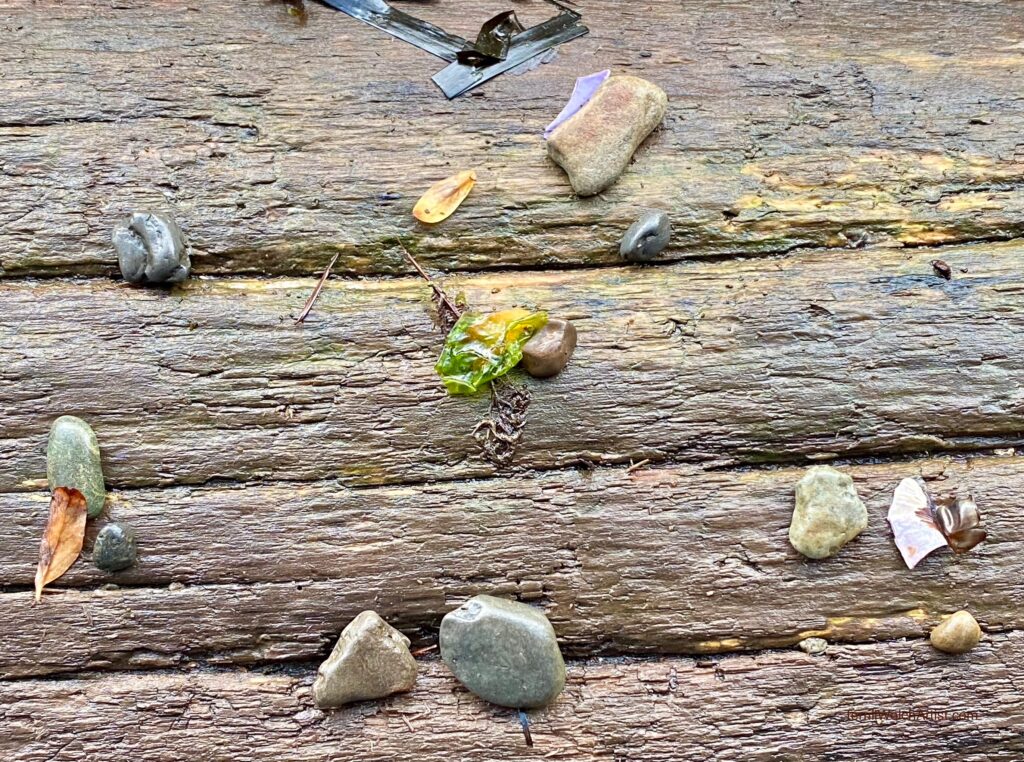
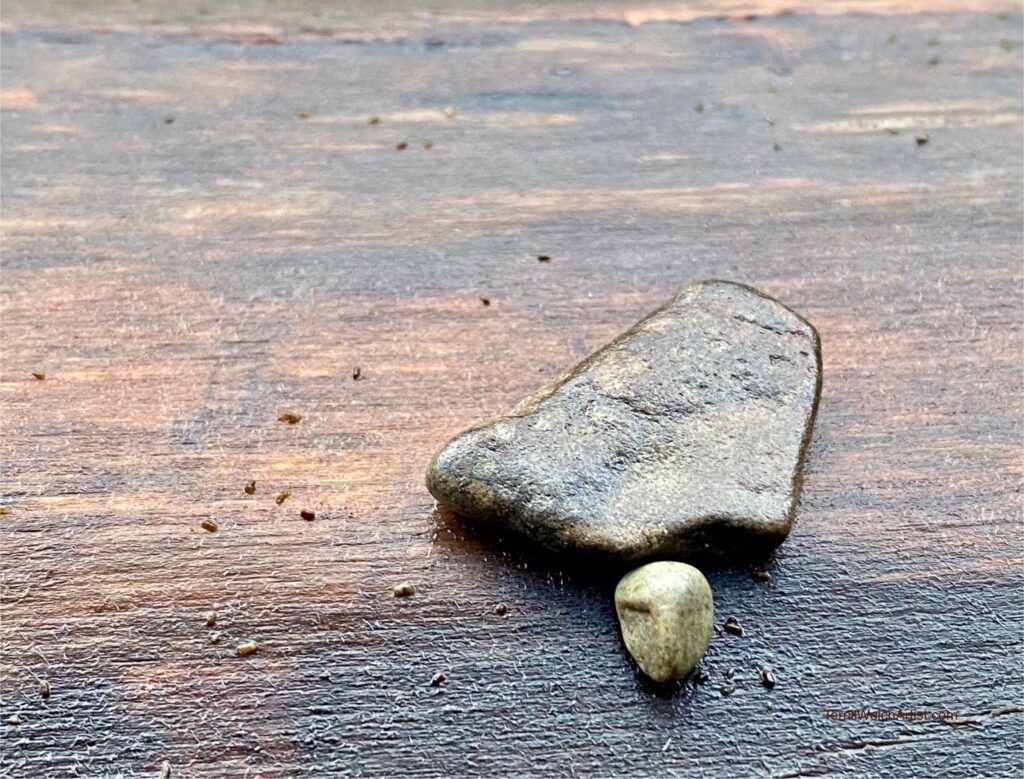
Bits of shell and small peddles were beautifully placed by the waves on the driftwood.


Sometimes these storm wave conversations are full and richly shared.


Other times, the vocabulary is brief and firm.


Then there are the perfectly formed found compositions just waiting for me to notice.


I marvel at the intricate random placement of each discovery.


I think about how humans have walked these island shores for thousands of years and I wonder how many pairs of eyes have paused knelt to admire something similar. This brings me to this morning’s shared making time and working on the 40 x 30 inch “Bennett Bay Midden” painting in the dark with my one studio lamp.


I will have to settle in with it again and sort out a few things in the daylight but no permanent damage was done. After all, my references for these midden shells are likely about 4,000 years old. Surely, my time with them during less than ideal condition on the wood painting surface is made of equally tough substance. It is the continuation of time that interests me the most with the idea for this painting. In my brush marks, I want to hear the laughter, tears and worries of those that gathered to eat these clams and then toss the shells in a heap to be exposed again such a long time later. I want those brush marks to be like the waves that carry a connection between then and now and this next discovery I find as I study the shore.


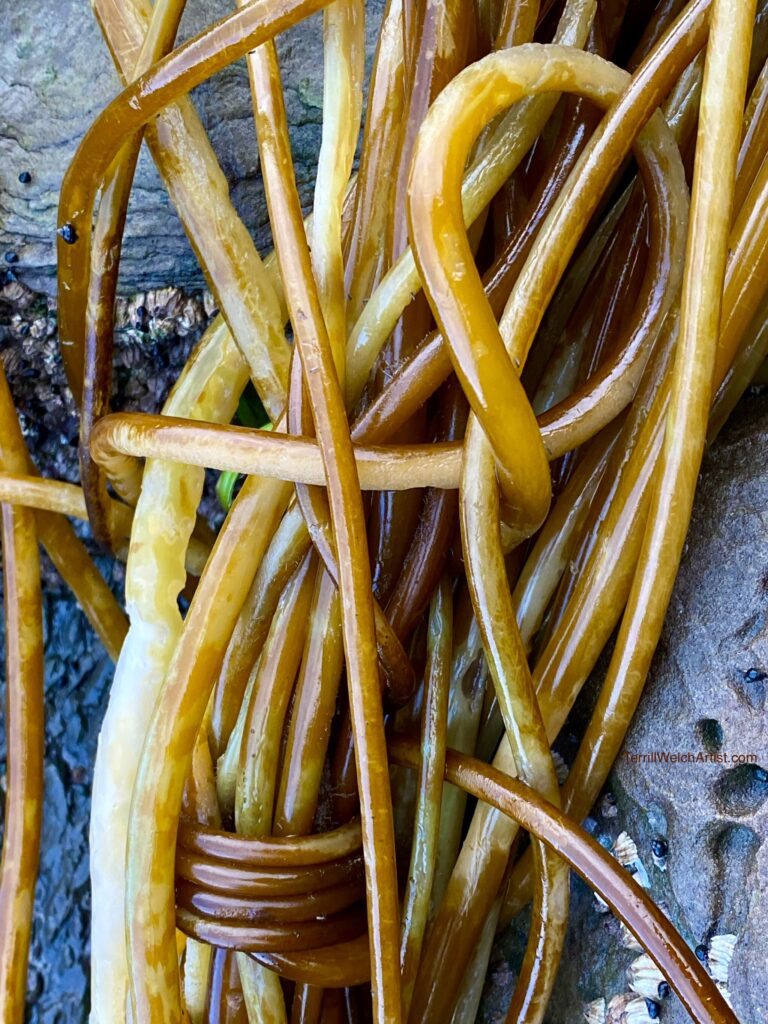
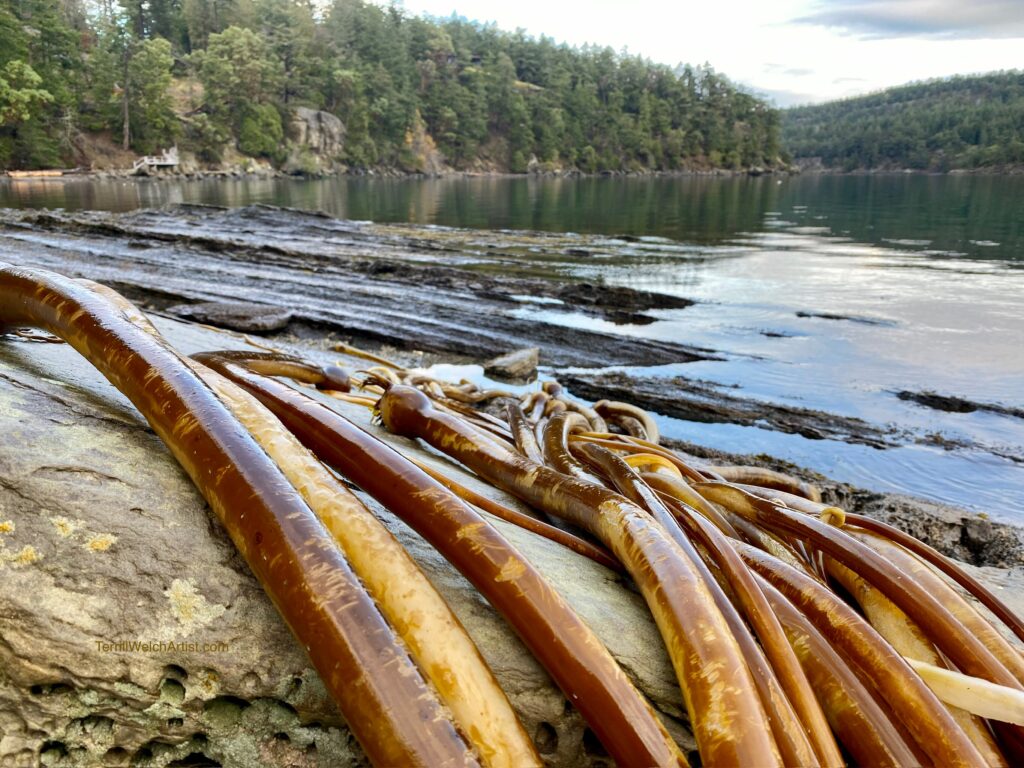
Bull kelp is knotted as if having carefully tied up a package below the surface of the sea.

If only I could bring you the scent of cool, damp, salty waters that is laced with fresh broken fir branches that had been snapped off during the recent high winds.

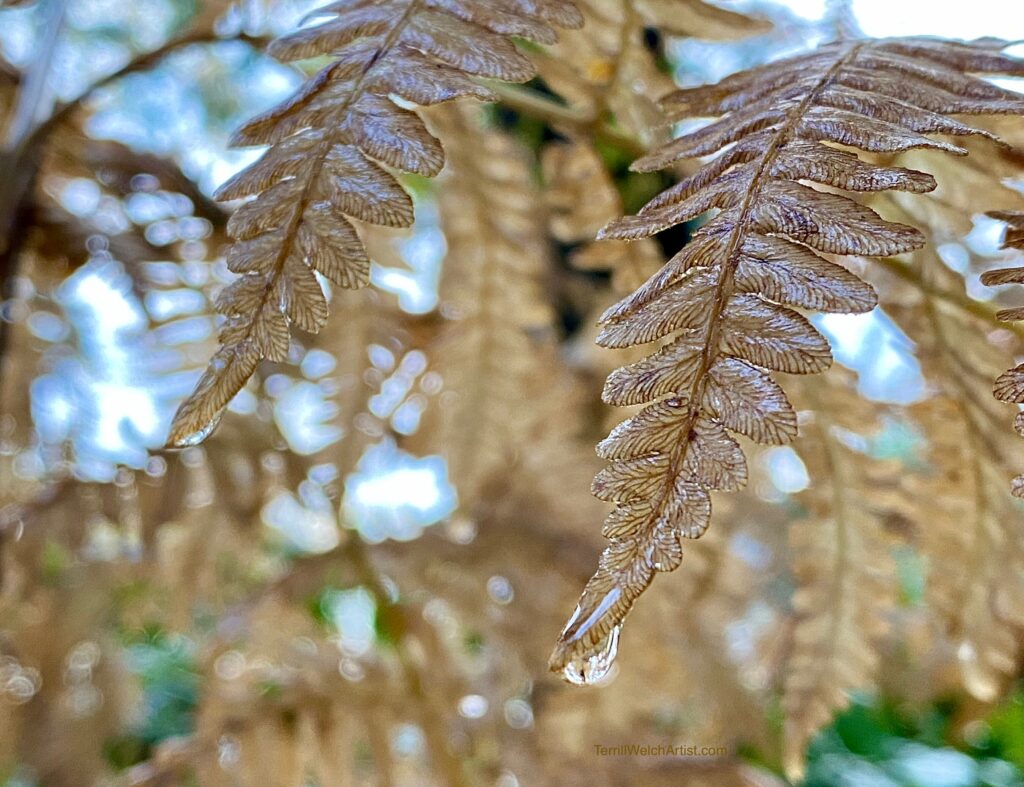
I continue on along the trail to where ferns are hanging transparent and dripping after our heavy rains.

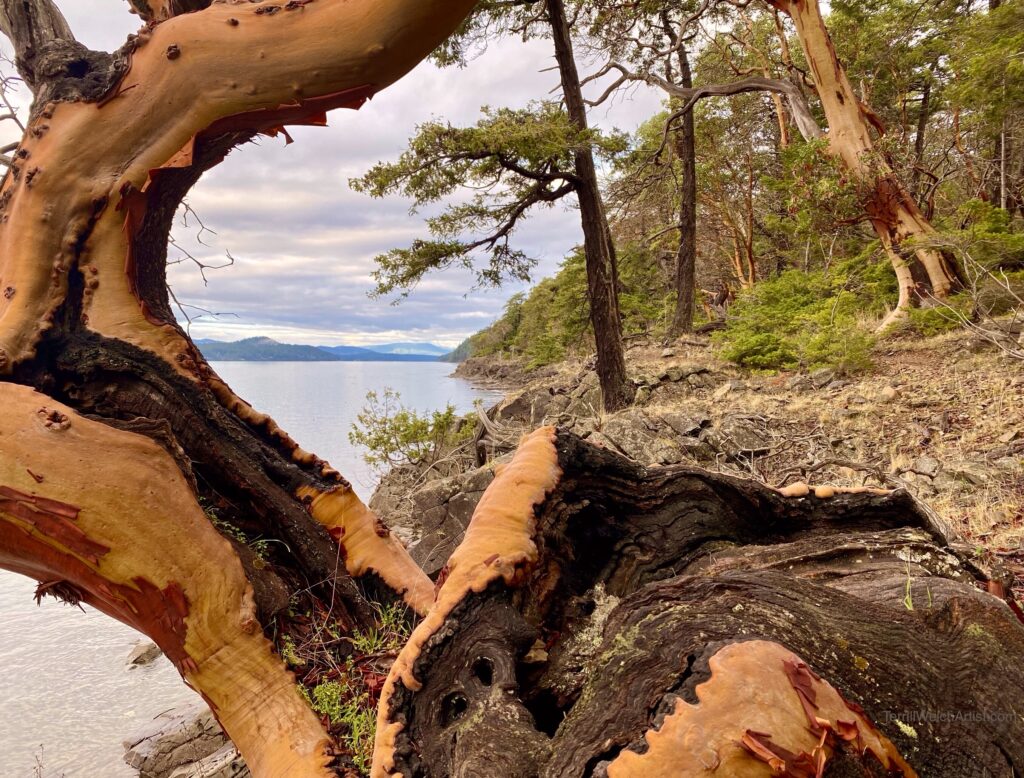
I walk onward through the arbutus tree grove and along the cliffs back towards the parking lot. This is where the tension tightens slightly between my subjects of the recent past and where I want to go with this new project. I have studied some of these arbutus trees for many years. They often feel like my closest friends.

This one is reaching the end of its life that has been shortened by several long summer droughts.


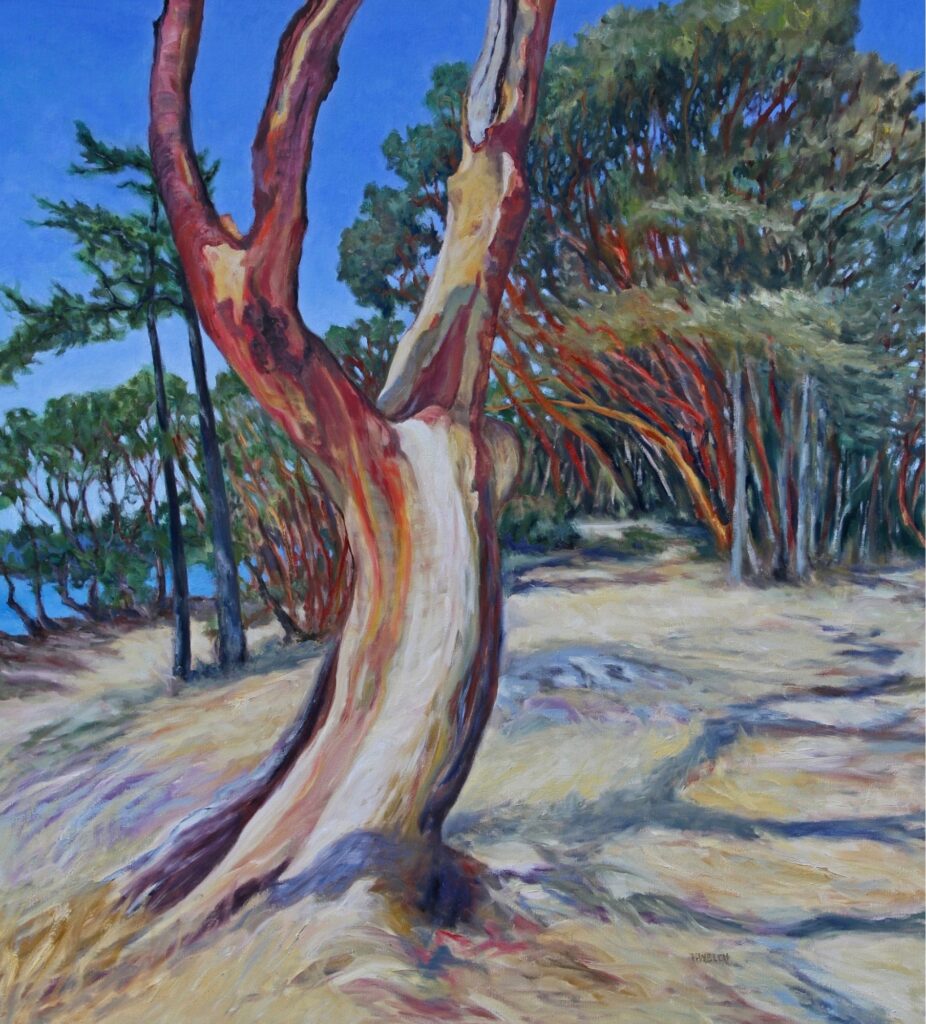
I have never painted it from this angle but my favourite is a larger work I did looking the other way.

“Arbutus on Saint John Point” by Terrill Welch, oil on canvas, 40 x 36 x 1.5 in (101.6 x 91.44 x 3.81 cm)

Artist notes: The portrait painting of this Arbutus tree seems to be saying “See, here we are. Just follow the trail and enjoy.” And I shall after a long pause visiting with this favourite elderly Arbutus tree because it won’t be with us for many more years. Painting these special trees is partly reverence and partly record keeping.

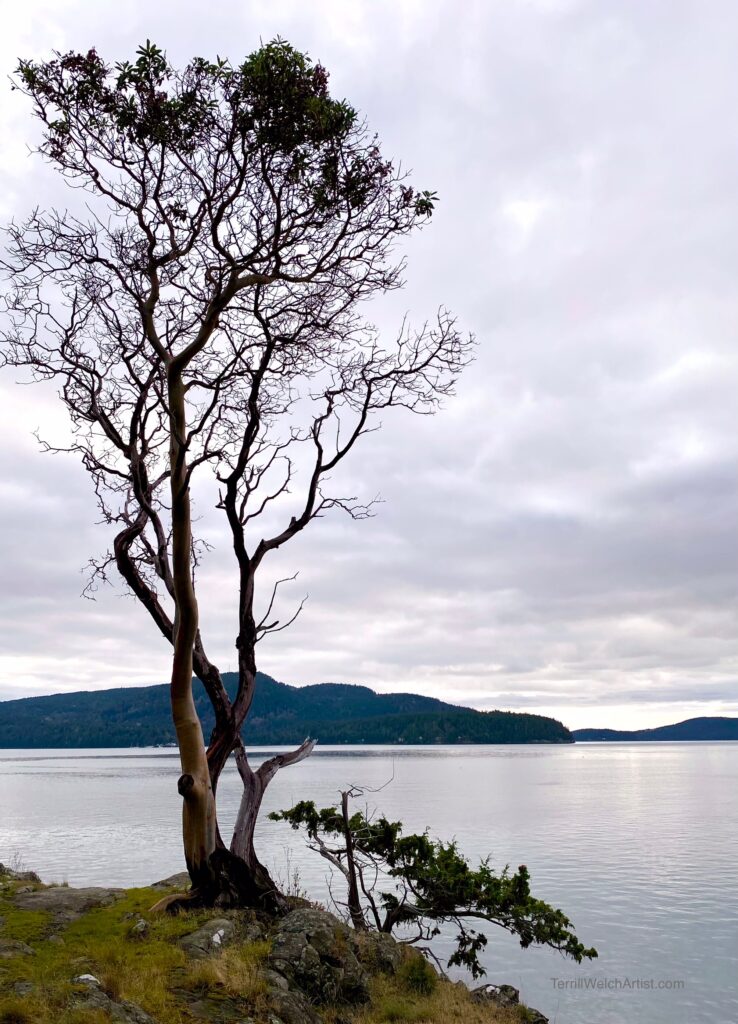
Farther along the trail, there is a magnificently curved arbutus tree that I I have become deeply attached to over the years.


I am not sure how many times I have painted its portrait from different angles in various weather. Here is one example.

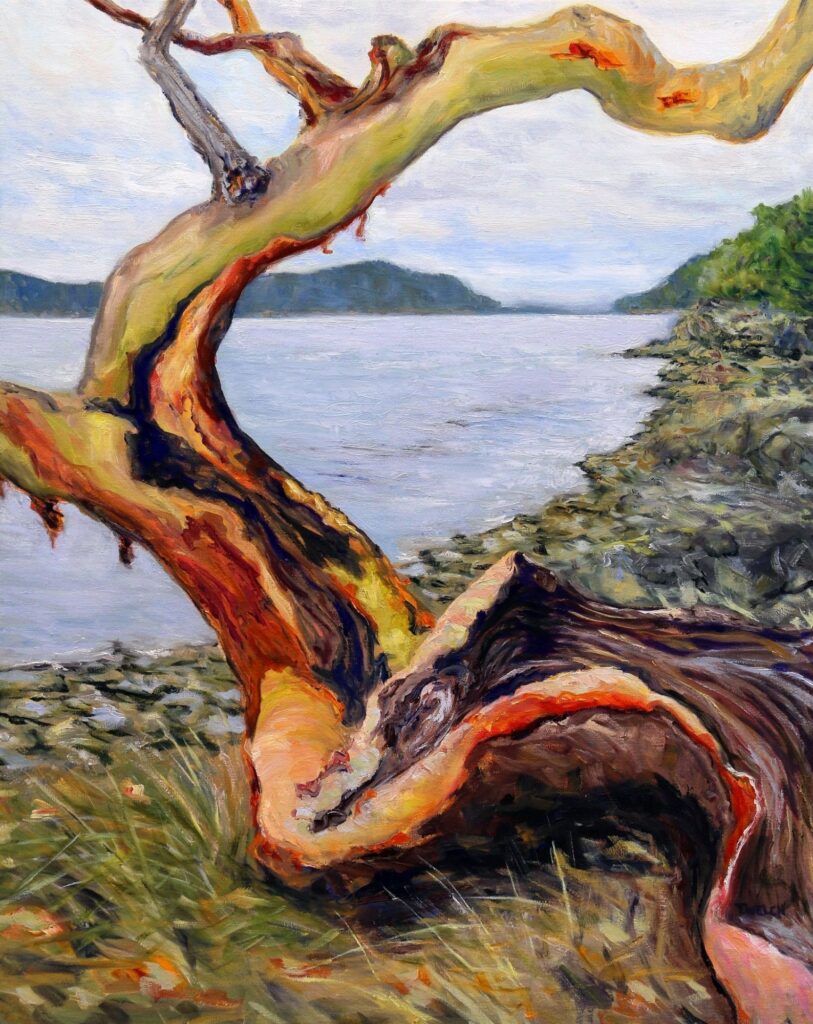
“Arbutus Entertaining A Grey Day” by Terrill Welch, walnut oil on canvas, 30 x 24 x 1.5 in (76.2 x 60.96 x 3.81 cm)

Artist notes: As the elegant Arbutus tree curved around, framing Navy Channel, I thought it wanted to show me something. And I suppose it did. Who wouldn’t want to be admired with a trunk like this!

I won’t share anymore in detail but instead I will leave myself the link to the whole of my arbutus tree collection for easy reference later on as needed.

https://www.artworkarchive.com/profile/terrill-welch/collection/arbutus-tree-paintings-only

I know I will find it hard over the next couple of years to walk past these arbutus tree beauties and not set them to paint and canvas. However, my compromise is to simply take references as desired and file them away for later. This shift in focus does not need to be forever, just for now. It feels like keeping my footing solid as I venture forward into the unknown of this programme that I suspect will take me in directions I have yet to discover. I want to be flexible and ready to overturn limiting believes and discover blind spots in my critical thinking and art practice while at the same time carrying the best from the past with me, even if I throw various aspect aside as I go.

I keep walking. There are still no other vehicles in the park parking when I return. It seems as if no one else has arrived since I left a few hours ago. I really don’t mind. I was more than ready to receive this intimacy that nature had to offer. I read every possible note and passage for all of us.

Exploring Art Theories

Sunday November 17, 2024

Following a reviewed my journal and notes, I see a gap worth exploring. That gap has to do with developing an understanding of current art theories. My habitual reference gathering and studio practice is solidly established. This means I can put my learning efforts for a few weeks into researching and reading about art theories without anything going off the rails.

My background is in theories of Sociology, Feminist theories and Gender theories with my last attentive and focused learning ending in 1998. With this in mind, I thought I would begin with Art Theory: A Very Short Introduction by Cynthia Freeland (Oxford 2003) 

I read the conclusion first starting (p. 138, Freeland, 2003)

Abstract

“Art theory is not like scientific theories, such as Einstein’s special theory of relativity or Darwin’s theory of evolution: there do not seem to be any ‘laws’ of art that will predict artists’ behaviours, or that explain the ‘evolution’ of art history by detailing what ‘succeeds’ in making a work beautiful or significant. Art Theory: A Very Short Introduction concludes that despite these differences from science, art theory is still an explanatory enterprise: it involves the effort to organize a dizzying variety of phenomena so as to try to say what they have in common that makes them special.”

Then the Introduction (p. xvii – xix Freeland, 2003)

“A theory is more than a definition; it is a framework that supplies an orderly explanation of observed phenomena. A theory should help things make sense rather than create obscurity through jargon and weighty words.”

“It should systematically unify and organize a set of observations, building from basic principles. But the ‘data’ of art are so varied that it seems daunting to try to unify and explain them. Many modern artworks challenge us to figure out why, on any theory, they would count as art.”

“A big problem about laying out the data for this book is that our term ‘art’ might not even apply in many cultures or eras. The practices and roles of artists are amazingly multiple and elusive. Ancient and modern tribal peoples would not distinguish art from artefact or ritual. Medieval European Christians did not make ‘art’ as such, but tried to emulate and celebrate God’s beauty. In classical Japanese aesthetics, art might include things unexpected by modern Westerners, like a garden, sword, calligraphy scroll, or tea ceremony.”

“Many philosophers from Plato onward have proposed theories of art and aesthetics. We shall scrutinize some of them here, including the medieval colossus Thomas Aquinas, the Enlightenment’s key figures David Hume and Immanuel Kant, the notorious iconoclast Friedrich Nietzsche, and such diverse twentieth-century figures as John Dewey, Arthur Danto, Michel Foucault, and Jean Baudrillard. Of course, there are also theorists in other fields who study art: from sociology, art history and criticism, anthropology, psychology, education, and more; I will refer to some of these experts as well.”

“Art theorists also ponder questions about artists: who are they, and what makes them special? Why do they do the sometimes odd things they do? Recently this has led to intense debate about whether intimate facts concerning artists’ lives, such as their gender and sexual orientation, are relevant to their art.” (p. xix Freeland, 2003) 

In reviewing these brief texts, I can see I have work to do. However, I shall start by reading this book and see where it takes me.

Reverence: 

Freeland, Cynthia, Art Theory: A Very Short Introduction, Very Short Introductions (Oxford, 2003; online edn, Oxford Academic, 24 Sept. 2013), https://doi.org/10.1093/actrade/9780192804631.003.0008, accessed 17 Nov. 2024.

The Risks of Surprising Myself and Other Plein Air Adventures

Tuesday, 29 September 2026

How does a seasoned painter surprise themselves and paint what they do not yet know? It was a good question and a practice that Tracey Emin embraced with rigor and is discussed in detail in My Heart Is This Tracey Emin On Painting by Martin Gayford (2026). So I thought, why not? Give it a go. What is the worst that could happen? A bad painting? Yes, the results were a bad painting.

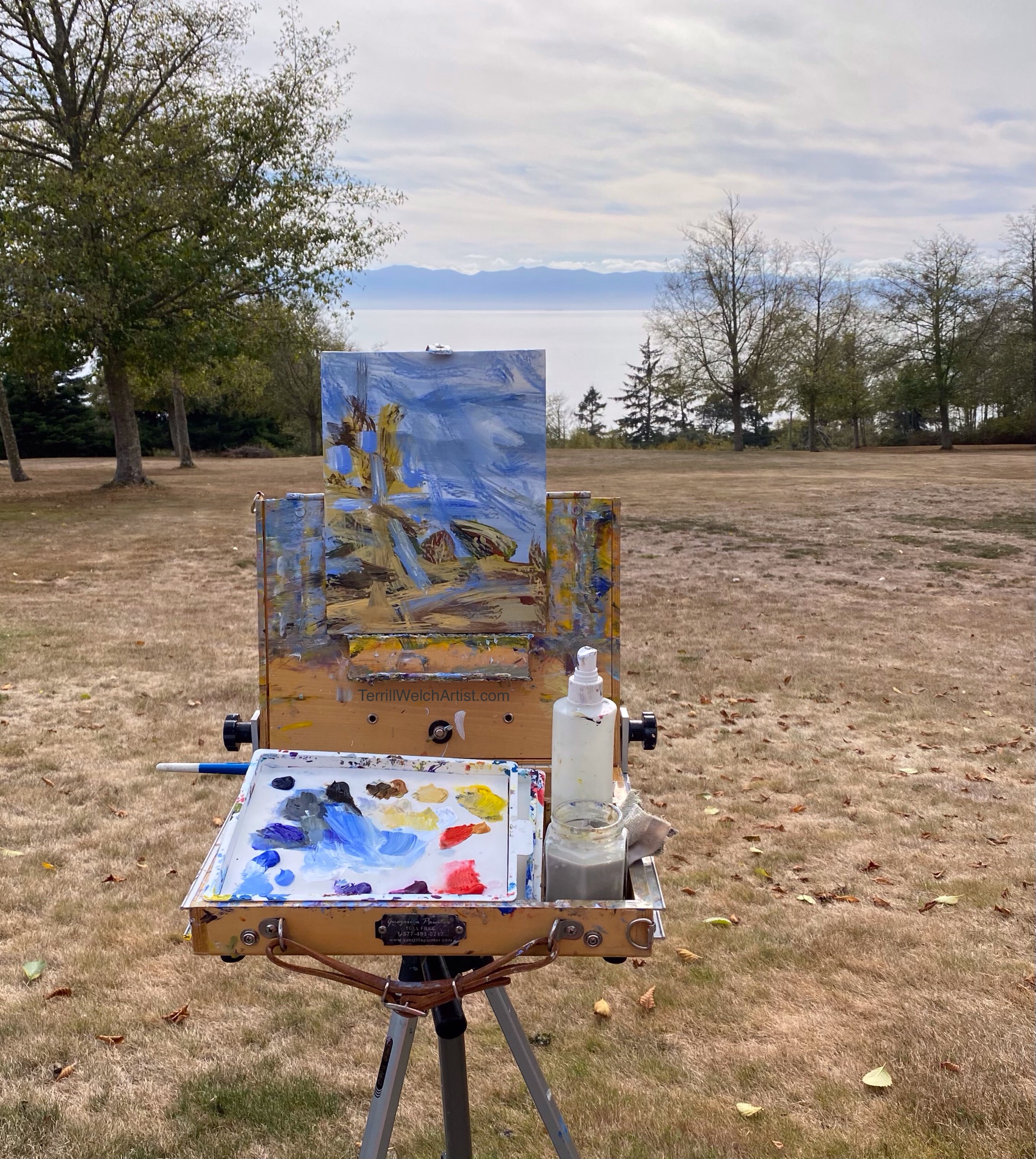
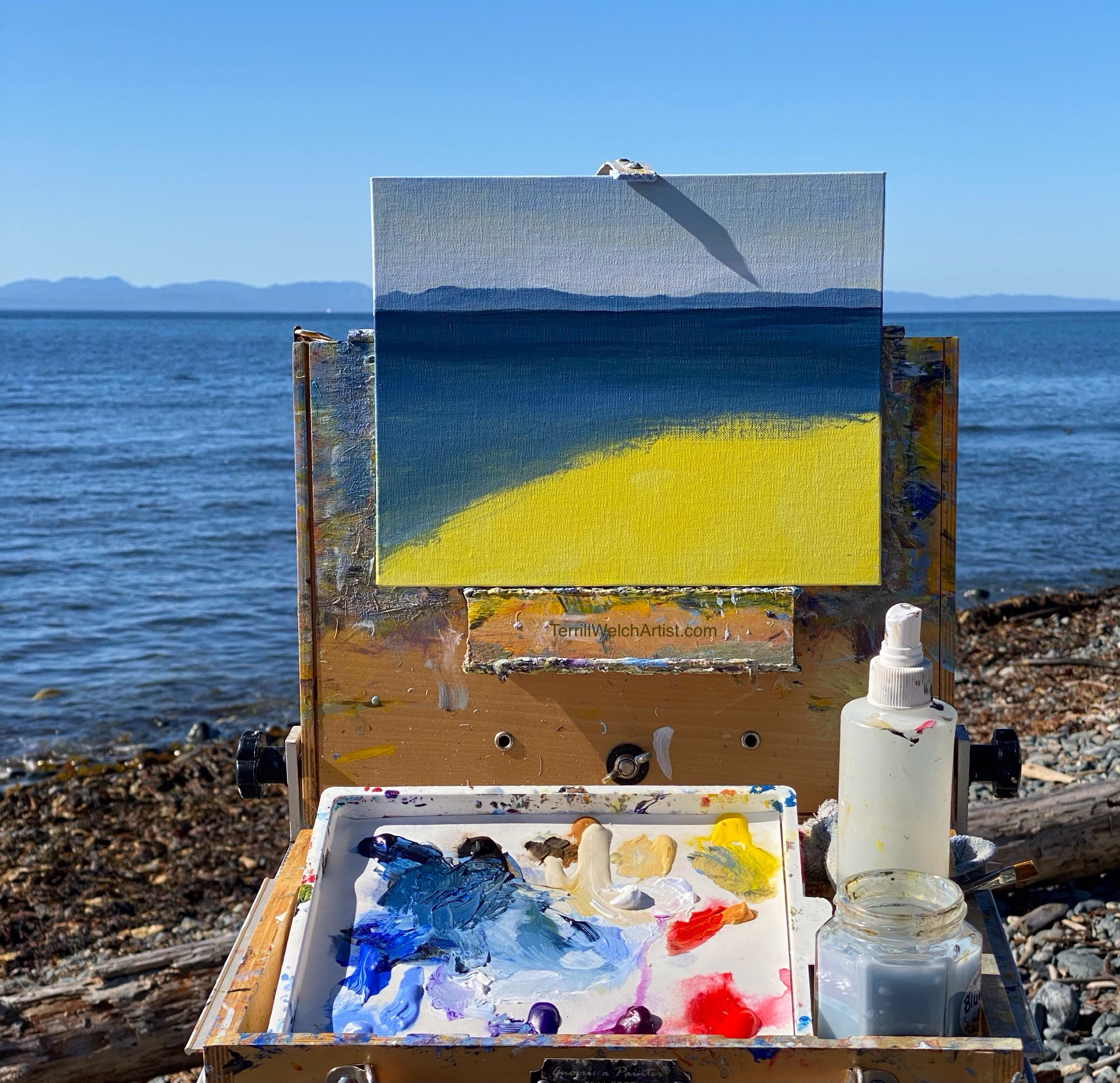
I began plein air with a grand manicured view in a location I was not familiar with on southern Vancouver Island at Otter Point Place. Possibly the most awkward part was the landscaped view. I had no idea what I might do with it. I started to paint the mountains on the far side of the strait and the sea and sky. It fell apart. Then I decided to lean into the feeling of the place through abstract mark making. Well things went from bad to worse.


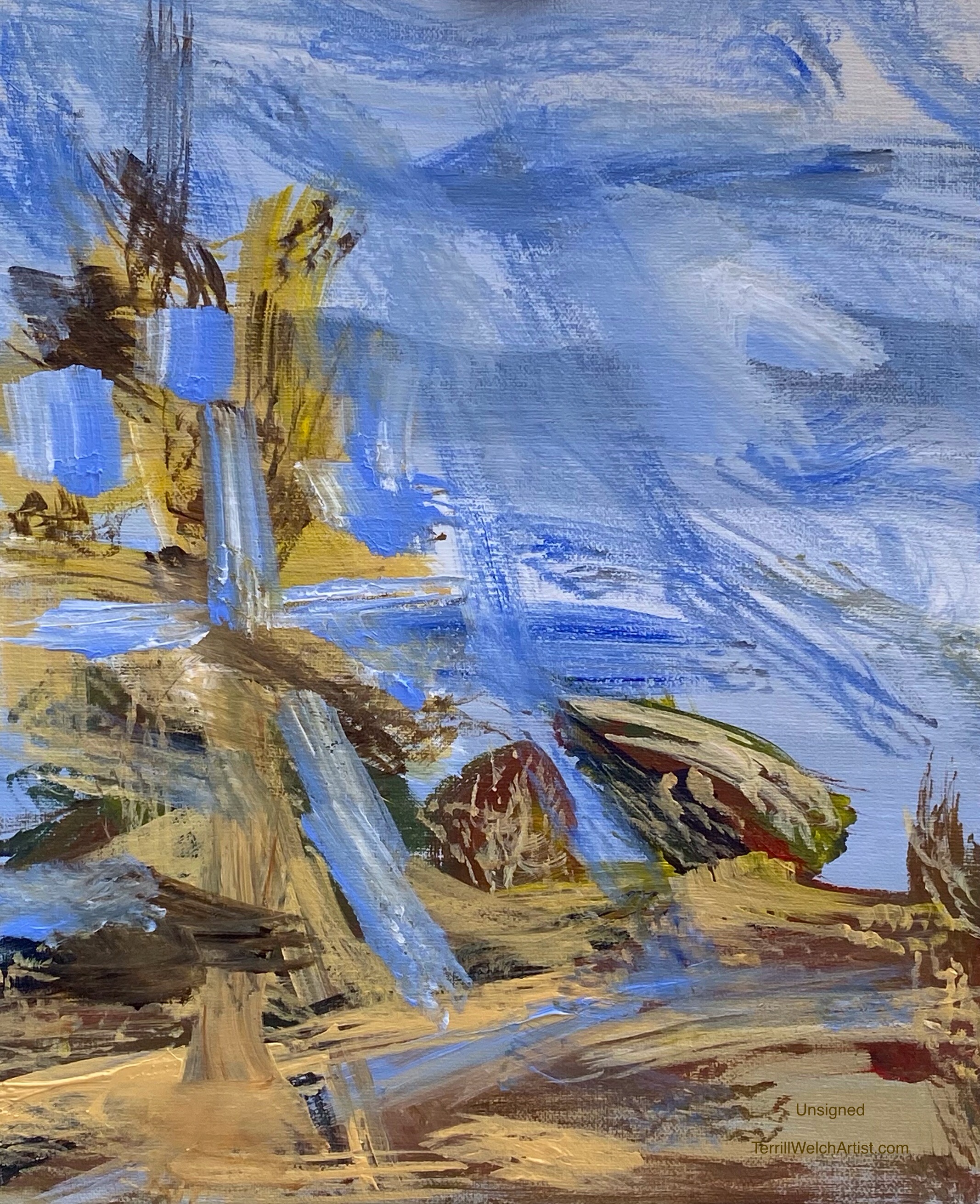
I stopped there because I had absolutely no idea how I could salvage it.

Unsigned and untitled exercise in painting something I didn’t know and surprising myself. Plein air 10 x 8 inch acrylic on linen at Otter Point Place, BC. Saturday, 26 September 2026.

I will paint over it at some point but first, I spent some time with it to see if there was anything at all I wanted to bring forward into the next work. Nothing came to mind… except maybe stop trying to surprise myself. 

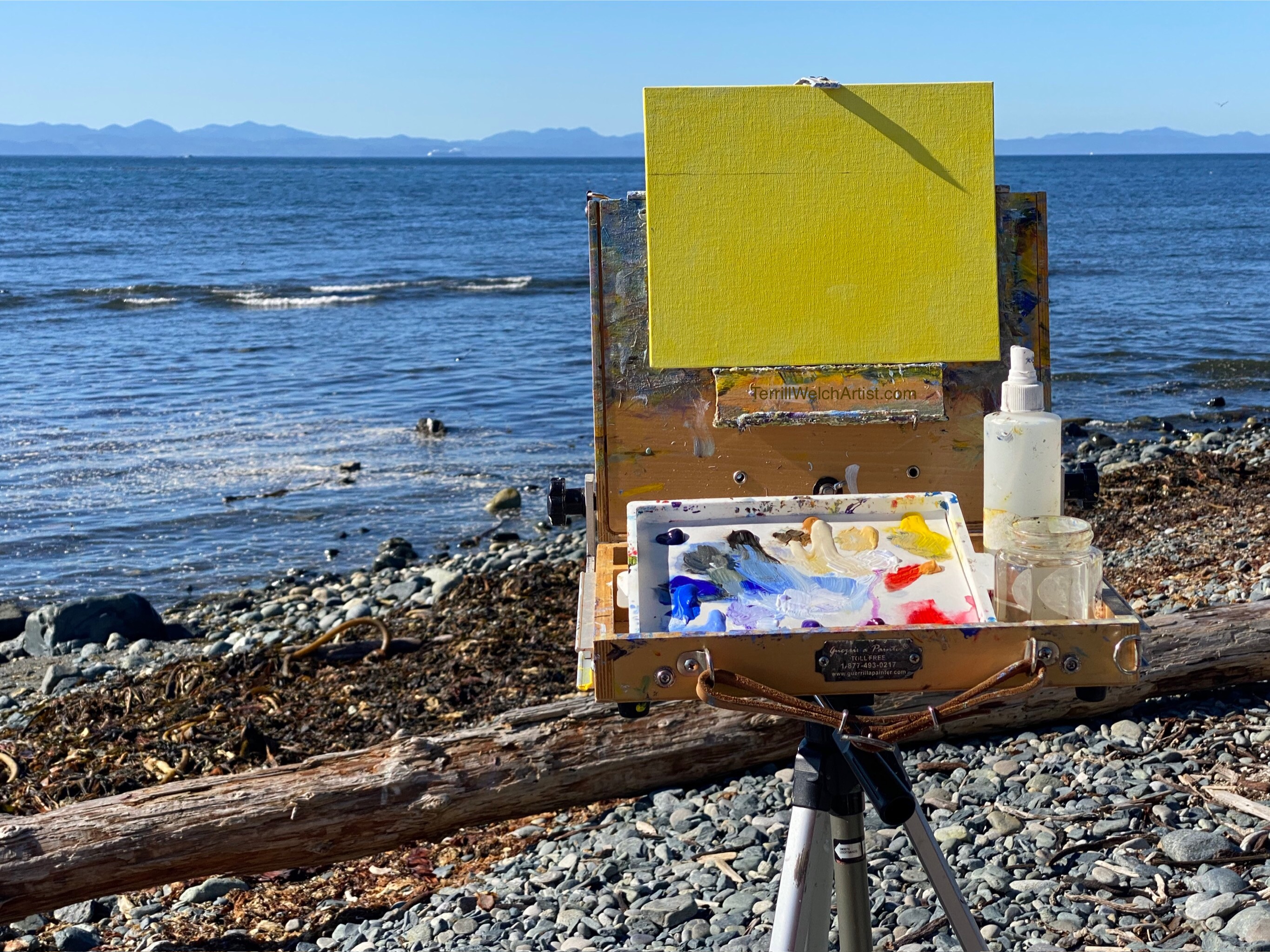
The next day late in the morning we went to the Jordan River beach area. My dignity was still smarting from the disaster from the day before. But I shrugged it off and set up my easel on a flat area of sea washed rounded, flat stones.


I didn’t take many in-progress images besides this one.


And then forty-five minutes from start to finish, it is done.

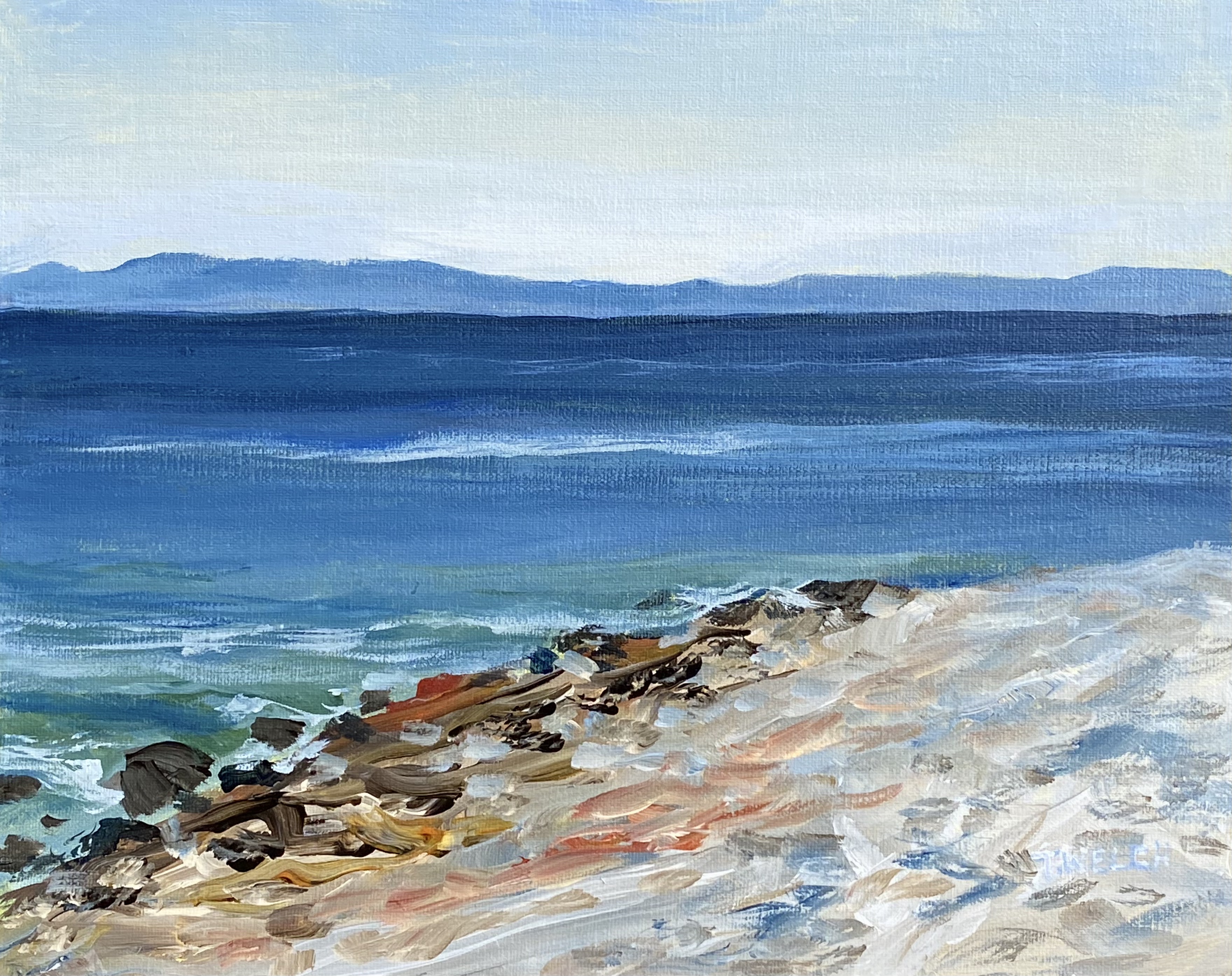
“By The Sea at Jordon River” by Terrill Welch, acrylic on linen board. Plein air, Sunday, 27 September 2026.

Artist notes: With a warm sun and underlying cool breeze the temperature reached 19 degrees Celsius as I stood on the round flat rocks at the easel. In 45 minutes, I gathered the main sensations and shapes and chose to leave it rough and fully of sensory information. This is the last day of full sun for the week as cooler more unsettled weather moves it.

As usual, when something doesn’t work, it is important to remember that it is just paint on a surface. Life and limb haven’t been risked in the process of mark making. Let it go and move on. I am not sure I am interested in surprising myself any further but it was insightful to paint what I didn’t know before moving on to being with nature beside the sea. I will likely say more in the data collection post for this painting a little later on but this will do for now.

Harbouring Hope Painting Data Collection

Painting Data Collection 

Tuesday, 22 September 2026

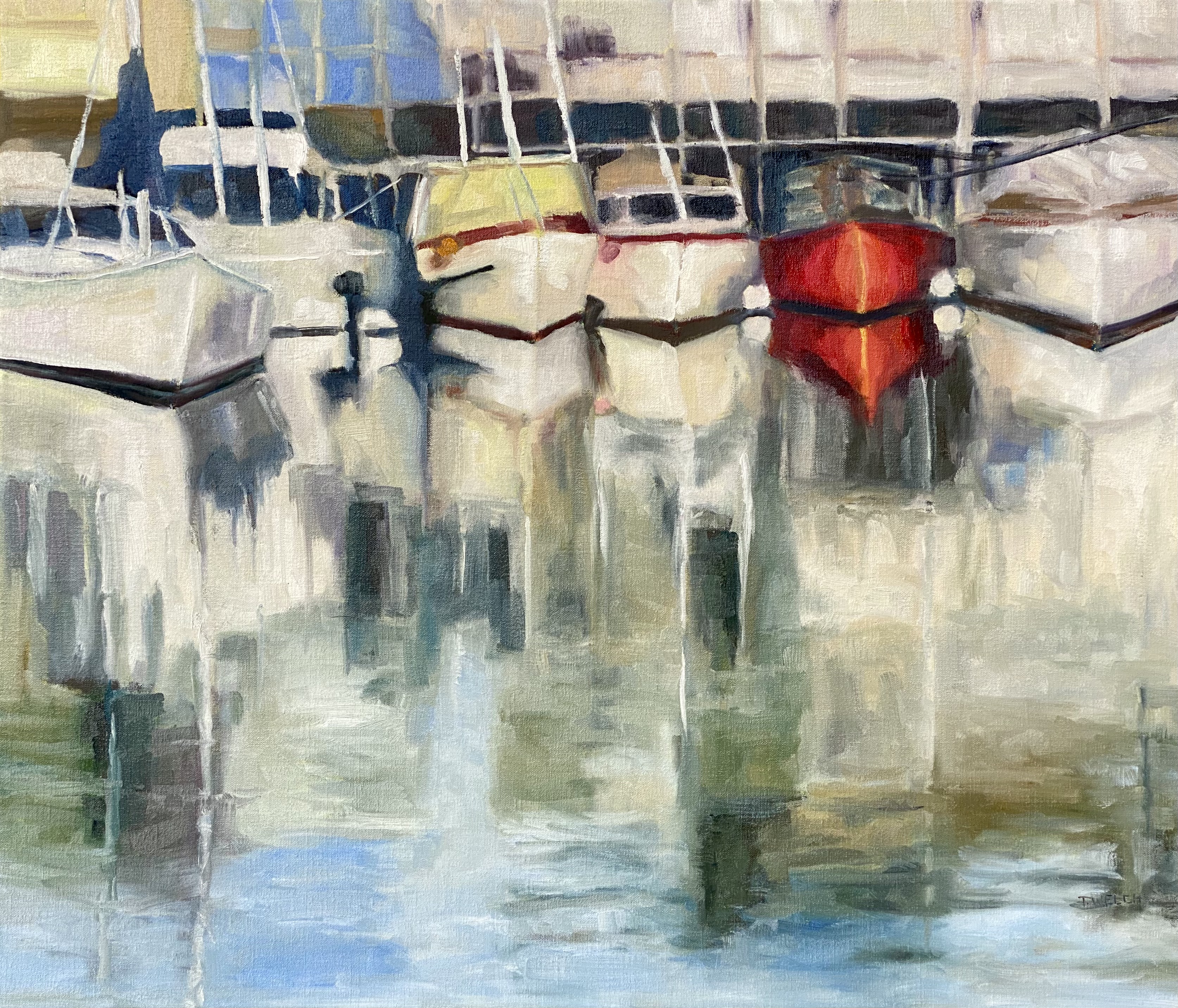
Title: Harbouring HopeDate Completed: Monday, 21 September 2026
Materials: oil on linenSize: 23.6 x 27.5 inches (60 x 70 cm)

Figurative/Abstract Self Assessment Band-Scale Rating between 1-10: 5-8

This painting still has strong impressionist leaning in the reflections but it also has an overall abstract sensibility to the shapes at the top of the painting. 

Reference Gathering: 

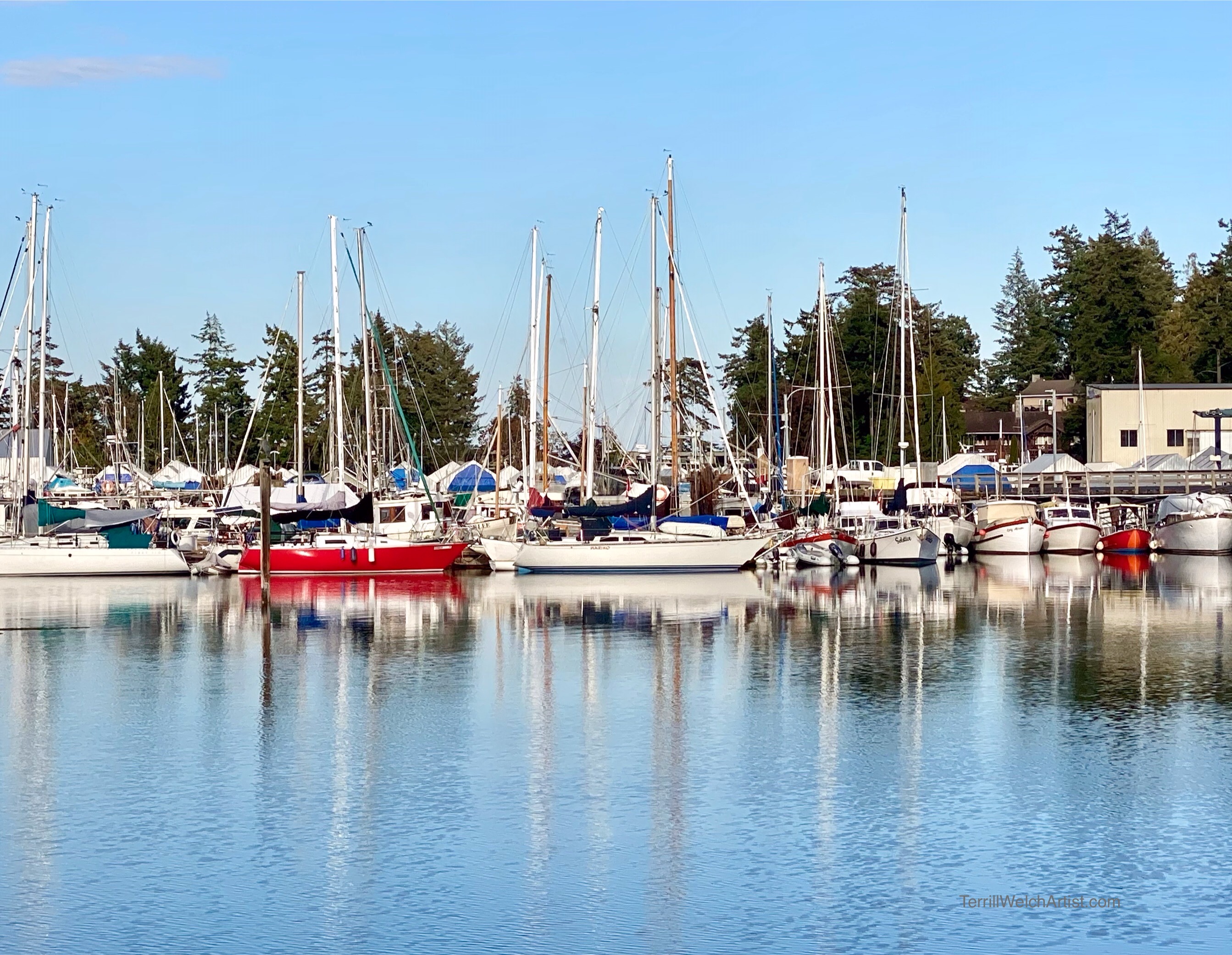
My reference gathering was thoughtful but cut short. I hadn’t planned on painting this scene. It was just an irresistible moment, like when a dog spots a squirrel. Their reaction is predictable and almost involuntary. My leash was that my husband David needing a bathroom and the ones in the park were closed. So we packed up and headed for the ferry with me turning back several times to look at the boats in the marina as we walked along the path back to the car. Their abstract shapes formed an enticing composition that wouldn’t let go of me.

Here is one of those reference images.

Marina at All Bay in Sidney, British Columbia mid September 2026. Photograph by Terrill Welch.

The next morning I pulled up the images and thought, if I just take this one small area here on the right, it will make a painting. That small suggestion from my mind to my heart was all it took. Now we have a painting! 

Making Process:

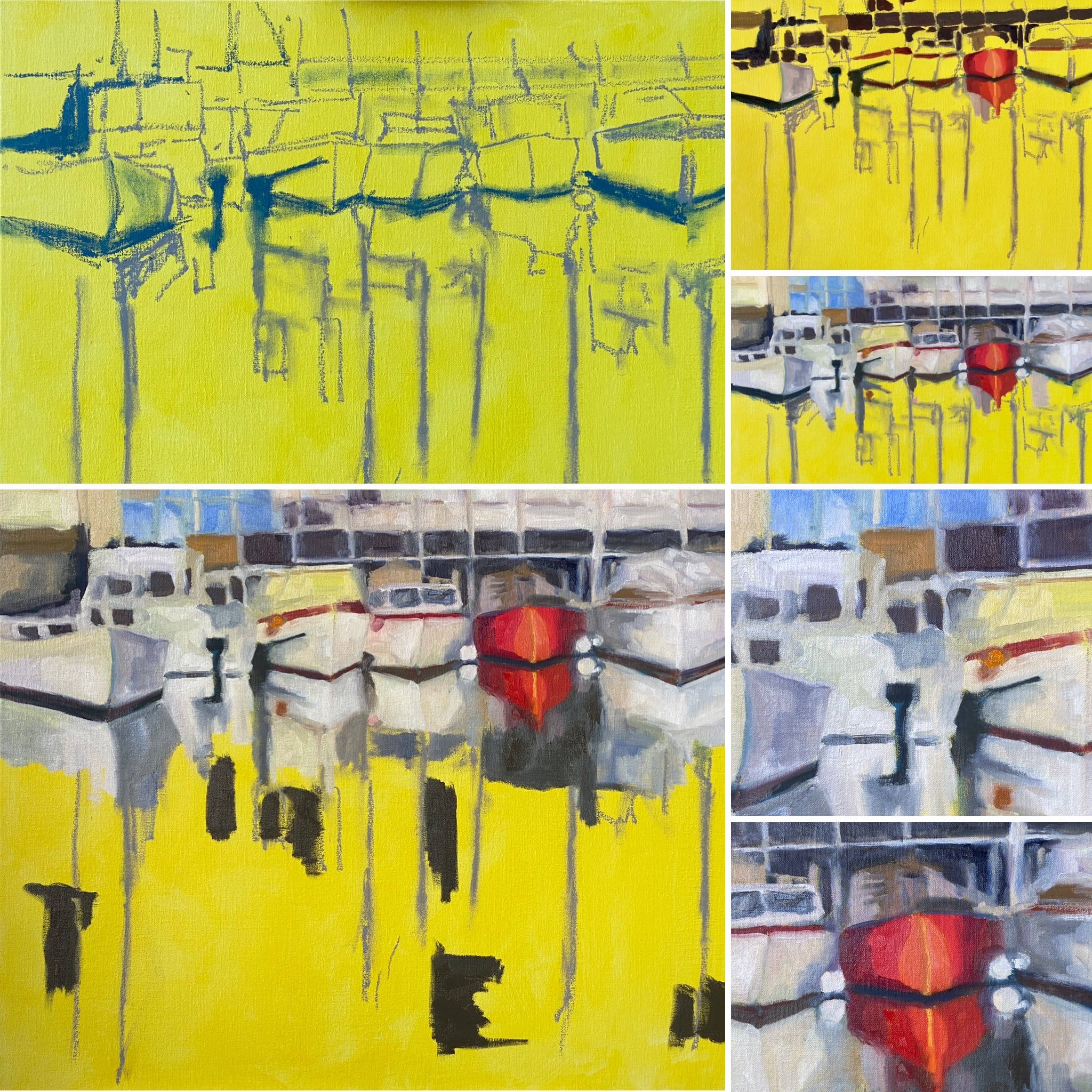
The making process was a process of simplifying to reach the core elements of my investigation and curiosity. 

Work-in-progress on “Harbouring Hope” by Terrill Welch, 23.6 x 27.5 inches (60 x 70 cm) oil on linen. Sunday, 20 September 2026.

I took a step back and then leaned into the spaces between the shapes and the light. This gave breadth as well as depth for emotion and energy in the work. The painting took shape over a period of six days beginning with oil sticks over a yellow acrylic ground on stretched linen.

Finished Painting:

“Harbouring Hope” by Terrill Welch, 23.6 x 27.5 inches (60 x 70 cm) oil on linen. Monday, 21 September 2026.

Making Notes:

I had just come from visiting a friend in the hospital and we stopped to have a picnic dinner in the park beside the marina at (what is now called) All Bay in Sidney, British Columbia. I took some reference images because the shapes and colours felt hopeful and there was a peaceful, reflective, deep calm about munching on sandwiches and looking out into the bay. I want to investigate the big gestures and emotions in this moment without getting caught in the weeds of visual or thought preciseness.

Reflective Analysis:

The painting of boats in a harbour is an old subject and likely has been happening as long as there have been boats. The question is, can I offer something more or unique in my approach? I reach into the big abstract-like shapes of the boats to carry the emotion of the work through their soft reflections. I pushed the horizon line high and let the sea in the bay hold the sky for me. I focus on the feeling of the moment rather than the details which allows the structure of the work to read true without getting caught up in the weeds of specifics and my own thinking. To pull this off, my brushstrokes must be filled with concentration, intuition and repeatable, confident, decision making. No second guessing. Make a mark and leave it. Make another mark and leave it. Paint something out, then paint it back in with the same confidence. It is not about getting it right but knowing what must be left behind, from the first mark to the last mark. The relationship of the marks within the composition outweighs architectural accuracy. The boats may feel like they are floating in the painting but no boat maker would build them this way. The most important aspect is that the work, in my first viewer’s eyes, reads as emotionally and physically whole. 
Reflexive Analysis: 

I have been musing about how there are no shortcuts in painting as there is in life. I must bring my whole vulnerable self to the easel, every time. I must be willing to investigate and admit, at least to myself, why I paint what I paint. In this case, it is part of processing the illness and healing of a dear friend who is in the hospital. We have been friends for over thirty years and I feel we are somehow both too young to be faced with her circumstances. But in truth, age has nothing to do with it. Illness has no fixed criteria. The details are private and personal but the experience is universal to human kind. Again, my painting practice takes on an undeniable reparative or healing undercurrent that isn’t visible in either the painting process or the end result, unless I choose to share it. I don’t usually paint boats in a harbour. In fact, I know little about boating or marinas. But I do know the sun and the sea. The boats are simply supporting actors for using shapes, forms and colour to facilitate a harbouring of hope. 

Key Findings: 

There is an openness in the space offered in this paint through the boldness of the shapes. This reminds me of painting the seafloor and focusing on the close up views of the seafloor and allowing abstract elements to press against more figuratively mark making. 

Anything else: 

I like the freshness and the depth of this work. I couldn’t have stopped myself from painting this painting no matter the risks of the derivative nature of the subject. I am glad that critique didn’t create a barrier but was left as – duly noted, before I proceeded. 

Oyster Bay Late August Painting Data Collection

Monday, 7 September 2026

Painting Data Collection 

Title: Oyster Bay Late AugustDate Completed: Friday, 28 August 2026
Materials: acrylic on linen board 
Size: 8 x 10 inches (20.32 x 25.4 x 0.51 cm)

Figurative/Abstract Self Assessment Band-Scale Rating between 1-10: 5

This is a plein air contemporary impressionist quick acrylic study to capture sensory information in the moment. 

Reference Gathering: 

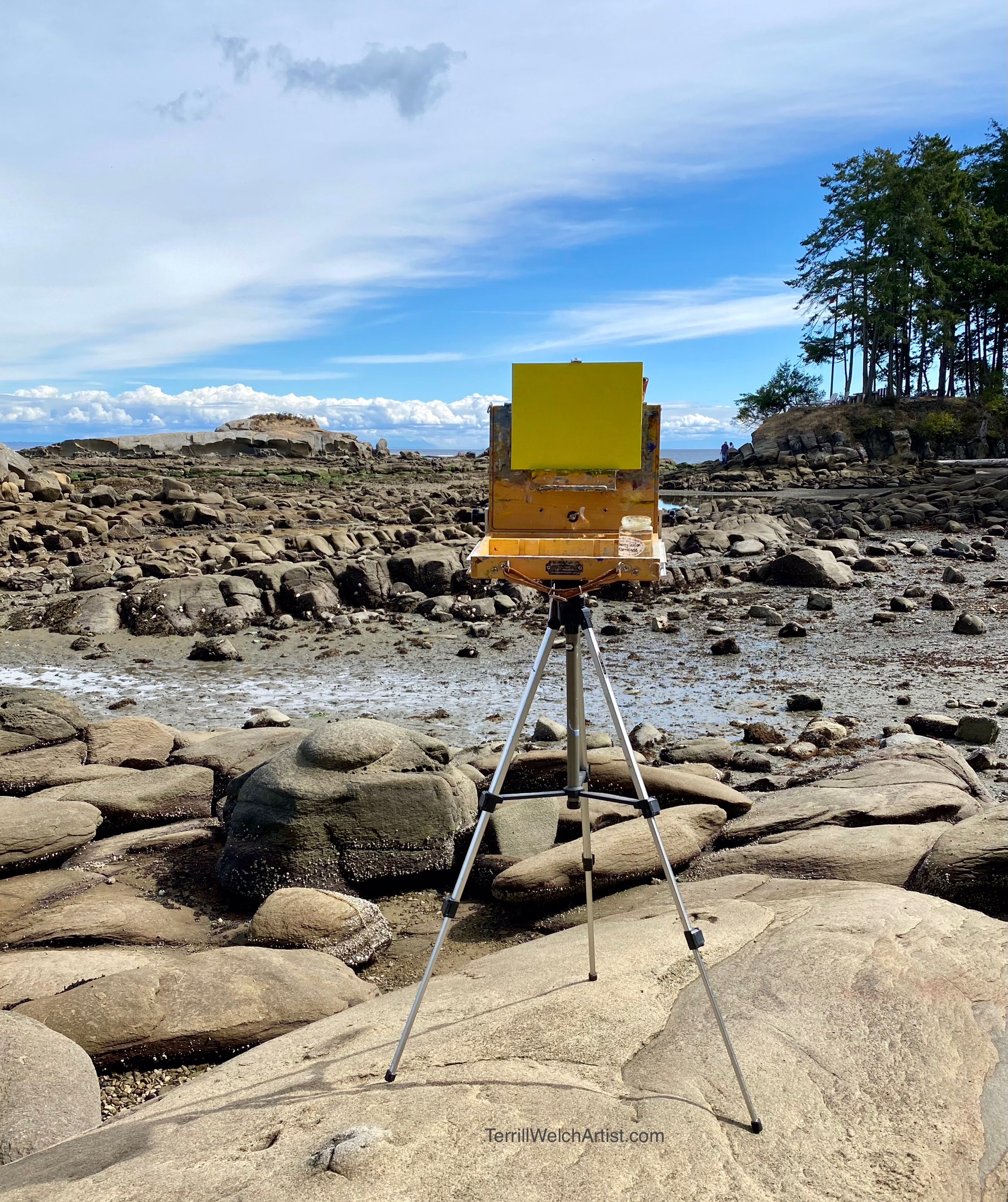
The references for this work were observations in the moment as I stood on the top of an exposed piece of sandstone in front of my easel in Oyster Bay on (what is now called) Mayne Island in British Columbia, Canada. 

Setting up to plein air paint at Oyster Bay in late August. Photograph by Terrill Welch, Friday, 28 August 2026.

When I began there was a couple making their way along the shoreline and a couple of construction workers building a bench up above them. Other than this, I had the place to myself for the painting session. 

Making Process:

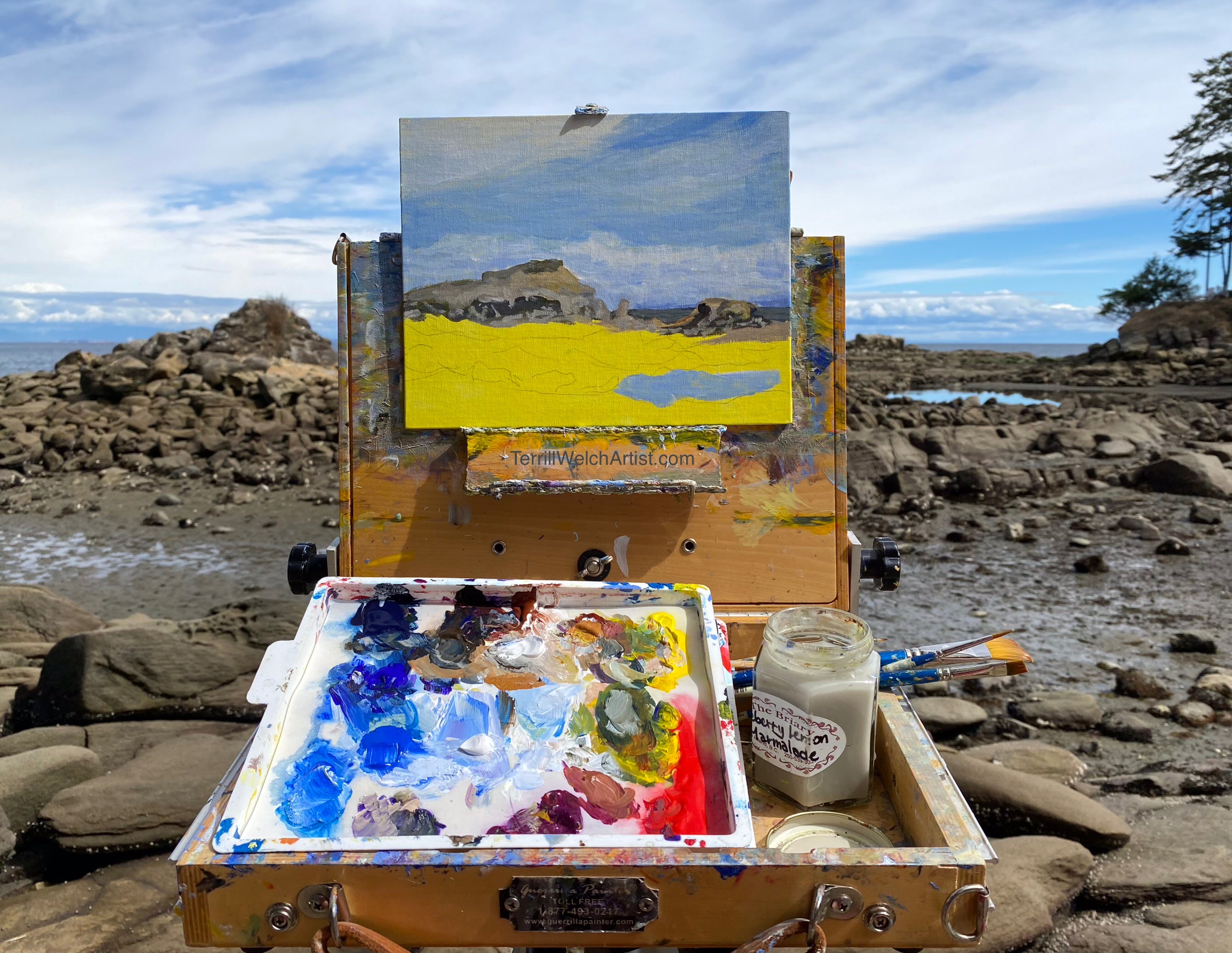
The painting process was direct and immediate as I captured the light first and then began to build up the forms of the sandstone.

Work-in-progress — Oyster Bay Late August by Terrill Welch, 8 x 10 inch acrylic on linen board. Photograph by Terrill Welch. Friday, 28 August 2026.

I was working with an older palette from a previous painting sketch that had ran a bit from being tilted in my plein air backpack. But it worked.

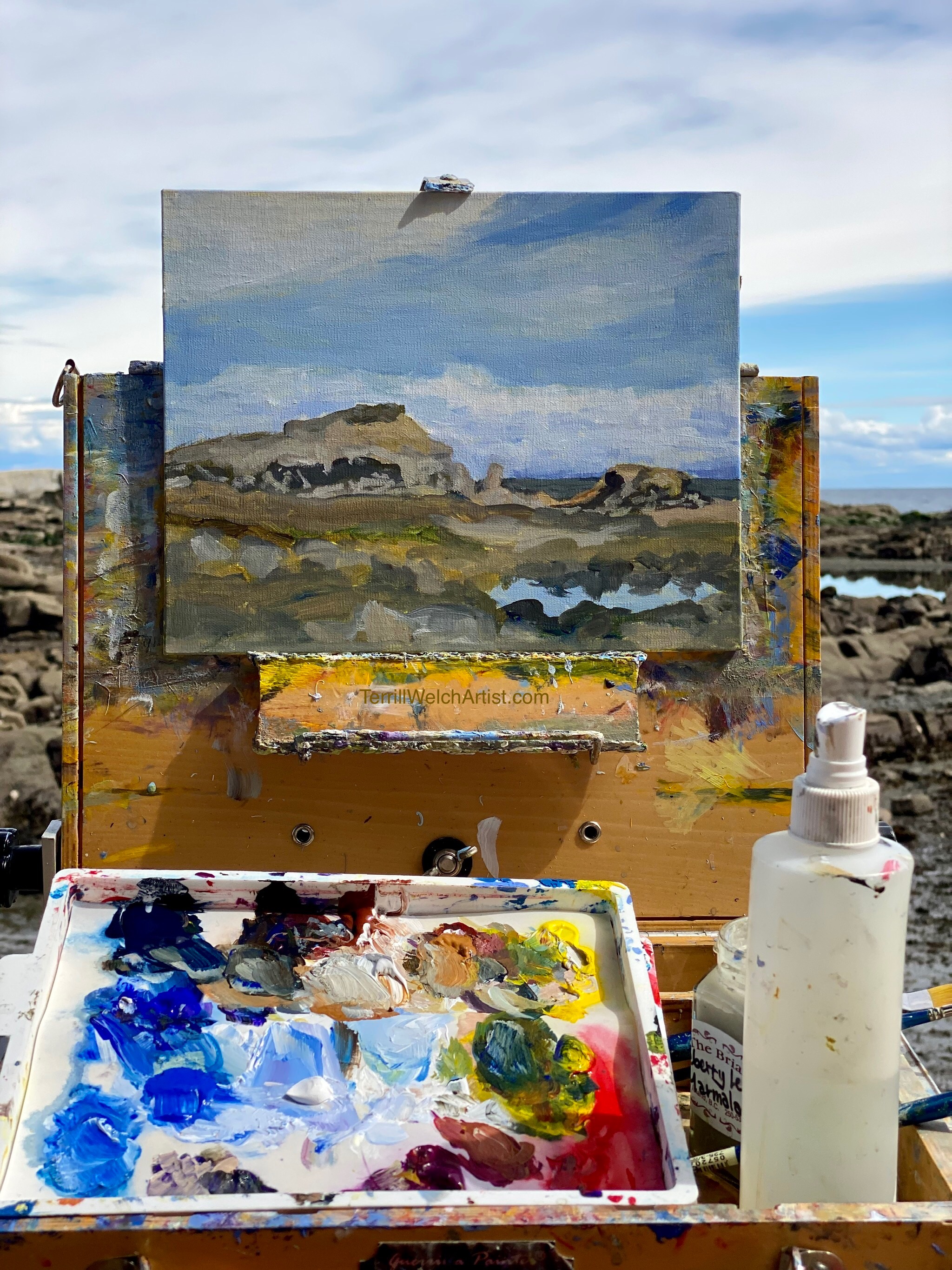
Work-in-progress 2 — Oyster Bay Late August by Terrill Welch, 8 x 10 inch acrylic on linen board. Photograph by Terrill Welch. Friday, 28 August 2026.

Eventually I managed to get everything blocked in and was able to slightly refine the piece before my available time came to an end.

Still on the easel — Oyster Bay Late August by Terrill Welch, 8 x 10 inch acrylic on linen board. Photograph by Terrill Welch. Friday, 28 August 2026.

Finished Painting:

Oyster Bay Late August by Terrill Welch, 8 x 10 inch acrylic on linen board. Completed August 28, 2026.

Making Notes:

I set the plein air easel on top of the sandstone and looked east over to the rocks exposed in a low tide. The day is pleasant with blue skies holding shapely clouds in the late August sun. I stay for a while with my brush in hand and drift through an hour of painting. It is my birthday and this is my gift to me.

Reflective Analysis:

I had been offered a chance to go out on my own while knowing someone was with my partner who has dementia but still is able to stay by himself for a few hours at a time, if set up with a note to remind him when I will be back and where I have gone. But it is always more freeing if someone is with him. It was a generous offer. She thought I could go for lunch with a friend or something for my birthday. I responded that what I would like to do is go plein air painting because I already had family coming over to visit on several different days for my birthday. She laughed and replied — of course you want to go paint for your birthday! 

Reflexive Analysis: 

One of the odd things to me about being a full time caregiver is that I do not crave time with friends or other people so much. We go out for breakfast or lunch a couple of times a week and then there are the times I see people when getting groceries or picking up produce at the Saturday market plus, I engage daily online while presenting my work. I was invited to join a philosophers café that meets once a month and I accepted as a way to have meaningful deep discussions in-person on topics of interest. This complete package of in-person engagement with others always seems like enough socializing for me. What I crave most is just a few hours at a time on my own. I can still get this but it can’t be for very long at a time. Two hours is ideal and three is stretching my partner’s ability to feel confident on his own. So when given a choice to go for lunch or go plein air painting, the painting wins. This is because I am certain that my time at the easel will offer regeneration and delight. It fills my personal bucket like nothing else has ever been able to do. Just me and nature working together for a focused 45-60 minutes. This is all it takes. Hiking the trails alone does a similar thing but painting is the very best! I always come home filled with satisfaction and refreshed. This is the reparative element to my painting practice in action. 

Key Findings: 

I thought I would do more with this small study back in the studio. But as I spent the next few days glancing at it on the window ledge amongst various other small works, I decided nothing more I did would improve my impressions of this time beside the sea. So I have left it just how it was when I packed up to come home. 

Anything else: 

I am still considering what or if I will do anything on larger surfaces with these recent small painting sketches. I am in no rush to make a decision. The weather to best enjoy painting outside with the golden fall light is brief and will soon come to an end. I can decide once the rains keep me inside more. 

Solace Between Sea and Sky Painting Data Collection

Painting Data Collection 

Title: Solace Between Sea and SkyDate Completed: Saturday, July 25, 2026
Materials: oil on canvas
Size: 31.5 x 27.5 inches (80 x 70 cm)

Figurative/Abstract Self Assessment Band-Scale Rating between 1-10: 

This work sits primarily at “4” with Camille Corot and April Gornik (Impressionism is a five and in the middle between figurative at 1 and full abstraction at 10). Yet it is a closer more intimate view that has us crouched next to the arbutus tree for company. The foliage above and below is abstracted but not noticeably so. The rest is clearly a figurative tree, sandstone shore, sea, sky and distant shoreline.

Reference Gathering: 

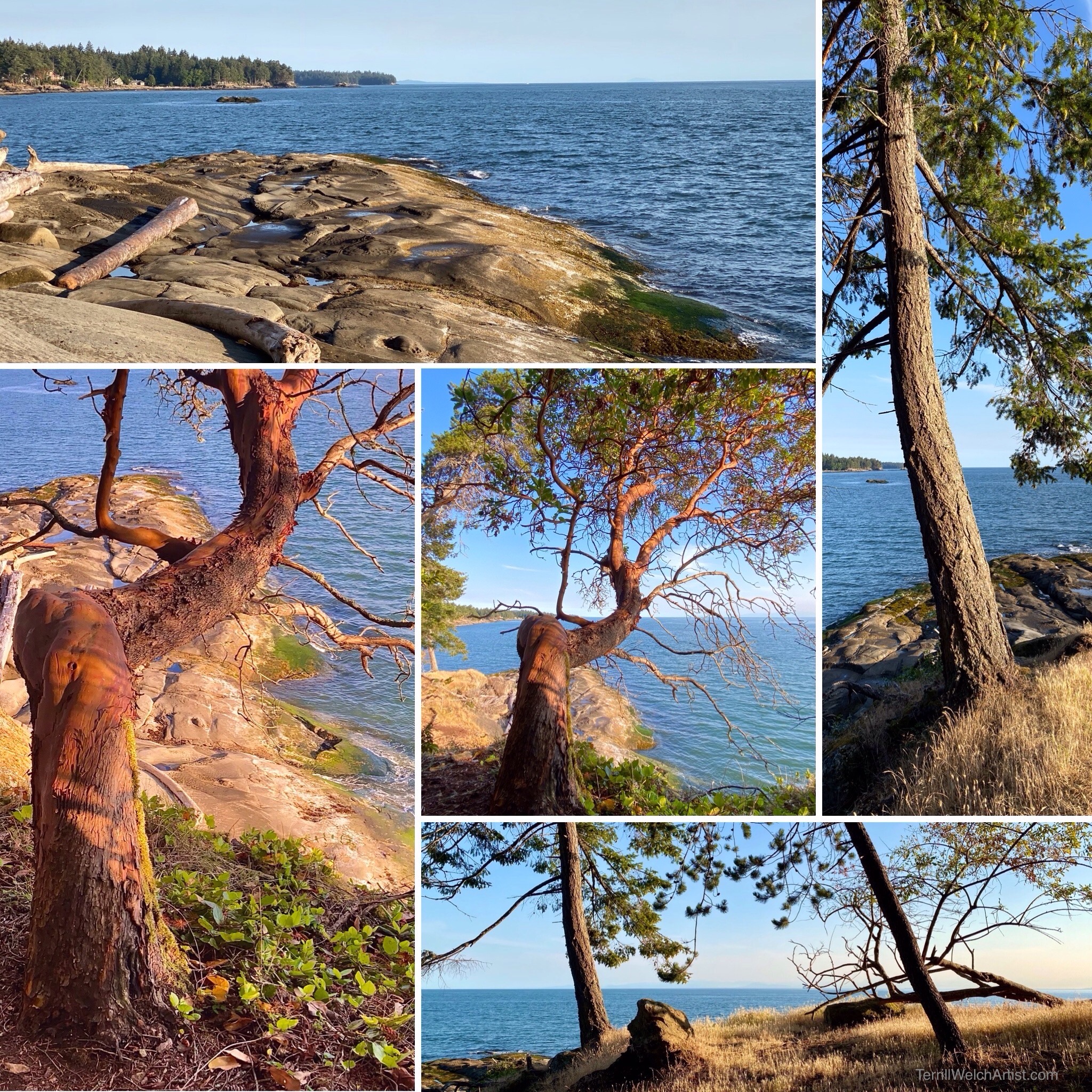
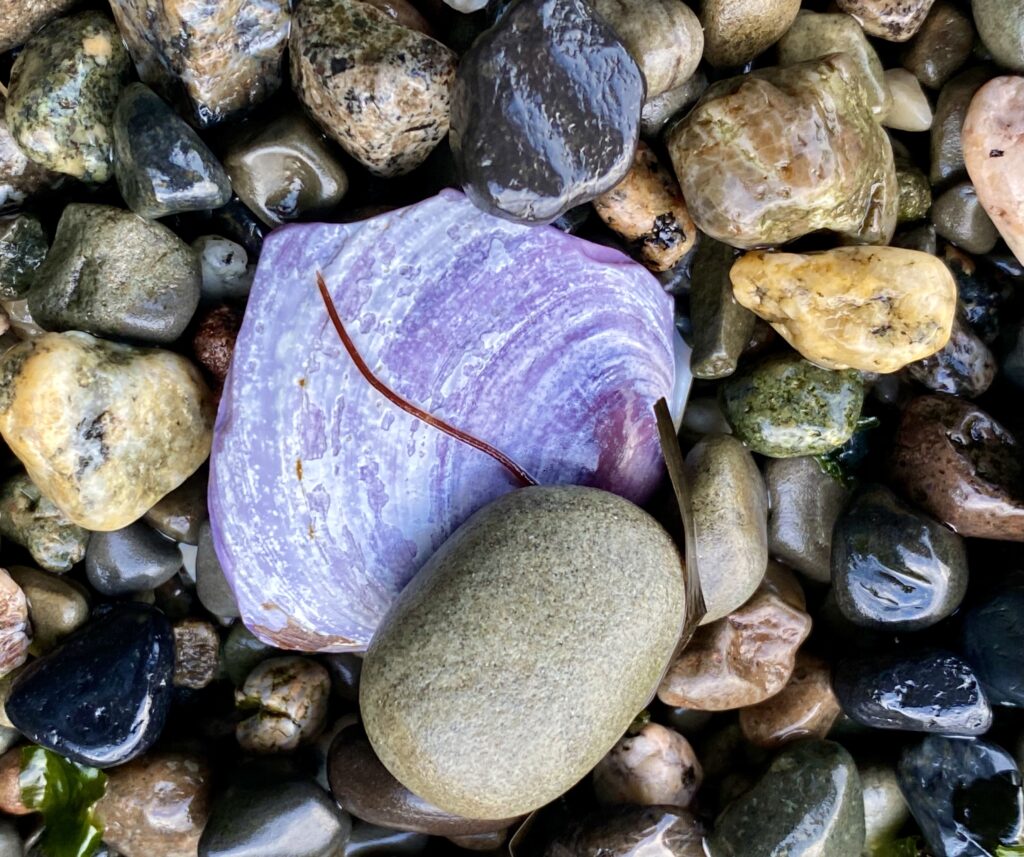
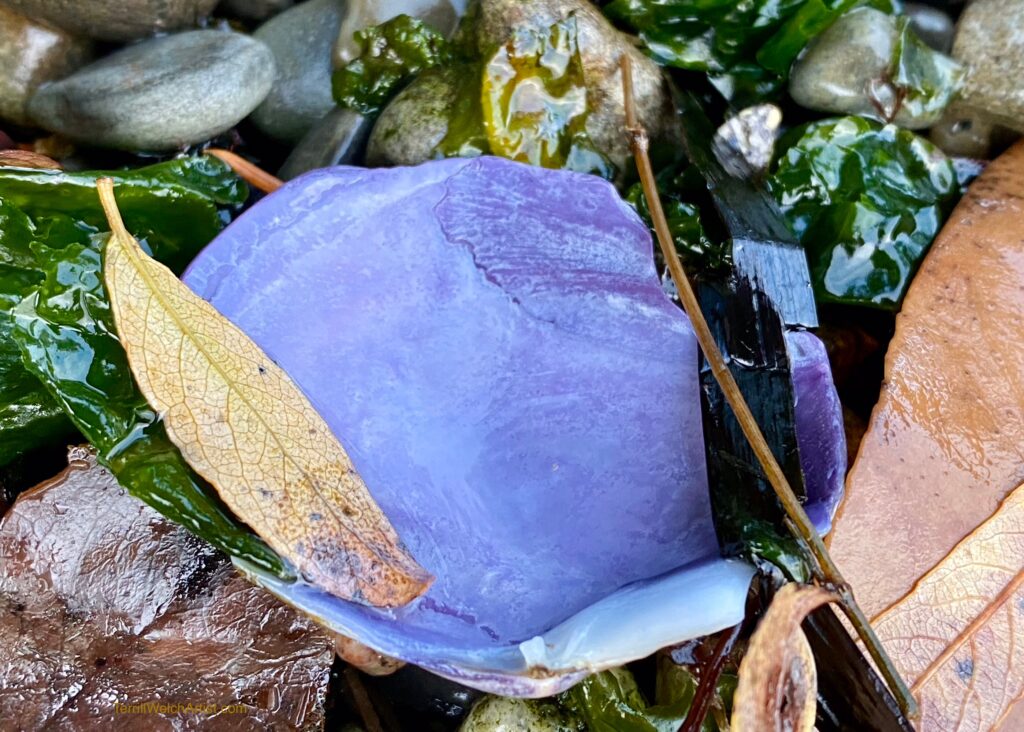
My references are from an early morning walk that saw me at this location on Edith Point at just before 7:00 am on Monday, July 6 2026. The sun had risen a couple of hours earlier but there were still hints of warm morning light. There is the arbutus tree of course but it was the totality of the morning’s walk that will later resonate in a more complete memory onto the canvas. The sandstone shore wasn’t just viewed. It was walked on and sat on while I ran my fingers over its sandpaper-like surface. The sea sounds were as soft as warm morning air flickering across my cheeks. There were other trees close by but I chose the arbutus and in the end its company is outside of our view. 

Reference inspiration for Solace Between Sea and Sky by Terrill Welch.

Making Process:

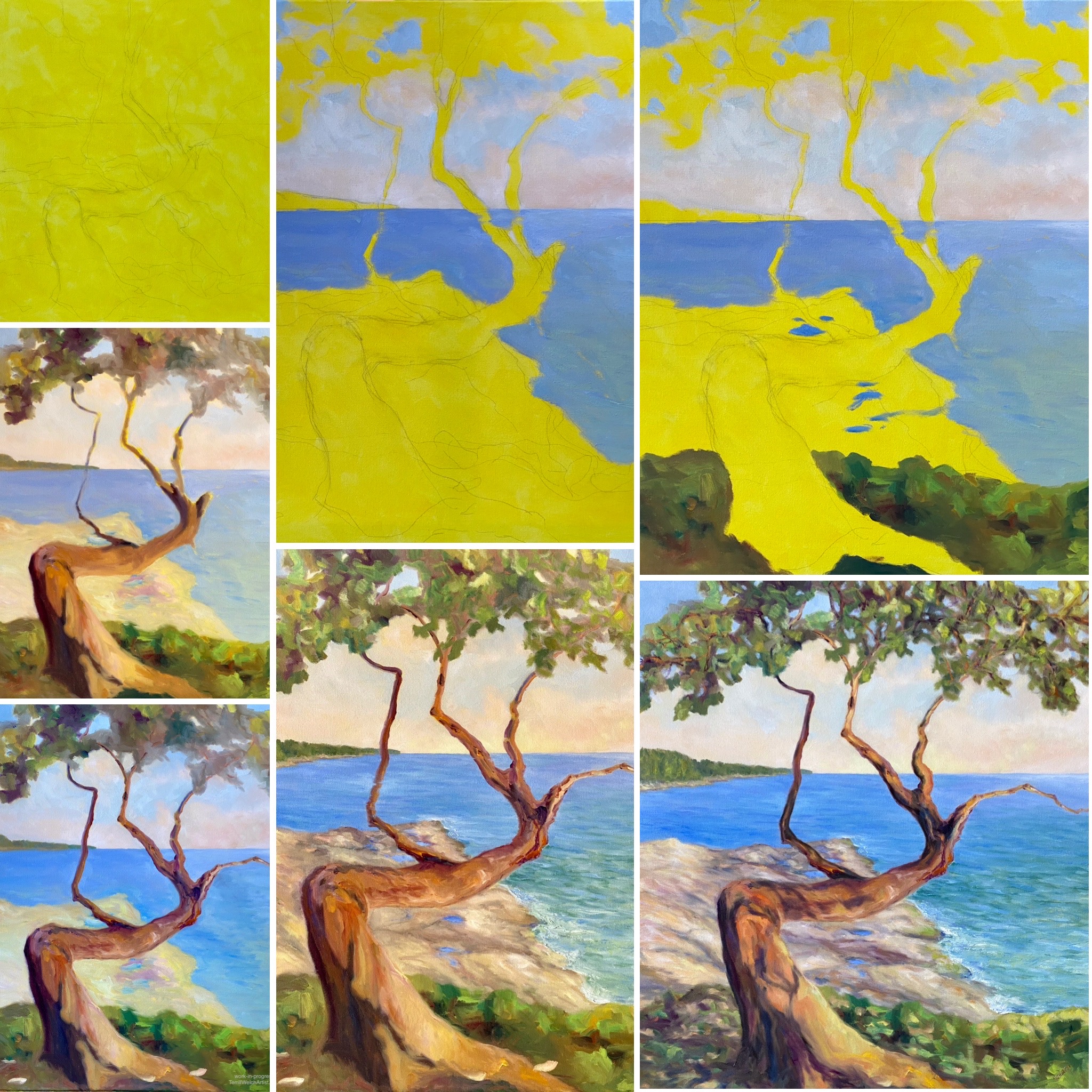
My painting process begins with a few composition lines. I have the notion of painting the tree “From the Ground Up” so that I can feel the forest overhead as well as under my feet. Yet, how will I create such a feeling? I also wanted to be standing “with” the arbutus tree rather than looking “at” it. I am listening to the arbutus tree tell me its story of time in what is a long and meaningful conversation. The painting process takes place over 12 days with moments of pause so layers can dry. But also pauses for the painting to decide what it needed from me. The last image in the collage is not the final painting yet but all significant decisions had been made at this point. My simplifications and exaggerations are in full view. Memory is often like that. We leave things out and make up other things to capture the inner resonance of what we want to convey. 

Painting process for Solace Between Sea and Sky by Terrill Welch.

Finished Painting:

Solace Between Sea and Sky by Terrill Welch, 31.5 x 27.5 inch oil on canvas. Completed July 25, 2026.

Making Notes:

Early in the morning I hiked along the outside trail early of the Edith Point Conservation Lands next to Strait of Georgia. During the summer the sun rises far enough north to slam this shore in brilliant sunlight for the first view hours of a day. The receding tide leaves small pools of seawater along the lower parts of the sandstone shore. Low clouds on the horizon still have a bit of an orange popsicle hue. What might it be like to be this specific arbutus tree rooted deeply along the high part of the bank and stretching day after day for every casual ray of sunlight? It is a quiet determined striving that I can take solace in. I soak up the moment for as long as it can last. Seconds really. Or maybe an eternity. Each brushstroke contains purpose and random execution at once. It is not the mystery of discover so much as knowing where I am and wanting it stay. This painting opens up under my first viewer’s gaze. I can feel the grandness of expanse filled with early morning’s comfort and possibilities just as I remembered it during my hike. 
Digital Room View for size reference:

Digital room view using the Canvy app showing at scale “Solace Between Sea and Sky” by Terrill Welch.

Reflective Analysis:

At this specific time, I am beginning a new thematic body of work that I have yet to form into a rigorous research question. I just know, I want to be with the trees and look down onto the seafloor where I have spent the past two years at the tideline painting close up work that I composed primarily vertically into “landscapes of the small” or “child’s view” compositions. One must hold the expanse of the shoreline above one’s head doing this work. I want to hold a grand view perspective again, even if I still crouch close to the earth. 

Reflexive Analysis: 

The title has the “solace” as a primary reference. I find in a moment of solace, as here in the company of the arbutus tree and taking in the sea and sky, there is also acknowledgment of pain or grief. The desire or need for solace necessarily describes the other. From my first viewer’s gaze, maybe due to my own painter’s hand, I can fully sense both of these halves that make a whole. I was raw and tired as I pushed hard to get the last of my assignment materials ready for assessment. We had lost our home support services due to retirement so my partner and I were working out how we were going to best do his showers together, just the two of us. We found a way but new routines are harder, for both of us, when someone has dementia. But in the end we came up with an even better solution than how he was showering before and a method that allowed him more independents under my prompts and supervision. So this arbutus tree is not just comfort but also a symbol or inner strength, perseverance and resilience. Standing with this tree, I have company during my most challenging doubts and fears and exhaustion. I come away from the view and the easel ready to continue and step just a little lighter from the warmth of such an early morning expanse and the recognition that all things are interconnected and whole, for this brief moment. 
Key Findings: 

I had the desire to keep a wide range of brush marks between figurative and abstract but that isn’t what the painting asked for and I knew better than to question its lead. The process from inspiration to completion of the work took 19 days plus another two days to organize my thoughts and data collection to write about the process. So if anyone asks how long it took, the answer is 50 years of a nature-centric, reparative painting practice plus 21 days of focused attention. This work doesn’t come easy. The paintings are moulded out of the blood flow that makes up my full sensory life and contemplated experiences. 

Anything else: 

The solution to an attempt that falls short of my intention is to try again. Keep painting, I tell myself. Just keep painting. 

What might you do to continue with something that you haven’t quite yet succeeded in accomplishing?

REAWAKENING MY PUBLIC ART RESEARCH JOURNAL

Monday, July 6 2026

For the past two years I have kept an art research journal as part of my MA Fine Art Studies. Many of these posts have been featured in my “Terrill Welch by herself” newsletter. However, my degree studies are coming to a close. I am beginning a new series of work. Since I have found the art research journal useful, I have decided to continue the practice here, even though this space has, for the most part, been dormant since 2022. What is four years in a lifetime of an art practice!? Let’s continue!

You can learn more about my recent art autoethnographic theory and nature-centric reparative painting research practice, as well as my intentions for disseminating my new Seafloor series, on my website at: https://terrillwelchartist.com/disseminating-a-nature-centric-reparative-painting-practice/

You can also visit my individual final degree show that will opening on August 20,2026. It has to be up and published now for assessment by the university so you are also welcome to have browse if you wish at: https://terrillwelchartist.com/terrill-welch-five-seasons-ma-fine-art-final-show/

I will continue to develop my theory and art research led painting practice as I begin a new series, tentatively called “Close to Home”, as I again spend time with trees as I meander (what is now called) Mayne Island and at times capture domestic moment that connect nature with our daily habits within the shelter of our strawbale timberframe home.

Early this morning at around 6:30 am, I was hiking Edith Point and think about how I might proceed. There is the most satisfying summer task of hanging laundry on the covered clothesline of the side porch.

Laundry drying on the line. Photograph by Terrill Welch. June 14, 2026.

Or, if my significant other is still sleeping, there is my morning coffee ritual in the blue chair down in the studio as I watch the sun come around to catch the trees on the far hill.

Morning coffee in the blue chair of the art studio. Photograph by Terrill Welch. June 28, 2026.

Then again, reading on the bench on the other side of the house is also a moment I treasure.

Outside on the bench with wind in the trees for company drinking garden mint tea and reading the second half of Book of Lives: a memoir of sorts that I put down at the beginning of my 3rd and final term in an MA Fine Art degree delivered completely online. Photograph by Terrill Welch. July 4, 2026.

However, there is also the calm of a blue-green sea that make me exhale fully.

A calm green Salish Sea strikes an elegant pose. Photograph by Terrill Welch. June 28, 2026.

Or it could be sighting the clouds that show up in a tidal pool that holds my attention.

Clouds in a Tidal Pool. Photograph by Terrill Welch. June 28, 2026.

Yet, as I was walking along with the scent of soil and sea enveloping the lemony hue of the morning air around me, I thought about the trees and how they continue to teach me how to thrive while being rooted in one place. Maybe this would be a good place to start?

Early morning sun greeting the crest of a knoll next to the sea. Photograph by Terrill Welch. July 6, 2026.

There is an arbutus tree that has yet to come under my brushes and I am itching to see what I can do for its portrait.

Arbutus tree catching the 7:00 am summer sun that is already warm and scenting the air with sea earth and a nearby pine tree. Photograph by Terrill Welch. July 6, 2026.

This tree might be the first of this new series to be tackled at the easel! We shall see. Right now, ideas are being filed into an album of references so that they are ready as soon as I get a chance to start.

Welcome to a new journey and adventure in my painting practice. I do not have a posting schedule but will likely add something new each week so I can keep track of what I am doing. Until next time! Feel free to comment if you wish.

When Morning Comes

When morning comes, I like to go down to the sea, particularly after a rain when the mist rolls across the water and slips up through the trees.

Miners Bay Mayne Island British Columbia – after the rains.

The mist is not the same as our pinkish smoke-filled days from the summer’s forest fires.

McLeese Lake, British Columbia – reflections in the heavy smoke.

I can breathe loosely, deeply and freely in the mist.

I have a thousand, at least a thousand, stories to tell but they too have slipped through the trees with the mist.

Instead, lets take a breath and release it into the autumn coolness.

What are you wanting to release today?

© 2017 Terrill Welch, All rights reserved.

Liberal usage granted with written permission. See “About” for details.

Creative Potager – Visit with painter and photographer Terrill Welch

From Mayne Island, British Columbia, Canada

For gallery and purchase information about Terrill’s photographs and paintings go to http://terrillwelchartist.com

The Moon is No Longer There – notice of extended travel

Dear friends, colleagues, fans, collectors, followers and random connections, starting immediately, I shall be on an extended leave to travel. My purpose is to bring you “the moon” in a way you will remember and notice for all time.

Mayne Island Blue Moon rise July 31 2015 by Terrill Welch 2015_07_31 170

In order to do this, I must live my best life. I am required to travel deeper and even more focused than ever before. My intention is clarified. My inner compass is set. My resources and research materials are organized. I am about to begin my journey to capture something unforgettable, rare and valuable – our ordinary, everyday, natural world.  The new series of work “The Moon Is No Longer There” may take a year or a life time. Only one thing is absolutely clear – my spiritual, emotional and physical bags are packed. I am ready.

Christmas Day Full Moonrise 2015 20 x 16 inch oil on canvas

christmas-day-full-moonrise-2015-20-x-16-inch-oil-on-canvas-by-terrill-welch-2015-12-26-img_8442

To my 780 friends and family and the 190 followers of my personal profile and the 1,360 likes of my Art of Terrill Welch Page on Facebook, you are important, generous and supportive individuals. You have been significant and instrumental in getting 90 or so of my paintings out in the world since 2010. As I begin traveling this quiet and sacred inward journey, I shall keep you in touch by sharing links to weekly posts on my Creative Potager blog  HERE.

To the over 100,000 followers of my West Coast Landscape collection and the more than 47,000 followers of my Artist in the Art Studio collection on Google Plus, once a week postings will continue. Or, you may want to join the over 5,000 direct and indirect followers of my Creative Potager blog  HERE.

To my 4,100 tweet friends on Twitter, my experience tells me that you will most likely miss my weekly tweets completely. If you are truly deeply connected to my paintings and photographs, I suggest subscribing directly to my Creative Potager blog  HERE.

For all other social platforms such as Instigram or Ello, please be advised via this shared post that I shall only infrequently send a signal in a new post to let you know I am alive and well. You are great. You are even awesome and this is not about you. It is all about me. If you are still reading this, I am sure you have figured out what to do if you desire to come traveling with me. Yep! Follow my Creative Potager blog HERE.

For those that only wish to be notified when new paintings are released, the best option is to follow my website posts on TerrillWelchArtist.com  HERE. If you are looking for something in particular or want to see if you have missed a recent painting release just go to the Galleries page on this website and head on over to my Artwork Archives online gallery  HERE. This online gallery will always have the most current released work and let you know what is sold.

So, that is it my lovely fellow human beings. Having captured a spray of tulips in the studio this morning, I am sending them along with compassion, love and humility! I am traveling light, with conviction, trust, integrity and a small measure of reckless abandon!

bunches-of-tulips-by-terrill-welch-img_8864

If, for any reason, you do need to contact me, email, painting inquires in the online gallery, private messaging or telephone calls and text messages will still be monitored and answered along with comments on posts.

I wish you all the best in living your very own best life!

Terrill

p.s. I understand that this is going to be different and a little strange for both of us. And it will be fine, it may even be great.

p.s.s. The Beauty of Oil Paints class and its private Facebook group are not impacted by my travel schedule.

What arrangements are you making to live your best life?

© 2017 Terrill Welch, All rights reserved.

Liberal usage granted with written permission. See “About” for details.

Creative Potager – Visit with painter and photographer Terrill Welch

From Mayne Island, British Columbia, Canada

For gallery and purchase information about Terrill’s photographs and paintings go to http://terrillwelchartist.com