Tuesday, 20 October 2026
Excerpts from Terrill Welch MA Fine Art Journal
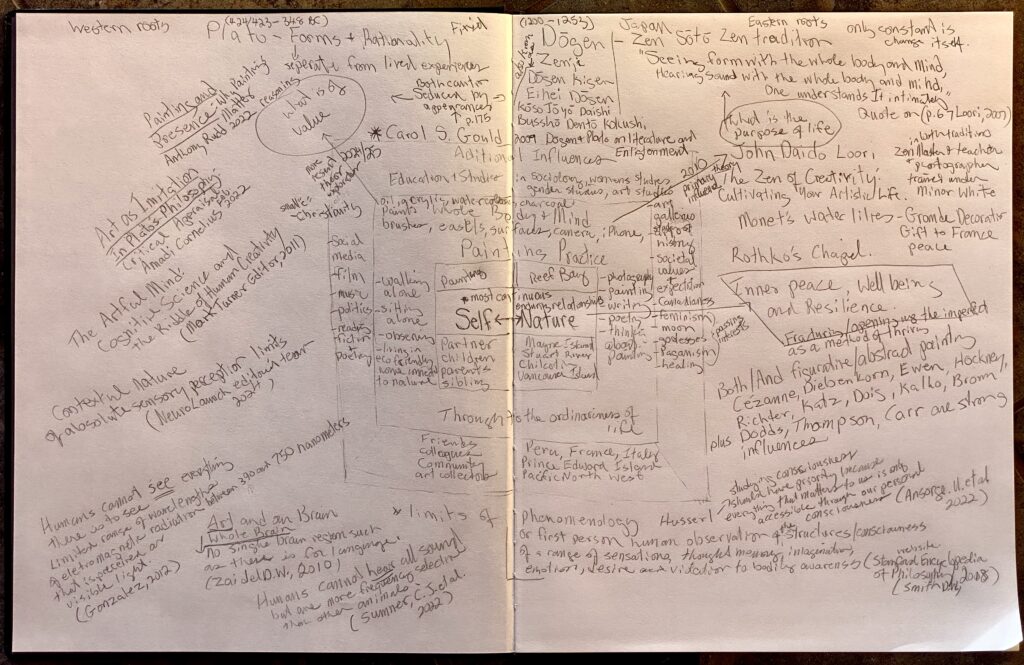
Much of this essay was later abandoned in relation to a research framework for my practice. Yet, some threads did get pulled through and it is worth it to me to have these rough ideas for further reflection going forward.
First written Sunday, 5 January 2025 and rewritten Wednesday, 12 February 2025
I begin with releasing my mind and body towards observing my subject and the things I have selected to observe, in this case the sea floor at the point where the land and sea meet. In doing this repetitively for months and years, I have noticed that I have a strong sense of inner peace as I get low to the ground and spend time with the shapes of seashells, bits of sticks, rocks and the water of the sea. This sensation is influenced not just by the shapes I see but equally by the smells, sounds, textures and rhythmic movement of the sea as I employ my whole full body and mind to these sensory experiences. Past experiences trickle into the present experience. I have layered ideas about what all the days of the sea floor where I am looking have in common. John Daido Loori (1931-2009) in The Zen of Creativity: Cultivating Your Artist Life suggests that I resist these generalizations and seek to observe with full attention what is specific in this moment. Loori uses the example of picking weeds in a garden by approaching “each weed as the first weed and the last weed of your life”. (Loori, 2005, p.75) To do this, I come back to my breath and I release all notions of what I think I know and I observe again as if it is my first experience. This is not a pure practice of perfection but rather a continuous repeating practice of observation. When I feel my thoughts drifting to what I think I know, I stop and start over observing again.
John Daido Loori was a Zen Buddhist rōshi (old teacher/master) and abbot (priest) who had the distinction of being one of three western dharma holders of both the Zen lineages of Eihei Dōgen’s Sōtō beginning in 1986 and Linji Yixuan’s Rinzai beginning in 1997. Loori was the founder of Zen Mountain Monastery and the Mountains and Rivers Order and served as their guiding teacher for almost 30 years. Loori’s nature photography was shown in the American Museum of Natural History in Manhattan, New York and his work has been published in Aperture and Time-Life. (Encyclopedia of Buddhism, 2023) Beginning in 1971, Loori also studied under photographer Minor White, who taught at the California School of Fine Arts beginning in 1946 at the invitation of Anzil Adams. (Loori, 2005, Wikipedia, 2020)
Since 2009, in my painting practice, I am clear about how I apply Loori’s Zen theory of seeing with the whole body and mind and moving through this awareness to be able to function in the ordinariness of our lives. (Loori, 2005, pp. 67-81) For me, this is about exploring the purpose of life through my painting practice. However, there is another whole school of western thought about the value of painting and art that begins with Plato and is frequently referenced when discussing art theory. (Cornelius, 2022, Gould, 2009, Rudd, 2022) In Plato’s theory, Forms are viewed as the ultimate reality compared to everything we experience through our senses which are a false copy of the ultimate reality of Forms. For Plato, paintings are further flawed as a copy or representation of a copy and therefore a poor imitation of reality and hence not particularly useful to furthering knowledge or understanding the truth. Using Plato’s theory of Forms, as it is discussed in Book 10 of the Republic, a painting doesn’t give us the thing itself but a poor copy from one perspective of a reflection or shadow of the thing itself. (Rudd, 2022, pp.18-19) Do these two theories have anything in common? Could one or both of these ways of thinking be useful in my painting practice where my intent is to paint the sea floor in such a manner as to translate my sense of inner peace, well-being and resilience in its presence? After all, these two philosophies come from different times and different cultural values and circumstances. However, both theories have long histories of influences on how humans engage in the act of living which includes the making of paintings. I am neither a master of Zen Buddhism nor a scholar of Plato. I am a humble painter of land and sea wishing to explore what is happening in my making practice. I seek to understand why I do what I do and determine if it is of value and important to pursue. To do this I must come back again to my painting practice.
As discussed, in order to identify the art theory that currently applies to my practice, I start with the Loori’s Zen theory of seeing with the whole body and mind and then moving through to ordinary life. After a time (usually 10 to 30 minutes), I include my camera and video recording practice into my observation practice. I then take my memory of these experiences and my reference information to my home studio. The exception to this is when I choose to stay and paint in the moment en plein air on location. In both situations the process of painting is similar, I consider my composition, the intention for my painting and then pull in my memory and reference be it photographic, video or still in front of me if I am painting on location. I set out my pigments in a muscle memory pattern in my palette. I take a long deep breath while standing at the easel and begin without thought or reason while holding the intention deep within the core of my being and releasing it to the universe in such a way that I paint with my whole body and mind through to my ordinary life. I have painted long enough that many of the critical decisions one must make do not require effort. It could possibly compare to how we drive as an experienced driver where we know our vehicle and can shift gears, stop and start and turn again and again until we get to our destination while placing our intention on inner peace, the beauty of the day and the traffic and what our friend is saying sitting in the passenger seat beside us. We can come back to our breath again and again, bringing our attention to the wholeness of all that is while moving through our awareness to the specific aspects of driving. This is what painting is like for me. The paintings are therefore significant and important as a practice for living a better life and sharing that better life with others through both their process of making and in the thing that is left behind. Painting is a painting that is the act of painting, breath by breath, brushstroke by brushstroke in an attempt to get to the essence of the subject and the essence of myself which are the same and part of the whole of oneness. A key aspect to my process is imperfection because if I were able to do this practice perfectly, I would reach enlightenment and no longer have need of a physical body to live my ordinary life. Therefore, the importance of practice is both the beginning and the end. Practice is the result that is repeated until one can no longer practice… until the breath only remains an exhale. At present, this is my painting practice.
What Plato offers in the theory of Forms in relation to painting comes from a different perspective and way of thinking than Zen theory of mind, body and seeking enlightenment. The challenge for Plato with painting from his perspective is that it encourages us to focus on the representation of the thing rather than the thing itself and further he believed that it encourages desires and passions that let these rule over intellect and logic, resulting in art being dangerous to the state of the Republic taking us away from the true ultimate nature of the thing. (Plato and Jowett, 1994) Plato is considering whether painting has value and serves an intellectual use or purpose.
In Plato’s theory, the physical realm is flawed and changing and so is that which we see and experience through our sensory systems. The spiritual realm is the constant and unchanging perfect Forms and ideas, and is that which we cannot see. (p.131-137 Cornelius, 2022) In considering Plato’s theory in relation to my painting practice of the sea floor, Plato would view it an inferior copy in my physical realm that I wish to make a representation of or a copy of a copy to explore or instil inner peace, well-being and resilience through the practice of painting and viewing the resulting paintings. Inner peace, well-being and resilience cannot be seen and are abstract ideas and might possibly be considered Forms in the theory of Plato’s spiritual realm. From this theoretical position, Plato might say to me – painter, don’t let your passion and desire for painting this physical land and sea distract you from your rational wisdom in seeking inner peace, wellbeing and resilience directly. My most immediate answer to Plato would be that my heart always wins… and there goes the good of the Republic with every brushstroke. So why do it? The answer seems to be in the human innate desire to share. Rational thoughts about ideal Forms are difficult for me to share without the language of paint. My best learning in this human body is accomplished by doing and experiencing my physical realm and sharing it with others through my conversations with land and sea in the expressive language of paint. This is then where Dōgen Zenji (1200 – 1253) and Zen Buddhism meet with Plato (424/423 – 348 BC) in my painting practice. Carol S. Gould explores the differences and similarities of these two philosophies in relation to literature. However, her research is useful to make similar connections between the two thinkers and my painting practice:
For Dōgen, enlightenment requires meditation and attentive sensitivity to the details of daily life, whereas for Plato, enlightenment requires intellectual dialogue, contemplation of abstract concepts, and ignoring quotidian tasks and details. Both thinkers begin from the same point, namely, skepticism about the phenomenal world and the precision of natural language. (Gould, 2009, p.170)
Both Dōgen and Plato caution against perceptual error or that things may not be as they appear to be. (Gould, 2009, p.175) However, in my painting practice, this doesn’t mean I shouldn’t study the phenomenal world. It only means we should do so knowing that we could be tricked or our observations can contain observed falsehoods that must be exposed and examined. In this way, both approaches to knowledge and practices for living a life may offer insight into how I approach my painting practice.
Both writers, however, use paradox in their work, and it is the confrontation with paradox that both poets find necessary for enlightenment. So, one must use poetry in order to abandon it. For both, then, the poet’s aesthetic ability is key to engaging the audience members and then to persuading them to reject the aesthetic in order to gain enlightenment. For Plato and Dōgen alike, the poet can guide the audience away from the aesthetic by using paradox. (p. 173 Gould, 2009)
Gould goes on to explain that:
Plato rhetorically leads us beyond the words and texts to increasingly abstract levels of understanding until we reach the limits of language, and, all being well, have a rationally intuitive grasp of the Forms. This is a theory of reality consisting of unchanging, eternal elements, each of which is self-sufficient. Plato takes it as axiomatic that the knowing self is distinct from what is known. Numerical plurality is therefore real for Plato. Dōgen rhetorically makes us look closely at the world of particularity so as to intuit the oneness and fluidity of reality and the illusion of the separateness of our egos. He therefore denies the duality between consciousness and the object. (p.174 Gould, 2009)
If I conclude that there is a usefulness, which I do, in continuing to explore these two theoretical approaches in relation to painting, what could this mean for my painting practice? To assist me in answering this question, I shall begin with Anthony Rudd and his book Painting and Presence: Why Paintings Matter (2022)
When I return to my reading, I am going to explore these text further:
Rudd, A. (2022) Painting and Presence: Why Paintings Matter, Oxford University Press eBooks. Oxford University Press. Available at: https://doi.org/10.1093/oso/9780192856289.001.0001.
Turner, M. (2006) The Artful Mind: Cognitive Science and the Riddle of Human Creativity, academic.oup.com. Oxford University Press. Available at: https://academic.oup.com/book/5920 (Accessed: 5 January 2025).
In addition, I want to identify how our human perception and sensory thresholds are limited and flawed as identified in my rough notes and links below:
Art and brain: insights from neuropsychology, biology and evolution
https://pmc.ncbi.nlm.nih.gov/articles/PMC2815940
“In evolutionary terms, we can only speculate on the selective pressures that have shaped the human brain in a direction that forged the practice of art. Art and language share a reliance on symbolic cognition but they could have developed and been selected through staggered and separate evolutionary paths. With the available data, no single brain region, pathway or cerebral hemisphere can explain the brain/art relationship. By contrast, it has been possible to ascertain language localization in the left hemisphere. This is partly due to the fact that art is a complex system where single definable units are not amenable to formulation, unlike those of language. Nevertheless, review of the current evidence from artists with brain damage suggests that artistic talent, skill and creativity are supported by wide brain areas, and are greatly resistant to brain damage.”
Art and Perception: Using Empirical Aesthetics in Research on Consciousness
https://pmc.ncbi.nlm.nih.gov/articles/PMC9222703
Sensory Thresholds: What They Are And How They Define Our Perception
https://psychologyfor.com/sensory-thresholds-what-they-are-and-how-they-define-our-perception/
Humans cannot hear all sound
“…we have known for a long time that in terms of range of frequencies and sensitivity to quiet sounds, a human would not win the top prize in a “spot-the-sound” competition against other animals. There would likely be another animal that could spot a quiet sound more easily than us! However, we now know that human hearing is more frequency selective than other animals. So perhaps we could win the inter-species “spot-the-difference-between-sounds” competition!”
https://pmc.ncbi.nlm.nih.gov/articles/PMC10353771
Humans cannot see everything there is to see
https://www.physicsgurus.com/61703/is-there-anything-around-but-cant-see-them-through-human-eyes
“There are many things around us that we cannot see with the naked human eye. Our eyes are sensitive to a limited range of wavelengths of electromagnetic radiation, which we perceive as visible light. However, the electromagnetic spectrum extends far beyond the range of visible light, and there are various forms of radiation and particles that are invisible to us.
Here are a few examples:
- Infrared and Ultraviolet Light: Infrared radiation has longer wavelengths than visible light, and ultraviolet radiation has shorter wavelengths. Both types of radiation are invisible to the human eye, but they can be detected using specialized instruments or cameras.
- X-rays and Gamma Rays: X-rays and gamma rays are high-energy electromagnetic radiation that can pass through most objects, including our bodies. They are used in medical imaging and other applications, but they are invisible to our eyes.
- Radio Waves: Radio waves are a type of electromagnetic radiation with long wavelengths. They are used for communication, such as radio and television broadcasts, but they are not visible to us without the aid of technology.
- Microorganisms: There are numerous microscopic organisms, such as bacteria and viruses, that are too small to be seen with the naked eye. We can only observe them through the use of microscopes.
- Dark Matter: Dark matter is a hypothetical form of matter that does not interact with light or other forms of electromagnetic radiation. It is believed to make up a significant portion of the universe’s mass, but it cannot be directly observed.
These examples illustrate that our perception of the world is limited by the capabilities of our senses and the instruments we use to extend our observations beyond what is visible to us.”
What are the limits of human vision? BBC 2015 https://www.bbc.com/future/article/20150727-what-are-the-limits-of-human-vision
What percentage of all smells can humans smell?
Humans have greater capacities for smell than previously speculated https://www.smithsonianmag.com/science-nature/human-nose-can-distinguish-between-one-trillion-different-smells-180950175/
Reference List:
Cornelius, A. (2022) ART AS IMITATION IN PLATO’S PHILOSOPHY: A CRITICAL APPRAISAL, ResearchGate. unknown. Available at: https://www.researchgate.net/publication/359258116_ART_AS_IMITATION_IN_PLATO (Accessed: 5 January 2025).
Eihei Dogen (2022) Dogen’s Shobogenzo Zuimonki. Simon and Schuster.
Gould, C. (2009) DŌGEN AND PLATO ON LITERATURE AND ENLIGHTENMENT 1, Florida International University, Asian Studies, Japan Studies Review, Volume XIII, pp. 169–185. Available at: https://asian.fiu.edu/jsr/gould-dogen-and-plato-p169.pdf (Accessed: 5 January 2025).
Loori, John Daido (2007) The Zen of Creativity: Cultivating Your Artistic Life. New York: Ballantine Books.
Plato and Jowett, B. (1994) The Republic, https://www.gutenberg.org/files/150/150.txt. Available at: https://www.gutenberg.org/cache/epub/150/pg150-images.html (Accessed: 5 January 2025).
Rudd, A. (2022) Painting and Presence: Why Paintings Matter, Oxford University Press eBooks. Oxford University Press. Available at: https://doi.org/10.1093/oso/9780192856289.001.0001.