Worthy of Waiting for Paint to Dry

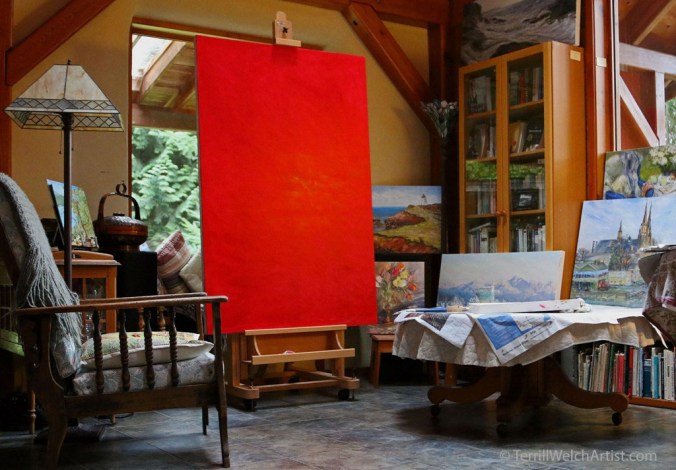
I’ve heard the marching chant often – “When do we want it?” “Now!” I internalize as meaning something before immediate, something that demands my response, similar to the wail of a newborn. During my internal travels this week, where deeply worn paths of immediacy are noticeable, alongside my restorative practices, I am reminded of these rallying-the-troop cries. Well, try shouting this at an exquisite impasto swipe of hansa yellow. Talk about being promptly escorted over to where the sun doesn’t shine, right next to the raw umber. Okay, maybe too much oil painter’s inside humour voice for pleasant company. But you get the idea. There are two basic approaches with oil paints. The first is to apply and keep applying while it is still wet. The second is to apply and wait for it to dry and then apply some more. This week’s ground on a large  60 X 40 inch canvas is in the second category.

red-ground-drying-on-large-canvas-in-great-room-by-terrill-welch-january-22-2017-img_9235

In fact, there is a serious amount of waiting in this artist’s life. Take that gorgeous brand new hunk of beechwood easel, twenty years of contemplation before I said yes. If I had taken as much consideration with my first two marriages, there would be two less Canadian divorce statistics to count. My reasoning delaying the purchase of a new easel was that I had a perfectly good folding mast easel my parents gave me the year I graduated from high school….. and it wasn’t quite used up yet. I have to admit though that the easel had been repaired several times over the past forty years and was getting bit wobbly at the hinges. But still!

However, this next work finally tipped my scales of reasoning and I broke. My longing and desire forced open my hand from around a large wad of cash and the next thing I knew we are pulling up to the art supply store loading area.

The subject for this next canvas has been studied with regularity for about seven years. There is a particular “story telling” tree from one of our regular walks in Bennet Bay that shall grace this canvas. I know this arbutus tree in my bones.  While I am putting down that red ground I begin curling around the shapes of its branches and trunks, bathed in golden winter light and pushing up against a cobalt afternoon sky. Fifty shades of green skitter across the garish lips of that stretched canvas. But wait. The ground must dry first. Yes, wait, and so must you.

The subject is worthy of the wait. I promise.

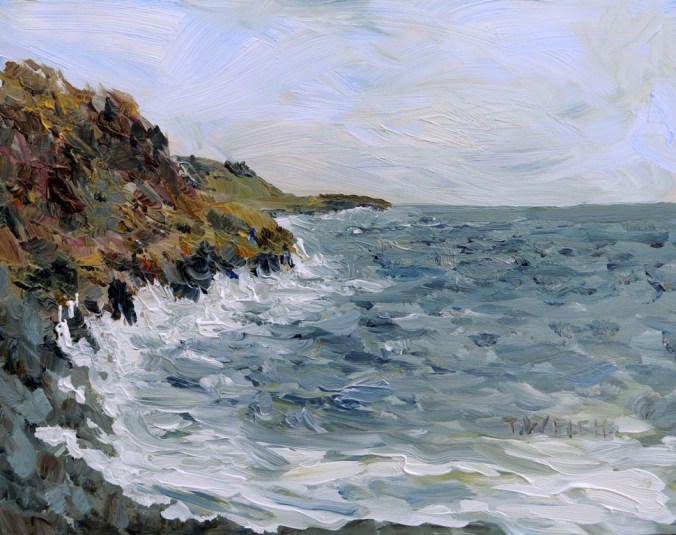
While we are waiting, how about taking in a coastal mountain view?

coastal-mountains-and-sun-at-play-by-terrill-welch-january-20-2017-img_9183

Or maybe you would prefer to sit with a charismatic tree out on the point?

edith-point-moment-by-terrill-welch-january-24-2017-img_9274

Will this do while we wait?

What do you do while waiting for the symbolic paint in your life to dry?

© 2017 Terrill Welch, All rights reserved.

Liberal usage granted with written permission. See “About” for details.

Creative Potager – Visit with painter and photographer Terrill Welch

From Mayne Island, British Columbia, Canada

For gallery and purchase information about Terrill’s photographs and paintings go to http://terrillwelchartist.com

Practice is a Painter’s Preparedness

Practice risk taking, practice discipline, practice different methods, practice boredom, practice not practicing but practice – insists the imagined studio master. Leading lines, point of view, colour harmony, rule of thirds, breaking rules, painting from life, painting from memory, painting wet-in-wet, using a dry brush method, starting with grounds or underpaintings, studying moving light, noticing the cool and warm shadows…… practice!

But for what does a painter practice?

“Now, the answer to that” says the imagined studio master with a wink “is good luck.”

Not just any kind of “good luck” but “good luck” as described by Deepak Chopra where “Good luck is nothing but preparedness and opportunity coming together.”

 If we accept for the moment, that this is a workable definition, then what is preparedness to the painter? Practice! If we are enhancing our skills daily, we are more likely to be prepared when an opportunity arises. We will be able to recognize the possibilities in an ordinary and yet unexpected, profound moment.

By way of example I am going to share a story I reread recently in The Zen of Creativity by John Daido Loori on page 153-154… Ryokan, a Zen master and poet, lived in a simple thatched hut. He was born around 1758 and ordained at the age of eighteen. Shortly after receiving dharma transmission, Ryokan’s teacher died. The poet went to live in a hermitage on Mount Kugami, where he spent his time sitting zazen, talking to visitors and writing poetry. Many stories of Ryokan’s simplicity and his love of children have come down to us, as well as of his indifference for worldly honor. In fact Ryokan called himself Daigo (Great Fool)….. One evening, when Ryokan returned to his hut, he surprised a thief who was naively trying to rob the hermit. There was nothing to steal in the hut. Yet Ryokan, feeling sorry for him, gave him his clothes, and the thief, shocked, ran away as fast as he could. Ryokan, shivering as he sat naked by the window, wrote the following haiku:

The burglar – neglected to take – the window’s moon.

In the next paragraph by Loori continues… To be simple means to make a choice about what’s important and to let go of all the rest. When we are able to do this, our vision expands, our head clears, and we can better see the details of our lives in all their incredible wonder and beauty.

This kind of simplicity and daily practice are what I seek for this next intention or project of The Moon is No Longer There. I believe it requires that I make a few changes in order to gain the perspective and rigor that is necessary. The moon is just an anchor and symbol of this intention, an everyday reminder.

But we know this don’t we? One of our greatest pianists today, Mitsuko Uchida, was recently quoted in an interview by The Telegraph as saying “It is not enough to play the piano – it takes a lifetime to understand music.” As I listened to her release each note of Mozart’s Concerto No. 20 in D minor K.466, with such preciseness, passion and excellence, I hear the music for the first time – every time that I listen. Her rigorous practice is visceral. I am, in that moment of listening, the breath between the notes. This same quality of practice is required for painting our natural world as well. It is not enough to paint a tree or a mountain or the sea – it takes a lifetime to understand our ordinary, everyday natural environment and translate these sensory experiences onto a surface. Painting from life by itself is not enough – it takes a lifetime to understand our universe. I can only hope that I may paint someday in the same way as Uchida plays! It is in the preparing or the daily practice, that I may possibly find an opportunity which provides me with the tools to render the essence of the universe in say – a single tulip.

detail-two-tulips-in-the-studio-18-x-14-inch-oil-on-canvas-by-terrill-welch-img_9096

Why am I so compelled by this project? I suppose it is an action that is driven by despair. I believe humanity has broken a sacred trust with nature. We are consciously destroying our natural world and ourselves in the process because of a pervasive character flaw – GREED. Our survival and the survival of our planet depend on our ability to understand and recognize our interconnectedness within the universe. We each have a responsibility to do whatever we can to address this situation. We are the only hope for one another and a large number of plants and animals. By our very breath, we depend on each other. Unfortunately, as an urban populous, we tend to be alienated from this simple fact. We can no longer see the moon and nor do wish to seek out its presence. For far too many of us, we have become intellectually and emotionally blind to nature and so the moon is no longer there.

This is why I must practice until I can bring you “the moon.” I must practice rendering our ordinary everyday with the best tools that I know how to use – my paints. I must practice until humanity collectively changes its ways. This is not work for a hero. It is work for the humble, the simple and possibly the fool. I find it comforting that I am not alone. This is work that is done with the companionship of many. It is collaborative work, as survival always is.

detail-one-tulips-in-the-studio-18-x-14-inch-oil-on-canvas-by-terrill-welch-img_9099

Paul Cezanne, shortly before his death in 1906, asked himself “whether the short time given us would be better used to understand the whole of the universe or to assimilate what is within our reach.” He goes on to say “I have to work all the time. I must strive for perfection, only for the satisfaction of becoming truer and wiser.” (The Life and Art of Paul Cezanne, May 5, 2014, Film, PBBS)

I find Cezanne to be an excellent companion to take with me on my travels.

The small slice of the moon or my practice that I bring you this week is…

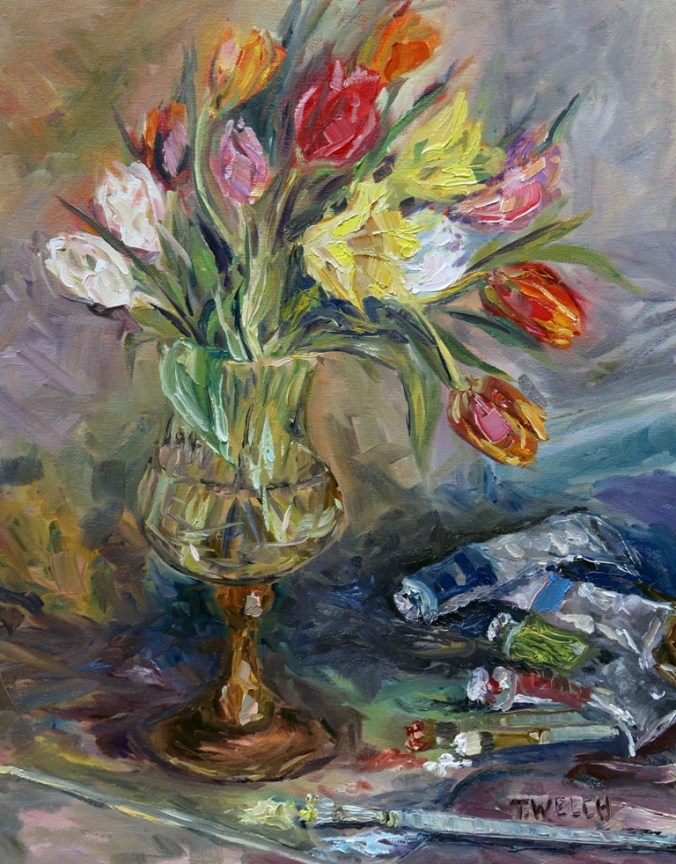
Tulips in the Studio 18 x 14 inch oil on canvas

This is an alla prima work completed in the quiet warmth of a January afternoon in the loft studio. When I saw these beauties at the grocery store, I knew I would bring a few home as a reminder of our pending spring. Even on Mayne Island, there are no tulips this time of year. These flowers have been imported from some unknown location. Our natural world has traveled far to reach me this week and undoubtedly precious fossil fuels were burned in the process. So with this acknowledgement, and some guilt, I am determined that the sacrifice is not wasted. The elegant vase is on loan from a good friend. These kinds of colourful winter still life painting days warm my heart and keep my spirit light.


tulips-in-the-studio-18-x-14-inch-oil-on-canvas-by-terrill-welch-january-15-2016-img_9087


What practice is your preparedness?

As always, I would deeply love to hear from you and feel free to include links to your work. If this is your first time commenting on the blog, be patient, I will need to approve your comment this one time only.

If nothing comes immediately to mind, one simply practice that will engage others is in this project is to thoughtfully share this post and my work. By thoughtful, I mean introducing the post with a sentence or a paragraph of your own considerations and then invite others into conversation with you by hosting a question or an idea related to the post. Because together, we can do this hard thing – because we must! Our natural world, which includes humanity, is worthy of our efforts and is depending on us. In this I am hopeful!

And welcome to all the new Creative Potager blog followers! Thank you for joining me in my inward travels.


© 2017 Terrill Welch, All rights reserved.

Liberal usage granted with written permission. See “About” for details.

Creative Potager – Visit with painter and photographer Terrill Welch

From Mayne Island, British Columbia, Canada

For gallery and purchase information about Terrill’s photographs and paintings go to http://terrillwelchartist.com


The Moon is No Longer There – notice of extended travel

Dear friends, colleagues, fans, collectors, followers and random connections, starting immediately, I shall be on an extended leave to travel. My purpose is to bring you “the moon” in a way you will remember and notice for all time.

Mayne Island Blue Moon rise July 31 2015 by Terrill Welch 2015_07_31 170

In order to do this, I must live my best life. I am required to travel deeper and even more focused than ever before. My intention is clarified. My inner compass is set. My resources and research materials are organized. I am about to begin my journey to capture something unforgettable, rare and valuable – our ordinary, everyday, natural world.  The new series of work “The Moon Is No Longer There” may take a year or a life time. Only one thing is absolutely clear – my spiritual, emotional and physical bags are packed. I am ready.

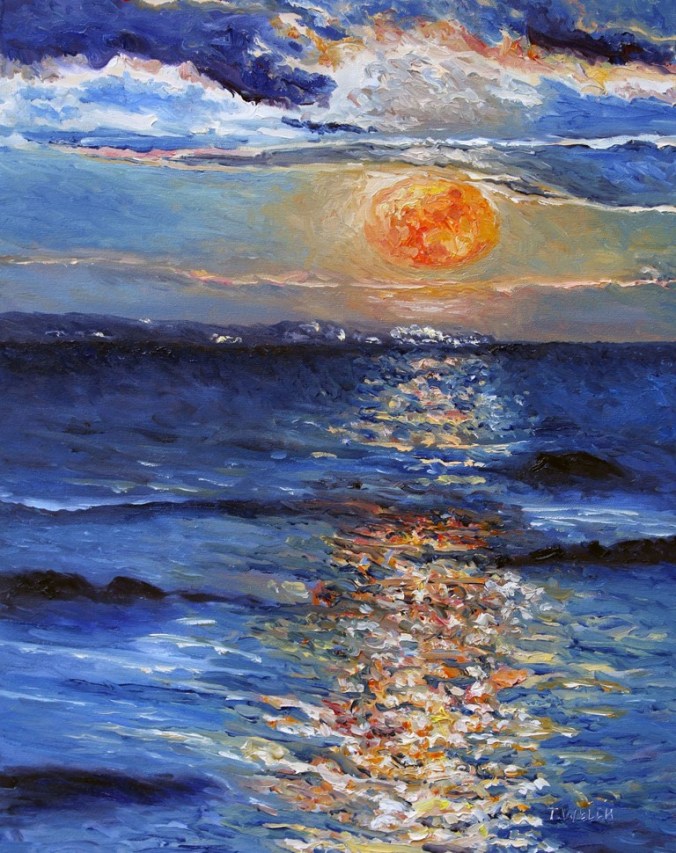
Christmas Day Full Moonrise 2015 20 x 16 inch oil on canvas

christmas-day-full-moonrise-2015-20-x-16-inch-oil-on-canvas-by-terrill-welch-2015-12-26-img_8442

To my 780 friends and family and the 190 followers of my personal profile and the 1,360 likes of my Art of Terrill Welch Page on Facebook, you are important, generous and supportive individuals. You have been significant and instrumental in getting 90 or so of my paintings out in the world since 2010. As I begin traveling this quiet and sacred inward journey, I shall keep you in touch by sharing links to weekly posts on my Creative Potager blog  HERE.

To the over 100,000 followers of my West Coast Landscape collection and the more than 47,000 followers of my Artist in the Art Studio collection on Google Plus, once a week postings will continue. Or, you may want to join the over 5,000 direct and indirect followers of my Creative Potager blog  HERE.

To my 4,100 tweet friends on Twitter, my experience tells me that you will most likely miss my weekly tweets completely. If you are truly deeply connected to my paintings and photographs, I suggest subscribing directly to my Creative Potager blog  HERE.

For all other social platforms such as Instigram or Ello, please be advised via this shared post that I shall only infrequently send a signal in a new post to let you know I am alive and well. You are great. You are even awesome and this is not about you. It is all about me. If you are still reading this, I am sure you have figured out what to do if you desire to come traveling with me. Yep! Follow my Creative Potager blog HERE.

For those that only wish to be notified when new paintings are released, the best option is to follow my website posts on TerrillWelchArtist.com  HERE. If you are looking for something in particular or want to see if you have missed a recent painting release just go to the Galleries page on this website and head on over to my Artwork Archives online gallery  HERE. This online gallery will always have the most current released work and let you know what is sold.

So, that is it my lovely fellow human beings. Having captured a spray of tulips in the studio this morning, I am sending them along with compassion, love and humility! I am traveling light, with conviction, trust, integrity and a small measure of reckless abandon!

bunches-of-tulips-by-terrill-welch-img_8864

If, for any reason, you do need to contact me, email, painting inquires in the online gallery, private messaging or telephone calls and text messages will still be monitored and answered along with comments on posts.

I wish you all the best in living your very own best life!

Terrill

p.s. I understand that this is going to be different and a little strange for both of us. And it will be fine, it may even be great.

p.s.s. The Beauty of Oil Paints class and its private Facebook group are not impacted by my travel schedule.

What arrangements are you making to live your best life?

© 2017 Terrill Welch, All rights reserved.

Liberal usage granted with written permission. See “About” for details.

Creative Potager – Visit with painter and photographer Terrill Welch

From Mayne Island, British Columbia, Canada

For gallery and purchase information about Terrill’s photographs and paintings go to http://terrillwelchartist.com

How a rainy day by the sea painting saved a west coast Christmas morning

This is a true modern-day story about how a “Rainy Day by the Sea” painting saved a west coast Christmas morning…

The shopping mall was stuffed with shiny objects, seasonal jingles and the grimaces of determined shoppers during the last weekend before the holidays. A woman stood stoically in the middle of the good cheer with her children draped casually against her side. There was one present left to get for her person, the love of her life, and the father of her children. Disappointed, she concluded that nothing in these many shops of splendour really seemed worthy of this occasion. What was she going to do?

Meanwhile, on a small southern Gulf Island, there was an artist noticing the evening settling in around her. The quiet valley was expecting another rare snowfall overnight. Despite the weather warning, she was cosy and content in their strawbale timberframe home. There were still a few presents to wrap but, the parcels that needed to be mailed had been sent. The new range had arrived that morning in time to make the seasonal shortbread. Life was peaceful and good.

The island artist has a studio home with oil paintings and acrylic painting sketches that lean two and sometimes three deep against banisters, walls and even windows. She has a great online gallery and social media presence but limited and sporadic bricks and mortar storefront exposure. Hence, holiday seasons are usually quiet for the artist. Besides, original oil paintings are often too personal and too expensive to be purchased as Christmas gifts. This is usually her reflective time, family and friends time and planning for the next year time.

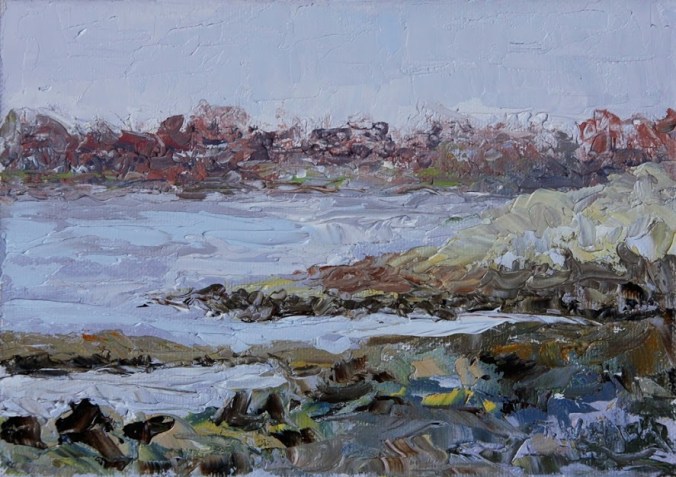
However, upstairs in the studio loft was a petite oil painting, a small gem that measured a wee size of 5 x 7 inches. It was a tiny study for a larger painting from a few years earlier and had lost its place on the studio walls to later works. Now the small painting sat rather forlorn in the loft window seat. Even the resent dramatic southern west coast snow seemed to conspire against the quiet colours of a “Rainy Day by the Sea.” What was the tiny work going to do?

Just then, with all the brilliant zazzle, shouting gizmos and screaming gadgets swirling around her, the woman in the mall became calm and centred. She had an idea. Pulling out her phone, right there in the bulging shelves of opportunity, she sent a private Facebook message to an artist she knew and whose work she admired on Mayne Island.

“Hi Terrill! Hope you are well on this crisp day. I just had a last-minute brain wave of buying X a painting of yours for Christmas. However, my budget is small… $xxx. I realize this might not be possible, but thought I’d ask anyway. I think your daughter mentioned you are coming here for Christmas, so perhaps transport could happen that way. Anyway, I have other ideas if it isn’t possible, but wanted to see what you thought. I am standing here in a mall feeling depressed at my surrounding options! Let me know your thoughts and I hope I haven’t insulted you with my budget!”

The artist assured the woman that she wasn’t insulted by the budget size at all. She thought for a moment and was sure she could help. She prepared her response and gathered the specific links to a couple of tiny paintings listed in her online gallery and sent them off.

The return message from the woman with her children in the shopping mall was prompt.

“Okay! The kids and I agreed on Rainy Day By The Sea!!! Thank you so much!!!!!!!!”

“Shall I pay with an e-transfer? Or what do you prefer?”

The artist confirmed that an e-transfer was great and that gift wrapping and delivery on Christmas Eve day were also included in the price. She then went up to the studio loft window seat, where the small painting now sat in the winter darkness. Carefully, the painter lifted the painting up, selected an appropriated box, and carried both downstairs to the table with the wrapping paper. She thought she could see the little painting smile. It was wearing a badge of local, original, handmade significance. It was the “Rainy Day by the Sea” painting that would save a west coast Christmas morning for a true love, a best friend and a cherished father. The petite painting’s last wish was that the artist would choose the brightest wrapping paper so that the small box wouldn’t be missed on Christmas morning. The artist was sure this final wish could be granted.

And this is a true modern-day story about how a “Rainy Day by the Sea” painting saved a west coast Christmas morning.

SOLD! Rainy Day by the Sea, 5 X 7 inch oil on canvas.

rainy-day-by-the-sea-5-x-7-inch-oil-on-canvas-by-terrill-welch-img_8831

View other paintings and painting sketches currently available at: https://www.artworkarchive.com/artwork/terrill-welch


Do you have a modern-day Christmas story to share?


© 2016 Terrill Welch, All rights reserved.

Liberal usage granted with written permission. See “About” for details.

Creative Potager – Visit with painter and photographer Terrill Welch

From Mayne Island, British Columbia, Canada

For gallery and purchase information about Terrill’s photographs and paintings go to http://terrillwelchartist.com

The Process of Painting Centuries of Seasons

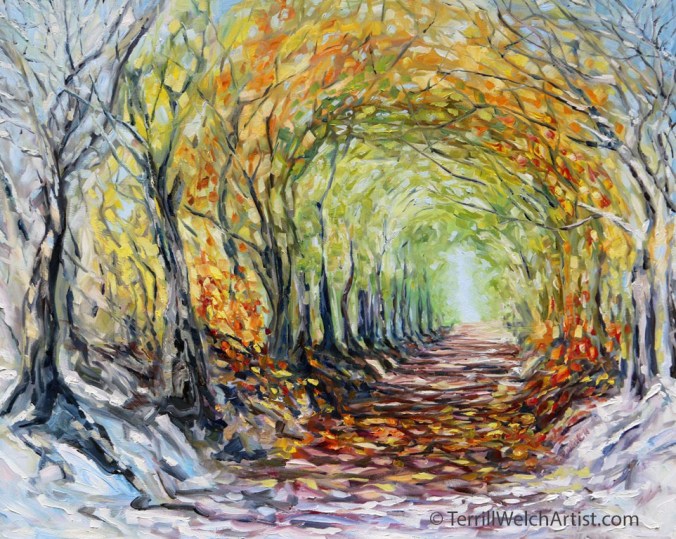
What follows is the process of painting “Centuries of Seasons” inspired by the Currie heritage road on Prince Edward Island.

centuries-of-seasons-heritage-road-pei-24-x-30-inch-on-wood-resting-by-terrill-welch-nov-11-2016-img_2653

On this day, November 11, 2016, the painting “Centuries of Seasons Heritage Road PEI” 24 x 30 inch walnut oil on wood comes to rest, overturning most of the grey disillusionment of the past few days with the curious unexpected results of the United States election and the more anticipated death of Leonard Cohen at the age of 82 years. It is also a day of remembrance for all of those who have fought for our freedom. And finally, it is my grandson’s fourth birthday. This hodgepodge of events, experiences and emotions are most fitting to brushes, paints and a painting surface.

Today, I am drawn to the words of Canadian painter Ozias Leduc (October 8, 1864 – June 16, 1955) who lived to be 90 and was born and living much of his life in Saint-Hilaire Quebec. During his career he decorated more than 30 churches and chapels in Québec, Nova Scotia and the eastern US. The last major project he accepted at the age of 76 was a request to providing the mural paintings for the Notre-Dame-de-la-Présentation, Shawinigan-Sud. The work was completed between 1943-55. Besides his religious commissions for churches, he rendered many easel paintings including portraiture, still life, and landscape paintings. The latter paintings were mainly from his intense study of the landscape that were then painted from memory and imagination in his studio home.

“Art teaches, informs. It uncovers the soul. No doubt it also has the power to sort the chaos of the unconscious into an orderly cosmos. It leads from disorder, suffering and unbalance to stability, harmony and joy.”

(Ozias Leduc, in a letter to Paul-Émile Borduas, 1943)

1-centuries-of-seasons-at-the-start-in-the-studio-by-terrill-welch

“The sole mission of the artist is to express beauty. Beauty without servitude. Beauty as unconstrained as space and time.”

“If the earth were strictly utilitarian it would not be so dear to us. Our eyes seize all of its dazzling sights.”

(Ozias Leduc, sometime in the late 1920s, from the “Ozias Leduc Documentary Canadian Painter” directed by Michel Brault, 1996)

2-centuries-of-seasons-at-the-beginning-in-the-studio-by-terrill-welch-img_2551

Leduc was not influenced by contemporary Canadian artistic currents and trends, and he held only one important exposition, which was at the St-Sulpice Library in 1916. By helping to promote the career of Paul-Émile BORDUAS, he became quite popular late in his career. He also left many texts, poems and short reflections on art. His feelings about modern painting are expressed in the mystical thought that man lives searching for the paradise he hopes to regain through a knowledge of nature and the beauty of art.

(Canadian Encyclopedia.ca)

3-centuries-of-seasons-at-the-beginning-by-terrill-welch-img_2547

“I do not have a style of my own and do not choose to have one. Every time I paint I am seeking something.”

(“Ozias Leduc Documentary Canadian Painter” directed by Michel Brault, 1996)

4-centuries-of-seasons-in-process-by-terrill-welch

This painting has been completed during these events and with these guiding words from a Canadian painter from before I was born. It might be said to have begun on a drive down the Currie Heritage Road on Prince Edward Island this past May.

5-centuries-of-seasons-heritage-road-pei-24-x-30-inch-on-wood-almost-done-by-terrill-welch-nov-9-2016-img_2563

It might be said that I only trust my brushes today and not my own words and convictions. This is true though not uncommon I would think to seek the experience of wise counsel when processing ones own experiences.

It might be said to have begun with the first trees I ever painted. This likely equally true because to know a tree well enough to paint is to spend years in its company.

It might be said that the centuries of seasons in this painting have no beginning and no ending. This too is true as we can observe that the road has worn away from years of passage over its red dirt surface.

But the work has come to rest and this is a record of the process of its completion.

Centuries of Seasons Heritage Road PEI 24 x 30 inch on wood “resting” by Terrill Welch

centuries-of-seasons-heritage-road-pei-24-x-30-inch-on-wood-resting-by-terrill-welch-nov-11-2016-img_2653

The painting will be released once it is truly considered completed, has dried and a final photograph taken.

Now my brushes shall be cleaned and the painting shall rest. Good day to you!


What wise counsel is guiding your day today?


© 2016 Terrill Welch, All rights reserved.

Liberal usage granted with written permission. See “About” for details.

Creative Potager – Visit with painter and photographer Terrill Welch

From Mayne Island, British Columbia, Canada

For gallery and purchase information about Terrill’s photographs and paintings go to http://terrillwelchartist.com

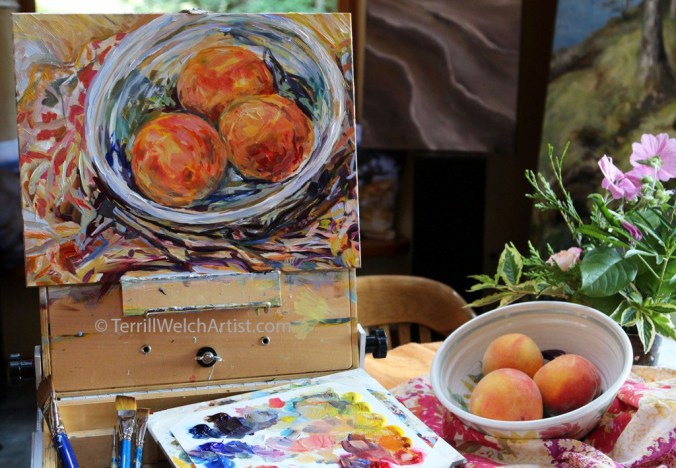
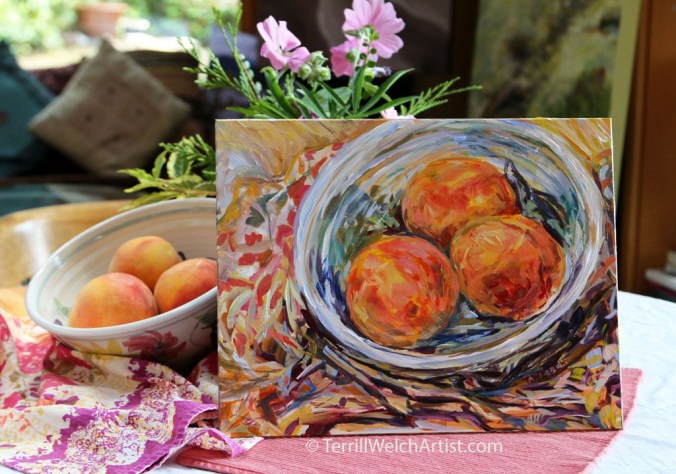
Three Large Plump Peaches in the Studio Today

There are just three large plump peaches, fresh from the fields, sitting in a bowl on the table.

Almost done still life painting sketch of peaches by Terrill Welch August 26 2016 IMG_9338

I paint the still life sketch promptly because there is a great risk of there only being two.

Study of Peaches 11 x 14 inch acrylic still life sketch by Terrill Welch August 26 2016 IMG_9390

The result is slightly larger than life contemporary impressionist style painting sketch.

Still life painting sketch of peaches by Terrill Welch  IMG_9400

Because this is all there will be, no larger painting anticipated, the 11 x 14 inch original acrylic still life painting sketch on gessobord has been released immediately HERE.

I have also released this work as a print and products in my Redbubble storefront HERE.

The studio study was completed simply for the pleasure of summer, peaches and paint.


What simple pleasures of summer are you enjoying?


Happy Friday to you!


© 2016 Terrill Welch, All rights reserved.

Liberal usage granted with written permission. See “About” for details.

Creative Potager – Visit with painter and photographer Terrill Welch

From Mayne Island, British Columbia, Canada

For gallery and purchase information about Terrill’s photographs and paintings go to http://terrillwelchartist.com

Art Studio Gossip

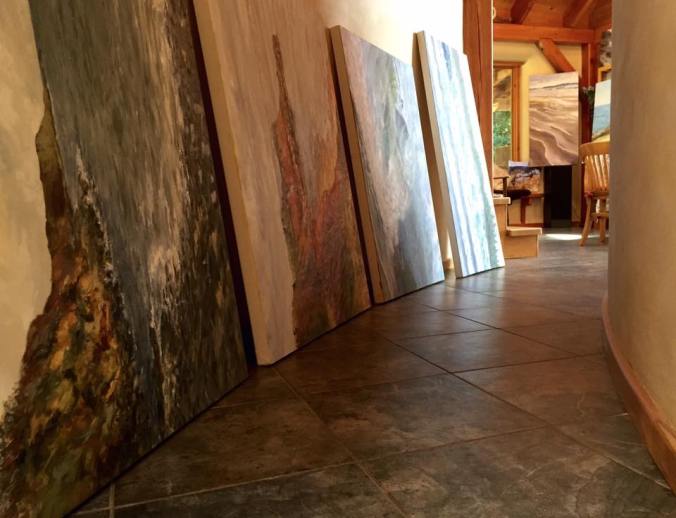
Gossip overheard in the artist’s studio this afternoon…

Standing on end and shouldering themselves into a rough order along the curved hallway, these landscape paintings whisper loudly to each other.

Gossip overheard in the the artist's studio by Terrill Welch

“What are we doing here? I don’t even have my edges painted yet!”

“Me either but I hear that is happening tomorrow. Apparently, we have a big gig coming up for September and October.”

“Yeah, I heard eight of us large ones will be showing in Victoria, BC ” says Seaside Mayne Island, as he heaves himself to a slightly better angle to be heard, without actually shouting, from the great room.

Then Evening And The Arbutus Tree leans over the railing from the loft.

“She told me that she wants to call the show ‘Above The Stacks’ because we are going to be in a new library and most of us will be way up high above the books. I said she had to add ‘Land and Sea’ to the title or no one will know that it is going to be us.”

Long Beach Vancouver Island sighs as the tide recedes farther up her midriff.

“You know” she comments patiently while stretching out one long sandy leg, and then the other “it is way too soon to be getting excited. There are still a couple of weeks to wait. No use wearing out all our shine in the studio.”

Then she winks and the light sparkles off of her sea “I do believe Emily Carr is somehow involved again.”

All the paintings in the studio start whispering at once. In fact one little fellow gets so excited that he falls over flat on his face in the magazine article he had been trying to read upside down.

Sea and Sun Cox Bay Tofino BC grumbles “You had to go and wake the little ones didn’t you!? You know they are too small to go in this show.”

“There will be other shows” Long Beach Vancouver Island replies. “After all, there are not many place that can handle the eight of us.”

The late summer afternoon warmth starts to make all the paintings drowsy – large ones, middle-sized ones and small ones. Sssshhhh!

The studio is quiet.


What are you whispering about today?


© 2016 Terrill Welch, All rights reserved.

Liberal usage granted with written permission. See “About” for details.

Creative Potager – Visit with painter and photographer Terrill Welch

From Mayne Island, British Columbia, Canada

For gallery and purchase information about Terrill’s photographs and paintings go to http://terrillwelchartist.com

In the Beginning there was Oil Paint and a Canvas

So you want to learn how to oil paint!? How does nine steps or building blocks to accomplishing this task sound? Does it make your brushes start dancing in their jar? Do your tubes of paint start squeezing themselves out on the palette? Okay, maybe that is just a bit too much to expect. But you get the idea. Painters have all started from somewhere near the same place….

The painting supply shopping is done and you are feeling slightly nauseous from the decrease in your bank balance. But you are ready with a few good oil paints and a handful of quality canvases. You have a couple of big brushes, a couple of medium brushes, one or three small brushes plus a tiny one for your all-important  signature. You have chosen some old clothes or a painting apron and you have scrounged up a painting rag. You have wrestled your portable easel together without running screaming into the night. You know to clean your brushes carefully with soap and water at the end of each painting session. You know that you are painting with your whole body and not your wrist and hand. If you can, you will stand to paint and when possible do it barefoot. You know to use all of the information from all of your senses, not just what your mind thinks your eyes are seeing. You know that “alla prima” is an Italian word for painting wet-on-wet in a first attempt. Now what?

With a flick of my painterly brush and fingers fluttering across the keyboard, let’s get started!

Today, we are going to begin en plein air (in the open air). Choose a canvas that is small to medium is size. Once you get to your painting location, possibly feeling a little like a pack mule with an unsecured load of pointed objects protruding from various bags and sacks, you are ready to decide on your subject. Once you have given the subject and composition of your painting careful consideration, set up your easel.  Swearing is allowed if no one is within hearing distance. Now, decide on your painting intention.

Painting intention: What are you loosely holding in mind as you work today? What is your aim? If you could direct the powers of the universe onto your finished canvas, what would the viewer experience?

Now you are ready to paint:

1. Your canvas can have a wet or dry ground colour. In this case, we have a dry ground in cadmium yellow. For our west coast landscape this is often the best ground in order to bring our many blues hues alive on a canvas. But, since this is early spring in a garden, the ground could just as well have been a taupe if it is a wet ground or a thin layer of raw or burnt umber if it is a dry ground. The use of a ground helps to break the barrier between painter and a stark white canvas. You become familiar with the size and shape of the canvas you are using in a very physical way by the time the ground is painted. You have made a start. The ground can sometimes make it easier to see the values or colour relationships as the painting is developing. It is also my preference to have parts of the ground showing through later on rather than the blank canvas.

1. start with a wet or dry ground by Terrill Welch IMG_9194

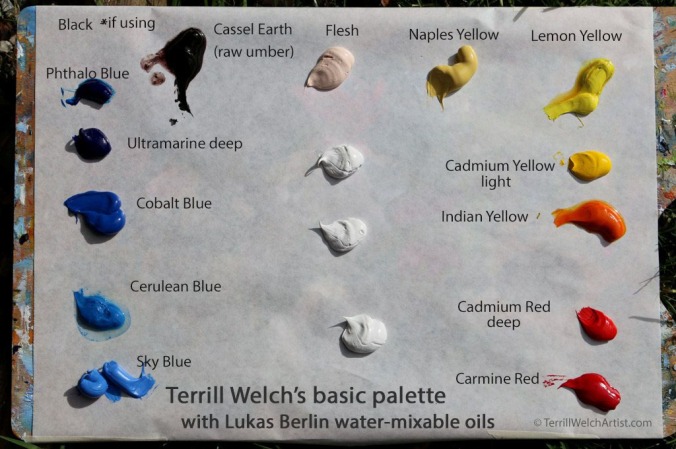
2. Set out your palette. In this case, I am using Lukas Berlin water-mixable oil paints. The pigments are rich, the clean up easy and the paint requires no use of solvents, making it more environmentally friendly than regular oil paints. My other choice, though a little pricey, is M. Graham walnut oil paints. Again, no solvents are necessary in my painting process. However, if you are using paints that require solvents, please make sure you have lots of ventilation. Eventually, each painter develops their own preferred palette layout. The most important aspect of this is that it becomes habitual in some way. You need to be able to easily remember where each pigment is located – without having to stop and think about it every time you want to mix a colour. I am left-handed. The arrangement below works for me. The lightest blue is at the bottom left. The lightest yellow starts in the top right and is arranged below until it gets to the deepest red. The top left is where I will mix my darkest hues, even though I need to reach across to my deepest red to make this happen. I sometime put out a flesh colour when painting landscapes as an alternative to adding white. Naples yellow is used in the same manner.
2. setting out palette by Terrill Welch IMG_9192

*Tip – Pigments mixed in various mediums and from different brands of paint behave slightly differently and may have different names. Learn how the brand you are using behaves by doing a few colour studies on a scrap of old canvas or panel.

Today, I have no black or payne’s grey on this palette. In fact, I recommend leaving this off until later in the learning curve of oil painting. Notice as well that there is no green or violet. These will be mixed for use as needed. If you haven’t studied a colour wheel recently in order to know what colours can be mixed to make another, don’t worry. For now – put your scientific adventure headband on and experiment. A detailed study of colour theory can come later and will continue for as long as you set about the process of painting. Paints are kind of like being presented with a spice cabinet and a garden full of herbs and then being told to gather together what smells right for the soup you are making. The first few times, you may come up with some rather strange combinations. However, eventually you figure out what you like and what works best for you. You could have just followed a recipe of course. But this leaves you looking up another recipe every time you want to make something new. If you learn by practice, from selectively gathering and using the raw ingredients, eventually you can flavour anything to your satisfaction that you want to cook. You can make adjustments at the start and at any point along the process. Painting is like this. If you experiment, from the very beginning, you have a better chance of developing the skills to allow you maximum creative freedom in the future. Methods, techniques and approaches are all just tools to accomplish the intention that you set out before beginning the painting process.

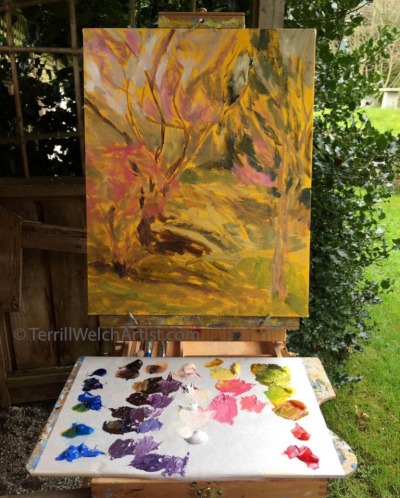
3. Mix a few of the more obvious colours in your composition or those that you want as reference points. In this case, my intention is to catch the very breath of early spring. I want to ensure I have the variety of pinks, violets, plums and purples of the plum blossoms. To have the best chance of getting this painting to sing the flush notes of spring, I mix these to ensure I have strong reference points for later on. At first, try to use your palette knife for mixing what you want to lay onto the canvas. However, I admit to having always used my brush, at least half the time, and continuing the final mix right on the canvas as I lay the wet paint down beside and on top of what is already there.
3 a. mix some more obvious colour in the compostion start with brief sketch by Terrill Welch

That long tail on an oil painting brush isn’t there for you to dangle the brush off the end of your fingertips. It is there to help with balance and to keep the tension between brush and canvas as you apply paint on a surface that is at an upright angle. Each paint brush is a little different. You will need to learn the balance point of each one by holding it between your fingers with a light grip that eventually allows you to roll it over-and-around with easy. Practice moving your fingers up and down the handle until you find your perfect balance point. If at any point you start to feel frustrated with how the paint is showing up on your canvas, the first thing to do is recheck that you are holding your brush in balance.
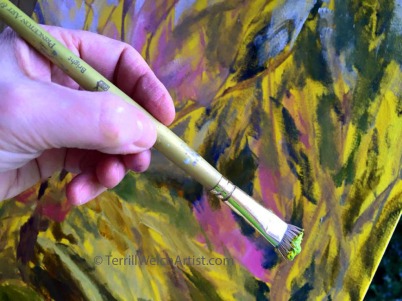
3 b. find the balance point to holding brush firm but lightly by Terrill Welch

*Tip – your brush is a tool or vehicle to get the paint from your palette and onto your canvas. To most efficiently accomplish this task, load ample paint on just the tip of the brush. But even before you do that dip the brush in oil or water if you are using water-mixable oil paints and squeeze the excess out. This makes the brush easier to clear at the end of the day and helps to release the paint from the brush onto the canvas.
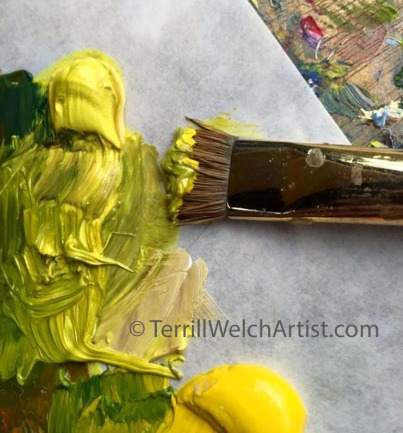
3 c. for alla prima load ample paint so it sits on the tip of the brush

4. Using a large brush or brushes, we are ready to start making a few marks and points of observation and reminders on the canvas. In this painting method, limited-to-no medium is necessary. You do not need to pay too much attention to fat over lean because the paint, for the most part, will all be of the same medium balance. The fat over lean lesson can be learned later on as it becomes necessary. Since you have spent time considering your composition before setting up to paint, don’t over-think this beginning. Just get started. It is only oil paint and canvas. Nothing is right or wrong at this point. You are starting a painting conversation with your subject. Short, brief sentences are perfect. Hello. How are you? What kind of day is it? I like the shape of that darkness stretching up. Look at that patch of pink!? Where is the movement in this composition? Where is the viewer? And so on…. You are beginning to warm up with the most pronounced darks and lights. Your canvas is being introduced to its subject using colour, shapes and the movement of directional brushstrokes.
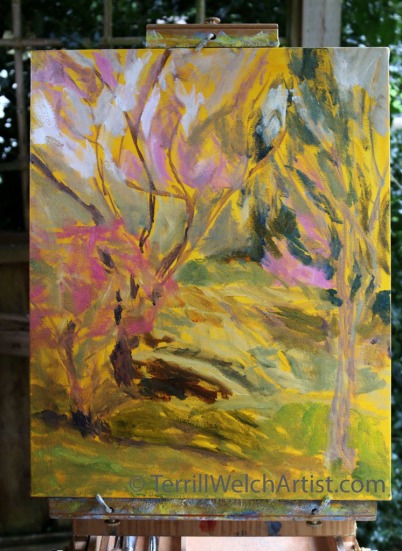
4. Begin to quickly block in composition by patches of colour IMG_9203

5. While working on your whole canvas, keep going until shapes start to appear. Now check the strength of the composition. Ask yourself – in this composition, who is the star and who are the supporting actors that make them shine? Make any corrections necessary in the various patches of colour. The painting won’t look like much yet but you should be able to see where it is going. The start should have good bones before we proceed. This is often called “blocking in” your composition. It may literally appear as blocks of solid colour. Or it may be more abstract patches of colour as I have here. If you are just beginning to paint, take the time to organize the bones of a composition maybe fifty or even a 100 times without ever proceeding to the tendons, muscles, skin, clothes and some fine jewelry of a finished painting. Research and learn what elements make a good composition. Study and practice composing compositions for a few minutes each day. You can use your smart phone for assistance or you can make a sliding rectangle with by placing your pointer fingers to your thumb on the opposite hand. If you want to get real fancy, you can even buy a small viewfinder and put it in your pocket. The point is that excellent compositions are everywhere. We just need practice in seeing and composing them. The skill of blocking in an initial strong composition, accomplished quickly with large brushes, is essential to the later quality of a painting. It is the support beams and studs of your painting building. This is not the time to be hanging curtains or putting down a throw rug! For now, large brushwork only. To keep the painting from becoming too muddy, you can use one large brush for darks and one for lights. Wipe the paint off the brush between changes in colour. But you don’t need to be too fussy about cleaning it at this point. The purpose is to get some paint on the canvas in the general location that it needs to be placed.
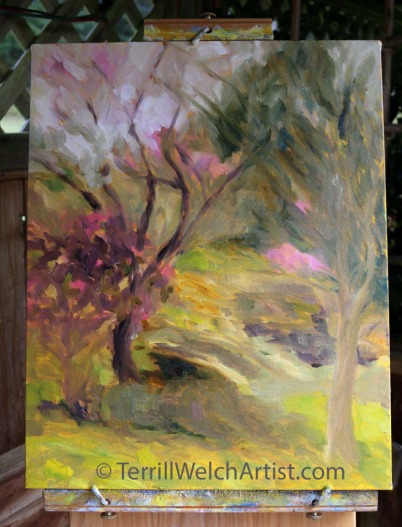
5. keep going until shapes start to appear then check strength of composition IMG_9209

6. Remember to be flexible. Up to this point it has been raining and I am set up in a little overhang. The air is cool enough that my water-mixable oils are a bit stiff. Ideally, I would have used my M. Graham walnut oil paints. But I wanted the easier clean up of the Lukas Berlin paints for the plein air work this morning. Now, the worst thing possible happens. The sun comes out. I have no place to protect my canvas from the direct light and then to still be able to see my subject. I seldom work with an umbrella over my painting easel so I am stuck. I try moving the easel around a few times. I look at the unpredictable sky that threatens to rain again without notice. I make a decision. I am best off to pack up and head to the studio to complete the work.

I had taken a few reference images before I started painting when I was still deciding on my composition. The light in my finished painting is hiding some place between here…
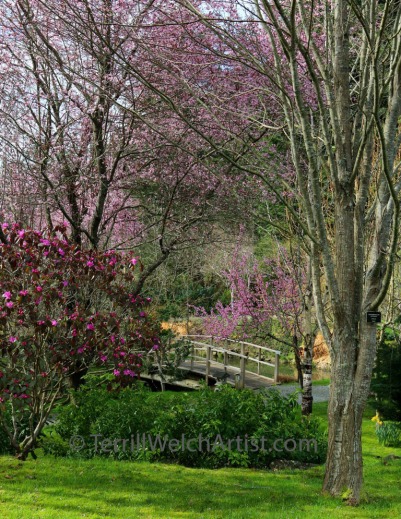
7. about ten am reference image by Terrill Welch IMG_9180

and here….

8. almost noon with the sun reference image by Terrill Welch out IMG_9219

*Tip – a specific photograph is almost useless to the process of rendering a painting alive. However, several reference images from various angles and perspectives, often captured over a few hours of plein air painting, can be a helpful resource once you are back in the studio. I frequently take between 50 and 150 reference images for a specific canvas. Sometimes I even have years of photographic references collected on a specific subject before I decide on a larger landscape canvas. The most significant difference between a photograph and the process of painting from life is that a photograph freezes the light and shadow. It has one still perspective. On the other hand, a painter, working from what is in front of them, paints the light and shadows in motion. This dynamic experience is combined with the actual motion and movement of the painter. A camera cannot see around corners. But a painter can. The painter also has all of the other information available to them from their other senses. In order to replicate this body of rich information in the studio, it must be gathered in the field to provide the sensory memory-triggers for the painter when they no long have the subject directly in front of them. The human eye darts around continuously recording patches of colour. The brain organizes this information by relevance and in relationship to each other, allowing us to quickly discern objects. This organizing is influenced by more than information provided by the eyes. It is accomplished by referencing information from all of our senses and by past experiences. We have, over our life-time of observation, created a refined system of “seeing” that has built-in short-cuts. In the painting-from-life and alla prima process, we want to unpack this refined system of observation and conclusions that our brain has developed. We attempt to bring our awareness back to as much of the raw data being input into the brain as we possibly can. The single camera image used as a painting reference interferes with this raw data retrieval process and, by extension, will interfere with the painting. However, a collection of images will more easily allow the painter to access what the eye, the ears, the nose, and the physical body observed  – before the brain began to organize and make sense of this information. A painter almost always wants access to the cumulative raw data from all of their senses when painting from life – before they attempt to draw any conclusions with a brush on a canvas. This is how mystery, intrigue and also familiarity is rendered onto a canvas. As a  painter, you are inviting the viewer to organize the raw information you have discovered and skillfully arranged onto the canvas for themselves. Through this painting kind of invitation, you have the best chance of being able to engage the full-body sensory receptors of the viewer when they look at your work.  They then use their own life-time practice of “seeing” and organize the information you have provided for themselves. In this manner the painting conversation will continue with each individual viewer – endlessly. That is the possibility, the promise and the hope anyway.

7. The closer to the actual life-experience one works in the studio, particularly in the beginning when learning to paint, the easier it is to access the first impressions of a subject within its context. So, when I return to the studio, I immediately continue working on my painting. By now, it is evident that the plum blossoms are my star and everything else is my supporting actors. To fulfill my intention of capturing the first breath of spring, all high, low and minor notes in the painting must come together in a full inhale and exhale towards this single purpose. The boldest of the bold must be visible on the canvas. The darkest dark and the lightest lights begin to fall into in place. The shimmering curves of colour must be placed and exaggerated just slightly for emphasis. We are now ready to add a simplistic garment over the bones, tendons of our composition.
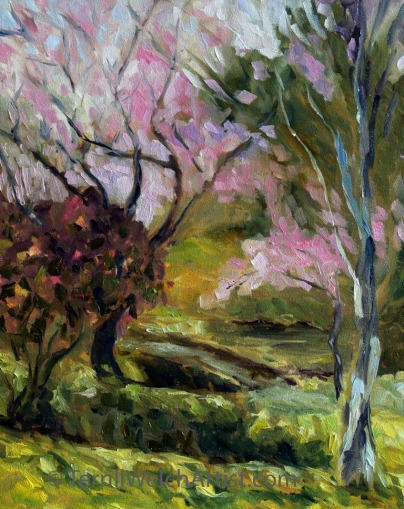
9. Plums Blossoms Japanese Garden work in progress 20 x 16 inch oil on canvas by Terrill Welch 2016-03-06 IMG_9240

8. I pause. I stand way back and revisit my composition. Some elements have shifted from their actual placement. Do they work better or worse than what I observed in my initial inspiration? At this point the painting must stand on its own. It must be able to breathe on its own. The painting must begin the process of separation from the actual subject and even from the painter’s own experience. Now, what is on the canvas and the painter’s intention must work together to bring the work to completion. I decide to take bit longer break before venturing into the final stages of completing the painting. A cup of tea. A twitter tweet. A Facebook post. A trip to the bathroom and a walk out on the deck. I glance at that painting from different angles out of the corner of my eye. I do whatever it takes to separate my ego-self from the painting and to allow me to join in an equal partnership with what is on the canvas. Do I want to continue the painting conversation? Is it a dynamic, meaningful and inspiring possibility? It is okay to if it is not, for then I ask myself and the canvas if it is a salvageable relationship. If it is not, then there is no need to go any further. The canvas can be scraped, the painting outlines with its rough paragraphs can be deleted. Or the bones of the work can be left to ponder or reorganize into another attempt. Whatever metaphors a painter wants to use, this is the point where I decide if I am fully invested in completing the work or if it was only a passing thought. The intention I set, before I ever pick up a brush or squeezed a tube of paint, is my best touch-stone in helping me to make this decision. Take yourself back to that loosely held aim for your canvas. In this way you can look at the canvas with fresh eyes. Now, make a decision one way or the other and move forward.

I decide to complete the painting. At this point I can start working with my medium and smaller brushes.

*Tip – to choose the best-size brush for the job of creating the painting impressions of your subject, pick up the largest one you think you can manage. Then put it down and choose one that is just slightly larger than that.

By the end of the day, I can feel the essence of early spring on the canvas. I am close to complete.
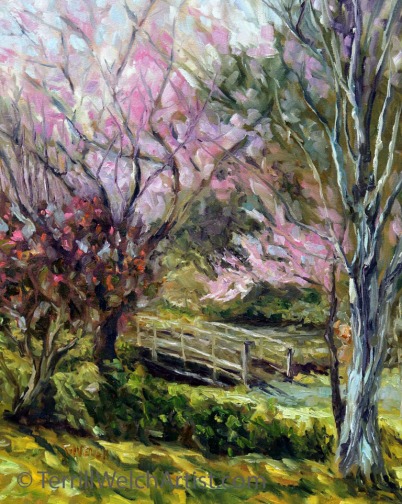
10. Plum Blossoms Japanese Garden resting 20 x 16 inch oil on canvas by Terrill Welch 2016-03-06

The next morning I refine the painting’s garments for a slightly better fit with a tuck here and a bracelet there, maybe a bolder pair of earrings for a bit of sparkle and I move the buckle of her plum-blossom belt right into the sunlight. The painting is done. Allow me to introduce you to:

Plum Blossoms Japanese Garden 20 x 16 inch oil on canvas by Terrill Welch
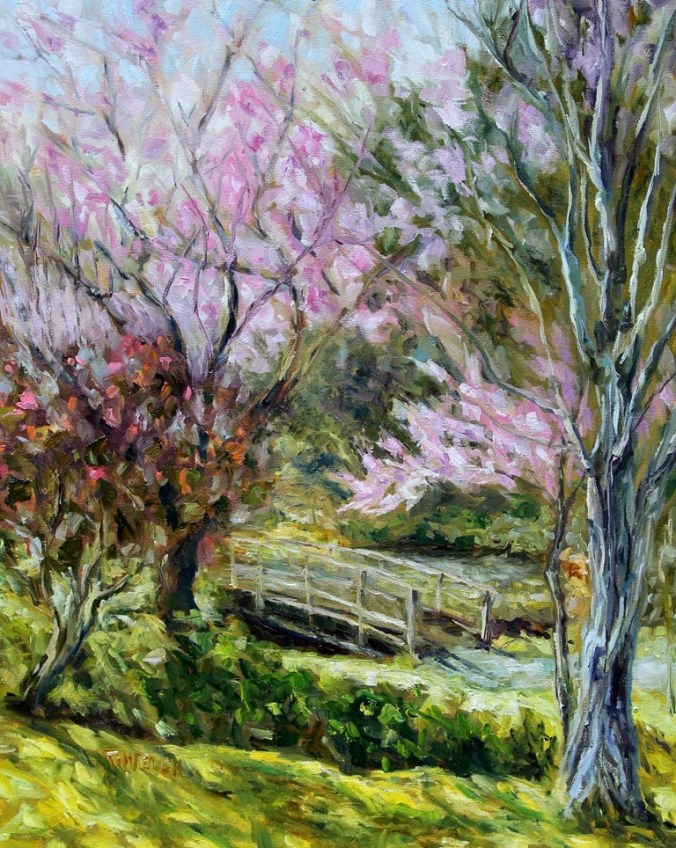
11. Plum Blossoms Japanese Garden 20 x 16 inch oil on canvas by Terrill Welch 2016-03-09 IMG_9315

You now have all the basic building blocks to paint your first oil painting using an alla prima oil painting method but one. Can you guess what it is?

9. To conclude your painting process, review your palette for clues to what you have learned, what you want to remember for next time and what worked and didn’t work. Ask yourself what you want to start doing, stop doing and keep doing for your next painting. No two paintings that use the method I have set out before you will look the same. Each painter brings their own experiences, temperament and attitude to the process. We each have our own painting fingerprint. Part of understanding these individual characteristics is to review your palette at the end of a painting process. To assist me in this process, I like to start with a clean palette at the beginning of each painting – because I love light and colour and the simple abundance that can be found in an ordinary day. This is part of my own personal finger print. A clean palette at the start of each painting gives me the best chance of mixing what I see before me rather than what I saw previously.
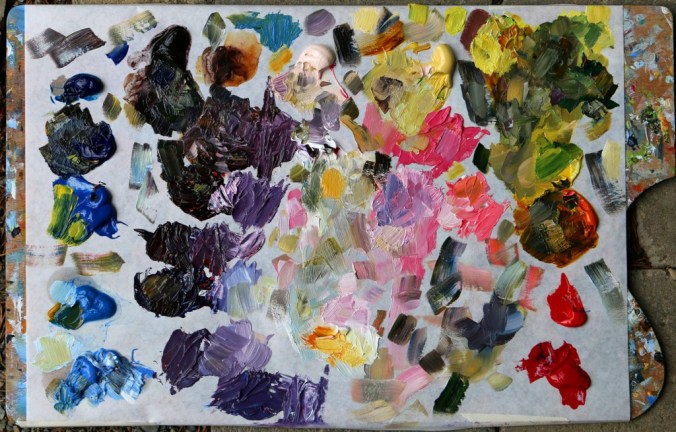
12. palette at the end of painting IMG_9280

Now you are ready to practice, practice and practice some more. As you come across new painting problems there will be new methods, approaches, techniques, painting theories and ideas to learn in order to find a solution. This process never ends. But you have enough information here to get you started. You have enough to allow your painting practice to serve your intentions. Of course, this is not the “right” way or the “only” way to approach oil painting. It is one way. As your body of knowledge and experience grows, you will refine and add to your own individual painting practice. The purpose of this post is to allow you to get started.

For my regular readers, this may seem like a gathering of the highlights from several years-worth of posts about my painting process that has been shared in this Creative Potager blog. Of course, it isn’t everything. Just a beginning. But it is a beginning that gives the reader some of the basics for a life-long practice of bringing the brush to paint and then to the canvas when using a wet-on-wet or alla prima method.

For new and regular readers, that want to learn how to oil paint, I hope you have found these nine steps helpful. If you would like to work together further, I am offering online feedback (for a fee) on your specific painting efforts via my personal Facebook profile or email at tawelch@shaw.ca  You may private message me if this is something that interests you. In order to prioritize my own studio time, I only have the capacity for a small number of participating painters at a time. However, please feel free to check in with me and we can see what might work. In the meantime, happy painting!


What intention are you setting for today?


© 2016 Terrill Welch, All rights reserved.

Liberal usage granted with written permission. See “About” for details.

Creative Potager – Visit with painter and photographer Terrill Welch

From Mayne Island, British Columbia, Canada

For gallery and purchase information about Terrill’s photographs and paintings go to http://terrillwelchartist.com

Intention, Composition and Underpainting are Tools of the Trade used by the Artist

Today’s work set aside to dry ….

Beginning with underpainting of Westerly Winds Victoria BC 30 x 40 inch oil on canvas

Beginning with underpainting of Westerly Winds Victoria BC 30 x 40 inch oil on canvas by Terrill Welch 2016-01-14 IMG_7555

Sometimes I am asked why do I use this tool of a flowing, rather shapeless underpainting? Wouldn’t a ground colour do? Why not just begin the painting and start with a pencil or charcoal sketch to mark the forms?

The answers to these questions are interrelated and to some extent personal and subjective to my intent. So lets start with my intent with this painting – I want my viewer to be standing along this specific shore on this specific day and be able to feel their presence within the landscape. Admittedly not a small task considering that 80% of the North American population lives in urban centres and has limited ability and time to spend watching how a specific landscape looks at different times of day and at different times in the year. Still, I believe part of my job is to provide this experience which then becomes more familiar to the viewer in the face of the actual physical environment. I make no assumption at all that the viewer is familiar with what it is I am about to paint. If we keep this in mind, it helps to understand the task I must complete with a rather simplistic landscape in order to convey the power of the universe through the sun, sea, and land.

First, in this case I began with a quick 20 minute plein air sketch yesterday.

Westerly Winds coming Ashore on the Sea 8 x 10 inch acrylic plein air sketch on panel board by Terrill Welch 206-01-13 IMG_7543

I wanted and needed that time on the shore to gather as many sensory notes as possible so that I can retrieve them for this work. So let’s unpack this underpainting process.

To proceed with a loose flowing “sketch” if you will for the underpainting is preferred in this case because the simplicity of the landscape makes it all the more difficult to render the movement and tension between the elements in the scene. This style of underpainting is preferred to a ground in this situation because the process provides a first check on the “rightness” of the composition for the intended purpose. The reds, yellows and oranges are simply a tool to bring the most movement and brilliance to the greys, blues, browns, yellows and whites of the finished landscape. Through trial and error I have found these pigments for underpaintings the most effective for capturing the significant range of lively blues in our west coast landscape. Therefore, the underpainting adds a strength to the end result that is near to impossible to replicate by beginning with the specific colours of the finished painting.

Do I always do an underpainting? No. Its use depends on my subject and my intention for the finished work. I sometimes do a quick painting sketch and work with the white canvas. I sometimes use a ground colour only. I sometimes work with wet grounds too. But this kind of underpainting, used for this work, is a favourite and there are reasons for this that go beyond any visual result and more to an intuitive remembering.

When I work a canvas up with this kind of underpainting, I begin to physically learn the window of space and the painting language that will be translated onto the canvas from my sensory information which I have gathered up to this point. My physical reference material will often include both photography and painting sketches.The sensory information is much more than what I see. It includes what I heard, smelled, tasted, and felt. There was the rolling of the stones on the shore beside me and the steps of people walking past. I could feel wind pushing cold air into my back and brushing my hair across my face. I could smell the cold dampness of snow, rain and salt. My eyelashes were cool. My hands were stiff with cold. But there was a warmth in the gray, the blue-green and the a brightness in the sky that was punctuated by the sturdy cliffs and the jut of land. It is all of this that I must translate into brushstrokes. The movement of the brushstrokes for the underpainting are like rough notes for the beginning of this painting conversation. I am intimately aware of the forcefulness between the elements of this seascape. I want this on the canvas from the very beginning.

iphone capture plein air painting Victoria BC by Terrill Welch 2016-01-13

I hope this helps to explain why I sometimes find this particular process of underpainting necessary to the rendering of my final work. Thanks for joining me and all the best of today.

Here is the finished painting:

Westerly Winter Winds Victoria BC – 30 x 40 inch oil on canvas

Details and purchase information are available HERE.

© 2016 Terrill Welch, All rights reserved.

Liberal usage granted with written permission. See “About” for details.

Creative Potager – Visit with painter and photographer Terrill Welch

From Mayne Island, British Columbia, Canada

For gallery and purchase information about Terrill’s photographs and paintings go to http://terrillwelchartist.com

Late Autumn Travel and news from the Studio

The lemon, cadmium and naples yellows are brilliant and the brush quick in the  Okanagan afternoon sun. Peachland reminds me of painting en plein air in France with everyone stopping to visit and comment on the progress as I worked.

This is very different from the usual Canadian standing back and frowning at me as they skeptically ask “Can you make a living do that?”

I always here their parent’s voice in these comments. After so many years of these exchanges, I am mostly use to it. But it can still, on occasion, be a little startling. I wonder, do these same people, if they see someone pruning hedges, or building a fence, or moving their herd of cattle, or tying up their charter fishing boat or cleaning the bathrooms in the provincial park, do they ask those people this same question? It is, after all, one would think, un-Canadian-like to ask such a personal question, tinged with judgement, to a person you see standing in front of an easel (paintbrush in hand) outdoors in our scenic landscape. But not so apparently. When I look up at these strangers, I realize that they just can’t help themselves. They simply must ask. Their curiosity seems to override politeness. I have a plan though.

The next time I am asked this question, I am going to reply “Why do you ask?”

I am sure their answers will be fascinating!

But in Peachland, like it was when I traveled in France, the people stopping by seemed to know and respect the seriousness and dedication that goes into the “real work ” of painting – even a quick plein air sketch. I was impressed and pleased. People could be seen crossing the street to come over to where I was busy working away at the easel.

Plein Air painting in Peachland British Columbia by Terrill Welch October 24 2015

They stopped in both direction on their walks along the waterfront to see how the sketch was coming along. It was a most pleasant 45 minutes on a fine autumn day!

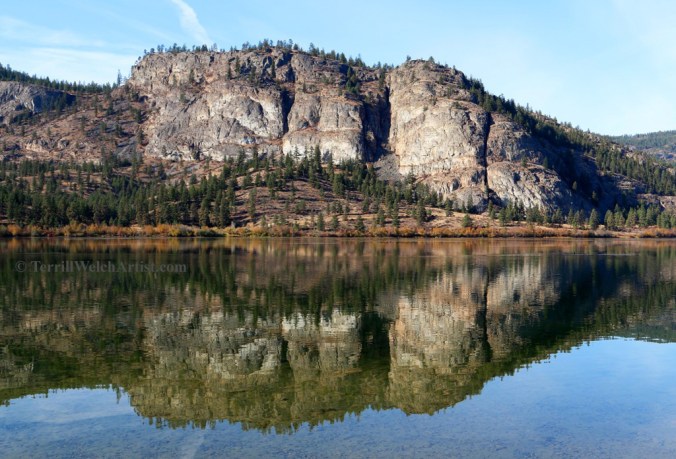
The southern interior of British Columbia in general simply IS different from our southwest coast. Take these reflections on Vaseux Lake.

A little colour…

A little colour south end of Vaseux Lake British Columbia by Terrill Welch 2015_10_30 075

and more colour…

Autumn Vaseux Lake British Columbia by Terrill Welch 2015_10_30 089

and then not much at all…

sleeping giant at Vaseux Lake British Columbia by Terrill Welch 2015_10_30 109

But the reflections! These kinds of reflections we do not get often on the Pacific Ocean. Not like this. I will be back another time I am sure. I have to test out other locations to see if more of the Okanagan has an appreciation of plein air artists or if it is just Peachland.

Back in the studio, another of the paintings that recently sold was delivered and is now ensconced in its new home. Doesn’t it look like it has always been there?

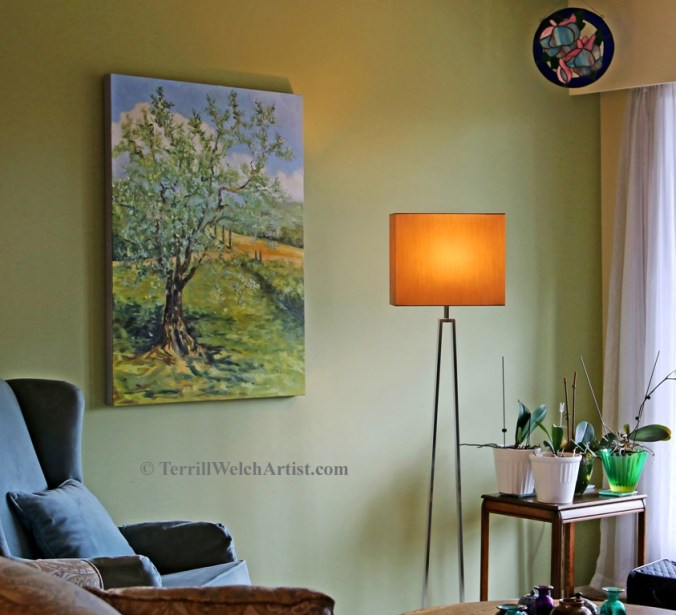
The Olive Tree 40 x 30 inch oil on canvas in its new home by Terrill Welch 2015_10_07 010

I did get one more finished, done excepted for the edges, new oil painting completed during the past few weeks. It started out with the usual underpainting and was built up from there.

The final result is “Winter” an 18 x 24 inch walnut oil on canvas Mayne Island seascape.

Winter 18 x 24 inch walnut oil on canvas by Terrill Welch 2015_11_10 024

In October, the painting shared in the previous post that I had just completed, “Salish Sea No Separation” 18 x 24 inch walnut oil, also sold before I could get it officially released. This work has safely arrived in Michigan and is now gracing the walls in the living room of a large rancher. I haven’t seen any photographs yet but I am sure I will before long.

Salish Sea No Separation 18 x 24 inch walnut oil on canvas by Terrill Welch 2015_08_23 096

Right now, I am feeling the pressure to find more studio time so that the inventory is replenished for the upcoming year. I trust I shall find the time. I know that I will. I must!

Then, we shall smile together when the next person says – “can she really make a living at that!?”

We can simultaneously reply… “Why do you ask?”

In other studio news, there are rumours of a possible pop-up show of my paintings early in the New Year. This will be confirmed once plans are in place. Also, I will be painting and staying in Victoria for the month of January and then traveling to Prince Edward Island to photograph and do painting sketches from the end of April until near the end of June. During the Art! Vancouver international art fair in May, I expect to have a couple of paintings in a gallery group show in Vancouver as well. The year ahead is shaping up to be eventful already.

For now though, I am rolling up my sleeves in the studio to paint!

Best of the holiday season everyone in case we don’t chat here again before then!

© 2015 Terrill Welch, All rights reserved.

Liberal usage granted with written permission. See “About” for details.

Creative Potager – Visit with painter and photographer Terrill Welch

From Mayne Island, British Columbia, Canada

For gallery and purchase information about Terrill’s photographs and paintings go to http://terrillwelchartist.com