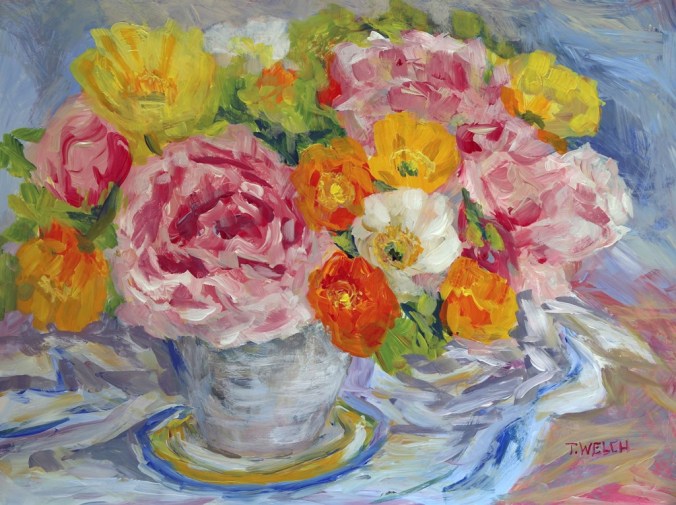
Three Large Plump Peaches in the Studio Today

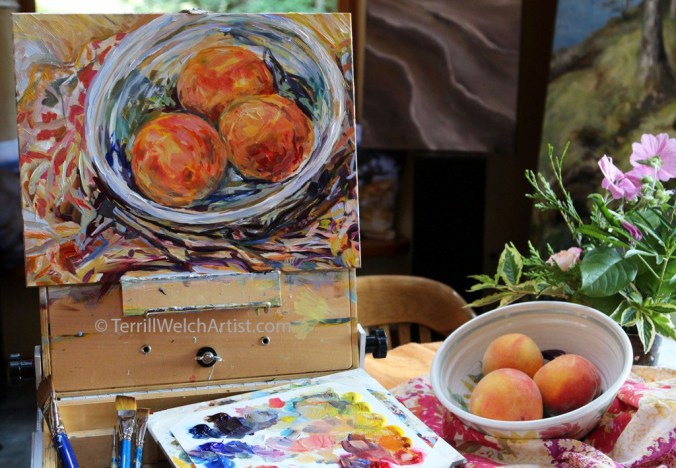
There are just three large plump peaches, fresh from the fields, sitting in a bowl on the table.

Almost done still life painting sketch of peaches by Terrill Welch August 26 2016 IMG_9338

I paint the still life sketch promptly because there is a great risk of there only being two.

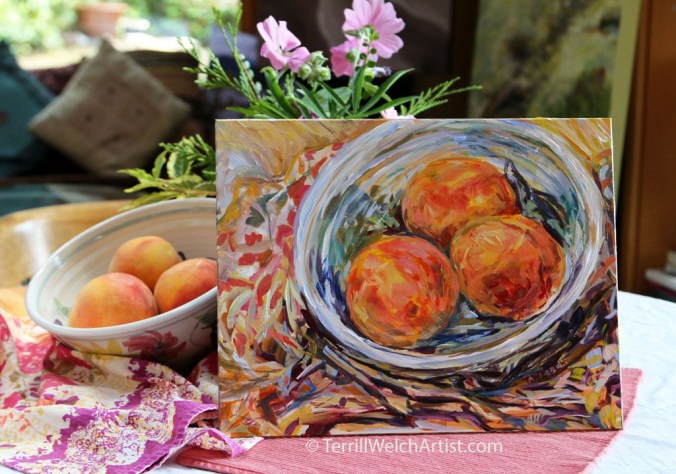
Study of Peaches 11 x 14 inch acrylic still life sketch by Terrill Welch August 26 2016 IMG_9390

The result is slightly larger than life contemporary impressionist style painting sketch.

Still life painting sketch of peaches by Terrill Welch  IMG_9400

Because this is all there will be, no larger painting anticipated, the 11 x 14 inch original acrylic still life painting sketch on gessobord has been released immediately HERE.

I have also released this work as a print and products in my Redbubble storefront HERE.

The studio study was completed simply for the pleasure of summer, peaches and paint.


What simple pleasures of summer are you enjoying?


Happy Friday to you!


© 2016 Terrill Welch, All rights reserved.

Liberal usage granted with written permission. See “About” for details.

Creative Potager – Visit with painter and photographer Terrill Welch

From Mayne Island, British Columbia, Canada

For gallery and purchase information about Terrill’s photographs and paintings go to http://terrillwelchartist.com

Art Studio Gossip

Gossip overheard in the artist’s studio this afternoon…

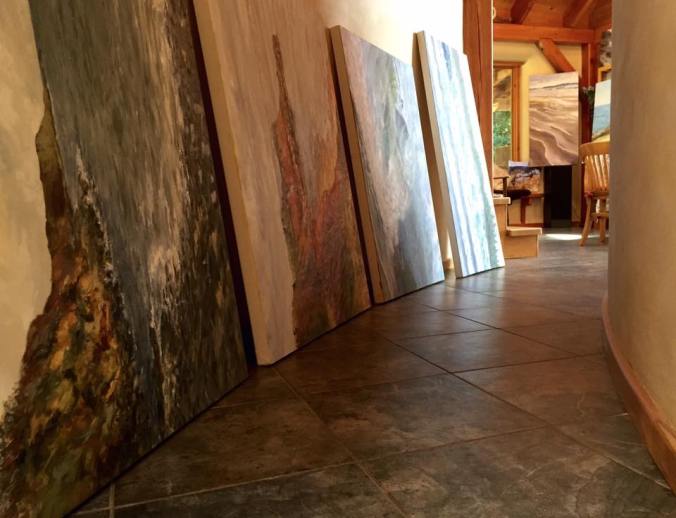
Standing on end and shouldering themselves into a rough order along the curved hallway, these landscape paintings whisper loudly to each other.

Gossip overheard in the the artist's studio by Terrill Welch

“What are we doing here? I don’t even have my edges painted yet!”

“Me either but I hear that is happening tomorrow. Apparently, we have a big gig coming up for September and October.”

“Yeah, I heard eight of us large ones will be showing in Victoria, BC ” says Seaside Mayne Island, as he heaves himself to a slightly better angle to be heard, without actually shouting, from the great room.

Then Evening And The Arbutus Tree leans over the railing from the loft.

“She told me that she wants to call the show ‘Above The Stacks’ because we are going to be in a new library and most of us will be way up high above the books. I said she had to add ‘Land and Sea’ to the title or no one will know that it is going to be us.”

Long Beach Vancouver Island sighs as the tide recedes farther up her midriff.

“You know” she comments patiently while stretching out one long sandy leg, and then the other “it is way too soon to be getting excited. There are still a couple of weeks to wait. No use wearing out all our shine in the studio.”

Then she winks and the light sparkles off of her sea “I do believe Emily Carr is somehow involved again.”

All the paintings in the studio start whispering at once. In fact one little fellow gets so excited that he falls over flat on his face in the magazine article he had been trying to read upside down.

Sea and Sun Cox Bay Tofino BC grumbles “You had to go and wake the little ones didn’t you!? You know they are too small to go in this show.”

“There will be other shows” Long Beach Vancouver Island replies. “After all, there are not many place that can handle the eight of us.”

The late summer afternoon warmth starts to make all the paintings drowsy – large ones, middle-sized ones and small ones. Sssshhhh!

The studio is quiet.


What are you whispering about today?


© 2016 Terrill Welch, All rights reserved.

Liberal usage granted with written permission. See “About” for details.

Creative Potager – Visit with painter and photographer Terrill Welch

From Mayne Island, British Columbia, Canada

For gallery and purchase information about Terrill’s photographs and paintings go to http://terrillwelchartist.com

In the Words of Strangers

By now you may have guessed, as a Canadian artist, I often have conversations strangers about my work when I am traveling. It comes with geographic proximity to my landscape subjects and other human beings. These engagements are frequently brief and fleeting in nature but this does not diminish their impact as a kind of concrete gentle-kindness to fortify my solitude as I put brush to canvas over and over again.

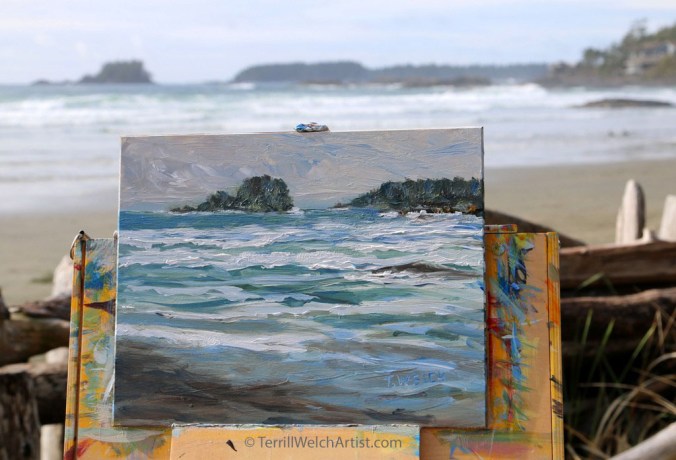
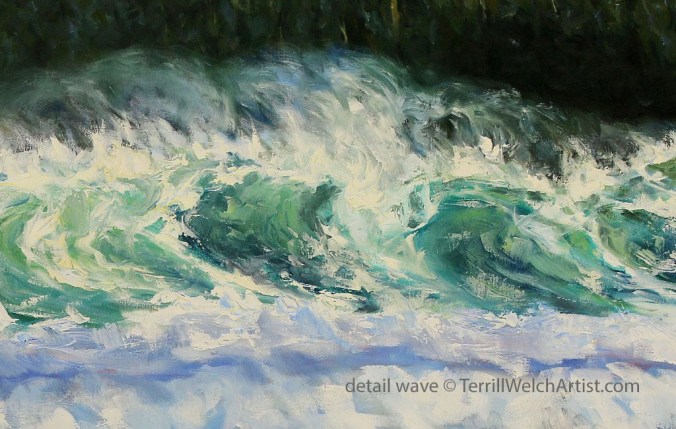
detail wave Sea and Sun Cox Bay Tofino BC 24 x 48 inch oil on canvas by Terrill Welch July 15 2016 IMG_7009

This same kind of engagement also happens through the vast and complex inter-connectedness of the world-wide-web.

Oh, I suppose could tell you about new works painted, several art shows and painting sales in the month since I have been home (my website has this information if it is desired). But, it has also been an unprecedented time of quiet recognition of my work. Complete strangers often contacted me to make requests about sharing my work elsewhere online. In the process, they frequently articulated why they wish to do so. Sometimes their words leave me rather stunned and deeply humbled with gratitude. Here are a couple of brief snippets as examples…

Received in my inbox today:

“I discovered your paintings from a Google image search of paintings of the Canadian coast. I grew up in ….. BC and spent much time sailing through Desolation Sound and the Gulf Islands. You’re paintings truly capture much of the beauty inherent in the
region. I was wondering if I could share one….”

Fog Inside Passage 12 x 24 inch oil on canvas

fog-inside-passage-12-x-24-inch-oil-on-canvas-by-terrill-welch-2013_02_03-064

Details and purchase information available HERE.

What do you think my answer was to this request!?

And here is part of a public comment this week on my TerrillWelchArtist.com website contact page:

“I have to tell you –though I hesitated to write this because I did not want to provoke anything which might disturb whatever wonderful thing it is that enables you to produce these works–I have spent numerous hours at the Musée du Quai d’Orsay fixed on one or another impressionist painting–usually one by Van Gogh. Your paintings have a similar effect. Your artistic sensibilities, while uniquely yours, seem to have a resonance with what I see communicated through Van Gogh’s pieces. Please don’t take offense at a comparison. Your work is truly original and beautiful–as is his. No mere imitator of Van Gogh, however talented, could ever hope to match this peculiar sensibility. I’m convinced that it must be something innately shared and, for me, your work expresses it in a way that’s of course your own. But these works could easily hang beside anything in the Orsay’s permanent collection.

It is no wonder to me that collectors snap up your paintings as soon as you finish them. If I had a fortune or was a curator at a major museum, I’d be collecting your paintings with the same interest that I’d have for any work by Van Gogh or Matisse or Raoul Dufy.”

Signed “P.”

One of the paintings of particular interest to this individual is Spring Tea, 16 x 20 inch oil on canvas, one of three paintings showing this weekend on Mayne Island at “La Vida Rústica” — multi-disciplinary reflections on the rustic life.

Spring Tea 16 x 20 inch oil on canvas plein air by Canadian Artist Terrill Welch 2015_04_25 140

Well, I must say, I really don’t know what to say when faced with such frank remarks…. except thank you, thank you – Thank You!

What is particularly powerful and meaningful to me is the clarity with which the paintings moved these commenters – it is as if the brushstrokes were felt even more than they were seen. There is no higher compliment or recognition as a painter I could ever wish for my work. This is a clean and perfect match to my intention and the driving force that brings me back to the studio again and again.

May the painting continue, without interference, and yet gently supported by the words of strangers!

On that note, I think we shall conclude with one of the latest paintings and the first large works from Prince Edward Island the East Coast of Canada.

In Studio placing last brushstroke on first large East Coast #PEI painting by Terrill Welch  IMG_6453


Can you share a time when you were moved by the insight and kindness of a stranger?


© 2016 Terrill Welch, All rights reserved.

Liberal usage granted with written permission. See “About” for details.

Creative Potager – Visit with painter and photographer Terrill Welch

From Mayne Island, British Columbia, Canada

For gallery and purchase information about Terrill’s photographs and paintings go to http://terrillwelchartist.com

The Wildest of the Wild West Coast of Canada Adventures

Some people go on vacations. They want to kick back and relax. A holiday from the grind of their real life they say. Not me! My real life is already scrumptiously engaging and meaningful. Though a little sunshine in just the right place never hurts.

Sun and Sea dance Frank Island Tofino British Columbia by Terrill Welch IMG_1751

When I leave home, I usually want to do more of what I do already in an ordinary day.

Terrill Welch on holidays by Josie Olszewski

I therefore call these gallivants-into-the-unknown, adventures! This latest six-day trip was to Chesterman Beach over on the wildest of the wild west coast in southern Canada, Tofino.

Wickaninnish Inn and the Sea by Terrill Welch IMG_1723

There is nothing like rain in a rain forest. Just put on that rain gear and go for it! Neither the giant trees nor you will mind in the least.

Rainy day forest walk with Josie and O boys iPhone capture by Terrill Welch

Or maybe the weather breaks for a few moments so you head for the beach again to… dig a hole, or play in the creek, or maybe you want to practice your clambering skills? Definitely a life-long ability worth refining in rough terrain. You just never know when you might want to climb straight up a hillside for a better view or down over some rocks to get that perfect angle.

the art of climbing by Terrill Welch IMG_1761

Or, how about a little plein air painting? Five years old

Eldest O boy at five years old painting on Chesterman Beach iPhone capture by Terrill Welch

or fifty-seven years old, it is all good!

plein air painting on Chesterman Beach by Terrill Welch 2016-03-22 IMG_0734

If it is crazy unpredictable weather, go anyway. Get out there and stretch those limbs!

beach walkers on Chesterman by Terrill Welch 2016-03-23 IMG_0830

Sun, rain, hail or high seas you will love it! I am as sure of it as these three are.

Josie and the two O boys on Chesterman Beach iPhone capture by Terrill Welch

But, for a landscape painter, that isn’t the last of it is it? The adventure continues back in the studio. Here are two of the latest Tofino oil paintings.

On the Rocks in Tofino 24 x 30 inch oil on canvas

On the Rocks in Tofino 24 x 30 inch oil on canvas by Terrill Welch 2016-03-30 IMG_2079

and Chesterman Beach Sunset 20 x 24 inch oil on canvas UPDATE: SOLD April 8, 2016

Chesterman Beach Sunset 20 x 24 inch oil on canvas by Terrill Welch 2016-04-01 IMG_2064

These will be available in my online gallery along with other work if you care for more information.

Now that is an adventure! My deepest thanks to the O family for inviting me along.

Stay tuned for the next traveling artist trip which will be to the East Coast of Canada for seven weeks on Prince Edward Island. Estimated time of arrive is late April.


Where is your next adventure going to take you?


© 2016 Terrill Welch, All rights reserved.

Liberal usage granted with written permission. See “About” for details.

Creative Potager – Visit with painter and photographer Terrill Welch

From Mayne Island, British Columbia, Canada

For gallery and purchase information about Terrill’s photographs and paintings go to http://terrillwelchartist.com

In the Beginning there was Oil Paint and a Canvas

So you want to learn how to oil paint!? How does nine steps or building blocks to accomplishing this task sound? Does it make your brushes start dancing in their jar? Do your tubes of paint start squeezing themselves out on the palette? Okay, maybe that is just a bit too much to expect. But you get the idea. Painters have all started from somewhere near the same place….

The painting supply shopping is done and you are feeling slightly nauseous from the decrease in your bank balance. But you are ready with a few good oil paints and a handful of quality canvases. You have a couple of big brushes, a couple of medium brushes, one or three small brushes plus a tiny one for your all-important  signature. You have chosen some old clothes or a painting apron and you have scrounged up a painting rag. You have wrestled your portable easel together without running screaming into the night. You know to clean your brushes carefully with soap and water at the end of each painting session. You know that you are painting with your whole body and not your wrist and hand. If you can, you will stand to paint and when possible do it barefoot. You know to use all of the information from all of your senses, not just what your mind thinks your eyes are seeing. You know that “alla prima” is an Italian word for painting wet-on-wet in a first attempt. Now what?

With a flick of my painterly brush and fingers fluttering across the keyboard, let’s get started!

Today, we are going to begin en plein air (in the open air). Choose a canvas that is small to medium is size. Once you get to your painting location, possibly feeling a little like a pack mule with an unsecured load of pointed objects protruding from various bags and sacks, you are ready to decide on your subject. Once you have given the subject and composition of your painting careful consideration, set up your easel.  Swearing is allowed if no one is within hearing distance. Now, decide on your painting intention.

Painting intention: What are you loosely holding in mind as you work today? What is your aim? If you could direct the powers of the universe onto your finished canvas, what would the viewer experience?

Now you are ready to paint:

1. Your canvas can have a wet or dry ground colour. In this case, we have a dry ground in cadmium yellow. For our west coast landscape this is often the best ground in order to bring our many blues hues alive on a canvas. But, since this is early spring in a garden, the ground could just as well have been a taupe if it is a wet ground or a thin layer of raw or burnt umber if it is a dry ground. The use of a ground helps to break the barrier between painter and a stark white canvas. You become familiar with the size and shape of the canvas you are using in a very physical way by the time the ground is painted. You have made a start. The ground can sometimes make it easier to see the values or colour relationships as the painting is developing. It is also my preference to have parts of the ground showing through later on rather than the blank canvas.
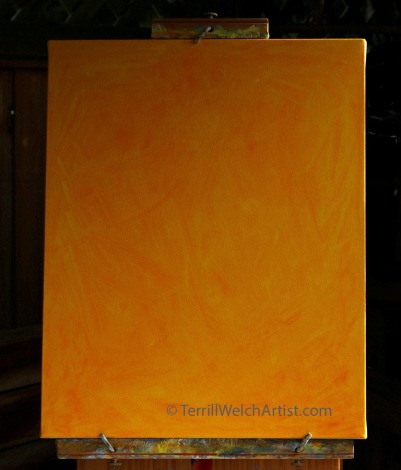
1. start with a wet or dry ground by Terrill Welch IMG_9194

2. Set out your palette. In this case, I am using Lukas Berlin water-mixable oil paints. The pigments are rich, the clean up easy and the paint requires no use of solvents, making it more environmentally friendly than regular oil paints. My other choice, though a little pricey, is M. Graham walnut oil paints. Again, no solvents are necessary in my painting process. However, if you are using paints that require solvents, please make sure you have lots of ventilation. Eventually, each painter develops their own preferred palette layout. The most important aspect of this is that it becomes habitual in some way. You need to be able to easily remember where each pigment is located – without having to stop and think about it every time you want to mix a colour. I am left-handed. The arrangement below works for me. The lightest blue is at the bottom left. The lightest yellow starts in the top right and is arranged below until it gets to the deepest red. The top left is where I will mix my darkest hues, even though I need to reach across to my deepest red to make this happen. I sometime put out a flesh colour when painting landscapes as an alternative to adding white. Naples yellow is used in the same manner.
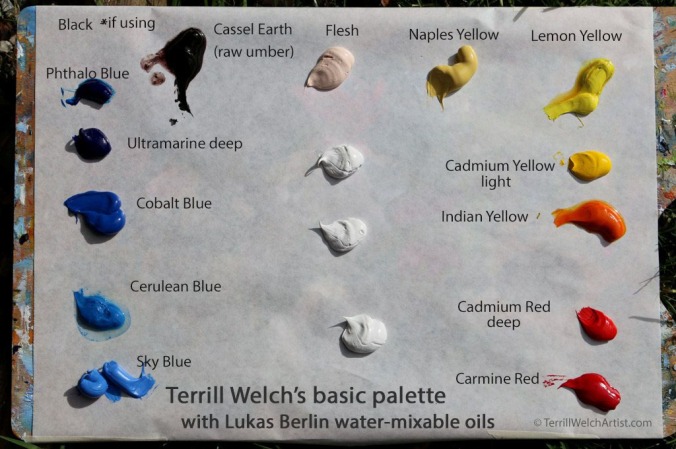
2. setting out palette by Terrill Welch IMG_9192

*Tip – Pigments mixed in various mediums and from different brands of paint behave slightly differently and may have different names. Learn how the brand you are using behaves by doing a few colour studies on a scrap of old canvas or panel.

Today, I have no black or payne’s grey on this palette. In fact, I recommend leaving this off until later in the learning curve of oil painting. Notice as well that there is no green or violet. These will be mixed for use as needed. If you haven’t studied a colour wheel recently in order to know what colours can be mixed to make another, don’t worry. For now – put your scientific adventure headband on and experiment. A detailed study of colour theory can come later and will continue for as long as you set about the process of painting. Paints are kind of like being presented with a spice cabinet and a garden full of herbs and then being told to gather together what smells right for the soup you are making. The first few times, you may come up with some rather strange combinations. However, eventually you figure out what you like and what works best for you. You could have just followed a recipe of course. But this leaves you looking up another recipe every time you want to make something new. If you learn by practice, from selectively gathering and using the raw ingredients, eventually you can flavour anything to your satisfaction that you want to cook. You can make adjustments at the start and at any point along the process. Painting is like this. If you experiment, from the very beginning, you have a better chance of developing the skills to allow you maximum creative freedom in the future. Methods, techniques and approaches are all just tools to accomplish the intention that you set out before beginning the painting process.

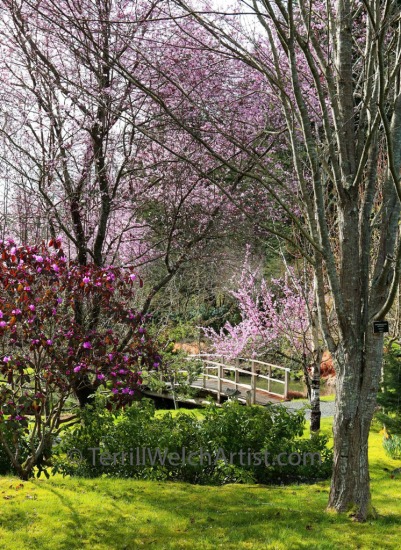
3. Mix a few of the more obvious colours in your composition or those that you want as reference points. In this case, my intention is to catch the very breath of early spring. I want to ensure I have the variety of pinks, violets, plums and purples of the plum blossoms. To have the best chance of getting this painting to sing the flush notes of spring, I mix these to ensure I have strong reference points for later on. At first, try to use your palette knife for mixing what you want to lay onto the canvas. However, I admit to having always used my brush, at least half the time, and continuing the final mix right on the canvas as I lay the wet paint down beside and on top of what is already there.
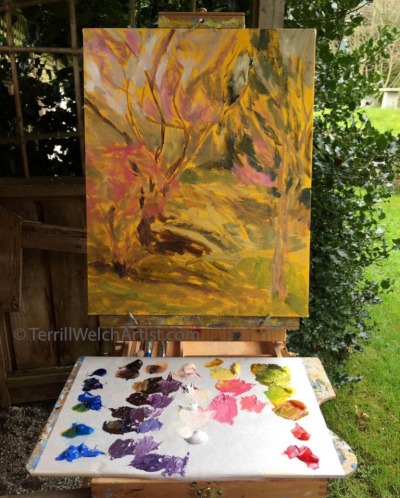
3 a. mix some more obvious colour in the compostion start with brief sketch by Terrill Welch

That long tail on an oil painting brush isn’t there for you to dangle the brush off the end of your fingertips. It is there to help with balance and to keep the tension between brush and canvas as you apply paint on a surface that is at an upright angle. Each paint brush is a little different. You will need to learn the balance point of each one by holding it between your fingers with a light grip that eventually allows you to roll it over-and-around with easy. Practice moving your fingers up and down the handle until you find your perfect balance point. If at any point you start to feel frustrated with how the paint is showing up on your canvas, the first thing to do is recheck that you are holding your brush in balance.
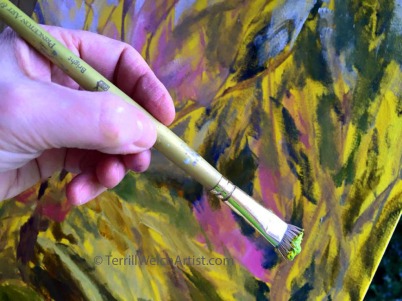
3 b. find the balance point to holding brush firm but lightly by Terrill Welch

*Tip – your brush is a tool or vehicle to get the paint from your palette and onto your canvas. To most efficiently accomplish this task, load ample paint on just the tip of the brush. But even before you do that dip the brush in oil or water if you are using water-mixable oil paints and squeeze the excess out. This makes the brush easier to clear at the end of the day and helps to release the paint from the brush onto the canvas.
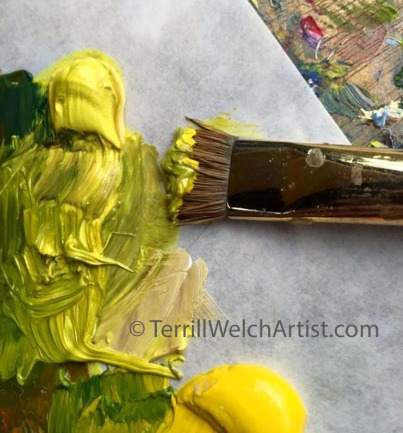
3 c. for alla prima load ample paint so it sits on the tip of the brush

4. Using a large brush or brushes, we are ready to start making a few marks and points of observation and reminders on the canvas. In this painting method, limited-to-no medium is necessary. You do not need to pay too much attention to fat over lean because the paint, for the most part, will all be of the same medium balance. The fat over lean lesson can be learned later on as it becomes necessary. Since you have spent time considering your composition before setting up to paint, don’t over-think this beginning. Just get started. It is only oil paint and canvas. Nothing is right or wrong at this point. You are starting a painting conversation with your subject. Short, brief sentences are perfect. Hello. How are you? What kind of day is it? I like the shape of that darkness stretching up. Look at that patch of pink!? Where is the movement in this composition? Where is the viewer? And so on…. You are beginning to warm up with the most pronounced darks and lights. Your canvas is being introduced to its subject using colour, shapes and the movement of directional brushstrokes.
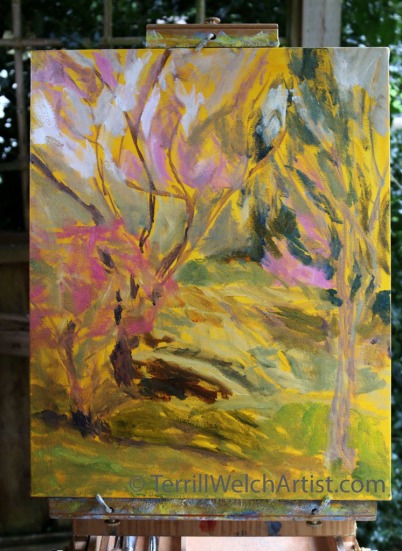
4. Begin to quickly block in composition by patches of colour IMG_9203

5. While working on your whole canvas, keep going until shapes start to appear. Now check the strength of the composition. Ask yourself – in this composition, who is the star and who are the supporting actors that make them shine? Make any corrections necessary in the various patches of colour. The painting won’t look like much yet but you should be able to see where it is going. The start should have good bones before we proceed. This is often called “blocking in” your composition. It may literally appear as blocks of solid colour. Or it may be more abstract patches of colour as I have here. If you are just beginning to paint, take the time to organize the bones of a composition maybe fifty or even a 100 times without ever proceeding to the tendons, muscles, skin, clothes and some fine jewelry of a finished painting. Research and learn what elements make a good composition. Study and practice composing compositions for a few minutes each day. You can use your smart phone for assistance or you can make a sliding rectangle with by placing your pointer fingers to your thumb on the opposite hand. If you want to get real fancy, you can even buy a small viewfinder and put it in your pocket. The point is that excellent compositions are everywhere. We just need practice in seeing and composing them. The skill of blocking in an initial strong composition, accomplished quickly with large brushes, is essential to the later quality of a painting. It is the support beams and studs of your painting building. This is not the time to be hanging curtains or putting down a throw rug! For now, large brushwork only. To keep the painting from becoming too muddy, you can use one large brush for darks and one for lights. Wipe the paint off the brush between changes in colour. But you don’t need to be too fussy about cleaning it at this point. The purpose is to get some paint on the canvas in the general location that it needs to be placed.
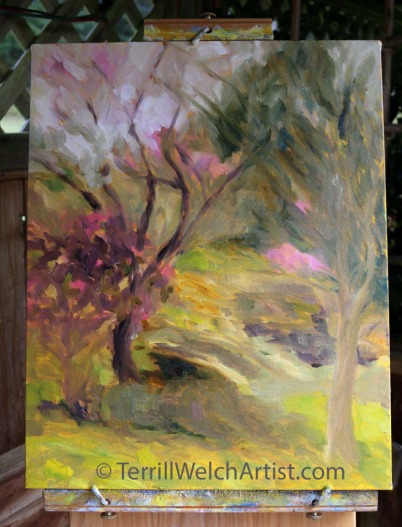
5. keep going until shapes start to appear then check strength of composition IMG_9209

6. Remember to be flexible. Up to this point it has been raining and I am set up in a little overhang. The air is cool enough that my water-mixable oils are a bit stiff. Ideally, I would have used my M. Graham walnut oil paints. But I wanted the easier clean up of the Lukas Berlin paints for the plein air work this morning. Now, the worst thing possible happens. The sun comes out. I have no place to protect my canvas from the direct light and then to still be able to see my subject. I seldom work with an umbrella over my painting easel so I am stuck. I try moving the easel around a few times. I look at the unpredictable sky that threatens to rain again without notice. I make a decision. I am best off to pack up and head to the studio to complete the work.

I had taken a few reference images before I started painting when I was still deciding on my composition. The light in my finished painting is hiding some place between here…
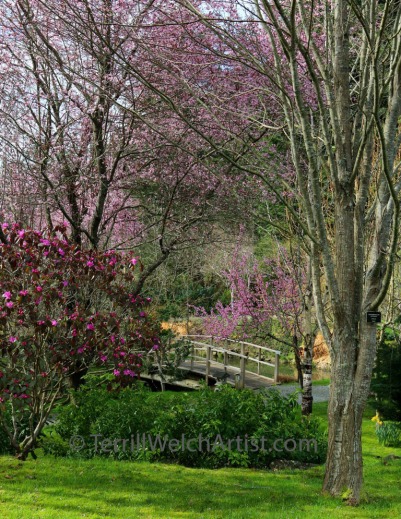
7. about ten am reference image by Terrill Welch IMG_9180

and here….

8. almost noon with the sun reference image by Terrill Welch out IMG_9219

*Tip – a specific photograph is almost useless to the process of rendering a painting alive. However, several reference images from various angles and perspectives, often captured over a few hours of plein air painting, can be a helpful resource once you are back in the studio. I frequently take between 50 and 150 reference images for a specific canvas. Sometimes I even have years of photographic references collected on a specific subject before I decide on a larger landscape canvas. The most significant difference between a photograph and the process of painting from life is that a photograph freezes the light and shadow. It has one still perspective. On the other hand, a painter, working from what is in front of them, paints the light and shadows in motion. This dynamic experience is combined with the actual motion and movement of the painter. A camera cannot see around corners. But a painter can. The painter also has all of the other information available to them from their other senses. In order to replicate this body of rich information in the studio, it must be gathered in the field to provide the sensory memory-triggers for the painter when they no long have the subject directly in front of them. The human eye darts around continuously recording patches of colour. The brain organizes this information by relevance and in relationship to each other, allowing us to quickly discern objects. This organizing is influenced by more than information provided by the eyes. It is accomplished by referencing information from all of our senses and by past experiences. We have, over our life-time of observation, created a refined system of “seeing” that has built-in short-cuts. In the painting-from-life and alla prima process, we want to unpack this refined system of observation and conclusions that our brain has developed. We attempt to bring our awareness back to as much of the raw data being input into the brain as we possibly can. The single camera image used as a painting reference interferes with this raw data retrieval process and, by extension, will interfere with the painting. However, a collection of images will more easily allow the painter to access what the eye, the ears, the nose, and the physical body observed  – before the brain began to organize and make sense of this information. A painter almost always wants access to the cumulative raw data from all of their senses when painting from life – before they attempt to draw any conclusions with a brush on a canvas. This is how mystery, intrigue and also familiarity is rendered onto a canvas. As a  painter, you are inviting the viewer to organize the raw information you have discovered and skillfully arranged onto the canvas for themselves. Through this painting kind of invitation, you have the best chance of being able to engage the full-body sensory receptors of the viewer when they look at your work.  They then use their own life-time practice of “seeing” and organize the information you have provided for themselves. In this manner the painting conversation will continue with each individual viewer – endlessly. That is the possibility, the promise and the hope anyway.

7. The closer to the actual life-experience one works in the studio, particularly in the beginning when learning to paint, the easier it is to access the first impressions of a subject within its context. So, when I return to the studio, I immediately continue working on my painting. By now, it is evident that the plum blossoms are my star and everything else is my supporting actors. To fulfill my intention of capturing the first breath of spring, all high, low and minor notes in the painting must come together in a full inhale and exhale towards this single purpose. The boldest of the bold must be visible on the canvas. The darkest dark and the lightest lights begin to fall into in place. The shimmering curves of colour must be placed and exaggerated just slightly for emphasis. We are now ready to add a simplistic garment over the bones, tendons of our composition.
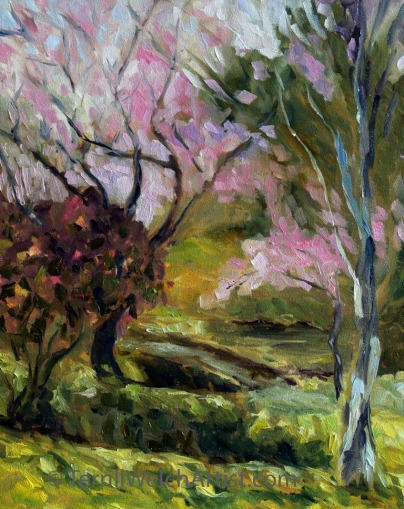
9. Plums Blossoms Japanese Garden work in progress 20 x 16 inch oil on canvas by Terrill Welch 2016-03-06 IMG_9240

8. I pause. I stand way back and revisit my composition. Some elements have shifted from their actual placement. Do they work better or worse than what I observed in my initial inspiration? At this point the painting must stand on its own. It must be able to breathe on its own. The painting must begin the process of separation from the actual subject and even from the painter’s own experience. Now, what is on the canvas and the painter’s intention must work together to bring the work to completion. I decide to take bit longer break before venturing into the final stages of completing the painting. A cup of tea. A twitter tweet. A Facebook post. A trip to the bathroom and a walk out on the deck. I glance at that painting from different angles out of the corner of my eye. I do whatever it takes to separate my ego-self from the painting and to allow me to join in an equal partnership with what is on the canvas. Do I want to continue the painting conversation? Is it a dynamic, meaningful and inspiring possibility? It is okay to if it is not, for then I ask myself and the canvas if it is a salvageable relationship. If it is not, then there is no need to go any further. The canvas can be scraped, the painting outlines with its rough paragraphs can be deleted. Or the bones of the work can be left to ponder or reorganize into another attempt. Whatever metaphors a painter wants to use, this is the point where I decide if I am fully invested in completing the work or if it was only a passing thought. The intention I set, before I ever pick up a brush or squeezed a tube of paint, is my best touch-stone in helping me to make this decision. Take yourself back to that loosely held aim for your canvas. In this way you can look at the canvas with fresh eyes. Now, make a decision one way or the other and move forward.

I decide to complete the painting. At this point I can start working with my medium and smaller brushes.

*Tip – to choose the best-size brush for the job of creating the painting impressions of your subject, pick up the largest one you think you can manage. Then put it down and choose one that is just slightly larger than that.

By the end of the day, I can feel the essence of early spring on the canvas. I am close to complete.
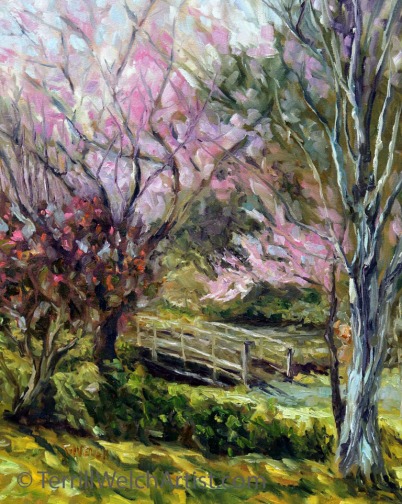
10. Plum Blossoms Japanese Garden resting 20 x 16 inch oil on canvas by Terrill Welch 2016-03-06

The next morning I refine the painting’s garments for a slightly better fit with a tuck here and a bracelet there, maybe a bolder pair of earrings for a bit of sparkle and I move the buckle of her plum-blossom belt right into the sunlight. The painting is done. Allow me to introduce you to:

Plum Blossoms Japanese Garden 20 x 16 inch oil on canvas by Terrill Welch
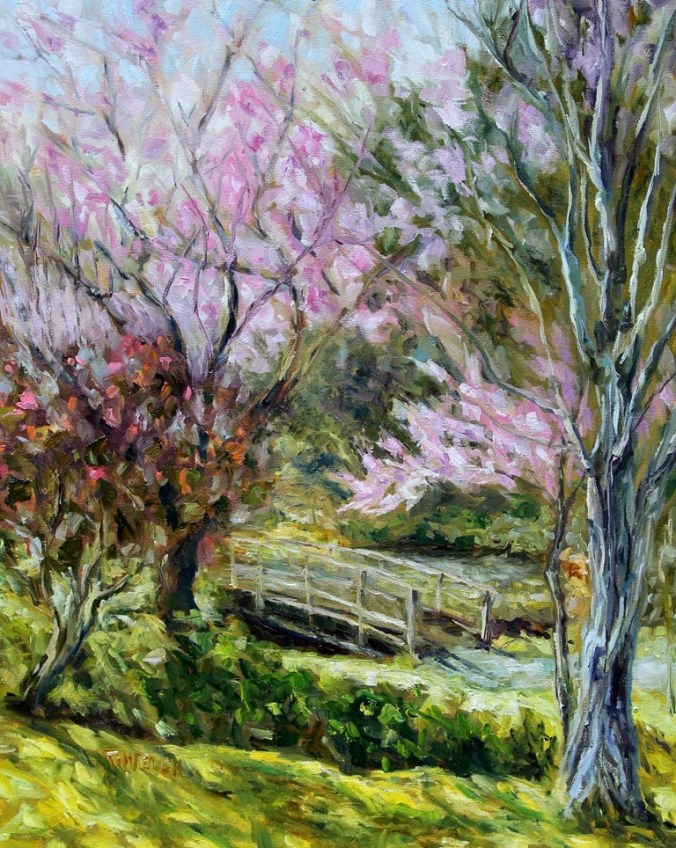
11. Plum Blossoms Japanese Garden 20 x 16 inch oil on canvas by Terrill Welch 2016-03-09 IMG_9315

You now have all the basic building blocks to paint your first oil painting using an alla prima oil painting method but one. Can you guess what it is?

9. To conclude your painting process, review your palette for clues to what you have learned, what you want to remember for next time and what worked and didn’t work. Ask yourself what you want to start doing, stop doing and keep doing for your next painting. No two paintings that use the method I have set out before you will look the same. Each painter brings their own experiences, temperament and attitude to the process. We each have our own painting fingerprint. Part of understanding these individual characteristics is to review your palette at the end of a painting process. To assist me in this process, I like to start with a clean palette at the beginning of each painting – because I love light and colour and the simple abundance that can be found in an ordinary day. This is part of my own personal finger print. A clean palette at the start of each painting gives me the best chance of mixing what I see before me rather than what I saw previously.
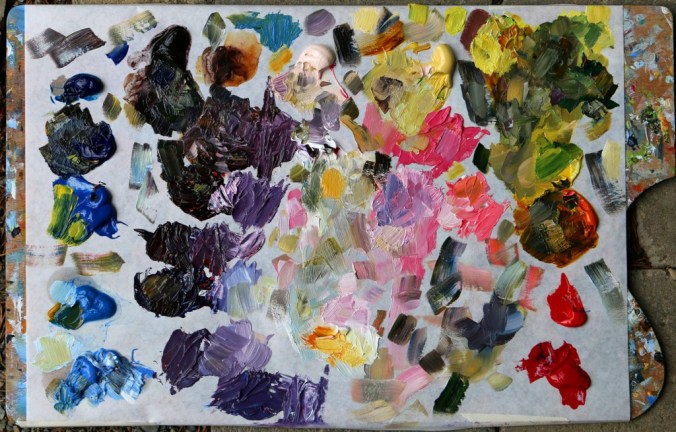
12. palette at the end of painting IMG_9280

Now you are ready to practice, practice and practice some more. As you come across new painting problems there will be new methods, approaches, techniques, painting theories and ideas to learn in order to find a solution. This process never ends. But you have enough information here to get you started. You have enough to allow your painting practice to serve your intentions. Of course, this is not the “right” way or the “only” way to approach oil painting. It is one way. As your body of knowledge and experience grows, you will refine and add to your own individual painting practice. The purpose of this post is to allow you to get started.

For my regular readers, this may seem like a gathering of the highlights from several years-worth of posts about my painting process that has been shared in this Creative Potager blog. Of course, it isn’t everything. Just a beginning. But it is a beginning that gives the reader some of the basics for a life-long practice of bringing the brush to paint and then to the canvas when using a wet-on-wet or alla prima method.

For new and regular readers, that want to learn how to oil paint, I hope you have found these nine steps helpful. If you would like to work together further, I am offering online feedback (for a fee) on your specific painting efforts via my personal Facebook profile or email at tawelch@shaw.ca  You may private message me if this is something that interests you. In order to prioritize my own studio time, I only have the capacity for a small number of participating painters at a time. However, please feel free to check in with me and we can see what might work. In the meantime, happy painting!


What intention are you setting for today?


© 2016 Terrill Welch, All rights reserved.

Liberal usage granted with written permission. See “About” for details.

Creative Potager – Visit with painter and photographer Terrill Welch

From Mayne Island, British Columbia, Canada

For gallery and purchase information about Terrill’s photographs and paintings go to http://terrillwelchartist.com
Intention, Composition and Underpainting are Tools of the Trade used by the Artist

Today’s work set aside to dry ….

Beginning with underpainting of Westerly Winds Victoria BC 30 x 40 inch oil on canvas

Beginning with underpainting of Westerly Winds Victoria BC 30 x 40 inch oil on canvas by Terrill Welch 2016-01-14 IMG_7555

Sometimes I am asked why do I use this tool of a flowing, rather shapeless underpainting? Wouldn’t a ground colour do? Why not just begin the painting and start with a pencil or charcoal sketch to mark the forms?

The answers to these questions are interrelated and to some extent personal and subjective to my intent. So lets start with my intent with this painting – I want my viewer to be standing along this specific shore on this specific day and be able to feel their presence within the landscape. Admittedly not a small task considering that 80% of the North American population lives in urban centres and has limited ability and time to spend watching how a specific landscape looks at different times of day and at different times in the year. Still, I believe part of my job is to provide this experience which then becomes more familiar to the viewer in the face of the actual physical environment. I make no assumption at all that the viewer is familiar with what it is I am about to paint. If we keep this in mind, it helps to understand the task I must complete with a rather simplistic landscape in order to convey the power of the universe through the sun, sea, and land.

First, in this case I began with a quick 20 minute plein air sketch yesterday.

Westerly Winds coming Ashore on the Sea 8 x 10 inch acrylic plein air sketch on panel board by Terrill Welch 206-01-13 IMG_7543

I wanted and needed that time on the shore to gather as many sensory notes as possible so that I can retrieve them for this work. So let’s unpack this underpainting process.

To proceed with a loose flowing “sketch” if you will for the underpainting is preferred in this case because the simplicity of the landscape makes it all the more difficult to render the movement and tension between the elements in the scene. This style of underpainting is preferred to a ground in this situation because the process provides a first check on the “rightness” of the composition for the intended purpose. The reds, yellows and oranges are simply a tool to bring the most movement and brilliance to the greys, blues, browns, yellows and whites of the finished landscape. Through trial and error I have found these pigments for underpaintings the most effective for capturing the significant range of lively blues in our west coast landscape. Therefore, the underpainting adds a strength to the end result that is near to impossible to replicate by beginning with the specific colours of the finished painting.

Do I always do an underpainting? No. Its use depends on my subject and my intention for the finished work. I sometimes do a quick painting sketch and work with the white canvas. I sometimes use a ground colour only. I sometimes work with wet grounds too. But this kind of underpainting, used for this work, is a favourite and there are reasons for this that go beyond any visual result and more to an intuitive remembering.

When I work a canvas up with this kind of underpainting, I begin to physically learn the window of space and the painting language that will be translated onto the canvas from my sensory information which I have gathered up to this point. My physical reference material will often include both photography and painting sketches.The sensory information is much more than what I see. It includes what I heard, smelled, tasted, and felt. There was the rolling of the stones on the shore beside me and the steps of people walking past. I could feel wind pushing cold air into my back and brushing my hair across my face. I could smell the cold dampness of snow, rain and salt. My eyelashes were cool. My hands were stiff with cold. But there was a warmth in the gray, the blue-green and the a brightness in the sky that was punctuated by the sturdy cliffs and the jut of land. It is all of this that I must translate into brushstrokes. The movement of the brushstrokes for the underpainting are like rough notes for the beginning of this painting conversation. I am intimately aware of the forcefulness between the elements of this seascape. I want this on the canvas from the very beginning.

iphone capture plein air painting Victoria BC by Terrill Welch 2016-01-13

I hope this helps to explain why I sometimes find this particular process of underpainting necessary to the rendering of my final work. Thanks for joining me and all the best of today.

Here is the finished painting:

Westerly Winter Winds Victoria BC – 30 x 40 inch oil on canvas

Details and purchase information are available HERE.

© 2016 Terrill Welch, All rights reserved.

Liberal usage granted with written permission. See “About” for details.

Creative Potager – Visit with painter and photographer Terrill Welch

From Mayne Island, British Columbia, Canada

For gallery and purchase information about Terrill’s photographs and paintings go to http://terrillwelchartist.com
Late Autumn Travel and news from the Studio

The lemon, cadmium and naples yellows are brilliant and the brush quick in the  Okanagan afternoon sun. Peachland reminds me of painting en plein air in France with everyone stopping to visit and comment on the progress as I worked.

This is very different from the usual Canadian standing back and frowning at me as they skeptically ask “Can you make a living do that?”

I always here their parent’s voice in these comments. After so many years of these exchanges, I am mostly use to it. But it can still, on occasion, be a little startling. I wonder, do these same people, if they see someone pruning hedges, or building a fence, or moving their herd of cattle, or tying up their charter fishing boat or cleaning the bathrooms in the provincial park, do they ask those people this same question? It is, after all, one would think, un-Canadian-like to ask such a personal question, tinged with judgement, to a person you see standing in front of an easel (paintbrush in hand) outdoors in our scenic landscape. But not so apparently. When I look up at these strangers, I realize that they just can’t help themselves. They simply must ask. Their curiosity seems to override politeness. I have a plan though.

The next time I am asked this question, I am going to reply “Why do you ask?”

I am sure their answers will be fascinating!

But in Peachland, like it was when I traveled in France, the people stopping by seemed to know and respect the seriousness and dedication that goes into the “real work ” of painting – even a quick plein air sketch. I was impressed and pleased. People could be seen crossing the street to come over to where I was busy working away at the easel.

Plein Air painting in Peachland British Columbia by Terrill Welch October 24 2015

They stopped in both direction on their walks along the waterfront to see how the sketch was coming along. It was a most pleasant 45 minutes on a fine autumn day!

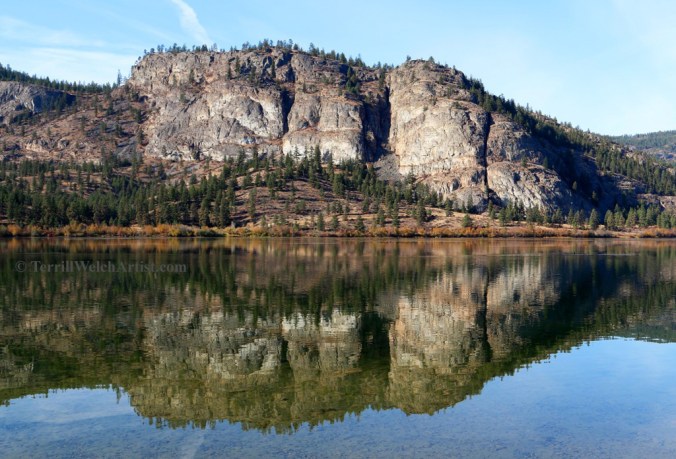
The southern interior of British Columbia in general simply IS different from our southwest coast. Take these reflections on Vaseux Lake.

A little colour…

A little colour south end of Vaseux Lake British Columbia by Terrill Welch 2015_10_30 075

and more colour…

Autumn Vaseux Lake British Columbia by Terrill Welch 2015_10_30 089

and then not much at all…

sleeping giant at Vaseux Lake British Columbia by Terrill Welch 2015_10_30 109

But the reflections! These kinds of reflections we do not get often on the Pacific Ocean. Not like this. I will be back another time I am sure. I have to test out other locations to see if more of the Okanagan has an appreciation of plein air artists or if it is just Peachland.

Back in the studio, another of the paintings that recently sold was delivered and is now ensconced in its new home. Doesn’t it look like it has always been there?

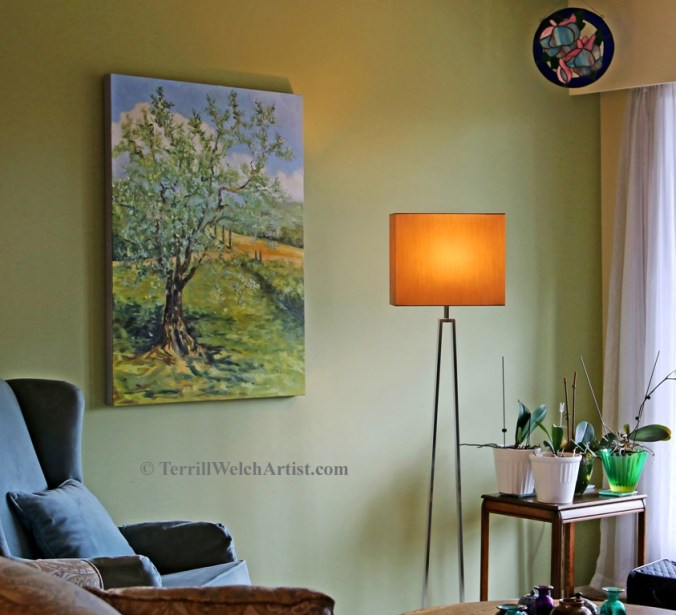
The Olive Tree 40 x 30 inch oil on canvas in its new home by Terrill Welch 2015_10_07 010

I did get one more finished, done excepted for the edges, new oil painting completed during the past few weeks. It started out with the usual underpainting and was built up from there.

The final result is “Winter” an 18 x 24 inch walnut oil on canvas Mayne Island seascape.

Winter 18 x 24 inch walnut oil on canvas by Terrill Welch 2015_11_10 024

In October, the painting shared in the previous post that I had just completed, “Salish Sea No Separation” 18 x 24 inch walnut oil, also sold before I could get it officially released. This work has safely arrived in Michigan and is now gracing the walls in the living room of a large rancher. I haven’t seen any photographs yet but I am sure I will before long.

Salish Sea No Separation 18 x 24 inch walnut oil on canvas by Terrill Welch 2015_08_23 096

Right now, I am feeling the pressure to find more studio time so that the inventory is replenished for the upcoming year. I trust I shall find the time. I know that I will. I must!

Then, we shall smile together when the next person says – “can she really make a living at that!?”

We can simultaneously reply… “Why do you ask?”

In other studio news, there are rumours of a possible pop-up show of my paintings early in the New Year. This will be confirmed once plans are in place. Also, I will be painting and staying in Victoria for the month of January and then traveling to Prince Edward Island to photograph and do painting sketches from the end of April until near the end of June. During the Art! Vancouver international art fair in May, I expect to have a couple of paintings in a gallery group show in Vancouver as well. The year ahead is shaping up to be eventful already.

For now though, I am rolling up my sleeves in the studio to paint!

Best of the holiday season everyone in case we don’t chat here again before then!

© 2015 Terrill Welch, All rights reserved.

Liberal usage granted with written permission. See “About” for details.

Creative Potager – Visit with painter and photographer Terrill Welch

From Mayne Island, British Columbia, Canada

For gallery and purchase information about Terrill’s photographs and paintings go to http://terrillwelchartist.com
Painting and then Selling Paintings are Done on a Different Breath

Working as an independent artist responsible for not only creating the work but also for getting it out there is the world is best understood using the analogy of breathing. The process of gathering information and executing a painting on a canvas is done on the in breath. The process of marketing and selling the painting is done on the out breath. As long as the painter remembers that it is not possible to breathe in and out at exactly the same time then the combine processes work rather well and the artist has a healthy sustainable life as a full-time artist. This is my theory anyway. So far so good.

And though I have completed a couple of plein air sketches

“As Sea to Shore” 11 x 14 inch plein air acrylic sketch on gessobord

As Sea to Shore 11 x 14 inch plein air acrylic sketch by Terrill Welch 2015_09_05 105


“Salish Sea late August morning” 11 x 14 inch acrylic plein air sketch on gessobord

Salish Sea late August morning 11 x 14 inch acrylic plein air sketch on gessobord by Terrill Welch 2015_08_20 092

and one painting,

Salish Sea No Separation 18 x 24 inch walnut oil on canvas (will be released soon) Update: This painting sold to a private collector in Michigan on October 19, 2015 before it could be formally released.

Salish Sea No Separation 18 x 24 inch walnut oil on canvas by Terrill Welch 2015_08_23 096

the majority of my effort has been on the “out breath” of selling paintings.

This wasn’t such a purposeful act of short breaths in and long breathes out but it is what has happened. So much so that seven paintings have been sold in seven short weeks. Here is one of these paintings Trail Along the Ridge a 30 x 40 inch oil on canvas, in its new home.

Trail Along The Ridge 30 x 24 inch oil on canvas in its new home IMG_4448

All seven paintings that have left the studio recently can be viewed HERE on the Terrill Welch Artist website.

Now, I expect to get back to some more moderate breath patterns with a rather relaxed even-pace between the in breath and the out breath of breathing, painting and selling as an independent artist. Life is good and the cupboards are full for the winter ahead!


What is the current breathing pattern of your creative breath?


© 2015 Terrill Welch, All rights reserved.

Liberal usage granted with written permission. See “About” for details.

Creative Potager – Visit with painter and photographer Terrill Welch

From Mayne Island, British Columbia, Canada

For gallery and purchase information about Terrill’s photographs and paintings go to http://terrillwelchartist.com
For the Record I am Still Very Much a Living Artist

The other day I had a long-time friend ask if I had any health problems. I was a bit puzzled about what prompted this inquiry but answered that I was fine other than being slightly rounder than I would like.

He continues “Oh, I was just wondering if I could cash in on those paintings of yours anytime soon. But I think you have to be dead first.”

He was teasing but it is not such an odd question to ask about an artist as I first thought. At a recent international art fair this was a common curiosity for art buyers – was the artist still alive and are they in the mature or later stages of their career? This is all a polite way of asking if the artist is dead yet or how much longer until we can expect them to be dead. Of course, then the collector or potential purchaser has to decide if they have a chance of outliving that artist in order to cash in on their holdings. This is the rather lifeless, dark side of the whole art business which I am not so fond of thinking about.

I admit to being a little weirded out by this whole line of decision-making or checking up on your art investment. So I just want to say, for the record, I am in good health, eat well, exercise regularly, do not smoke, spend ample time in nature breathing clean air and sometimes have a glass of red wine with my dinner. Chances are fairly good that I have several years of painting left in me yet and I shall be around for a long, long time. No quick return on your investment is reasonably expected here. Then again we never really know do we?  After all, I am closer to 60 than 50 years old now. But I provide you with summary this  information and leave it with you to calculated your odds.

Now that we have that out-of-the-way, there is another kind of being dead as an artist that is far more dangerous than a last breath. This is the death of risk taking. Playing it safe, in whatever creative medium an artist uses, is not recommended. Sometimes the worst thing for an artist is to figure out something that works and is appreciated by viewers and collectors. Under these circumstances, we can lose focus, desire, drive and passion quicker than the heart can skip a beat. We must keep ask – I wonder? and – what if? and then go for it! The life in our work depends on this risk taking as much as our body relies on fresh organic fruit and vegetables. Yes, we can stop asking the questions for a short-while. But we will develop artistic scurvy if it goes on for too long. Let me show you an example of the kind of risk taking I am talking about….

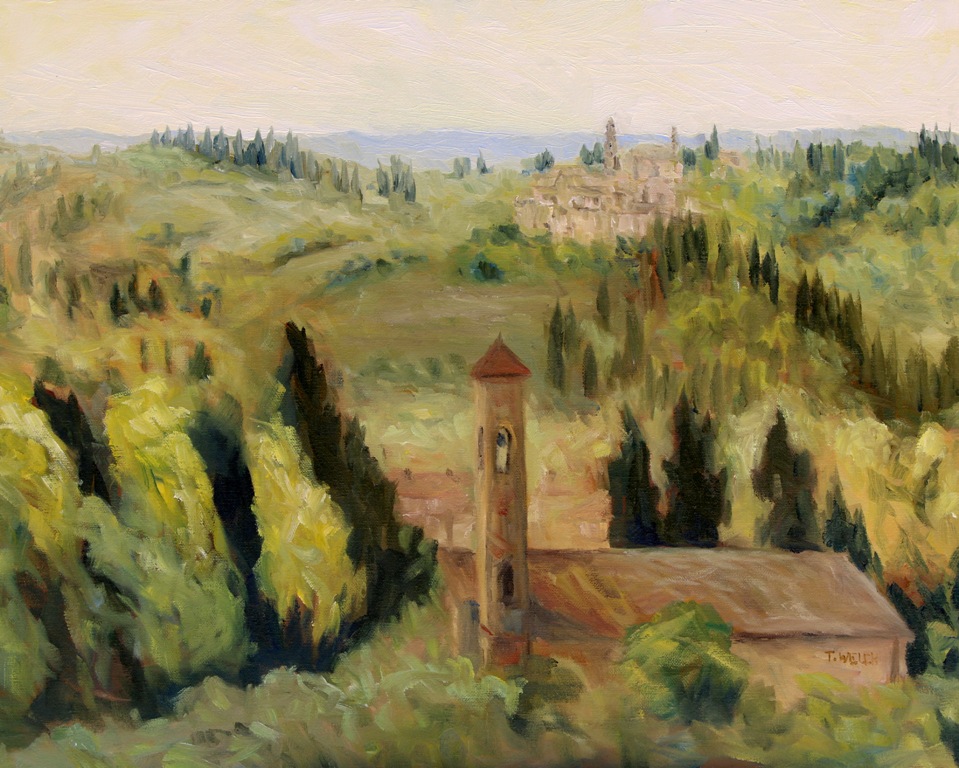
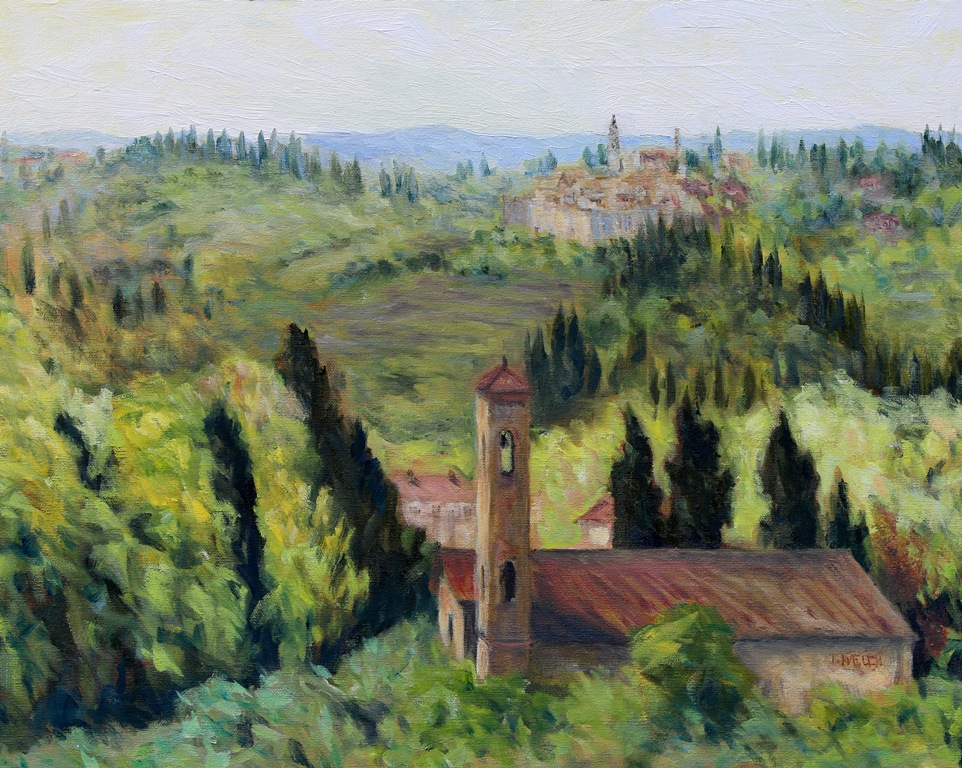
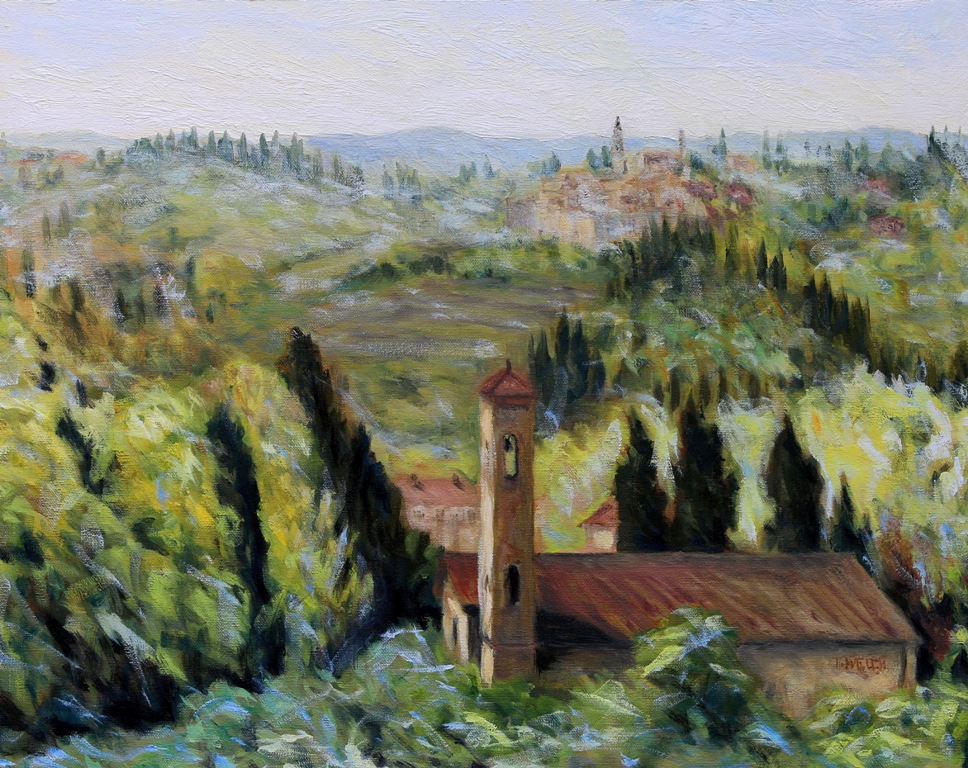
My paintings don’t just appear on the canvas with each bit perfectly formed. They are coerced, poked and enticed into existence. I start with an idea about how I want to handle a particular subject and gradually it starts to take shape as the layers of paint and brushstrokes are moved onto the canvas. Bell Towers of Florence Countryside – 16 x 20 inch walnut oil on canvas has been more than a year in the musing and thinking process.

I start the landscape with my usual warm underpainting …

Bell Towers of Florence Countryside 16 x 20 inch walnut oil on canvas in progress 1 by Terrill Welch 2015_07_30 002

I began working right on top of the wet underpainting. I wanted this warmth to be come integral to the later stages of the painting.

Bell Towers of Florence Countryside 16 x 20 inch walnut oil on canvas in progress 2 by Terrill Welch 2015_07_30 003

The main themes and compositional elements of the painting are still fluid and transitory. It is coming along nicely.

Bell Towers of Florence Countryside 16 x 20 inch walnut oil on canvas in progress 3 by Terrill Welch 2015_07_30 011

Slowly my ideas start to solidify – just a bit…

Bell Towers of Florence Countryside 16 x 20 inch walnut oil on canvas in progress 4 by Terrill Welch 2015_07_30 014

I begin building up what seems to be working…

Bell Towers of Florence Countryside 16 x 20 inch walnut oil on canvas in progress 5 by Terrill Welch 2015_07_31 001

I keep going…

Bell Towers of Florence Countryside 16 x 20 inch walnut oil on canvas in progress 6 by Terrill Welch 2015_07_31 008

There is some variation in colour between stages because of the lighting condition at different times of day. But you get the idea. Finally the painting is getting close.

Bell Towers of Florence Countryside 7 resting 16 x 20 inch walnut oil on canvas by Terrill Welch 2015_08_01 070

If you are walking from Florence south via del Podesta which is part of the old road to Rome take via del Portico to the right that is above Galluzzo. It is the medieval Chiesa di Santa Lucia in the foreground. The church has two bells from the 14th century. The Monastero della Certosa del Galluzzio founded by Niccolò Acciaiuoli in 1342 is on the hillside in the background. Today there are cars and freeways running lengthwise between these two places but from this view one can imagine there being only foot traffic moving along the narrow roads between stone walls from one place to the other. Thinking about what it was like standing in this spot, I make a few more changes and then I am ready to leave the painting to “rest” and decide if it needs anything else.

Bell Towers of Florence Countryside 7 resting 16 x 20 inch walnut oil on canvas 8 still resting by Terrill Welch 2015_08_02 002

Well, I slept on it and I thought about this place some more. I then thought about the state of the world and so on. I could have left this most pleasant, idealized scene just as it is. The painting is fine. No risk taking is necessary really. But what would be the use of that? Do we really just need one more perfect picture of a grand view? No we don’t. I know we don’t. I have more to say than that and I had best figure out how to say it. We are often dazzled by dramatic light and memories that deny an imperfect past. This is even more pronounced to me when looking at these old churches, monasteries and bell towers in the Florence countryside. The whining hornet-sounds of motorcycles on the narrow road are an invisible reminder of our fossil-fuel reliant present. The young olive trees on the hill are young because of a hard frost a number of years ago that was attributed to changes in weather patterns. We seem to be wiping out our past and our present even as we observe this magnificent view. Like cataract suffers, we keep focusing on the bright spots and missing the rest. We are slowly going blind and this beautiful view will soon be lost to us. How can I possibly show this with paint and my brush?

Bell Towers of Florence Countryside  16 x 20 inch walnut oil on canvas by Terrill Welch 2015_08_02 062

Risk taken. I believe we now have more than simply a beautiful landscape and one that is very much alive, just like the artist who painted it.


What risk are you currently taking in order to be very much alive?


© 2015 Terrill Welch, All rights reserved.

Liberal usage granted with written permission. See “About” for details.

Creative Potager – Visit with painter and photographer Terrill Welch

From Mayne Island, British Columbia, Canada

For gallery and purchase information about Terrill’s photographs and paintings go to http://terrillwelchartist.com

Profit and Losses of Peonies and Poppies Still Life in the Art Studio

Notes from my artist’s journal:

Saturday’s flowers for $12.00 from the Hardscrabble Farm stall at the Farmers Market resulted in “Peonies and Poppies Still Life” 12 x 16 inch acrylic painting sketch shown here just as itwas completed in the studio. Thegessobord was $5.20 and the paints used maybe $2.80 bringing the total investment for materials to around $20.00 dollars. Then there is my hard-earned skills, creative genius and of course my time.

Peonies and Poppies Still Life 12 x 16 acrylic painting sketch just completed  in the studio by Terrill Welch 2015_06_07 305

I took it off easel and set it next to the flowers for a moment.

A June Sunday morning in the studio by Terrill Welch 2015_06_07 379

This was my June Sunday morning in the studio and a good morning it was!

I usually do not sell these sketches as they remain in my private collection for reference. But I felt for now I had done all that I wanted to do with this subject. I was quite pleased with the sketch and decided it could stand on its own as a finished work.

On Monday morning I posted the quick acrylic sketch on social media for the purchase price of $400 including shipping.

Late Monday evening the painting sketch SOLD!

Peonies and Poppies still life 12 x 16 inch acrylic painting sketch on gessobord by Terrill Welch 2015_06_07 477

Prints of this work are still available and can be purchased by clicking the image or HERE.

On Wednesday morning the e-transfer of funds was deposited and I had finished packaging and shipping the painting sketch to the new collector. I went to the small town of Sidney B.C. and purchased ink for my big printer, canvases and paints. The total was $368 dollars. I heaved a bit of a frustrated sigh as all of my profits from the sale, after supplies, taxes and shipping, were immediately reinvested back into the studio. Then I chided myself with the reminder that at least I had profits to reinvest.

Now it is Thursday morning. The flowers have faded. The peonies remind me of soiled pink toilet paper and poppy petals lay scattered onto the table.

Maybe, I will feel inspired to paint peonies and poppies again next year.

Don’t get me wrong I am THRILLED to have this work with a collector who I KNOW will treasure this painting sketch! I am always thankful and humbly grateful to ALL the art collectors who purchase my work. It is just that, well…. It’s all good right?

So goes the profits and losses of painting a peonies and poppies still life sketch in my art studio.


What are you adding up today?


© 2015 Terrill Welch, All rights reserved.

Liberal usage granted with written permission. See “About” for details.

Creative Potager – Visit with painter and photographer Terrill Welch

From Mayne Island, British Columbia, Canada

For gallery and purchase information about Terrill’s photographs and paintings go to http://terrillwelchartist.com