A wild lighthouse chase over on Seven Devils Road and other stuff

The sun is rising all peachy and I have only a few minutes with a low connection so this is going to be quick. Our weather is holding on the Oregon coast it looks like for a bit yet. Here are a few captures from the last few days.

Smaller rocks on Cannon Beach
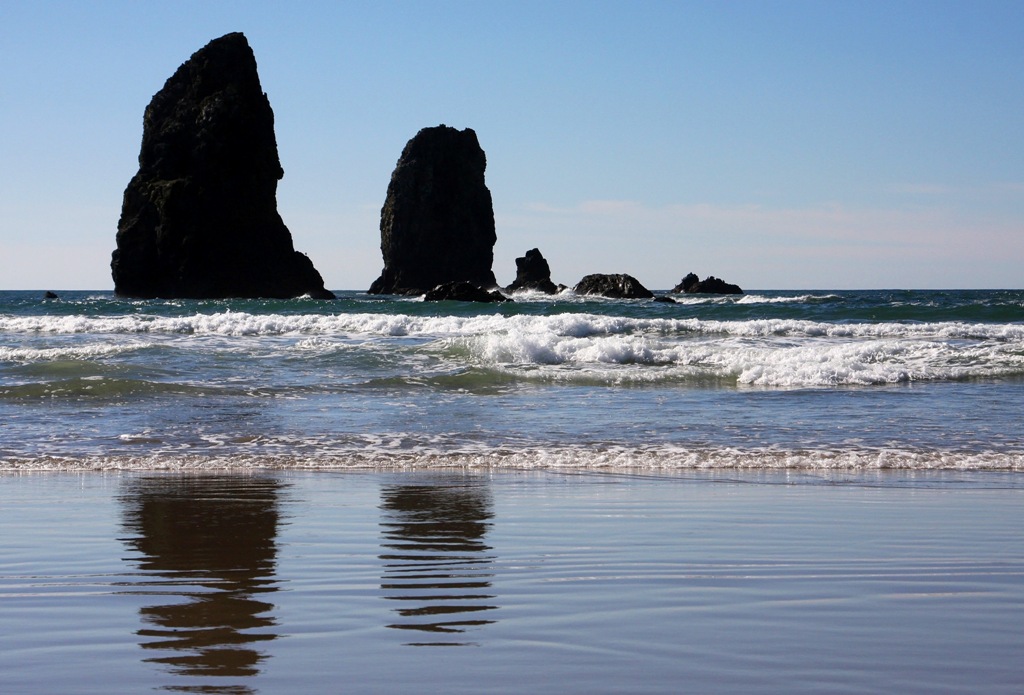
Smaller rocks Cannon Beach Oregon by Terrill Welch 2015_02_21 301

The brute on Cannon Beach which I walked for 45 minutes to get on the other side of for this portrait.

The brute on Cannon Beach Oregon by Terrill Welch 2015_02_21 324

Sunset at Neskowin with a lone figure standing in awe at its beauty.
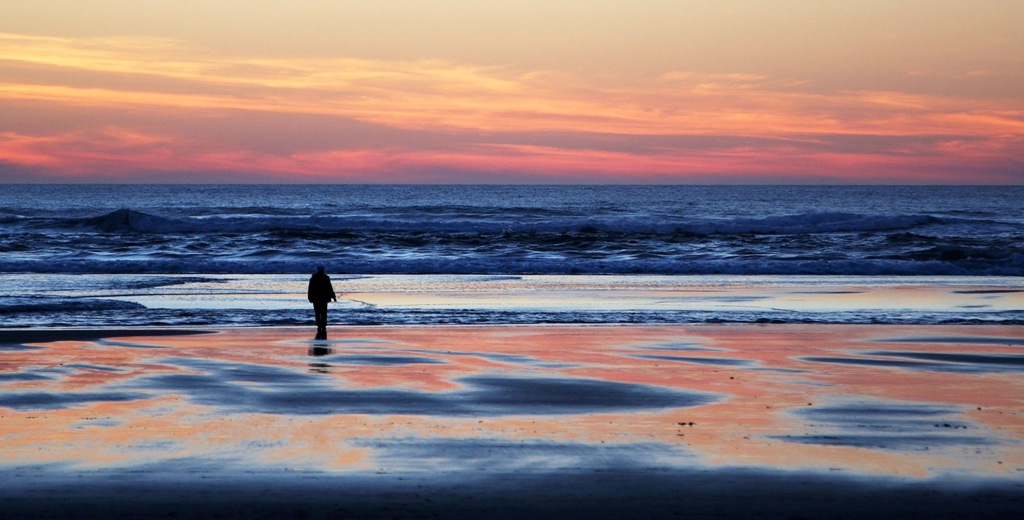
Lone figure sunset Neskowin Oregon by Terrill Welch 2015_02_21 556

First light on shore at Neskowin.

first sun in  morning Neskowin Oregon by Terrill Welch 2015_02_22 001

Plein air painting a little later in the morning.

morning plein air painting at Neskowin Oregon by Terrill Welch 2015_02_22 015

I was photographed by Penny Lulich while we were visiting and I was workin.
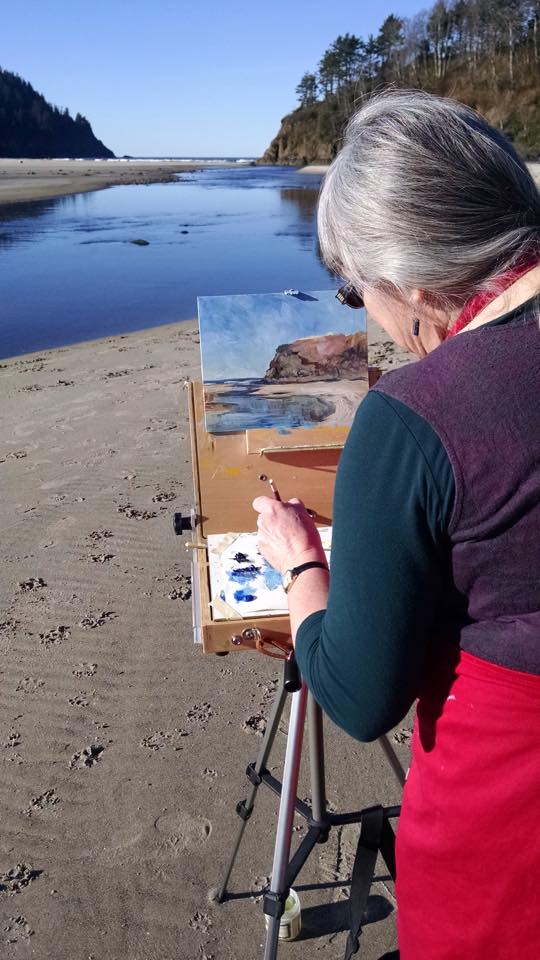
Terrill Welch painting at Neskowin Oregon by Penny Lulich February 22 2015

As someone commented “a nice place to have an office.” In fact, we liked it so much that we stayed an extra day and watched the sun come up again.

morning sky at Neskowin Oregon by Terrill Welch 2015_02_23 017

Threading a day at Neskowin Oregon

threading a day at Neskowin Oregon by Terrill Welch 2015_02_23 298

with a long walk up the beach.

morning beach at Neskowin Beach by Terrill Welch 2015_02_23 228

But I did promise you lighthouses and a many devils road and we are about to get to that adventure after breakfast at the Hawk Creek Cafe. Well, maybe we will slip over at Seal Rock for a gander first.

Seal Rock Oregon by Terrill Welch 2015_02_23 340


So as you go through Reedsport start thinking lighthouse, any lighthouse will do but maybe start with Umpqua Lighthouse. Nope it is not out on a rock with waves crashing around it but high on a cliff behind a chain-link fence. Still it is a thing of aged beauty and it was time for bread and cheese and a stretch.

Umpqua lighthouse Oregon by Terrill Welch 2015_02_23 364

It was after, just as we navigated to the scenic route through North Bend that things got a little confusing. David says “what are you looking for?”

“A lighthouse.” I reply with complete confidence.

“Which one?” he inquires looking at the map.

“The first one.” I confirm. “Someplace near Charleston.”

The GPS is sending us through the city section in a maze of turns until we finally end up at Cape Arago with no lighthouse in site. But there are sea lions on the rocks.

Sea Lions at Cape Arago Oregon by Terrill Welch 2015_02_23 377

And the view is spectacular

Cape Arago Oregon by Terrill Welch 2015_02_23 387

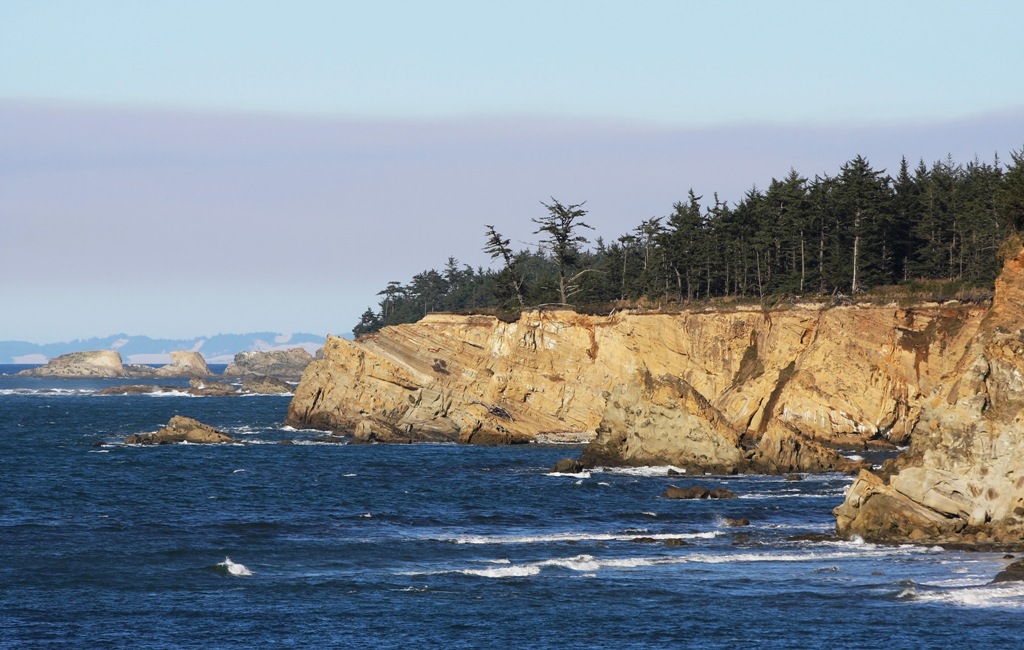
In fact there is a red dot on the far row of large rocks which I later believe to be the missing lighthouse. As we go back the way we came I see it once through the trees but that is it. There is no long access to it according to the section of our guide which I didn’t read until after supper last night. At this point David is weary of stop and go and is just as happy to see me punch in “Bandon” on the GPS. Off we go eventually along Seven Devils Road which I am sure was named to taunt lighthouse chasers.  David has his eyes closed and doesn’t say a word as I get close to Bandon and turn left before the bridge after spotting the sign for another lighthouse. The wind is whipping up sand that sticks to your smile as soon as the door opens. David just turns a little harder into the passenger seat and pretends I am not getting out. I take a couple of shots of the abandon Coquille River Lighthouse but nothing pleases me in the early evening light. I give up and drive us back out and over the bridge to Bandon turning into old town looking for a place to stay. I drive right through and off on a side road that gives me a good view of the lighthouse which I am sure is the reason I just had to go this way. David opens one eye but says nothing.
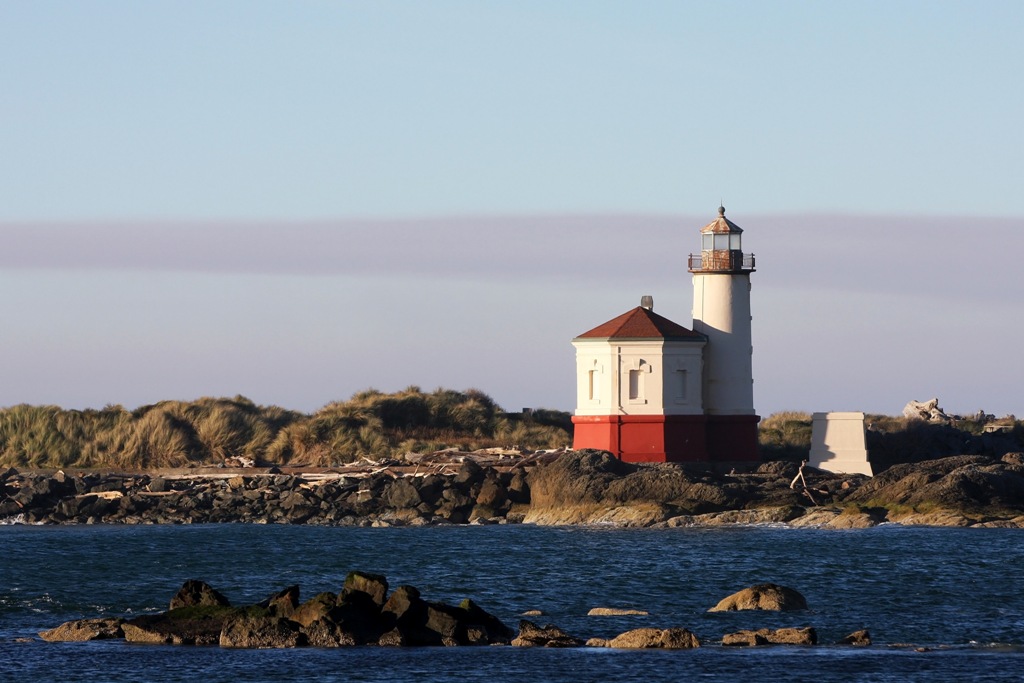
Coquille River Lighthouse Bandon Oregon by Terrill Welch 2015_02_23 433

I pull out the maps and seriously look for a place to stay. We decide on the Bandon Inn overlooking the old town and are not disappointed. We are given a lower than low season rate by a warm desk clerk for a lovely room with a continental breakfast. For my B.C. folks, it could just as easily be the Super 8 in Williams Lake but with a better view.

Today we should find our way through the Oregon Redwoods and maybe into Northern California. I do see a couple of lighthouses on the map at Crescent City…. shhhh! Don’t tell David. He is still sleeping and it might give him nightmares.

When was the last time you were on a wild goose – lighthouse – chase?

© 2015 Terrill Welch, All rights reserved.

Liberal usage granted with written permission. See “About” for details.

Creative Potager – Visit with painter and photographer Terrill Welch

From Mayne Island, British Columbia, Canada

For gallery and purchase information about Terrill’s photographs and paintings go to http://terrillwelchartist.com

Canadian Contemporary Artist Terrill Welch solo exhibit and auction

Just so you know…

Terrill Welch's avatarTerrill Welch

Twenty-two of Terrill Welch’s paintings open in a solo exhibit today in the International Fine Arts Collaborative (IFAC) ZEN Gallery Facebook Page curated by Sukhee Kwon.

S O L O . E X H I B I T I O N : 1 2
Collection: T E N D I N G . T O . T H E . O R D I N A R Y
Artist: Terrill Welch

IFAC Zen Gallery Solo Exhibition 12 Terrill Welch
To view the exhibit click on the image or HERE.
Intro: Terrill Welch is internationally recognized. Her paintings are sold to art collectors throughout Canada and the United States as well as in Australia, England, Norway and Switzerland. Since 2010, more than 50 of her paintings have found their way into private collections.

TENDING TO THE ORDINARY is a selection of paintings chosen for their moments of engagement with our everyday world. The brushstrokes render the light, shadow…

View original post 163 more words

The Diamond on the hill is Villeneuve lez Avignon France

What is it that has us gasp in awe when we look across an expansive vista? I believe it is because we are able to find ourselves within a much larger context. We experience our relationship to our surroundings in a different way than when inclosed by trees or buildings. This experience is a challenge to capture in a painting or photography without separating the viewer from the view and leaving them standing outside of a landscape. You will know this from your own, sometimes disappointing, photography efforts when you say to yourself – but that wasn’t what it was like at all! If you have been having conversations with me for a while, you know that I like to have my viewers experience my paintings from inside the landscape or seascape. I believe I may have succeeded in this desire in my latest painting which has us looking down onto the Rhone River at Pont D’ Avignon and across the view to Villeneuve lez Avignon, France.  Before I explain further let’s look at the painting and you can experience it for yourself.

Villeneuve lez Avignon France – 24 x 36 inch oil on canvas

Villeneuve lez Avignon France 24 x 36 inch oil on canvas by Terrill Welch 2014_07_16 030

If you just want to experience the painting for its own sake I suggest that you read no further. However, if you are curious about what happened in this canvas please feel free to join me by reading the rest of the post.

This is a good-sized painting so let’s look at it again with a bit of context around it.

on the stairs for context - Villeneuve lez Avignon France 24 x 36 inch oil on canvas  by Terrill Welch

Even though the painting is harder to see at this second angle in the early morning light, it does give us a feel for its size and how it looks relative to its surroundings. This is the same idea as what viewing a distant vista does for us. In the second photograph I want to move around and maybe get closer for a clearer view. The same thing happens when looking across a valley. How many times have you walked out on a viewpoint and then moved from spot-to-spot to make sure you were viewing it from the best vantage point? I believe this action of searching is what keeps us inside a landscape rather than viewing it as a spectator. So you might ask – how did I attempt to replicate this exercise for just our eyes in the painting above?

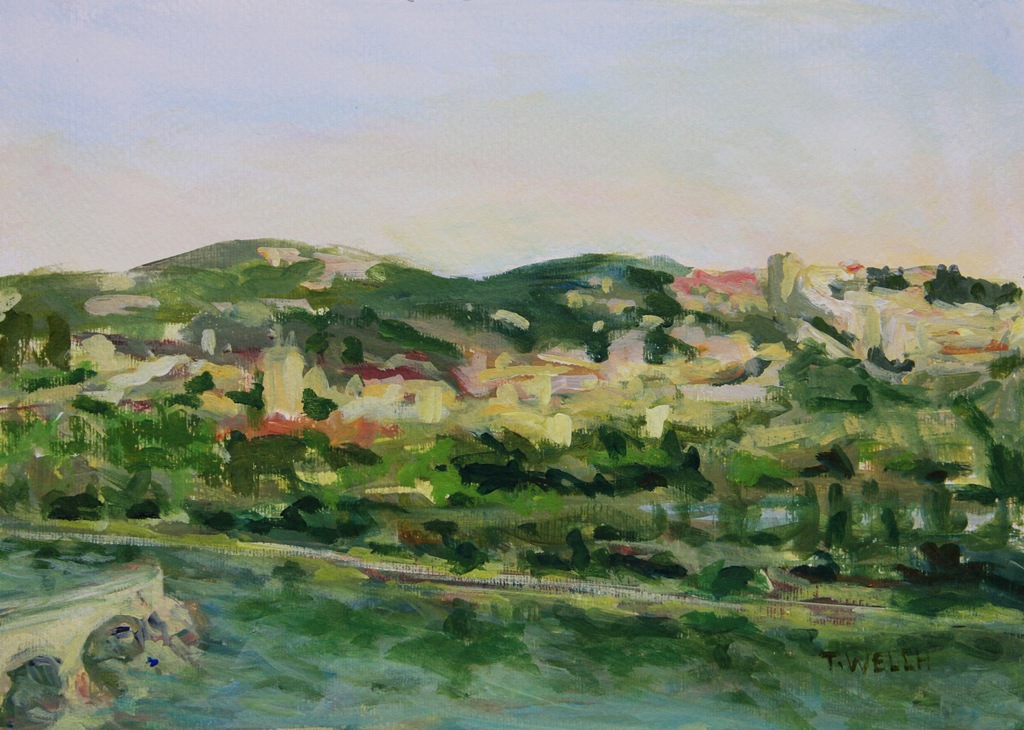
First, I stood on the very hillside that the viewer does when looking at this painting. I personally did the act of searching for that “best vantage point” by moving around the top of the hillside. Then I did a painting sketch. It was during the act of doing that painting sketch that I became familiar with the forms and structure of the landscape. We can read more about this in my earlier post “Artists Camille Corot and Terrill Welch Visit Avignon France 171 Years Apart” but for ease of comparison, I will post again the painting sketch

Across the Way Villeneuve lez Avignon France
plein air 25 × 35 cm acrylic painting sketch on 185 lb paper.

Across the Way Villeneuve lez Avignon France 25 x 35 cm acrylic painting sketch by Terrill Welch 2014_06_012 106

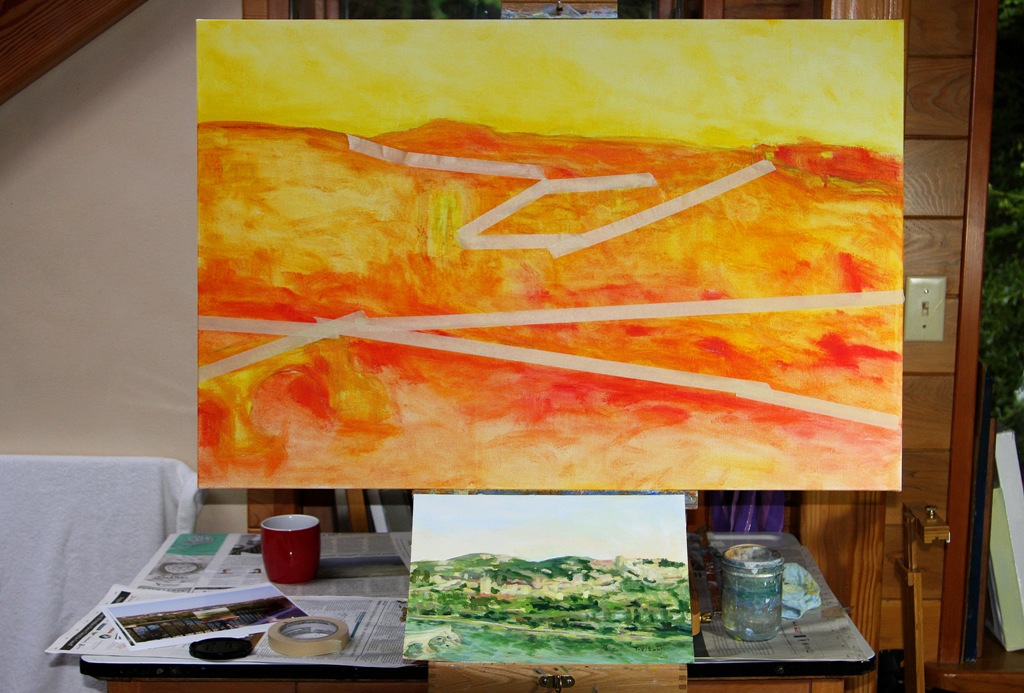
In the earlier post I talk about crunching the landscape slightly in my mind’s eye to fit the canvas shape. But now I am not so sure that is the only reason it was adjusted. Let’s have another look at the underpainting with bits of masking tap marking lines of intersection and tension.

compositional tension in Villeneuve lez Avignon France 24 x 36 inch oil on canvas by Terrill Welch 2014_07_07 005

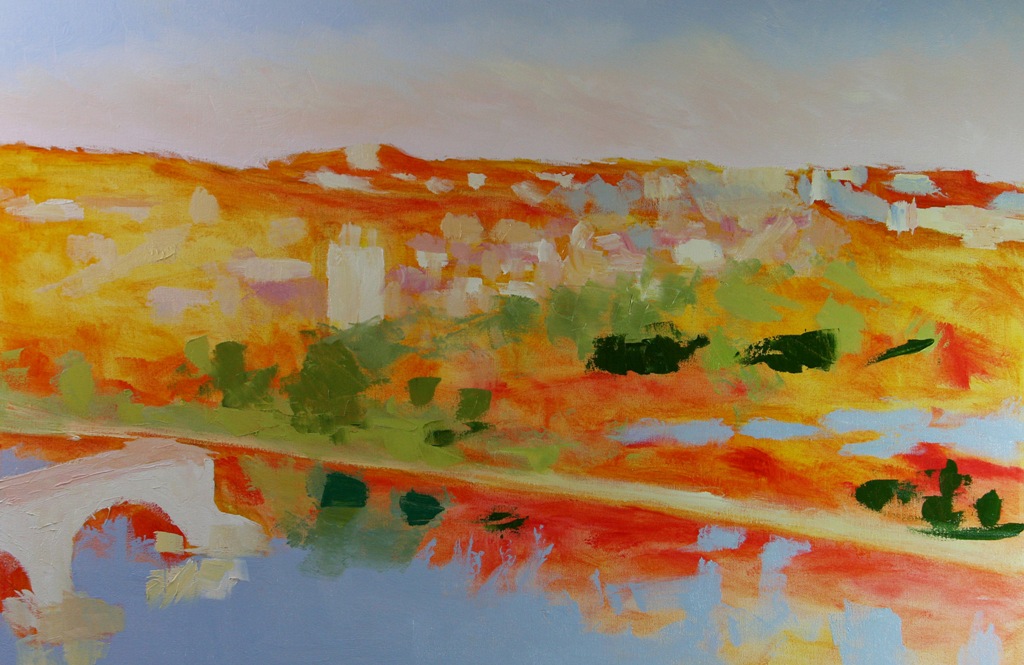
If we look at the plein air sketch and the larger canvas these same lines of intersection and tension exist. Whereas in reality, if one was a surveyor and painted to measure this tension is stretched out much further. So what happened? I believe it is the process of walking around the vantage point for the best view. In doing this we gather information about the expanse and reconstruct it in our mind’s eye to provide us with the best view of all aspects. In this case, the elements of interest are brought closer together adjusted in size and clarity exaggerating the tensions and lines of intersection. The diamond shape of Villeneuve les Avignon is our eye’s anchor but we do not look at it closely do we? At least I didn’t. By having these conversations with myself while I painted I began to unravel how we can experience a landscape painting from inside of the view rather than as a spectator. The result is that the view is created as one might do for themselves if they were to be standing on the hillside gathering the experience in their own mind’s eye. We the viewer are therefore inside the painting through the intentional design and execution of the work. To do this I first had to understand the compositional intersections and tensions and then combine three different painting techniques from the realism of the arches on the bridge to the impressionism of the morning light hitting the trees to the abstract expressionism of the buildings on the hillside. This combination of technique is not evident in the plein air sketch however.  I developed this deliberate conscious use of brush and paint as I began working up the underpainting.

work-in-progress Villeneuve lez Avignon France 24 x 36 inch oil on canvas by Terrill Welch 2014_07_07 010

I started to see the results though about here nearer to the end of the painting.

work-in-progress 2 Villeneuve lez Avignon France 24 x 36 inch oil on canvas by Terrill Welch 2014_07_07 021

I knew what I needed to do but I wasn’t sure I could make it work because culturally we have stripped these approaches into separate schools of practice. We have learned to understand paintings as if these are three separate painting languages. But from my recent visits through many European museums I find that artists are often multilingual. They will often find the perfect brush stroke using whatever painting language they have access to through their experience. This separation of painting languages is to some extent the work of art historians generalizing major movements in art and our understanding of  painting over time – which is directly influenced by our world experience as it intersects with our internal self. So I made a deliberate attempt to break these separation rules and stretch across as much painting history is covered by the Pont D’ Avignon itself. I wanted the viewer to view the painting as if they were standing on the hillside constructing the view within their own mind’s eye. This was much more important to me than conforming to painting schools of style and technique. I think that the strength of this approach is evident if we revisit the plein air sketch and then final painting. The same life and vitality of a quick sketch was carried over into the larger painting but the visual strength that the larger painting has is missing from the earlier painting sketch. At least that is what I experience. I would love to hear what you experience as well because the risk of mixing several languages of any sort is to be miss-understood.


Can you tell us about a time when you consciously merged separate approaches or languages to achieve a desired result?


Please note that the larger painting will be release at a later date – it is still resting 🙂


© 2014 Terrill Welch, All rights reserved.

Liberal usage granted with written permission. See “About” for details.

Creative Potager – Visit with painter and photographer Terrill Welch

From Mayne Island, British Columbia, Canada

For gallery and purchase information about Terrill’s photographs and paintings go to http://terrillwelchartist.com