Friday, 13 November 2026
These floating shells wasn’t something I paid much attention to until I started rigorously studying the seafloor. I have now shown this painting in a large in person public group show and it has been interesting engaging with the feedback of viewers who at first we’re not sure what they were looking at and how that little stone on the shell is often identified as a pearl instead of a stone. It has been a great reminder about how the painter and the painting create only part of the story.
Saturday, 12 April 2025 to Saturday, 3 May 2025
Though this large 48 x 40 inch oil painting with an acrylic underpainting was completed over almost a three week in painting time with the reference having been gathered a few days before this, my memory of the process is of a fluid flow from beginning it end.
The references for this painting are few and on this rare occasion the painting stay fairly true to what I saw and experienced when discovering this floating arrangement of shells that would have fit in the palm of my hand. In the third of these three images below, I have manipulated the reference using a digital editing tool called BeCasso which allows me to apply various filters and techniques and reduce visual clutter while keeping the strength of the light, forms and colour. The other two are as they were when I took them with my phone camera.
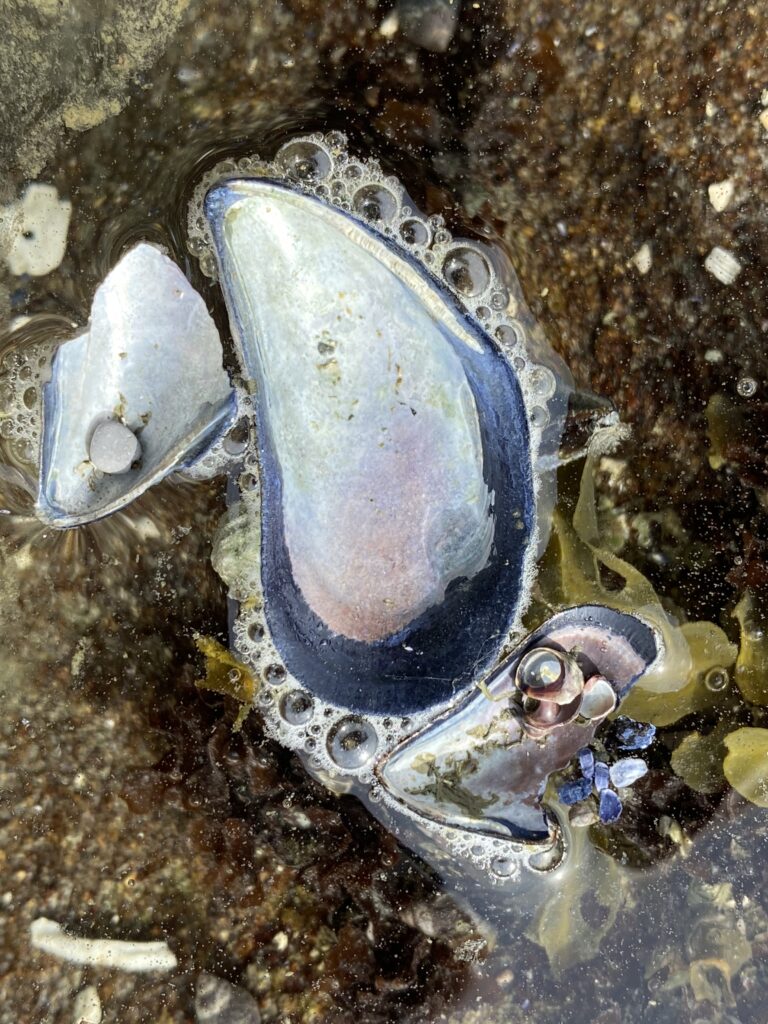
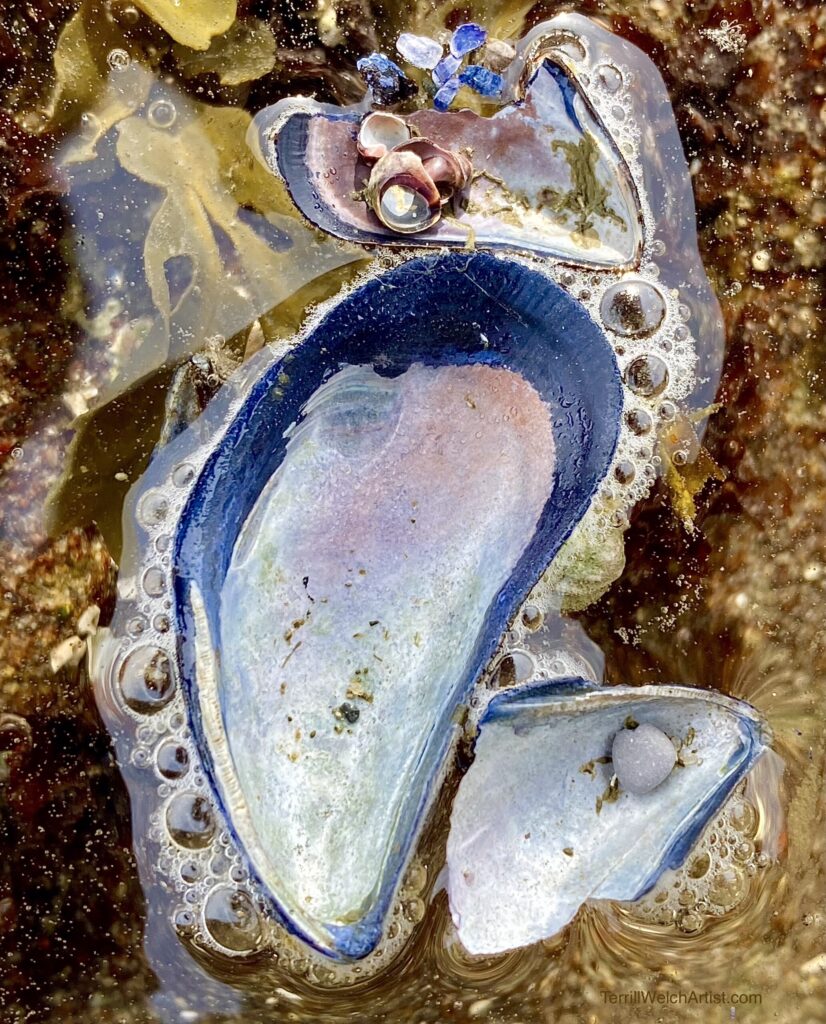
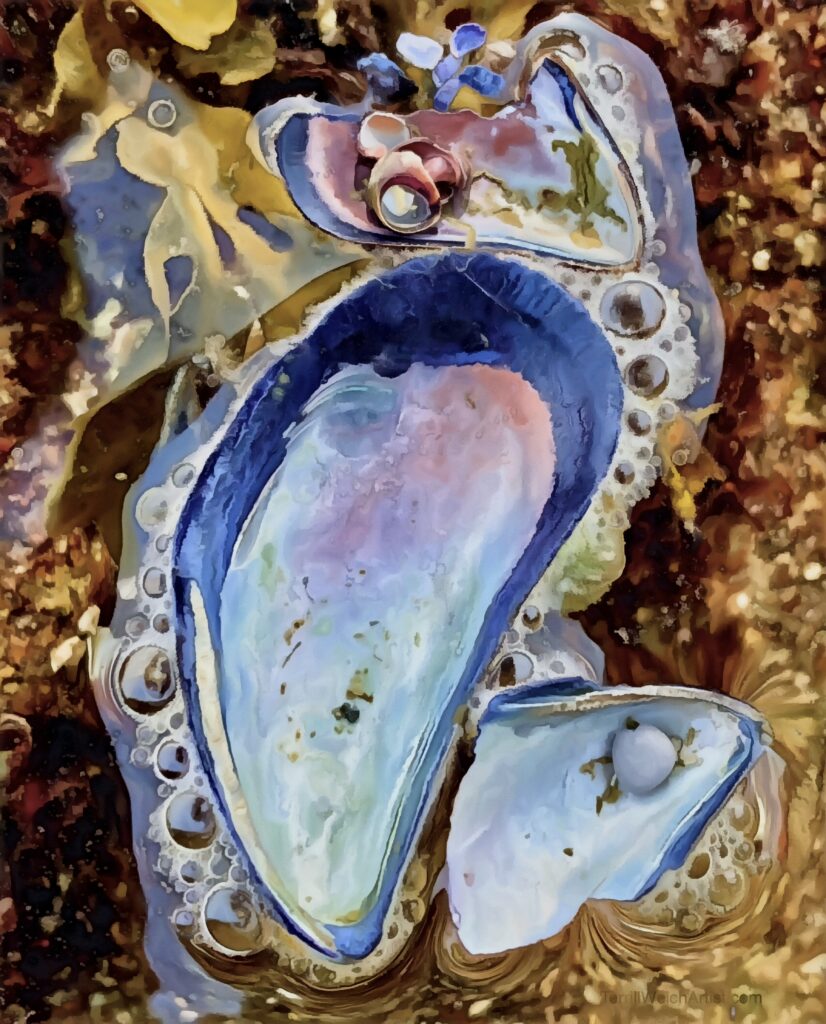
Above: Reference images taken and edited by Terrill Welch on 9, April 2025.
I had been out in the afternoon around 3:30 pm at Reef Bay on Mayne Island just as a lazy tide was drifting in. I was thrilled to find this floating arrangements of shells as I had mentioned in one of my earlier posts. Though it was a small arrangement in real life, I knew I wanted to paint it large and with a sense of intimacy as I explored its unique relationships and shapes. I can still smell the dank seashore after a low tide during a day of sun. There was hardly a breeze and the chirping of the oystercatchers were more plentiful than the calls of seagulls.
I started by putting on the hanging wire on the round table in the great room so I could attach the large canvase to the easel without the top mount.

The Spring sun is bright in the studio area.

It is the curse of the art studio’s south exposure. I put the canvas on the easel anyway.

By the next day, Sunday, 13 April 2025, our frequent southwest coast clouds offer me filtered light to begin the underpainting in acrylic.

Though the floating arrangements of shells is a new and unique subject that is something less common to observe, the painting process itself is familiar. I wanted the deep red areas to assist me with getting the mixed darks even darker and to provide a richness that would be difficult to get any other way. From there I added orange as I was feeling my way into the shapes and the strength of the composition which I wanted to twist just slightly to help with a feeling of dynamic movement.

I then added a yellow to offer some depth and harmony connection that I feel will be needed due to the stark warm/cool contrast between the shells and the seaweed filled sea cover the sandstone reef.

I leave it here for a day to think about how the shapes are interacting. Will it work I ask myself and the answer from myself is only a uncommitted shrug as I turn away from the easel to clean the brushes.
The next step is to begin the over painting. I decide to start with the deepest blue knowing it will be a good anchor and reference point for whatever else follows.

I added the dark warm brown purple areas next.

From this point forward, the painting process is a little soft around the edges. I have a few images as the painting developed after a nine day pause. However, I was rebellious about having any intrusion into this reflective space. I have no obvious or self-revealing reason for my resistance. I was simply unwilling to document beyond the minimum necessary once I started working on the painting again. In hindsight, maybe it was the vast reach between warm and cool I was attempting to balance on the end of my brushes. Or, it could just be that this time is a break in my actual course work and I am revelling in the freedom of it all. Whatever the reason, this is where I was and now I will share what I did record of the process.

I keep going.

I continue to add more loose brush marks onto the canvas.

Then I leave the painting for another week. I could tell you about a series of events that prevented me from getting back to the easel. They are not likely valid reasons, except for maybe going to the city to sign our income tax so that it can be filed. That one I believe is a legitimate interruption of my studio time. I also did the experiment with paper impressions that I documented earlier during this time.

The painting is quickly blocked in leaving me with many wet areas to build in a very few details and make adjustments to such things as the strange troll face in the top shell that is actually a partial snail shell.

I continue to work on the painting over the next two days in a slow and deliberate fashion where I pause and stand back almost with each brushstroke. But it doesn’t take much until the painting rocks easily to a place of resting with only a few nudges from me.

I take a few detail images to have a closer look at various areas.

The face is now gone though the shape of the worn snail shell remains elusive. I leave it.

The dark yellow ochre seaweed floating below the surface of the sea is connected by the bubbles to the floating shells. Each is in their own space yet come together as one.

I can feel the heaviness and purposeful weight of the layers as I review the images of the details. The painting dissolves into brush marks at this distance on the 24 inch or so patches of the canvas.

I feel myself separate from the canvas. It is on its own now. I may at some point in the future make a change but the chances of this are low. Be what it may, the painting is finished.

There will be a final high resolution image taken once the work is not so shiny and the edges still need to be painted. That said, let’s see what it looks like in a gallery space.

Or maybe in a quiet corner of a private home?

How about high up in an open concept apartment?

After all, I imagine my paintings being lived with and having conversations with viewers as they go on adventures far away from my brushes, experiments and ideas. Or the painting could just stay with me for years into the future. I wouldn’t mind. As is frequently the case, when I am really taken with a subject, I paint it larger as a way of keeping with me for a while longer. Sometimes this strategy works.

