Monday, 23 November 2026
Included is two posts from my MA Fine Art Journal rolled into one.
Monday, 23 June 2025
What is the focus of my practice?
I am exploring the land at the edge of where it is revealed from the sea by changing tides on Mayne Island, primarily at Reef Bay, on the southwest coast of Canada.
I am currently exploring the land, primarily at Reef Bay on Mayne Island, at the edge of the sea where the land is revealed and covered by the changing tides in what I am tentatively call ‘a child’s view’, ‘landscapes of the small’ and ‘drop in the ocean landscapes’ resulting in a Seafloor and Seashell series of paintings. This series will aim to connect me with nature’s quiet yet profound rhythms, offering a visual meditation on the resilience and grace I experience within the sea and along its shores through a practice that explores the continuum between figurative and abstract expressions.
Where are the creative risks in my practice?
I am pushing as far as I can uncomfortably go into a tension or continuum between figurative/abstract expression of my whole body and mind experience of my subject. It is a process of expansion and contraction between these two approaches to mark making.
What are the social, political, ecological, technical (or other) concerns in my practice?
One of my ecological concerns is to explore my subject while leaving the Seafloor as undisturbed as possible.
My art practice and subject are located on the unceded lands of the Coast Salish people. As a white woman of settler ancestry, my relationship and position to these lands are complex. I completed two artworks last unit as a way of visualizing this complexity.
There are environmental and climate change impacts related to my subject and to my practice. For example, I work to limit environmental impacts of my materials in making, showing and shipping. In addition, the artwork and my practice itself are a way of maintaining and deepening my connection with nature. The premise is that what we pay attention to and care about we are more likely to take steps to protect.
What are my research methods?
My methodologies are a whole body and mind observation practice that develops into a conversation in paint or interpretation of my subject (seafloor).
My methods include but are not limited to whole body and mind sensory information recorded by notes and memory that are enhanced through a photographic and video reference gathering practice and expressed through paint on a surface. I ask myself questions such as where am I geographically located? What time of day and year is it? Where will the sun and tide be an hour from now? What am I noticing? What is holding my attention? What is new? What is familiar? How can I connect with what I have discovered in a deeper way? How might I translate what the land is telling me into a paint on a surface? I often work with my smaller painting plein air sketches or studio studies to develop larger compositions.
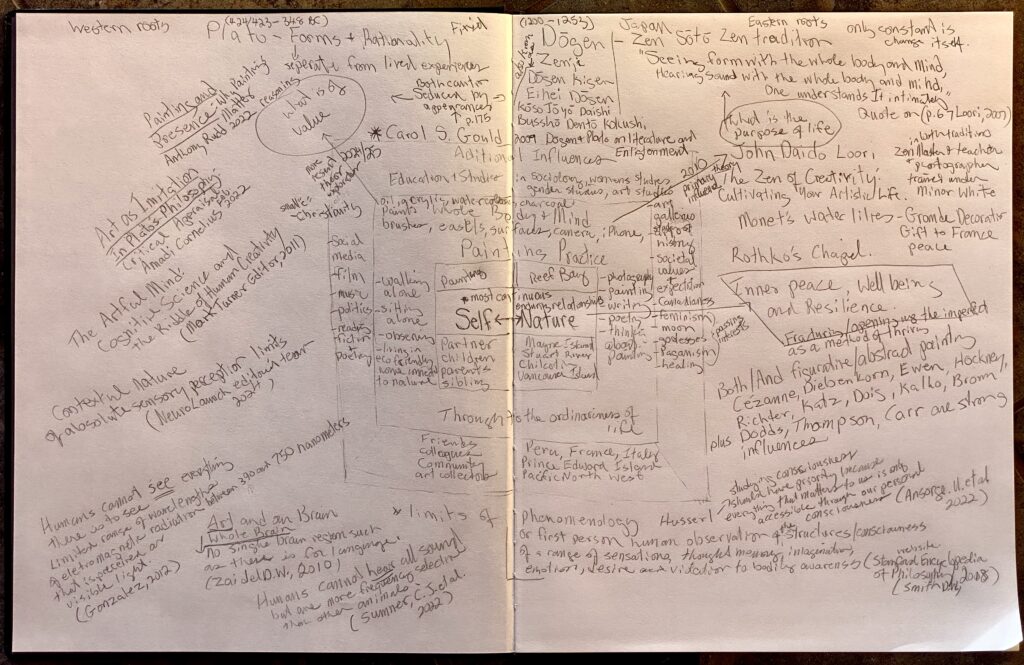
These methodologies and methods are grounded in theoretical foundations. Following is an excerpt from my Unite 1 Contextual Study:
Plato’s perspective is that using my practice to connect me with nature’s quiet yet profound rhythms, offering a visual meditation on its resilience and grace through my painting is an inferior copy in my physical realm. I would be making a representation of a copy or a copy of a copy (Welch 2025a, 2025d). I accept Plato’s observation that sensory information is flawed and limited. However, I reject the notion that my observations and paintings are inferior copies of my physical realm but rather suggest that they offer something new beyond what words can offer (Rudd, 2022, p.9).
The American philosopher, Anthony Rudd, also rigorously questions this conclusion. Art theory, as described by Cynthia Freeland, ‘involves the effort to organize a dizzying variety of phenomena so as to try to say what they have in common that makes them special’ (Freeland, 2003). In my practice, paintings are the things that are left behind. Anthony Rudd, in his book Painting Presence: Why Paintings Matter, expands on the work of Russian philosopher and theologian Paul Evdokimov and adds an additional fourth element to the three already defined by Evdokimov.
In summary, Rudd concludes that every kind of physical painting has the following four elements:
- The artist as the maker of the painting,
- the work itself as a physical object,
- the viewer as the person who looks at the painting, and
- the subject matter made present in its essential nature (2022, pp. 226-229, Welch 2025b, 2025e).
While I continue to examine the first element of the artist as maker and I explore the second element for various possibilities in the making of a physical object, it is Rudd’s fourth element of the subject matter ‘made present in its essential nature’ where I want to further expand my painting practice and focus my investigation using the methods of practitioner-researcher (Gray and Malins, 2016 p.105).
What Plato offers in the theory of Forms in relation to painting comes from a different perspective and way of thinking than the Zen theory of mind, body and seeking enlightenment. Loori asserts:
We can affect that process by letting go of thoughts and returning our attention to the immediacy of the breath…[w]hen that kind of attention informs our life, we see beyond our ideas into reality itself (Loori, 2005, p.73).
The challenge for Plato with painting is that it encourages us to focus on the representation of the thing rather than the thing itself and further he believed that it encourages desires and passions that let these rule over intellect and logic, resulting in art being dangerous to the state of the Republic and taking us away from the true ultimate nature of the thing (Plato and Jowett, 1994). Plato is considering whether paintings have value and serve an intellectual use or purpose. Following Plato’s theoretical argument, Rudd claims that paintings do have value because of how paintings make themselves present to us (Rudd, 2022, p.9).
Where might my research go next?
My current exploration and where I am tentatively going next is farther along the figurative/abstract continuum to the abstract while maintaining a thin but compelling figurative element with a short horizon line with a small slice of sky and sea. In order to develop these compositions I am testing two approaches. The first, which is what I used in the most recent painting “A Breath between Sea and Sky” shared in the next post, takes a small area detail of one of my ‘landscape of the small’ painting sketches or studies as a starting point for inspiration. The second approach uses a circle exercise demonstrated by artist Kazuaki Tanahashi to connect in deeper ways to the circle of life and death. I want to explore the possibilities of adapting this practice to expanding my sensory experience of being at the tide’s edge. In both approaches, the desire is to enhance and strengthen my first experience at the tides edge and keep a strong connection to this experience while going as far as I can uncomfortable go with my sweeping large brushstrokes of colours that are faded by the sun and washed by the sea. I want to lean way over into pure sensations yet still anchored to physical aspects of the subject through a figurative drop of ocean with a thin slice of horizon.
Others artists currently working using a similar approach include:
Deborah Osberg is a South African artist currently living in Portugal. In her biography on her website, Osberg describes how her:
artistic focus has grown from a career as an educational theorist in Britain, following her experiences of colonizing forces while living and working as a white zoology lecturer in apartheid and post-apartheid South Africa. Her art explores tensions within political systems of power and control.
Osberg uses acrylics, charcoal, chalk, ink, wax, rust and fragments of academic text to create richly textured surfaces that reveal traces of what is hidden beneath. The rawness of her artistic process is integral to her work: tearing, layering, and juxtaposing fragments of academic texts—both her own and those of others—into disjointed arrangements that evoke a sense of rupture and resistance. She paints over, censors, or obscures texts. The resulting compositions are not merely visual narratives but tactile experiences that invite the viewer to question what is shown and what is concealed (Osberg, 2024).
Also, worth reading some of the philosophical papers that inform Osberg’s art. (Osberg, 2024).
YouTube interview March 2025: https://youtu.be/JhnHBCU8rFI?si=70QSFfK6ugeTUdbV
There is another artist whose philosophy also has caught my attention and this is contemporary abstract artist David Mankin in Cornwall, England. Mankin describes his process as follows:
Through my painting I aim to express something of the sensory experience of being in the landscape. Living and working in the far west of Cornwall is uniquely inspirational. Daily walks on the coast path near my studio provide a visual stimulation that can’t help but find its way onto the canvas.
Textures, colours, shapes, sounds, movements and spaces collide to create a wealth of visual and spatial relationships in constant flux. This is my source. The work is both an emotional response to the natural environment and an attempt to communicate a sense of the freedom, the vastness, the rhythm and the ebb and flow of nature, which is characteristic to this part of Cornwall.
I work in an intuitive and gestural way, burying and unearthing marks and textures through an energetic process of destruction and excavation, which mirrors the acts of nature on the landscape. Through the process I explore surface, shape, colour, texture, composition and mark making in order to articulate and form images which express my experiences in the Cornish landscape (Mankin, n.d.).
I was referred to Mankin by a fellow artist who knows my work well. It was while studying Mankin’s work that I came up with the idea to take smaller detailed sections of my painting sketches as starting points and stretch further into abstract rendering of my sensory experience of the seafloor. Again, this is a short 14 minute clip.
YouTube Interview 2019: https://youtu.be/iv3vlEadTB0?si=BW7s_hy-zrmb9p5J
Though neither of these artists in the videos have much to do with my own physical expression of painting, their approaches to life and an observation led creative practice resonates. They are a great reminder that a subject can be approached using various methods and the renderings can still hold its integrity.
References list:
Mankin, D. (n.d.). About | David Mankin. [online] -david-mankin. Available at: https://www.david-mankin.com/about [Accessed 23 Jun. 2025].
Osberg, D. (2024). Deborah Osberg. [online] Deborah Osberg. Available at: https://www.deborahosberg.com/about [Accessed 23 Jun. 2025].
UNDERSTANDING PLAY IN MY PAINTING PRACTICE
Sunday, 15 June 2025
It is Sunday, 8 June 2025. The temperature is rising quickly but with the breeze it is intoxicatingly pleasant down in the sandstone at Georgian Point right at the entrance of Active Pass. This is not a ’landscape of the small’. The view is too full and grand for that. I only desire to take it in its wholeness. I gather references and return home as David settles in with soft jazz music playing in his office. I go to the studio and pull out the oils and sketch in a the view on a deep red ground covering an 11 x 14 inch gessobord.

The laundry does a final spin. Mounds of damp, cool linens fill my arms as I reach beyond them for the door handle to the covered deck. Swaths of terracotta and navy brush against me on an early summer breeze while my finger grip handfuls at a time and secure the clothespins to the line. We are supposed to have warm temperatures for the next few days but, with a bit of luck, I can still ease into the rhythm of brush, paint and surface without the oils turning to the consistency of warm butter. I close the outside door behind me, cutting out the mournful whistle of a ferry that vibrates just above a droning seaplane over Navy Channel. Now I am free to paint. It is almost noon. I have two and half hours before I need to go pick up my painting from the regional art show. Not much but it is what I have and it will have to do.

It is now twenty minutes to one as I reach to load the first brush with paint.

At twenty minutes to three, I have the painting done. I stand back and say to myself – this is what pure play feels and looks like in my practice!
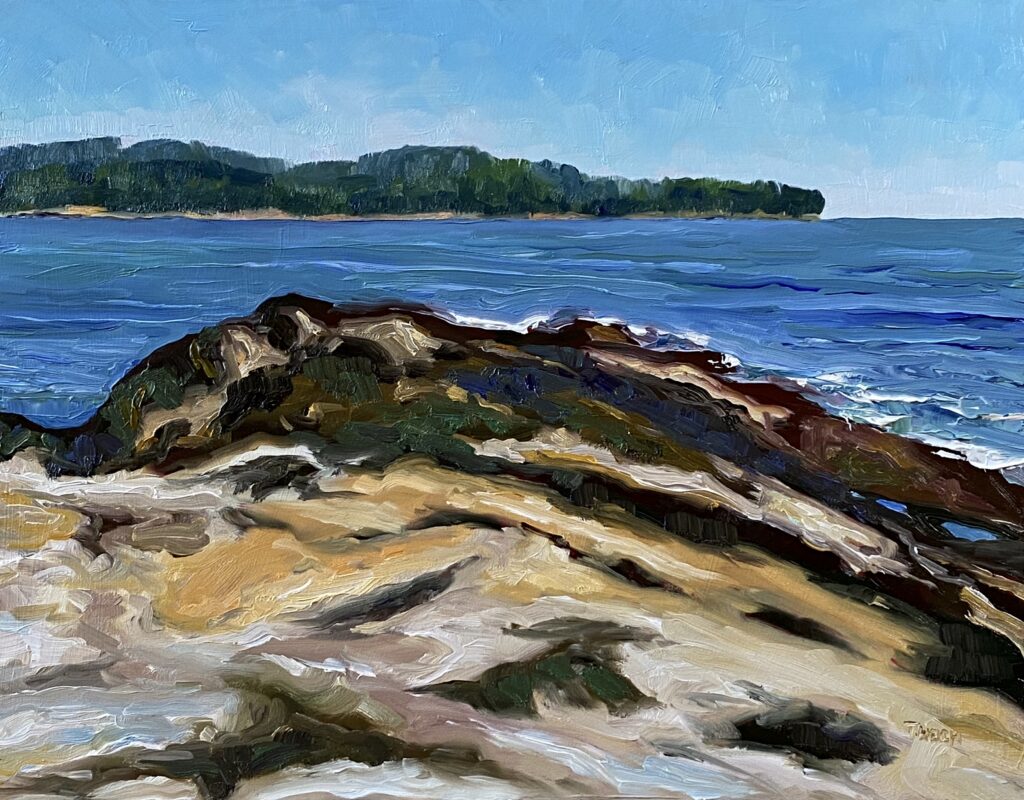
Artist notes: Blue skies wrap in a warm embrace around the morning sun hovering over the sandstone shore next to Active Pass at Georgina Point on Mayne Island. I gathered as much as I can of memory and images remembering the crunch of barnacles underfoot and the cool breeze lifting off the water with the scent of the sea. I take the heaviness and the weight of the land covered in seaweed and mussels with me. I acknowledge my love for this place. Later, my oil paints turn to the consistency of butter in the midday temperatures of the art studio, allowing sea and land to merge in a continuous motion. Is love enough of a reason to spend a day rendering a place in paint. No preliminary theory or research methods. Simply breathing and following one’s heart. Is this enough?
This is what it is like to give myself over to the conversation between a specific moment of sky, sea, and land. This is getting at the very essence of my connection to this place and what it has to say to me and me to it.
Reflections: How does this approach fit into my current project of exploring the tension between the abstract/figurative continuum? Is there a way to bring some of this approach to play into the ‘landscape of the small’ or even the ‘drop in the ocean landscape’ approaches? I have no ready answers and place this post here as a marker to recording the fullness of my painting practice.