Oyster Bay Late August Painting Data Collection

Monday, 7 September 2026

Painting Data Collection 

Title: Oyster Bay Late AugustDate Completed: Friday, 28 August 2026
Materials: acrylic on linen board 
Size: 8 x 10 inches (20.32 x 25.4 x 0.51 cm)

Figurative/Abstract Self Assessment Band-Scale Rating between 1-10: 5

This is a plein air contemporary impressionist quick acrylic study to capture sensory information in the moment. 

Reference Gathering: 

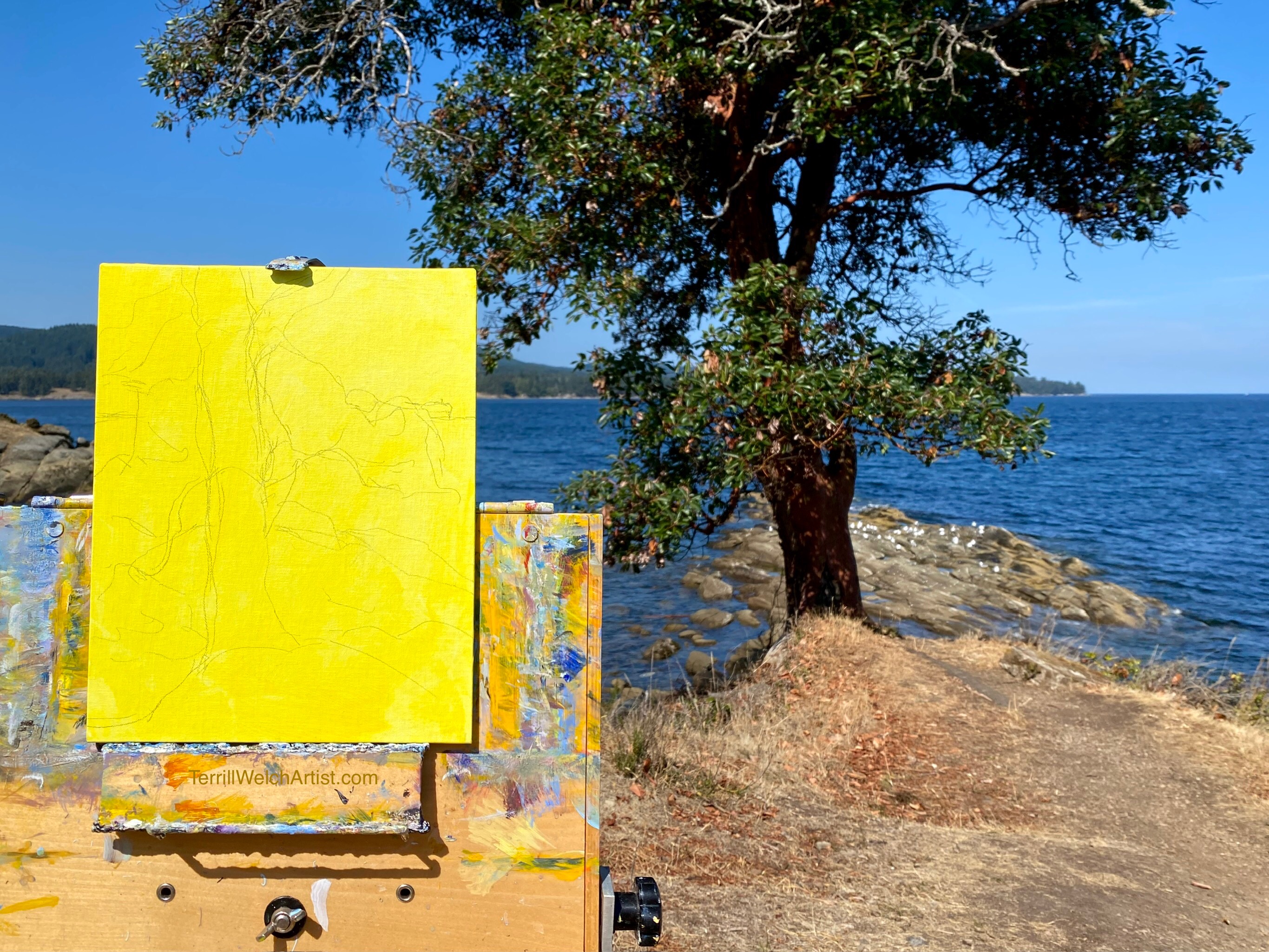
The references for this work were observations in the moment as I stood on the top of an exposed piece of sandstone in front of my easel in Oyster Bay on (what is now called) Mayne Island in British Columbia, Canada. 
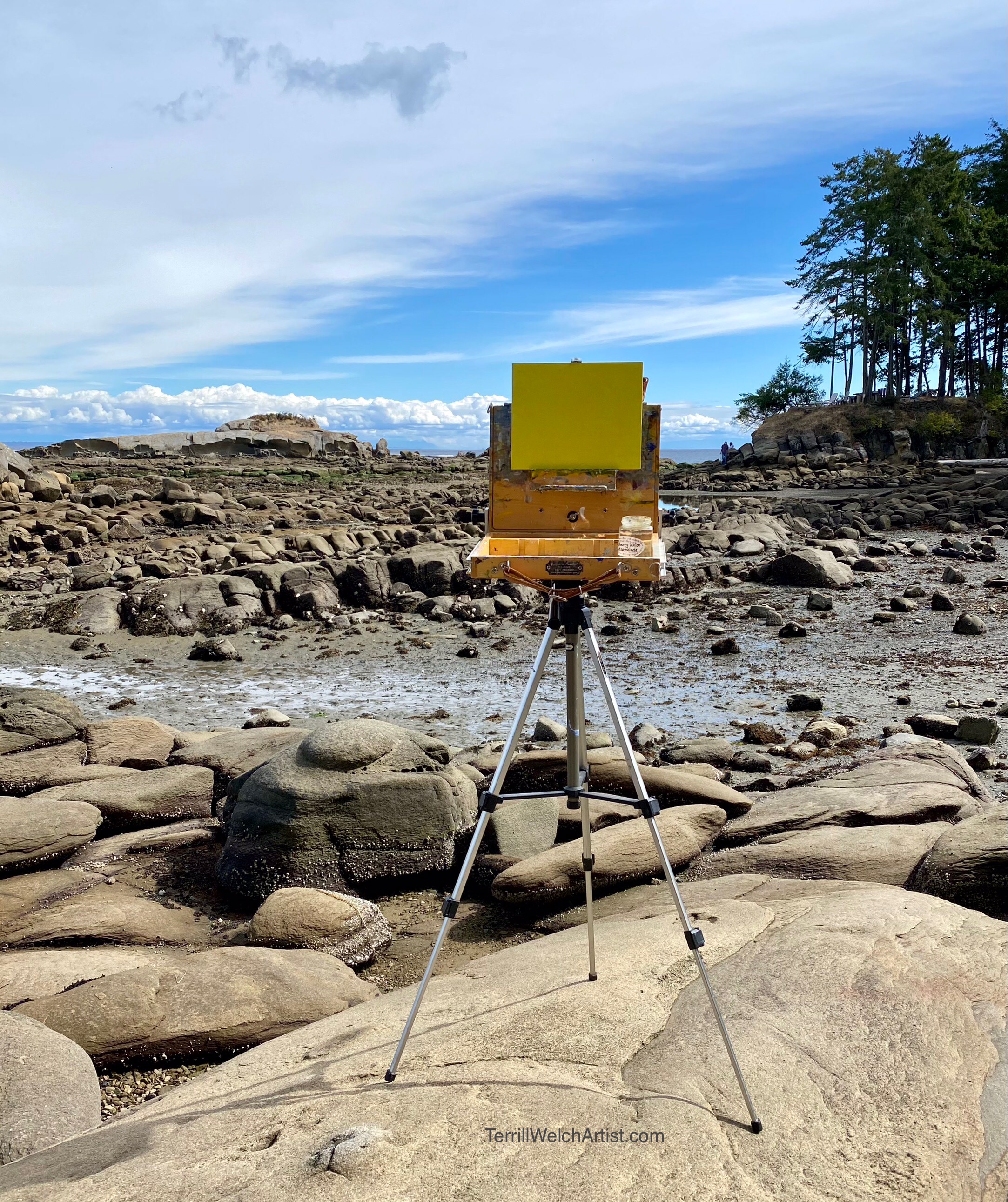
Setting up to plein air paint at Oyster Bay in late August. Photograph by Terrill Welch, Friday, 28 August 2026.

When I began there was a couple making their way along the shoreline and a couple of construction workers building a bench up above them. Other than this, I had the place to myself for the painting session. 

Making Process:

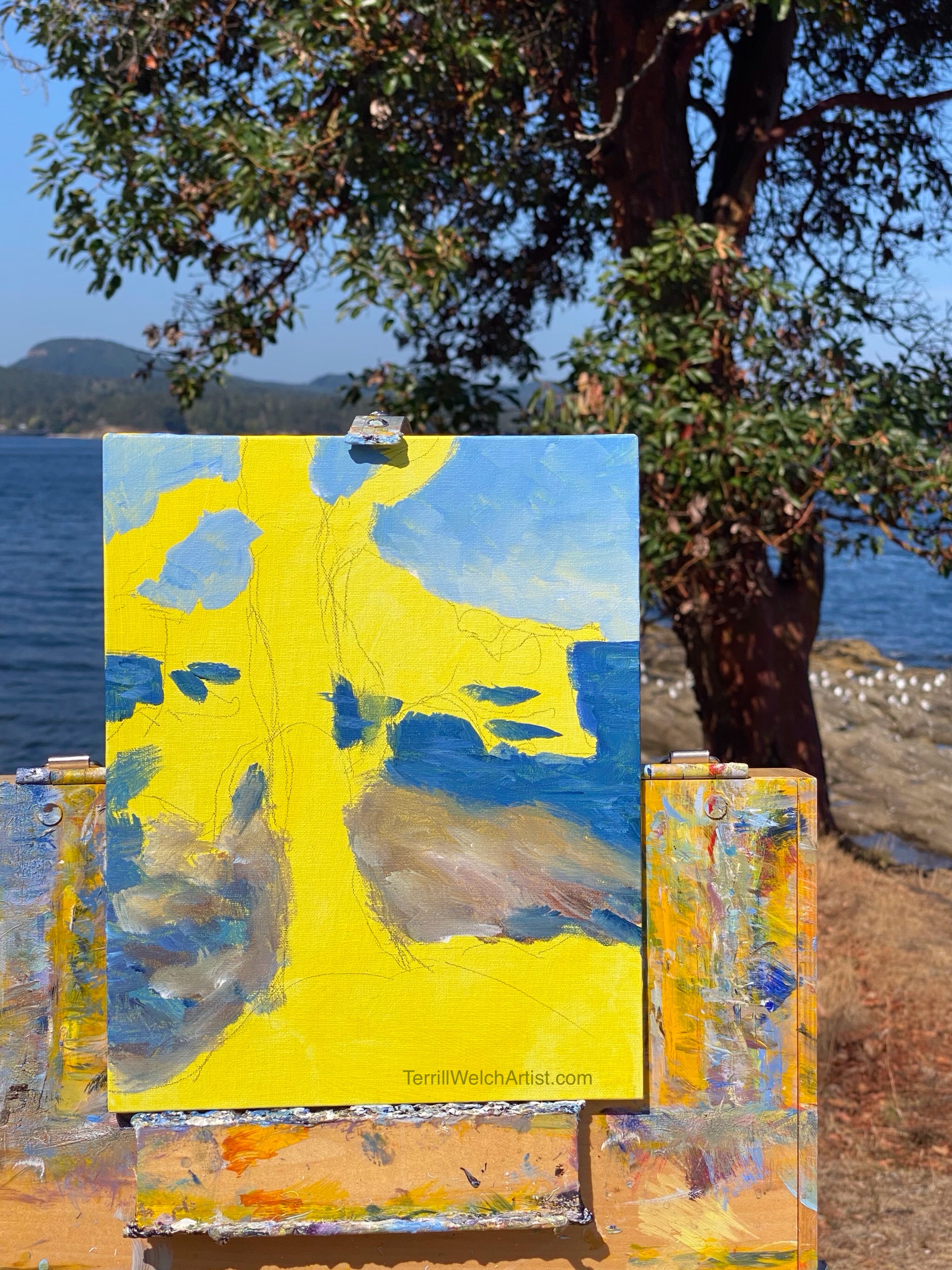
The painting process was direct and immediate as I captured the light first and then began to build up the forms of the sandstone.
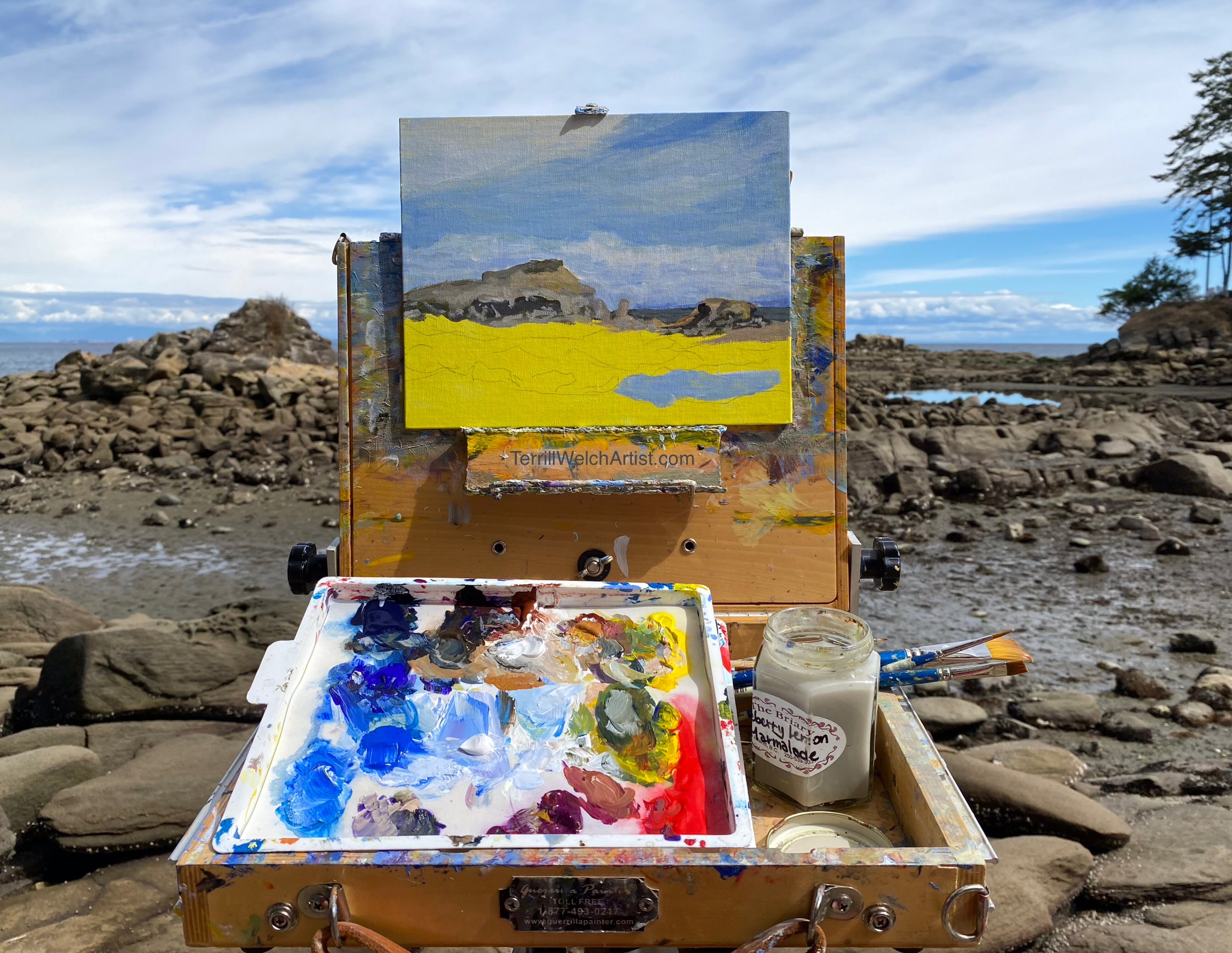
Work-in-progress — Oyster Bay Late August by Terrill Welch, 8 x 10 inch acrylic on linen board. Photograph by Terrill Welch. Friday, 28 August 2026.

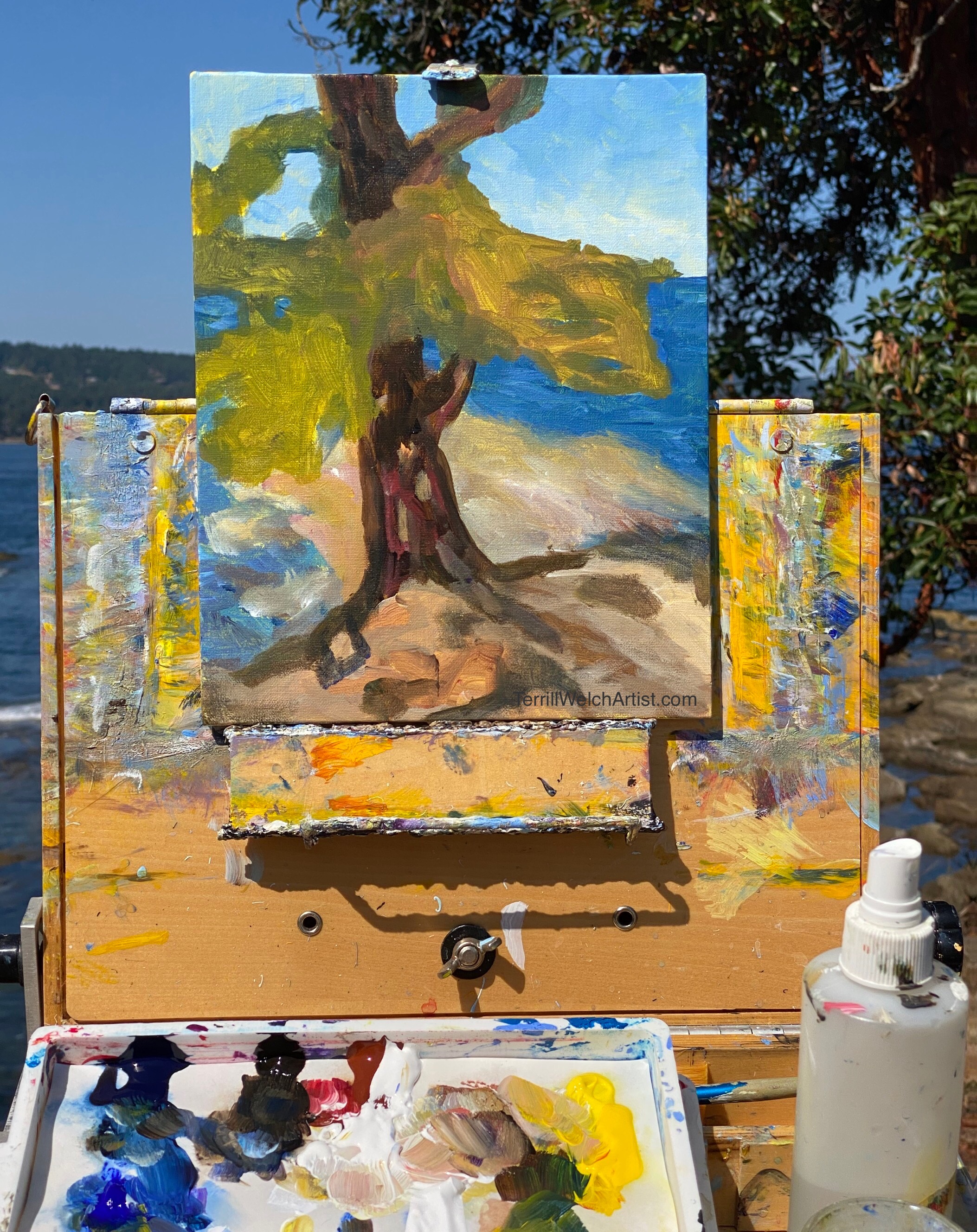
I was working with an older palette from a previous painting sketch that had ran a bit from being tilted in my plein air backpack. But it worked.
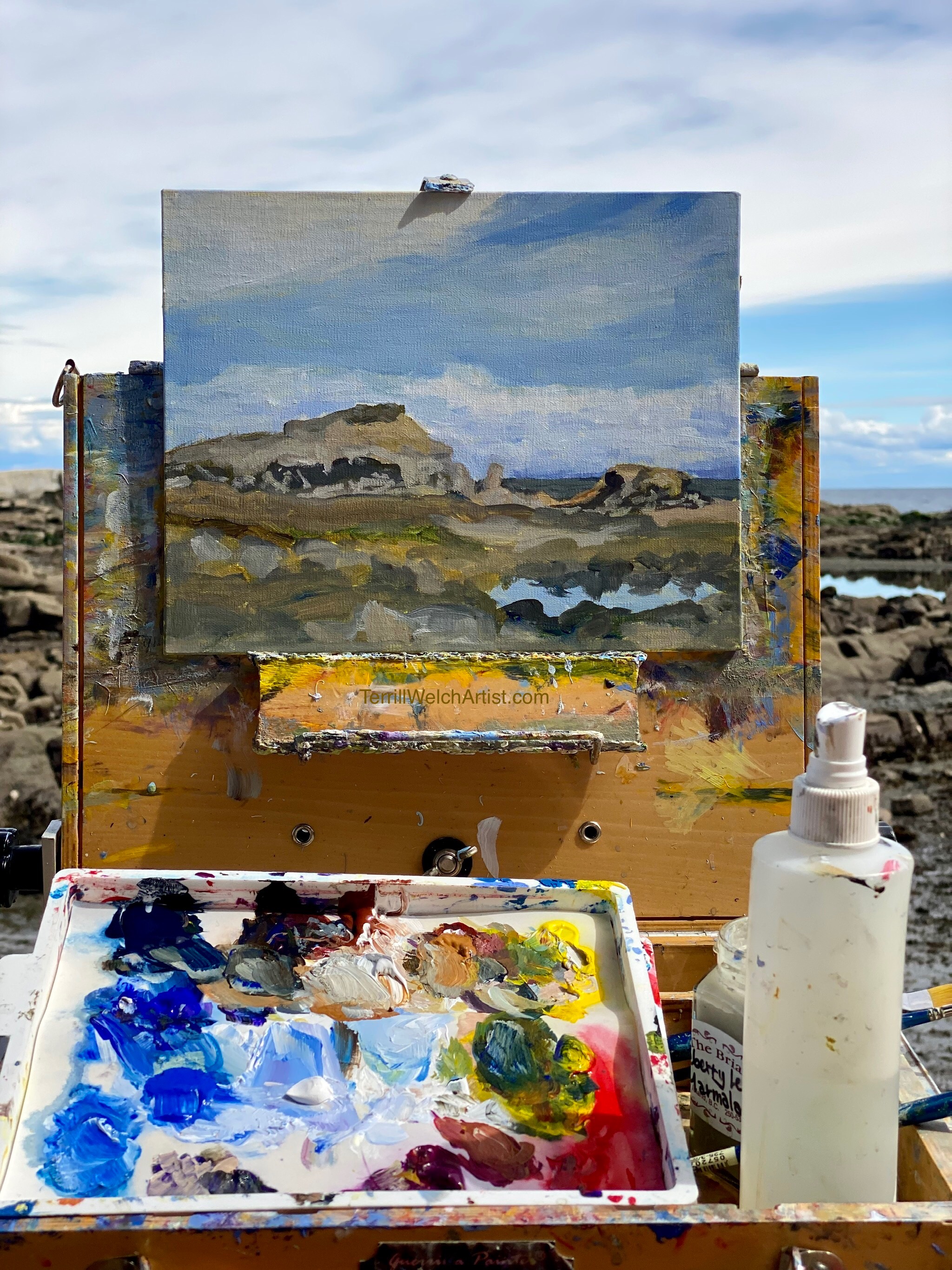
Work-in-progress 2 — Oyster Bay Late August by Terrill Welch, 8 x 10 inch acrylic on linen board. Photograph by Terrill Welch. Friday, 28 August 2026.

Eventually I managed to get everything blocked in and was able to slightly refine the piece before my available time came to an end.
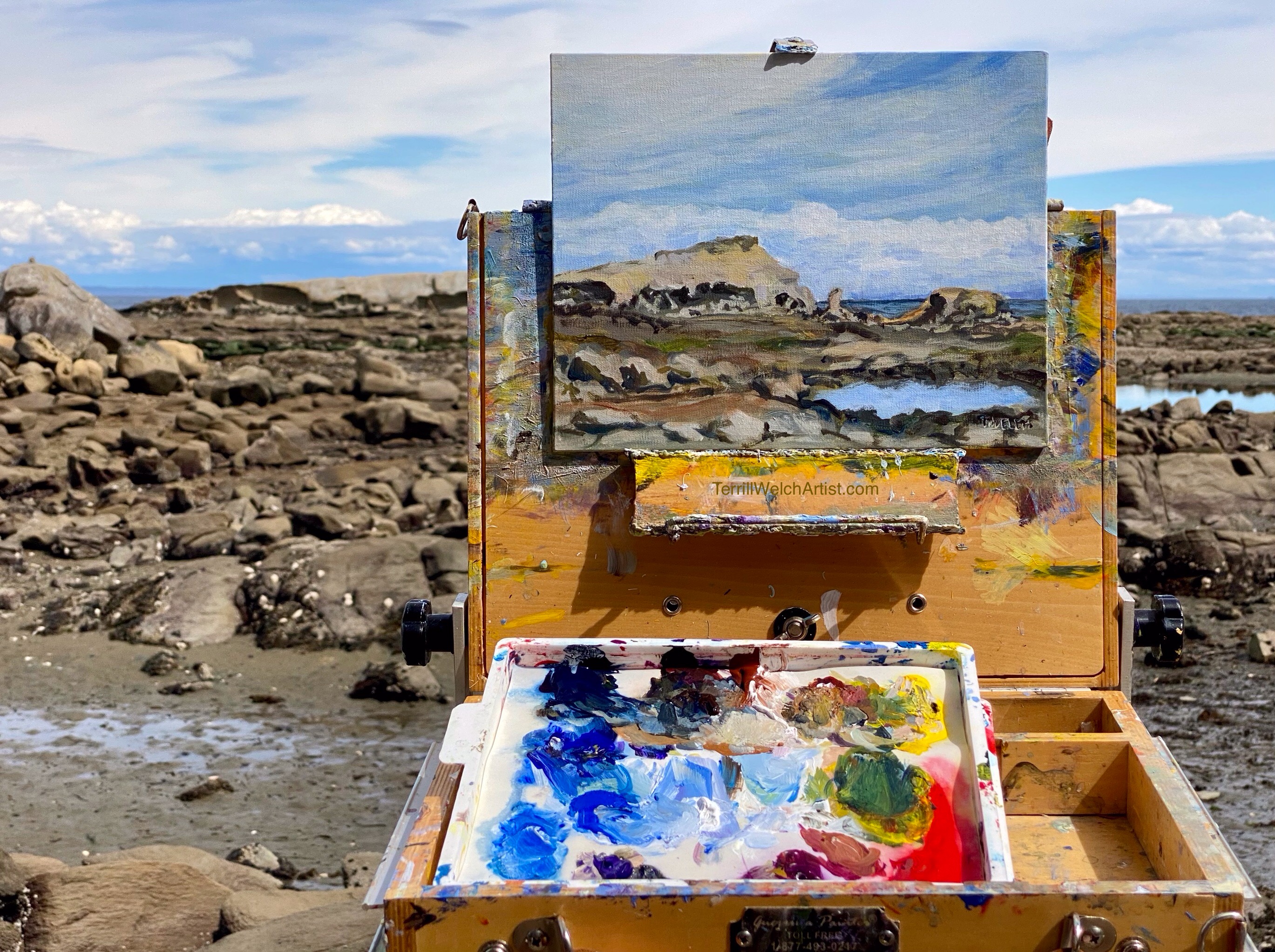
Still on the easel — Oyster Bay Late August by Terrill Welch, 8 x 10 inch acrylic on linen board. Photograph by Terrill Welch. Friday, 28 August 2026.

Finished Painting:

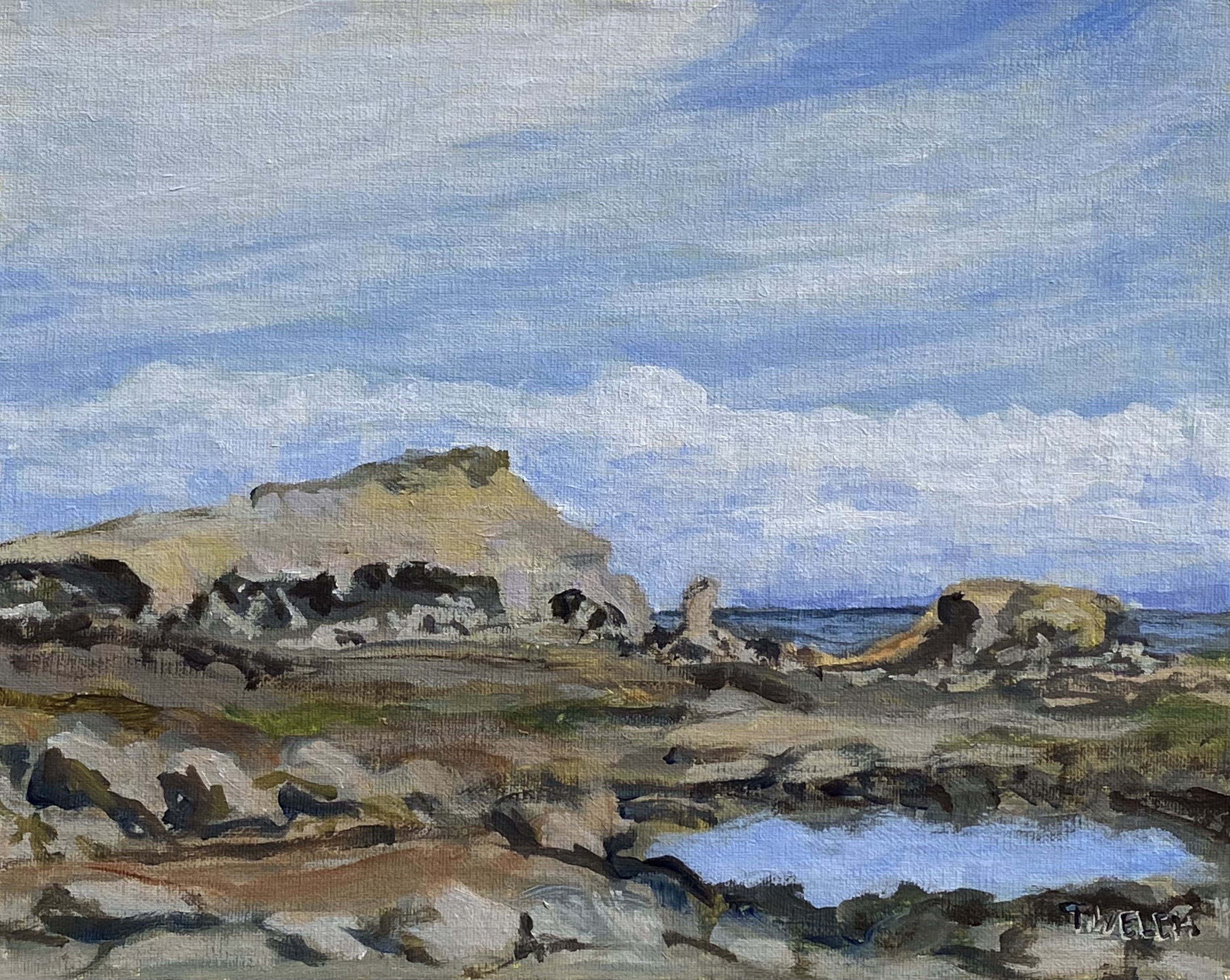
Oyster Bay Late August by Terrill Welch, 8 x 10 inch acrylic on linen board. Completed August 28, 2026.

Making Notes:

I set the plein air easel on top of the sandstone and looked east over to the rocks exposed in a low tide. The day is pleasant with blue skies holding shapely clouds in the late August sun. I stay for a while with my brush in hand and drift through an hour of painting. It is my birthday and this is my gift to me.

Reflective Analysis:

I had been offered a chance to go out on my own while knowing someone was with my partner who has dementia but still is able to stay by himself for a few hours at a time, if set up with a note to remind him when I will be back and where I have gone. But it is always more freeing if someone is with him. It was a generous offer. She thought I could go for lunch with a friend or something for my birthday. I responded that what I would like to do is go plein air painting because I already had family coming over to visit on several different days for my birthday. She laughed and replied — of course you want to go paint for your birthday! 

Reflexive Analysis: 

One of the odd things to me about being a full time caregiver is that I do not crave time with friends or other people so much. We go out for breakfast or lunch a couple of times a week and then there are the times I see people when getting groceries or picking up produce at the Saturday market plus, I engage daily online while presenting my work. I was invited to join a philosophers café that meets once a month and I accepted as a way to have meaningful deep discussions in-person on topics of interest. This complete package of in-person engagement with others always seems like enough socializing for me. What I crave most is just a few hours at a time on my own. I can still get this but it can’t be for very long at a time. Two hours is ideal and three is stretching my partner’s ability to feel confident on his own. So when given a choice to go for lunch or go plein air painting, the painting wins. This is because I am certain that my time at the easel will offer regeneration and delight. It fills my personal bucket like nothing else has ever been able to do. Just me and nature working together for a focused 45-60 minutes. This is all it takes. Hiking the trails alone does a similar thing but painting is the very best! I always come home filled with satisfaction and refreshed. This is the reparative element to my painting practice in action. 

Key Findings: 

I thought I would do more with this small study back in the studio. But as I spent the next few days glancing at it on the window ledge amongst various other small works, I decided nothing more I did would improve my impressions of this time beside the sea. So I have left it just how it was when I packed up to come home. 

Anything else: 

I am still considering what or if I will do anything on larger surfaces with these recent small painting sketches. I am in no rush to make a decision. The weather to best enjoy painting outside with the golden fall light is brief and will soon come to an end. I can decide once the rains keep me inside more. 
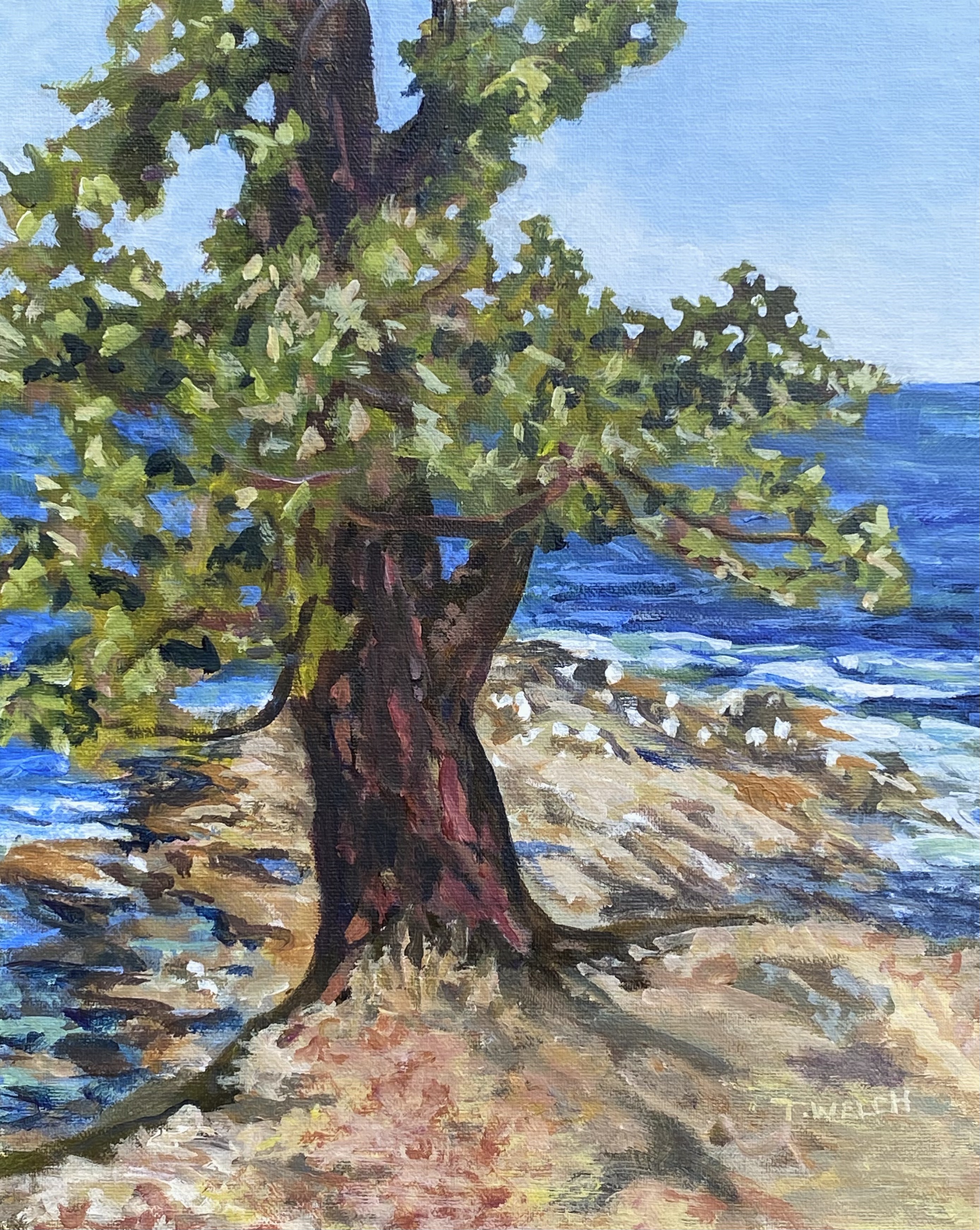
Arbutus in August Painting Data Collection

Painting Data Collection 

Title: Arbutus in August Date Completed: Wednesday, 19 August 2026
Materials: acrylic on linen board
Size: 10 x 8 inches (25.4 x 20.32 cm)

Figurative/Abstract Self Assessment Band-Scale Rating between 1-10: 5

This small plein air study is clearly responsive to the seasonal moment and light and has an impressionist immediacy. I can still feel the warmth of the sun on my back when I look at it. 

Reference Gathering: 

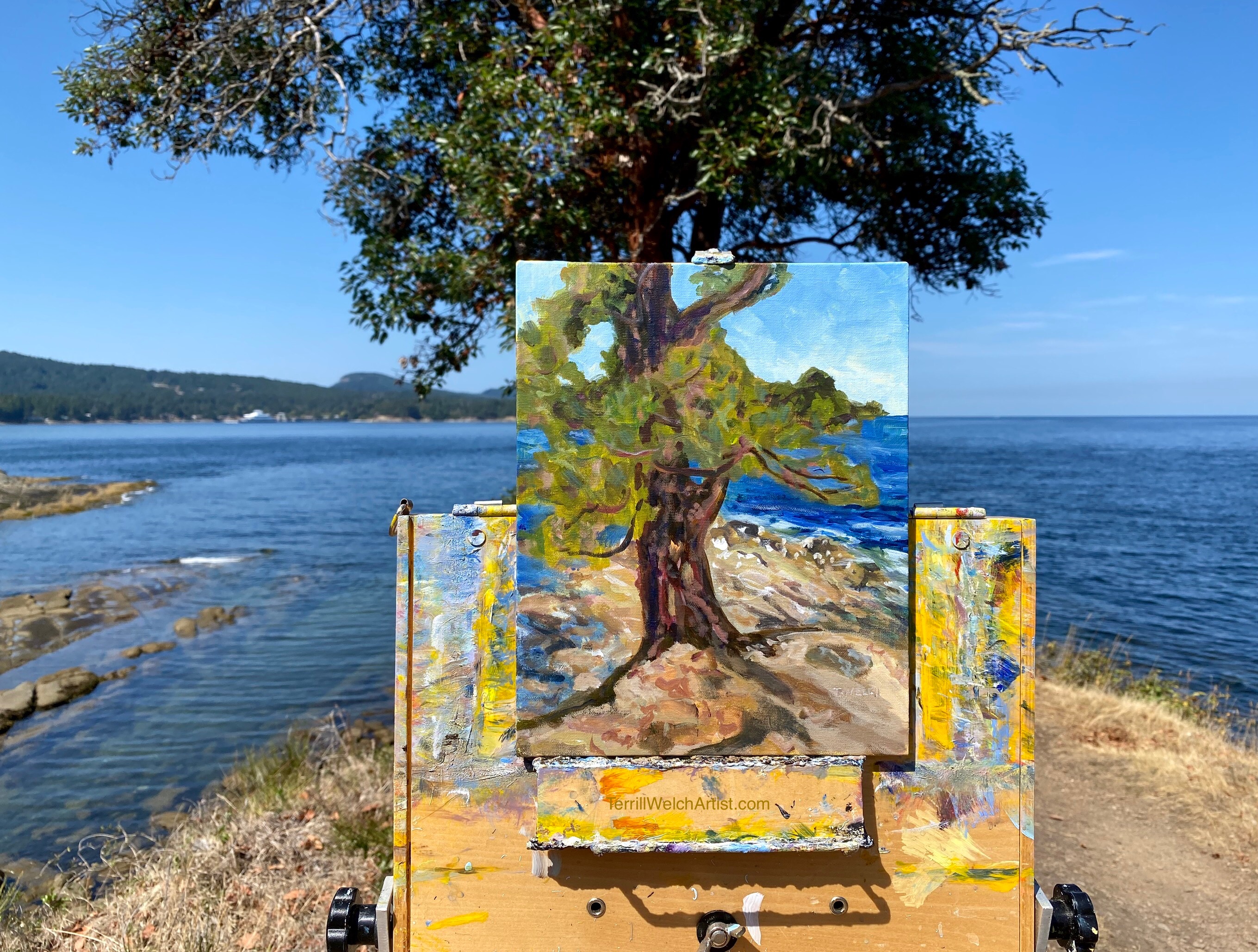
The reference was the view itself as I stood at the easel.

Still on the easel – “Arbutus mid August Study” by Terrill Welch, 10 x 8 inch acrylic on linen board. Quick plein air painting sketch at Georgina Point on Mayne Island in British Columbia, Canada.

Making Process:

My making process was familiar in the sense that I wanted to catch the light references first and then build up the painting from there. 

Sketched in — “Arbutus mid August Study” by Terrill Welch, 10 x 8 inch acrylic on linen board.
Work-in-progress — “Arbutus mid August Study” by Terrill Welch, 10 x 8 inch acrylic on linen board.

Finished Painting:

“Arbutus in August” by Terrill Welch, 10 x 8 inch acrylic on linen board. Completed Wednesday, 19 August 2026.

Making Notes:

I focus on catching the full range of my sensory experience in the small plein air painting from the light breeze to breaking waves, seagulls squawking and the feel of the sun on my shoulders and the dryness of the acrylic paint on my brush as it contacts the linen surface. There is a powdery dry feeling mingling with the coolness from the sea to the mid August air. I linger after packing up. The moment is pleasant and yet holds a warning, like splitting the winter’s wood on a warm summer’s day. That freshness foreshadows the coming of shorter days and brisk winds and heavy rains. This arbutus tree will be ready and so will I.

This is a quick plein air painting sketch at Georgina Point on Mayne Island in British Columbia, Canada and adds to my reference work for my current “Close to Home” series. The range of brushstrokes are impressionist in a painting language that I find best facilitates my sensory conversation with nature.

The painting is already listed so you are welcome to visit my online gallery if you wish at: https://www.artworkarchive.com/profile/terrill-welch/artwork/arbutus-in-august 

Reflective Analysis:

These long moments of observation while plein air painting anchor me within the seasons and the rhythm of my daily living. A walk or a photoshoot doesn’t have the same sustained intensity of experience that standing at the easel in front of my subject while the lights and shadows progress with an unstoppable certainty. It is that tension between a full stop and infinity which spirals endlessly as I squint and make yet another mark on the surface of the canvas. 

Reflexive Analysis: 

There are things I do where I feel the strength of every cell that is engaged in preserving my life force. The intensity of plein air painting is right near the top of this list of things. I seem to become permeable with my surroundings through my all encompassing sensory awareness that results from settling in with nature. This is the reparative or healing aspect of my work in its most tangible form. It is not a state that I maintain for more than about 45 or 60 minutes at a time but the effect of these painting sessions can last for hours and even days with the distinct possibility of tapping back into them every time I look at the sketch or use it as a reference for a larger work in the studio. It feels like muscle or cellular memory that is stored in various parts of my body and then used and replenished as I view the sketch or work on a new work that recalls that moment through the sketch. Most often these sketches are less about experimenting and much more about gathering information in substantial abundance that it can be used later on. 

Key Findings: 

I have a habit of either dismissing my quick painting sketches or else expecting too much from them. They are my first impressions of an idea or composition and complete in their own right. 

Anything else: 

Not at this time. 

Memories of Mornings by the Studio Window Painting Data Collection

Painting Data Collection 

Title: Memories of Mornings by the Studio WindowDate Completed: Wednesday, 19 August 2026
Materials: Acrylic on linen board
Size: 8 x 10 inches (25.4 x 20.32 cm)


Figurative/Abstract Self Assessment Band-Scale Rating between 1-10: 5

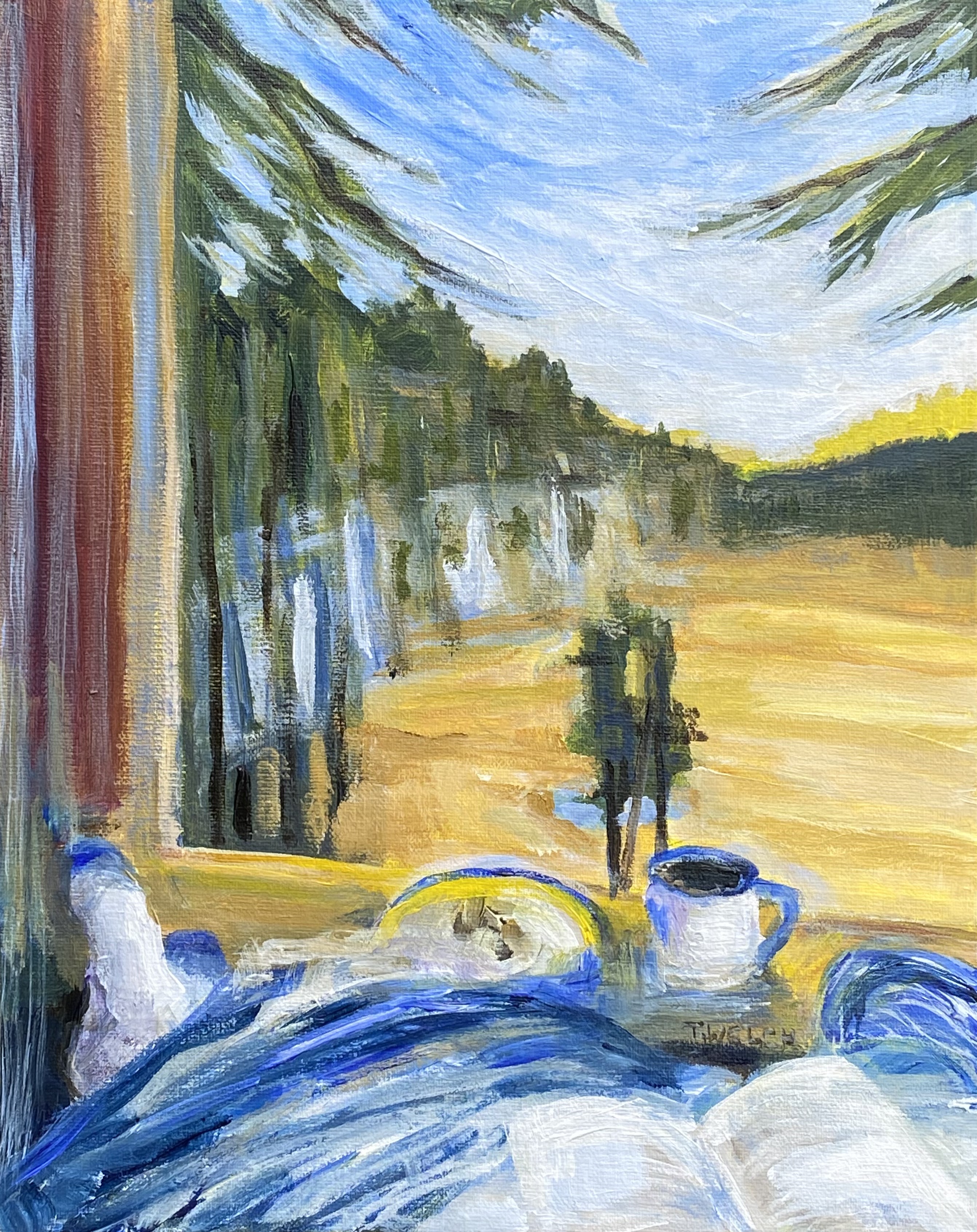
This work is a quick impressionist study. Attention has been paid to light, relationships between elements and sensory records of the fragrance of dark coffee, fresh morning air through an open window and the softens of wool socks cozying around bare feet sticking out from under the edge of a blanket. 

Reference Gathering: 

References for this study are minimal with most mark making relying on repeated mornings of similar moments that created a bank of memories. 

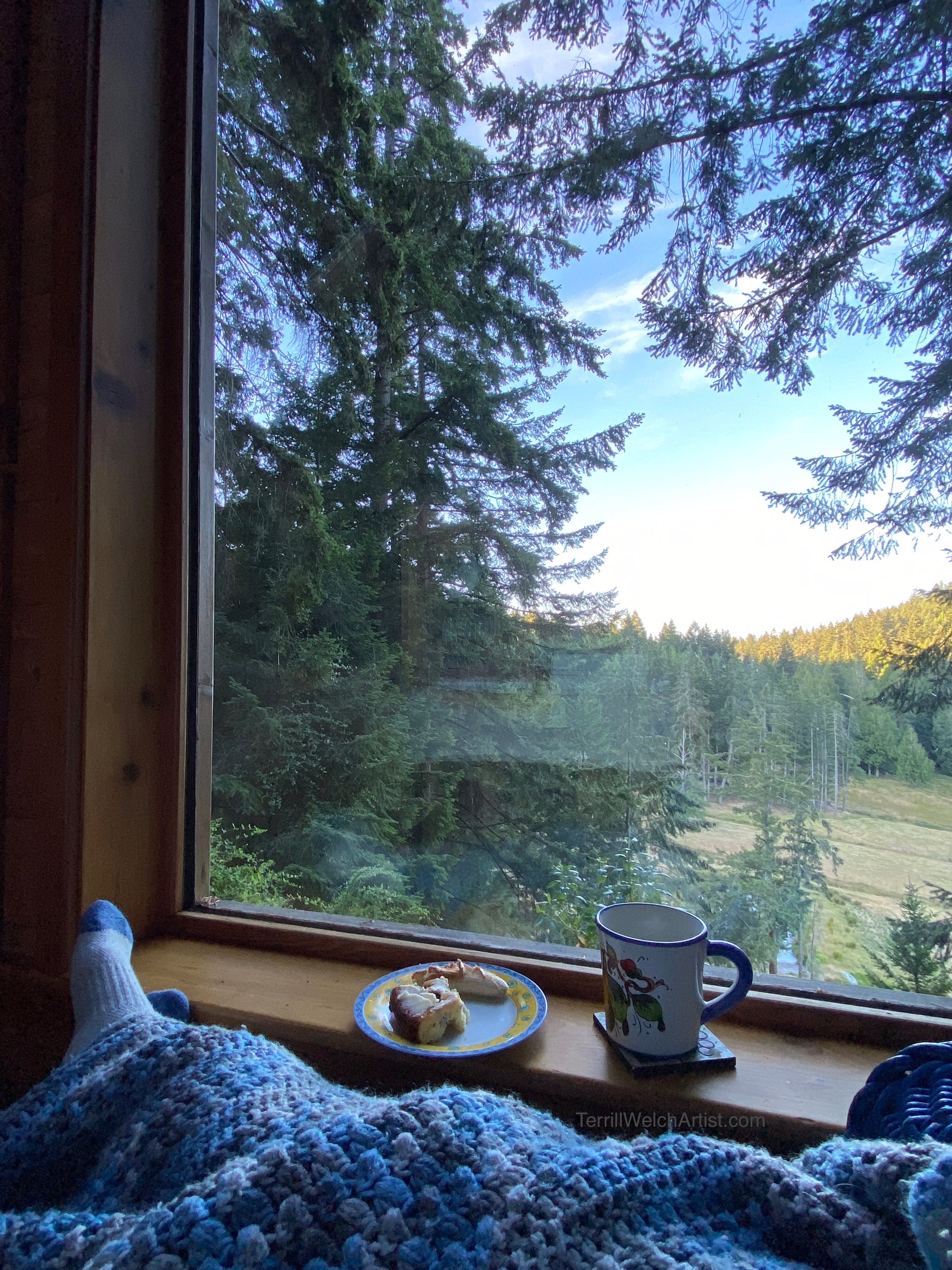
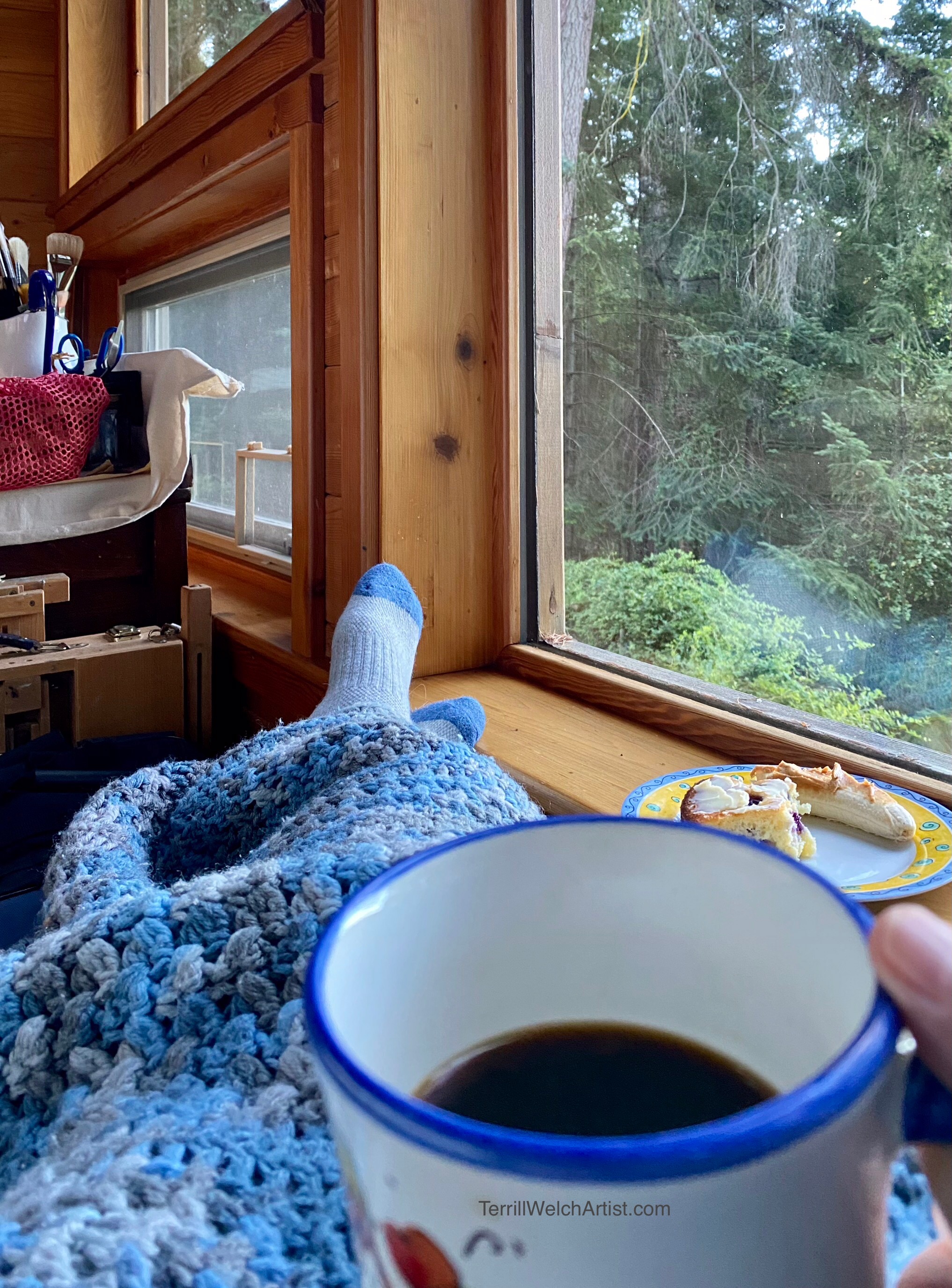
But there are two images that provide a starting point. 

Sun catching the hill as seen from the chair beside the studio window. Photograph by Terrill Welch Sunday 28 June 2026.
Mornings in the chair of the studio window. Photograph by Terrill Welch Sunday 28 June 2026.

Making Process:

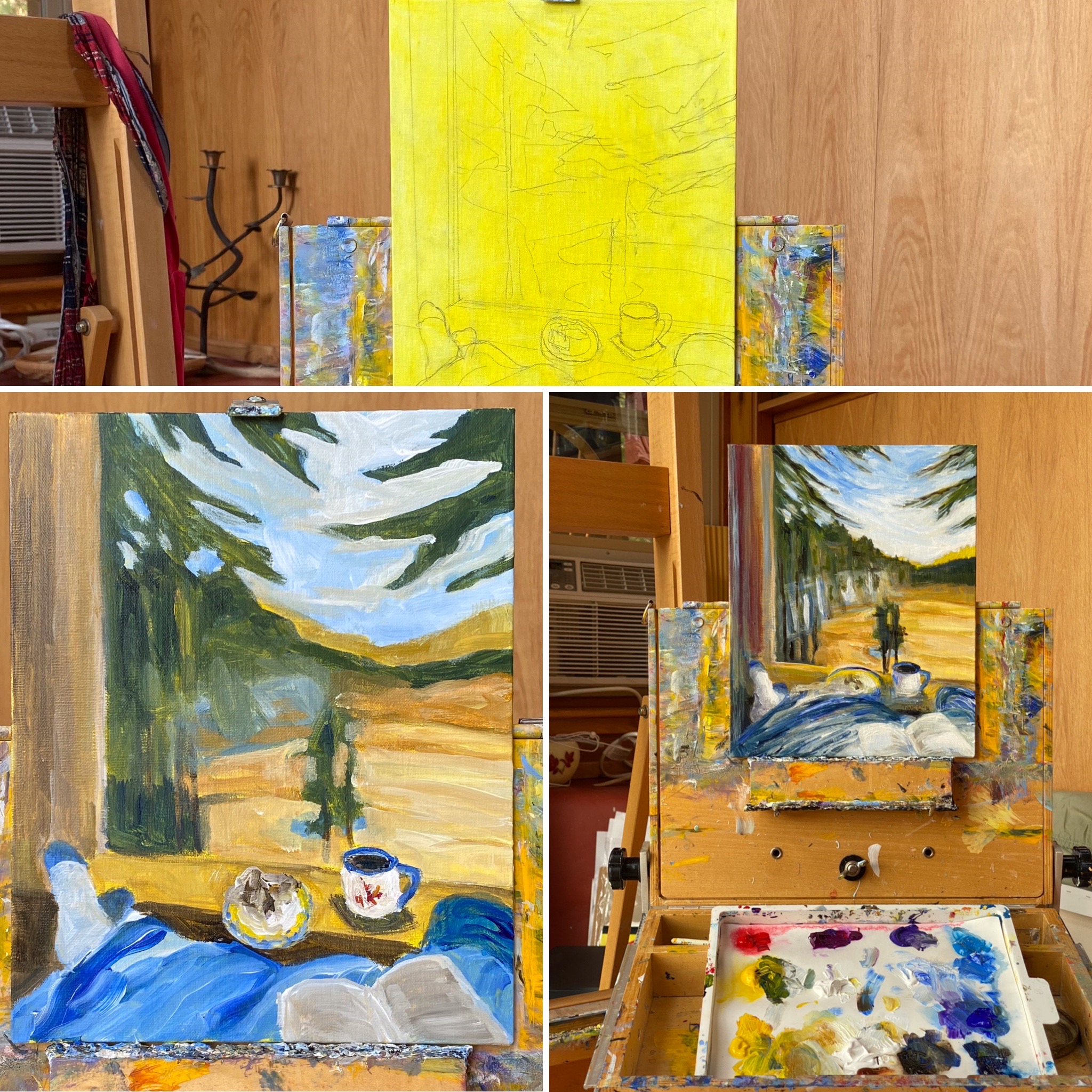
The making process is equally sparse because once I settled down to paint, I forgot to take many photographs as the work developed. But there are a few. 

Work-in-progress collage of images for Memories of Mornings by the Studio Window by Terrill Welch, 10 x 8 inch acrylic on linen board.

Finished Painting:

Memories of Mornings by the Studio Window by Terrill Welch, 10 x 8 inch acrylic on linen board. Completed Wednesday, 19 August 2026.

Making Notes:

So many mornings seated in the studio window with coffee and breakfast just like this morning. I worked from memory though there are references. My attention drifted from what I might be reading to the dark savoured bitterness of the coffee then over to where the rising sun is catching the far hill in the valley. The fields are cut and dry and a cool breeze is coming in the window next to the one I am sitting beside. There is a precious sense of optimism swinging on the branches of the fir trees. I sigh and blink my way into the day. This quick sketch is a brief reminder of something that as of yet has no words other than the importance of waking up.

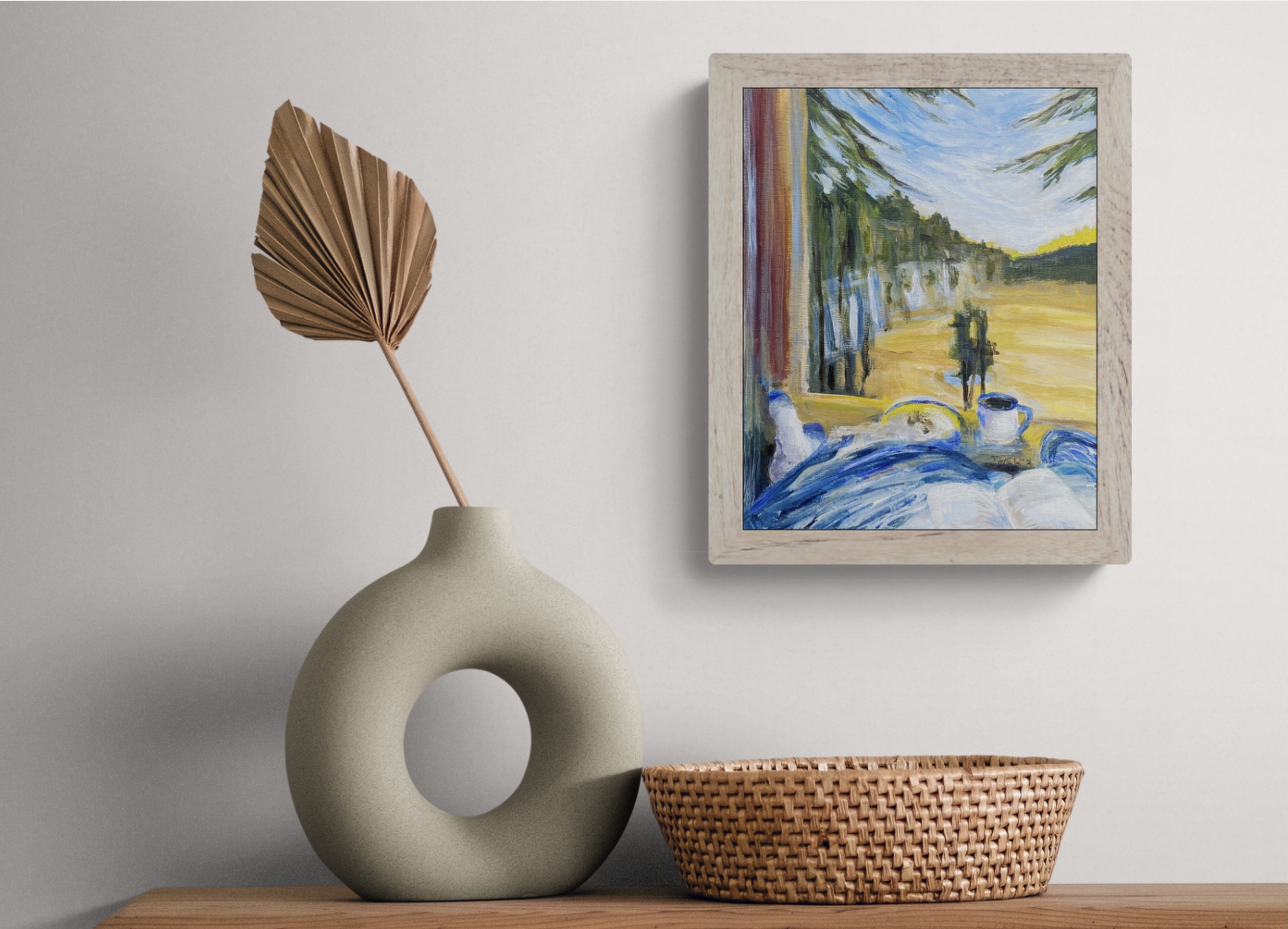
Here is a digital room view for size context. 

Digital viewing room with Memories of Mornings by the Studio Window by Terrill Welch, 10 x 8 inch acrylic on linen board.

Reflective Analysis:

Mornings have always been an important part of my day and this appreciation has deepened over the years. Though I most often rise early it is not a busy time of day. I like to wake up before others can have any demands on my time or my thoughts. Sometimes, this is only a brief ten minutes. Other times I can be gifted a couple of hours. It all feels like the intervention of chance really. I used to swear that my young children heard my eyes flutter open and then they leaped out of bed so as not to miss out on anything. Now, my partner often does the same. But there is always a chance that everyone will sleep just a little longer and I can watch the day begin, wrapped up cozy, from one window or the other. 

Reflexive Analysis: 

Strong dark roast black coffee is my morning beverage of choice and comes with a whole ritual of hand grinding (by hand, no electric whirring noises for me) locally roasted coffee beans. The beans are coarsely ground for a 30 year old stainless steel insulated French press. Once brewed, a cup is poured into a favourite Italian mug and the rest is put into a heated stainless steel thermos that takes me most of the morning to drink. This ritual is a mix of childhood references of the practices of my parents and a west coast of Canada coffee culture that started developing around about the late 1980’s, early 1990’s, while I was going to the University of Victoria with two young children as a single parent, who also worked part time while going to school full time. Now, when I sit peacefully in the art studio chair by the window, still in my pajamas, drinking my whole first cup of coffee while it is hot, without having it answer questions, sign notes for school, add a child’s birthday party coming up on the weekend to my calendar, be reminded to pick someone up after school, I feel particularly blessed. I loved parenting and yet, I am still thrilled when my mornings begin by easing into the day instead of starting at full throttle. 

Key Findings: 

When I think back, I remember one of my high school principals who picked me up while hitchhiking in our small village to the place I was living a few miles away in the rural farmlands. He was very clear that, though I had graduated grade twelve, I was going to grow up to be poor white trash. I was unmarried, pregnant with my first child and not yet 19 years old. I mean — who says this to a young kid finding her way after having made some difficult choices!? I am ever-so-glad that I simply just didn’t believe him. I have always had a strong inner self-motivating pull to problem-solve around ways to achieve whatever is of most driving interest to me. These ritualized morning coffees are the foundation for my thinking and of my organizing structures. It is when I prioritize the items written into my calendar into the order that either must be done that day or that I have the most desire to complete. It is also where I look ahead over the coming weeks and months and see what needs to be refined and it is when I measure how well I am fulfilling any intentions I might have set. This small sketch holds all of this for me. 

Anything else: 

It is usually the case that we can accomplish far more than we and others think we can. There is a cost of course and this can’t be discounted. This isn’t usually what stops us from trying. More often than not it is a fear of failure or fear of something awful happening. I have learned to ask myself during my morning coffee — what is the worst that can happen and can I live with it? What is the worst that will happen if I do and what is the worst that will happen if I don’t? If I can live with the worst in relation to the decision I most want to make, that will generally be the route I will take. Who knew a small painting study of a person sitting in a window having a morning coffee could hold so much? 

Lady Arbutus Painting Data Collection

Painting Data Collection 

Title: Lady Arbutus Date Completed: Wednesday, 5 August 2026
Materials: oil on linen covered birch wood
Size: 14 x 11 inches (36 x 28 cm)

Figurative/Abstract Self Assessment Band-Scale Rating between 1-10: 4-7 

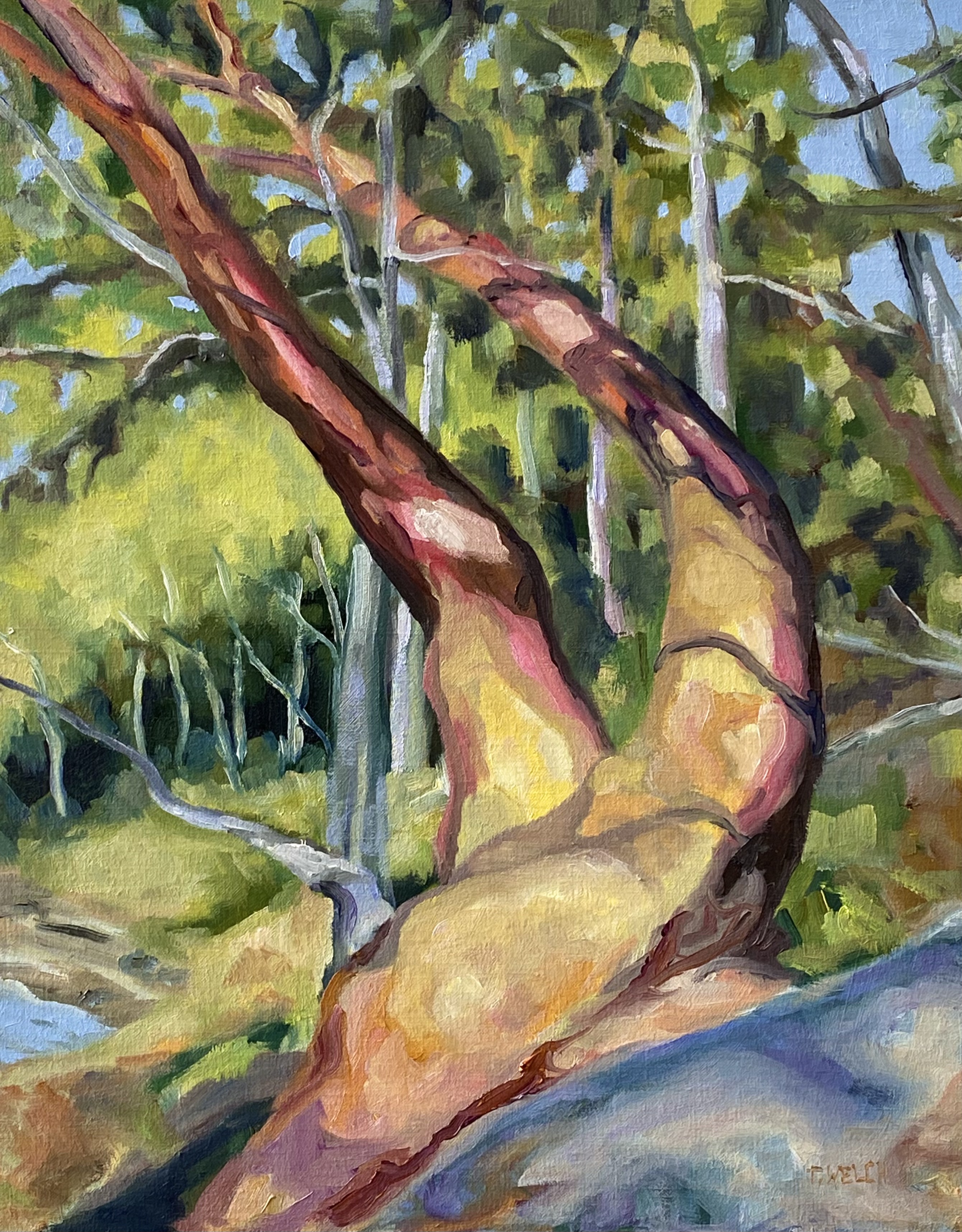
The background offers a loose abstract network of brushmarks while the tree is given figurative prominence with large shapes holding the composition within a visual space of warm morning summer light. 

Reference Gathering: 

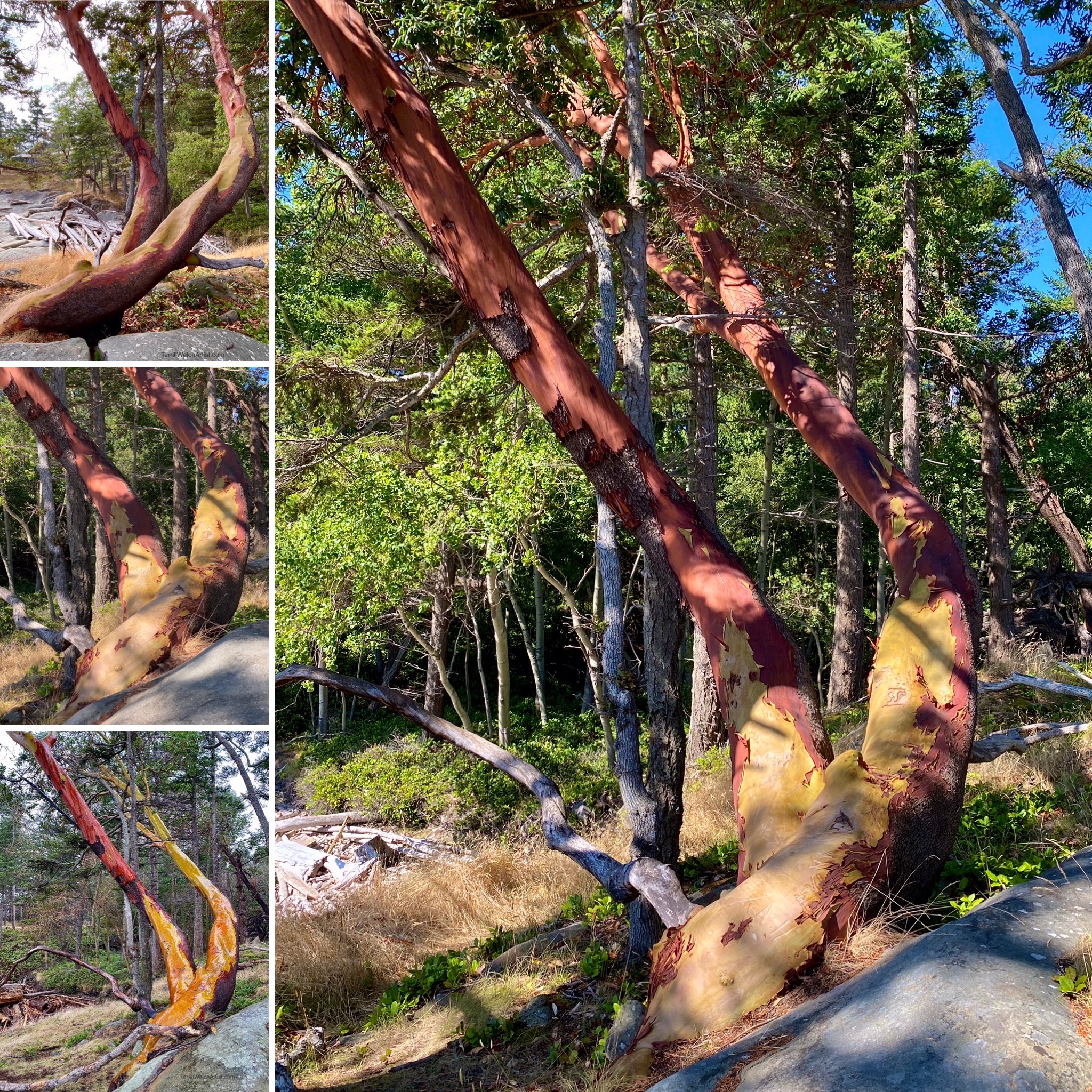
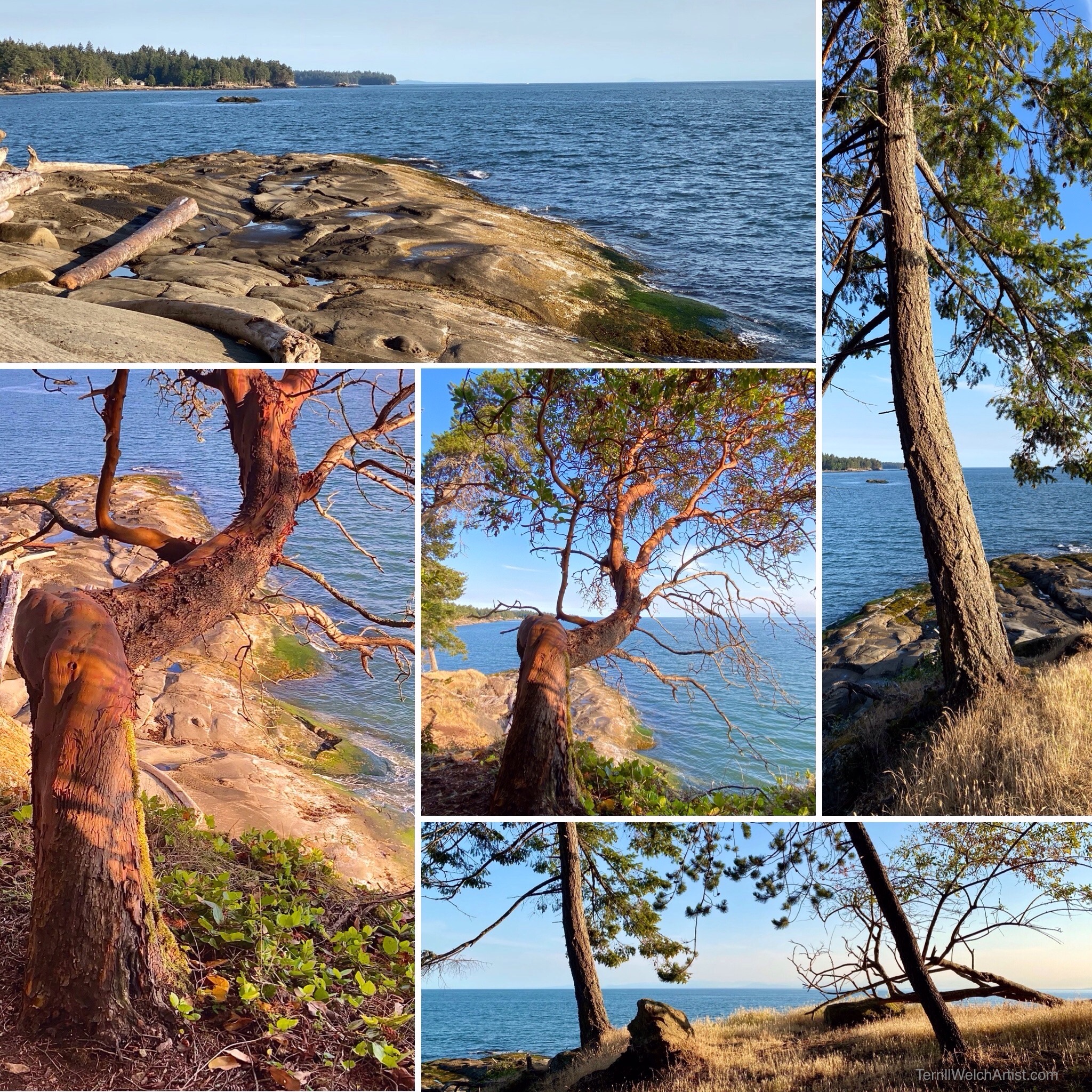
This is a commissioned work and stems from an art collector’s shared love of this specific arbutus tree that resembles the long legs of a woman elegantly reaching for the sky. I have references going back years but chose just a few, between August 2023 and August 2025.

Collection of reference images between August 30, 2023 and August 20, 2025 by Terrill Welch in preparation for painting “Lady Arbutus” in August 2026.

Making Process:

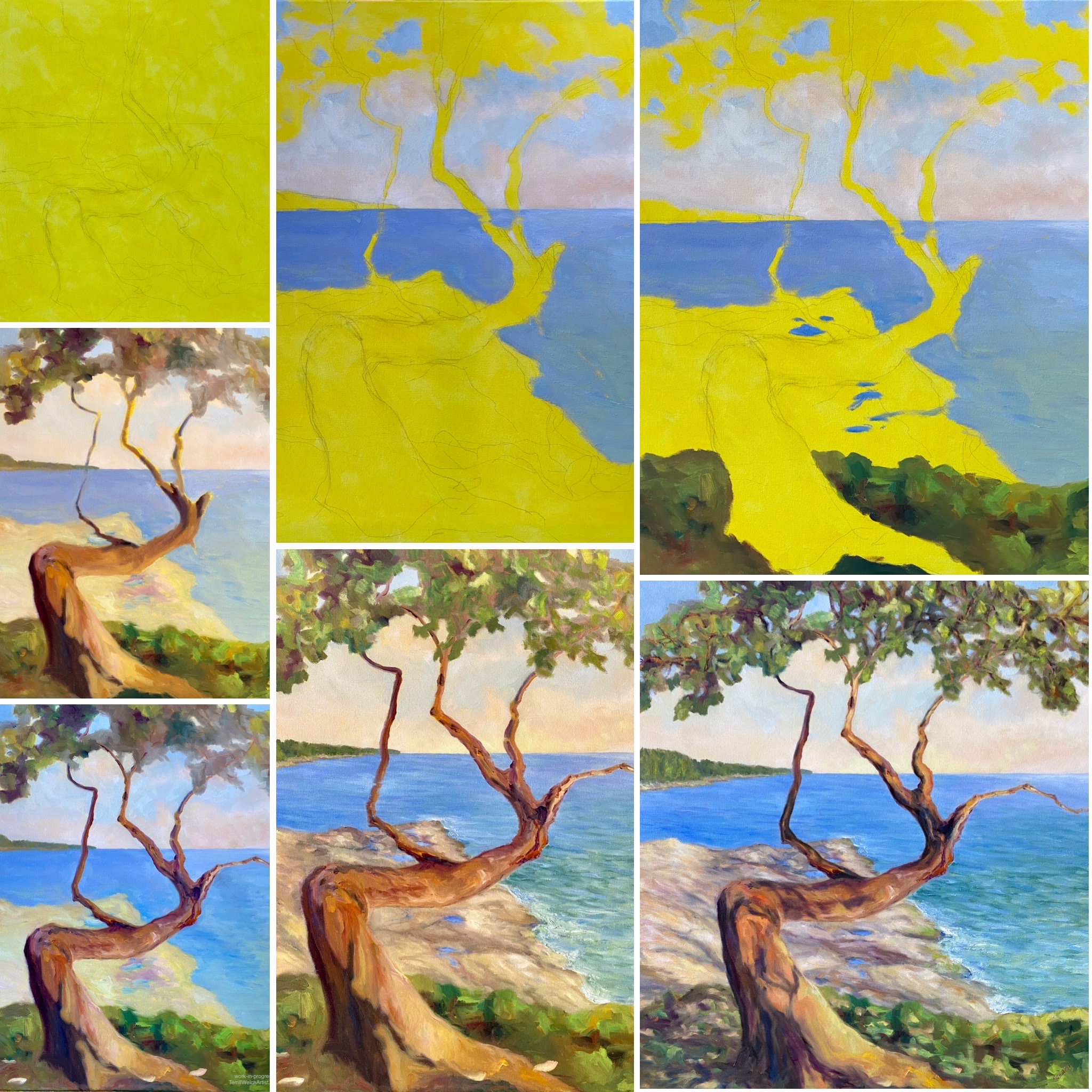
My studio making process proceeded over a few days in 2-3 hour painting sessions. I required pauses to really listen to the painting and what it was asking of me. I also mentally invited the art collector into my musings with nature so that I could draw on the abundance of influences between us three. The focus is on a portrait of the arbutus tree while keeping a sense of context and hints of the ocean behind and beside the viewer. I have a special relationship with not just the arbutus tree but also the polar trees on the middle left. There are very few on Mayne Island but they grew in abundance around my childhood home. 

Collage of work-in-progress images for Lady Arbutus by Terrill Welch 14 x 11 inch oil on linen covered birch wood.

Finished Painting:

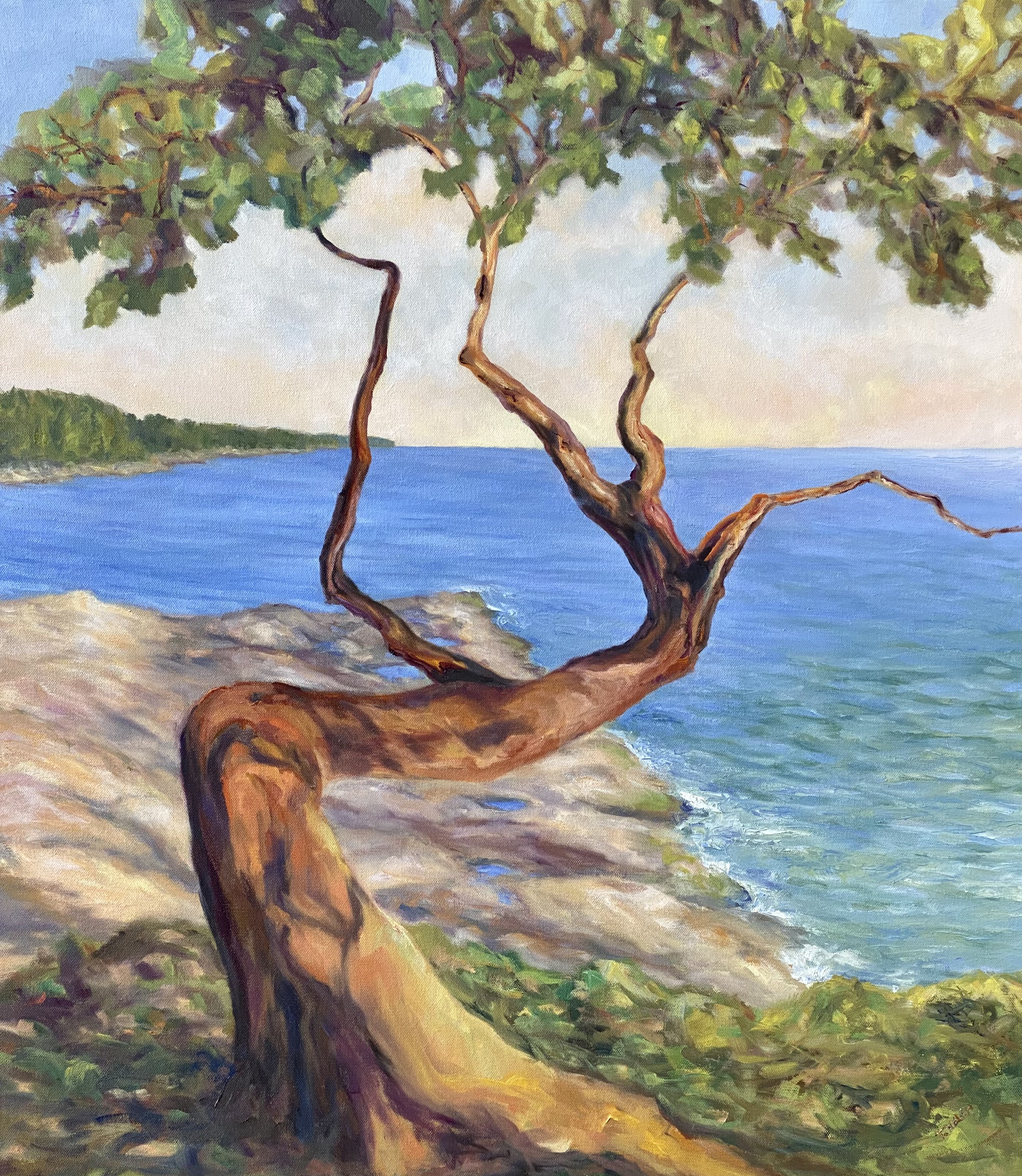
“Lady Arbutus” by Terrill Welch, 14 x 11 inch oil on linen covered birch wood. Completed Wednesday, 5 August 2026.

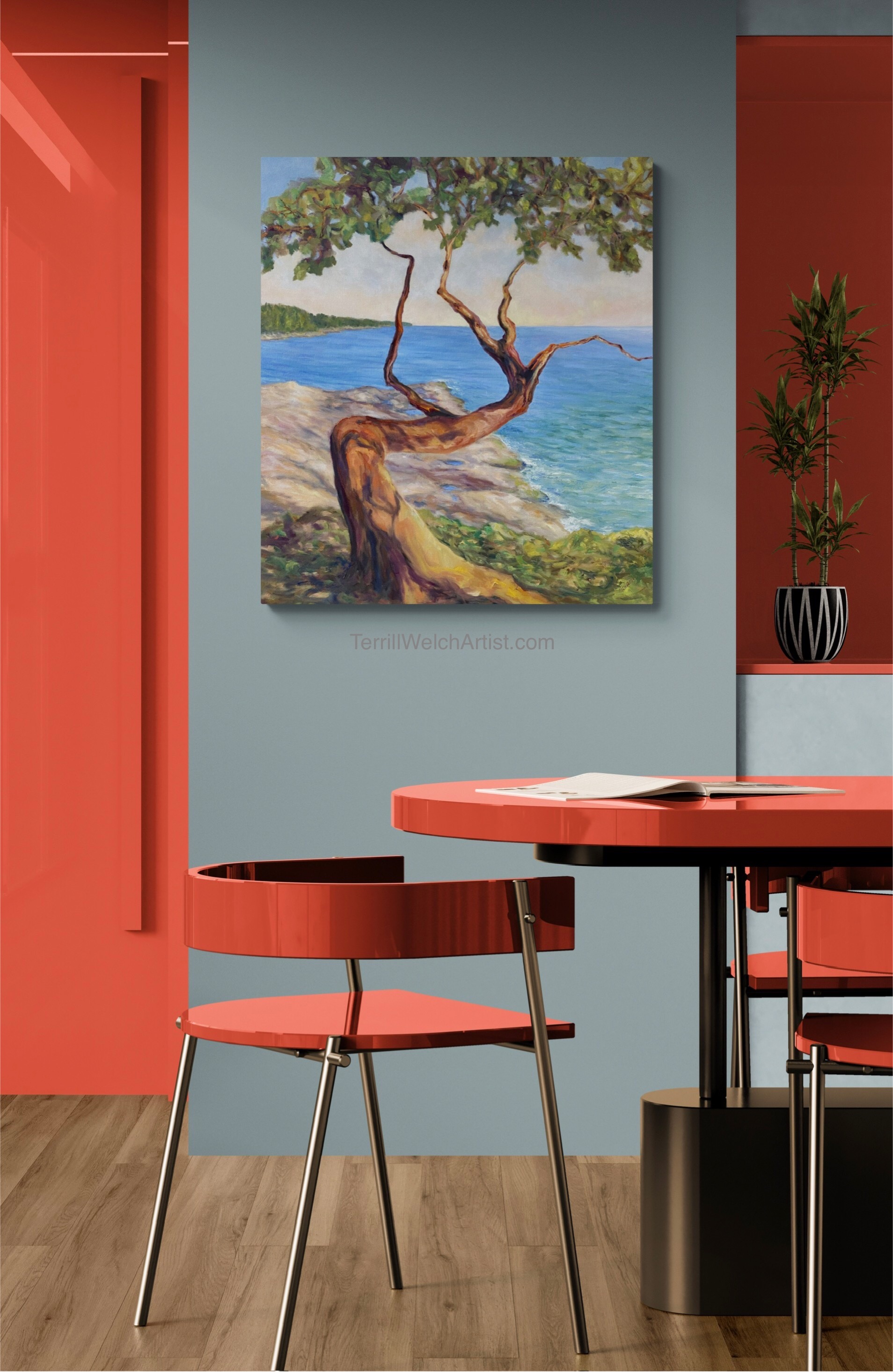
For scale, here is the painting in a digital viewing room.

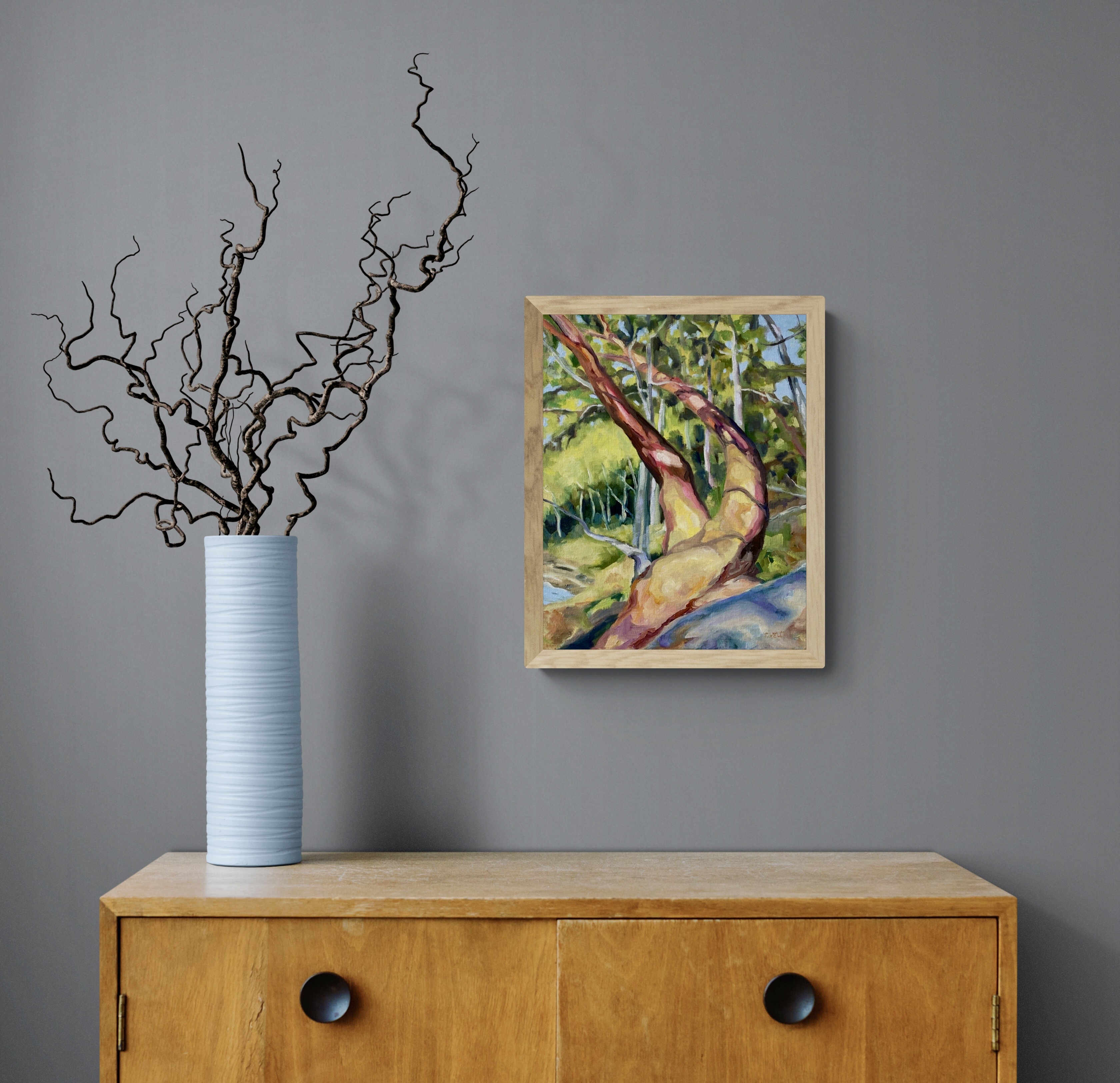
Digital room view – Lady Arbutus by Terrill Welch, 14 x 11 inch oil on linen covered birch wood.

Making Notes:

A ferry whistles in Active Pass on the other side of the island and echoes a response to the August sun pressing towards it through the trees. The calm ocean behind me pools at the bottom of the ridge next to a group of scrubby polar trees. Deep shadows offer a counterbalance to the bright trunks of the arbutus trees and rich soft greens of the grove. What would it like to be this arbutus tree tucked in next to a few strong firs beside the Salish Sea? I can feel the effort of stepping up on the weathered sandstone beside it as I traverse the narrow trail from the point. I like to pause for a few moments and just share its company before moving on. The artwork is a complex interconnected view to render in paint between dancing sunlight and thick growth reaching for the skies. Much is left to interpretation in an integrated network of suggestive figurative to abstract mark making.

Reflective Analysis:

For this painting, the complexity of vegetation and terrain was demanding to navigate into paint on a surface without over simplifying or offering so much information that the poetry of the moment is lost. I held significant pauses as I worked in order to make decisions about the order of things and then worked in a flurry for a while only to pause again to consider. The types of brushstrokes were decided by subject as I was mindful of only offering just enough to bring the work to life and present the essence of being this specific arbutus tree on this specific day. 

Reflexive Analysis: 

Commissions are different from work that is solely decided by my commitment and curiosity. I do have a formal process that allows maximum artistic freedom but it is still unique from my self-directed body of work. With my commission process, the art collector chooses the subject and size and a price is determined. I gather my own references and then paint the subject as I see fit. The art collector then decides if the work is to their satisfaction. If not, the work goes into my inventory and I try again. Payment for an artwork happens once a final decision to accept a painting has been made. This gives me maximum freedom as the painter and is the lowest risk for the art collector. Over the years this has been a win-win for everyone. That said, I only accept a very few commissions each year as they frequently take me away from whatever I am working in my studio practice. Not this painting though. It fits nicely into my current focus. 

For this painting, I am aware that there is an alignment between how I approach my work and the lived experience of the art collector. So there is the Lady Arbutus tree and her immediate environment on this specific day that is then enriched by around nineteen years of my having walked and sat next to her in all kinds of weather and throughout the seasons. Then there is my awareness of the art collector’s numerous similar experiences and her many conversations with me over about half as many years. The art collector has entrusted me to bridge these various experiences and bring them to the surface of the painting in as much of an unencumbered way as I can imagine. But influences are like seed burs. They sink their hooks into my  experiences and come along for the ride every time I dip my brush into the paint. It is something I must notice and also make peace with in order to bring the best I have to whatever work I am creating. Like all experiences, painting is not a pure isolated practice. The process is embedded in a multitude of interrelated and related variables. From this sea of information, a painting comes to rest uneasily on a surface as if by some alchemical, divine intervention. Even though the brushstrokes are made by my own hand, from my own observations and study, no one really owns these results in a lineage sort of way. It would be like saying that the dried thyme added to a stew was the only ingredient that mattered. It is important but, as with the painting, it wouldn’t be much without everything else. 

Key Findings: 

This painting was a great reminder to trust my creative process and stick with it, even when small doubts creep in around the edges. 

Anything else: 

The directness of working on this painting reminds me that I can benefit from creating without direct canvas and paint contact, even if it does not result in finished work. While I finished this painting, I also made some painted paper to cut up for collage puzzles. These never seem to amount to anything but they do offer a sort of different texture to my practice. Now that I have finished this work, I have set my paints aside to further explore these bits of hand coloured paper while I think about my overall research question and working definitions for this next body of work – Close To Home. 

Solace Between Sea and Sky Painting Data Collection

Painting Data Collection 

Title: Solace Between Sea and SkyDate Completed: Saturday, July 25, 2026
Materials: oil on canvas
Size: 31.5 x 27.5 inches (80 x 70 cm)

Figurative/Abstract Self Assessment Band-Scale Rating between 1-10: 

This work sits primarily at “4” with Camille Corot and April Gornik (Impressionism is a five and in the middle between figurative at 1 and full abstraction at 10). Yet it is a closer more intimate view that has us crouched next to the arbutus tree for company. The foliage above and below is abstracted but not noticeably so. The rest is clearly a figurative tree, sandstone shore, sea, sky and distant shoreline.

Reference Gathering: 

My references are from an early morning walk that saw me at this location on Edith Point at just before 7:00 am on Monday, July 6 2026. The sun had risen a couple of hours earlier but there were still hints of warm morning light. There is the arbutus tree of course but it was the totality of the morning’s walk that will later resonate in a more complete memory onto the canvas. The sandstone shore wasn’t just viewed. It was walked on and sat on while I ran my fingers over its sandpaper-like surface. The sea sounds were as soft as warm morning air flickering across my cheeks. There were other trees close by but I chose the arbutus and in the end its company is outside of our view. 

Reference inspiration for Solace Between Sea and Sky by Terrill Welch.

Making Process:

My painting process begins with a few composition lines. I have the notion of painting the tree “From the Ground Up” so that I can feel the forest overhead as well as under my feet. Yet, how will I create such a feeling? I also wanted to be standing “with” the arbutus tree rather than looking “at” it. I am listening to the arbutus tree tell me its story of time in what is a long and meaningful conversation. The painting process takes place over 12 days with moments of pause so layers can dry. But also pauses for the painting to decide what it needed from me. The last image in the collage is not the final painting yet but all significant decisions had been made at this point. My simplifications and exaggerations are in full view. Memory is often like that. We leave things out and make up other things to capture the inner resonance of what we want to convey. 

Painting process for Solace Between Sea and Sky by Terrill Welch.

Finished Painting:

Solace Between Sea and Sky by Terrill Welch, 31.5 x 27.5 inch oil on canvas. Completed July 25, 2026.

Making Notes:

Early in the morning I hiked along the outside trail early of the Edith Point Conservation Lands next to Strait of Georgia. During the summer the sun rises far enough north to slam this shore in brilliant sunlight for the first view hours of a day. The receding tide leaves small pools of seawater along the lower parts of the sandstone shore. Low clouds on the horizon still have a bit of an orange popsicle hue. What might it be like to be this specific arbutus tree rooted deeply along the high part of the bank and stretching day after day for every casual ray of sunlight? It is a quiet determined striving that I can take solace in. I soak up the moment for as long as it can last. Seconds really. Or maybe an eternity. Each brushstroke contains purpose and random execution at once. It is not the mystery of discover so much as knowing where I am and wanting it stay. This painting opens up under my first viewer’s gaze. I can feel the grandness of expanse filled with early morning’s comfort and possibilities just as I remembered it during my hike. 

Digital Room View for size reference:

Digital room view using the Canvy app showing at scale “Solace Between Sea and Sky” by Terrill Welch.

Reflective Analysis:

At this specific time, I am beginning a new thematic body of work that I have yet to form into a rigorous research question. I just know, I want to be with the trees and look down onto the seafloor where I have spent the past two years at the tideline painting close up work that I composed primarily vertically into “landscapes of the small” or “child’s view” compositions. One must hold the expanse of the shoreline above one’s head doing this work. I want to hold a grand view perspective again, even if I still crouch close to the earth. 

Reflexive Analysis: 

The title has the “solace” as a primary reference. I find in a moment of solace, as here in the company of the arbutus tree and taking in the sea and sky, there is also acknowledgment of pain or grief. The desire or need for solace necessarily describes the other. From my first viewer’s gaze, maybe due to my own painter’s hand, I can fully sense both of these halves that make a whole. I was raw and tired as I pushed hard to get the last of my assignment materials ready for assessment. We had lost our home support services due to retirement so my partner and I were working out how we were going to best do his showers together, just the two of us. We found a way but new routines are harder, for both of us, when someone has dementia. But in the end we came up with an even better solution than how he was showering before and a method that allowed him more independents under my prompts and supervision. So this arbutus tree is not just comfort but also a symbol or inner strength, perseverance and resilience. Standing with this tree, I have company during my most challenging doubts and fears and exhaustion. I come away from the view and the easel ready to continue and step just a little lighter from the warmth of such an early morning expanse and the recognition that all things are interconnected and whole, for this brief moment. 

Key Findings: 

I had the desire to keep a wide range of brush marks between figurative and abstract but that isn’t what the painting asked for and I knew better than to question its lead. The process from inspiration to completion of the work took 19 days plus another two days to organize my thoughts and data collection to write about the process. So if anyone asks how long it took, the answer is 50 years of a nature-centric, reparative painting practice plus 21 days of focused attention. This work doesn’t come easy. The paintings are moulded out of the blood flow that makes up my full sensory life and contemplated experiences. 

Anything else: 

The solution to an attempt that falls short of my intention is to try again. Keep painting, I tell myself. Just keep painting. 

What might you do to continue with something that you haven’t quite yet succeeded in accomplishing?