Wednesday, 28 October 2026
This first journal entry is the first link to what eventually becomes the strongest position in my nature-centric, reparative painting practice. The second journal entry assists in unpacking the theoretical importance of paintings.
Excerpts from Terrill Welch MA Fine Art Journal
January 28, 2025
For two days I have sat with my large sketch book and mapped out my contextual study in a way that likely will only make sense to me. However, as I draft and redraft and write again about what theories, research apply most to my artwork and the contextual environments and artistic influences that underpin my painting practice in relation to the project I am committed to working on, this should be useful.
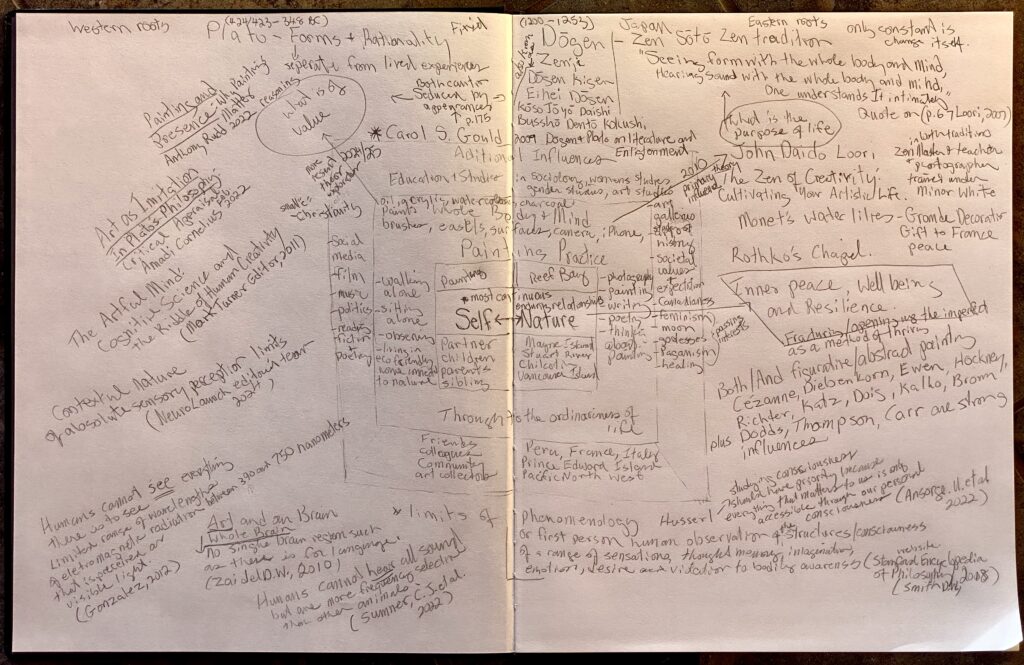
It is not a static map but one that can be added to and subtracted from as needed. Mostly, it is a transitory guide to my current living and breathing painting practice. It is not meant to be finite or definitive or fixed in any aspect. This map might include facts but I do not intend for it to be factual in nature. I am using it more as a sensation or a glimpse out of the corner of our eye where we might see something about me and my painting practice that we never noticed before. I will unpack some of my markers and findings into a 3,000 word contextual study essay and leave the rest as a bit of a personal mystery. I am not so much seeking a truth but rather living a life – the most meaningful life I can possibly learn to live. The most profound finding from doing this exercise is realizing how impactful and enduring my relationship with nature has been and how it remains the strongest and most consistent influence on both my work and life.
Anthony Rudd and Why Paintings Matter
29 January 2025
A few quick notes so I don’t lose them…
I can now admit that I was becoming terribly disappointed with attempting to place my painting practice into a theoretical context that made any definitive sense to me. Plato and his Forms and exemplification of reason and Dōgen and his oneness as a path to enlightenment were only taking me so far. I value the analysis by Carol S. Gould for her astute ability to summarize where these two thinkers intersected and diverged. Yet, it wasn’t yet enough. I still felt like my intellectual feet were floating on air with no perceptible firm ground linking to my painting practice. I read passages of translations of original text about the work of both Plato and Dōgen. That was useful for its own sake but did not move my theoretical framework any closer to my painting practice.
Then I settled down to read Painting and Presence: Why Paintings Matter by Anthony Rudd, 2022.
Besides Gould’s article “Dōgen and Plato on Literature and Enlightenment” published in 2009, it seems to be the most promising fit with my current painting practice and provides a promising path forward in my explorations of painting the sea floor as a subject that will instil inner peace, wellbeing and resilience; while using the theory and methods of whole body and mind through to ordinary life as presented by John Daido Loori in The Zen of Creativity published in 2007.
Rudd’s “claim is that painting matters because it is or can be truthful, that—apart from all the many particular reasons why we might value some particular paintings—good paintings in general are of value because they disclose essential aspects of reality.” (Rudd, 2022, p.9)
He goes on to say “Paintings make themselves present to us, but in so doing they also make something else—their subject matter—present to us in a way that discursive representations cannot. (I argue that this is true in a sense even of abstract or ‘non-representational’ paintings.)” (Rudd, 2022, p.9)
Rudd goes on “However, if it is to explain the value of painting, the theory needs to explain not only the connection of painting to the True, but also to the Good; it must explain, that is, why the particular kind of knowledge by acquaintance that painting provides is good to have. I argue that it can only do this if what painting discloses—the essences of things, the order of nature—is itself good. But this is, in fact, what we experience, not only indirectly through painting, but directly in the aesthetic appreciation of nature itself. To experience nature aesthetically is to experience it as being valuable, as having an ontological goodness—however problematic it may be to relate this to a notion of moral goodness. So—as seems right if we are to answer Plato’s critique—the Beautiful (i.e. positive aesthetic value), the True, and the Good must all come together. Painting cannot be of value unless it is a response to the real value of the broader order of things. So an adequate account of the value of painting—and of the aesthetic appreciation of nature—requires us to repudiate the modern picture of a ‘disenchanted’ value-free world. In the final chapters I consider whether or in what way this ‘re-enchantment of the world’ can be considered to be religious in character. In so far as it can, then the icon is exemplary for painting in general not only in a weak sense (there is a structural parallel between the way an icon makes a saint present and the way in which any painting makes its subject matter present) but also in a stronger sense—that what all painting discloses is, in a sense, something sacred and that painting itself, therefore, is a sacred, even a quasi-sacramental act.” (Rudd, 2022, p.11)
This is a powerful proposition to unpack and one that resonates not just in the specifics of my painting practice but also with my interest in Monet’s Grande Decoration in the Orangery and Rothko’s Chapel paintings and how they connect to my approach to the sea floor paintings.
I will stop here for the moment and go back to reading but this gets at the root or core of what I value about painting and why I find it important as a means of conversation or communication between nature, myself as painting and to the close disclosure of the painting to the viewer.
Reference list:
Gould, C. (2009) DŌGEN AND PLATO ON LITERATURE AND ENLIGHTENMENT 1, Florida International University, Asian Studies, Japan Studies Review, Volume XIII, pp. 169–185. Available at: https://asian.fiu.edu/jsr/gould-dogen-and-plato-p169.pdf (Accessed: 5 January 2025).
Loori, John Daido (2007) The Zen of Creativity: Cultivating Your Artistic Life. New York: Ballantine Books.
Rudd, A. (2022) Painting and Presence: Why Paintings Matter, Oxford University Press eBooks. Oxford University Press. Available at: https://doi.org/10.1093/oso/9780192856289.001.0001.

