Working Summary of Ideas, Plans and Practice

Monday, 5 October 2026

Excerpt from Terrill Welch MA Fine Art Journal

Tuesday, 29 October – Wednesday, 30 October 2024

Working Summary of Ideas, Plans and Practice

Ideas: 

I am currently exploring the possibility of increasing peace through a sustained engagement with the land at the edge of the sea where the land is revealed and covered by the changing tides in what I am tentatively calling a macro landscape sea floor series of paintings. This series will aim to connect us with nature’s quiet yet profound rhythms, offering a visual meditation on the resilience and grace found within the sea and along its shores.

The paintings in this series will reflect the intimate gaze of observing the sea floor while the tide is low. I am searching to see if this new series will deepen my understanding of how our observation and connection with nature can contribute to a broader understanding of how peace is derived. If I hold the objective of understanding peace in my thoughts and as a direct intent of my painting process will this desire and learning be discernible and available to viewers?

My working definition of peace is best summarised in a quote from Etty Hillesum. 

“Ultimately, we have just one moral duty: to reclaim large areas of peace in ourselves, more and more peace, and to reflect it towards others. And the more peace there is in us, the more peace there will be in our troubled world.” (Hillesum, 2002, p. 535)

Hillesum was born January 15, 1914 in Middelburg, Netherlands. She died in Auschwitz concentration camp on November 30, 1943 at the age of 29. 

For this series, I am working with a rough definition of nature which includes flora and fauna in its natural state and the activities of humans who live and work respectfully in harmony with their natural environment, specifically as observed on Mayne Island in British Columbia, Canada where I live.

Plans: 

My best guess is that I will likely have at least twenty of these small painting sketches for my project over the next two years and I hope to have about twelve larger paintings tentatively in the size of 48 x 40 inches completed in oil on canvas. I have ordered some 12 x 10 inch canvas for the smaller painting sketches and studies and I will also likely complete some medium size paintings that are 24 x 20 inches. To answer some of my questions about impact of this work I will also want to create a viewer feedback opportunity. I am not sure how this will be designed yet or how formal or informal the process will be. 

A few of my draft questions in relation to this body of work include –

How will I know if my focused intention on peace during my painting process creates a change in the areas of peace within me and/or in the amount of peace that is reflected and received by the viewers of the artwork?

Is there any noticeable difference in the paintings in this series from my previous work?

Could this work be powerful enough to impact both myself as the creator of the paintings and the viewers of the paintings by enhancing our ongoing experience of peace over time?

This completed body of work can then be shown together in a suitable public gallery or venue space or in part in my own gallery. It will also be possible to place it in a virtual gallery for online viewing using something like Kunstmatrix art spaces :

https://artspaces.kunstmatrix.com/en

Practice: 

Separation between my act of living and my art practice are fleeting and microscopic at best. Sitting and walking in nature is accomplished within a flow of activities such as getting groceries, picking up the mail, car picnics, daily walks and providing primary care for my husband, David, who had a severe stroke fifteen years ago. As his cognitive abilities become more compromised, he can no longer stay on his own overnight and is finding it difficult to travel away from the island. My art practice exists within this tension of daily living and responsibilities. My studio is within our living space and painting breaks are used for putting such things the laundry in the dryer and getting potatoes into the oven to bake. The business side of my art practice is its own creature with a gallery space at our front gate that is open daily for walk-in self-browsing supported by an online gallery, social media posts and a monthly newsletter to art collectors and serious fans. Then there are the galleries and venues that represent my work that require less time but not none.

Since 2020, I have less ability to spend whole days traversing the shores and seaside trails. I have extremely limited ability to explore shores and trails off of our island. It is simply a fact. The constraint has meant taking my practice deeper into this specific place. I call it “thriving in place” and I completed a year of artwork in 2022 – 2023 with this intention. In fact, these constraints are what led me to examining and considering the sea floor as a subject of study. 

Several times a week, I wander down to the sea shores around Mayne Island at various times of day to gather inspiration and photographic sketches for later reference in the studio. In my reference gathering of these photographic sketches, I often take a child’s view and get low to the earth’s surface. I have found this releases a kind of inner curiosity and strengthens my ability to observe without having to know what I am observing. It is a way of framing by shape and texture in those moments before my brain begins the naming of things. This allows me a more fuller multiple sensory experience and memory. 

Once back in the studio, I edit and keep these photographic sketches in an album of references for my sea floor series painting project. I then take the images that resonate the most and decide how I might use them individually or together in a composition. From there, I choose a surface and set my intension of rendering the essence of peace as I worked from memory, references and intuition. I tend to work my surfaces wet-into-wet in a wholistic way building up passages in overall layers while standing at the easel and moving repeatedly back and forward from the surface.

Context: 

What other painters and artists have approached this subject of peace through history and in contemporary art?

Historical – 

Monet’s Waterlilies panels at the Musée de l’Orangerie Paris, France that were a gift to France. These are of particular interest for their all over painting quality. 

Rothko’s Chapel in Houston, Texas, U.S.A 

Matisse’s Chapel in Vence, south of France

Richard Diebenkorn, U.S.A and his series of work that moved between abstract and figurative landscapes.

Contemporary – This I am still researching though the work of Lois Dodd, Alex Katz, and Peter Doig seems like a possible place to start. 

What artists and writers have a strong influence on my painting practice?

Since January 2010, when I made a commitment to develop a full-time painting practice, there have been many painters, poets and writers who have figuratively and sporadically sat with me as I worked. However, so far there are just two individuals and three books that have provided me enduring company during my journey. My frequent visits to these three books is evident in their tattered covers, pencil and pen marked pages and frequent bent over sticky notes. In no particular order, they are The Zen of Creativity: Cultivating Your Artistic Life by John Daido Loori (2007) and New Selected Poems, Volume One (1992) and Two (2006) by Mary Oliver. Both Loori’s book and Oliver’s two volumes of poems bring me back to how I want to approach nature and my art practice. There is an emphasis on observing, noticing while at times waiting for permission to access what the land and sea have to offer. There is an underpinning of honesty and respect that is devoid of naivety and false reverence.

Reference list

Hillesum, E. (2002) Etty the Letters and Diaries of Etty Hillesum, 1941-1943. Edited by K.A.D. Smelik. Translated by A.J. Pomerans. Grand Rapids, Mich. Eerdmans.

Loori, J. (2007) The Zen of Creativity: Cultivating Your Artistic Life. New York: Ballantine Books.

Meiers, A. (2020) How the Rothko Chapel Creates Spiritual Space, JSTOR Daily. Available at: https://daily.jstor.org/how-the-rothko-chapel-creates-spiritual-space/ (Accessed: 30 October 2024).

Monet, C., Kendall, R. and Marzo, B. (2000) Monet by himself : paintings, drawings, pastels, letters. Boston ; London: Little, Brown.

Oliver, M. (1992) New and Selected Poems, Volume One. Boston, Massachusetts: Beacon Press.

Oliver, M. (2006) New and Selected Poems, Volume Two. Boston, Massachusetts : Beacon Press.

Rothko Chapel (no date) http://www.rothkochapel.org. Available at: https://www.rothkochapel.org/learn/about/ (Accessed: 30 October 2024).

The Silence of Mark Rothko: Documentary – YouTube (2016) Youtu.be. YouTube Movies & TV. Available at: https://youtu.be/VT8tvCCbmYI?si=uhhIeQ5jArycfV9o (Accessed: 30 October 2024).

Virtual galleries for art | present your art in 3D‎ | art.spaces | KUNSTMATRIX (no date) artspaces.kunstmatrix.com. Available at: https://artspaces.kunstmatrix.com/en (Accessed: 30 October 2024).

Additional notes from lecture:

Thursday, October 31, 2024

Has the group session broadened or challenged your thinking in relation to your field of practice? How and why?

There are several observations worth noting: 

I appreciated the reminder that we live in a globally influenced world where artists create discussion and discourse. 

I am intrigued by the work of Dorothy Hood and her “Homage to Gorky” 1969, oil on canvas, Overall: 70 1/8 × 60in. (178.1 × 152.4 cm) that is currently held in the Whitney Museum of American Art collection. I am assuming that she means Arshile Gorky whose work and life I have recently been studying. Out of curiosity, I will do some further research to see where their work intersects. 

New Materialism – read more about:

The Arts and New Materialism: A Call to Stewardship through Mercy, Grace, and Hope by Nicholas Leonard

Art and Design Education, Northern Illinois University, DeKalb, IL 60115, USA

Humanities 2020, 9(3), 84; https://doi.org/10.3390/h9030084

Submission received: 24 June 2020 / Revised: 7 August 2020 / Accepted: 13 August 2020 /Published: 17 August 2020

https://www.mdpi.com/2076-0787/9/3/84

I am always fascinated with how artists use their bodies within their art, not just in the making of a art but how bodies can become part of the work such as that of Joseph Beuys in his 1974 “I like America and America Likes me” and also Florence Peake “The Keeners” performance, 2015. The idea of art being temporary in its physical form where only imperfect and partial residue is left behind in memory, photographs and video. Could this be true of all art, that in the process of creating, the work is already dissolving because the artist has changed, the viewer has changed and the art product has changed?

The Story About My Making Practice

Saturday, 2 November 2024

There are stories we tell ourselves about ourselves. There are stories we tell others about ourselves. Then there are stories others tell about us. All these stories are predominantly fictional with a skeletal structure of facts. It is not that we intend these stories about ourselves to be fictional. Rather, in the process of flawed remembering and telling and retelling, they come to be this way. With this acknowledgment, I have done my best to concisely tell others about my making process.

In my art practice, I make a conscious effort to remove myself as the hero in the work and allow my subject to hold this central role in conversation with the viewer, with the first intimate viewer being me. 

This is the story I tell others about my making of a painting in 297 words:

When painting, I do most of my exploring before I start through incessant internal iterations developed from my reference gathering practice of photographic sketches and small plein air studies. Once an idea holds my sustained excitement, I begin. 

I squeeze oil pigments in my left-handed, muscle memory order onto palette paper. I quickly mix a few colours knowing that I will make refinements later, sometimes right on the painting. 

I begin with two brushes, one each for light and dark. The specific brushes are decided by the size and material quality of the surface and the marks I want to make.

I lightly hold an intention for the work and then start with minimal lines in paint or pencil to guide my process on the dry, often complementary coloured, ground or underpainting. 

Developing the whole surface in rhythmic motion, I stand to paint and settle deeply into the core of my body rather than painting from my wrist or arm. At regular intervals, I move back and forth about six feet from the easel. There is no music playing. I prefer to work in silence allowing my subject to take up most of my internal and external meditative attention.

Eventually, the surface is loosely covered in paint. At this point, my reference materials are of little value and I set them aside. I again breathe into my intention. With soft focused eyes, I continue somewhere between my full-sensory memory for the work and fragments of information from other experiences. My brush-to-canvas movements are equally spontaneous and considered. After a while, I step back and pause. My critical thinking fully engages. I review what is left behind on the surface. Does it work? Is it asking for anything more? Have I said all I can say for now? 
Harbouring Hope Painting Data Collection

Painting Data Collection 

Tuesday, 22 September 2026

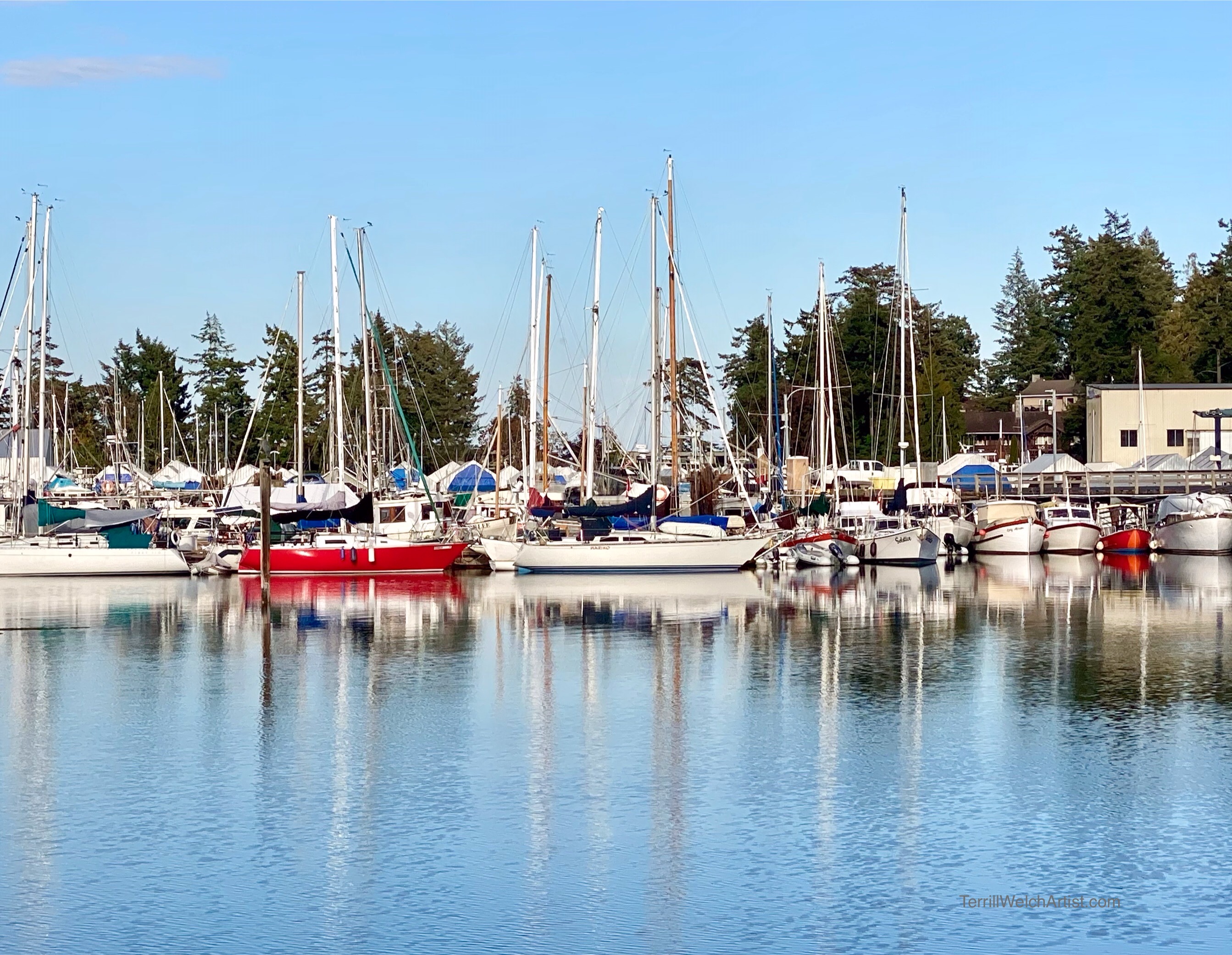
Title: Harbouring HopeDate Completed: Monday, 21 September 2026
Materials: oil on linenSize: 23.6 x 27.5 inches (60 x 70 cm)

Figurative/Abstract Self Assessment Band-Scale Rating between 1-10: 5-8

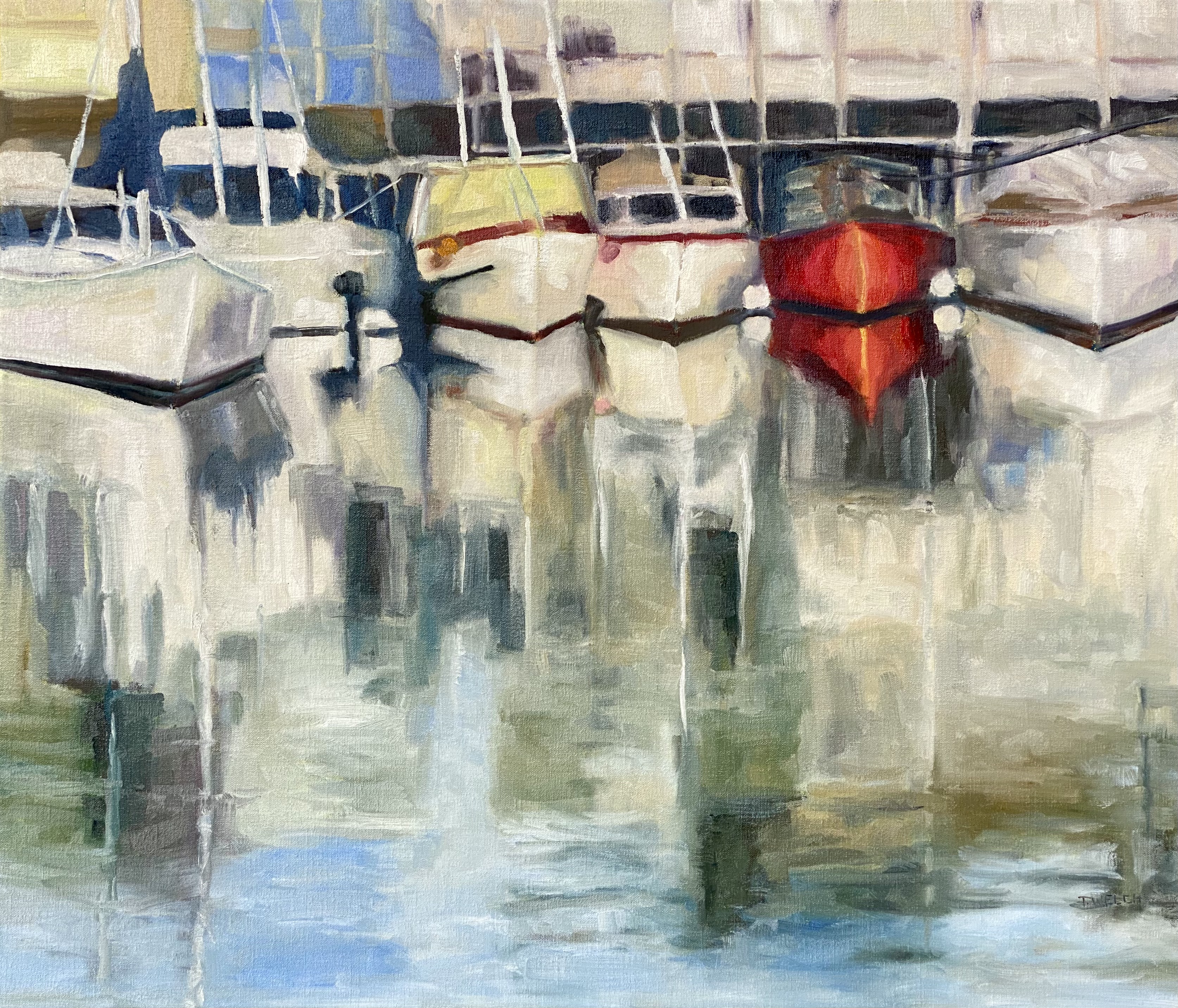
This painting still has strong impressionist leaning in the reflections but it also has an overall abstract sensibility to the shapes at the top of the painting. 

Reference Gathering: 

My reference gathering was thoughtful but cut short. I hadn’t planned on painting this scene. It was just an irresistible moment, like when a dog spots a squirrel. Their reaction is predictable and almost involuntary. My leash was that my husband David needing a bathroom and the ones in the park were closed. So we packed up and headed for the ferry with me turning back several times to look at the boats in the marina as we walked along the path back to the car. Their abstract shapes formed an enticing composition that wouldn’t let go of me.

Here is one of those reference images.

Marina at All Bay in Sidney, British Columbia mid September 2026. Photograph by Terrill Welch.

The next morning I pulled up the images and thought, if I just take this one small area here on the right, it will make a painting. That small suggestion from my mind to my heart was all it took. Now we have a painting! 

Making Process:

The making process was a process of simplifying to reach the core elements of my investigation and curiosity. 

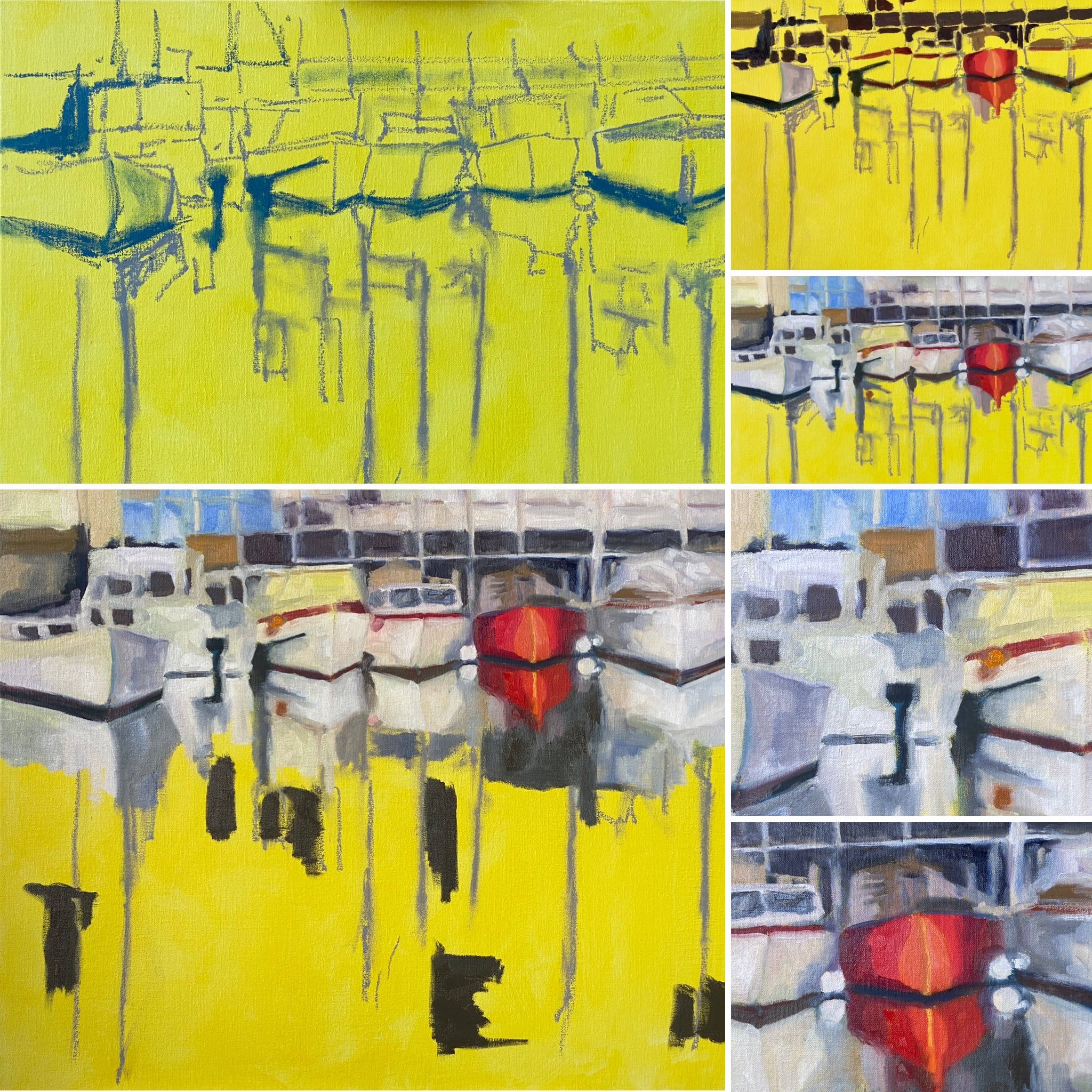
Work-in-progress on “Harbouring Hope” by Terrill Welch, 23.6 x 27.5 inches (60 x 70 cm) oil on linen. Sunday, 20 September 2026.

I took a step back and then leaned into the spaces between the shapes and the light. This gave breadth as well as depth for emotion and energy in the work. The painting took shape over a period of six days beginning with oil sticks over a yellow acrylic ground on stretched linen.

Finished Painting:

“Harbouring Hope” by Terrill Welch, 23.6 x 27.5 inches (60 x 70 cm) oil on linen. Monday, 21 September 2026.

Making Notes:

I had just come from visiting a friend in the hospital and we stopped to have a picnic dinner in the park beside the marina at (what is now called) All Bay in Sidney, British Columbia. I took some reference images because the shapes and colours felt hopeful and there was a peaceful, reflective, deep calm about munching on sandwiches and looking out into the bay. I want to investigate the big gestures and emotions in this moment without getting caught in the weeds of visual or thought preciseness.

Reflective Analysis:

The painting of boats in a harbour is an old subject and likely has been happening as long as there have been boats. The question is, can I offer something more or unique in my approach? I reach into the big abstract-like shapes of the boats to carry the emotion of the work through their soft reflections. I pushed the horizon line high and let the sea in the bay hold the sky for me. I focus on the feeling of the moment rather than the details which allows the structure of the work to read true without getting caught up in the weeds of specifics and my own thinking. To pull this off, my brushstrokes must be filled with concentration, intuition and repeatable, confident, decision making. No second guessing. Make a mark and leave it. Make another mark and leave it. Paint something out, then paint it back in with the same confidence. It is not about getting it right but knowing what must be left behind, from the first mark to the last mark. The relationship of the marks within the composition outweighs architectural accuracy. The boats may feel like they are floating in the painting but no boat maker would build them this way. The most important aspect is that the work, in my first viewer’s eyes, reads as emotionally and physically whole. 

Reflexive Analysis: 

I have been musing about how there are no shortcuts in painting as there is in life. I must bring my whole vulnerable self to the easel, every time. I must be willing to investigate and admit, at least to myself, why I paint what I paint. In this case, it is part of processing the illness and healing of a dear friend who is in the hospital. We have been friends for over thirty years and I feel we are somehow both too young to be faced with her circumstances. But in truth, age has nothing to do with it. Illness has no fixed criteria. The details are private and personal but the experience is universal to human kind. Again, my painting practice takes on an undeniable reparative or healing undercurrent that isn’t visible in either the painting process or the end result, unless I choose to share it. I don’t usually paint boats in a harbour. In fact, I know little about boating or marinas. But I do know the sun and the sea. The boats are simply supporting actors for using shapes, forms and colour to facilitate a harbouring of hope. 

Key Findings: 

There is an openness in the space offered in this paint through the boldness of the shapes. This reminds me of painting the seafloor and focusing on the close up views of the seafloor and allowing abstract elements to press against more figuratively mark making. 

Anything else: 

I like the freshness and the depth of this work. I couldn’t have stopped myself from painting this painting no matter the risks of the derivative nature of the subject. I am glad that critique didn’t create a barrier but was left as – duly noted, before I proceeded. 

Oyster Bay Late August Painting Data Collection

Monday, 7 September 2026

Painting Data Collection 

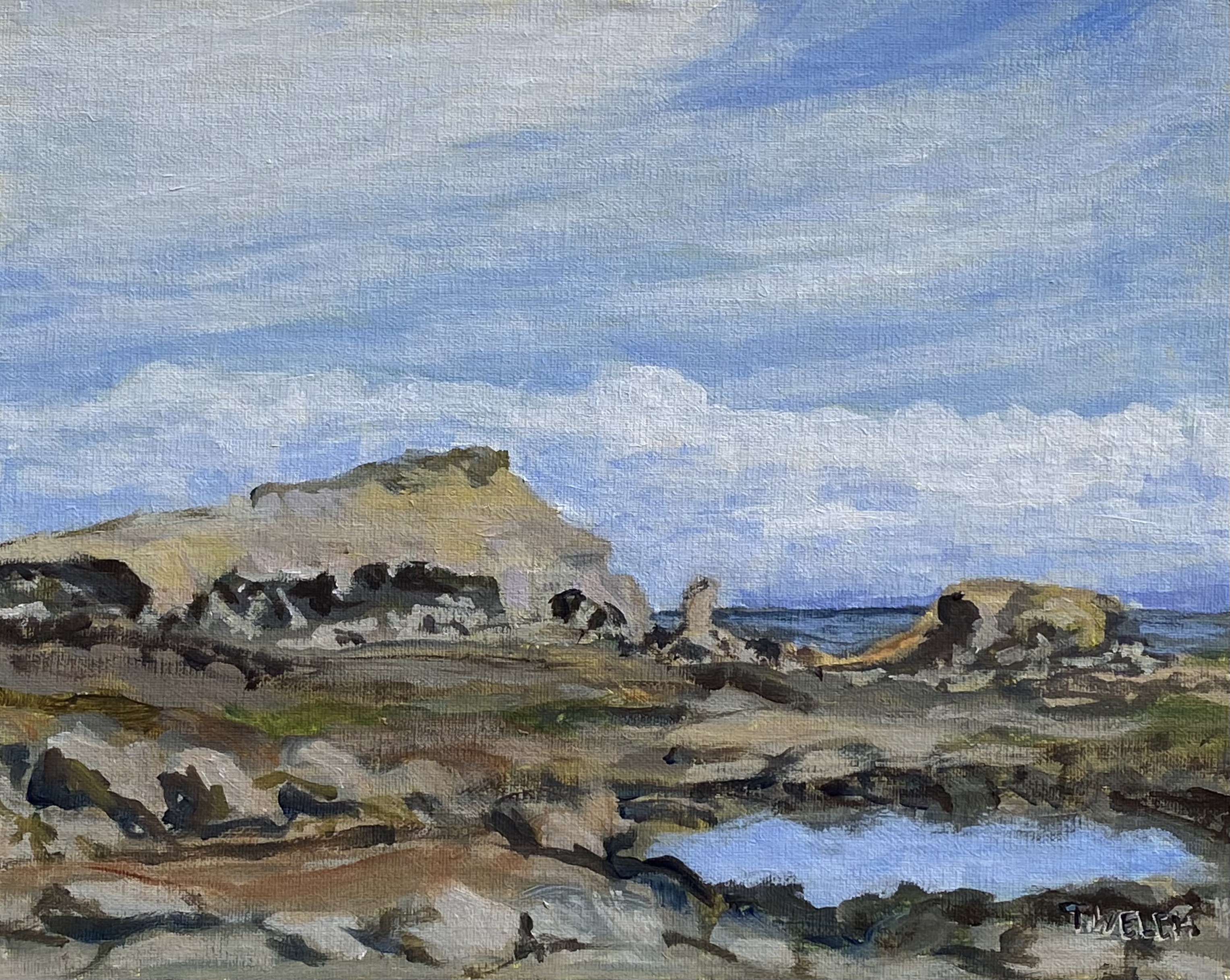
Title: Oyster Bay Late AugustDate Completed: Friday, 28 August 2026
Materials: acrylic on linen board 
Size: 8 x 10 inches (20.32 x 25.4 x 0.51 cm)

Figurative/Abstract Self Assessment Band-Scale Rating between 1-10: 5

This is a plein air contemporary impressionist quick acrylic study to capture sensory information in the moment. 

Reference Gathering: 

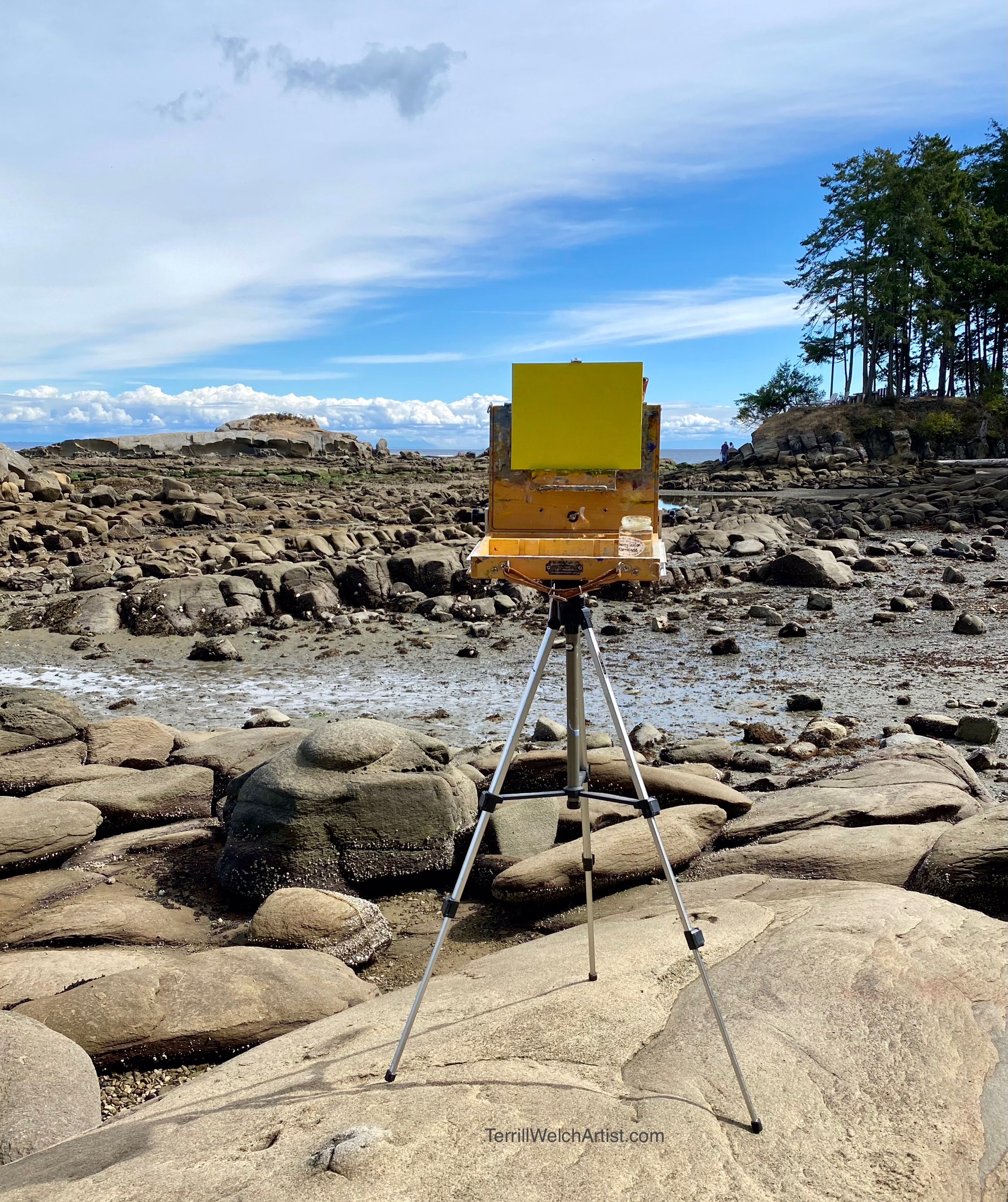
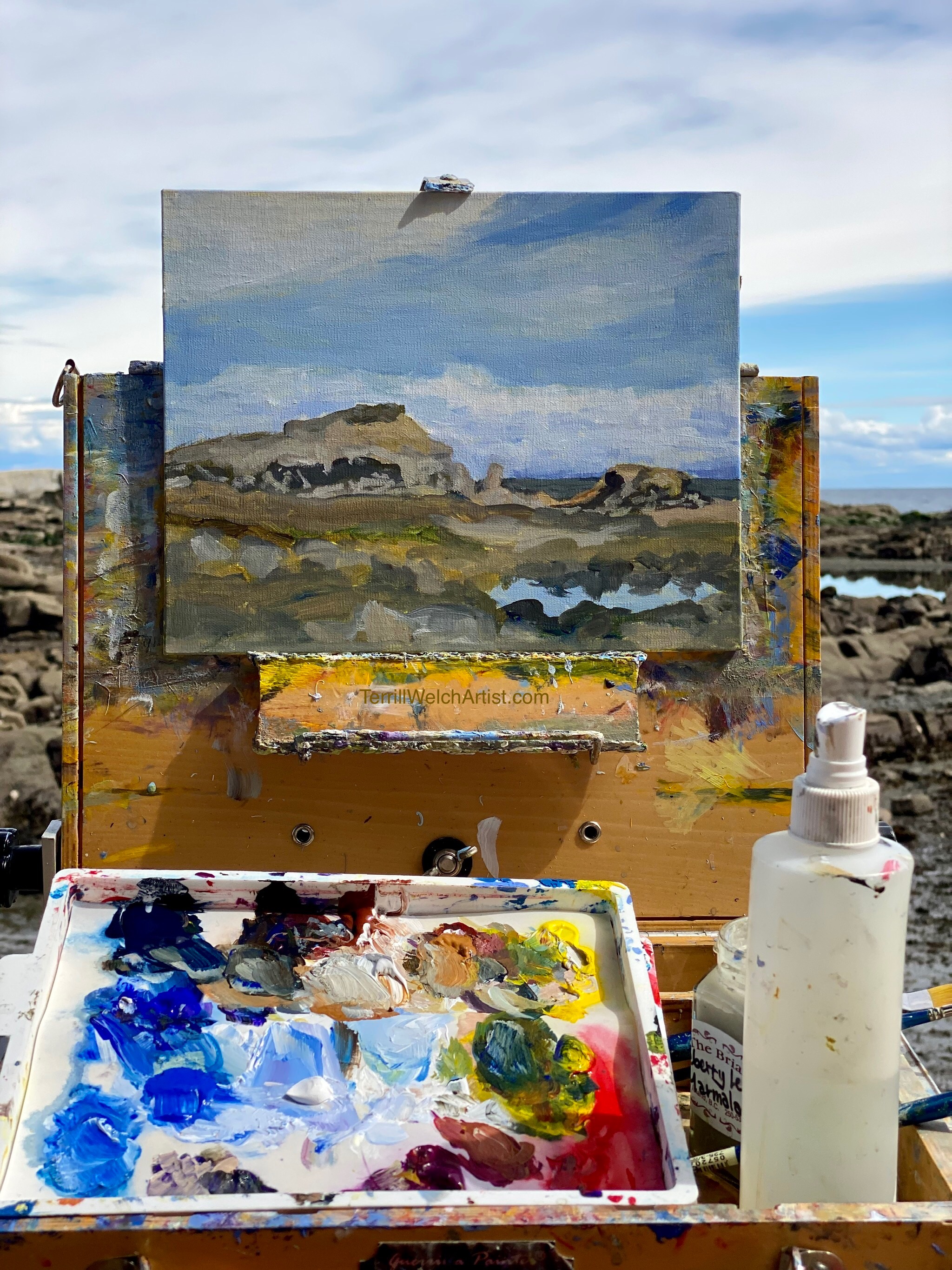
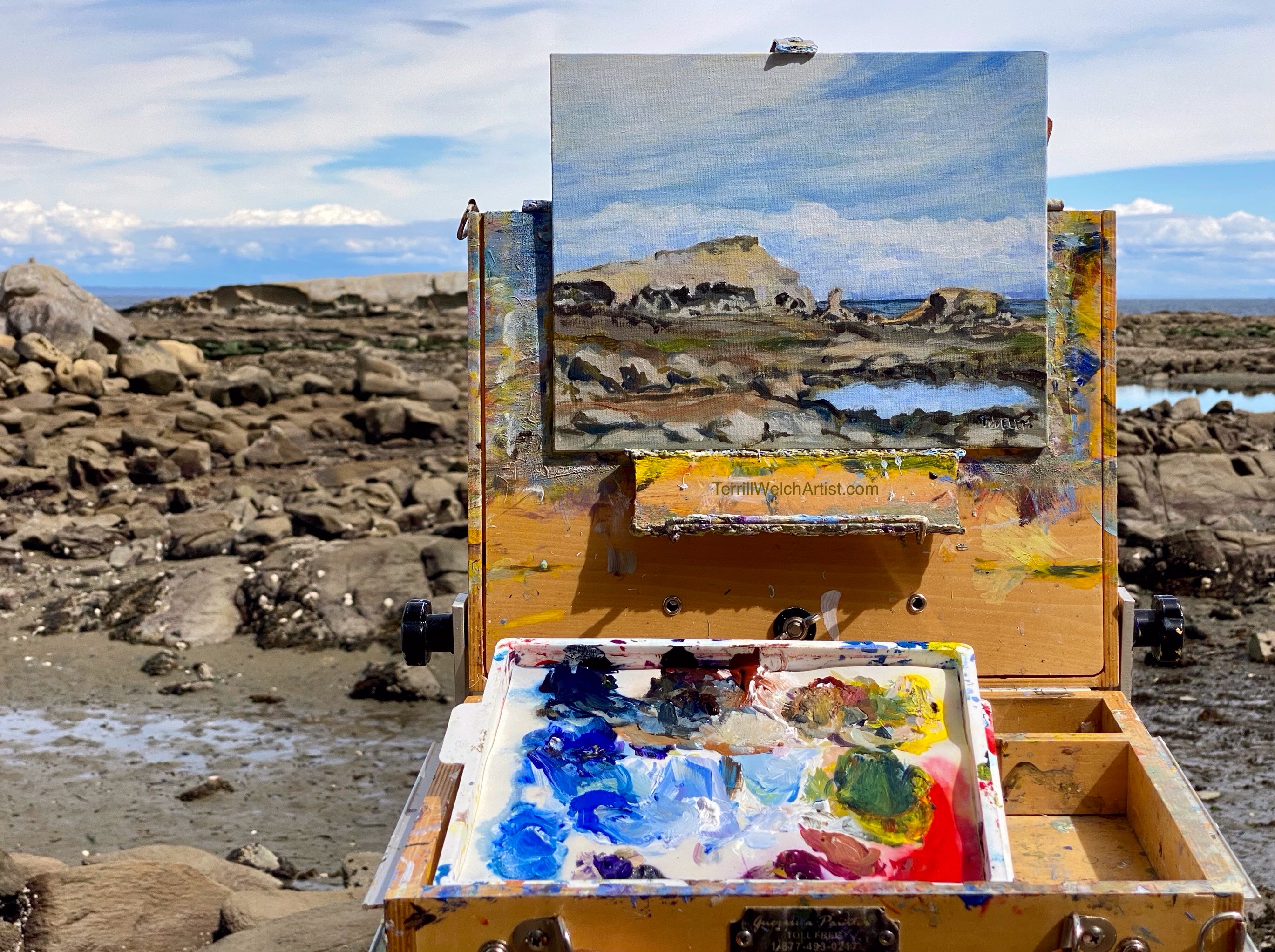
The references for this work were observations in the moment as I stood on the top of an exposed piece of sandstone in front of my easel in Oyster Bay on (what is now called) Mayne Island in British Columbia, Canada. 

Setting up to plein air paint at Oyster Bay in late August. Photograph by Terrill Welch, Friday, 28 August 2026.

When I began there was a couple making their way along the shoreline and a couple of construction workers building a bench up above them. Other than this, I had the place to myself for the painting session. 

Making Process:

The painting process was direct and immediate as I captured the light first and then began to build up the forms of the sandstone.

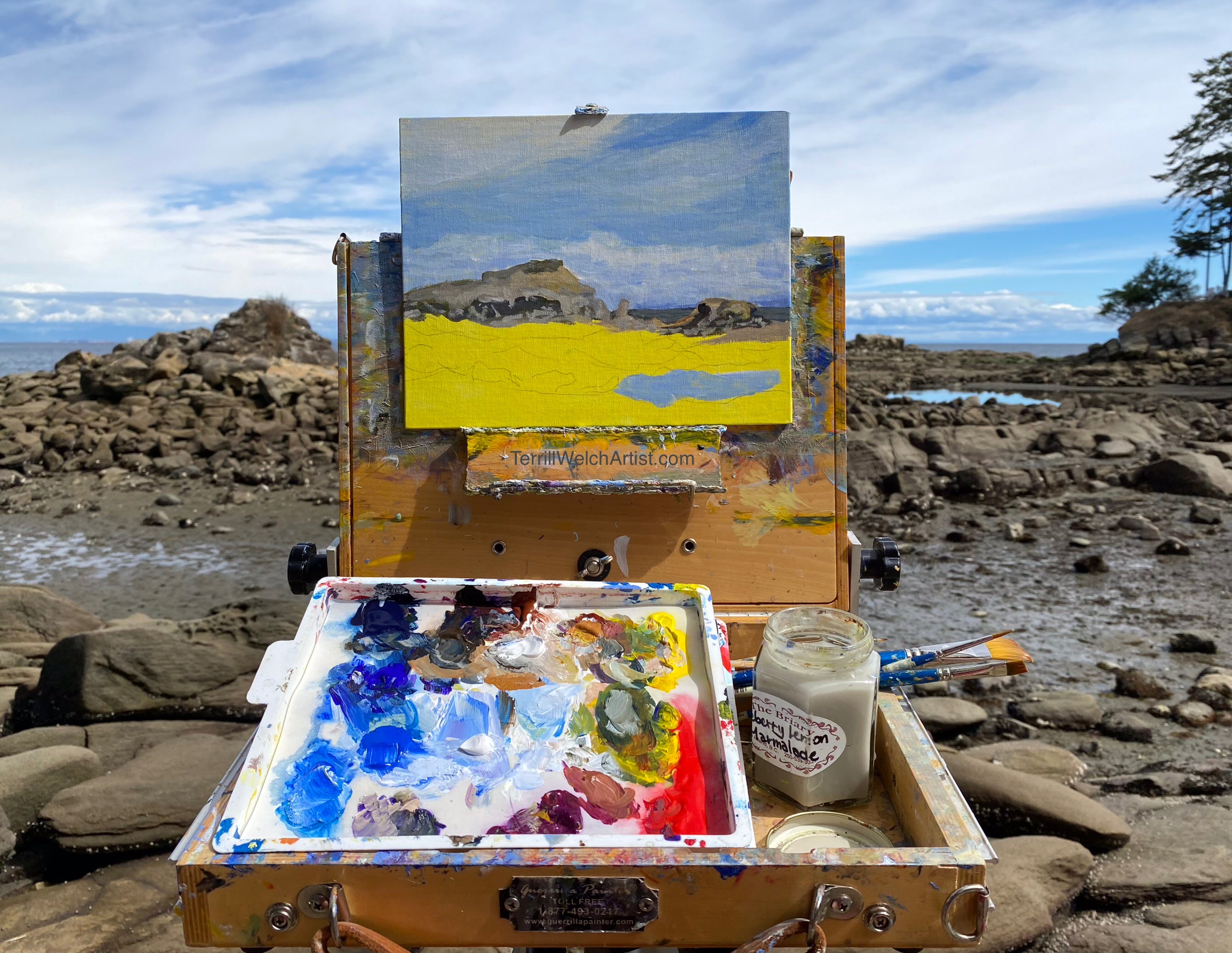
Work-in-progress — Oyster Bay Late August by Terrill Welch, 8 x 10 inch acrylic on linen board. Photograph by Terrill Welch. Friday, 28 August 2026.

I was working with an older palette from a previous painting sketch that had ran a bit from being tilted in my plein air backpack. But it worked.

Work-in-progress 2 — Oyster Bay Late August by Terrill Welch, 8 x 10 inch acrylic on linen board. Photograph by Terrill Welch. Friday, 28 August 2026.

Eventually I managed to get everything blocked in and was able to slightly refine the piece before my available time came to an end.

Still on the easel — Oyster Bay Late August by Terrill Welch, 8 x 10 inch acrylic on linen board. Photograph by Terrill Welch. Friday, 28 August 2026.

Finished Painting:

Oyster Bay Late August by Terrill Welch, 8 x 10 inch acrylic on linen board. Completed August 28, 2026.

Making Notes:

I set the plein air easel on top of the sandstone and looked east over to the rocks exposed in a low tide. The day is pleasant with blue skies holding shapely clouds in the late August sun. I stay for a while with my brush in hand and drift through an hour of painting. It is my birthday and this is my gift to me.

Reflective Analysis:

I had been offered a chance to go out on my own while knowing someone was with my partner who has dementia but still is able to stay by himself for a few hours at a time, if set up with a note to remind him when I will be back and where I have gone. But it is always more freeing if someone is with him. It was a generous offer. She thought I could go for lunch with a friend or something for my birthday. I responded that what I would like to do is go plein air painting because I already had family coming over to visit on several different days for my birthday. She laughed and replied — of course you want to go paint for your birthday! 

Reflexive Analysis: 

One of the odd things to me about being a full time caregiver is that I do not crave time with friends or other people so much. We go out for breakfast or lunch a couple of times a week and then there are the times I see people when getting groceries or picking up produce at the Saturday market plus, I engage daily online while presenting my work. I was invited to join a philosophers café that meets once a month and I accepted as a way to have meaningful deep discussions in-person on topics of interest. This complete package of in-person engagement with others always seems like enough socializing for me. What I crave most is just a few hours at a time on my own. I can still get this but it can’t be for very long at a time. Two hours is ideal and three is stretching my partner’s ability to feel confident on his own. So when given a choice to go for lunch or go plein air painting, the painting wins. This is because I am certain that my time at the easel will offer regeneration and delight. It fills my personal bucket like nothing else has ever been able to do. Just me and nature working together for a focused 45-60 minutes. This is all it takes. Hiking the trails alone does a similar thing but painting is the very best! I always come home filled with satisfaction and refreshed. This is the reparative element to my painting practice in action. 

Key Findings: 

I thought I would do more with this small study back in the studio. But as I spent the next few days glancing at it on the window ledge amongst various other small works, I decided nothing more I did would improve my impressions of this time beside the sea. So I have left it just how it was when I packed up to come home. 

Anything else: 

I am still considering what or if I will do anything on larger surfaces with these recent small painting sketches. I am in no rush to make a decision. The weather to best enjoy painting outside with the golden fall light is brief and will soon come to an end. I can decide once the rains keep me inside more. 

Arbutus in August Painting Data Collection

Painting Data Collection 

Title: Arbutus in August Date Completed: Wednesday, 19 August 2026
Materials: acrylic on linen board
Size: 10 x 8 inches (25.4 x 20.32 cm)

Figurative/Abstract Self Assessment Band-Scale Rating between 1-10: 5

This small plein air study is clearly responsive to the seasonal moment and light and has an impressionist immediacy. I can still feel the warmth of the sun on my back when I look at it. 

Reference Gathering: 

The reference was the view itself as I stood at the easel.

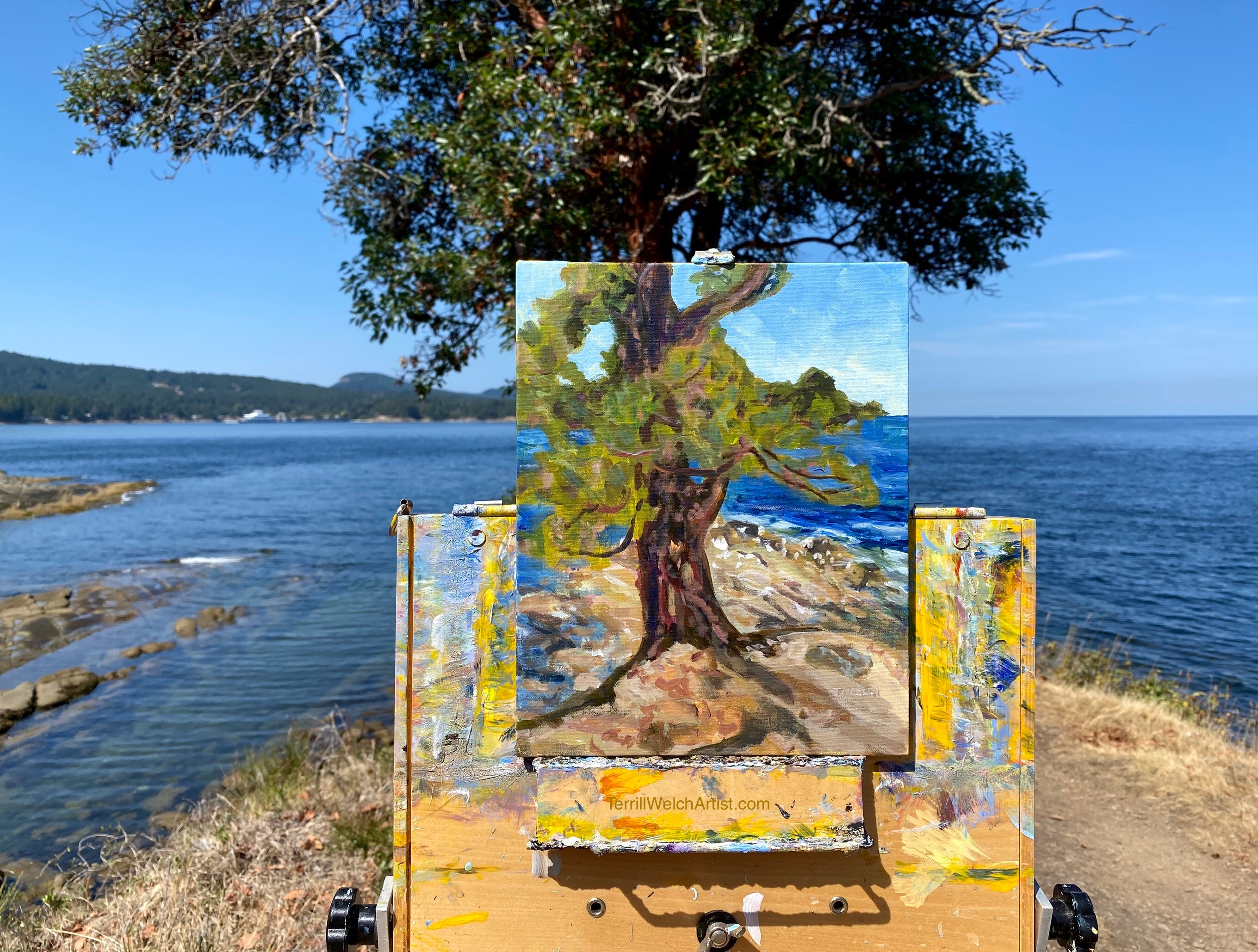
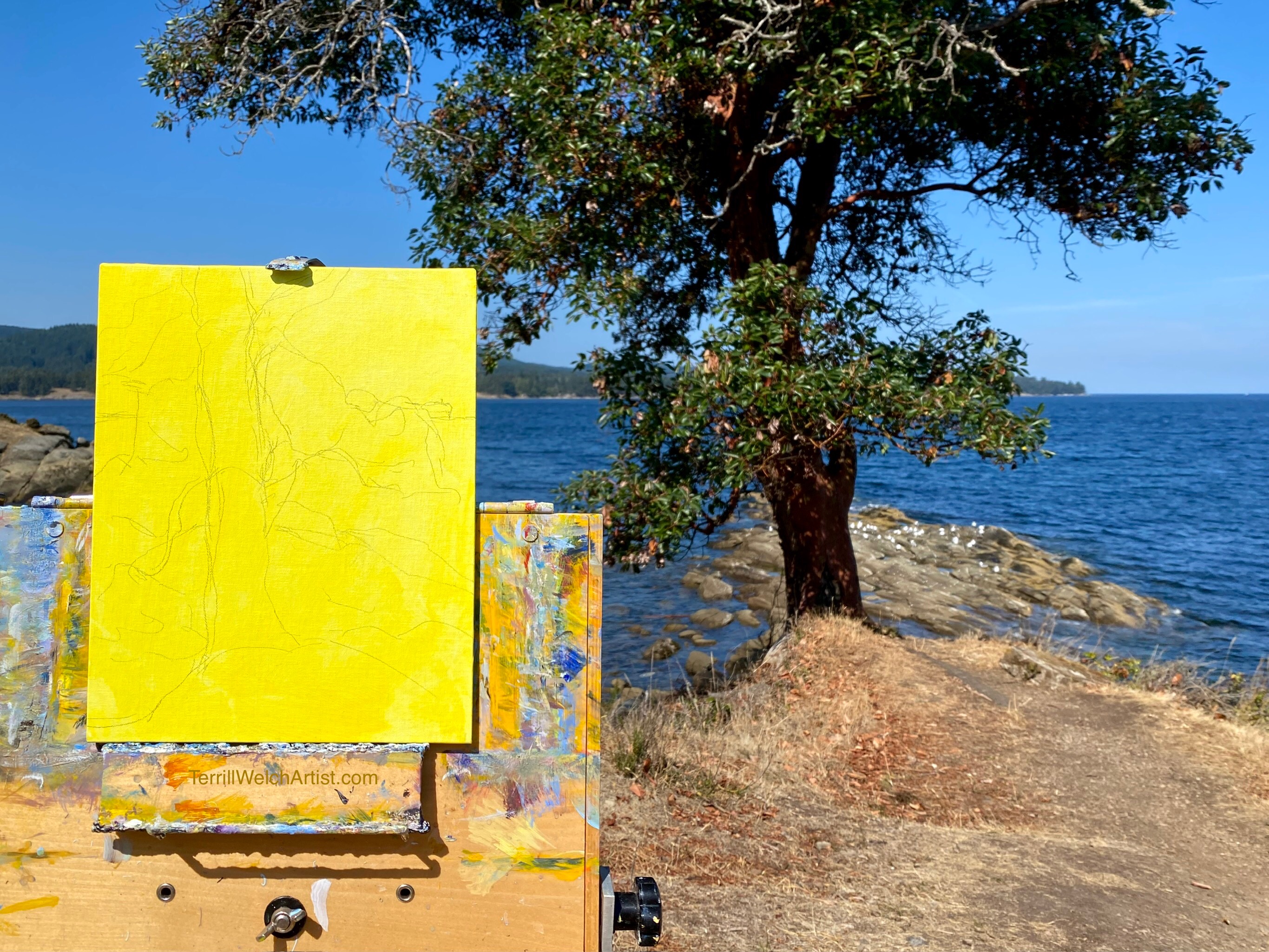
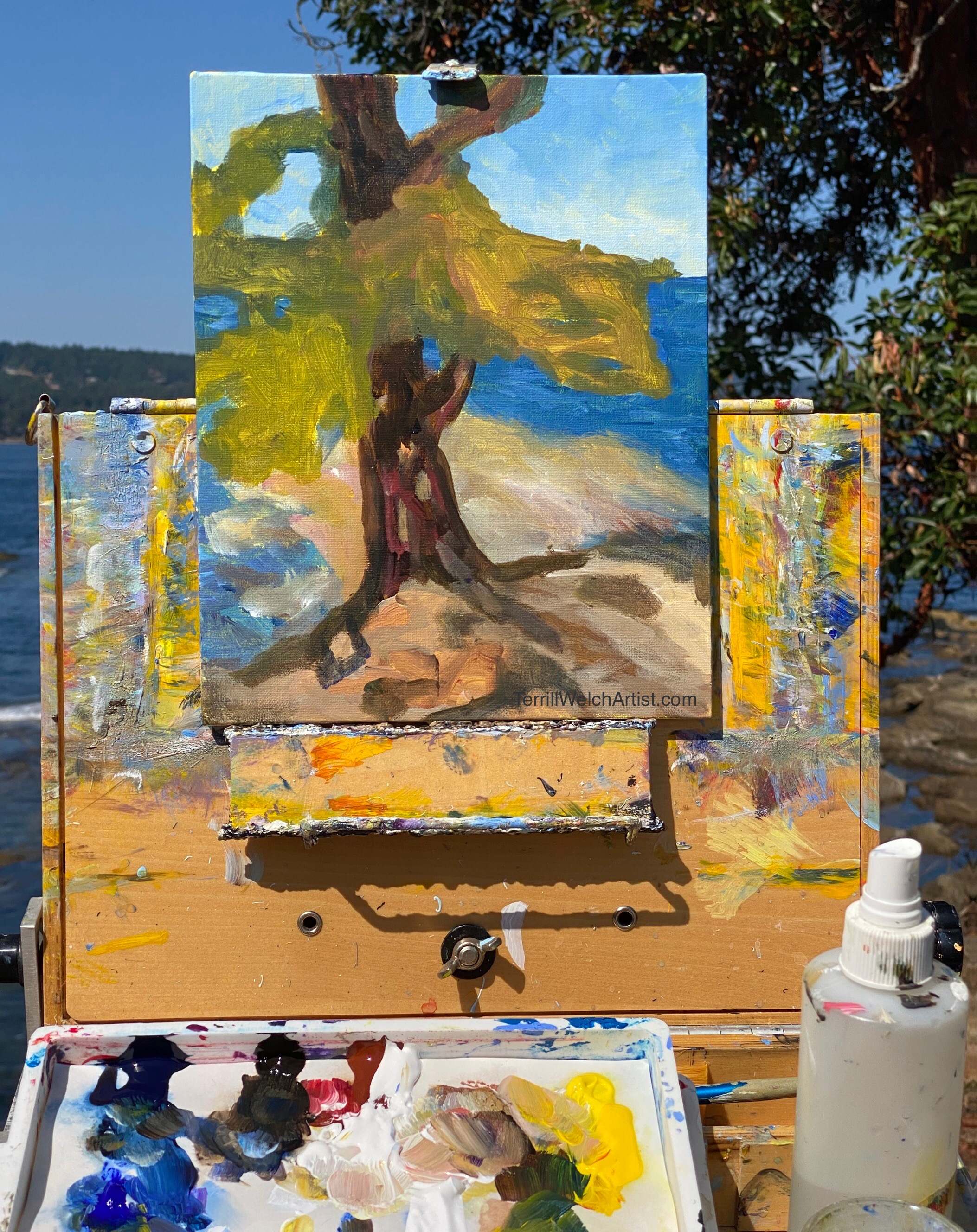
Still on the easel – “Arbutus mid August Study” by Terrill Welch, 10 x 8 inch acrylic on linen board. Quick plein air painting sketch at Georgina Point on Mayne Island in British Columbia, Canada.

Making Process:

My making process was familiar in the sense that I wanted to catch the light references first and then build up the painting from there. 

Sketched in — “Arbutus mid August Study” by Terrill Welch, 10 x 8 inch acrylic on linen board.
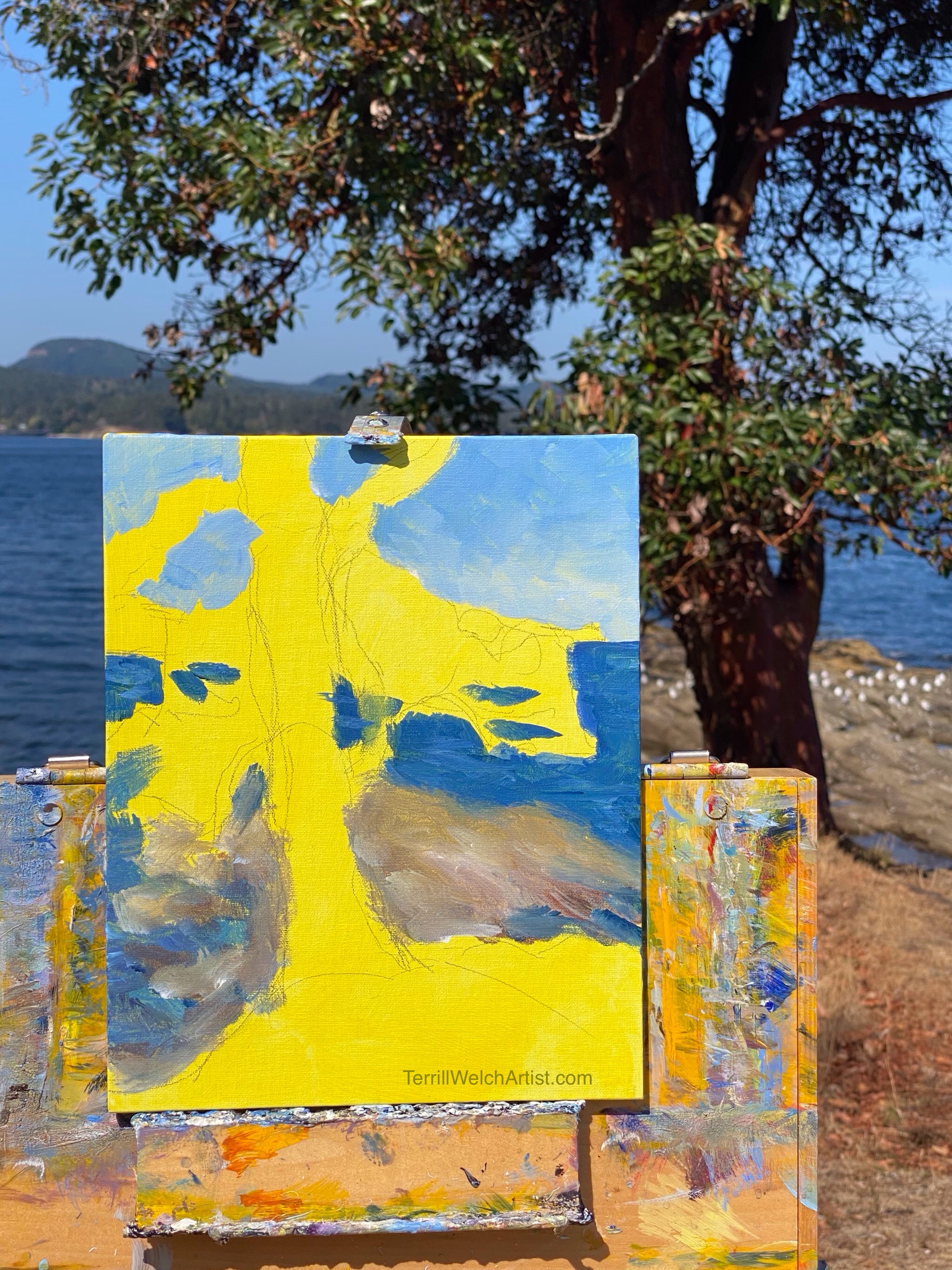
Work-in-progress — “Arbutus mid August Study” by Terrill Welch, 10 x 8 inch acrylic on linen board.

Finished Painting:

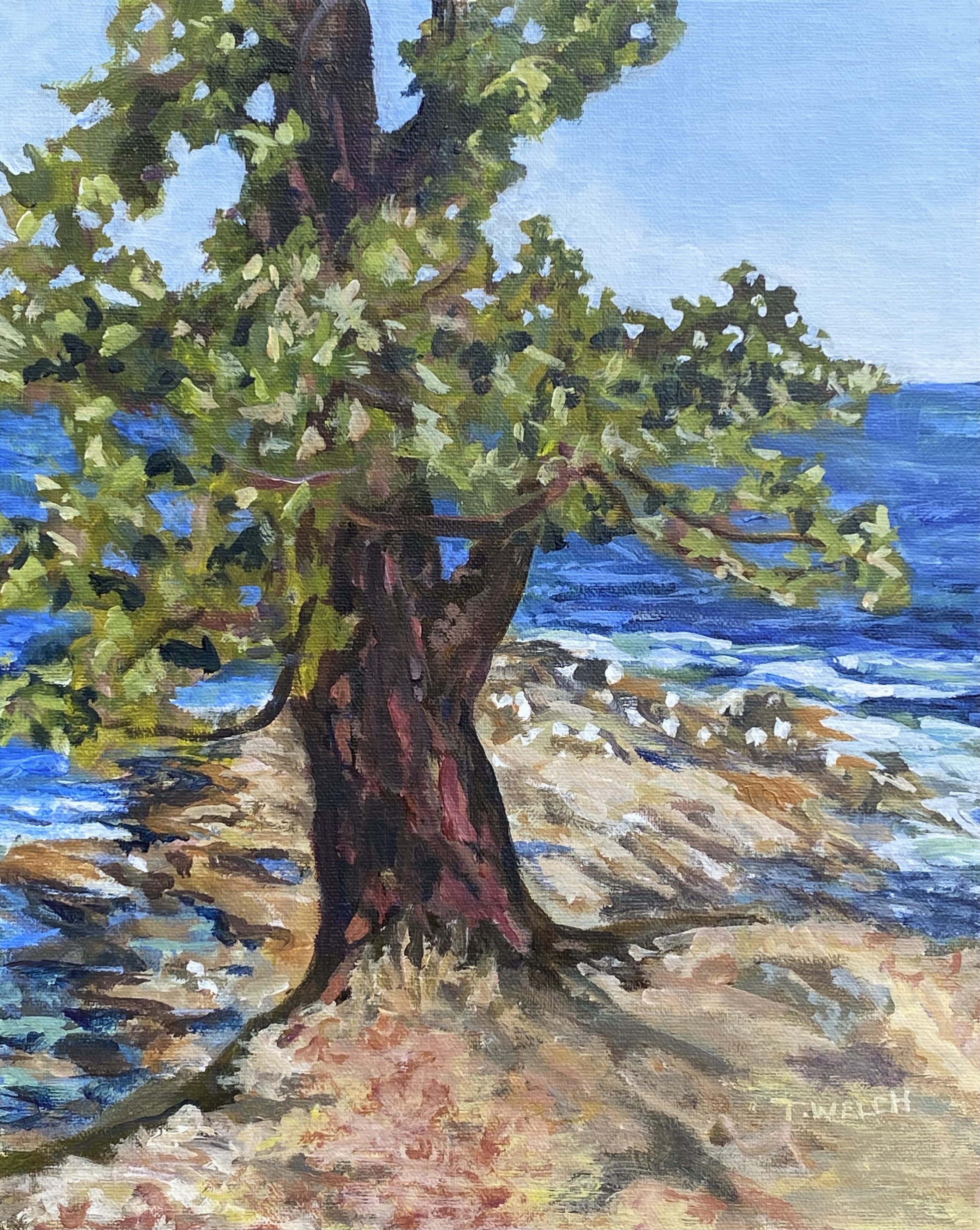
“Arbutus in August” by Terrill Welch, 10 x 8 inch acrylic on linen board. Completed Wednesday, 19 August 2026.

Making Notes:

I focus on catching the full range of my sensory experience in the small plein air painting from the light breeze to breaking waves, seagulls squawking and the feel of the sun on my shoulders and the dryness of the acrylic paint on my brush as it contacts the linen surface. There is a powdery dry feeling mingling with the coolness from the sea to the mid August air. I linger after packing up. The moment is pleasant and yet holds a warning, like splitting the winter’s wood on a warm summer’s day. That freshness foreshadows the coming of shorter days and brisk winds and heavy rains. This arbutus tree will be ready and so will I.

This is a quick plein air painting sketch at Georgina Point on Mayne Island in British Columbia, Canada and adds to my reference work for my current “Close to Home” series. The range of brushstrokes are impressionist in a painting language that I find best facilitates my sensory conversation with nature.

The painting is already listed so you are welcome to visit my online gallery if you wish at: https://www.artworkarchive.com/profile/terrill-welch/artwork/arbutus-in-august 

Reflective Analysis:

These long moments of observation while plein air painting anchor me within the seasons and the rhythm of my daily living. A walk or a photoshoot doesn’t have the same sustained intensity of experience that standing at the easel in front of my subject while the lights and shadows progress with an unstoppable certainty. It is that tension between a full stop and infinity which spirals endlessly as I squint and make yet another mark on the surface of the canvas. 

Reflexive Analysis: 

There are things I do where I feel the strength of every cell that is engaged in preserving my life force. The intensity of plein air painting is right near the top of this list of things. I seem to become permeable with my surroundings through my all encompassing sensory awareness that results from settling in with nature. This is the reparative or healing aspect of my work in its most tangible form. It is not a state that I maintain for more than about 45 or 60 minutes at a time but the effect of these painting sessions can last for hours and even days with the distinct possibility of tapping back into them every time I look at the sketch or use it as a reference for a larger work in the studio. It feels like muscle or cellular memory that is stored in various parts of my body and then used and replenished as I view the sketch or work on a new work that recalls that moment through the sketch. Most often these sketches are less about experimenting and much more about gathering information in substantial abundance that it can be used later on. 

Key Findings: 

I have a habit of either dismissing my quick painting sketches or else expecting too much from them. They are my first impressions of an idea or composition and complete in their own right. 

Anything else: 

Not at this time. 

Podcast Episode: Painting Nature And Grief

Pip: Welcome to Creative Potager, where the paint is still wet and the questions are older than the canvas.

Mara: This episode draws from Terrill Welch’s recent posts — we’re moving through landscape painting on the Salish Sea shoreline, the pauses and decisions that shape a painting mid-process, and the harder territory of grief and creative repair.

Pip: Let’s start with the arbutus trees and what it means to keep returning to them.

Painting Arbutus Trees on the Salish Sea Shore

Mara: The first post opens at seven in the morning on a sandstone shoreline — the question underneath it is what it means to paint the same subject repeatedly and still find it necessary.

Pip: The post frames it directly. The setup is a hillside at dawn, references gathered, canvas waiting — and then this: “I have painted these arbutus trees many times but I am never done with them. There is a spiritual connection that seems to happen with arbutus trees.”

Mara: So the repeated subject isn’t a habit or a comfort zone — it’s an ongoing conversation. The tree is a place to put something down, literally: losses and grief as compost, released into the soil rather than carried.

Pip: And the companion piece, Solace Between Sea and Sky Painting Data Collection, makes that concrete. The finished painting took nineteen days of focused work — plus, as the post puts it, fifty years of practice.

Mara: The data collection post is unusually candid about why the solace was needed. New caregiving routines, exhaustion, a partner with dementia. The arbutus tree becomes, in that context, a symbol of quiet, determined striving.

Pip: Which is exactly what Martin Gayford argues painting demands — the post quotes him: “Making a truly powerful and original painting is very hard.” The response here isn’t to aim for brilliant. It’s to keep the conversation going rather than go silent.

Mara: That’s the real stakes of the segment — not mastery, but refusal to stop speaking.

Listening to What the Canvas Needs

Mara: Answering the Painter’s Questions sits inside the same painting’s timeline and asks something specific: what do you do when the work stalls and won’t proceed?

Pip: The answer is — you wait. The post describes leaving the canvas “sitting in an awful awkwardness as if caught in an elaborate pose of painter’s frozen tag.”

Mara: What follows isn’t paralysis. It’s a walk, a birthday, an hour of painting when the window opens. The post frames every decision — abstract the foliage or not, make the tree pop — as provisional, each answer undoing several others already made.

Pip: Painting is a process of endless decisions and often there are no right answers. Just better ones, eventually.

Grief, Caregiving, and the Reparative Turn

Pip: The Reparative Turn in Painting names the hardest territory directly — what does a painting practice mean when you’re watching someone you love decline?

Mara: The post anchors itself in a specific art-historical idea: “What does the reparative turn in my painting practice mean under these circumstances? I am surmising it flexes on my desire, for now, to stay grounded and rooted on this earthly plain of existence.”

Pip: Monet painting beside his dying wife. Munch recording his sister’s death. Those are the predecessors named here — but the post draws a careful distinction. Those were final moments. Caregiving dementia is the long preceding journey of knowing and watching and bracing.

Mara: The painting that launches from this post is the same arbutus tree, the same lemon-yellow ground. The creative act and the grief work are not separate projects.


Pip: Three segments, one shoreline, one persistent question about why we keep making things when everything is hard.

Mara: The next episode will show us where that question leads — keep painting, as the post says. Just keep painting.

Note: this is a fictional dialogue created with WordPress AI using content from Terrill Welch’s recent Creative Potager posts to make a podcast summary for people who like to listen as well as read.

The posts used are:

And…

The Reparative Turn in Painting: Embracing Grief and Creativity

Wednesday, July 8 2026

Painting the Beauty and Sorrow of Loss – beginning the Close to Home Series

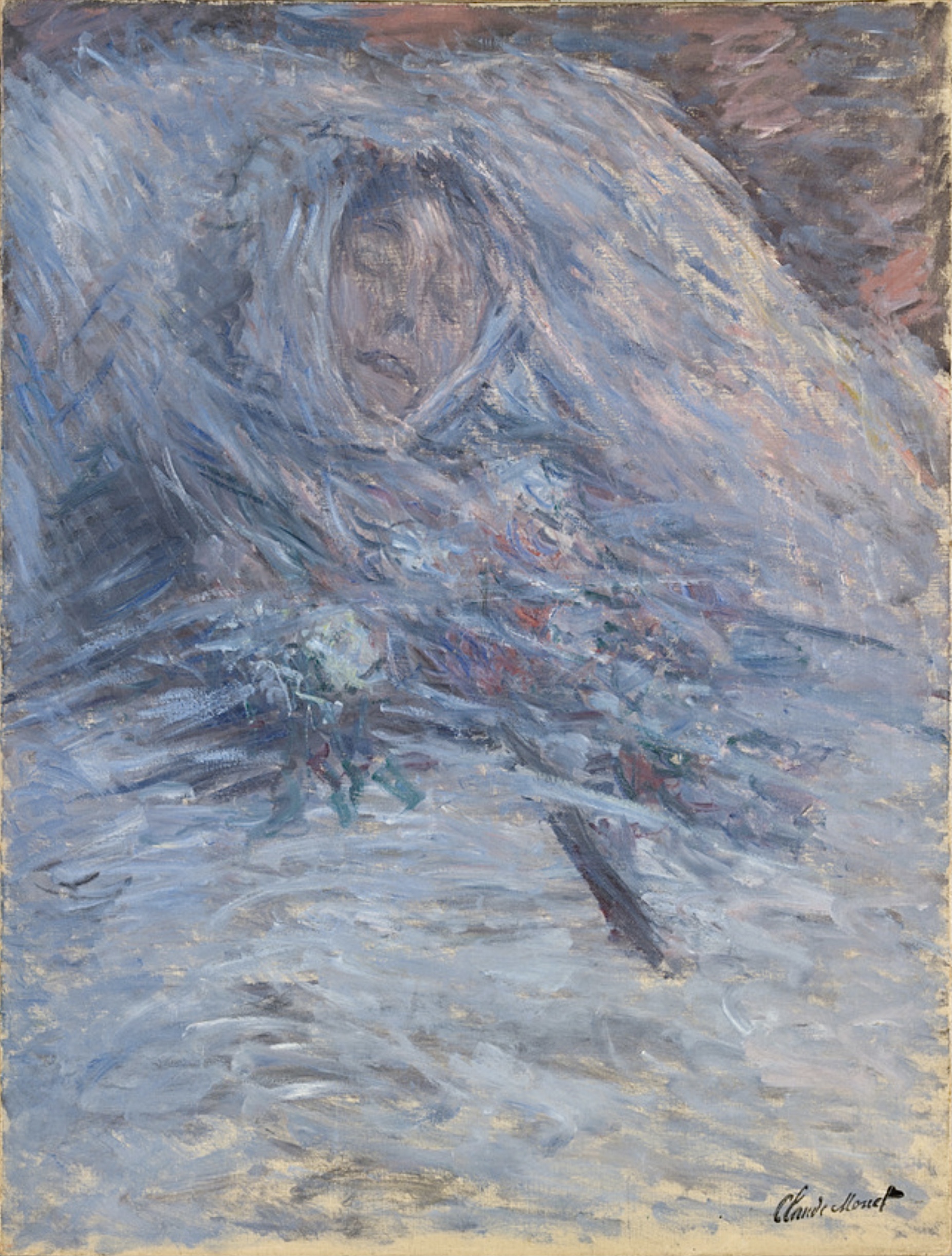
This series will require courage and bravery to honestly and frankly find my balance between beauty and sorrow within loss. I have other painters before me who have faced such challenges through their own brushes, such as “Camille on Her Deathbed” by Monet from 1879 where he stood painting beside his wife Camille, who was dying. 

Camille on Her Deathbed by Claude Monet, 1879.

Then there was time Monet was painting the lily pads following the death of his son while the echo from the guns of battle were audible in the distance. There is also Edvard Munch and “Death in the Sickroom” from 1893 when he recorded the death of his sister to tuberculosis.

Though these are more final moments rather than the proceeding journey of knowing and watching and bracing oneself that comes from caregiving someone in the later stages of dementia. 

What does the reparative turn (Forrester, 2020) in my painting practice mean under these circumstances? I am surmising it flexes on my desire, for now, to stay grounded and rooted on this earthly plain of existence. I will unpack this further as I continue to work over the months ahead. This is where my first painting in this series begins with painting the portrait of an arbutus tree along the shores of (what is now called) Mayne Island next to the Salish Sea – from the ground up. 

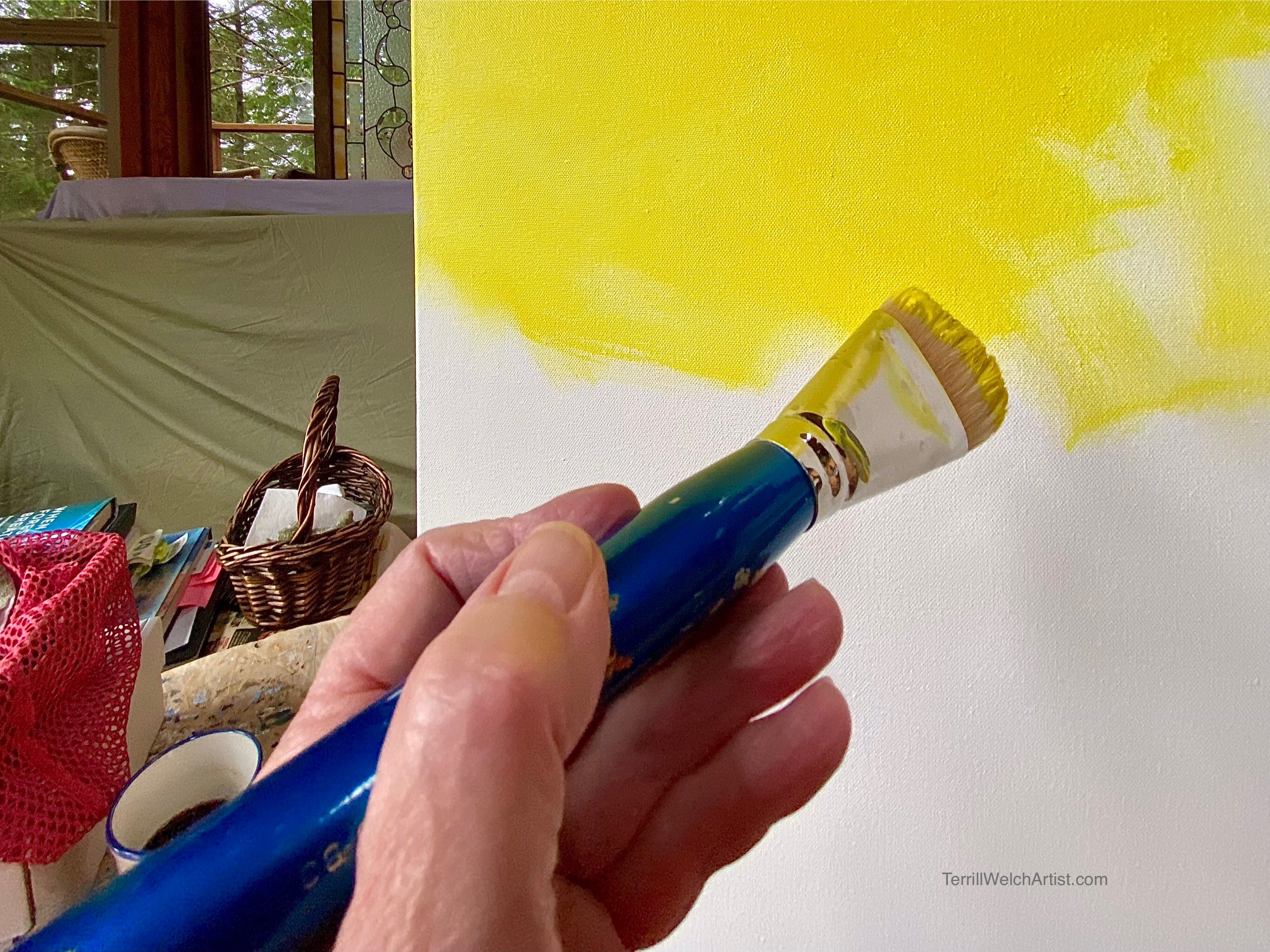
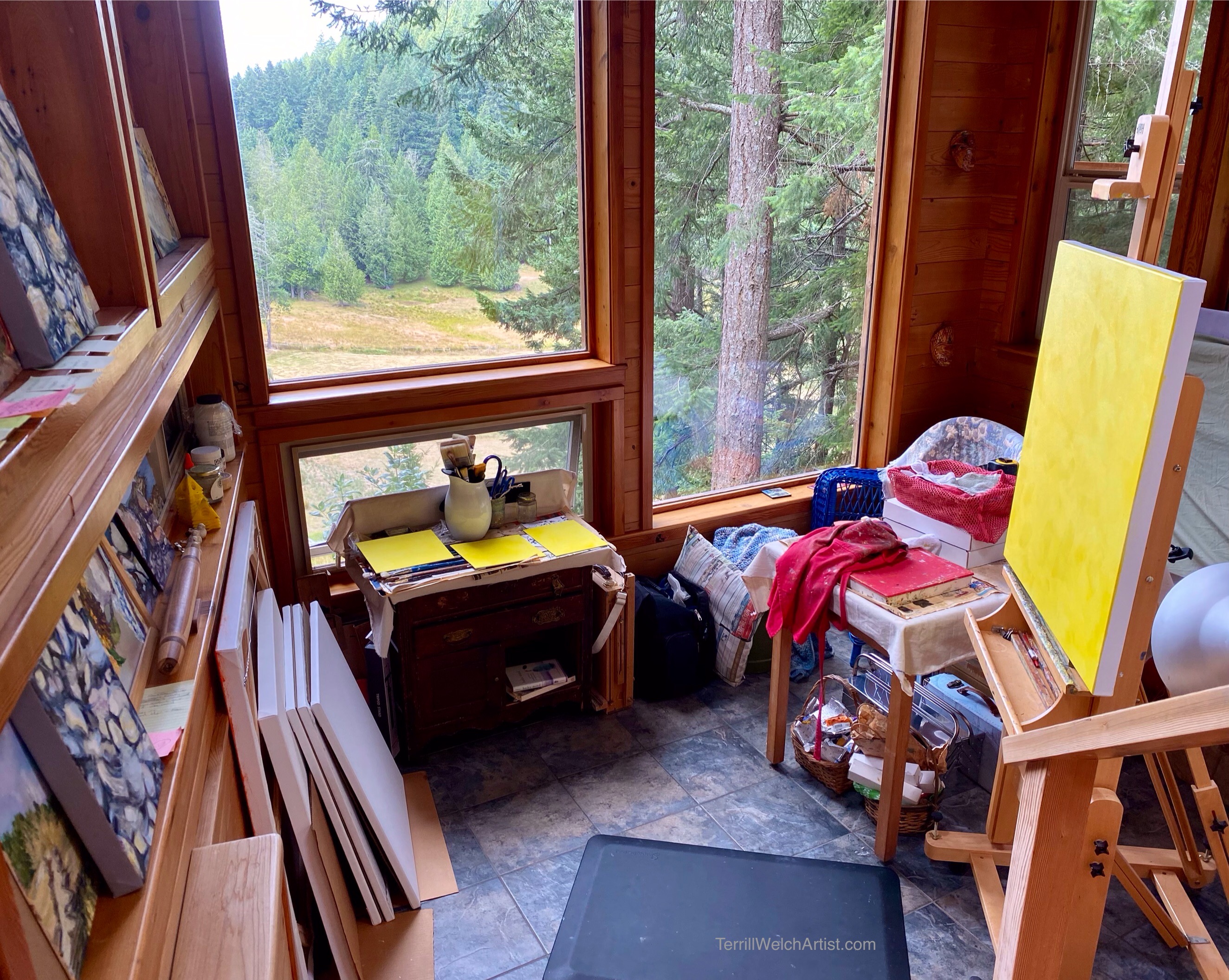
The morning began with painting acrylic lemon yellow grounds on a larger 31.5 x 27.5 canvas and three smaller 8 x 10 inch linen boards that will be used for studies and plein air painting. 

Terrill Welch laying down a lemon ground on a large cotton canvas in the overcast morning of the studio as her coffee grows cold. July 8, 2026.

There is something palatably thrilling in the tension that coils up inside the core of my being when I am about to launch into a new body of work. 

View down into the wood framed windows of art studio of Terrill Welch with small finished work lining the ledge on the left, new small linen boards with yellow grounds on an old washstand under the window. On the right a crumpled corner with throw and studio blue chair before the enamel topped table holding the artist’s apron resting on a covered palette beside the large wood easel with a substantial canvas with an equally bright yellow ground. A black anti-fatigue mat rests waiting in front of the easel on the grey stone finished ceramic tiles.

The only question remaining is – do I start the new work or paint the edges of recently finished pieces first? 

Reference List: 

Forrester, S. (2020). Painting from the Other Side: Tracing the Reparative Turn in Contemporary Practice. Art/Research International: A Transdisciplinary Journal, 5(1), pp.116–147. doi:https://doi.org/10.18432/ari29486 

REAWAKENING MY PUBLIC ART RESEARCH JOURNAL

Monday, July 6 2026

For the past two years I have kept an art research journal as part of my MA Fine Art Studies. Many of these posts have been featured in my “Terrill Welch by herself” newsletter. However, my degree studies are coming to a close. I am beginning a new series of work. Since I have found the art research journal useful, I have decided to continue the practice here, even though this space has, for the most part, been dormant since 2022. What is four years in a lifetime of an art practice!? Let’s continue!

You can learn more about my recent art autoethnographic theory and nature-centric reparative painting research practice, as well as my intentions for disseminating my new Seafloor series, on my website at: https://terrillwelchartist.com/disseminating-a-nature-centric-reparative-painting-practice/

You can also visit my individual final degree show that will opening on August 20,2026. It has to be up and published now for assessment by the university so you are also welcome to have browse if you wish at: https://terrillwelchartist.com/terrill-welch-five-seasons-ma-fine-art-final-show/

I will continue to develop my theory and art research led painting practice as I begin a new series, tentatively called “Close to Home”, as I again spend time with trees as I meander (what is now called) Mayne Island and at times capture domestic moment that connect nature with our daily habits within the shelter of our strawbale timberframe home.

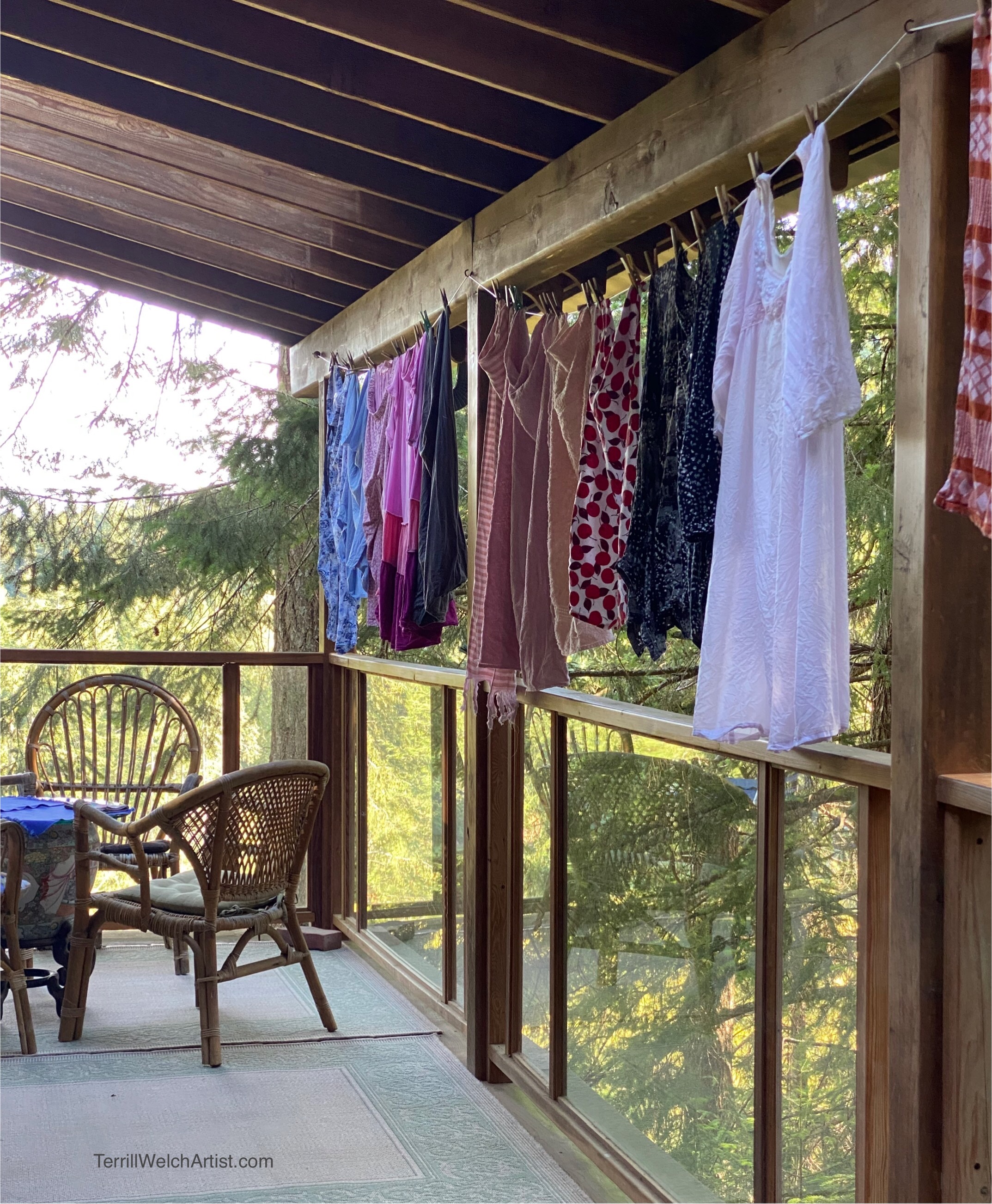
Early this morning at around 6:30 am, I was hiking Edith Point and think about how I might proceed. There is the most satisfying summer task of hanging laundry on the covered clothesline of the side porch.

Laundry drying on the line. Photograph by Terrill Welch. June 14, 2026.

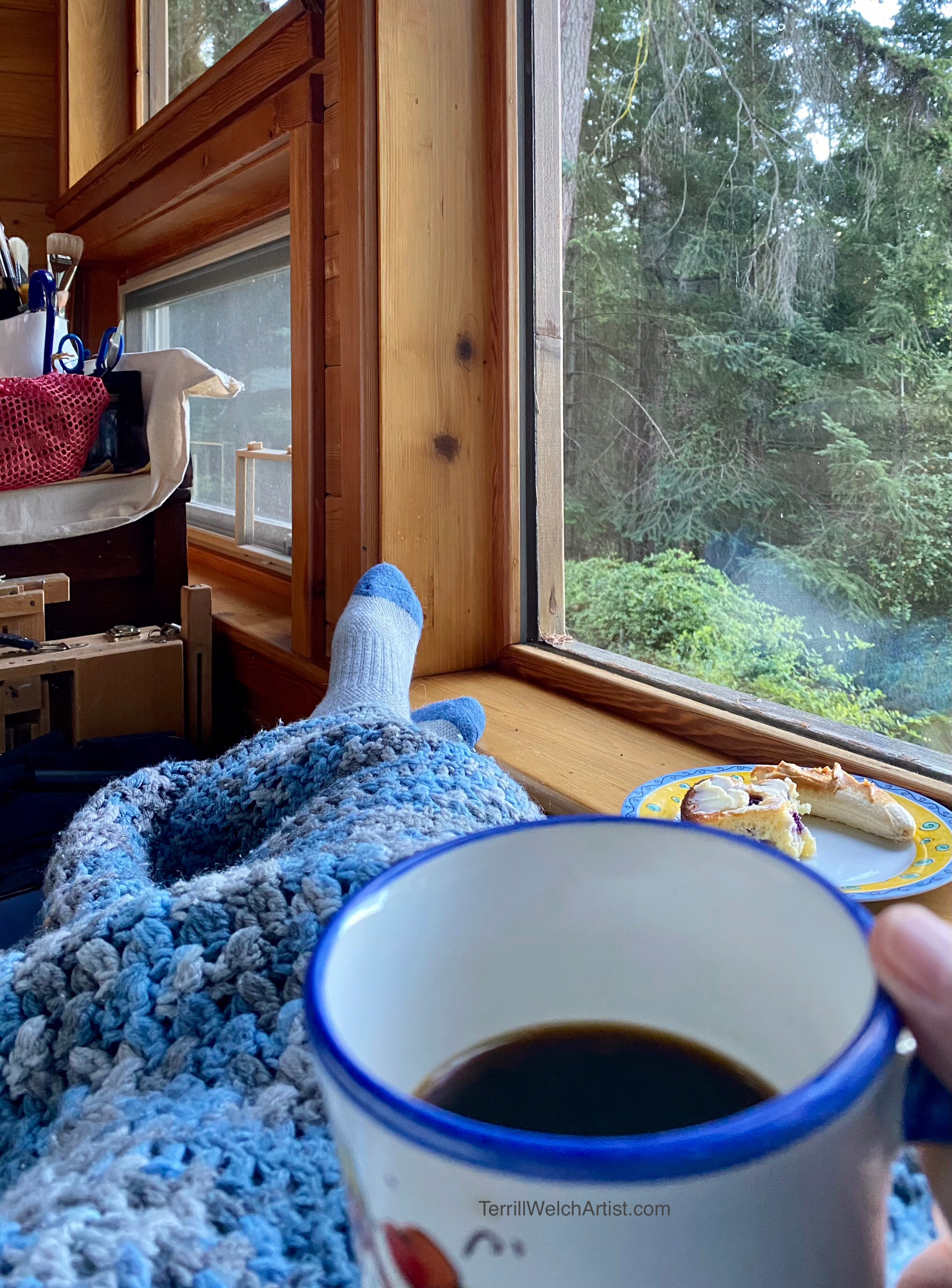
Or, if my significant other is still sleeping, there is my morning coffee ritual in the blue chair down in the studio as I watch the sun come around to catch the trees on the far hill.

Morning coffee in the blue chair of the art studio. Photograph by Terrill Welch. June 28, 2026.

Then again, reading on the bench on the other side of the house is also a moment I treasure.

Outside on the bench with wind in the trees for company drinking garden mint tea and reading the second half of Book of Lives: a memoir of sorts that I put down at the beginning of my 3rd and final term in an MA Fine Art degree delivered completely online. Photograph by Terrill Welch. July 4, 2026.

However, there is also the calm of a blue-green sea that make me exhale fully.

A calm green Salish Sea strikes an elegant pose. Photograph by Terrill Welch. June 28, 2026.

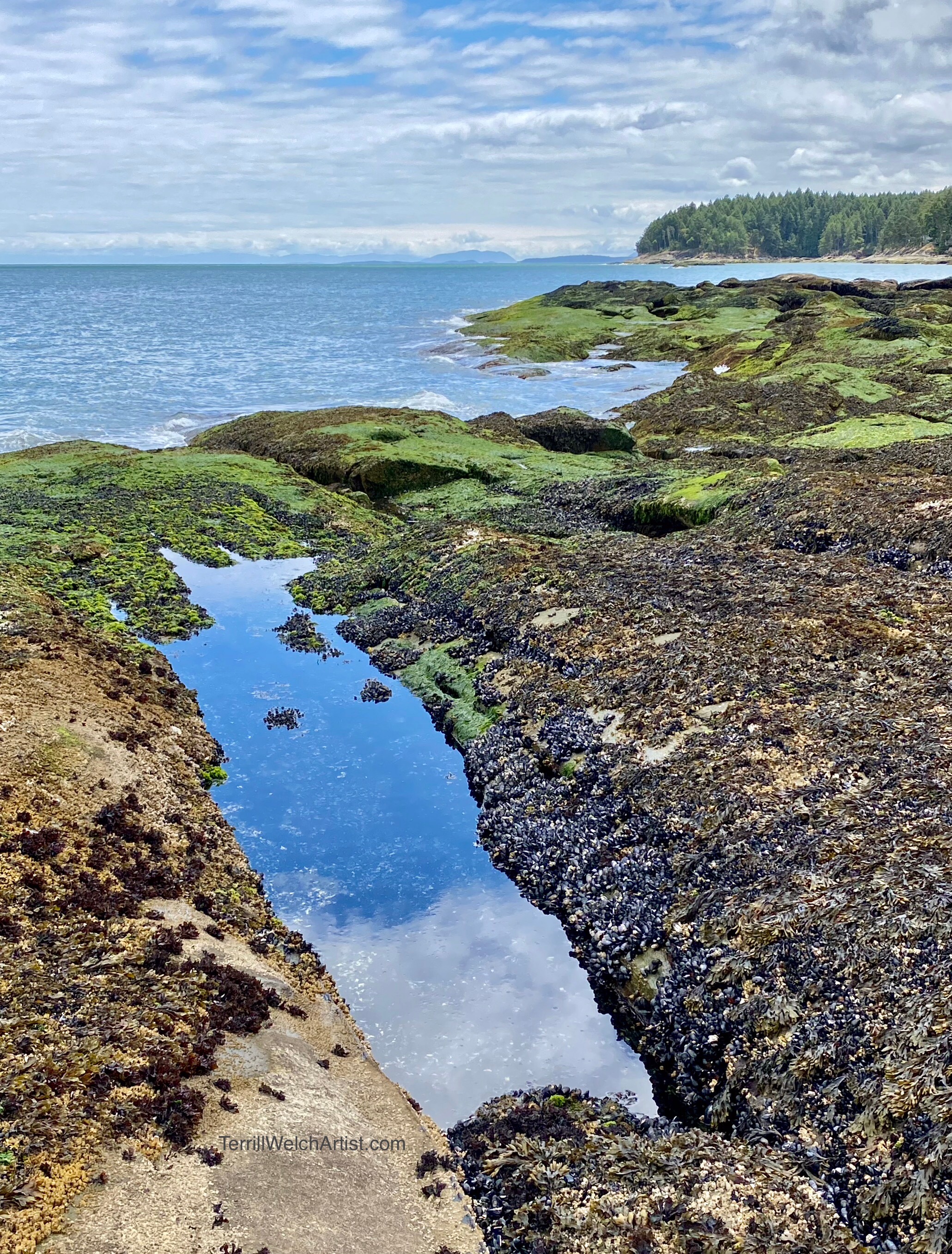
Or it could be sighting the clouds that show up in a tidal pool that holds my attention.

Clouds in a Tidal Pool. Photograph by Terrill Welch. June 28, 2026.

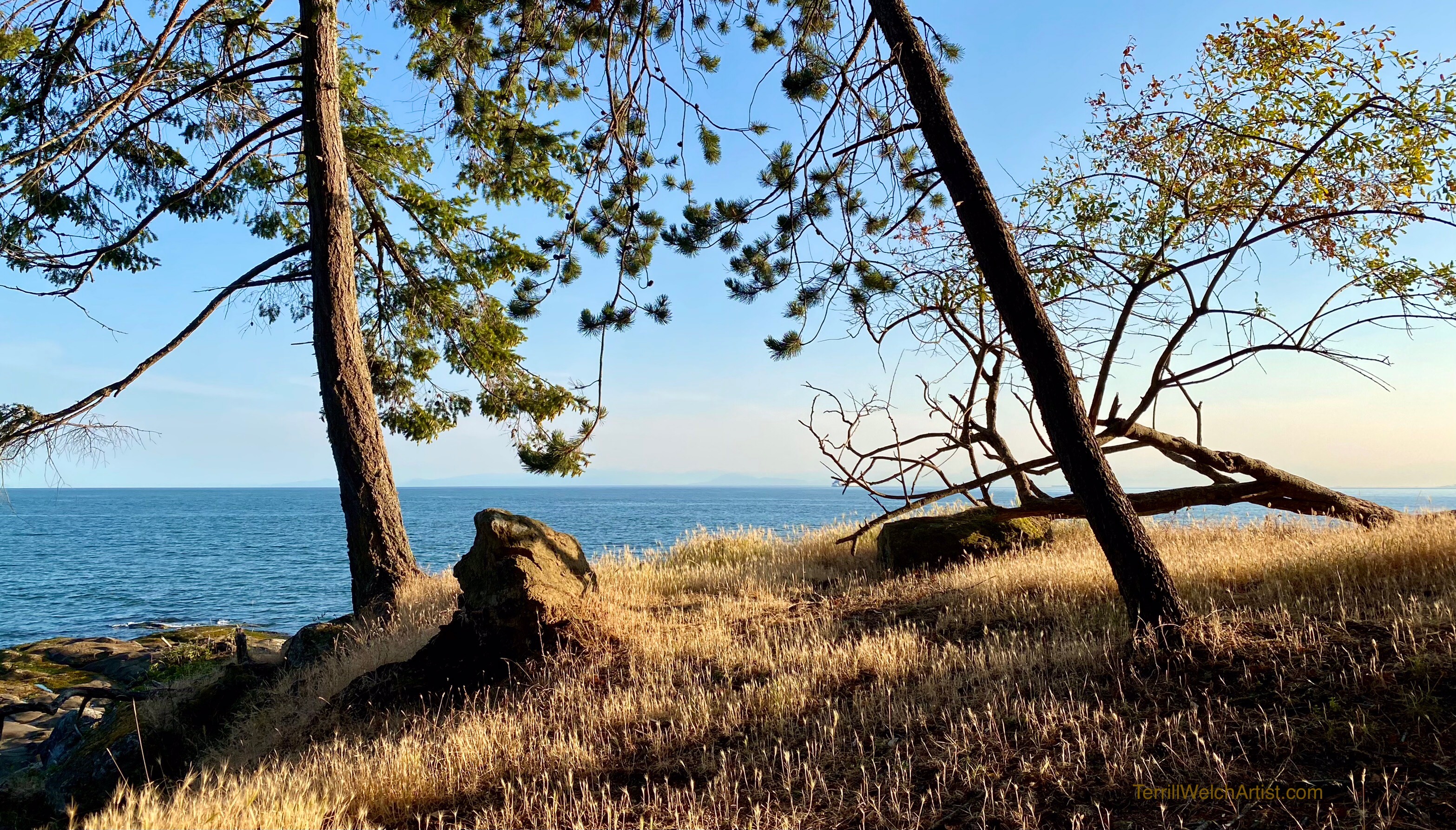
Yet, as I was walking along with the scent of soil and sea enveloping the lemony hue of the morning air around me, I thought about the trees and how they continue to teach me how to thrive while being rooted in one place. Maybe this would be a good place to start?

Early morning sun greeting the crest of a knoll next to the sea. Photograph by Terrill Welch. July 6, 2026.

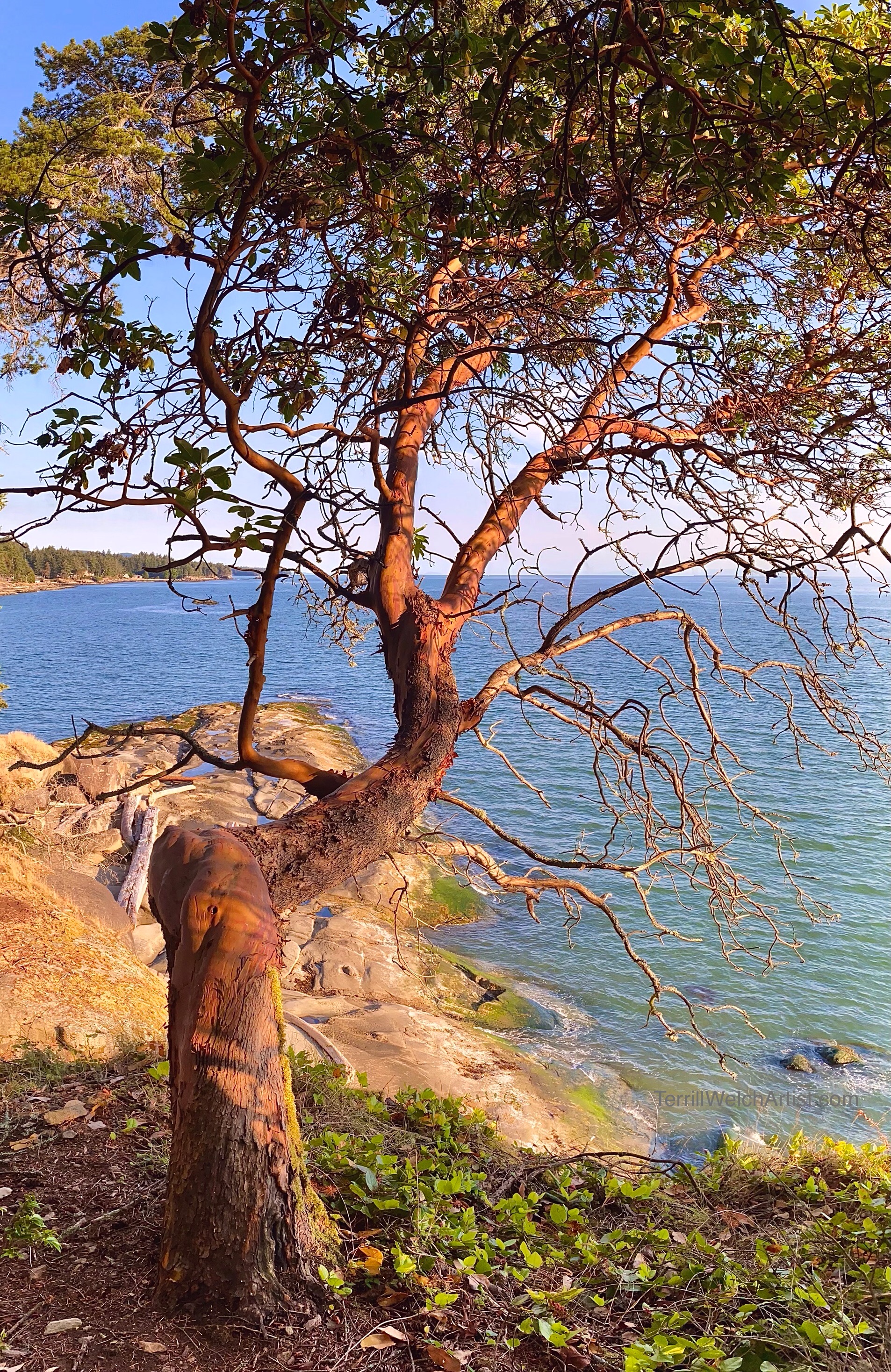
There is an arbutus tree that has yet to come under my brushes and I am itching to see what I can do for its portrait.

Arbutus tree catching the 7:00 am summer sun that is already warm and scenting the air with sea earth and a nearby pine tree. Photograph by Terrill Welch. July 6, 2026.

This tree might be the first of this new series to be tackled at the easel! We shall see. Right now, ideas are being filed into an album of references so that they are ready as soon as I get a chance to start.

Welcome to a new journey and adventure in my painting practice. I do not have a posting schedule but will likely add something new each week so I can keep track of what I am doing. Until next time! Feel free to comment if you wish.

I am alive. I choose kindness. I have work to do.

Wednesday November 6, 2024

I woke to affirm that our earth has again turned to give us a rising sun. I am alive. I choose kindness. I have work to do. I choose kindness and hope while respecting the collective choices of others. However, this does not mean I agree or that I do not have serious concerns about these choices. 

I have no expectation that this living thing will be easy. 

I am alive. I choose kindness. I have work to do. 

I choose this grand, out of my control, adventure.

In doing so, I will start by borrowing a few lines from a poem by John Roedel that he shared on his Facebook profile, November 4, 2024. (Roedel, 2024)

“You are living on a spinning wet rock of a planet that resides next to a constantly exploding fireball in the middle of an ever-expanding universe that is filled with mysteries beyond your wildest imagination.”

“And on this planet that you are hurtling through the great expanse in – you are coexisting with billions of other people who have free-will and their own experiences that shape their perspectives and beliefs.”

“And while all this is going on your soul is residing in a physical body that is such a miracle of delicate engineering that at any given moment could produce its last heartbeat.”

The poem, written as a conversation between god and a human, goes on to say that we have two things we can control. The first is kindness towards others and the second is kindness towards ourselves. 

I have no expectation that this living thing will be easy. 

I am alive. I choose kindness. I choose hope. I have work to do.

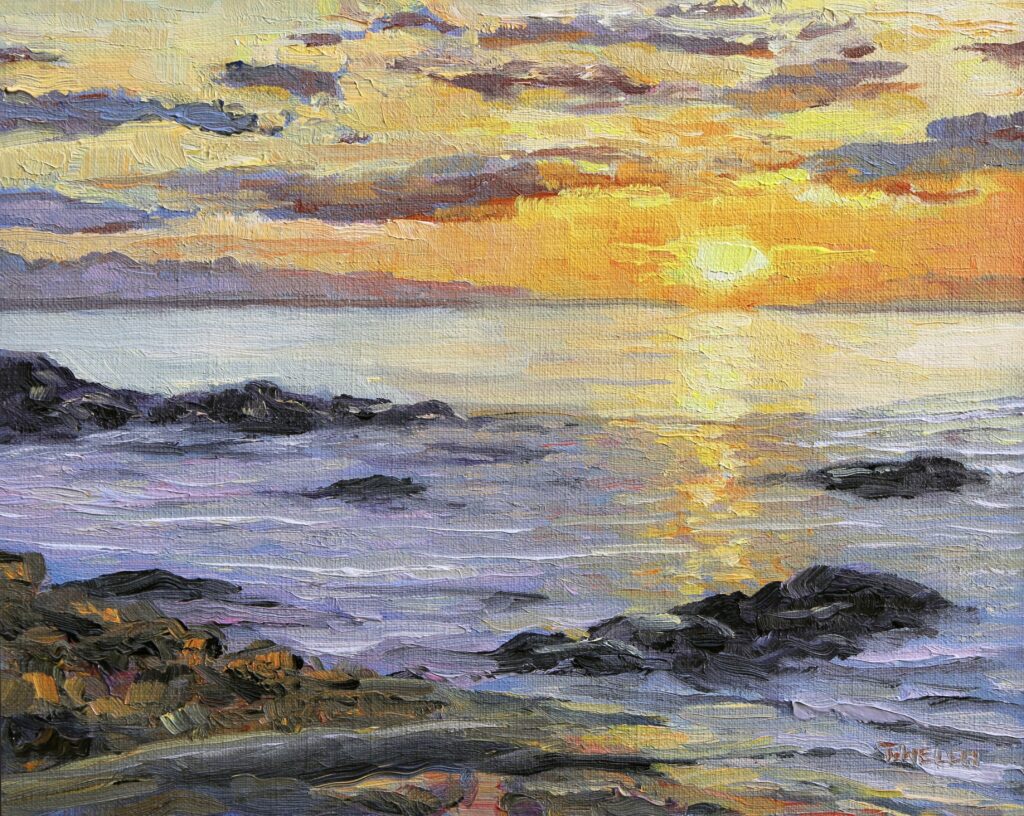
“Sun is Up” by Terrill Welch, 8 x 10 inch walnut oil on linen board, January 1, 2024.

Artist notes: The light is just starting to hang itself on the tips of the tall fir branches outside our windows when I rise. I quickly grind the dark whole beans while the water is boiling and brew coffee to take with me to the beach at Reef Bay. Slipping unnoticed out the door, I am there by 5:30 am, perched and waiting to receive a renewable gift of resilience, hope and possibility in that spectacular phenomena, millions of years older than humanity – sunrise, mid May 2023. 

And before you consider this a lighthearted naivety, this painting was inspired by a few lines from Mary Oliver’s Goldfinches in her poem “Invitation” (p.107 Oliver, 2020)

believe us, they say,
it is a serious thing

just to be alive on this fresh morning in the broken world.

We will get through this time, as countries and as global citizens.

References:

Oliver, M. (2020) DEVOTIONS : the selected poems of Mary Oliver. Penguin Press.

Roedel, J. (2024) John Roedel, Facebook.com. Available at: https://m.facebook.com/story.php?story_fbid=10169245051305276&id=862760275 (Accessed: 6 November 2024).

Welch, T. (2024) Sun is Up [walnut oil on linen board]. Available at: https://www.artworkarchive.com/profile/terrill-welch/artwork/sun-is-up (Accessed: 6 November 2024).

Early Autumn in the Japanese Garden

Sunshine and cooler temperatures are the perfect time for drifting between productive activity and leisurely strolls. I have sorted, cleaned and reclaimed my office space in the loft. I find it so refreshing to have it “in hand” so to speak. Now it is time to go for that stroll. 


I go off into the gorgeous early autumn weather with its warm sun and blue skies. One of my stops is our Mayne Island Japanese Memorial Garden. 


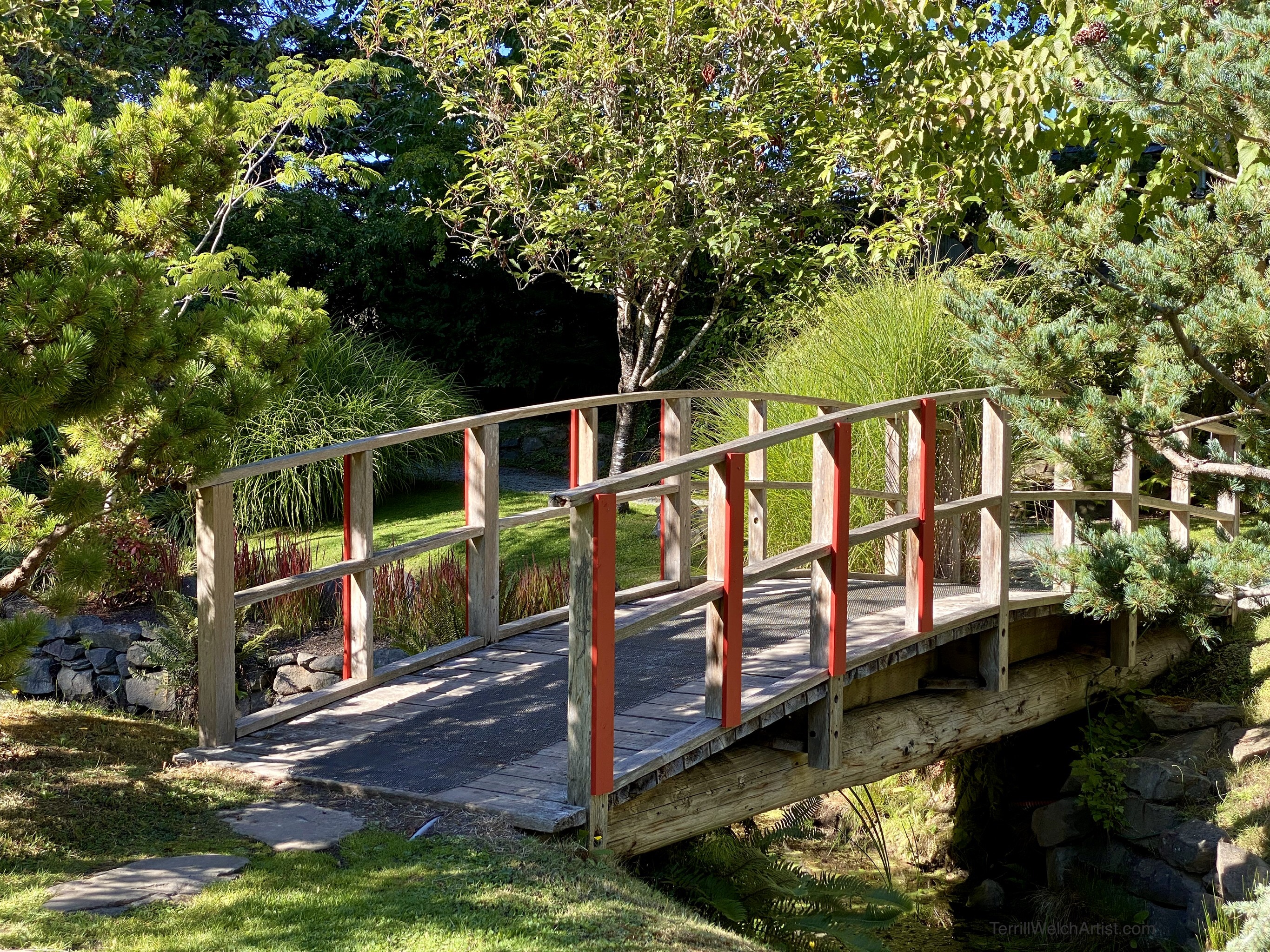
The bridge is looking more elegant than usual with its orange red boards. I smile to myself remembering bringing students to plein air paint in the garden. This bridge lovingly was referred to as “the dreaded bridge”. 


The bridge can be seen from almost anywhere in the circular walk around the garden.


It is a popular prop for photographing family and friends. 


The Japanese maples are starting to turn red.


Samaras prepare to twirl off in a gust of wind. 


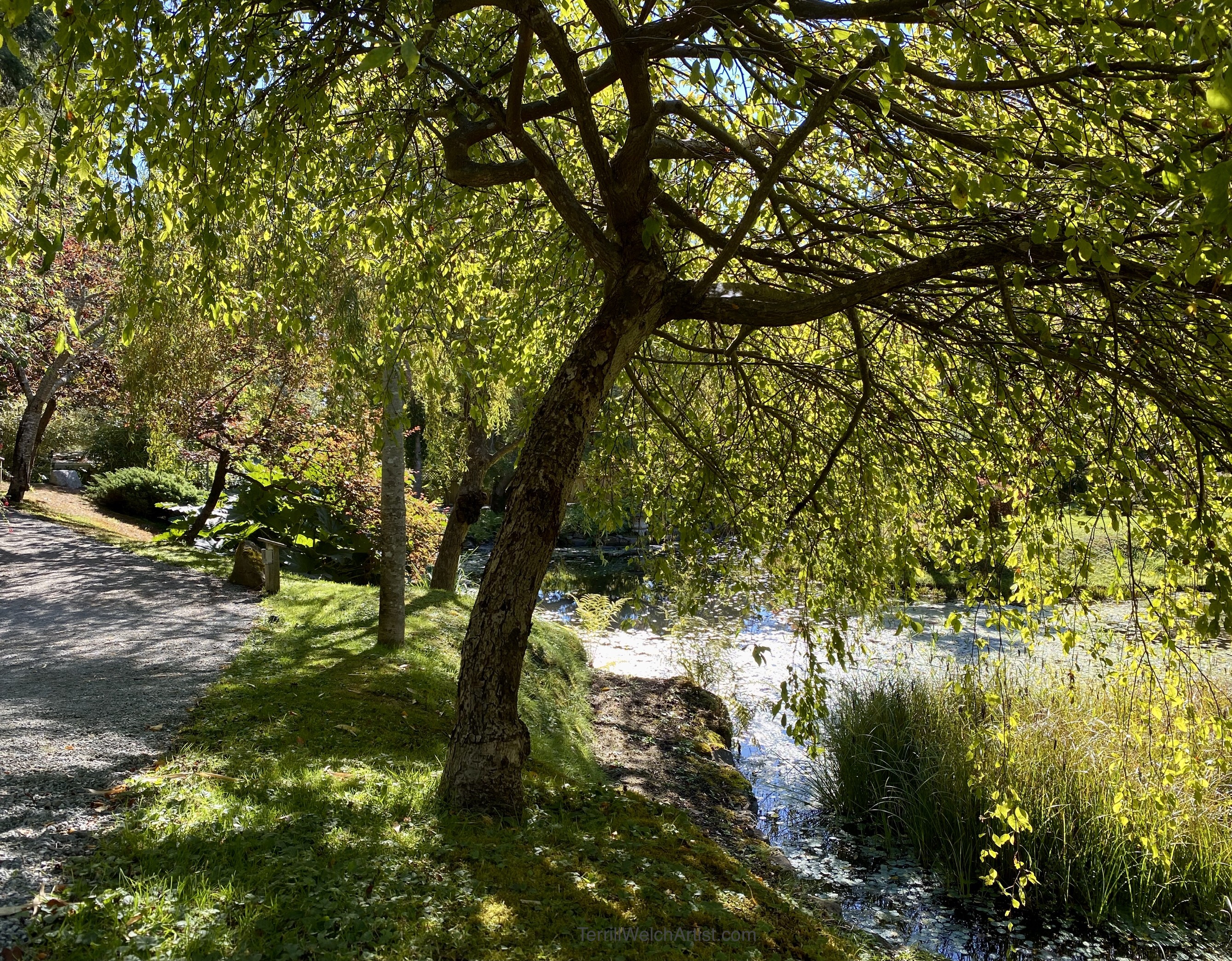
I find myself sitting in the ground beside the path even though there are many comfortable benches tucked into the garden. 


I am sitting next to the new bamboo shishi odoshi that translates as “deer frightening” in English. Thankful all the deer are fences out of this beautiful garden. 


I head home to prepare supper. Before I feel ready, the day is over. The sun is setting through the trees and creating magical light across the room. 


The time on my phone says that it is just seven in the evening. I am not ready yet for the fast shortening of the days in our northern hemisphere. I want to savour the last of our late summer’s warmth, even if it is shaking hands with early autumn before its annual departure. 

Meanwhile, Russia has announced a partial mobilization. First it was for 300 reservists. Now I hear possibly one million. Nuclear weapons are mentioned. Is it a bluff? Likely they say while failing to pause before insisting that we should take this threat seriously and prepare. How does one prepare for a Nuclear war? Is an animal really cornered if they very carefully constructed the corner themselves? The analogy doesn’t seem to work somehow. I listen to the UN security talks. I check with trusted YouTube analysts for updates about changes in the Ukrainian frontline. What shall I prepare in the face of possible war? A prayer for peace? A dedicated meditation on love? Possibly. I will go to garden for a powerful potion of fresh peppermint for my tea. I will watch the bright green leaves swirl in the hot water of my favourite mung and I shall breathe. I shall breathe slowly, purposefully and with an open heart, cradled in strength and a unrelenting force. 

Such are these days of this early autumn here on the southwest coast of Canada. 

What is it like this time of year in your  neighbourhood? 

ONLINE GALLERIES include –

ArtWork Archive original paintings and acrylic sketches currently available

Redbubble painting and photography prints and merchandise

Website: TerrillWelchArtist.com 

We Now Have A New Gallery

The past few days have been a bit of a whirlwind. However, everything has come together and today, being as it is my birthday and it is Sunday, will be a quieter day so I thought I would catch us up….

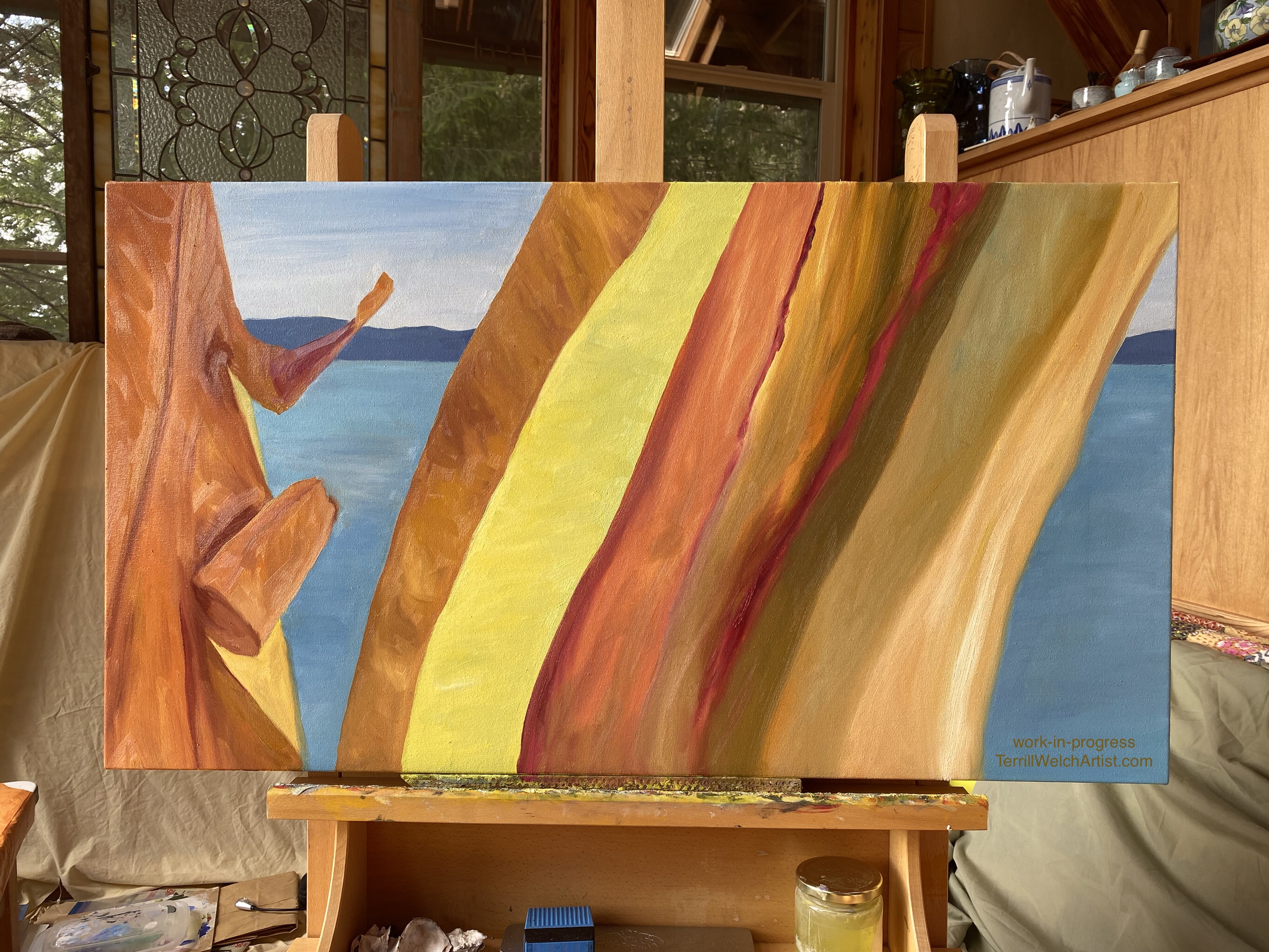
First, I started working a new 20 x 36 inch oil on canvas of arbutus trees this week. The canvas is just blocked in but I think it is possible to see where it going. It will be another in my Red Line Series. I anticipate this series being the second show in the gallery pod but it might be the third. We shall see.

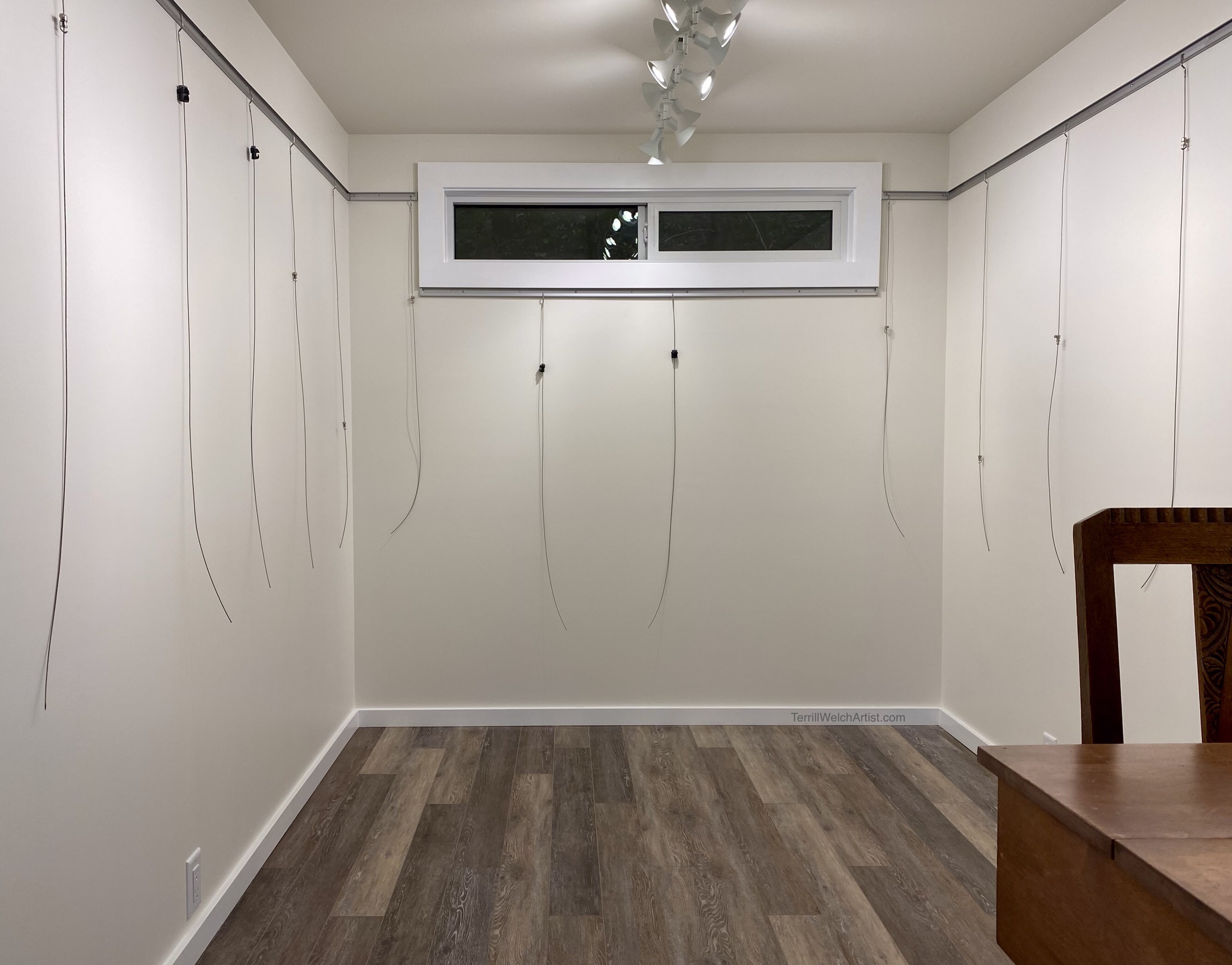
On that note, let’s go to the gallery pod. On Friday, my trusted builder, Jean-Daniel Cusin owner of Mayne Island Kitchen and Bath, dropped by to give me a hand getting the track lighting and the hanging system in. This is the third gallery space we have worked on together and I had tagged him way back in December for assistance.

You would think it would get easier since we have done this twice before but there is still a lot of fiddling finding studs, cutting things to length and running to the hardware store a couple of times to get things we needed. Still, we got it done in a few hours and the next morning I twisted in all the lights into place and put the hanging wires up to get ready for paintings.

The anchor painting for this show went up first.

Then the other two large paintings that will keep it company.

From there, the hanging went fairly quickly and now the paintings are all in place, including the guest painting by Jody Waldie. Every few weeks, there will be one larger guest painting by one of the local Mayne Island artists who show in the other Terrill Welch Gallery adventure – ISLAND TIME ART. This gallery space shows their smaller work in the blue building with Dragonfly at the ferry but it is just not quite large enough to put in many bigger work. The gallery pod can handle them though!

I will write an announcement for the website to publish later today or tomorrow that is specifically about what is in this first show and more about visiting. I still have a few wrinkles to work out. Like, do I want labels or just a list sheet of the paintings that people can take away with them? How much signage do I need if this is going to function as a self browsing location with assistance as desired or requested? How much landscaping should I try and get done right away around the gallery pod? Who needs a personal invite to feel like they have really been invited? Just a few things like this! I still have time. The official opening is 11-4 Thursday, September 1st through Tuesday September 6th, when we will have both the gallery pod and the home studio open for walk in visitors. After that time, it will be just the gallery pod that will be open during the fall shoulder season for walk-in 11-4 Thursday through Monday or by arrangement on other days. The home studio will remain open by advance arrangement or impromptu visits if it is possible. However, if you are in the neighbourhood between now and the official opening, it is possible to visit the gallery pod. I will turn the lights on and put the open sign out from 11-4 each day. The road signs will be put up as well. Almost! We are almost ready after nine months since I started planning. I am totally thrilled with the outcome so far but you will have to come see for yourself or get me to do a video or FaceTime visit for you.

So this is it for the moment. How is your day going?

ONLINE GALLERIES include –

ArtWork Archive original paintings and acrylic sketches currently available

Redbubble painting and photography prints and merchandise

Website: TerrillWelchArtist.com