Tuesday, 10 November 2026
Now having completed the first Unit, “Research and Practice”, I begin the second of three units about “Contextual Perspectives”. This is a long post but definitely sets the direction for the next six months of studies.
Thursday, 11 April 2025
I was walking through the seaside trails the other day and thinking about how I came to be studying the seafloor. I didn’t just wake up on day and decide that seaweed, seashells and ‘landscape of the small’ would be the most amazing subject for painting. I could have maybe but I didn’t. Instead, it was an evolution of observation and restrictions that has brought me to this place. Let’s go through the day and see if we can learn more through reflection as I walk, live and explore.
I have always liked to photograph the spring and summer wild flowers. Today I cam across my first Calypso Orchids on the Saint John Point trails.

They are worth a close study both for their delicate structure and beautiful scent.

I have yet to paint these wildflowers. Maybe someday.
The arbutus trees out on the point is another story. They have come under my brush many times. When I walk among them, these works often map onto what I am seeing. Here is just one example.


Other times I notice a composition I had ‘t considered before. I ask myself, what might I beat.e to do with this?

The hike is only a little over 4 km long but by the time I amble over the uneven ground along the cliffs sitting and observing now and again, it generally takes me about 2 hours. On this day, I had my eye out for as many wildflowers as I could find. Down over the steep cliff side were sedum growing in locations where the deer couldn’t reach them. Hence, neither could I.

However, I did find some between the rocks that were safely within my reach.

The trail is not really the same each visit as the light is unique offering distinct formation to be pronounced in the landscape.
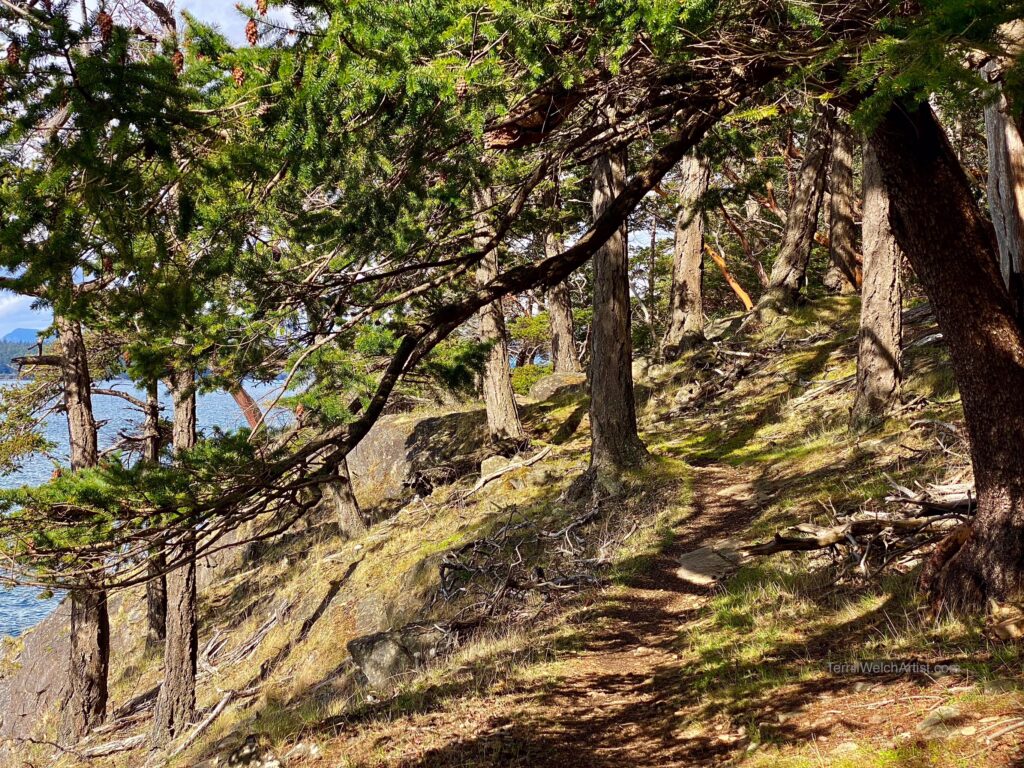
I continue on until I spot two more patches of small wildflowers.


Then finally a perfect yellow beauty that we all know…

You might be thinking, yes but what does this have to do with my study fi the seafloor? I wondered the same and have come to the conclusion that just as I observe both the landscape and the forest floor, it would make sense that eventually I would observe the seafloor as well as the seascape and shoreline.
I came home and made us current and orange scone biscuits.

These were served still warm with cheese and strawberries.

My stepson has been visiting and was staying with my husband so I could be gone for longer than I was usually comfortable leaving him alone these days. A special lunch seemed like a nice token of thank you.
It might seem odd to add in the making of lunch to my post about my creative practice but it is somehow thoroughly embedded as part of a complete representation of how I live and work with the best moment, the best materials and the best ingredients I am able to gather and experience. Making lunch is part of living purposefully in a considered way during the fullness of my making day.
I am still puzzling about how I came to be interested in the seafloor and asked my husband if he wants to come out to Reef Bay with me for a while. He was game and trundled his outside walker to the car in record speed. Reef Bay is ideal for us because I can drive right up to the edge of the beach where he can then stay in the car and still see what is going on and keep an eye on me as I clamber around on the sandstone reefs. The tide is still quite a way out but on its way in and the sea is still.
I start by gathering a few ‘child’s view’ photographic sketches of shells.
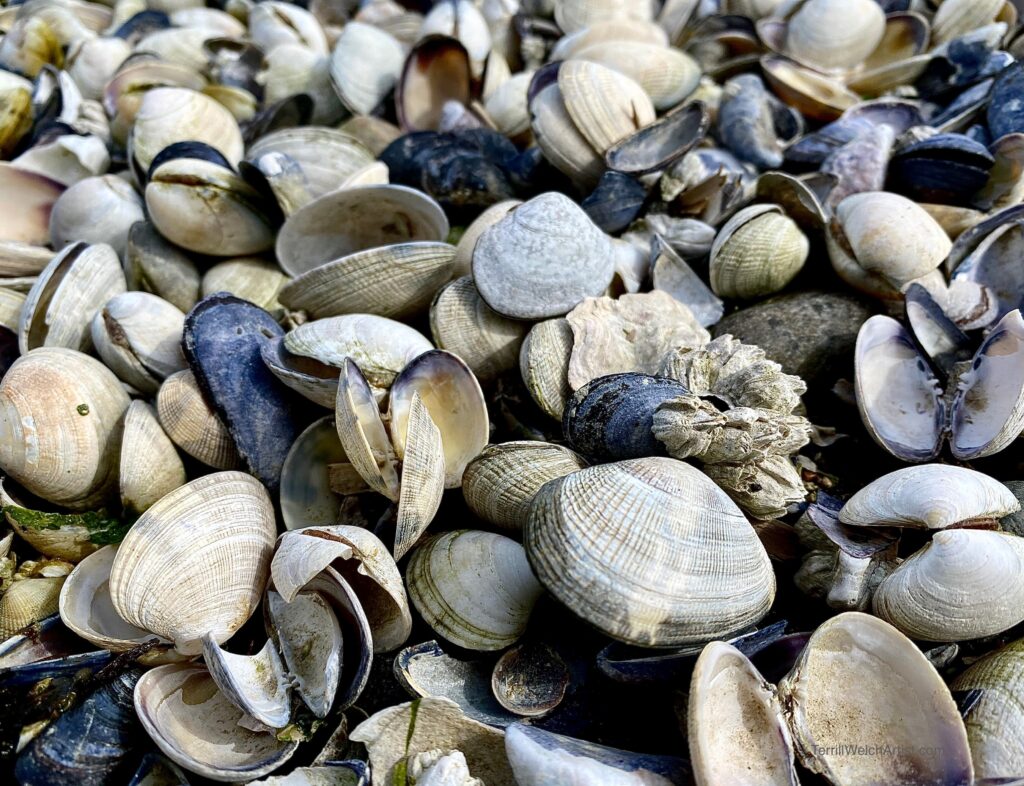
It is my way of warming up and settling into the moment.

Shapes and colours seem to frame themselves freely behind the lenses of my iPhone.

But then I begin to get lower yet and frame up a ‘landscape of the small’ that offers more contextual environment to the shells.

This reminds of the first painting I have done for the second Unit which as yet it be fully documented in my art journal.

Artist notes: The seashore was restless. There had been thunder and lightning with heavy rain the night before. It was as if the various weather events had not yet sorted themselves under the morning sun.
The top of the main reef has dried in the wind and sun that after a few Spring days clears it of slippery seaweed. I walk out as far as I can.

It is not far as we can see when I turn back towards the shore.

I gather photographic sketches of shells and seaweed in various small environments on both my way out and back.
An old oyster shell caught under the incoming tide.

Another oyster is a little farther below the surface of the sea in the cracks between the rocks.

These feel like half finished abstract works to me. I am not sure I can bring anything more to them with paint. Yet, they somehow record information that feels important even if it is never used directly.

I find that it is significant to capture this quieter process of sea and shore meeting… more of a slow caress than a heartbeat and breath rhythm of rolling waves.
Then I spot this cluster of shells floating in an immediately enthralling composition. This I can see putting to paint on a canvas! I have seen these before but never so visually and sensory complete and, most importantly, I can get close enough to document my discovery.

I have been working for months to capture something like this! Ta-da! It will be such a pleasure to unravel the mysteries of these shapes and the movement of the sea around the forms of the shells. This I can do something with!
I continue on, enjoying the colours do the limpid shells.

I notice layers and patterns of sandstone and sea with the rising tide.

Another old oyster shell captures briefly my attention.
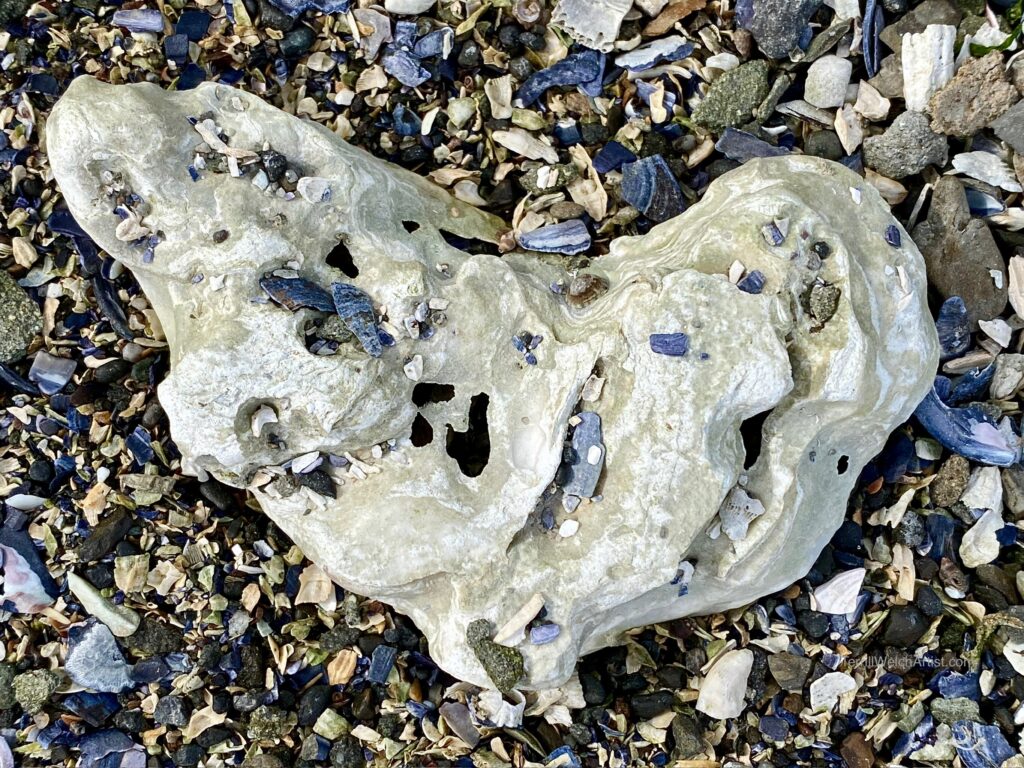
However, I am still remembering that cluster of floating shells and thinking about what size of canvas I should use to paint it, maybe large so I can keep it longer.
Going back to my original question about how I have come to study and paint the seafloor, I have tentative answers. Since 2020, I have been required to stay close to home. First, because of the pandemic and second, because of my husband’s health. I deliberately decided early on to focus on what I can do rather than what is temporarily not easily possible. If I wasn’t going to be able to travel to paint then I was going to need to learn how to thrive in place. I challenged myself to go deeper rather than further. To this end, in late 2021 until near the end of 2023 I painted a series called ‘Thriving in Place’ that can be viewed at:
https://www.artworkarchive.com/profile/terrill-welch/collection/thriving-in-place
These physical restrictions in my life and meeting them with a thriving challenge has resulted in learning and living on the land beside the sea in new ways with an even greater appreciation. In hindsight, it seems obvious that I would eventually tackle painting the seafloor rather than just the seascape. What I have come to understand over these past few years is that deep learning and observation is as limitless and endless as travelling and gathering a breadth of understanding. In the end, thee is no great mystery to unveil in my decision to study the seafloor. Rather, it is a continuation of painting expression that captures my regard and respect for our earthly existence.

