Practice risk taking, practice discipline, practice different methods, practice boredom, practice not practicing but practice – insists the imagined studio master. Leading lines, point of view, colour harmony, rule of thirds, breaking rules, painting from life, painting from memory, painting wet-in-wet, using a dry brush method, starting with grounds or underpaintings, studying moving light, noticing the cool and warm shadows…… practice!
But for what does a painter practice?
“Now, the answer to that” says the imagined studio master with a wink “is good luck.”
Not just any kind of “good luck” but “good luck” as described by Deepak Chopra where “Good luck is nothing but preparedness and opportunity coming together.”
If we accept for the moment, that this is a workable definition, then what is preparedness to the painter? Practice! If we are enhancing our skills daily, we are more likely to be prepared when an opportunity arises. We will be able to recognize the possibilities in an ordinary and yet unexpected, profound moment.
By way of example I am going to share a story I reread recently in The Zen of Creativity by John Daido Loori on page 153-154… Ryokan, a Zen master and poet, lived in a simple thatched hut. He was born around 1758 and ordained at the age of eighteen. Shortly after receiving dharma transmission, Ryokan’s teacher died. The poet went to live in a hermitage on Mount Kugami, where he spent his time sitting zazen, talking to visitors and writing poetry. Many stories of Ryokan’s simplicity and his love of children have come down to us, as well as of his indifference for worldly honor. In fact Ryokan called himself Daigo (Great Fool)….. One evening, when Ryokan returned to his hut, he surprised a thief who was naively trying to rob the hermit. There was nothing to steal in the hut. Yet Ryokan, feeling sorry for him, gave him his clothes, and the thief, shocked, ran away as fast as he could. Ryokan, shivering as he sat naked by the window, wrote the following haiku:
The burglar – neglected to take – the window’s moon.
In the next paragraph by Loori continues… To be simple means to make a choice about what’s important and to let go of all the rest. When we are able to do this, our vision expands, our head clears, and we can better see the details of our lives in all their incredible wonder and beauty.
This kind of simplicity and daily practice are what I seek for this next intention or project of The Moon is No Longer There. I believe it requires that I make a few changes in order to gain the perspective and rigor that is necessary. The moon is just an anchor and symbol of this intention, an everyday reminder.
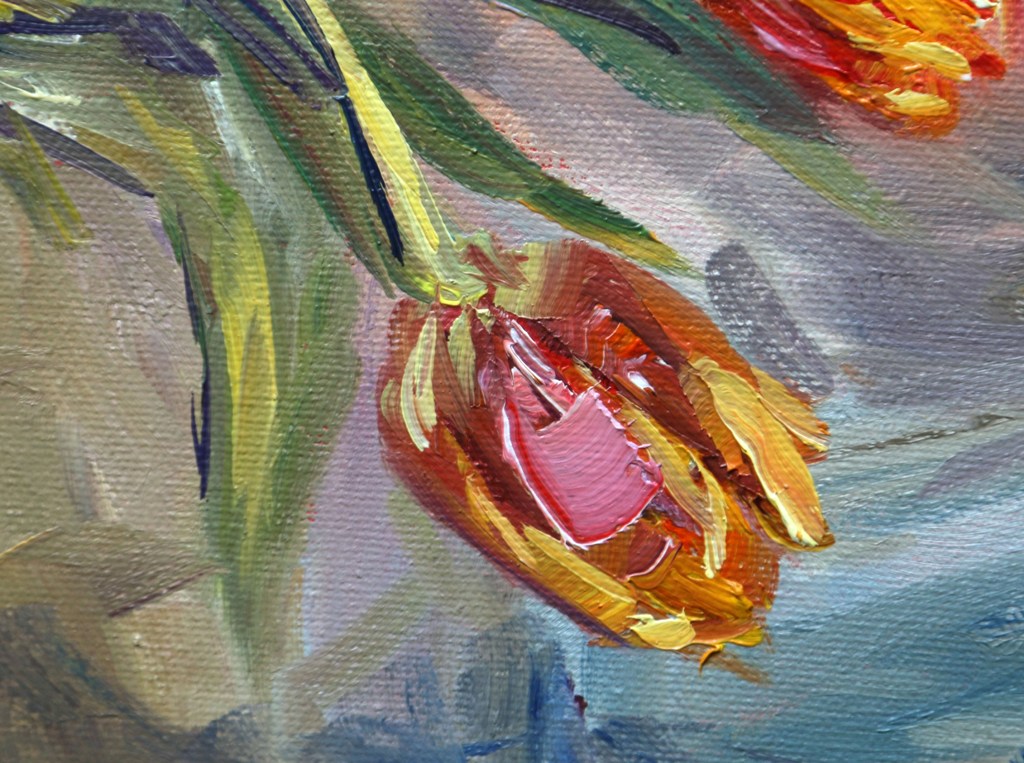
But we know this don’t we? One of our greatest pianists today, Mitsuko Uchida, was recently quoted in an interview by The Telegraph as saying “It is not enough to play the piano – it takes a lifetime to understand music.” As I listened to her release each note of Mozart’s Concerto No. 20 in D minor K.466, with such preciseness, passion and excellence, I hear the music for the first time – every time that I listen. Her rigorous practice is visceral. I am, in that moment of listening, the breath between the notes. This same quality of practice is required for painting our natural world as well. It is not enough to paint a tree or a mountain or the sea – it takes a lifetime to understand our ordinary, everyday natural environment and translate these sensory experiences onto a surface. Painting from life by itself is not enough – it takes a lifetime to understand our universe. I can only hope that I may paint someday in the same way as Uchida plays! It is in the preparing or the daily practice, that I may possibly find an opportunity which provides me with the tools to render the essence of the universe in say – a single tulip.
Why am I so compelled by this project? I suppose it is an action that is driven by despair. I believe humanity has broken a sacred trust with nature. We are consciously destroying our natural world and ourselves in the process because of a pervasive character flaw – GREED. Our survival and the survival of our planet depend on our ability to understand and recognize our interconnectedness within the universe. We each have a responsibility to do whatever we can to address this situation. We are the only hope for one another and a large number of plants and animals. By our very breath, we depend on each other. Unfortunately, as an urban populous, we tend to be alienated from this simple fact. We can no longer see the moon and nor do wish to seek out its presence. For far too many of us, we have become intellectually and emotionally blind to nature and so the moon is no longer there.
This is why I must practice until I can bring you “the moon.” I must practice rendering our ordinary everyday with the best tools that I know how to use – my paints. I must practice until humanity collectively changes its ways. This is not work for a hero. It is work for the humble, the simple and possibly the fool. I find it comforting that I am not alone. This is work that is done with the companionship of many. It is collaborative work, as survival always is.
Paul Cezanne, shortly before his death in 1906, asked himself “whether the short time given us would be better used to understand the whole of the universe or to assimilate what is within our reach.” He goes on to say “I have to work all the time. I must strive for perfection, only for the satisfaction of becoming truer and wiser.” (The Life and Art of Paul Cezanne, May 5, 2014, Film, PBBS)
I find Cezanne to be an excellent companion to take with me on my travels.
The small slice of the moon or my practice that I bring you this week is…
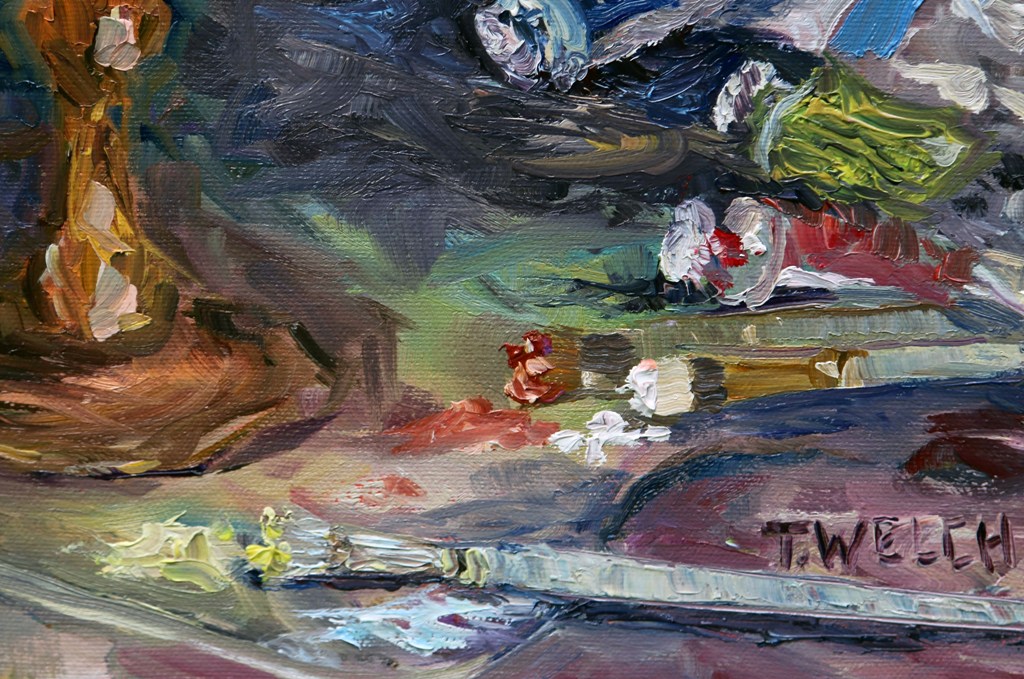
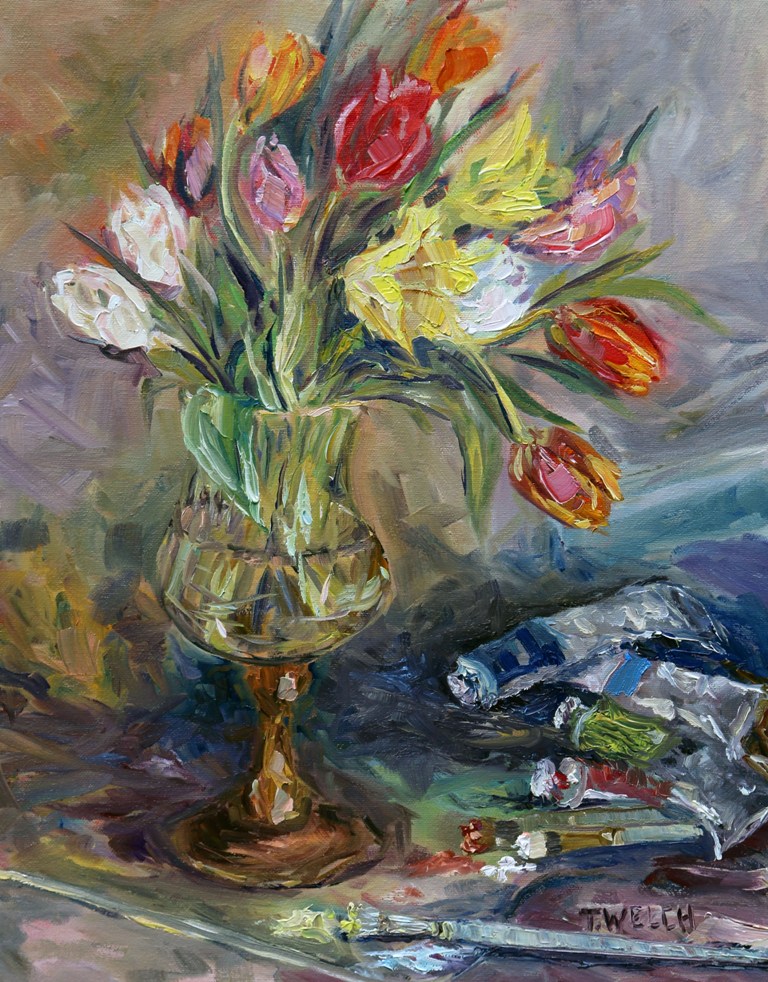
Tulips in the Studio 18 x 14 inch oil on canvas
This is an alla prima work completed in the quiet warmth of a January afternoon in the loft studio. When I saw these beauties at the grocery store, I knew I would bring a few home as a reminder of our pending spring. Even on Mayne Island, there are no tulips this time of year. These flowers have been imported from some unknown location. Our natural world has traveled far to reach me this week and undoubtedly precious fossil fuels were burned in the process. So with this acknowledgement, and some guilt, I am determined that the sacrifice is not wasted. The elegant vase is on loan from a good friend. These kinds of colourful winter still life painting days warm my heart and keep my spirit light.
What practice is your preparedness?
As always, I would deeply love to hear from you and feel free to include links to your work. If this is your first time commenting on the blog, be patient, I will need to approve your comment this one time only.
If nothing comes immediately to mind, one simply practice that will engage others is in this project is to thoughtfully share this post and my work. By thoughtful, I mean introducing the post with a sentence or a paragraph of your own considerations and then invite others into conversation with you by hosting a question or an idea related to the post. Because together, we can do this hard thing – because we must! Our natural world, which includes humanity, is worthy of our efforts and is depending on us. In this I am hopeful!
And welcome to all the new Creative Potager blog followers! Thank you for joining me in my inward travels.
© 2017 Terrill Welch, All rights reserved.
Liberal usage granted with written permission. See “About” for details.
Creative Potager – Visit with painter and photographer Terrill Welch
From Mayne Island, British Columbia, Canada
For gallery and purchase information about Terrill’s photographs and paintings go to http://terrillwelchartist.com