Friday, 30 October 2026
This process and painting is still within the first of the three unites of my studies. I hadn’t yet fully developed my theory and research practice yet. The data collection template came later. In addition, I have included a short add on post as it doesn’t seem to fit anywhere else easily. Going back over these entries, I have to resist the temptation to add in things that I investigated and discovered later on. Exploration is incomplete by its intrinsic nature and I want to preserve this in these transferred art research journal posts.
Excerpts from Terrill Welch MA Fine Art Journal
Monday, 10 February 2025
My days are full to overflowing with painting, reading, class and peer discussions, and absorbing my first tutor feedback suggestions to further develop my painting project about the sea floor. These threads remain entangled as I keep theory, research and my painting practice woven tightly together.
The American philosopher Anthony Rudd in his book Painting Presence: Why Paintings Matter expands on the work of Russian philosopher and theologian Paul Evdokimov and adds an additional fourth element to the three already defined by Evdokimov.
In summary, Rudd concludes that every painting has the following four elements:
- The artist as the maker of the painting,
- the work itself as a physical object,
- the viewer as the person who looks at the painting, and
- the subject matter made present in its essential nature. (2022, pp. 226-229)
Rudd’s fourth element is where I want to further expand or break open my investigation of the sea floor. The question is – how do I do this?
The tutorial feedback suggests taking more in-progress images so as to better reflect on what is happening during the creation of a painting. This is offered primarily as a way of stepping back. I am guessing this is not in the physical sense of stepping back because I already have a well developed muscle memory practice of rhythmically stepping back in my actual standing painting process. I am taking this suggestion to step back to mean more of an interrogation of my painting decisions as a way of finding other points of departure or consideration. Since this is nearly impossible, at least for me, to do while actually painting, my idea is to capture the process more thoroughly while it is happening and then step back to find new points of entry into my practice.
This takes unflinching, clear-eyed bravery which brings me to France and a letter dated Monday, June 24, 1906 by Rainer Maria Rilke to his wife Clara where he writes “After all, works of art are always the result of one’s having been in danger, of having gone through an experience all the way to the end, to where no one can go any further.” (2002, p.11)
My colleague, painter, linguist and writer, Dr. Elena Maslova-Levin, used this quote to anchor my work in her introduction to our shared exhibition catalogue Conversations on Edge published in 2018. Not surprisingly, this prospect of going “all the way to the end, to where no one can go any further” remains a guiding proposition in my practice. (Maslova-Levin and Welch, 2018)
This may appear as if I have moved away from the theoretical influences presented in the western philosophy of Plato and the eastern philosophy of Dōgen about painting and art. However, the opposite is more accurate. I will come back to this again later on.
For now, I have a 22 minute video that details the development of my latest painting on a 30 x 24 inch canvas using walnut oil paint called “Seashells Afternoon”. This is also my journal entry for week 18 – documenting process.
Or view on YouTube at:
Note: The room view in the video of the painting is created using a digital tool called Canvy and it can be found at Canvy.com. The digital tool was created specifically for room views to show two dimensional artwork.
Here is the painting again while it is still on the easel.

Review of My Painting Practice:
In reviewing my painting practice and creative process as outlined in the video above, I would like to further emphasize the aspect of painting being a translation of a conversation between my subject and myself that is then available to the viewer. However, the primary engagement is between me and the subject. My first point of reference is the specific nature of my focus. In general, the natural environment is my longest, most enduring and consistent relationship. This is the relationship with which I have the most familiarity and trust. All else in my painting practice is value-added and welcomed but also less critical to my process. What this means in practical terms is that art theory and research are additions to my established and developing painting practice. Therefore, theory and research are currently in service to my painting and must find their way around and within my discernment of the sea floor and moving brushes across a surface. I am not sure how useful this orientation is to my finding other points of departure or consideration in my painting practice However, it where I am at the moment. To further explore the relationship between my chosen theoretical approach and my painting practice, I am going to do a small series of painting study sketches in acrylic as a way of slowing the painting process down to moments of full stop and to have an easy ability to paint over with limited drying time. This should provide me with more critical information and assessment about my painting practice than I have now and hopefully provide a stronger overt connection to my theoretical considerations.
For easy of reflection and review, I am going include a private viewing room link on Artwork Archive for all works completed so far in this unit. This includes detailed information for each piece such a medium and size and my artist notes.
https://www.artworkarchive.com/rooms/terrill-welch/0baa50
Note: If you are reading this as part of my art journal links assessment, to save time, you may want to wait and view the selected artworks instead of opening the link above.
For quick reference, here is a digital room view using Canvy that shows these same works to scale together.
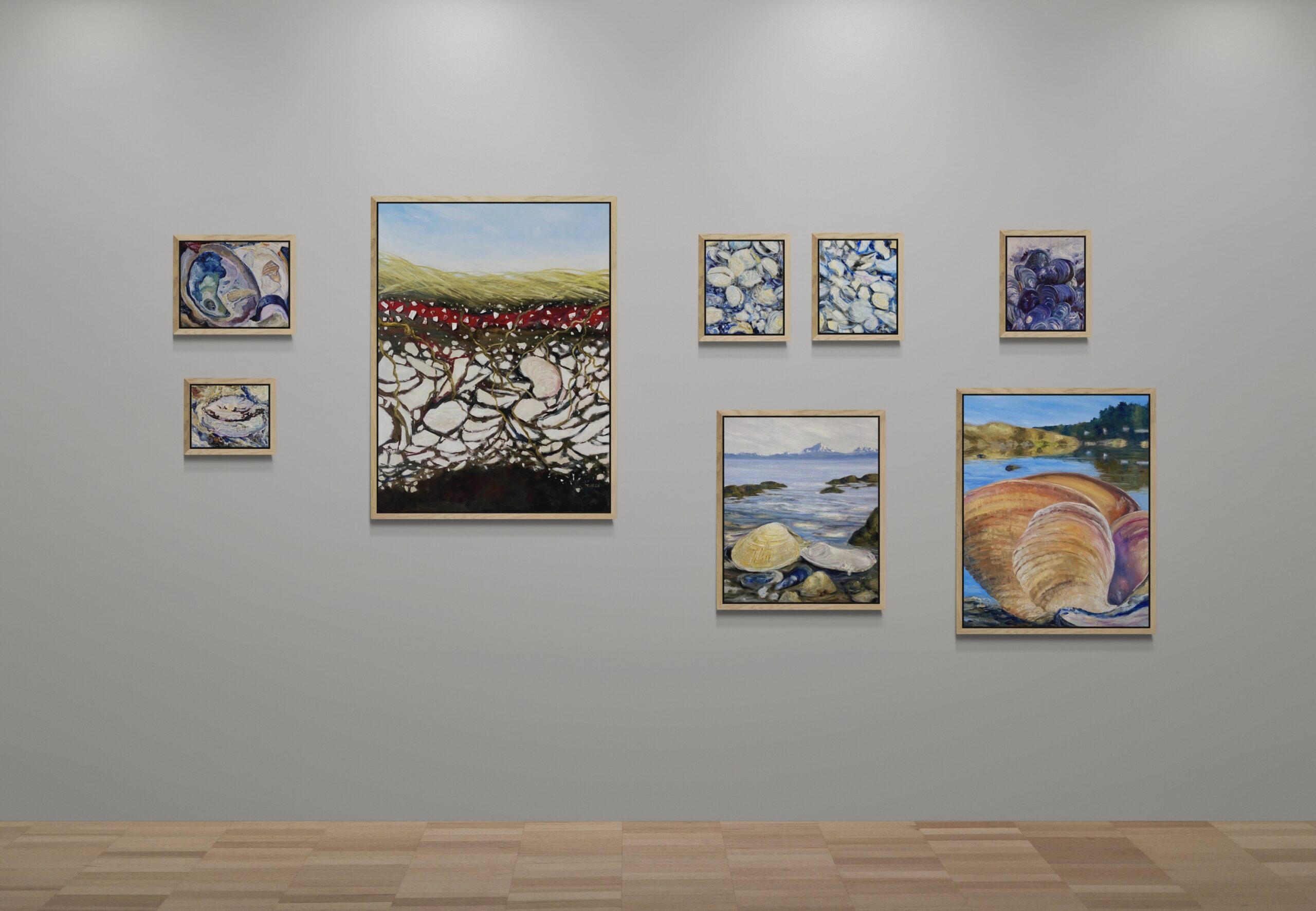
Thursday, 20 February 2025
I want to include the first of acrylic painting sketch studies as it is a departure in paint from oil or acrylic and slightly different in process from the preceding work in the unit. Here is a tile gallery of the development of the work-in-progress on this 10 x 8 inch gessobord.
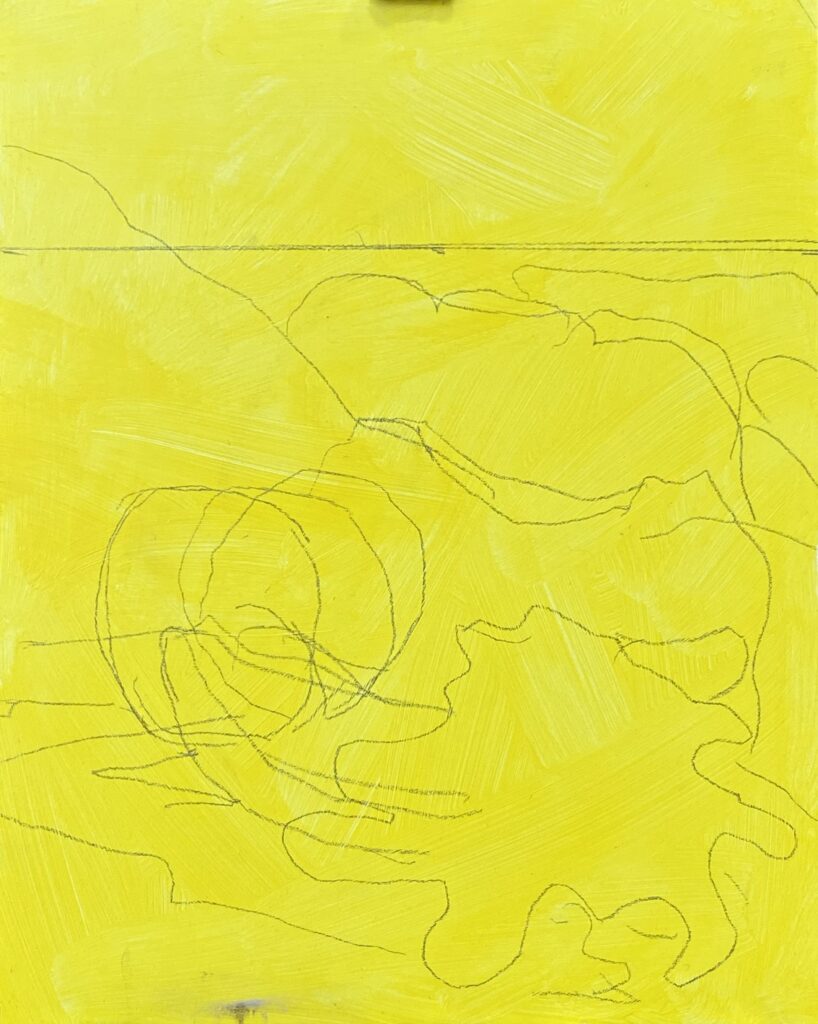
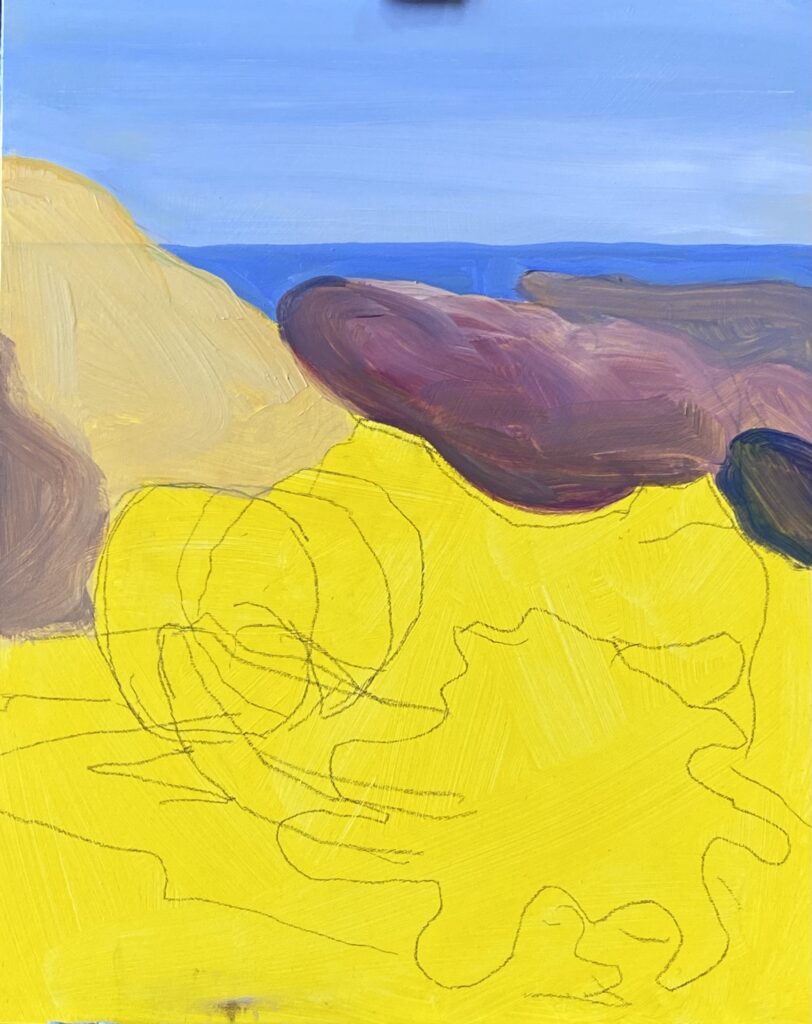
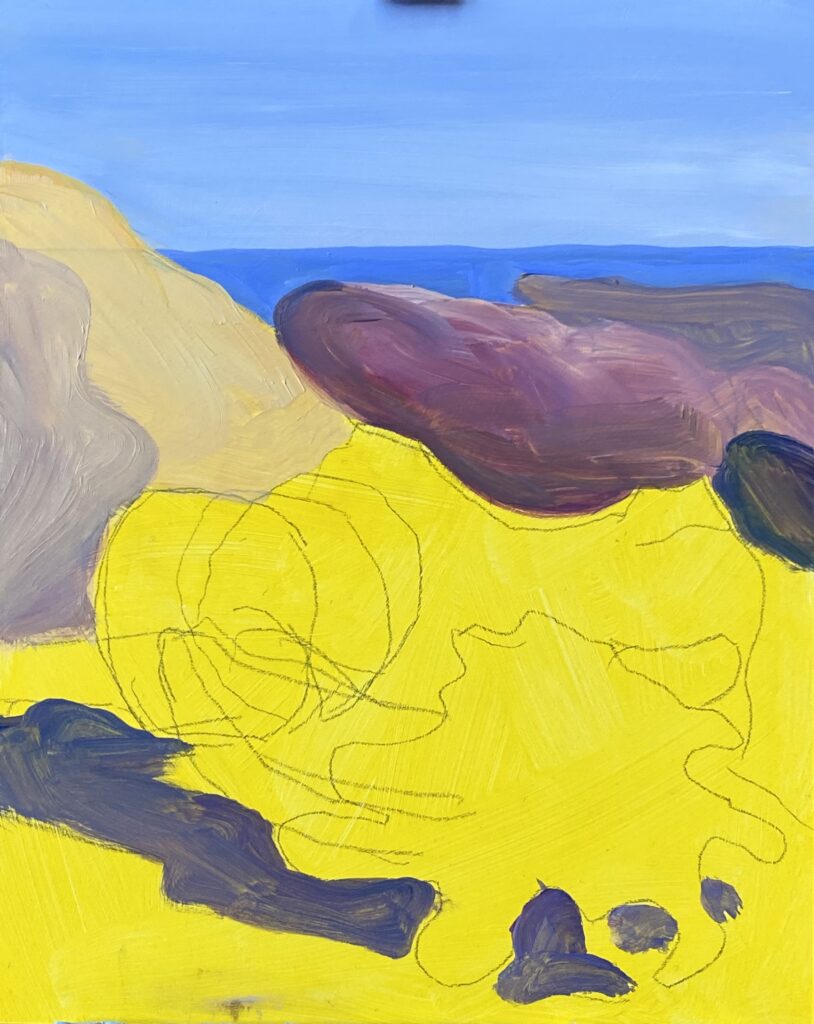
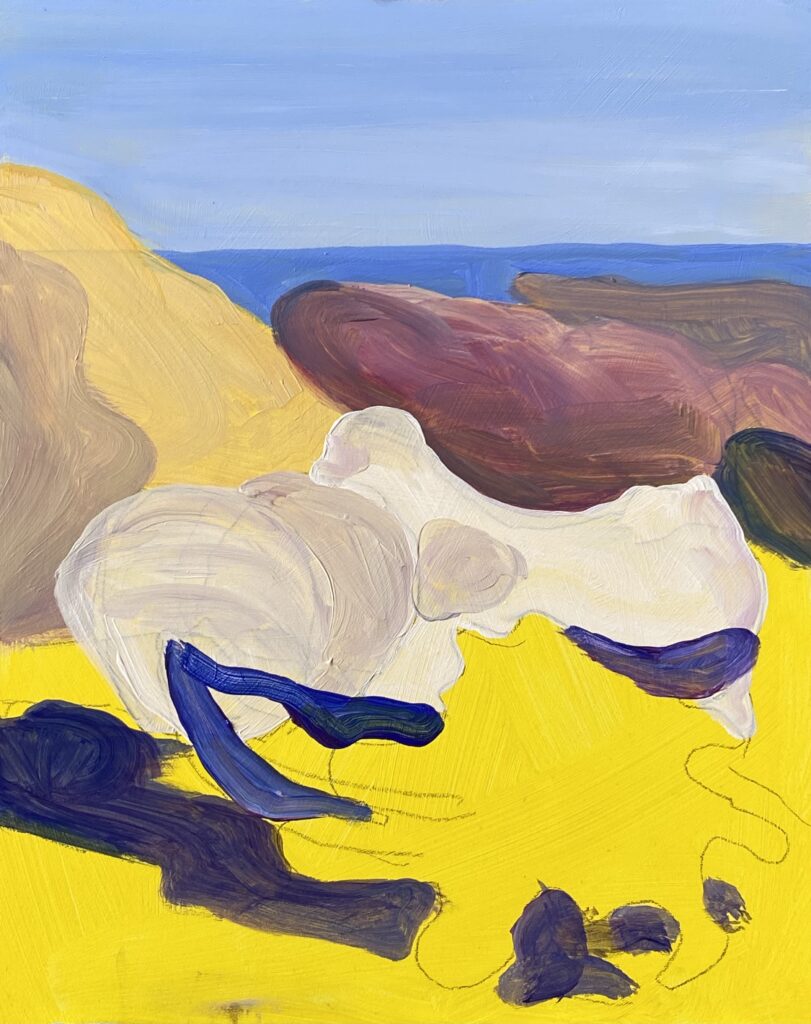
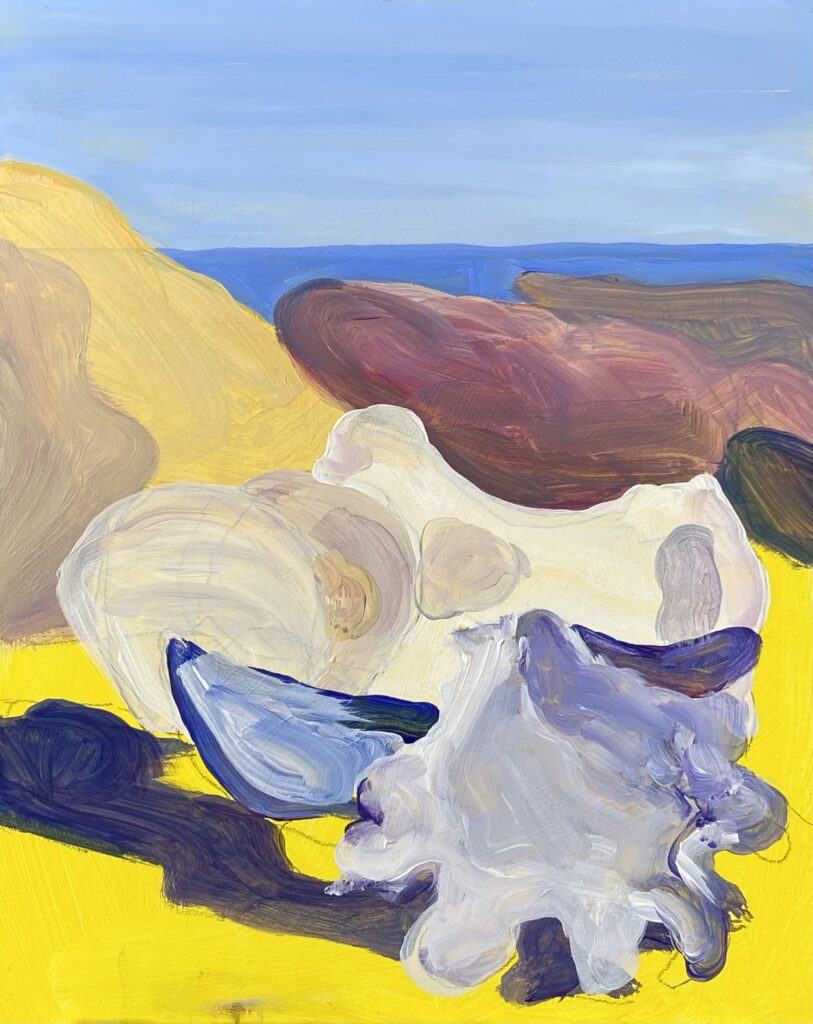
I stopped painting at this stage below.
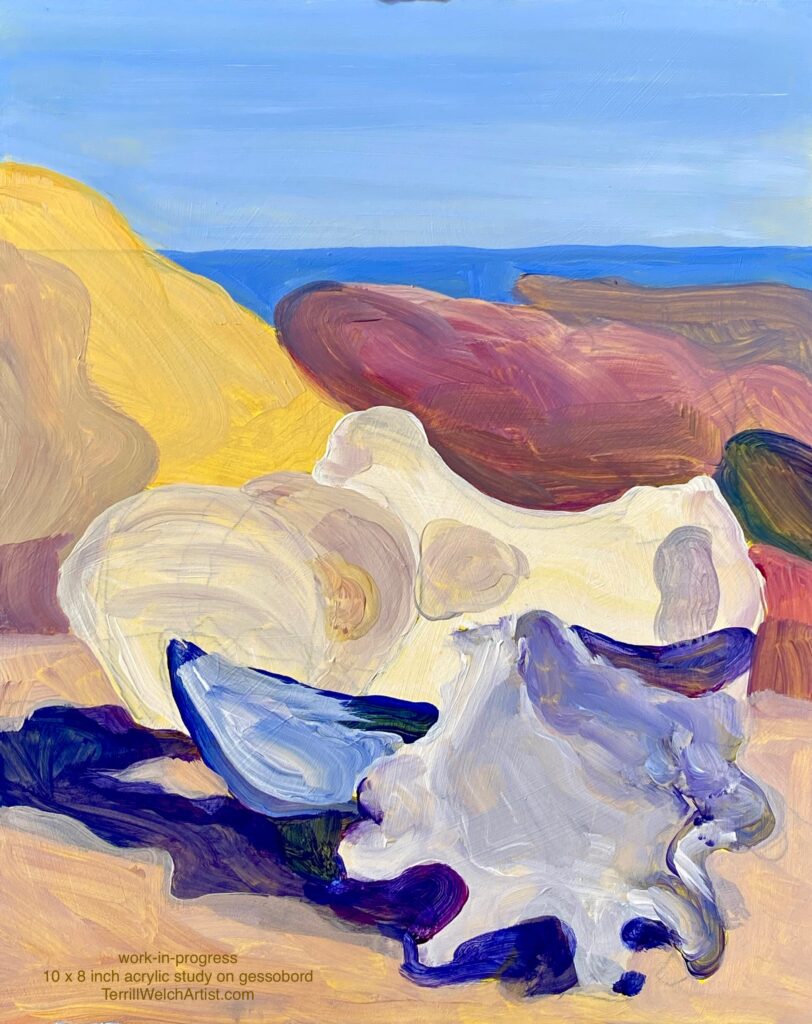
The painting sketch is still on the easel for now while I contemplate its character within my process.
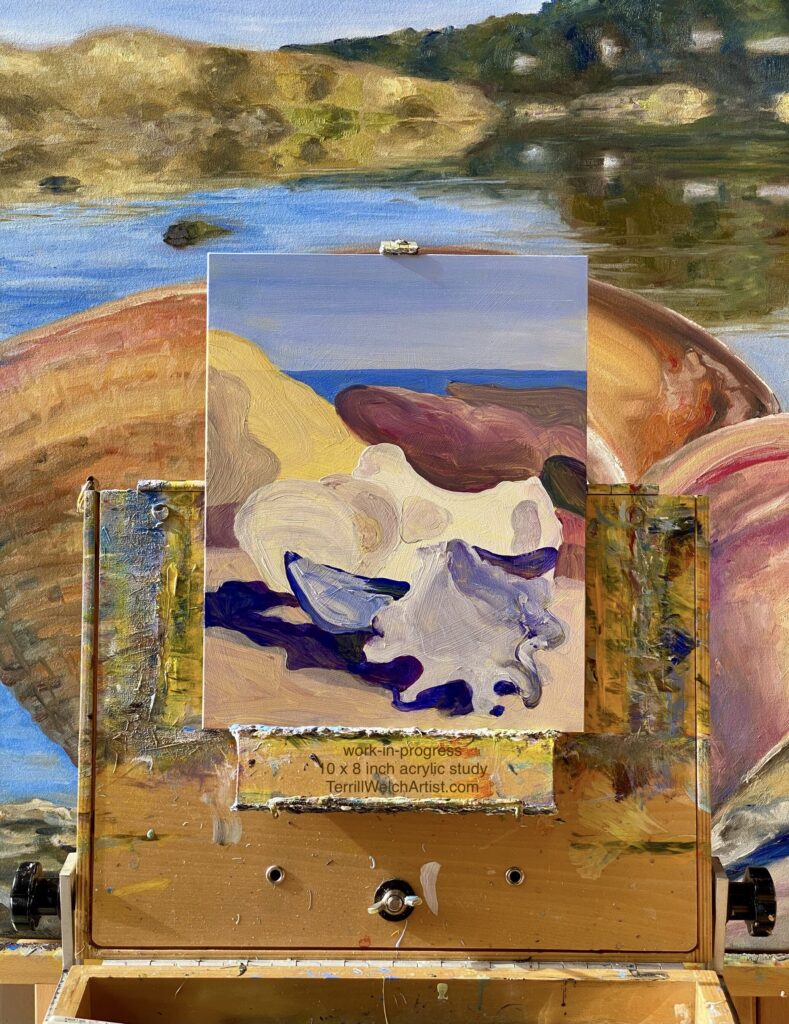
At this stage, the work has an immediacy of its history of development. Pencil marks show through. The ground is evident throughout. I look at it in all its raw nakedness and I remember how I held each shell while I was painting and then closed my right hand around it and continued painted. This part of the process is new. I remember that I used one of my references to assist with scale while doing the line drawing at the very beginning and then worked from memory as much as possible. This part of the process is familiar. I now am at a place of deciding whether or not to leave the work for now at this unfinished work-in-progress stage or if I keep going until I am satisfied that I have taken it as far as I can go. I haven’t decided yet because I am still assessing which will serve me more as I work to fracture or break open my practice for points of new discovery.
Reference list:
Canvy (2025). Canvy. [online] Canvy. Available at: https://canvy.com [Accessed 11 Feb. 2025].
Maslova-Levin, E. and Welch, T. (2018). Conversations on Edge . [online] Abebooks.com. Available at: https://www.abebooks.com/9781986742214/Conversations-Edge-Maslova-Levin-Elena-Welch-1986742210/plp [Accessed 9 Feb. 2025].
Rudd, A. (2022). Painting and Presence: Why Paintings Matter. [online] Oxford University Press eBooks. Oxford University Press. doi:https://doi.org/10.1093/oso/9780192856289.001.0001.
Welch, T. (2025). Seashells Afternoon Painting Process by Terrill Welch. [online] Youtu.be. Available at: https://youtu.be/ai_yr3lgyKk?si=h9IlQoQj6d0csmb5 [Accessed 11 Feb. 2025].
Element of Chance to Studying Seashells using Line Drawing
Thursday, 13 February 2025
I temporarily borrowed a few seashells from Reef Bay for this exercise to introduce an element of chance to studying seashells using line drawing. This exercise is an adaptation of an exercise offered by John Daido Loori in The Zen of Creativity: Cultivating Your Artistic Life called “Practice: Experiencing Without Identifying”. (Loori, 2005, pp.80-81) My intention is to place more emphasis on using my capacity of touch to determine shape and size by placing the shells out of view in a cloth bag and then reaching in with my right hand to choose one to draw while drawing with my dominant left hand. What I found most interesting was that more elements of chance were introduced than I had anticipated. Some of the pencils I had set out didn’t work very well. Sometimes I couldn’t find the shells in the cloth bag and I had to resist the urge to look and you can see me starting to lift open the cloth bag and put it down again several times when I was trying to find the shells. However, I did get to know the shells better even in this short exercise.
What I Discovered: My takeaway is that it might be interesting to do this again without recording and setting time constraints. I could try a variation by using a combination of visually hidden touch study like in this exercise and combine it with visual observation time drawing that is repeated in a rhythmic pattern like the sea exposing and covering the shells. I could maybe do it by opening and closing my hand that is holding the shell. It might be interesting to do this with one of my video recordings observations offering the sounds of the sea at the same time or by drawing by the sea once it gets warmer. The idea is not to trick myself but to strengthen my relationship with touch as a source of sensory information in my painting practice. These are ideas for future exercises. For now, this video records what happened during this first line drawing practice exercise.

As I mention in the video, this could be done with any smaller objects. I chose the seashells because it is central to my project. I do not remove shells from the beach lightly because they are of significant importance to the health and wellbeing of the sea floor. For this reason, I will return them to where I found them now that I have finished the drawing exercise and will do the same if I do any further drawing exercises in the same manner.
Reference:
Loori, John Daido (2005). The Zen of Creativity: Cultivating Your Artistic Life. New York: Ballantine Books.

