Answering the Painter’s Questions

Monday, July 20 2026

Oftentimes, a painting doesn’t proceed in a straightforward momentum from start to finish. I need pauses to listen clearly to what the canvas is asking. Then the paint becomes tacking in the dry summer air and I must let it completely dry to the touch before continuing. Such was the case last Wednesday. I left it sitting in an awful awkwardness as if caught in an elaborate pose of painter’s frozen tag.

Work-in-progress of a new arbutus tree portrait on a 31.5 x 27.5 inch oil on canvas work by Terrill Welch shown on the easel in her studio. Wednesday, July 15, 2026.

I went to Reef Bay and couldn’t help myself but to gather a few random compositions of the seafloor. It is like picking berries. I don’t want to just let the ripe ones fall to the ground and forever lost. Instead, I collected them up in reference images and tucked them in the folder for “Close to Home”.

Nothing may come of them but they stilled something restless within me. 

David had a birthday on Sunday and on Saturday family came to celebrate. That meant Friday was used for preparation and Thursday is still school for a few more weeks. So here we are with a dry to the touch painting late Monday morning. 

The work-in-progress oil on canvas by Terrill Welch has now dried to the touch. She is ready to continue. Monday, July 20 2026.

I had about an hour available to me to paint. I took it! The linseed oil softened to the consistency of butter in the midday heat. I focused and then drifted on the gentle blue sea that has yet to come alive in the painting. I didn’t get far but still. It is something.

work-in-progress oil on canvas by Terrill Welch. Monday, July 20 2026.

We then went for a drive to get David a mocha and then stopped at a farm stand for the first of the blackberries and some sweet yellow plums. The deep warm of the sun kisses the air with their fragrance.

Local Mayne Island Blackberries and Yellow Plums. Photograph by Terrill Welch. Monday, July 20 2026.

As I drive, I am still thinking about the painting. It needs more paint I decide. And the arbutus tree really needs to pop as the star if it is going to be a portrait. Do I want to abstract the foliage both at the top of the tree and on the ground? Painting is a process of endless decisions and often there are no right answers but there might be better answers and one decision usually affects (undoes) several others that have already been made. But this is all the answering I am going to do for today. 

The Spiritual Connection in Painting Arbutus Trees

Monday, July 13 2026

I crest the low ridge just after seven in the morning as sunlight slams into the lower sandstone shoreline and dances across the sea to meet a soft mostly cobalt blue sky once it lifts over the fog resting on the water near the coast mountains. My eyes scan the elements and square up the view. It will work. I am sure it will work. I begin to gather references, shifting my feet and contorting my body to get the angles I desire. Nothing is perfect of course. I do not expect it to be. This is why it will need my imagination, a canvas and paint. References are a memory link and a starting point for later.

Now in the studio with the ground dry on a 31.5 x 27.5 inch canvas, I begin to block in various elements. A couple of hours pass. I take off my paint smeared red apron and document what I have so far.

The beginning of painting an arbutus tree along the shores of Edith Point by Terrill Welch.


It is almost noon. While boiling water for tea I begin to ponder. What does it mean to be this specific arbutus tree on this specific ridge overlooking the Salish Sea? If I was this tree, what would be the most dominant element? Would it be that soft peachy morning sky or would I give priority to the sea? Or maybe it would be the squishing of tiny roots spreading through the salal that I am standing in that is taking up the most attention. Perhaps it is the wind whistling through dried lower branches as it cools the first rays of sun? I am not sure I can guess. I sip my tea and look at the messy beginnings.

I have painted these arbutus trees many times but I am never done with them. There is a spiritual connection that seems to happen with arbutus trees. I imagine laying my hand on the large exposed root at the base of its trunk and let whatever is troubling me drain down into the earth on its long spidery tentacles. Losses and grief are good compost and best turned over and released into the soil rather than being compartmentalized and carried between my shoulder blades. 

I reach for a new book I am reading by Martin Gayford, How Painting Happens (and why it matters). Gayford begins where a painter knows he must – “Painting is difficult. Or rather, making a truly powerful and original painting is very hard (Gayford, 2024, p. 12). He goes on to explain that part of the problem is the long history of painting that has been practiced by brilliant artists ahead of me and that it is hard to find new areas to explore. This has never really stopped me from trying though. Not because I expect to paint anything particularly brilliant or ground breaking but because painting is a way of holding a conversation between nature and me and then later, with the viewer. What is the alternative? To remain silent? Better to paint something that is less than brilliant than to say nothing at all. 

Reference list: 

Gayford, M. (2024). How Painting Happens. Thames and Hudson Ltd.

The Reparative Turn in Painting: Embracing Grief and Creativity

Wednesday, July 8 2026

Painting the Beauty and Sorrow of Loss – beginning the Close to Home Series

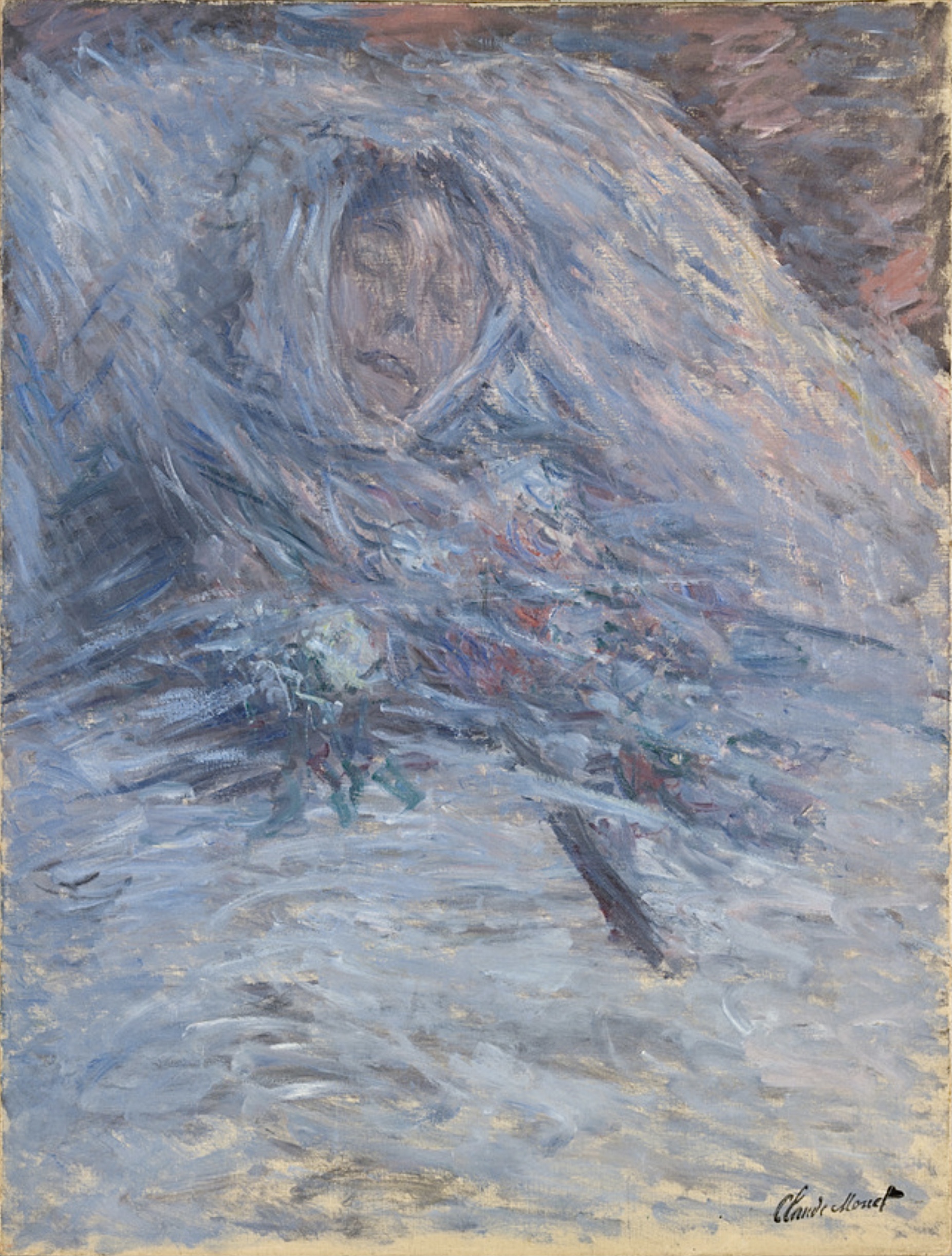
This series will require courage and bravery to honestly and frankly find my balance between beauty and sorrow within loss. I have other painters before me who have faced such challenges through their own brushes, such as “Camille on Her Deathbed” by Monet from 1879 where he stood painting beside his wife Camille, who was dying. 

Camille on Her Deathbed by Claude Monet, 1879.

Then there was time Monet was painting the lily pads following the death of his son while the echo from the guns of battle were audible in the distance. There is also Edvard Munch and “Death in the Sickroom” from 1893 when he recorded the death of his sister to tuberculosis.

Though these are more final moments rather than the proceeding journey of knowing and watching and bracing oneself that comes from caregiving someone in the later stages of dementia. 

What does the reparative turn (Forrester, 2020) in my painting practice mean under these circumstances? I am surmising it flexes on my desire, for now, to stay grounded and rooted on this earthly plain of existence. I will unpack this further as I continue to work over the months ahead. This is where my first painting in this series begins with painting the portrait of an arbutus tree along the shores of (what is now called) Mayne Island next to the Salish Sea – from the ground up. 

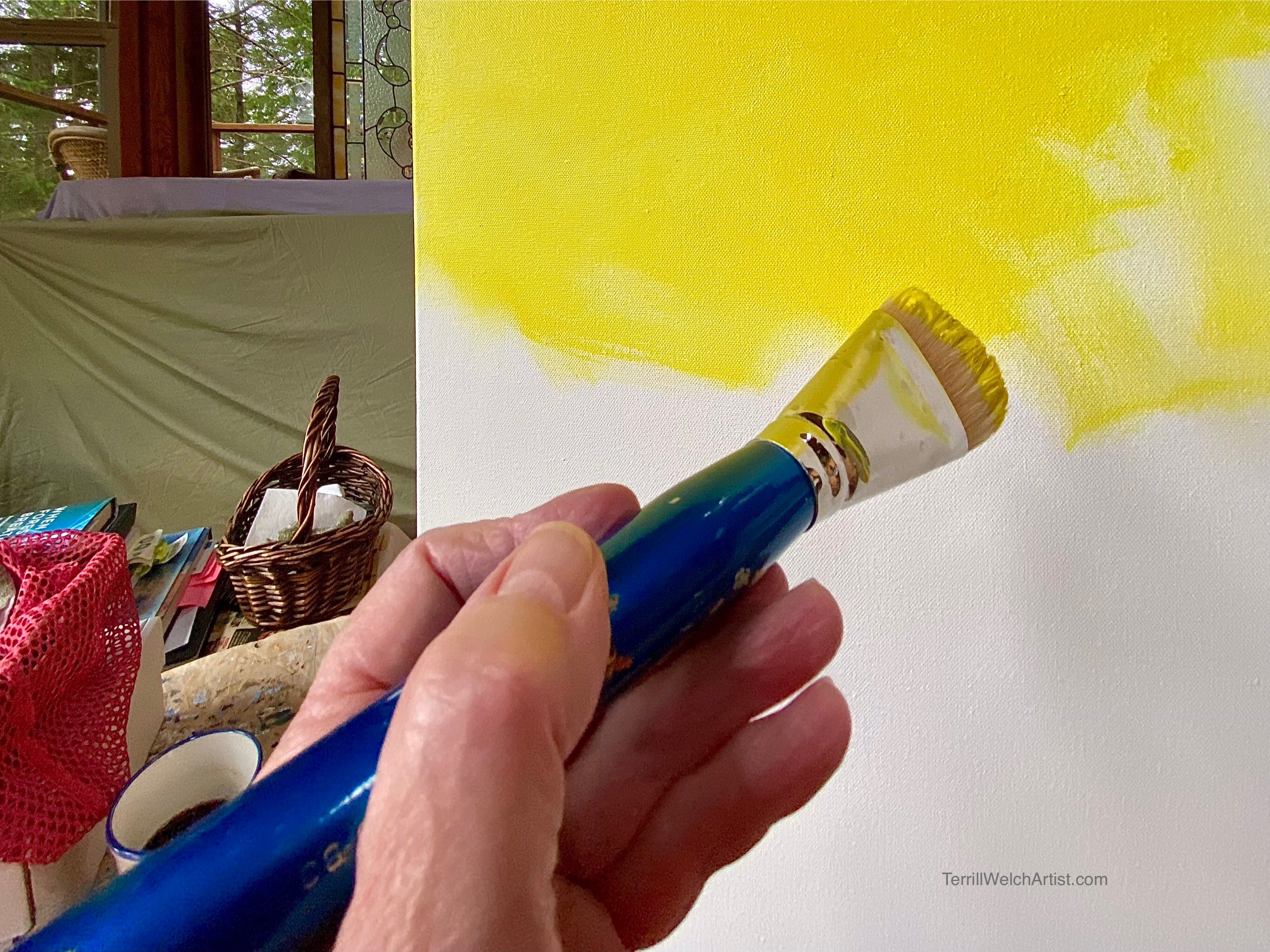
The morning began with painting acrylic lemon yellow grounds on a larger 31.5 x 27.5 canvas and three smaller 8 x 10 inch linen boards that will be used for studies and plein air painting. 

Terrill Welch laying down a lemon ground on a large cotton canvas in the overcast morning of the studio as her coffee grows cold. July 8, 2026.

There is something palatably thrilling in the tension that coils up inside the core of my being when I am about to launch into a new body of work. 

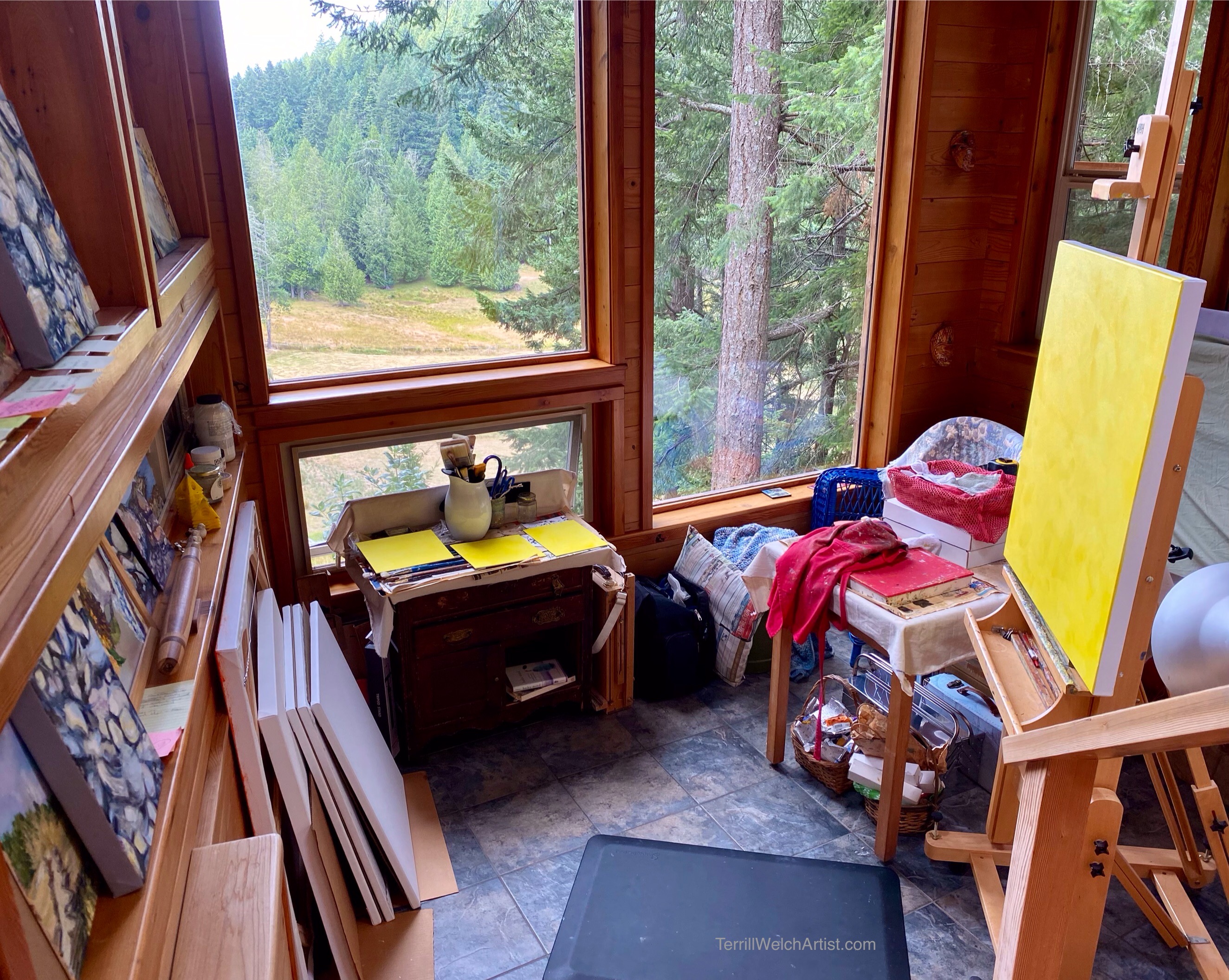
View down into the wood framed windows of art studio of Terrill Welch with small finished work lining the ledge on the left, new small linen boards with yellow grounds on an old washstand under the window. On the right a crumpled corner with throw and studio blue chair before the enamel topped table holding the artist’s apron resting on a covered palette beside the large wood easel with a substantial canvas with an equally bright yellow ground. A black anti-fatigue mat rests waiting in front of the easel on the grey stone finished ceramic tiles.

The only question remaining is – do I start the new work or paint the edges of recently finished pieces first? 

Reference List: 

Forrester, S. (2020). Painting from the Other Side: Tracing the Reparative Turn in Contemporary Practice. Art/Research International: A Transdisciplinary Journal, 5(1), pp.116–147. doi:https://doi.org/10.18432/ari29486 

REAWAKENING MY PUBLIC ART RESEARCH JOURNAL

Monday, July 6 2026

For the past two years I have kept an art research journal as part of my MA Fine Art Studies. Many of these posts have been featured in my “Terrill Welch by herself” newsletter. However, my degree studies are coming to a close. I am beginning a new series of work. Since I have found the art research journal useful, I have decided to continue the practice here, even though this space has, for the most part, been dormant since 2022. What is four years in a lifetime of an art practice!? Let’s continue!

You can learn more about my recent art autoethnographic theory and nature-centric reparative painting research practice, as well as my intentions for disseminating my new Seafloor series, on my website at: https://terrillwelchartist.com/disseminating-a-nature-centric-reparative-painting-practice/

You can also visit my individual final degree show that will opening on August 20,2026. It has to be up and published now for assessment by the university so you are also welcome to have browse if you wish at: https://terrillwelchartist.com/terrill-welch-five-seasons-ma-fine-art-final-show/

I will continue to develop my theory and art research led painting practice as I begin a new series, tentatively called “Close to Home”, as I again spend time with trees as I meander (what is now called) Mayne Island and at times capture domestic moment that connect nature with our daily habits within the shelter of our strawbale timberframe home.

Early this morning at around 6:30 am, I was hiking Edith Point and think about how I might proceed. There is the most satisfying summer task of hanging laundry on the covered clothesline of the side porch.

Laundry drying on the line. Photograph by Terrill Welch. June 14, 2026.

Or, if my significant other is still sleeping, there is my morning coffee ritual in the blue chair down in the studio as I watch the sun come around to catch the trees on the far hill.

Morning coffee in the blue chair of the art studio. Photograph by Terrill Welch. June 28, 2026.

Then again, reading on the bench on the other side of the house is also a moment I treasure.

Outside on the bench with wind in the trees for company drinking garden mint tea and reading the second half of Book of Lives: a memoir of sorts that I put down at the beginning of my 3rd and final term in an MA Fine Art degree delivered completely online. Photograph by Terrill Welch. July 4, 2026.

However, there is also the calm of a blue-green sea that make me exhale fully.

A calm green Salish Sea strikes an elegant pose. Photograph by Terrill Welch. June 28, 2026.

Or it could be sighting the clouds that show up in a tidal pool that holds my attention.

Clouds in a Tidal Pool. Photograph by Terrill Welch. June 28, 2026.

Yet, as I was walking along with the scent of soil and sea enveloping the lemony hue of the morning air around me, I thought about the trees and how they continue to teach me how to thrive while being rooted in one place. Maybe this would be a good place to start?

Early morning sun greeting the crest of a knoll next to the sea. Photograph by Terrill Welch. July 6, 2026.

There is an arbutus tree that has yet to come under my brushes and I am itching to see what I can do for its portrait.

Arbutus tree catching the 7:00 am summer sun that is already warm and scenting the air with sea earth and a nearby pine tree. Photograph by Terrill Welch. July 6, 2026.

This tree might be the first of this new series to be tackled at the easel! We shall see. Right now, ideas are being filed into an album of references so that they are ready as soon as I get a chance to start.

Welcome to a new journey and adventure in my painting practice. I do not have a posting schedule but will likely add something new each week so I can keep track of what I am doing. Until next time! Feel free to comment if you wish.

The Deeper Change Of Season

Under the heavy warmth of blankets, I can hear my alarm twittering loudly from across the room. It is 5:30 am and dark. Sleep has a stranglehold on all of my sensory facilities. I really don’t want to wake up and I certainly am not going to leap cheerfully to the floor to greet the day! Stiffly, I sit up and reach for my glasses. Somehow during the night I misplaced the exact location of my nose and ears and must fumble to sort out lenses, arms and facial parts. I suppose, I should go turn that little pest of a clock off. My half-awake brain reminds me that this early start is my choice. I am choosing to get up before daylight, just like I chose to buy a new jar of honey even though there is still a third left in the old jar and just like I chose to put two extra leaves in the kitchen table for six even though only David and I shall be eating at it. The quick, almost nonsensical, answer for these seasonal choices is that the evenings are shorter and the days are cooler.

The longer deeper answer is that there is still some part of me that gathers the equivalent of a squirrel’s nuts for the winter months. It is irrational behavior really. I tell myself that the honey will keep for years… but so will the dark brown sugar I already have. I do not need to start cooking dinner earlier and go to bed earlier but I do. So much so, that when the track lighting in the kitchen quit working six years ago we have neglected to replace it. Oh, we think about fixing it alright. We have even pick out new lights and talked to the electrician.  But mostly we hardly notice. Dinner is made and cleaned up before dark year round or we move a lamp over to the kitchen counter if we have guests and are eating later. Then we notice. But this doesn’t happen very often. So we forget again.

The thing is, we tend to live naturally in harmony with the way of the seasons – most days without even conscious reasoning. Let’s put the extra leaves in the table this week we say. We do not have a specific reason. But within a few hours books we are reading creep onto the surface and there is a notebook for writing down fragments of ideas. A sketchbook is then added and then a few drawing pencils. I think about the candles up in the loft and how nice they would look with the large table-cloth. They are idle thoughts. Nothing is rushed, orderly or precise. One minute I am considering whether we need more flashlight batteries and the next about picking up a bag of local apples to make crisp. There is seemingly no connection between these two fragments of seasonal activities. Yet, they linger, waiting for to respond. Like the low golden light that lasts thorough the autumn afternoon, there is comfort in their presence.

Other parts of my life are more rushed, scheduled and structured. There are new fall oil painting classes to teach, someone wants private painting lessons and another person schedules a personal visit to the gallery midweek before the latest show changes. These things squeeze up against my precious painting time – time that has to puff out its chest just to be able to reach the brushes between all the other demands.

But the painting still holds, still reaches and most weeks still happens. Two new works are ready to have their edges painted later this afternoon. One of them is this one….

Just Before Sunset Mayne Island BC “resting” 30 x 24 inch oil on canvas

This is the reason I am writing a blog post, the 616th blog post since late December 2009, before daylight. It is because this afternoon is reserved for painting! Painting edges, painting grounds and just painting…. and then maybe a long walk.

What natural rhythms of autumn seasonal changes do you notice in your own life?

P.S. Remind me to write early next week about a new group art show coming up with The Beauty of Oils Painters.

© 2017 Terrill Welch, All rights reserved.

Liberal usage granted with written permission. See “About” for details.

Creative Potager – Visit with painter and photographer Terrill Welch

From Mayne Island, British Columbia, Canada

For gallery and purchase information about Terrill’s photographs and paintings go to http://terrillwelchartist.com

Greetings Fir Tree and Your Simple Goodness – poem by Terrill Welch

Greetings Fir Tree and Your Simple Goodness

The briefness of winter sun,
Met by the upturned corners
Of my mouth.

Free, for just a moment,
From any monetary value.
Free from any request.
Free from all, except today,
A quiet Sunday,
A late rising dawn.

Greetings fir tree
And your simple goodness.

© Terrill Welch Dec. 3, 2012

And, here is the tree and in the moment that inspired these words for a Zen Sunday.

greetings fir tree by Terrill Welch 2012_12_02 011

All the best of today to you!


What simple goodness is greeting you today?


ONLINE GALLERIES with Terrill Welch paintings and photography include-

Xanadu Studio Gallery for large original paintings

Artsy Home for most original oil paintings currently available

Redbubble for photography prints, greeting cards and posters

Current Local Mayne Island VENUES –

Green House Restaurant – small original oil paintings and photography prints

Farm Gate Store – one large painting

And by appointment at Terrill Welch’s home studio

© 2012 Terrill Welch, All rights reserved.

Liberal usage granted with written permission. See “About” for details.

Purchase photography at http://www.redbubble.com/people/terrillwelch

Creative Potager – Visit with painter and photographer Terrill Welch

From Mayne Island, British Columbia, Canada

Terrill Welch Artist website at http://terrillwelchartist.com


An interview with Terrill Welch by Charles van Heck

Every once in a long while someone reaches out and gently grasps your elbow to steer you over to a quiet spot where they can ask evocative questions. Such has been my experience in being interviewed by writer Charles van Heck! When someone is really listening in a deep and meaningful way I often have lots to say – so this in not a short read. However, I hope you will find it an interesting one. Enjoy!

Impression and Perspectives from Mayne Island
An Interview with Terrill Welch

at Whitman Pond Charles van Heck – Woodhull Arts Journal

Whitman Pond is the website of poet and author, Charles van Heck. Welcome to Whitman Pond, a fictional place that has had a long gestation.

I know that for those of you that regularly visit here you will enjoy discovering Charles van Heck’s website and his writings and interviews.

SPROUT: Who recently asked you such good questions that you didn’t realize until afterwards how much you had to say?


© 2012 Terrill Welch, All rights reserved.

Liberal usage granted with written permission. See “About” for details.

Purchase photography at http://www.redbubble.com/people/terrillwelch

Creative Potager – where imagination rules. Be inspired.

From Mayne Island, British Columbia, Canada

Terrill Welch online Gallery at http://terrillwelchartist.com

Impermanence

I share with you these pears dancing in the light of the sun coming through the window. But they are no longer there. We ate them. They were delicious. The photograph is history like all photographs has captured history.

(image may be viewed and purchased here)

Impermanence is difficult concept to viscerally accept. My limited understanding comes from Buddhist practices but it is an idea that has fascinated me since I was a small child and realized that turning of the earth gave me a glimpse of visually watching the passage of time. In fact, it is fair to say that expression of impermanence is a strong underpinning in most of my paintings and much of my reflective writing.  The Buddhist notion of impermanence is that all of conditioned existence, without exception, is in a constant state of flux. Here a section on the subject from wikipedia:

According to the impermanence doctrine, human life embodies this flux in the aging process, the cycle of birth and rebirth (samsara), and in any experience of loss. This is applicable to all beings and their environs including devas (mortal gods). The Buddha taught that because conditioned phenomena are impermanent, attachment to them becomes the cause for future suffering (dukkha).

Conditioned phenomena can also be referred to as compounded, constructed, or fabricated. This is in contrast to the unconditioned, uncompounded and unfabricated nirvana, the reality that knows no change, decay or death.

Impermanence is intimately associated with the doctrine of anatta, according to which things have no fixed nature, essence, or self.

Though I do meditate and go to the odd meditation retreat, I am not a practicing Buddhist. But there are times when I find that the Buddhist doctrine resonates and helps me to live a better life – with less suffering. Such a time is when the hard drive of my computer crashes beyond recovery. Some things were lost. Some things have been found in other places. I wasn’t and I am not particularly worried or grieving about any of these things.

What did strike me in a new way was the concept of impermanence. It was like I had been accumulating this understanding for years and all of a sudden I had a glimpse of it – just for a few days and even then only for a few hours at a time. I was able to experience impermanence beyond what my brain had constructed … it was tangible in the cells of my body, the earthquakes in Japan, David’s stroke, the birth of my grandchildren, the lines on the backs of my hand, and the daffodils in the woods.

(image may be viewed and purchased here)


This wasn’t a sense of peace and ease I was experiencing – I was terrified. My experience of the world, through my five senses, was no more permanent than the passing light between the trees. I was borrowing these experiences and stretching their presence through memory, writing, painting and collecting data on my hard drive. My thoughts go to Atlantis, the Egyptian pyramids, the ancient Greek poet Sappho – all passing moments in time with just a few fragments left visible through story, crumbling earth and fragments of poetry.  I grasp that my existence, my being, and my experiences are all expressions of impermanence. For a few moments, okay hours, it was hard not to hyperventilate and go screaming naked through the woods.

But after awhile I concluded, nothing had changed. These things were the same before I looked them squarely in the eye. My knowing did not chance impermanence – only my experience of impermanence.

(image may be viewed and purchased here)

This week I shall work on another painting. I shall do it with conscious awareness of my impermanence and its impermanence.

Sprout question: How does impermanence express itself in your creativity?

© 2011 Terrill Welch, All rights reserved.

Liberal usage granted with written permission. See “About” for details.

Purchase photography at http://www.redbubble.com/people/terrillwelch

Creative Potager – where imagination rules. Be inspired.

From Mayne Island, British Columbia, Canada

Terrill Welch online Gallery at http://terrillwelchartist.com

Impression of an Artist

Week after week I visit myself on the canvas of a painting, through the frame of an image or between the words of a paragraph. Do these impressions provide any further insight into my being and my interpretation of my world?

I like to think they do. I like to believe that these creative endeavors cast at least a shadow of truth on what I often think of as my core essence – that part of me that isn’t body or earth-bound in this life time. But is this really a possible truth?

As the paint is chosen, mixed and applied without thought, I like to believe there is a subconscious part of me that knows what it is doing. But maybe it is all accidental fragments of my conscious mind colliding with the paint, the canvas and the movement of my brush.

I am doing a study of blue – a series on the shades of blue. What I am discovering is that blue is more than a colour. Blue is a spiritual void for reflection… as I paint the sea… the shadows of the trees… or the sky. If I had known how wide this void would open up, would I have committed to the series?

Ah, no point in musing about what might have been.

This week I have one 10 X 12 inch cotton canvas underpainting ready for completion. In my imagination the heavy clouds press down with formidable force over the dark seas. May I be able to hold this moment long enough to reach in and pull out something that is the essence of me, of you and of the very world itself.

Sprout question: What impression best describes your creative self?

© 2011 Terrill Welch, All rights reserved.

Liberal usage granted with written permission. See “About” for details.

Purchase photography at http://www.redbubble.com/people/terrillwelch

Creative Potager – where imagination rules. Be inspired.

From Mayne Island, British Columbia, Canada

A Fall Day on Mayne Island

It occurred to us as we were eating lunch that it might be sinful not to take a long leisurely walk in the warmth of this most glorious fall day.

I am always fascinated by the ribbons of blues that stack up like exotic candy layers as I look out to the meeting of sea and sky. I drift and dream on the waves as the seagulls squawk and fish from the rocks.  Mount Baker is almost visible in the haze of the far shore – if you know it is there. I sense that it is time to move on.

I flatten body-to-earth on a sunny knoll next to the deep cool shadows of maple trees as they undress, dropping one crunchy brown leaf after another. We do not get much colour here on Mayne Island in the fall.

Mostly things turn brown and drift downward, sometimes holding themselves up as if to say “no, not yet! I’m not quite ready yet.” But the rains will come, silencing their whispers. These large brown leaves will be mulched into the earth to feed the first sprouts of spring.

Sprout Question: What are you letting go of to sprout new creativity?

Important: If you want gift cards, calendars, photographic prints before Christmas, October is the time to place your order at http://www.redbubble.com/people/terrillwelch. Original oil paintings can be purchased directly from me by sending an emailing to tawelch@shaw.ca .

© 2010 Terrill Welch, All rights reserved.

Liberal usage granted with written permission. See “About” for details.

Purchase photography at http://www.redbubble.com/people/terrillwelch

Creative Potager – where imagination rules. Be inspired.

From Mayne Island, British Columbia, Canada