Monday, 3 August 2026
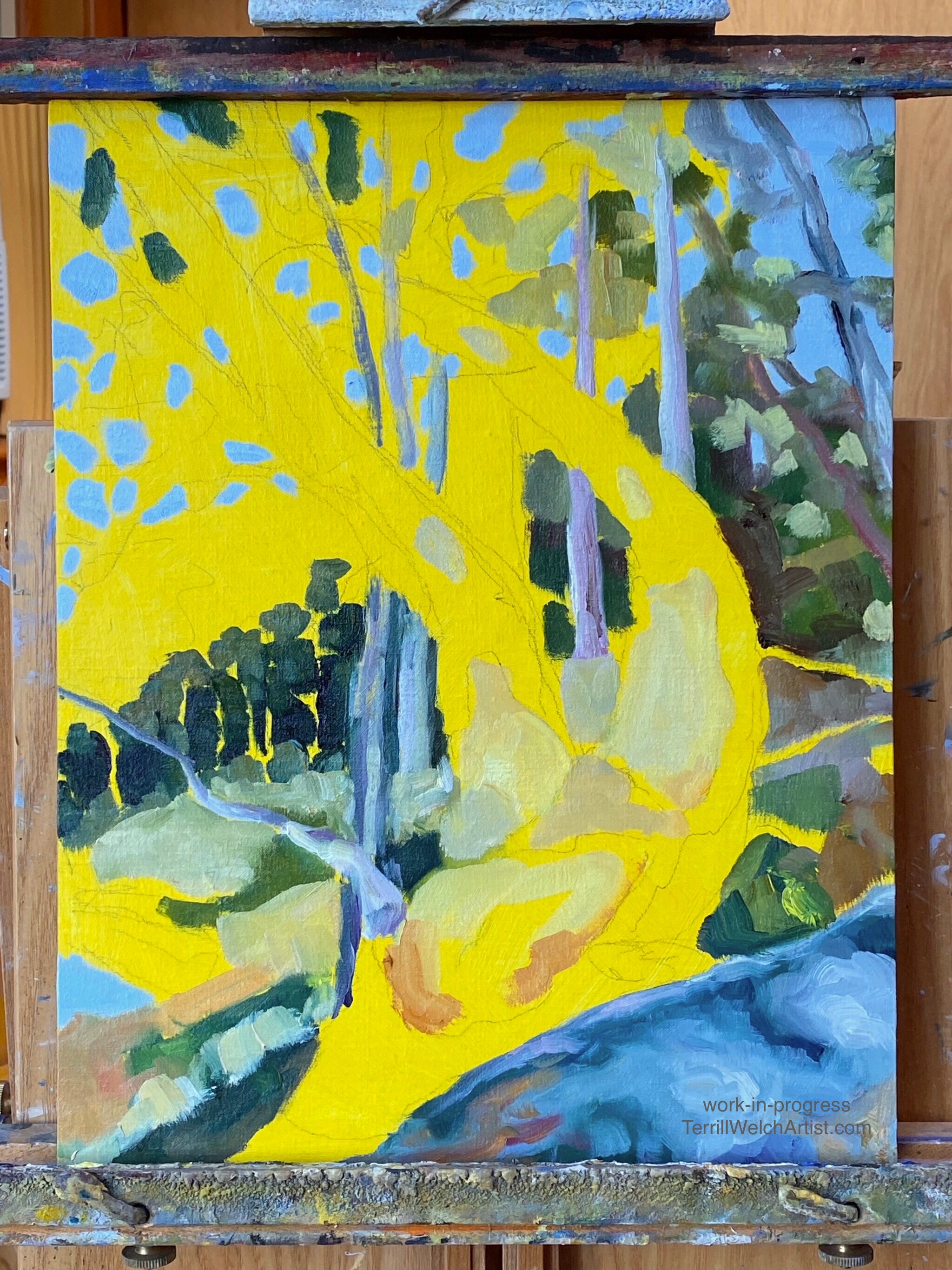
I am standing at the easel this morning and decided I would write while taking a teabreak. The painting catches the glare from the late morning sun outside the art studio window. I leave it and the brushes where they were put down and glance at the finished painting with almost dry edges that I thankfully had remembered to cover before I started.

A rough sketch had been completed yesterday and set up on my old French Box easel so that I could settle right into painting this morning.

This is a commissioned work and stems from an art collector’s shared love of this specific arbutus tree that resembles the long legs of a woman elegantly reaching for the sky. I have references going back years but chose just a few, between August 2023 and August 2025. It seems fitting that I would begin painting it in August 2026.
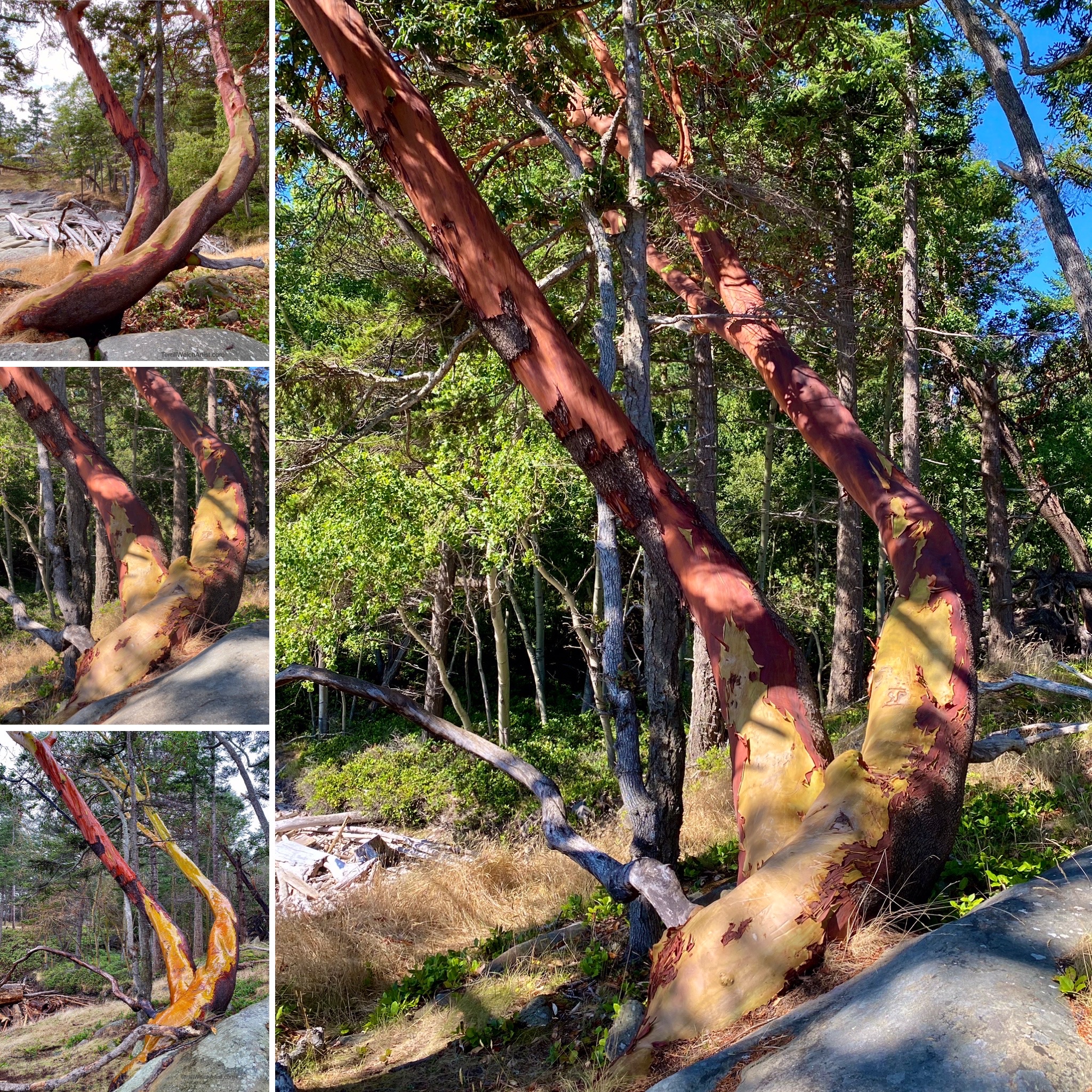
While I am painting, I do not think of much but rather focus on what I am remembering and feeling about this specific tree and this specific place which is no longer publicly accessible since much of the land around it was purchased as part of a conservation land use agreement. I cherish and I am deeply grateful for the vision of the landowners and those that worked to acquire the lands for this reason. It is a small price to pay to respect the request to stay off of the very point of Edith Point that is still held as private land. This aside, I lean into my memories again.

There is a ferry whistle in Active Pass on the other side of the island that echoes a response to the August sun pressing towards it through the trees. A calm ocean behind me pools in the bottom left of the painting. It isn’t there in the reference. This won’t matter and it might not even stay to the finish line. For now it needs to be there. Deep shadows offer a counterbalance to the bright trunks of the arbutus trees and rich soft greens of stunted poplar trees in the grove. What would it like to be this arbutus tree tuck in next to a few strong firs next to the Salish Sea? Answering this question is a significant part of the job of this painting. Though it may indeed capture a beautiful moment, that is not its purpose. It is a working painting and will bring a sense of being close to home and all that this means. This is true for most of my paintings. They are not collected as decorative objects or for status or for their uniqueness but rather for good company!
This brings me to a book I am reading and a question. Can paintings have an everyday use, like a hand turned pottery mug or a hand knit sweater? The Japanese philosopher, art historian, aesthete and poet, Soetsu Yanagi (1889 – 1961), proposes that true beauty does not come from straining to be remarkable. It comes from a kind of forgetting. Mingei or “crafts of the people”, is used to describe an approach and an object that “must be wholesomely and honestly made for practical use” (Yanagi, 2019, p. 5). These objects have been made without a need to be special or important and without grasping for attention. Further, the objects grow in beauty by their daily use. They are objects that have been made well and keep us company as we move through our ordinary lives. Yanagi in his book The Beauty of Everyday Things is speaking about anonymous folk craft and something that is different from what we understand as aristocratic contemporary fine art. However, I want to consider how my paintings might be and most often are acquired for their use value — not for decoration, not for spectacle or status but rather for daily company. This daily company is of course the underlying practice in which my brush touched the canvas in the first place. The paintings are the result of my conversation with nature that then invites the viewer into these exchanges. Skill, practice, the quality of the materials matter, just like they do for the craft worker making a mug or weaving a basket. The works are not about being unique, though this over time happens without this being the intent. I mostly want to examine how a painting, as a crafted object, has a use value in our ordinary day, beyond an exploration of an idea that would lend itself to being considered contemporary art which, for the most part, is less interested in skill mastery or material quality. More importantly, can a painting hold both these philosophical and practical frameworks at the same time – humble usefulness for daily company and the successful exploration of a unique idea or concept? These are the questions I am asking as I read while knowing that my work does not have a physical use, definitely is not anonymous, and often it is not, broadly speaking, unique enough to fit easily into contemporary art sensibilities (presuming contemporary art can genuinely claim such a thing as sensibility).
Well, teabreak is over. It is time I set this musing aside and get back to the easel and see where this painting takes me next.
Reference list:
Yanagi, S. (2019). The Beauty of Everyday Things. Penguin Books.

