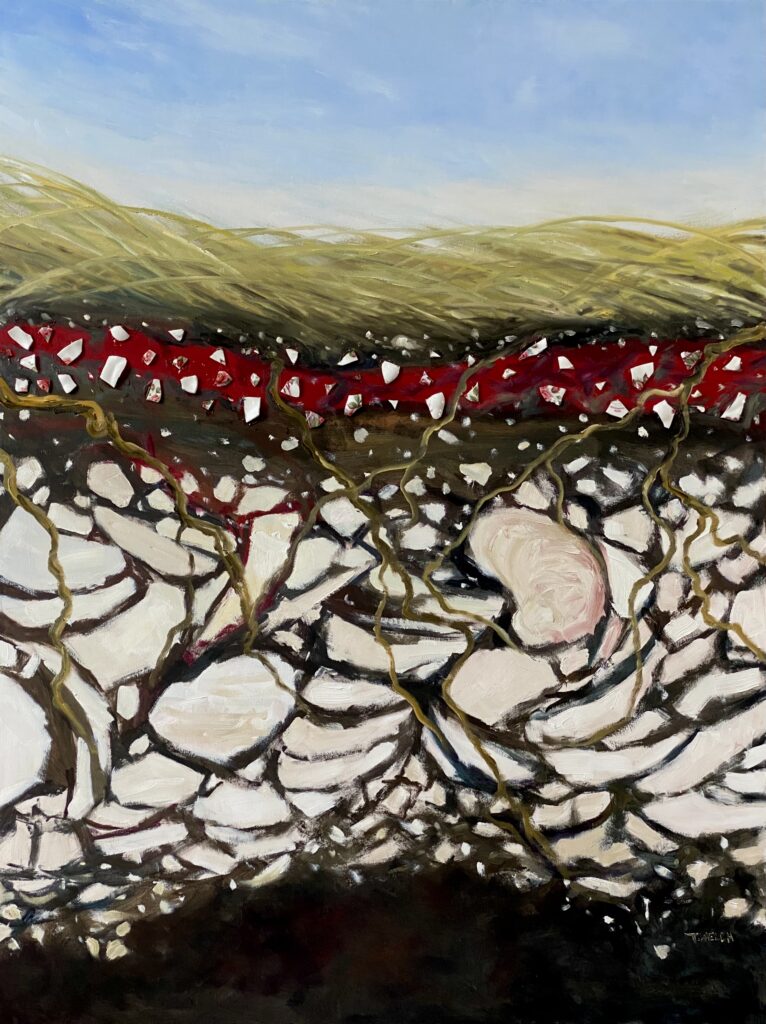
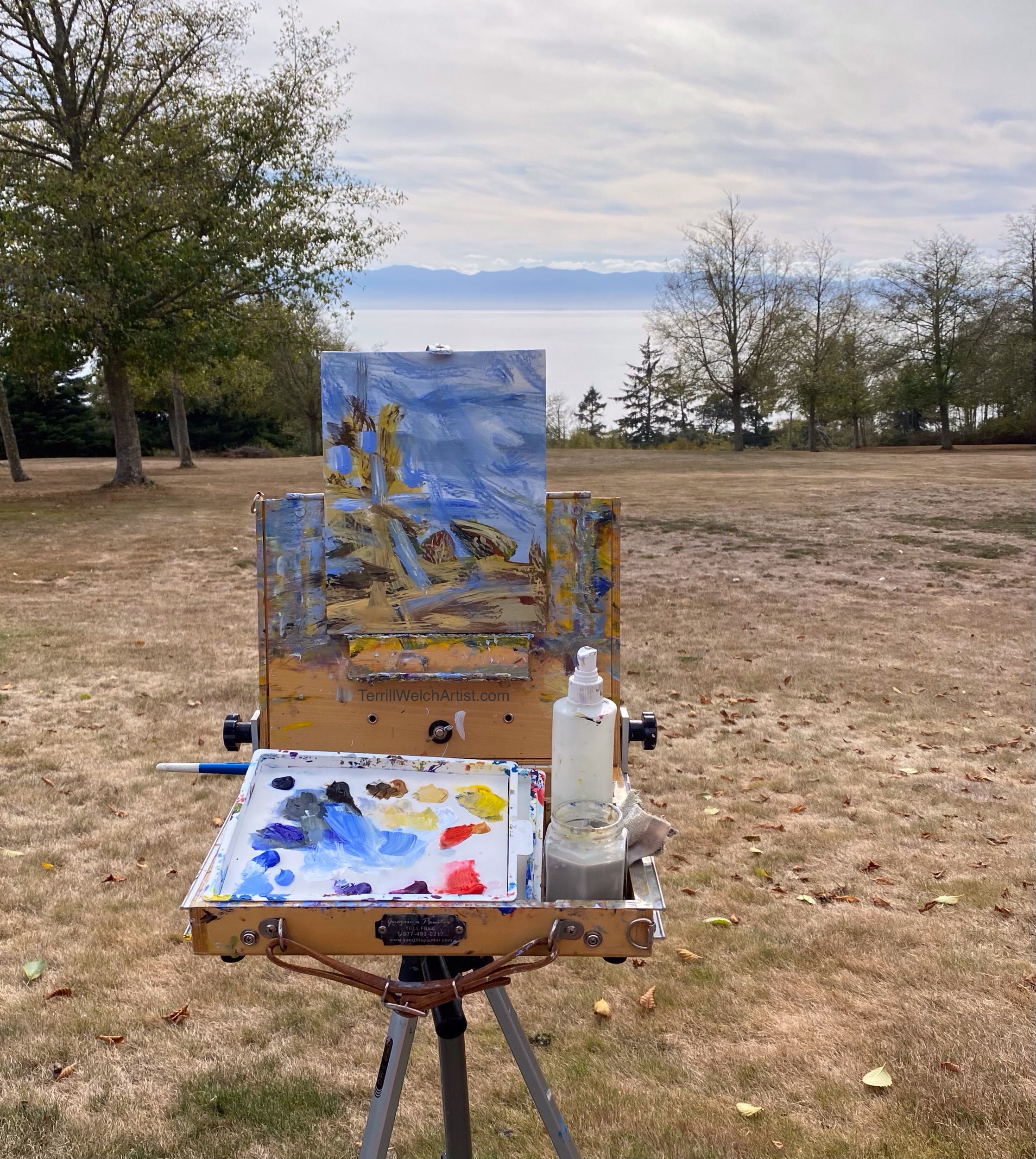
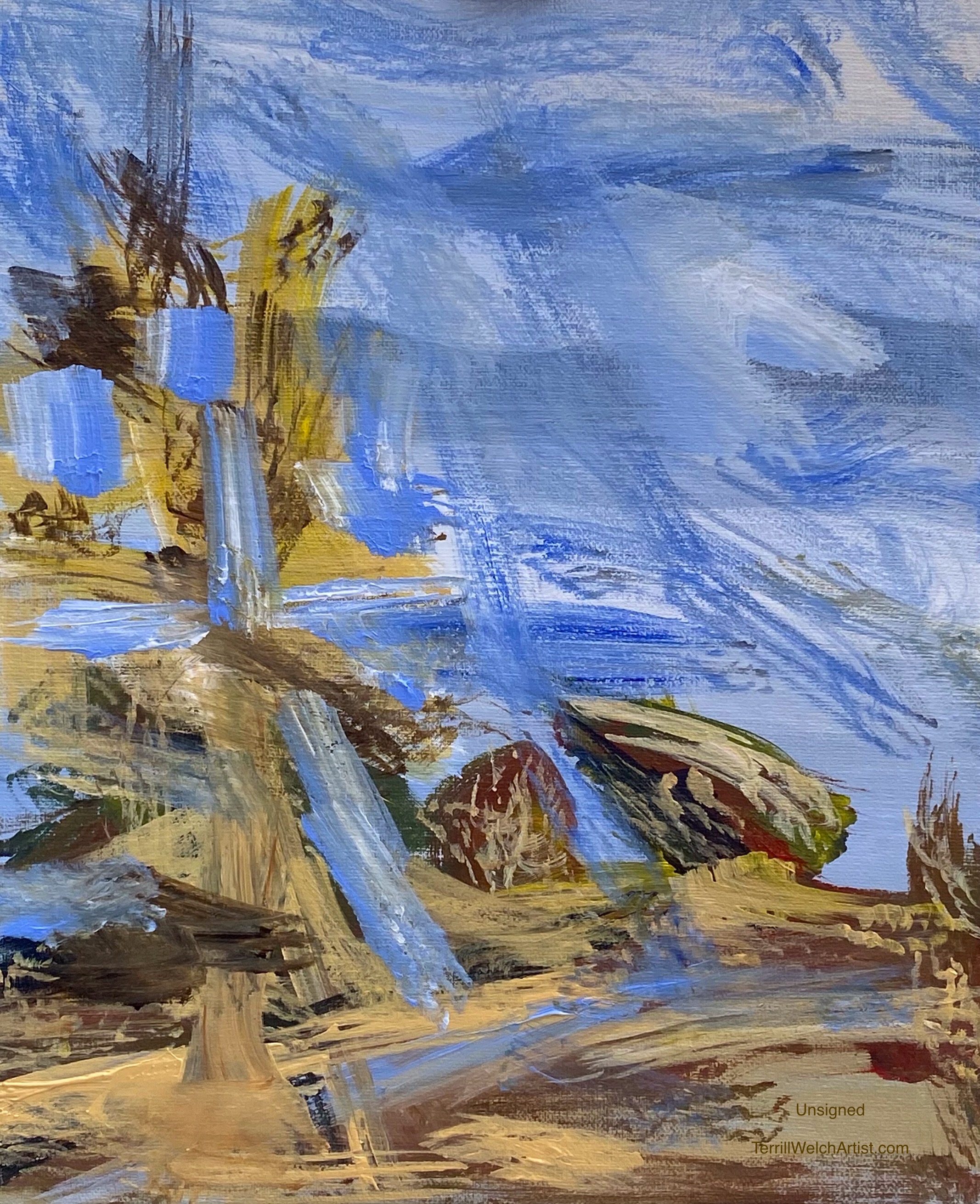
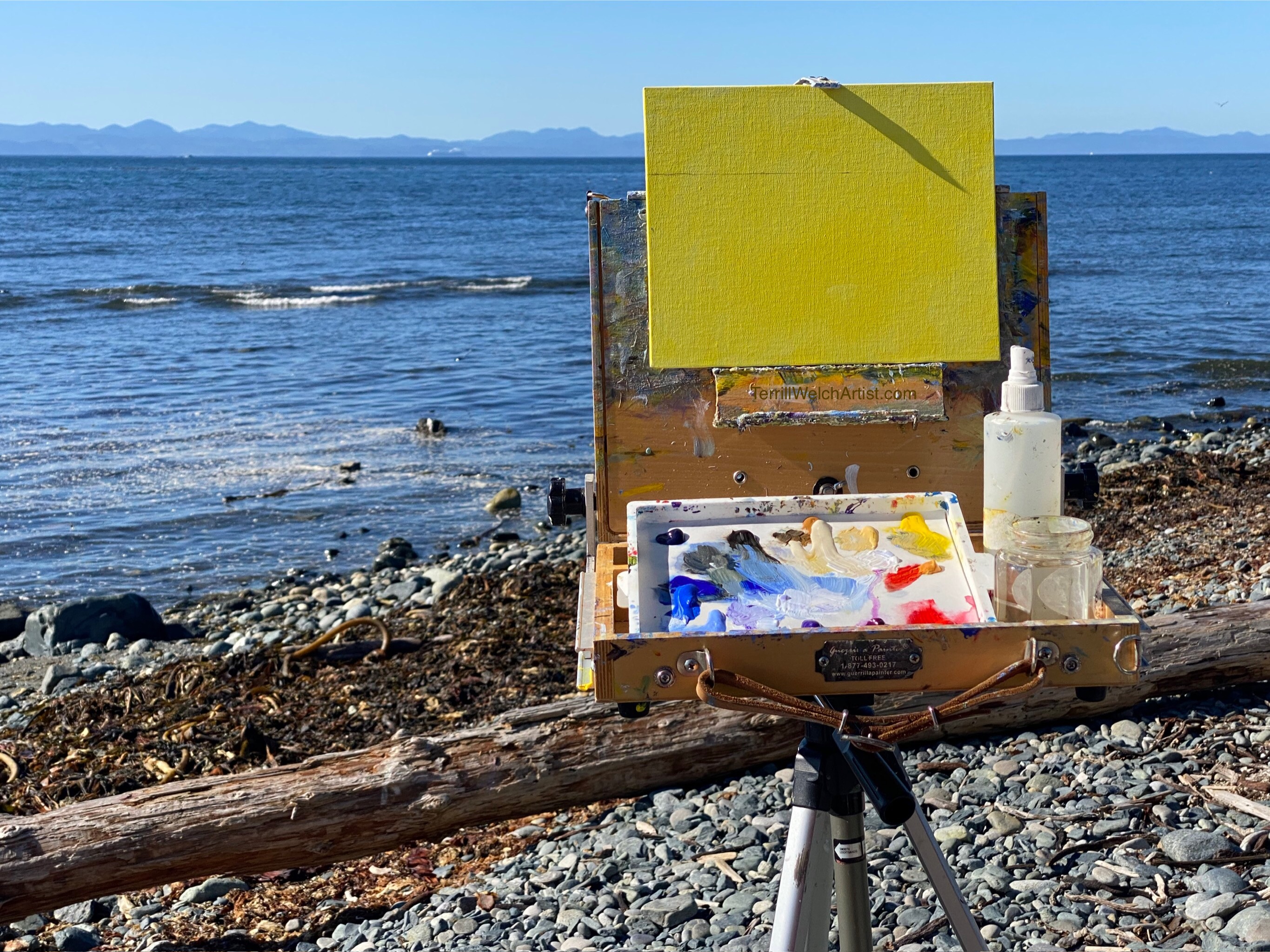
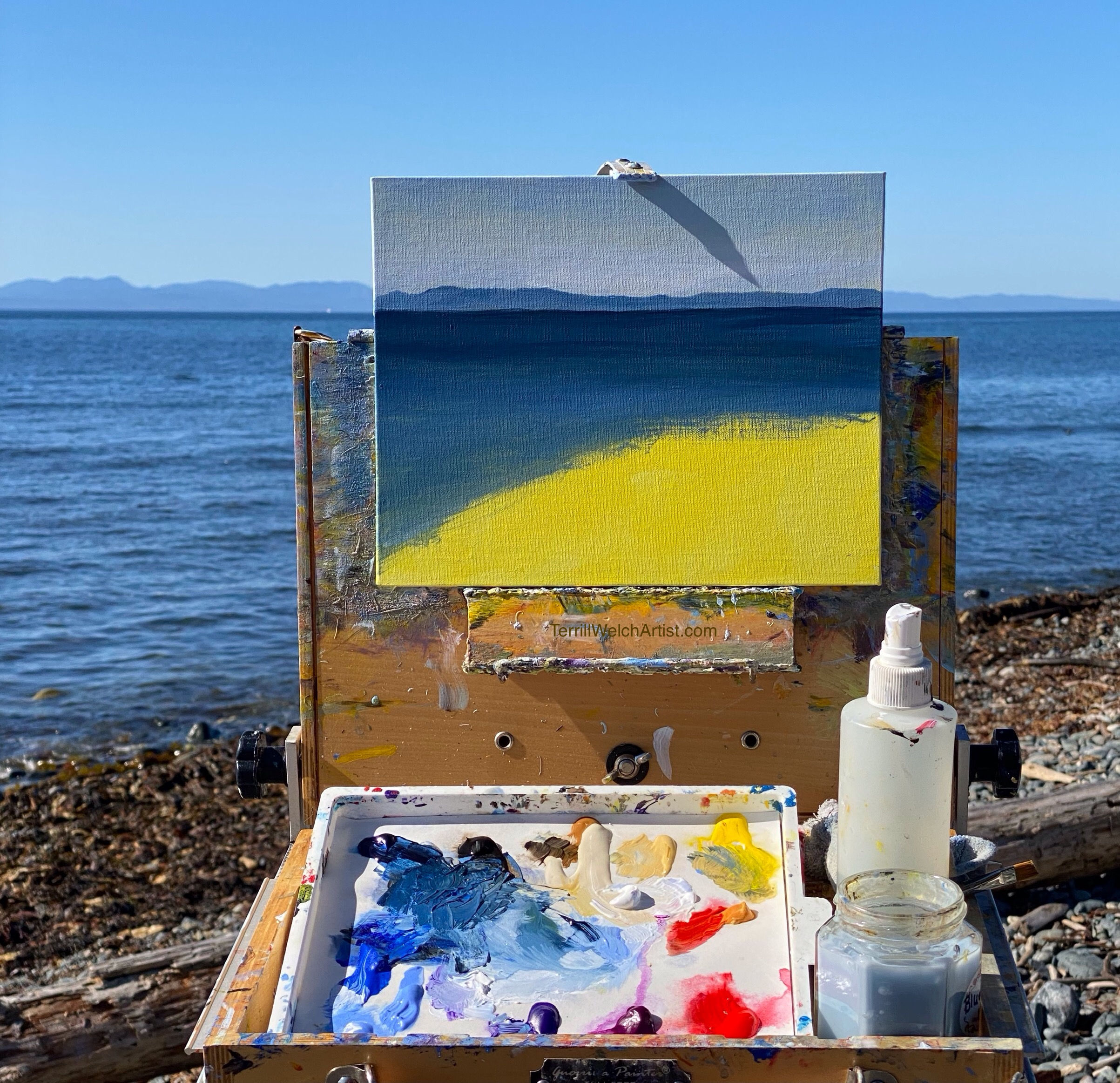
Defining “Close to Home” as a focus within my nature-centric, reparative painting practice

Monday, 17 August 2026

“Close to home” at first, brings up familiarity, safety and comfort. It is where I live my daily life most of the time. Geographically, these days “close to home” is usually limited to within a day’s drive in any direction which gives the concept physical parameters. There is an ordinariness that comes with these sustained intimately observed passages of time in one place doing “the usual” things such as getting groceries, hanging laundry on the line, grinding the morning coffee beans, paying bills online, going to the dentist, getting the car serviced, working in the yard, hugging my partner, children, grandchildren and friends between taking long hikes, painting in the studio and promoting the gallery and artworks. I ask myself, why is this focus on “Close to Home” in my painting practice important? 
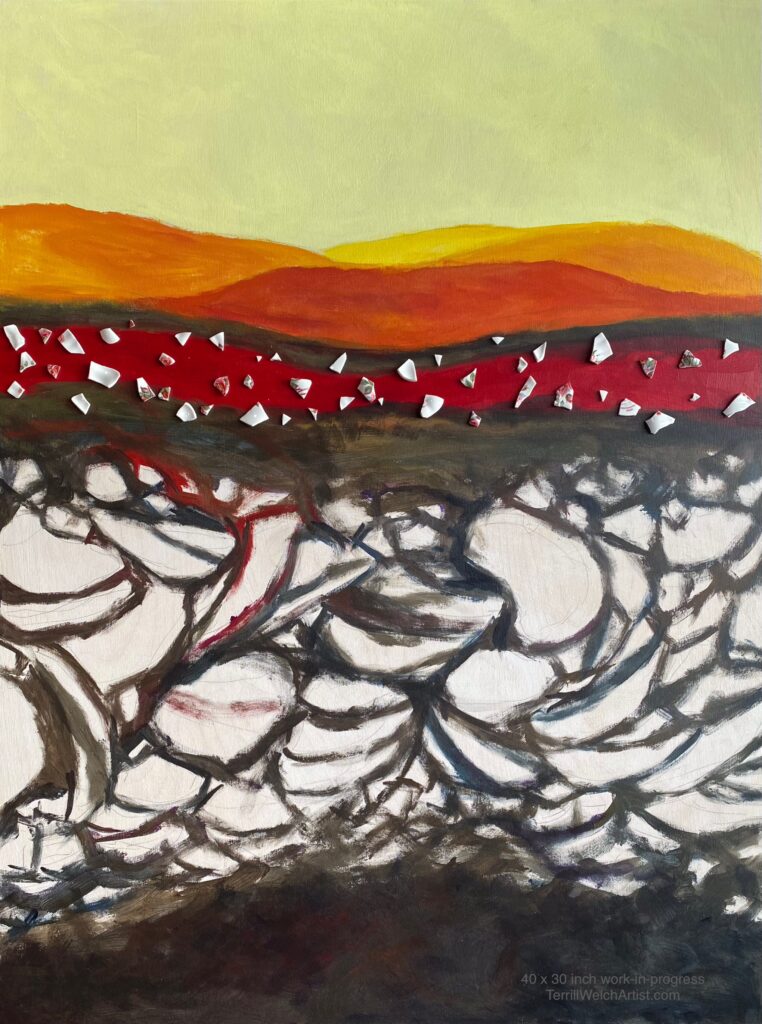
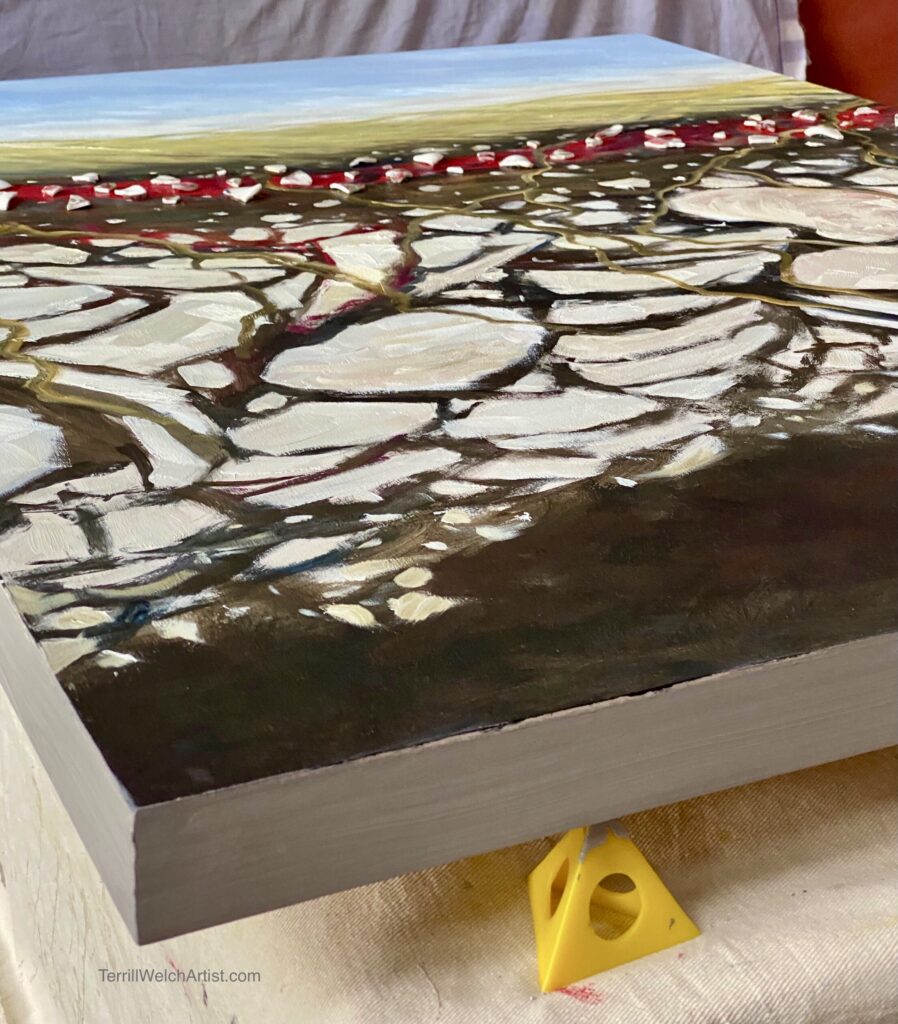
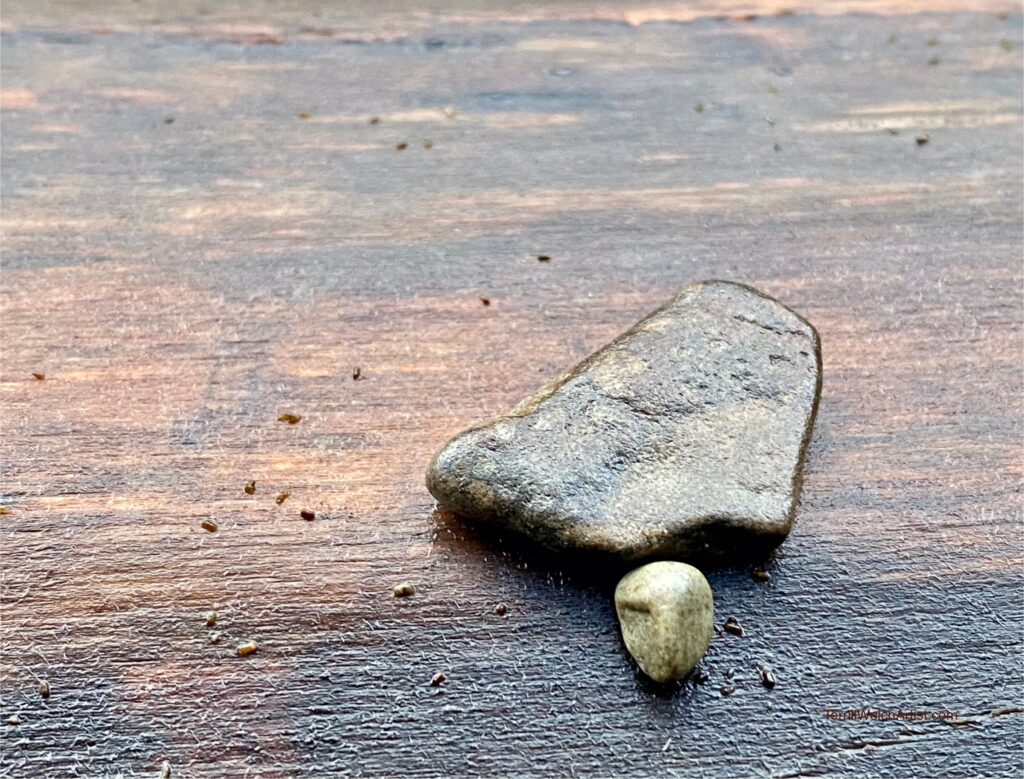
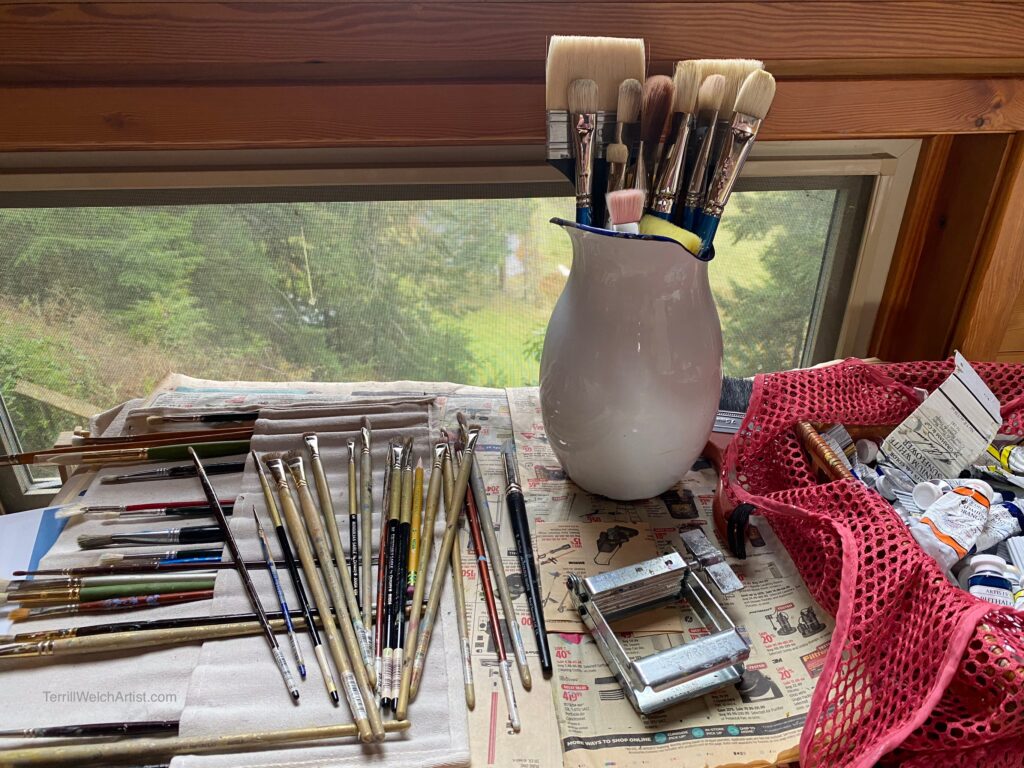
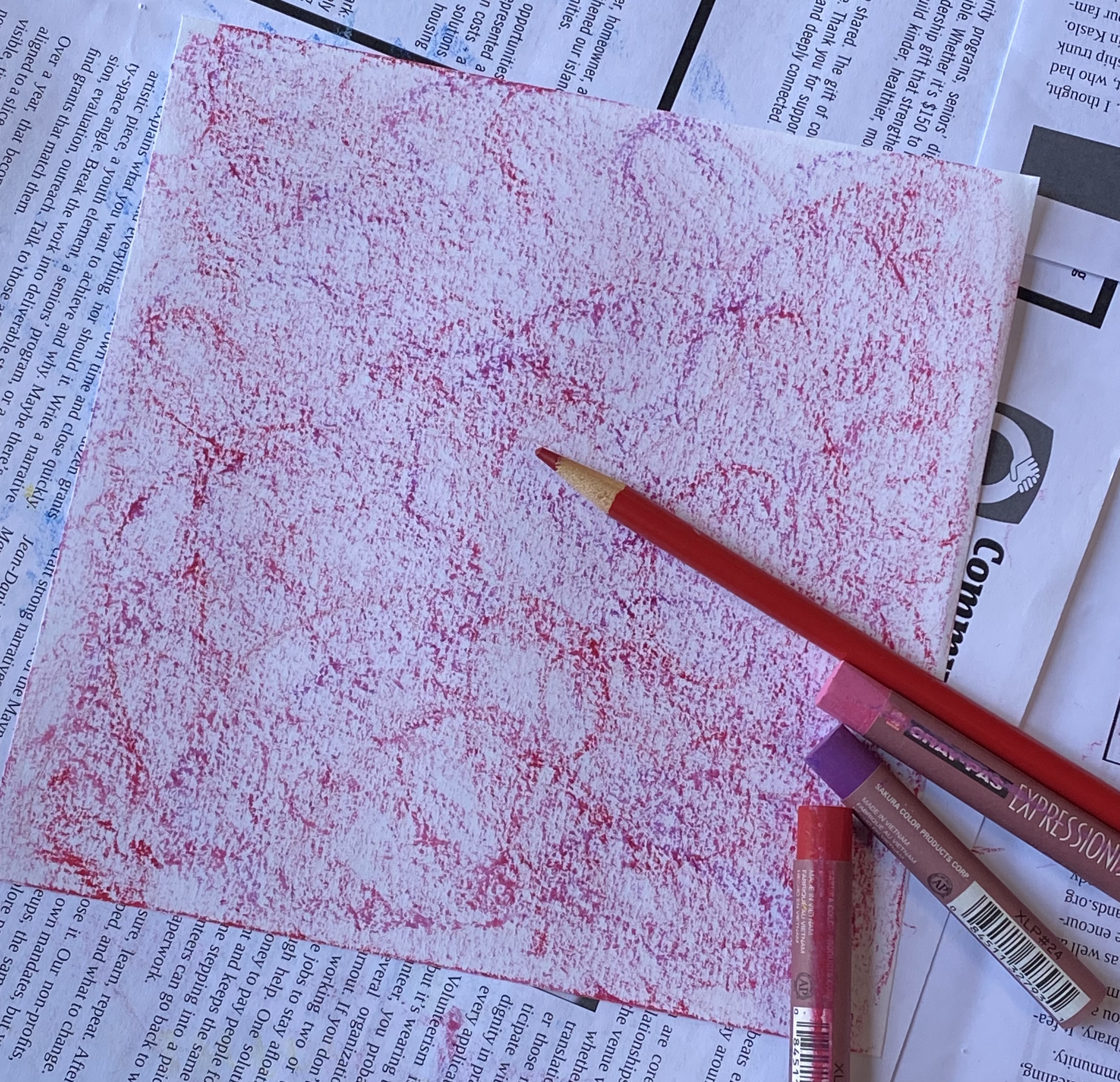
Developing red collage paper by Terrill Welch. August 8, 2026.

To answer this question is to first observe aspects of my contextualized autoethnographic references. The first and most obvious factor is that I am a full-time, primary caregiver for a partner that can quite happily no longer go further than the geographical territory mentioned above. I remain close to home because, to provide the best care for someone else, I must. The alternatives are to place my special human in respite care or to have someone come to stay with them. Neither of these options are easily workable in practice. By the time I get someone or someplace up to speed on this special being’s needs and them familiar with something they don’t want to do, the brief break becomes more of a traumatic ordeal for both of us than an actual opportunity. At least, this has been our experience so far. Eventually when regular weekly respite breaks become necessary, we will then have someone familiar providing additional support on ongoing. This might then present some opportunities for longer breaks for me to be able to at least go see my elderly parents which is a 7-10 day round trip visit away. For now, primary caregiving responsibilities take a central role, as a wife and as the human that is closest to the person in need. There are children. But the personal care needs and ongoing vascular dementia monitoring and prompting have gone well beyond their comfort levels and therefore not an option except possibly during a short term emergency until other care could be put in place. Community health home support services have been limited and expensive for what is provided. This leaves just me for now. We muddle through as best we can together which for now is pretty well. As an almost 68 year old white woman of settler ancestry, living on a rural small island on the southwest coast of Canada, I am resourceful, resilient, organized and pragmatic with a strong work ethic. I will face poverty level cash flows if/when the time comes to manage only on my own pensions. For now, there is enough to comfortably support both of us. But this reality is partly why I spent the past two years completing my MA Fine Art degree. It is a way to recognize the seriousness with which I take my painting practice that then might possibly lead to my artwork offering a small financial buffer if it is needed in the future. Global instability may make this a difficult proposition to realize but it would be even less of a possibility as an older woman artist without doing this degree. 

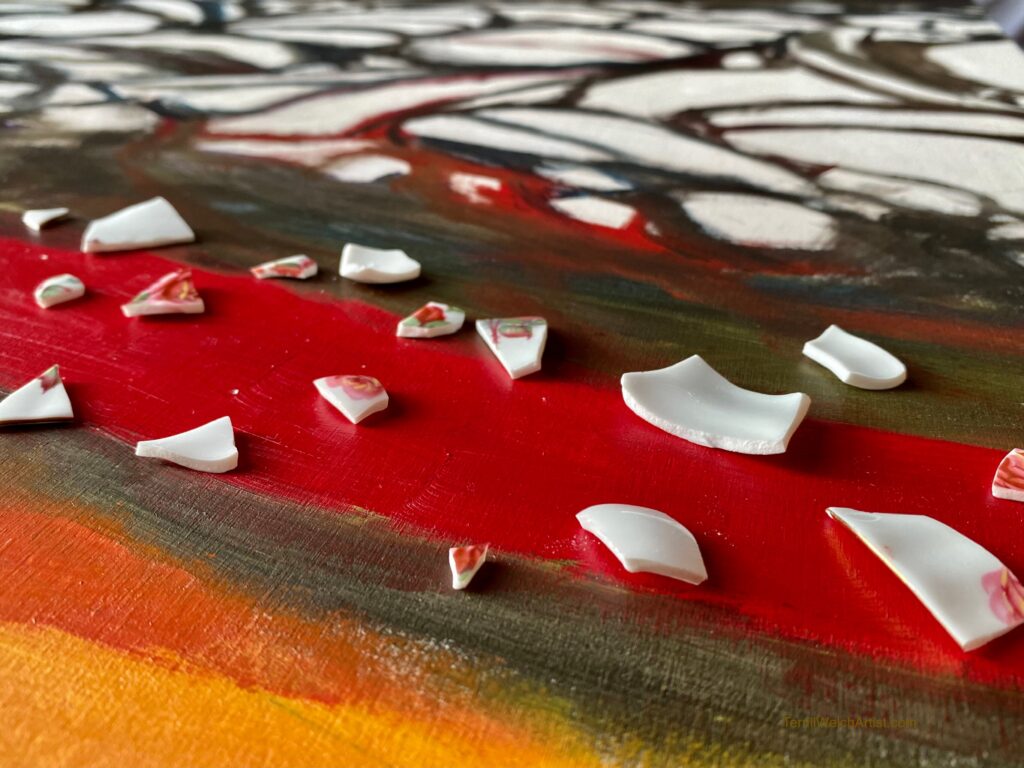
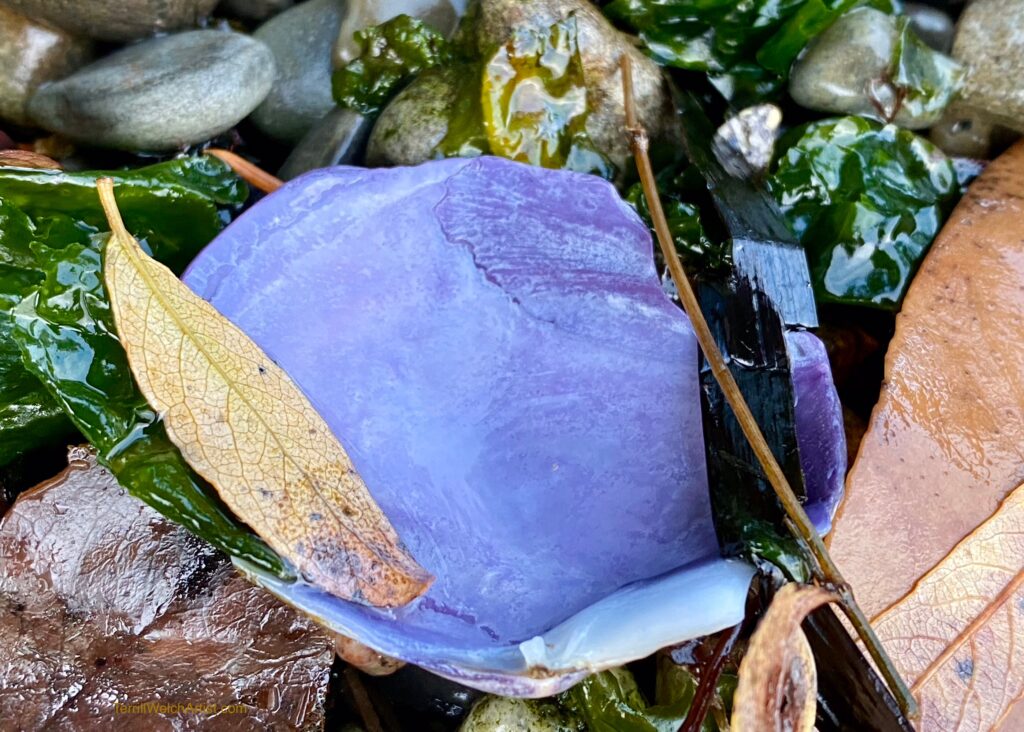
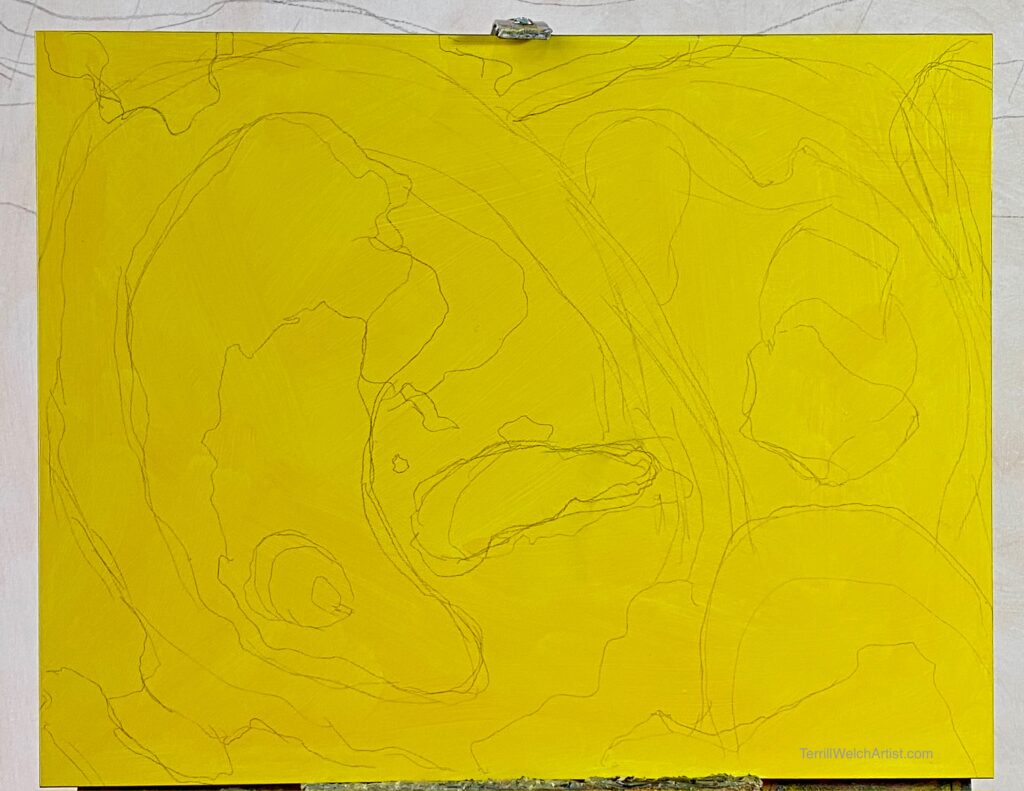
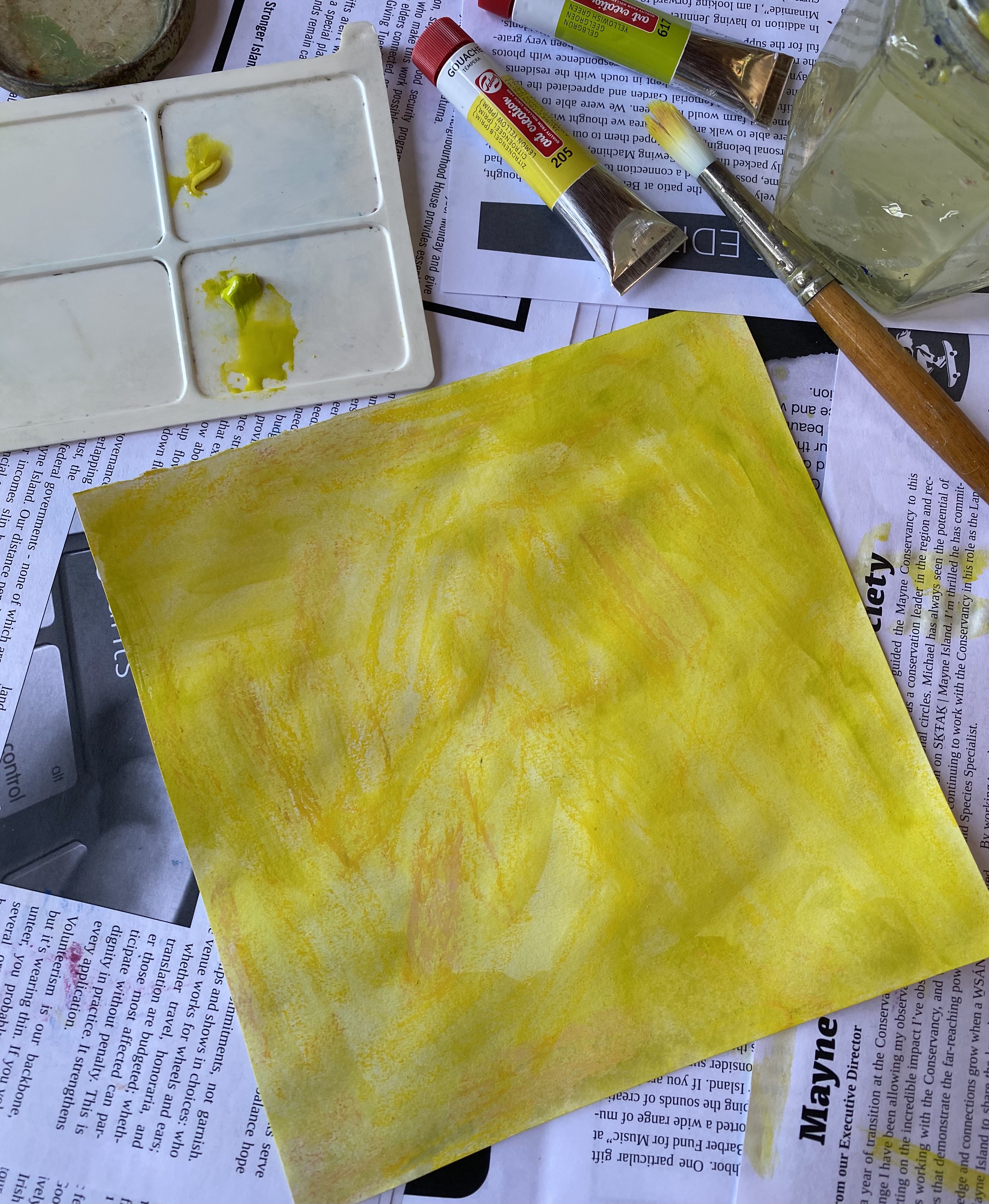
Yellow gauche covered collage paper by Terrill Welch. August 8, 2026.

This brings up other aspects about being “Close to Home” including a sense of loss of freedom, of heavy sadness/grief about slowly losing someone to their disease, as well as facing my own limitations and mortality. How long can I reasonably keep up with these responsibilities? How long can I manage living on this rural island as the only person who is able to drive?

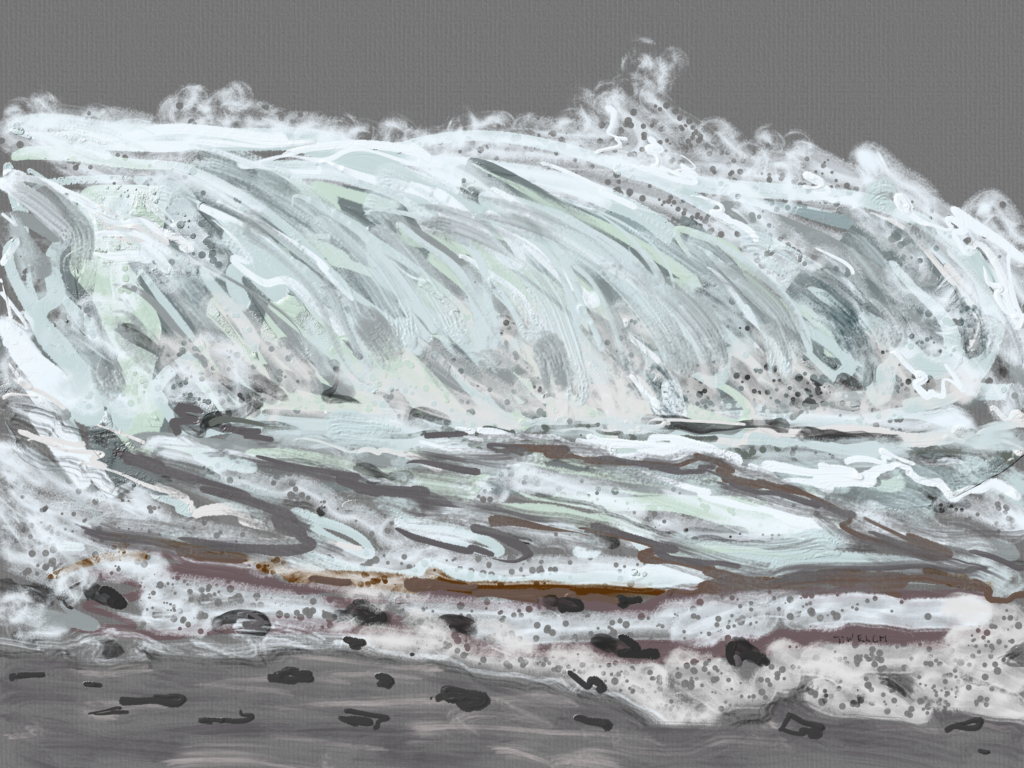
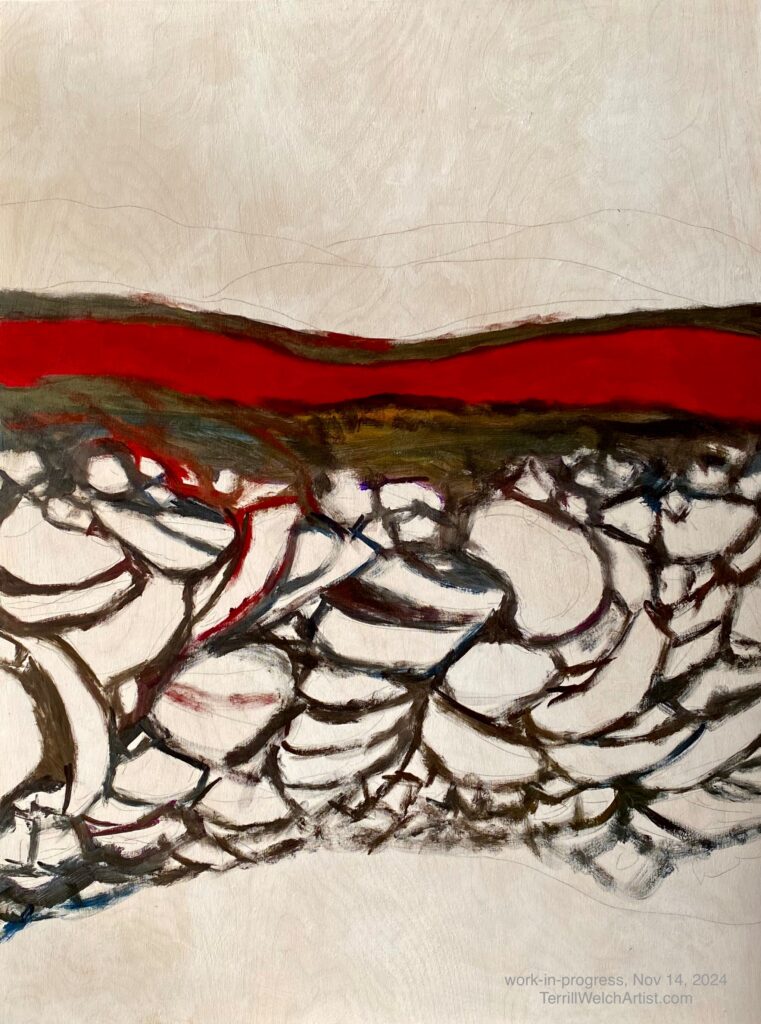
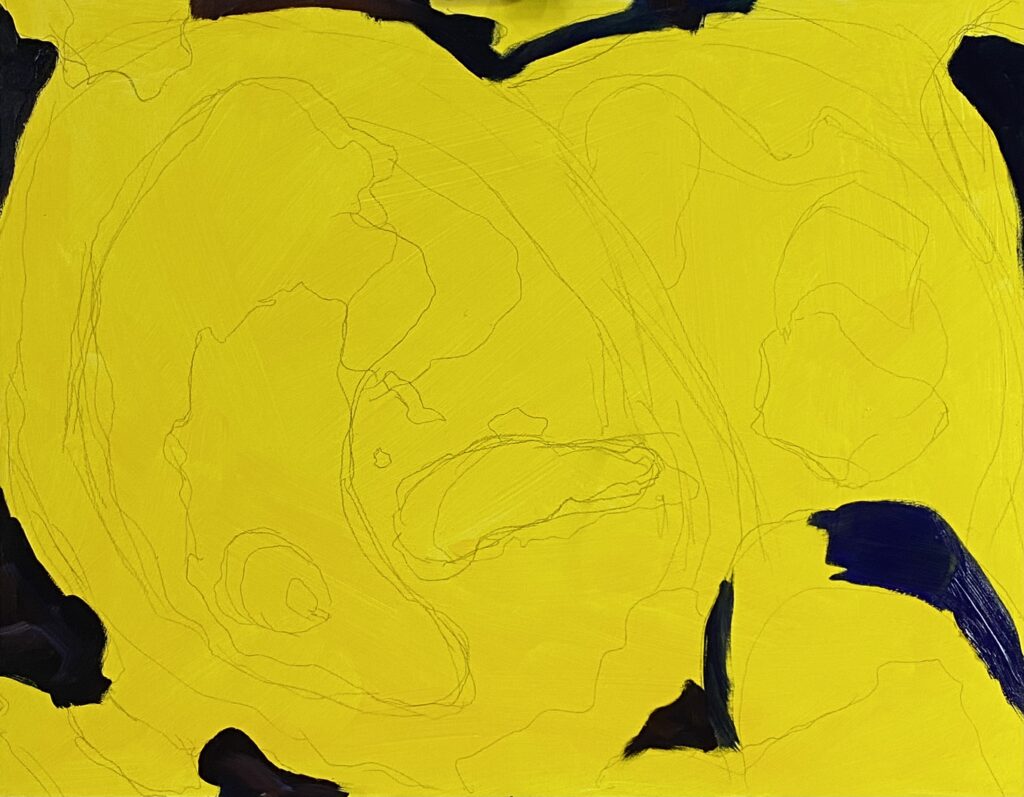
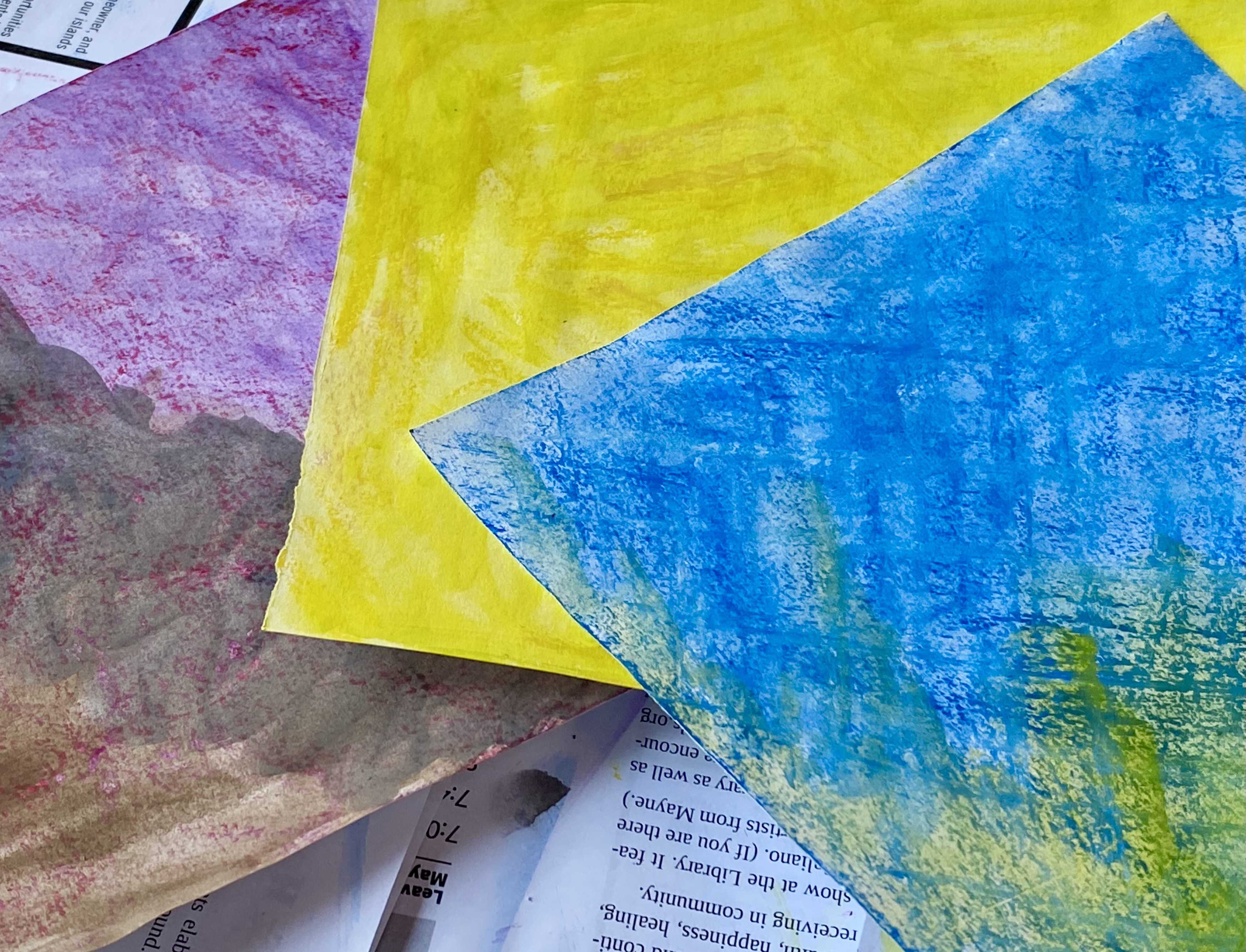
Three sheets of collage paper created by Terrill Welch. August 8, 2026.

Then I return again to my painting practice and its central role in making all challenging situations much more possible, pleasurable and endurable. This is especially true if I turn my painting practice directly towards what is challenging. In doing this, I seem to find my footing and my strength as well as my joy and pleasure with simply being alive.

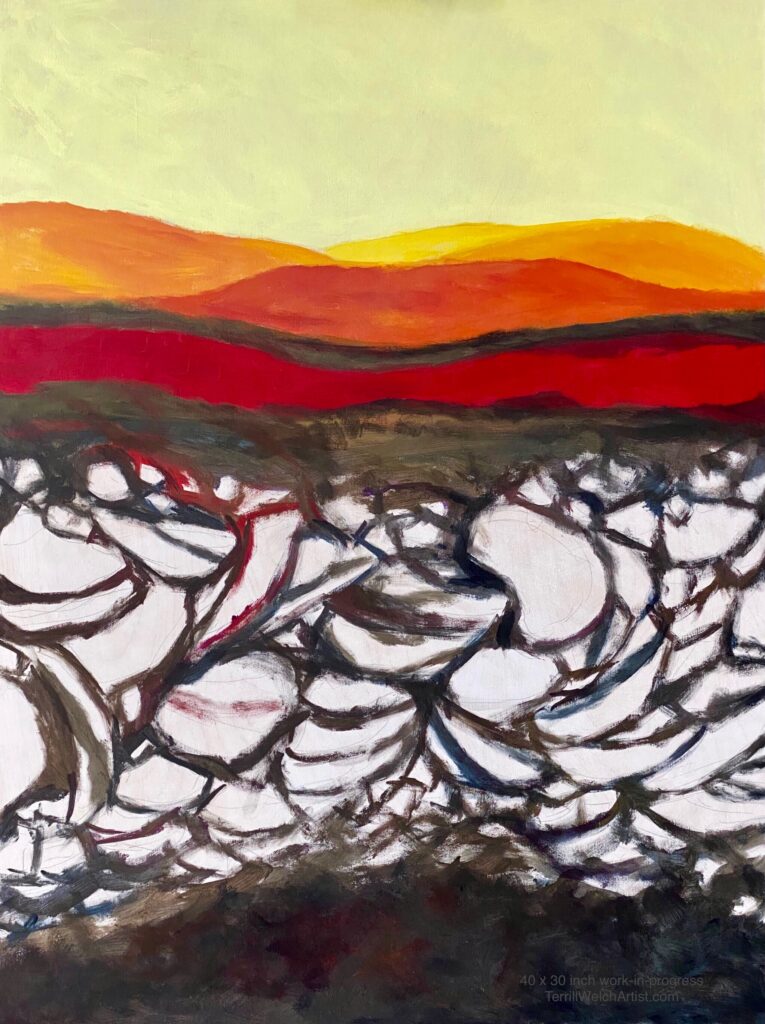
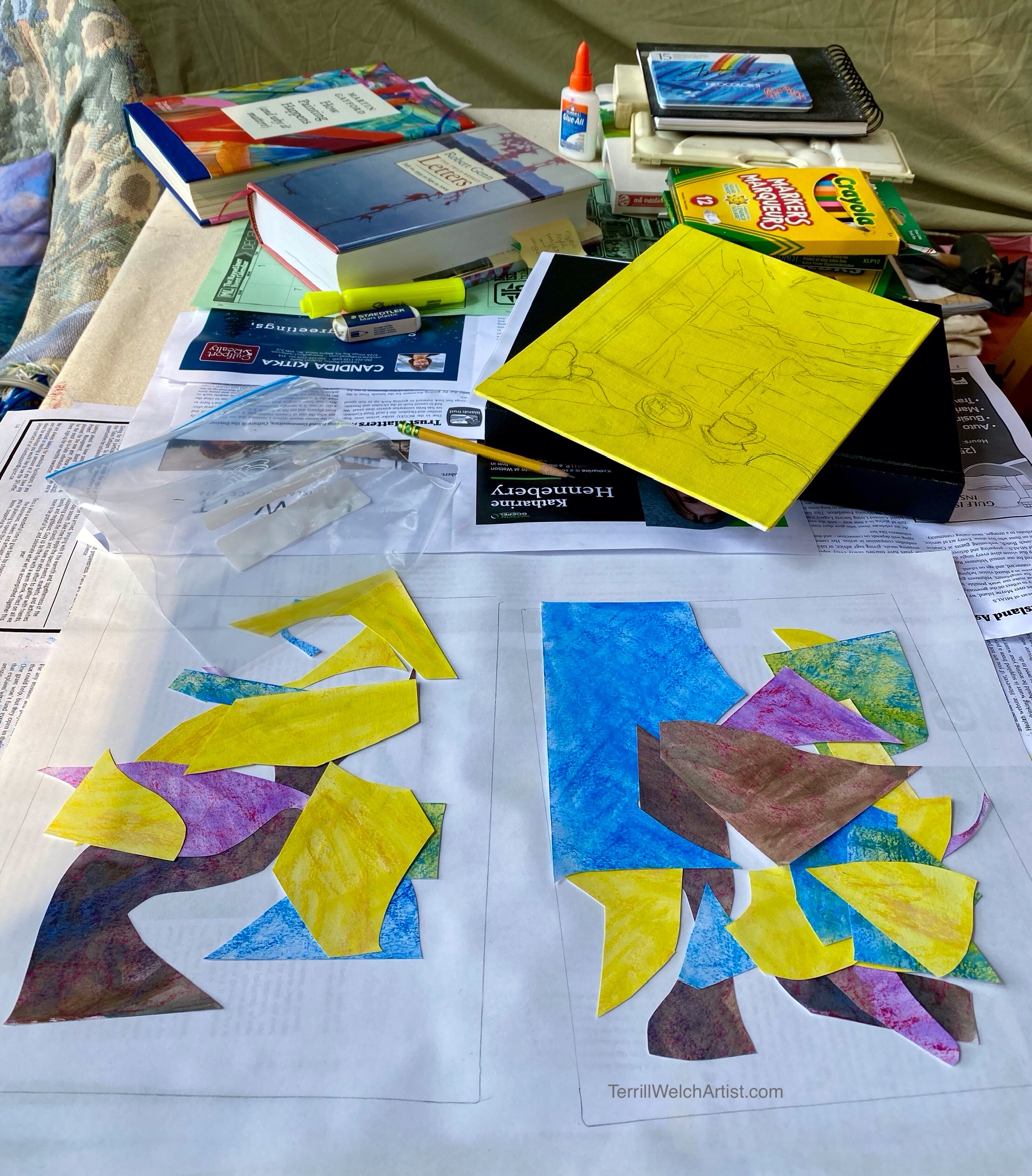
These are the thoughts that came to mind as I created the collage paper, cut it up and then decided I wanted to paint instead. So, I packed up the paper cuttings and put them in a bag for another day.

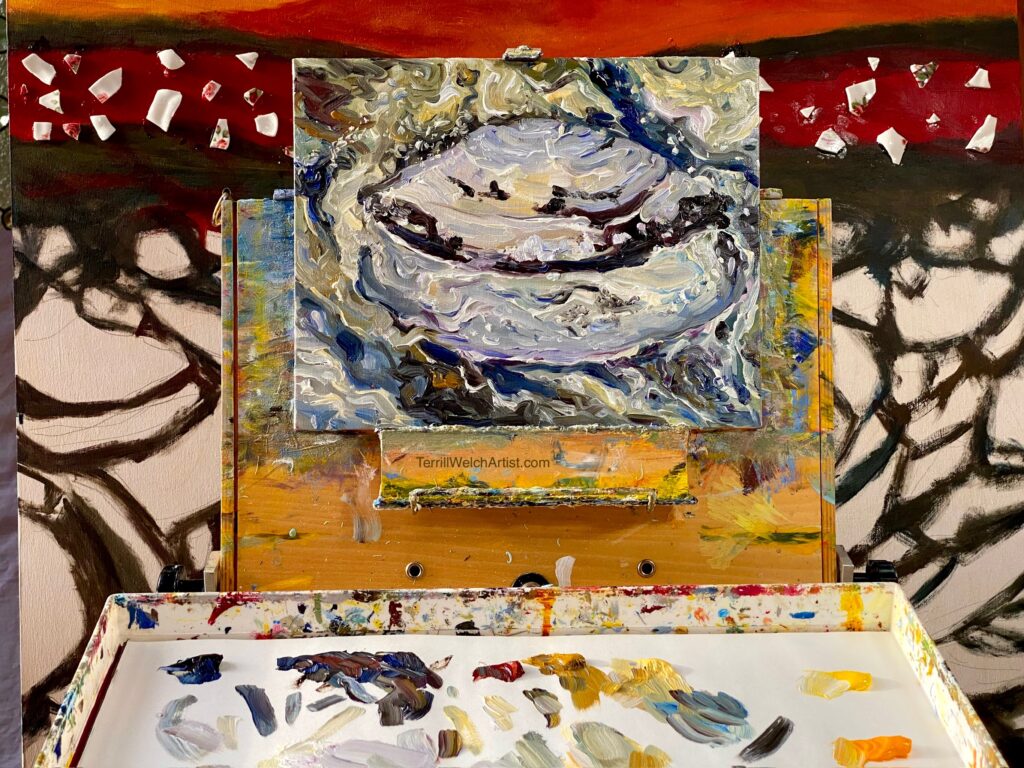
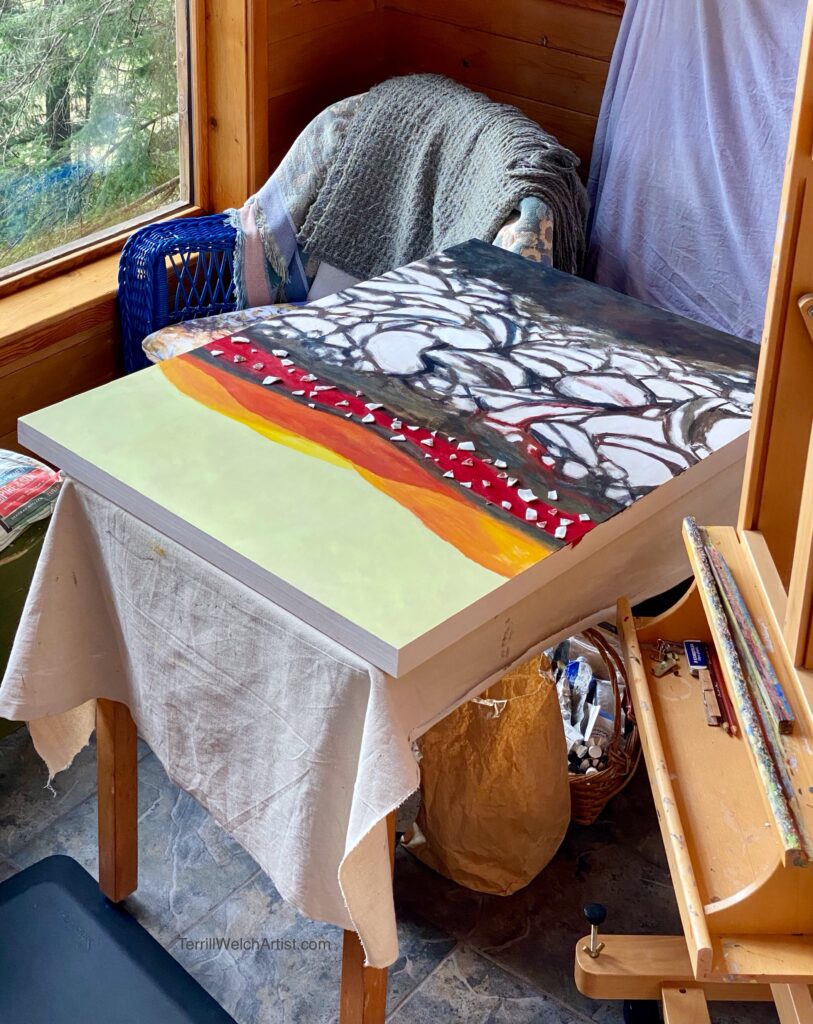
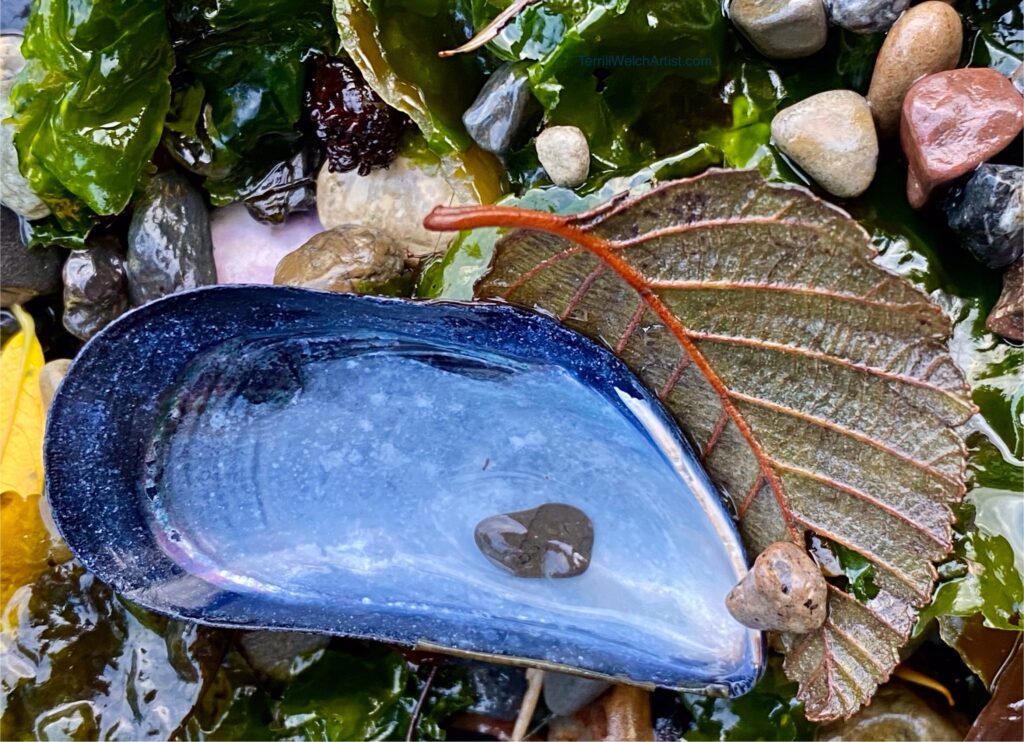
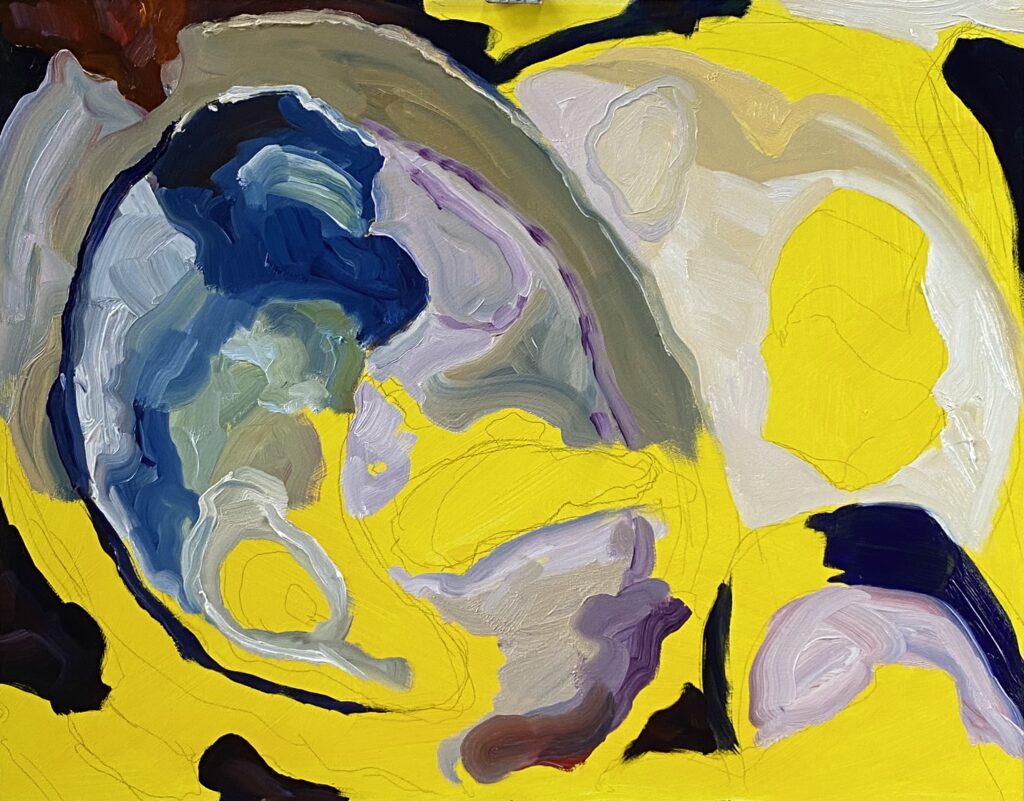
Collage paper cuttings and a sketched ready to paint in Terrill Welch’s art studio.

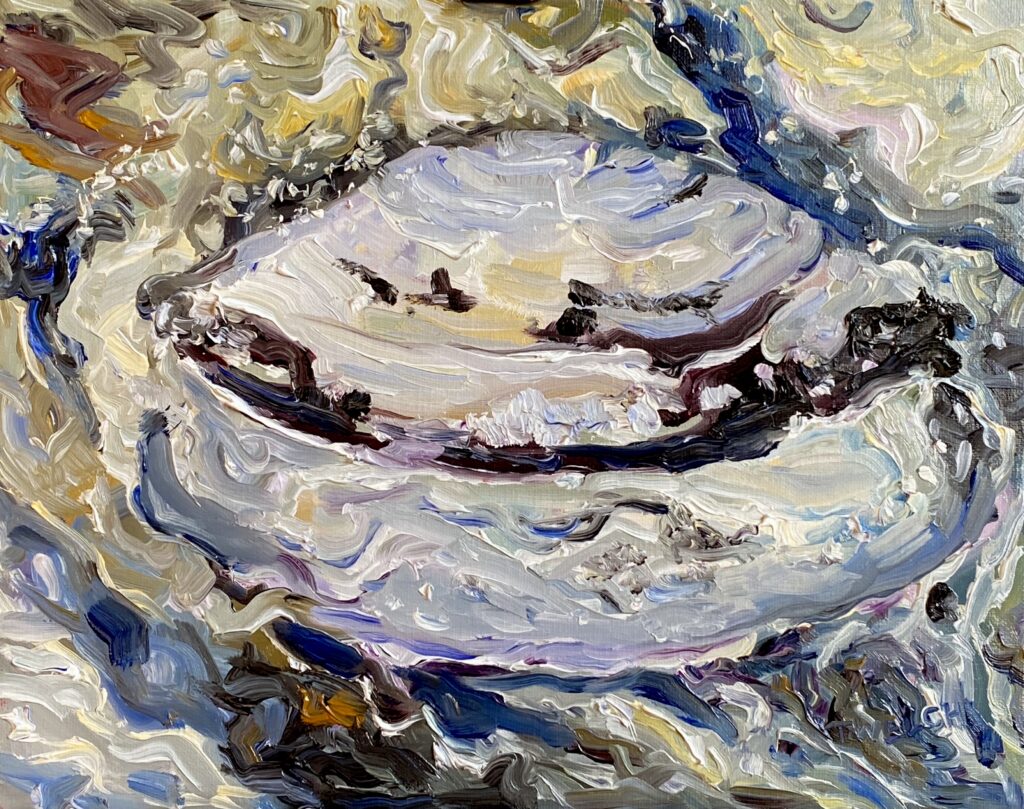
I expect to have much more to discover about my focus on “Close to Home” as I proceed but for now, it is time to work on a small painting sketch featuring morning coffee in my studio chair.

Lady Arbutus Painting Data Collection

Painting Data Collection 

Title: Lady Arbutus Date Completed: Wednesday, 5 August 2026
Materials: oil on linen covered birch wood
Size: 14 x 11 inches (36 x 28 cm)

Figurative/Abstract Self Assessment Band-Scale Rating between 1-10: 4-7 

The background offers a loose abstract network of brushmarks while the tree is given figurative prominence with large shapes holding the composition within a visual space of warm morning summer light. 

Reference Gathering: 

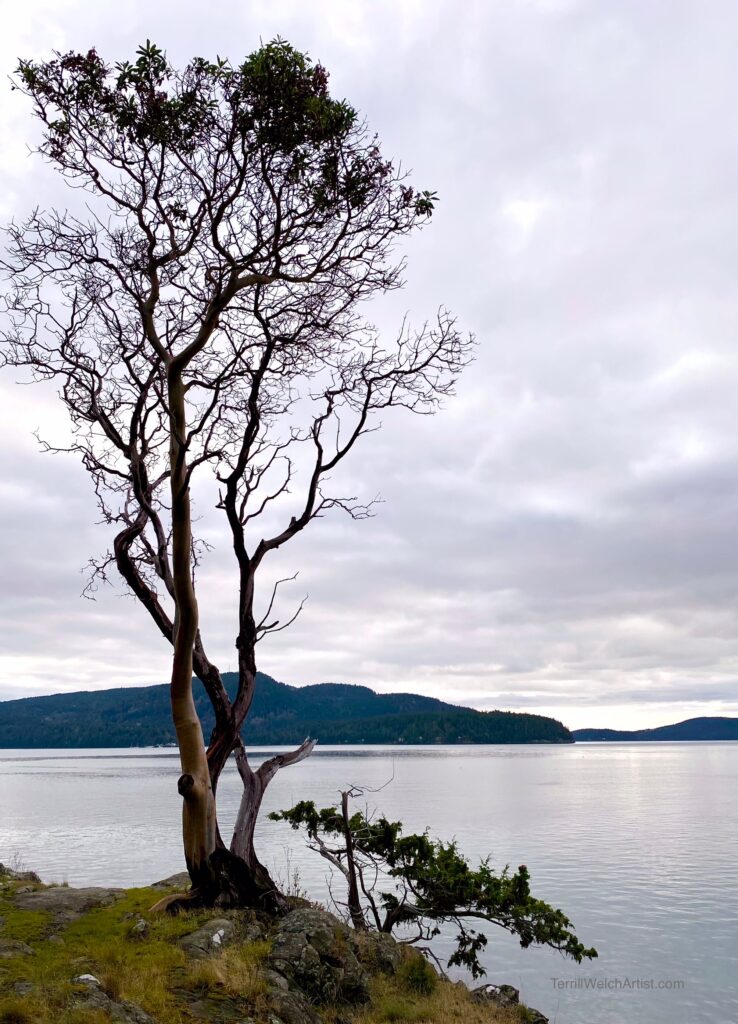
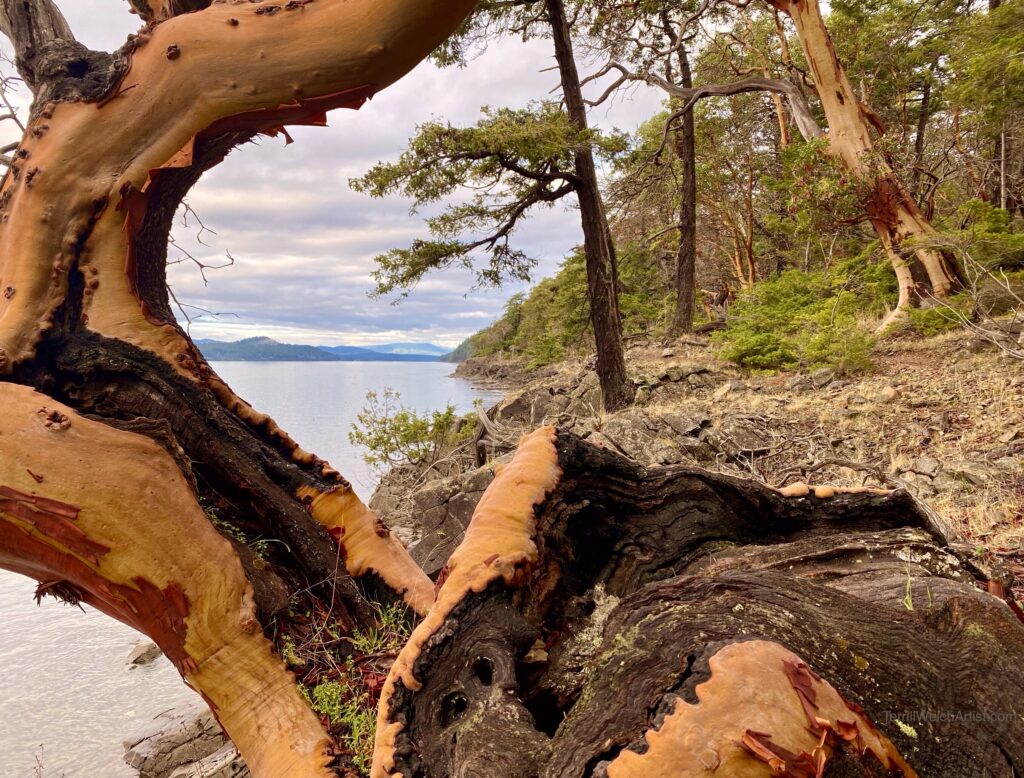
This is a commissioned work and stems from an art collector’s shared love of this specific arbutus tree that resembles the long legs of a woman elegantly reaching for the sky. I have references going back years but chose just a few, between August 2023 and August 2025.

Collection of reference images between August 30, 2023 and August 20, 2025 by Terrill Welch in preparation for painting “Lady Arbutus” in August 2026.

Making Process:

My studio making process proceeded over a few days in 2-3 hour painting sessions. I required pauses to really listen to the painting and what it was asking of me. I also mentally invited the art collector into my musings with nature so that I could draw on the abundance of influences between us three. The focus is on a portrait of the arbutus tree while keeping a sense of context and hints of the ocean behind and beside the viewer. I have a special relationship with not just the arbutus tree but also the polar trees on the middle left. There are very few on Mayne Island but they grew in abundance around my childhood home. 

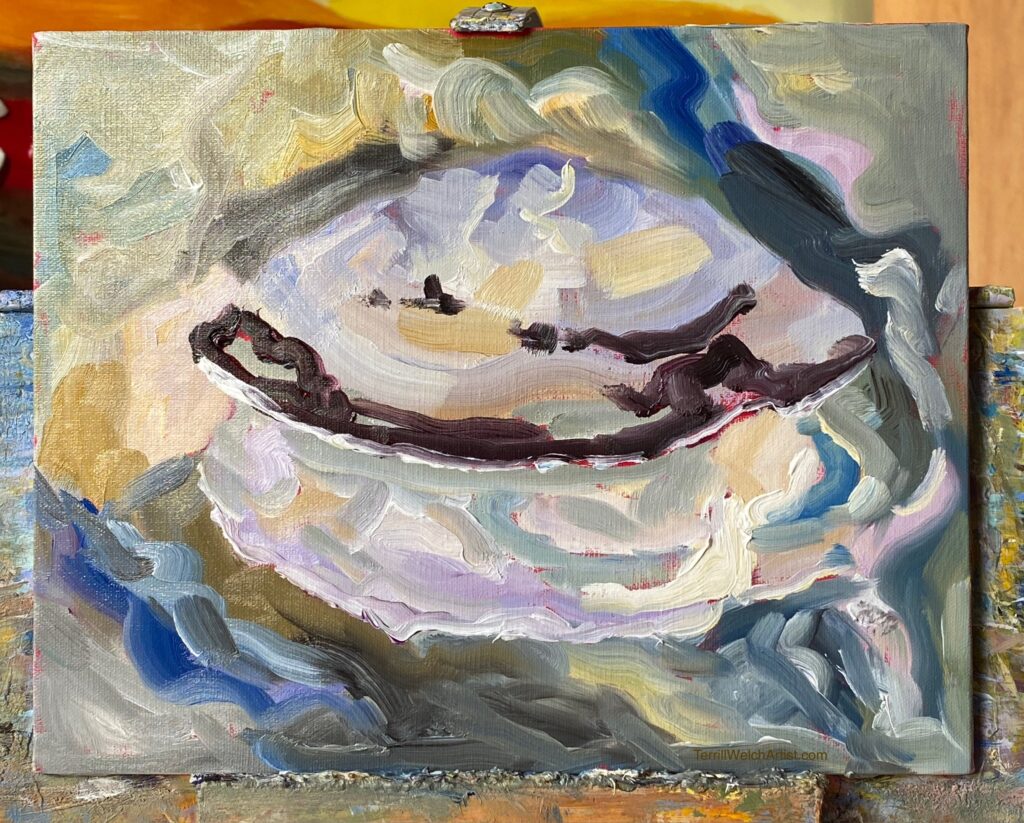
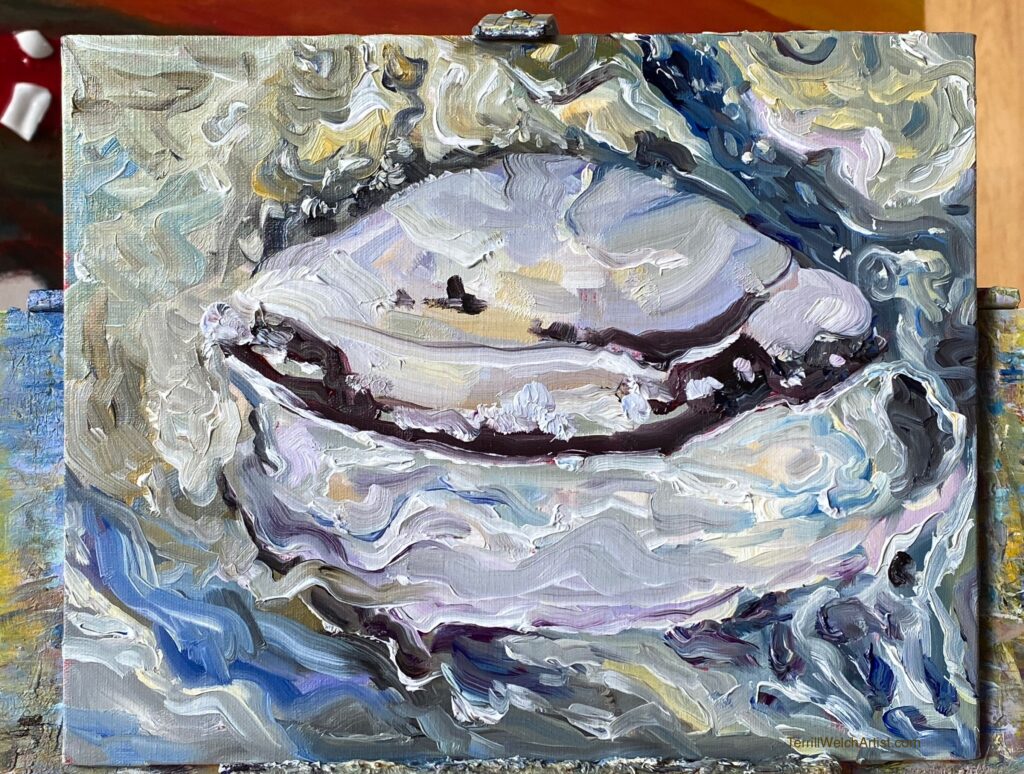
Collage of work-in-progress images for Lady Arbutus by Terrill Welch 14 x 11 inch oil on linen covered birch wood.

Finished Painting:

“Lady Arbutus” by Terrill Welch, 14 x 11 inch oil on linen covered birch wood. Completed Wednesday, 5 August 2026.

For scale, here is the painting in a digital viewing room.

Digital room view – Lady Arbutus by Terrill Welch, 14 x 11 inch oil on linen covered birch wood.

Making Notes:

A ferry whistles in Active Pass on the other side of the island and echoes a response to the August sun pressing towards it through the trees. The calm ocean behind me pools at the bottom of the ridge next to a group of scrubby polar trees. Deep shadows offer a counterbalance to the bright trunks of the arbutus trees and rich soft greens of the grove. What would it like to be this arbutus tree tucked in next to a few strong firs beside the Salish Sea? I can feel the effort of stepping up on the weathered sandstone beside it as I traverse the narrow trail from the point. I like to pause for a few moments and just share its company before moving on. The artwork is a complex interconnected view to render in paint between dancing sunlight and thick growth reaching for the skies. Much is left to interpretation in an integrated network of suggestive figurative to abstract mark making.

Reflective Analysis:

For this painting, the complexity of vegetation and terrain was demanding to navigate into paint on a surface without over simplifying or offering so much information that the poetry of the moment is lost. I held significant pauses as I worked in order to make decisions about the order of things and then worked in a flurry for a while only to pause again to consider. The types of brushstrokes were decided by subject as I was mindful of only offering just enough to bring the work to life and present the essence of being this specific arbutus tree on this specific day. 

Reflexive Analysis: 

Commissions are different from work that is solely decided by my commitment and curiosity. I do have a formal process that allows maximum artistic freedom but it is still unique from my self-directed body of work. With my commission process, the art collector chooses the subject and size and a price is determined. I gather my own references and then paint the subject as I see fit. The art collector then decides if the work is to their satisfaction. If not, the work goes into my inventory and I try again. Payment for an artwork happens once a final decision to accept a painting has been made. This gives me maximum freedom as the painter and is the lowest risk for the art collector. Over the years this has been a win-win for everyone. That said, I only accept a very few commissions each year as they frequently take me away from whatever I am working in my studio practice. Not this painting though. It fits nicely into my current focus. 

For this painting, I am aware that there is an alignment between how I approach my work and the lived experience of the art collector. So there is the Lady Arbutus tree and her immediate environment on this specific day that is then enriched by around nineteen years of my having walked and sat next to her in all kinds of weather and throughout the seasons. Then there is my awareness of the art collector’s numerous similar experiences and her many conversations with me over about half as many years. The art collector has entrusted me to bridge these various experiences and bring them to the surface of the painting in as much of an unencumbered way as I can imagine. But influences are like seed burs. They sink their hooks into my  experiences and come along for the ride every time I dip my brush into the paint. It is something I must notice and also make peace with in order to bring the best I have to whatever work I am creating. Like all experiences, painting is not a pure isolated practice. The process is embedded in a multitude of interrelated and related variables. From this sea of information, a painting comes to rest uneasily on a surface as if by some alchemical, divine intervention. Even though the brushstrokes are made by my own hand, from my own observations and study, no one really owns these results in a lineage sort of way. It would be like saying that the dried thyme added to a stew was the only ingredient that mattered. It is important but, as with the painting, it wouldn’t be much without everything else. 

Key Findings: 

This painting was a great reminder to trust my creative process and stick with it, even when small doubts creep in around the edges. 

Anything else: 

The directness of working on this painting reminds me that I can benefit from creating without direct canvas and paint contact, even if it does not result in finished work. While I finished this painting, I also made some painted paper to cut up for collage puzzles. These never seem to amount to anything but they do offer a sort of different texture to my practice. Now that I have finished this work, I have set my paints aside to further explore these bits of hand coloured paper while I think about my overall research question and working definitions for this next body of work – Close To Home. 

The Everyday Beauty of Art: Reflections on ‘Lady Arbutus’

Monday, 3 August 2026

I am standing at the easel this morning and decided I would write while taking a teabreak. The painting catches the glare from the late morning sun outside the art studio window. I leave it and the brushes where they were put down and glance at the finished painting with almost dry edges that I thankfully had remembered to cover before I started. 

An early August morning in the art studio of Terrill Welch with work-in-progress.

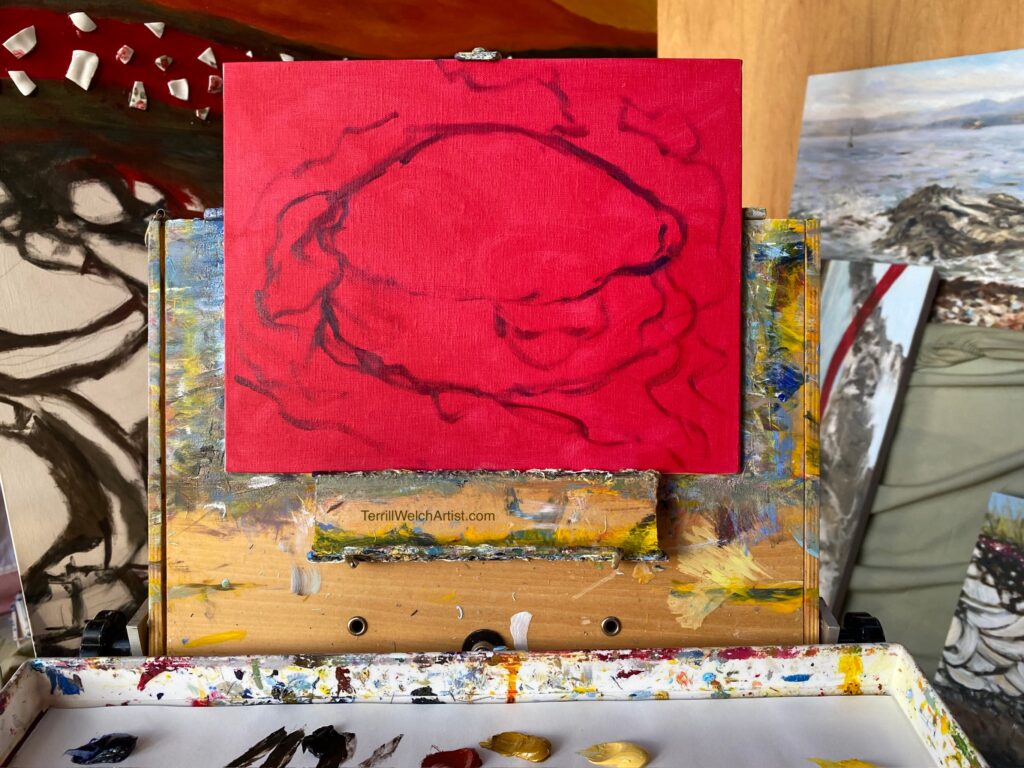
A rough sketch had been completed yesterday and set up on my old French Box easel so that I could settle right into painting this morning. 

A rough sketch by Terrill Welch, on a 14 x 11 inch linen covered birch board surface, is set on a French Box easel with the palette below Sunday evening in preparation for the next morning’s painting session.

This is a commissioned work and stems from an art collector’s shared love of this specific arbutus tree that resembles the long legs of a woman elegantly reaching for the sky. I have references going back years but chose just a few, between August 2023 and August 2025. It seems fitting that I would begin painting it in August 2026.

Collection of reference images between 30 August 2023 and 20 August 2025 by Terrill Welch in preparation for painting “Lady Arbutus” in August 2026.

While I am painting, I do not think of much but rather focus on what I am remembering and feeling about this specific tree and this specific place which is no longer publicly accessible since much of the land around it was purchased as part of a conservation land use agreement. I cherish and I am deeply grateful for the vision of the landowners and those that worked to acquire the lands for this reason. It is a small price to pay to respect the request to stay off of the very point of Edith Point that is still held as private land. This aside, I lean into my memories again. 

work-in-progress on the easel of “Lady Arbutus” by Terrill Welch, 14 x 11 inch oil on linen covered birch board.

There is a ferry whistle in Active Pass on the other side of the island that echoes a response to the August sun pressing towards it through the trees. A calm ocean behind me pools in the bottom left of the painting. It isn’t there in the reference. This won’t matter and it might not even stay to the finish line. For now it needs to be there. Deep shadows offer a counterbalance to the bright trunks of the arbutus trees and rich soft greens of stunted poplar trees in the grove. What would it like to be this arbutus tree tuck in next to a few strong firs next to the Salish Sea? Answering this question is a significant part of the job of this painting. Though it may indeed capture a beautiful moment, that is not its purpose. It is a working painting and will bring a sense of being close to home and all that this means. This is true for most of my paintings. They are not collected as decorative objects or for status or for their uniqueness but rather for good company! 

This brings me to a book I am reading and a question. Can paintings have an everyday use, like a hand turned pottery mug or a hand knit sweater? The Japanese philosopher, art historian, aesthete and poet, Soetsu Yanagi (1889 – 1961), proposes that true beauty does not come from straining to be remarkable. It comes from a kind of forgetting. Mingei or “crafts of the people”, is used to describe an approach and an object that “must be wholesomely and honestly made for practical use” (Yanagi, 2019, p. 5). These objects have been made without a need to be special or important and without grasping for attention. Further, the objects grow in beauty by their daily use. They are objects that have been made well and keep us company as we move through our ordinary lives. Yanagi in his book The Beauty of Everyday Things is speaking about anonymous folk craft and something that is different from what we understand as aristocratic contemporary fine art. However, I want to consider how my paintings might be and most often are acquired for their use value — not for decoration, not for spectacle or status but rather for daily company. This daily company is of course the underlying practice in which my brush touched the canvas in the first place. The paintings are the result of my conversation with nature that then invites the viewer into these exchanges. Skill, practice, the quality of the materials matter, just like they do for the craft worker making a mug or weaving a basket. The  works are not about being unique, though this over time happens without this being the intent. I mostly want to examine how a painting, as a crafted object, has a use value in our ordinary day, beyond an exploration of an idea that would lend itself to being considered contemporary art which, for the most part, is less interested in skill mastery or material quality. More importantly, can a painting hold both these philosophical and practical frameworks at the same time – humble usefulness for daily company and the successful exploration of a unique idea or concept? These are the questions I am asking as I read while knowing that my work does not have a physical use, definitely is not anonymous, and often it is not, broadly speaking, unique enough to fit easily into contemporary art sensibilities (presuming contemporary art can genuinely claim such a thing as sensibility). 

Well, teabreak is over. It is time I set this musing aside and get back to the easel and see where this painting takes me next.

Work-in-progress on “Lady Arbutus” by Terrill Welch, 14 x 11 inch oil on linen covered birch board.

Reference list:

Yanagi, S. (2019). The Beauty of Everyday Things. Penguin Books.

Answering the Painter’s Questions

Monday, July 20 2026

Oftentimes, a painting doesn’t proceed in a straightforward momentum from start to finish. I need pauses to listen clearly to what the canvas is asking. Then the paint becomes tacking in the dry summer air and I must let it completely dry to the touch before continuing. Such was the case last Wednesday. I left it sitting in an awful awkwardness as if caught in an elaborate pose of painter’s frozen tag.

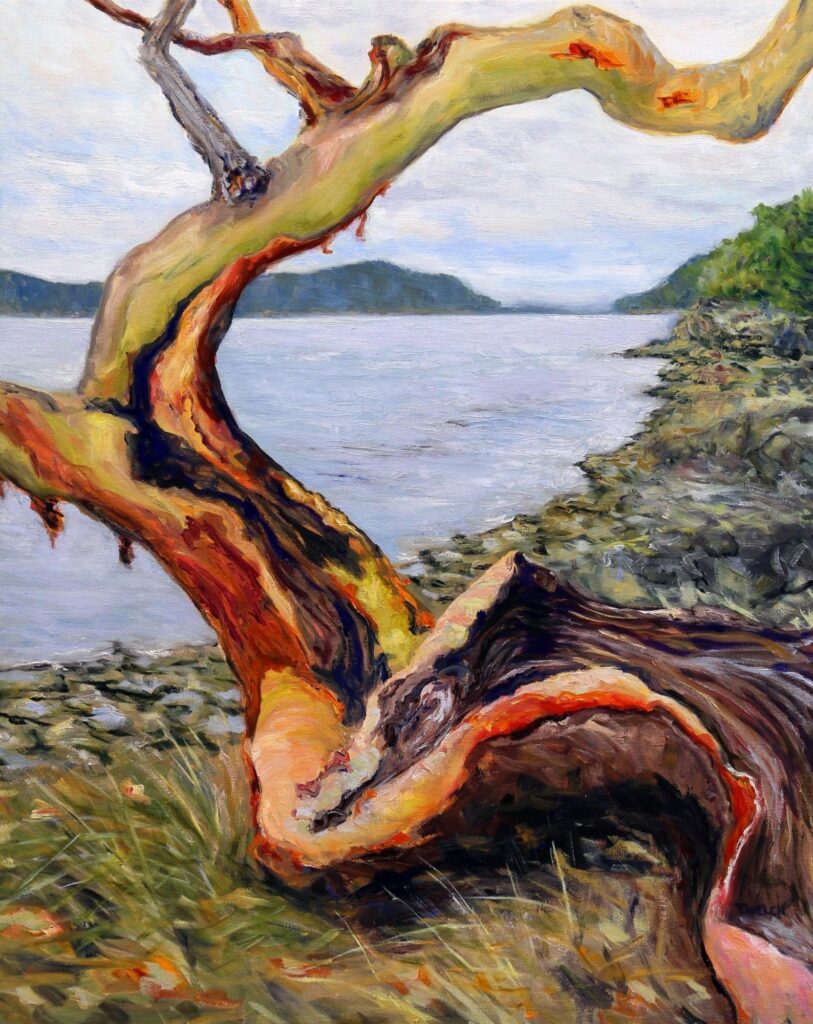
Work-in-progress of a new arbutus tree portrait on a 31.5 x 27.5 inch oil on canvas work by Terrill Welch shown on the easel in her studio. Wednesday, July 15, 2026.

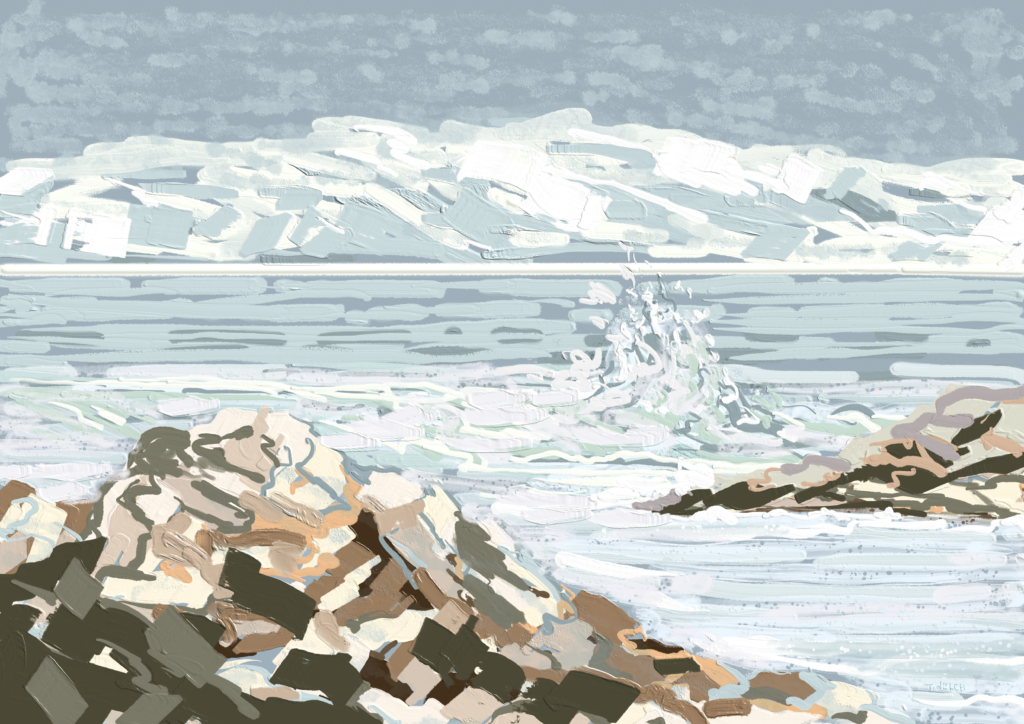
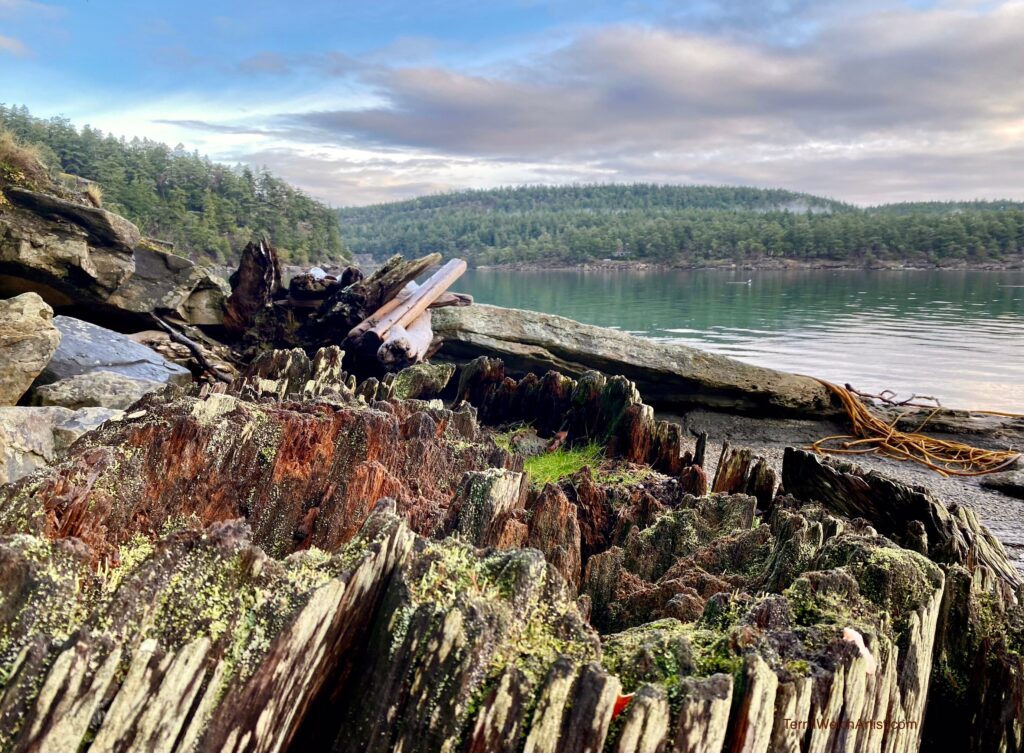
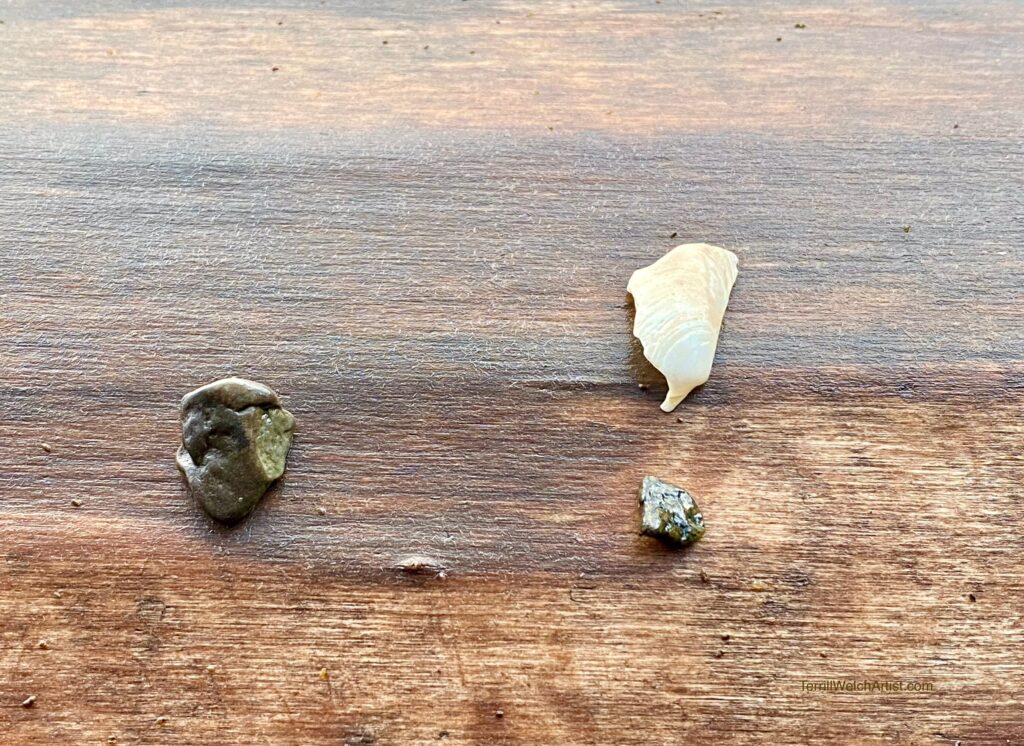
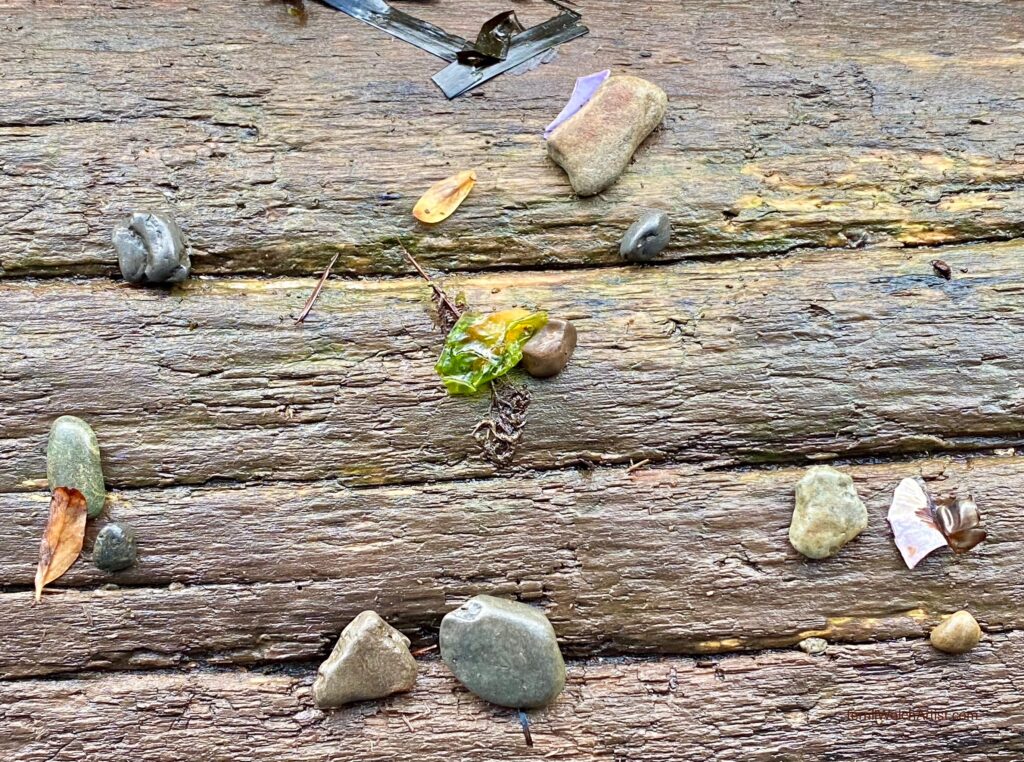
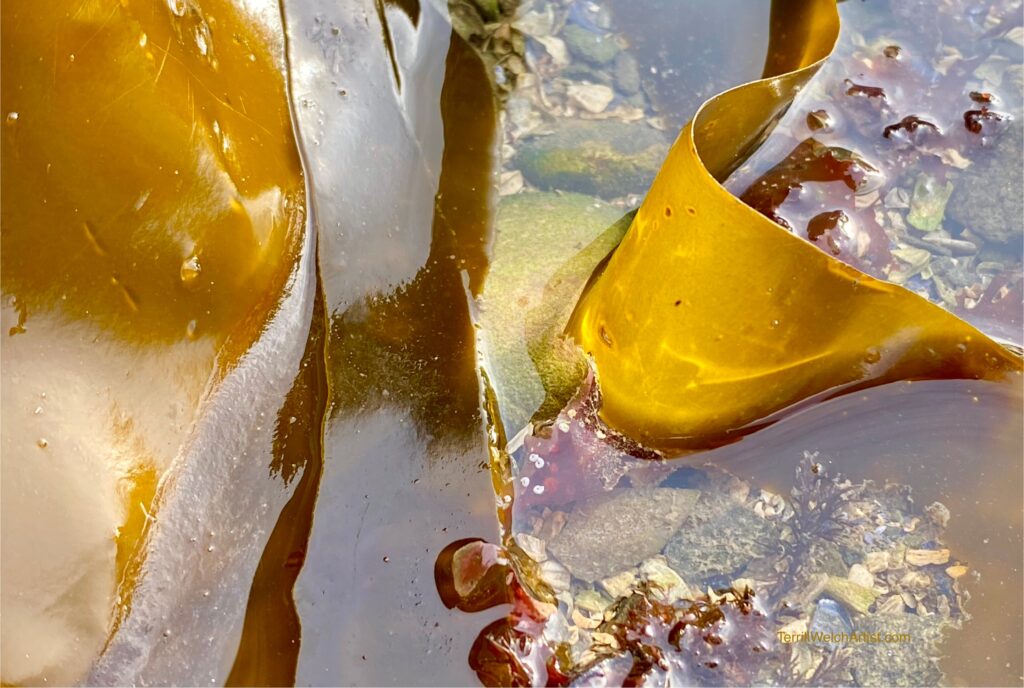
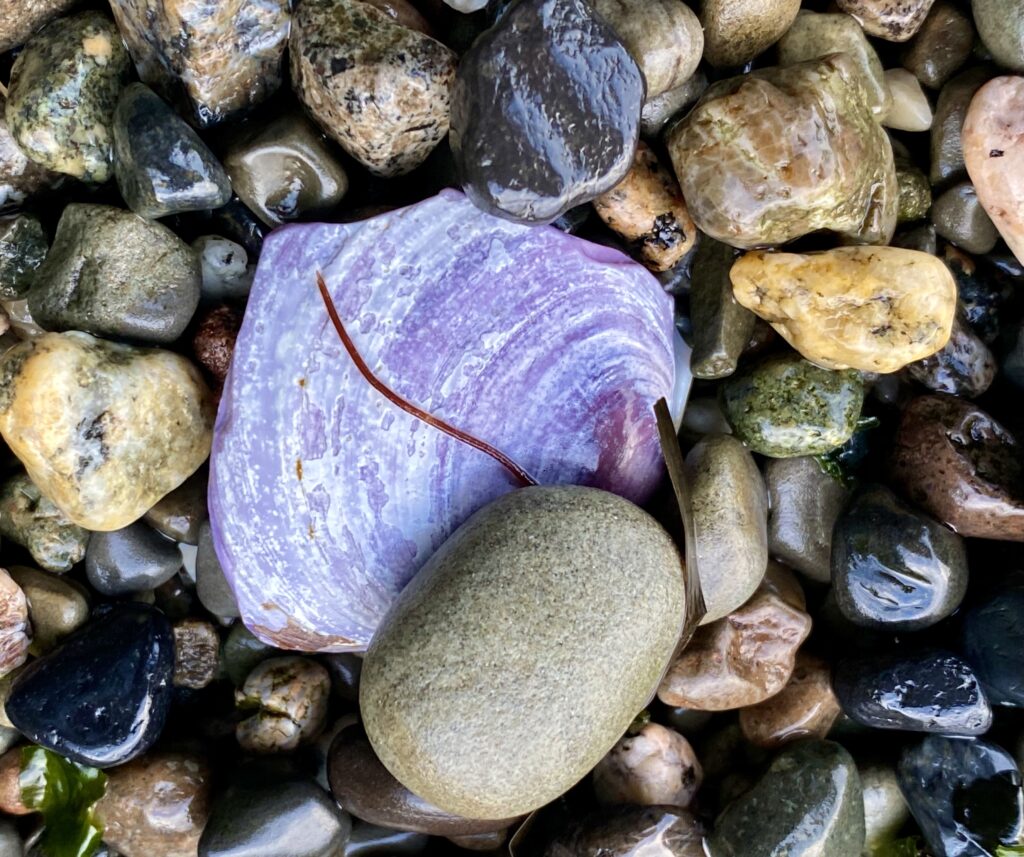
I went to Reef Bay and couldn’t help myself but to gather a few random compositions of the seafloor. It is like picking berries. I don’t want to just let the ripe ones fall to the ground and forever lost. Instead, I collected them up in reference images and tucked them in the folder for “Close to Home”.

Nothing may come of them but they stilled something restless within me. 

David had a birthday on Sunday and on Saturday family came to celebrate. That meant Friday was used for preparation and Thursday is still school for a few more weeks. So here we are with a dry to the touch painting late Monday morning. 

The work-in-progress oil on canvas by Terrill Welch has now dried to the touch. She is ready to continue. Monday, July 20 2026.

I had about an hour available to me to paint. I took it! The linseed oil softened to the consistency of butter in the midday heat. I focused and then drifted on the gentle blue sea that has yet to come alive in the painting. I didn’t get far but still. It is something.

work-in-progress oil on canvas by Terrill Welch. Monday, July 20 2026.

We then went for a drive to get David a mocha and then stopped at a farm stand for the first of the blackberries and some sweet yellow plums. The deep warm of the sun kisses the air with their fragrance.

Local Mayne Island Blackberries and Yellow Plums. Photograph by Terrill Welch. Monday, July 20 2026.

As I drive, I am still thinking about the painting. It needs more paint I decide. And the arbutus tree really needs to pop as the star if it is going to be a portrait. Do I want to abstract the foliage both at the top of the tree and on the ground? Painting is a process of endless decisions and often there are no right answers but there might be better answers and one decision usually affects (undoes) several others that have already been made. But this is all the answering I am going to do for today. 

The Spiritual Connection in Painting Arbutus Trees

Monday, July 13 2026

I crest the low ridge just after seven in the morning as sunlight slams into the lower sandstone shoreline and dances across the sea to meet a soft mostly cobalt blue sky once it lifts over the fog resting on the water near the coast mountains. My eyes scan the elements and square up the view. It will work. I am sure it will work. I begin to gather references, shifting my feet and contorting my body to get the angles I desire. Nothing is perfect of course. I do not expect it to be. This is why it will need my imagination, a canvas and paint. References are a memory link and a starting point for later.

Now in the studio with the ground dry on a 31.5 x 27.5 inch canvas, I begin to block in various elements. A couple of hours pass. I take off my paint smeared red apron and document what I have so far.

The beginning of painting an arbutus tree along the shores of Edith Point by Terrill Welch.


It is almost noon. While boiling water for tea I begin to ponder. What does it mean to be this specific arbutus tree on this specific ridge overlooking the Salish Sea? If I was this tree, what would be the most dominant element? Would it be that soft peachy morning sky or would I give priority to the sea? Or maybe it would be the squishing of tiny roots spreading through the salal that I am standing in that is taking up the most attention. Perhaps it is the wind whistling through dried lower branches as it cools the first rays of sun? I am not sure I can guess. I sip my tea and look at the messy beginnings.

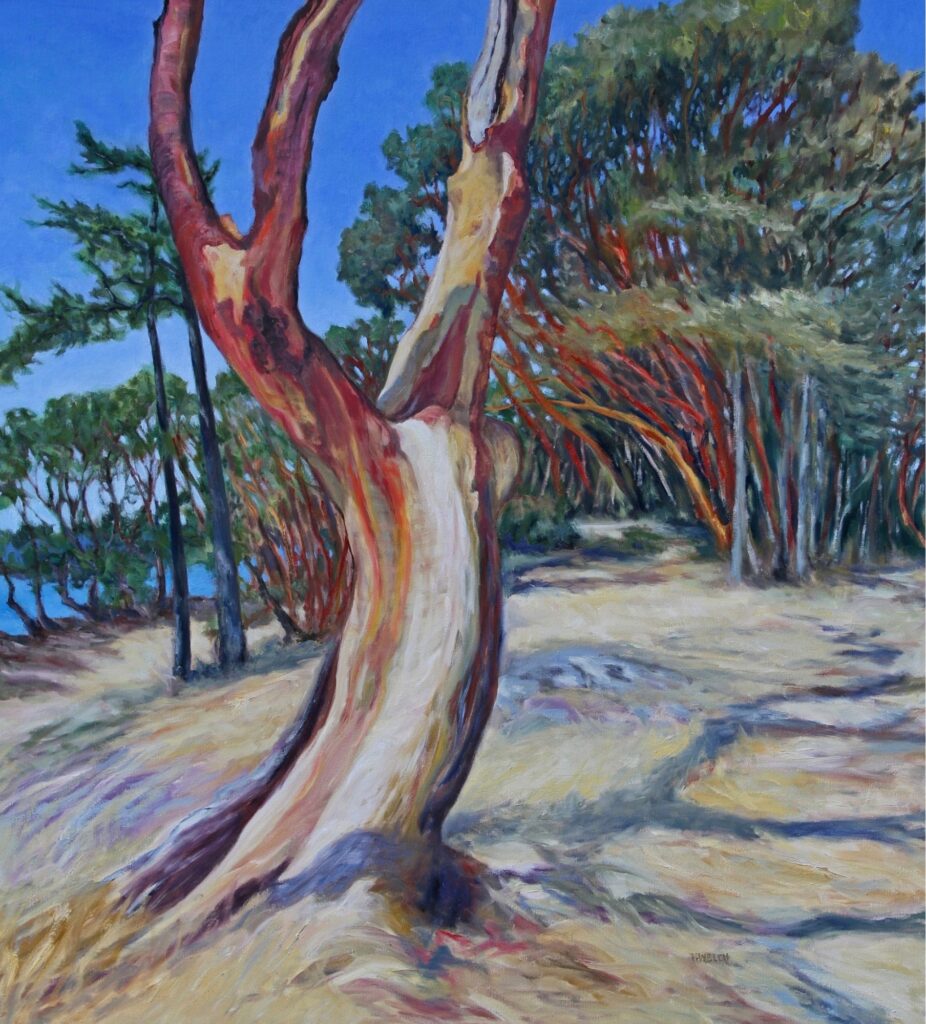
I have painted these arbutus trees many times but I am never done with them. There is a spiritual connection that seems to happen with arbutus trees. I imagine laying my hand on the large exposed root at the base of its trunk and let whatever is troubling me drain down into the earth on its long spidery tentacles. Losses and grief are good compost and best turned over and released into the soil rather than being compartmentalized and carried between my shoulder blades. 

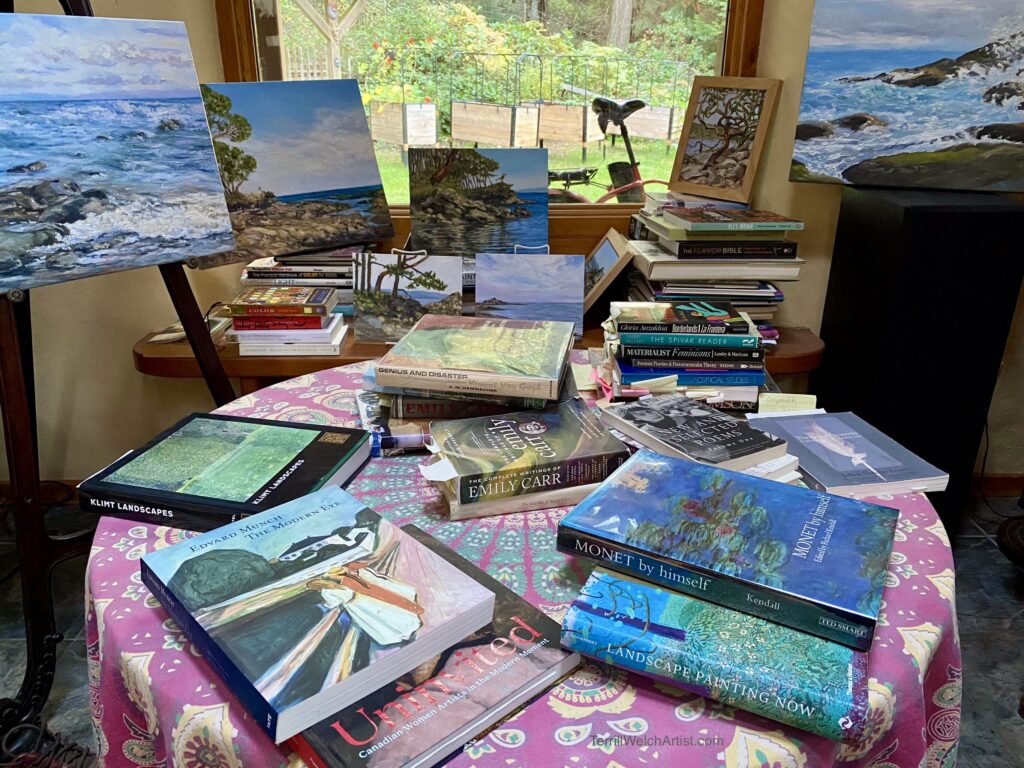
I reach for a new book I am reading by Martin Gayford, How Painting Happens (and why it matters). Gayford begins where a painter knows he must – “Painting is difficult. Or rather, making a truly powerful and original painting is very hard (Gayford, 2024, p. 12). He goes on to explain that part of the problem is the long history of painting that has been practiced by brilliant artists ahead of me and that it is hard to find new areas to explore. This has never really stopped me from trying though. Not because I expect to paint anything particularly brilliant or ground breaking but because painting is a way of holding a conversation between nature and me and then later, with the viewer. What is the alternative? To remain silent? Better to paint something that is less than brilliant than to say nothing at all. 

Reference list: 

Gayford, M. (2024). How Painting Happens. Thames and Hudson Ltd.

Does anyone read blogs and does it matter that you write?

Short answer: Yes they do and yes it does!

Sold – photography print on canvas  of  Building with a View #2  in series of five by Terrill Welch

(available for purchase HERE)

There is a wonderful story that goes with this sale. Yesterday, as I was standing on top of a bench-seat in order to hang a small painting in the Green House Bar and Grill here on Mayne Island,  I hear a woman say

“Are you Terrill Welch?”

I turn, raising my eyebrows slightly at the smiling stranger and reply “yes I am”

The woman came bounding forward.

“OMG! I read your blog all the time! I am from Edmonton and whenever it is miserable there I go to your blog. I love your work! It is such a pleasure to meet you!”

Her husband is more nonchalantly and says – before saying hello to me –

“Is this the blog you always send me links to at work and tell me I just have to see it?” and as his wife is nodding he then smiles at me and says hello.

She is laughing and says “oh I send your blog posts everywhere – to my husband, my dad, all my friends”

Teasing she adds “you are famous in Edmonton you know.”

(For those not familiar with Edmonton – population 752,412 in 2007 and it is in Alberta, Canada – right next to British Columbia and about a two-day drive away from Mayne Island. Many make this trip at least once a year and sometimes several times. Anonymity intact!)

Before the couple even get their lunch ordered, this piece is selected and set aside for purchasing when they were ready to leave. She was able to ask for it by name and fortunately it was one of the photography prints I had selected to show this time.

I tell this story because if, as an artist, photographer or writer, you ever doubt the impact of your blogging efforts and all the time you put into posting your work – think again. It does matter. It does make a difference in connecting your work to those who will and do enjoy it.

I had never met this delightful woman before. I did not know this reader as one of my regular readers who comments here on Creative Potager.  And the post with this photograph was made on February 19, 2010

https://creativepotager.wordpress.com/2010/02/19/simplicity

I allow those who have a subscription to my blog to receive the whole post so they can read it and share it – the consequence of this is the views do not show up in my viewing statistics. But none-the-less, she is a regular reader and was able to comment on past and recent posts with great joy.

A fine moment for any artist, photographer or writer.
Thank you, thank you to my dear reader who has quietly enjoyed these posts and shared them with her family and friends. Thank you to all those readers I have yet to meet. And thank you to those readers I know well and who comment and share my work regularly. You are wonderful! You are a joy! You make my heart glad to be alive!


SPROUT Question: __________________ (you decide:)


P.S. This wasn’t the only sale yesterday as I was putting up the new show – but that is another story! 😉


© 2012 Terrill Welch, All rights reserved.

Liberal usage granted with written permission. See “About” for details.

Purchase photography at http://www.redbubble.com/people/terrillwelch

Creative Potager – where imagination rules. Be inspired.

From Mayne Island, British Columbia, Canada

Terrill Welch online Gallery at http://terrillwelchartist.com


Painting the Desperation of Wanting to Stay Alive

Claude Monet is quoted from a conversation with an American neighbour in Giverny as follows:

When you go out to paint, try to forget what objects you have before you, a tree, a house, a field or whatever…. merely think here is a little square of blue, here an oblong of pink, hear a streak of yellow, and paint it just as it looks to you, the exact color and shape, until it gives you your own naive impression of the scene before you. (reference Claude Monet 1840-1926 by The Art Institute of Chicago catalog published 1995)

I suppose you think I am going to argue with this sound advice!? No I agree and my brushes feel the same. Yes, of course I consulted my brushes and they spoke to the canvas and we are all in the same painting with Monet. However, as we conferred we also notice that Monet had left something out in his recipe for painting. It is not enough to get the colour just right or the shape just so.

A painter must paint the desperation of wanting to stay alive.

Here is a very wet detail from my painting today where I worked on this “must.”

Image

No matter how beautiful and accurate the painting of the light or interesting the composition, the painting must leave the viewer with an understanding that the painter knows that the moment in the painting is a gift in time – one worth being alive to experience. This must be said in every brushstroke, every slice of the palette knife, every squeeze of the paint tube and in absolutely every decision the painter makes to execute her vision into that brief second of a moment on a canvas.

SPROUT: How do you create with the desperation of wanting to stay alive?

© 2012 Terrill Welch, All rights reserved.

Liberal usage granted with written permission. See “About” for details.

Purchase photography at http://www.redbubble.com/people/terrillwelch

Creative Potager – where imagination rules. Be inspired.

From Mayne Island, British Columbia, Canada

Terrill Welch online Gallery at http://terrillwelchartist.com

REACHING THE SEA original oil painting by Terrill Welch

I never really know where a painting will take me. We start together from a humble beginning

and begin to build on those first foundations towards synergistic vision.

I find it is easy to get lost on a large canvas such as this 30 X 40 inch piece — lost in both structure and colour. I put paint markers like mental blazes in place to be able to stay on course. This is a larger colour palette than I usually select. But the painting seemed to be requesting it, so I went along.

Gradually the light and shadow references begin to take shape.

Good! Everything is still nice and loose. Unfortunately, I need to leave it for a few days. I enjoy a couple of details in the underpainting

that I know will eventually disappear.

Days pass and I walk by the painting pondering and anticipating my next chance to settle in for a good long stretch working my brush across its canvas. The time finally comes. I spend the day happily trying to “reach the sea.” But something is off. The painting is struggling and seems to be twisting on the canvas. What is it?

Hum! There that is what it is! Painting seascapes is a little like being a carpenter – measure the horizon line twice and paint once. I was down by half an inch to the left. I will let you in on a little secret. This “down a little on the left” is common for me both in painting and in my photographs. For whatever reason, I will pull down to the left. I am left-handed and see better out of my left eye so this might be part of the issue. But leveling takes care of these things nicely. How many times to I paint the horizon line in a seascape? Many. It is critical to getting the distance or depth in the paint and getting it to “settle” on the canvas. Time to pause for a moment.

There are a few challenging and unusual elements to this painting. First, the focal point is the lower top right third. Most often, we expect the composition to work from details in the foreground to less in the background. This painting is forcing the viewer’s eye past the foreground towards the reflections near the end of the reef. Hence the name of the work “REACHING THE SEA.”  Secondly, the sun is in front of us reflecting on the water creating deep shadows and light patterns that are more difficult for me to represent by having my brush following the light. It is a painting that is moving towards the viewer and demands, not asks, that the viewer meet it two-thirds of the way into the frame. That was the painting’s idea. I am usually much more polite.

We are almost there…

The painting has never really tightened up and the layers have built themselves in the generous way of land and sea in perpetual transformation. I have heard many times that green is one of the most difficult colours to mix. The green of seaweed. The brown of sandstone. The diverse blues of the sea. The brightness of the facing the midday sun. The deep shadows of the shoreline. Thank heavens for the light, softness of the sky! … I see a few wayward brushstrokes, maybe a little lighter over here and yes, a little darker over there. Done!

REACHING THE SEA 30 x 40 original oil painting by Terrill Welch

As usual, I need to paint the edges yet before putting it on the market. But very soon. I will just need to make a day of it do nothing but paint edges!


SPROUT: What unusual adventures has your creativity taken you on lately? 


© 2012 Terrill Welch, All rights reserved.

Liberal usage granted with written permission. See “About” for details.

Purchase photography at http://www.redbubble.com/people/terrillwelch

Creative Potager – where imagination rules. Be inspired.

From Mayne Island, British Columbia, Canada

Terrill Welch online Gallery at http://terrillwelchartist.com

Three Mayne Island photography landscapes go to Vancouver

The year of 2012 has started out on a high note here at la casa de inspiracion. A new collector of my work will shortly be receiving three extra-large approximately 20 X 28 inch photography canvas prints  to complete the remodeling of her home in Vancouver. Shall we have a look to see what she has chosen for her walls? Yes? I though you might say that.

MIST

(image is available for purchase Here

ARBUTUS STRAIT OF GEORGIA

(image is available for purchase Here

and the ever popular…

TRAVELING INTO THE MIST

(image is available for purchase Here

SPROUT: If you could collect anything you wanted what would it be? 

SEED: Have you ever wondered how I define “a collector of my work?” It is someone who has three or more pieces of my Fine Art. It could be three or more photography prints or three or more original paintings or a combination of both. Here is a link that I recently wrote for my Google Plus – Terrill Welch Fine Art page about buying an original painting https://plus.google.com/115927302973552189234/posts/aVAcdo661WE The same advice holds to be equally true for photography Fine Art. In addition, I would like to suggest this fantastic article by art consultant, advisor, author, and independent appraiser, Alan Bamberger,How to Collect Art Like a Pro – Building a Collection.” It is like an advance course in learning how to buy what you love.

© 2012 Terrill Welch, All rights reserved.

Liberal usage granted with written permission. See “About” for details.

Purchase photography at http://www.redbubble.com/people/terrillwelch

Creative Potager – where imagination rules. Be inspired.

From Mayne Island, British Columbia, Canada

Terrill Welch online Gallery at http://terrillwelchartist.com

SPILLING OVER original oil painting by Terrill Welch

Do you remember back in early September when a following sea was making a grand entrance onto the shore? We had taken a long walk together admiring the arbutus trees and then the sea.

Well one of those photographs kept nudging at me to put it on canvas. So here we go.

From some very dark beginnings

I sketch in some guiding marks for the composition.

I begin to work in the primary forms.

If we look a little closer you can see these are easy and free strokes suggesting rather than predicting what is to come.

I build up the paint and enjoy the movement of water coming into the canvas.

At this point the canvas is getting too wet to do anymore.

Besides it had started to snow outside.

So I left the painting to rest and stuck it where I could keep an eye on it. Over the next week or so I would pick it up and work on it some more as it became clear what it was it was asking for. Finally, here is the finished piece.

SPILLING OVER 12 X 12 inch original oil on canvas painting by Terrill Welch

The painting is available for purchase in a new online gallery Artsy Home along with some of my other original paintings. Yes, you can now buy my work directly from this site using all sorts of means. Isn’t this grand? I will be adding more pieces very shortly.

Sprout Question: What is spilling over in your creativity?

Please note: It is December and I shall be on a vacation from regular blogging. You will still hear from me such a special holiday post and near the end of December I will be post a two year anniversary post for Creative Potager. Regular scheduled posts will then begin again the first week of January.

© 2011 Terrill Welch, All rights reserved.

Liberal usage granted with written permission. See “About” for details.

Purchase photography at http://www.redbubble.com/people/terrillwelch

Creative Potager – where imagination rules. Be inspired.

From Mayne Island, British Columbia, Canada

Terrill Welch online Gallery at http://terrillwelchartist.com