Heart

Heart and home are frequently connected for me. Home is more than a place of dwelling, more than the place where I eat and where I sleep. Home is where I walk, talk, listen and breathe each day. Home is as much the earth’s surface, its beings, its presence as is any four walls I’ve called my own.

I often, without effort, find heart shapes in nature. This “found heart” image is from my latest photo shoot on Saturna Island, BC, Canada. “Cliff Echo Bay” is dedicated and gifted for use in her work to Laurie Buchanan who guides us to “listen with our heart.”

View and purchase full resolution image here.

On my cyber passage to writing this morning’s post, I went via a feature of Zennie in my on-line community of Gaia where I watched and listened to this Rumi poetry “The Way of the Heart.” I feel it is a perfect piece to include today.

And, as the sun touches down on the white frosted grass in the valley floor, another day begins here on Mayne Island in southwestern British Columbia, Canada.

Sprout Question: What is at the heart of your creativity?

© 2010 Terrill Welch, All rights reserved.

Liberal usage granted with written permission. See “About” for details.

Purchase photography at http://www.redbubble.com/people/terrillwelch

Creative Potager – where imagination rules. Be inspired.

From Mayne Island, British Columbia, Canada

Simplicity

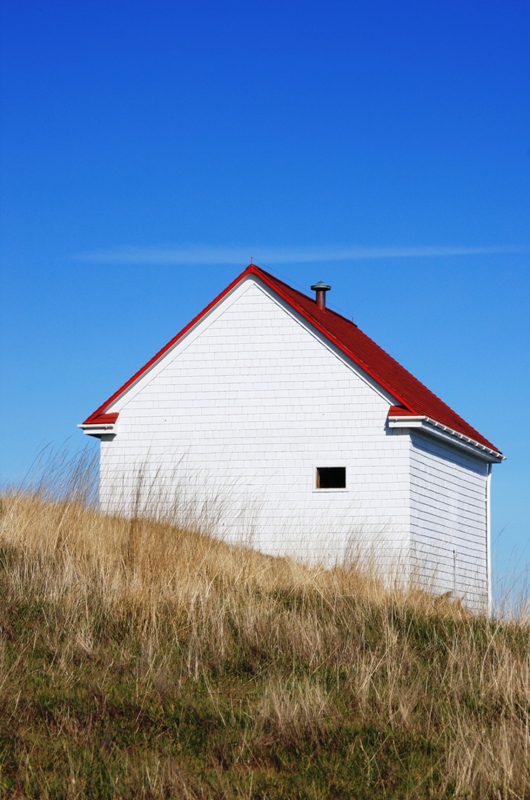
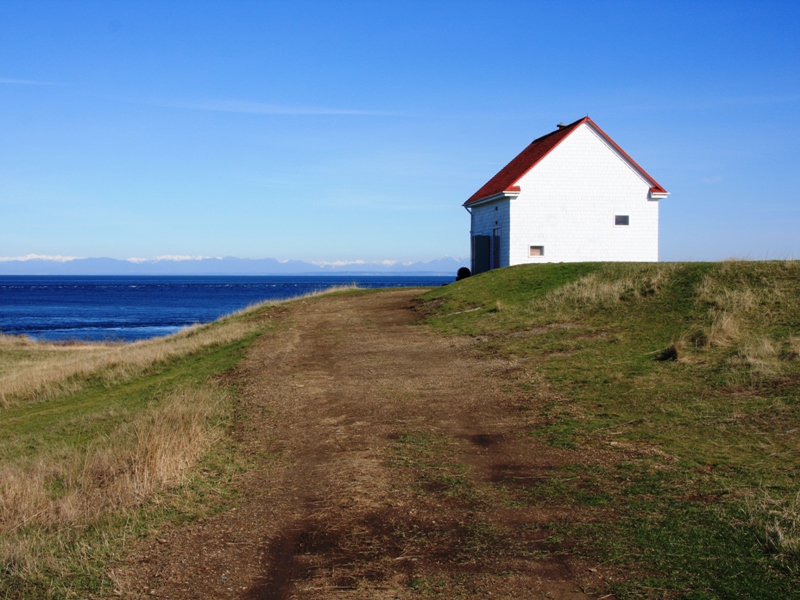
Often, the underlying effect of wabi-sabi is melancholy beauty in its worn simplicity. Yet nature, as our life, is often a messy. Eco-systems thrive on an untidy tangle of old, new and diverse growth (particularly here in the west coast rain forest). The old saying of “not being able to see the forest for the trees” describes how easy it is to become overwhelmed and to lose our centre or still-point in the face of all that is. There are only a few vistas in my travels that have captured my imagination with their beautiful simplicity. A building on a hill at East Point on Saturna Island is one of these places. I have not yet researched to know if this grassy knoll is caused by human intervention or if it is natural. However, the minimalist coming together of nature and construction sang to me. The delight and challenge then becomes composition.

Here are my various efforts over two days to capture “a building on a hill at East Point.”

And finally “window” , my personal favourite, and a featured image today in redbubble group  The Woman Photographer. This is a great honour as there are 2,527 members in this group and 79,986 images.

View and purchase full resolution image here.

Sprout Question: What principles of composition help you to create simplicity?

© 2010 Terrill Welch, All rights reserved.

Liberal usage granted with written permission. See “About” for details.

Purchase photography at http://www.redbubble.com/people/terrillwelch

Creative Potager – where imagination rules. Be inspired.

Sabi

If wabi is a preference for very little in recognition of its unequaled abundance in the face of all else, then what is sabi?

According to Robyn Griggs Lawrence, in The Wabi-Sabi house: the Japanese Art of Imperfect Beauty , sabi means “the bloom of time.” Sabi implies an understanding that beauty and life are fleeting. Sabi is the grace of wear through the passage of time and use. Sabi is the appreciation of imperfections. Sabi is not about things of poor quality falling apart or leaving things in poor repair. Sabi is the carefully mended knee of a pant leg which is still in service.

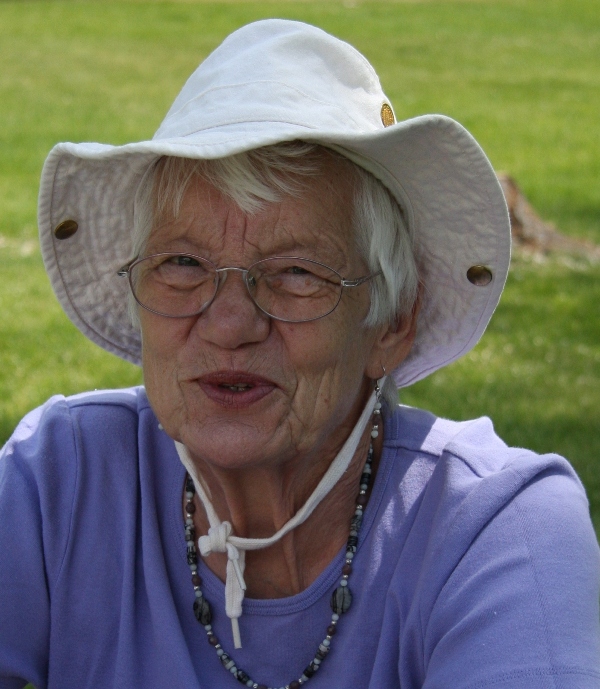
Sabi is our lines, wrinkles, and weathered beauty.

Sabi is the waxed, worn, wooden arm of a chair.

View and purchase full resolution image  here.

Sabi is rust through the oiled surface of a wood cook stove.

View and purchase full resolution image here.

Tomorrow I will put wabi and sabi together as in  wabi-sabi.

Sprout Question: Does sabi have any part in your creativity?

p.s. I am away today and tomorrow. I will reply to sprout responses when I return.

© 2010 Terrill Welch, All rights reserved.

Liberal usage granted with written permission. See “About” for details.

Purchase photography at http://www.redbubble.com/people/terrillwelch

Creative Potager – where imagination rules. Be inspired.

Wabi

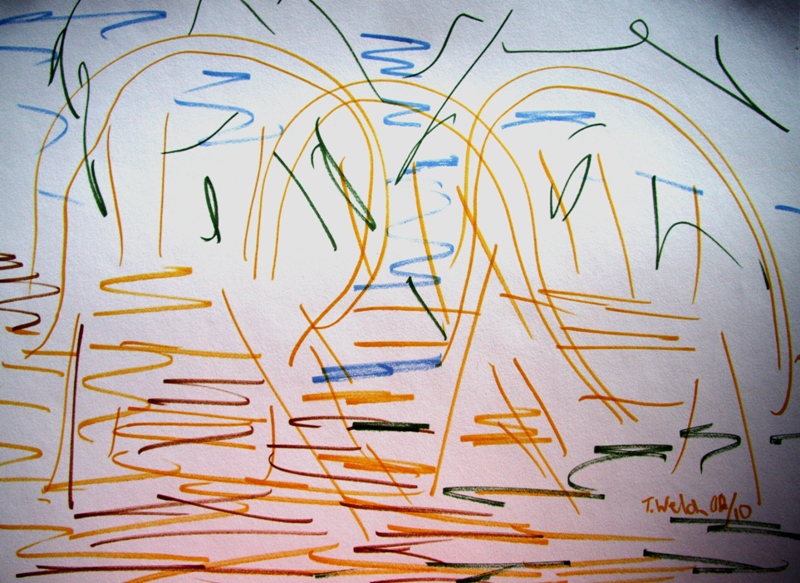
Today’s winter wabi room quick sketch 8″x11″ artist pen .

Wabi-sabi is a difficult concept (particularly for westerners) which can have reverberating impact on our creativity. We have been dancing gently around wabi-sabi in recent Creative Potager posts.  In particular, Laurie Buchannan has repeatedly articulated and demonstrated a link between minimalism and her creative clarity. In North America, such a practice is counter to material capitalism, advertising and socialization. Yet, when we experience wabi-sabi – when we live in humble, harmony with natural decay and the beauty of imperfection – we know an inner peace that the latest gadgets can never provide – because it would be contrary to their purpose. I believe wabi-sabi is a creative necessity and fuels for originality and creative resilience.

What is wabi-sabi?  I will break it down into several posts over the next few days. Though there is much to read on the subject, since we are focus on the theme of “home” for the month of February, my primary source is The Wabi-Sabi house: the Japanese Art of Imperfect Beauty (2004) by Robyn Griggs Lawrence.

Wabi began as a literary concept in fifth and sixth century Japan poetry to reflect melancholy. Wabi has come to mean simple, minimalist, humble and in tune with nature. It is often said that if you are a wabi person you are content with very little. However, it is more than being content… it is the enjoyment of very little with an appreciation and the awareness about how “less is more” in a way that bubbles from the inside over the sparse surfaces of our outside. Wabi is a preference for very little in recognition of its unequaled abundance in the face of all else.

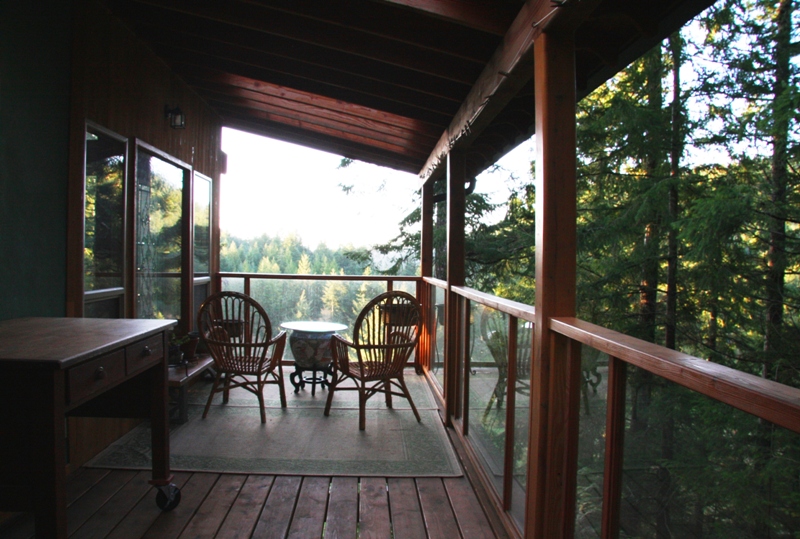
One winter wabi room at dawn this morning…

Tomorrow, we will look at “sabi” and its connection with wabi.

Sprout Question: Does wabi have any part in your creativity?

© 2010 Terrill Welch, All rights reserved.

Liberal usage granted with written permission. See “About” for details.

Purchase photography at http://www.redbubble.com/people/terrillwelch

Creative Potager – where imagination rules. Be inspired.

Naked

With my nightgown hung on the line, I’m reminded that there is nakedness when I am home. Nakedness that usually has little to do with bare skin. Home is actually where we rarely entertain and seldom share the space with others. I think of it as the freedom to allow my energies to easily flow in the space around me. Home is sacred space… when we invite others in to our home – it is to share that sacred space with us.

On Saturday, I cleaned and cleared the cooking and eating utensils. I asked myself – how many people are we really going to have visit at one time? How much cutlery do we need? How many wooden spoons do we use?

The answer was: “far less than was actually in our stash.”

Hence, a great lovely bundle of goods are ready for the thrift store.

Then, the next afternoon, we went for a long walk in a Valentine’s Day Sunday sun. I realized that this too is part of what I considered “our home.” “Home” extended beyond our property. “Home” is Mayne Island a place where my energy flows easily within sacred space.

View and purchase full resolution image here.


View and purchase full resolution image here.


And, in honour of Valentine’s Day, the arbutus tango…

View and purchase full resolution image here.

Welcome to our home.

Sprout Question: Does your creative self have or need sacred space beyond your studio or writing desk?

© 2010 Terrill Welch, All rights reserved.

Liberal usage granted with written permission. See “About” for details.

Purchase photography at http://www.redbubble.com/people/terrillwelch

Creative Potager – where imagination rules. Be inspired.

Everyday objects

Our creative journeys are journeys shared with other creative human-beings. Even if we tend to be reclusive, their presence is with us in our homes, in our everyday objects. A sensual blue image combined with a thought-provoking article Epreuve 05 :: Epreuve d’Artiste :: Altered States by Ian Talbot of London UK, inspired my still life sketch this morning of an everyday object. Thank you Ian.

8″x11″ graphite quick sketch

As I was standing at the counter doing my “awakener” sketch of our medium-sized Bialetti stovetop (Yes it has the little man on it but it is on the other side – I’m left handed. Handles are always on the opposite side of what one usually expects.) I started thinking more about Ian’s article and how I often overlook the creativity and artistic qualities of my favoured everyday objects. Yet, aesthetics and wabi-sabi charm generally influences my choice in the first instance when acquiring the object. Why is it that the creative care embodied in the stovetop coffee maker doesn’t leap out at me before my fingers can grip its black handle? I adore my coffee ritual with a zest that not much else can compete – particularly at 6:00 am. I can see its every detail with my eyes half closed. Well, that is mostly how I see it so that isn’t much of a revelation. However, I think you get the idea….

Though living is often a messy process, simplicity and functionality attract my sense of a world-as-should-be. This simplicity can be in everyday object or in everyday nature as in the image below.

View and purchase full resolution image of “amazement” here.

Sprout Question: When was the last time you recognized the creativity in everyday objects?

p.s. I was interviewed this past week by Stephan Weidner COO of Noomii for coaching blog article “Dealing with your Spouse’s Stroke: Terrill Welch’s Coaching Journey” The interview provides a concise account of how Creative Potager came to be.

© 2010 Terrill Welch, All rights reserved.

Liberal usage granted with written permission. See “About” for details.

Purchase photography at http://www.redbubble.com/people/terrillwelch

Creative Potager – where imagination rules. Be inspired.

Possible

Creative possibility comes from getting it wrong.
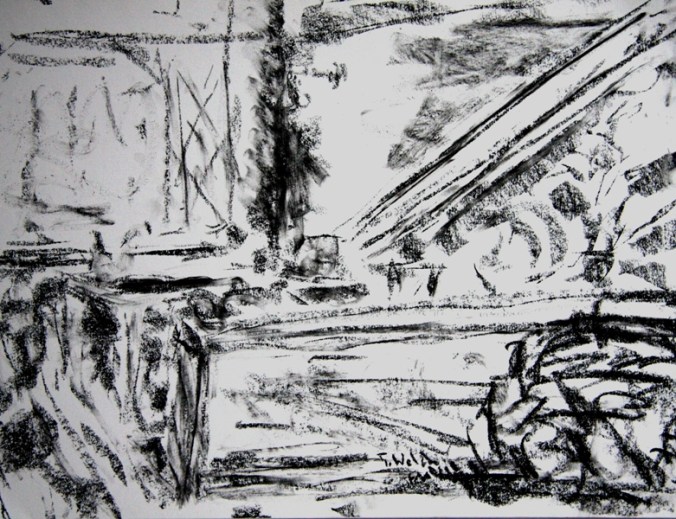
Studio mess – my home – time to de-clutter. 8’X11″ charcoal quick sketch.

“Oh, I could never draw or paint like that.”

“I’m not a writer like you.

“My photographs don’t compare to yours.”

If I had a dime for each time I heard these comments or others like them, all of my creative work could be used for charity fundraising because I would be independently wealthy. The sad thing is these statements are not true. They are lies we come to believe because we compare our attempts with finished products rather than the process that lead to their creation.

Here is a best kept secret: creative excellence comes from getting things wrong. Yes, wrong. As I commented on Coffee Messiah’s blog this morning, one of my drawing teachers, Glenn Howarth, was fond of saying things like: “It is the shoulder or wrist you struggle to draw that teaches you the anatomy of an arm.”

This is why I have committed to showing you my first morning “awakener” sketch. These first sketches are to engage me in the creative process. My sleepy eyes begin to frame, compose and dig at the relationship between elements I am about to sketch. My stiff arm and hand begin to respond to these relationships. In these first sketches, few mental barriers about “getting it right” have been erected. My judgment is left aside – these are not “keepers” they are “awakeners.”

In a three-hour drawing class, I often do 30 quick sketches that progressively increase in length until it is time to settle into the last hour-long sketch. When I am doing a photo shoot, I may take 150 images with maybe three becoming “keepers.”

Hours and days of exploring “that which is not yet quite right” leads to the creative possibility for success. This is where we discover our unique creative expression. This is where we learn our craft. We learn what is possible by getting it wrong.

My first quick sketch of the day is to inspire you to say to yourself – “hey, I can do that!” And you can.

Here is the last of my chosen three out of 150 shots of mist…

View and purchase full resolution image here.

Sprout Question: What do you do to strengthen your creative possibility?

p.s. Glenn Howarth was the most outstanding art instructor I have had the pleasure of working under. I am forever grateful for the few short years I was in his figure drawing classes. Glenn Howarth died last year at the age of 62. Very little of his thinking and work is on-line but here is an article he wrote that was published in  Canadian Art and Art Resource Directory: “Pictophile – Plein Air Painting”


© 2010 Terrill Welch, All rights reserved.

Liberal usage granted with written permission. See “About” for details.

Purchase photography at http://www.redbubble.com/people/terrillwelch

Creative Potager – where imagination rules. Be inspired.

What Is

Today I woke with a feeling of being surrounded by sludge as thick and slimy as yesterday’s latte left on the counter over night. I’m on day five of my recovery from a common head cold – well enough to be grumpy and think I “should be doing things” when all I really want to do is be a caterpillar – munching and moving slowly from one comfortable place to another.

Long-time “tweet friend,” massage therapist and intrinsic coach Fred Krazeise, from Washington D.C., reminded me “Just let the day come to you Terrill!” With only a little resistance, I have. What is “is.” Or…. it is what it is. Sounds simple but I have spent much of my life resisting the sludge when it wraps around me. I tend to want to fight back as it feels like giving up or giving in. Yet, I know the harder I fight the tighter the sludge holds me. So I am going to follow Fred’s gentle advice. I’m letting the day come to me.

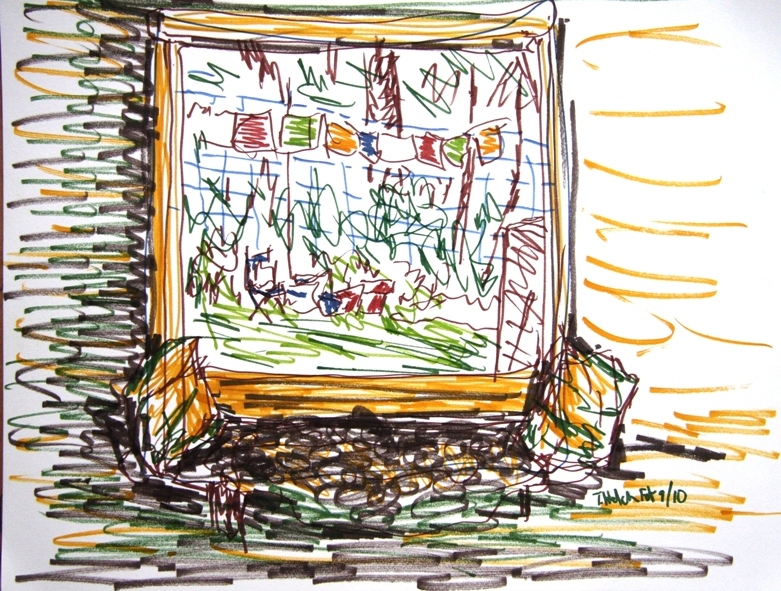
Here is this morning’s sketch of our window seat looking east into the side yard where the Tibetan flags hang on the six feet tall deer fence.

8″x11″ artist waterproof  Indian ink quick sketch

And here is another photo from Sunday’s photo shoot in the mist….

View and purchase full resolution image here.

May you enjoy and embrace what is – even the slimy sludge days.

Sprout Question: What do you do on you slimy sludge days?

© 2010 Terrill Welch, All rights reserved.

Liberal usage granted with written permission. See “About” for details.

Purchase photography at http://www.redbubble.com/people/terrillwelch

Creative Potager – where imagination rules. Be inspired.

Garbage

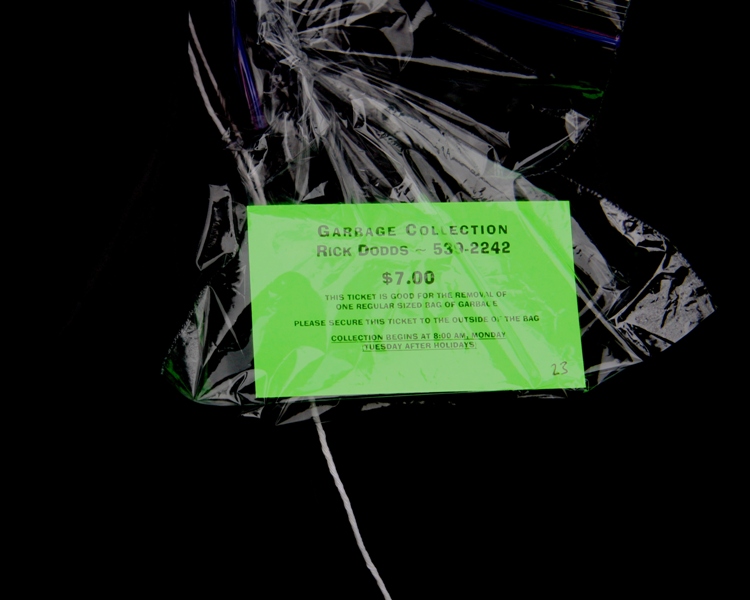
As I open the window a crack to hear this mornings song birds, I can imagine you are wondering why garbage would be part of a blog about creativity that is focusing on the theme of “home” for the month of February. I’d say that is a reasonable query. When I returned our rented movies to the gas station yesterday I paid cash (as the money is put in a separate envelope for the garbage collector) for a $7.00 tag to be placed on one, not too big and not too heavy bag of garbage.

This morning I tied off our one bag of garbage that we accumulate every three to four weeks and carried up to the main intersection to be picked up and then hauled off our island.

We live down the hill and around the corner of the road on the right.

It is a ritual I love. Being good islanders, we compost, regift, recycle, reuse, reduce and refuse with gusto. But there is always that little bit left that no one wants or can seem to find a use. This remaining refuge becomes our bag of garbage. Our creating, cleaning and clearing of our home has us frequently contemplating environmental practices which then brings us to examining what decisions we make earlier the acquiring and creating process.

My digital camera is a step in the direction of “reduce” by only printing the best while also being able to make these images available for viewing by many. Most recently, my creativity has been influenced by the “refuse” part of the environmental practices equation. I purchased a set of water miscible oil paints because I could use my same brushes and canvases but didn’t need to use any toxic solvents nor would there be the same use of materials in framing as with my watercolour paintings. In my creative process, I’m refusing to use as many toxic materials as possible and limiting the use of materials needed to create my finished products.

A frequent responder to sprout questions and full-time artist Tobin Eckian from Newburyport, MA takes the creative environmental practice even a step further into an area she calls “upcycle” in her use of cardboard in her art. Tobin’s blog and Etsy shop delight and inspire me with her creative “upcycle” art.

And just so you don’t think my weekend was all about garbage, here is an image from Sunday afternoon’s photo shoot…

View and purchase full resolution image here.

Sprout Question: How do environmental practices influence your creativity?

p.s. thank you for reading, participating and sharing Creative Potager. This is the 31st post since December 27, 2009 and because of you, there has been 246 comments and over 2000 views.

© 2010 Terrill Welch, All rights reserved.

Liberal usage granted with written permission. See “About” for details.

Purchase photography at http://www.redbubble.com/people/terrillwelch

Creative Potager – where imagination rules. Be inspired.
Attachment

A house full of stuff is not just about my reluctance to spend my time cleaning and clearing. It is about letting go of attachments. This doll and cradle are a perfect example. The cradle was made with hand tools by my great grandfather for my mother as a birthday gift when she was a little girl. My mother is now 72 years old. My grandmother gave me the cradle when I was young to “take care of.”

today’s sketch 11″x14″ artist colour pencils “Doll and Cradle”

I wasn’t a doll girl so didn’t have a doll to put in the cradle until I received a Katie, with her gorgeous ceramic hand-painted face and beanbag weighted body. She feels real when you pick her up.

I was 35 years old when Katie came into my life. I had wanted another baby but that was neither possible nor practical. My partner at the time presented me with Katie. A large, rough and burly logger, he had gone to a doll show and had a couple of elderly women help him pick out Katie and choose a set of cloths for her.

The doll and cradle has always had room my home because of these attachments. Someday I may need to find a new home for them – but not today.

Sprout Question: How does attachment influence your creativity? (your home, your subject choice)

p.s. I have lots of children in my life. I have two birth children and six step-children plus two grandchildren. The burly logger is now working in the oil fields and is a life-long friend from my childhood.

© 2010 Terrill Welch, All rights reserved.

Liberal usage granted with written permission. See “About” for details.

Purchase photography at http://www.redbubble.com/people/terrillwelch

Creative Potager – where imagination rules. Be inspired.