Distortion

Exactness is not the same as expressing the exact emotion in our work.

Our discussion in yesterday’s post “Shadow Memories” entered into my dreams, leaving various images and reflections scatter around at dawn where small birds and coffee tell me it is now morning. Shadow memories are distorted reflections, yet their fleeting brilliance, can engage our emotional responses more deeply than the original image or experience.

From my training and experience as a counselor, I know that some memories are stored in our brains differently. These memories can be trauma memories or any experience that is overwhelming. We store these experiences without “feeling” first. When the time is right, we can “reflect” on those memories and experience the emotions connected with that moment for the FIRST time.

Why am I telling you this? What does this have to do with writing, painting, photography or other forms of creativity? I believe it may have everything to do with creativity. Creative work that moves us, positive or negative, must elicit an emotional response. Countless examples tell us that it is not the perfection or accuracy with which the creator has captured the original experience but rather, the accuracy with which an emotion is captured that makes, impactful work. The entrance to that emotional connection is likely a distorted emphasis or reflection of a subject.

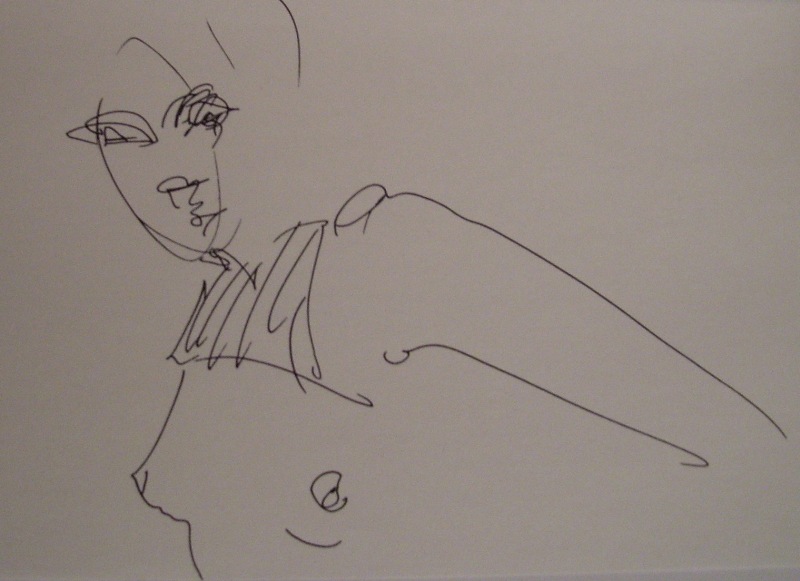
Take for instance the sketches above. When sketching, I have little ability to edit. I sketch quickly. My marks are made in rapid succession on the paper. I “feel” rather than show you exactly what I am seeing. The feelings are not just the ones present at the moment but also the ones that flicker in the shadows connecting through all time and space that I define as my experience. The sketches are far from being an exact replication of the nude male model I was drawing. Yet, in the distorted strokes of the charcoal on paper there is little doubt that they reflect a nude masculine form. Shadow memories flicker through or prance in the forefront of our creativity providing passages into deep emotions for ourselves and then for others.

Today I shall write as I sketch. I shall not edit. I shall write and allow the distorted brilliance of shadow memories to catch my imagination with vivacious autonomy.

Sprout Question: How do you access the exact emotion expressed in a piece of work?

© 2010 Terrill Welch, All rights reserved.

Liberal usage granted with written permission. See “About” for details.

Purchase photography at http://www.redbubble.com/people/terrillwelch

Creative Potager – where imagination rules. Be inspired.

From Mayne Island, British Columbia, Canada

Shadow Memories

Shuffling the source material for my new book Mona’s Work, I’m having difficulty deciding what story to write next. It is not the material that is difficult. The bits of paper, the scribbler and the recipe book are all straight forward. It is the shadow memories.

The memories I want for the book are also connected to ones I would rather not revisit. Is this why I have been working on Mona’s Work since 2007 with only a slim volume of stories to show for my efforts?  I have seen enough therapists, made my way through enough healing circles and drawn enough pictures about these experiences to feel the work I need to do is done. I wish not to haunt my readers with these stories as it seems unnecessary. The memories are not related to the same people, or the same places just the same time in my life.

I’m determined that these shadow stories not become part of the final cut but will I need to write them anyway – so that I can mine deeper into the my memory for the stories I do want to retrieve? Or can I just note them and place the memory on a “parking lot list” such as I use when facilitating so that groups do not derail? Items placed on a parking lot list are revisited at the end of a process to see if there is anything that must be done with them. They are seen as valuable in the first instance – just not part of the immediate work. They are placed in the parking lot so as not to be lost (as if that is ever going to happen).  Can I do this with the shadow memories? Or should I write through the memories, allowing the darkness in behind the bright colours of Mona’s Work?

I wonder if, as in the image below of “city morning in spring,” I can find the balance and beauty of my shadow memories – as is evident in the buildings showing their shadowy bulk behind the trees illuminated in the morning sun.

View and purchase full resolution image here.

Sprout Question: How do your shadows impact or influence your creative process?

© 2010 Terrill Welch, All rights reserved.

Liberal usage granted with written permission. See “About” for details.

Purchase photography at http://www.redbubble.com/people/terrillwelch

Creative Potager – where imagination rules. Be inspired.

From Mayne Island, British Columbia, Canada

Why Women’s Day – Oscar or no Oscar?

Blossoms for courage and abundance on International Women’s Day.

View and purchase full resolution image here.

Today, March 8, 2010 is International Women’s Day. This year a lovely man told me that he appreciated women everyday not just on March 8th. I’m relieved this is the case. But International Women’s Day is about much more than appreciation. All the blossoms, appreciation and love in the world for women will not, by itself, effect the change necessary for women’s equality. The disparity between women and men is the motivation behind my by-donation services design for Terrill Welch – A woman behind Women. The disparity between women and men is part of my motivation for writing Mona’s Work.

Last night, for the first time, an Oscar was given to a woman film director, Kathryn Bigelow, in the 82 year history of the academy – for a war movie, which surprises people that it was directed by a woman. Need I say more? Yes?

In an interview on March 2, 2010 with Willa Paskin of Slate, Kathryn Bigelow says the following about creativity and being a woman….

“…I come from the art world, or that’s where I was creatively, aesthetically, and intellectually formed and informed.

Certainly at the time I was there, there was never a discussion of gender per se. Like, this is a woman’s sculpture or a man’s sculpture. There was never this kind of bifurcation of particular talent. It was just looked at as the piece of work. The work had to speak for itself. And that’s still how I look at any particular work.

I think of a person as a filmmaker, not a male or female filmmaker. Or I think of them as a painter, not a male or female painter. I don’t view the world like that. Yes, we’re informed by who we are, and perhaps we’re even defined by that, but yet, the work has to speak for itself.” Read the full interview here.

Do I disagree with Bigelow? No, I agree. This is the ideal we are striving for. The question is – are we there yet? Can women compete in creative fields beyond the styles and topics held in esteem by male colleagues? If they do, is their creativity then labeled as women’s art, or women’s crafts? These are thorny questions which have no easy quick answers – at least, no easy answers I have found in the twenty years I’ve been part of these discussions. Yet, today, International Women’s Day, I beg the questions for your consideration.

Sprout Question: Do you feel your gender influences your creativity?

HAPPY INTERNATIONAL WOMEN’S DAY to all women, and women artists! Congratulations to the men who appreciate their creativity.

© 2010 Terrill Welch, All rights reserved.

Liberal usage granted with written permission. See “About” for details.

Purchase photography at http://www.redbubble.com/people/terrillwelch

Creative Potager – where imagination rules. Be inspired.

From Mayne Island, British Columbia, Canada

Talking Bread Loaves PART 3

View and purchase full resolution image here.

Blossoms are everywhere. It is spring in Victoria and it is Friday. What can possibly be better than this?

PART 3 and the conclusion of “Talking Bread Loaves” If you missed part one you can read part it  here and part two here.

After about an hour I help mom punch the bread dough down and she makes the loaves and sets them to rise for a second time. This is when the magic really begins. Mom starts adding “just the right sticks” of wood to the stove and every so often she places her arm in the oven. Each time she checks, I ask “Does it feel right yet?” I’m amazed that she can tell when the temperature is “right” to put the loaves in to bake. Soon she is carefully placing four loaves into the oven. I find something to do at the kitchen table so I don’t miss what I count on happening next.

I have enough time to draw two horse pictures, one barn picture and part of a chicken coop before mom opens the oven door. She lifts a loaf carefully up to her ear. I stand breathlessly beside her.

Looking intently at the frown on her face I ask “what did it say mom? What did it say?”

In a deep gravelly voice she answers “put me back in.” and just a little louder over my giggles, she continues “I’m not ready yet.”

Each loaf is lifted up in turn. In sing-song notes the next loaf responds “well, I think I’m cooked” followed by its close companion who complains “don’t be in such a hurry. I’m raw in the middle.” Then the fourth one replies with a shiver “burrrrr, close the oven door, it’s getting cold in here.”

As the first loaves finish cooking, more wood is added to the stove and the next four loaves are again carefully placed in the oven. All eight loaves have something to say when mom lifted them to her ear. There wasn’t a silent loaf in the bunch.

Sprout Question: What makes you giggle that child-belly-laugh when you imagine it?

The very best of  Friday to you and I hope you have a wonderful weekend… and take some time out for a good giggle. It does wonders for releasing creative energy.

© 2010 Terrill Welch, All rights reserved.

Liberal usage granted with written permission. See “About” for details.

Purchase photography at http://www.redbubble.com/people/terrillwelch

Creative Potager – where imagination rules. Be inspired.

From Mayne Island, British Columbia, Canada
Talking Bread Loaves PART 2

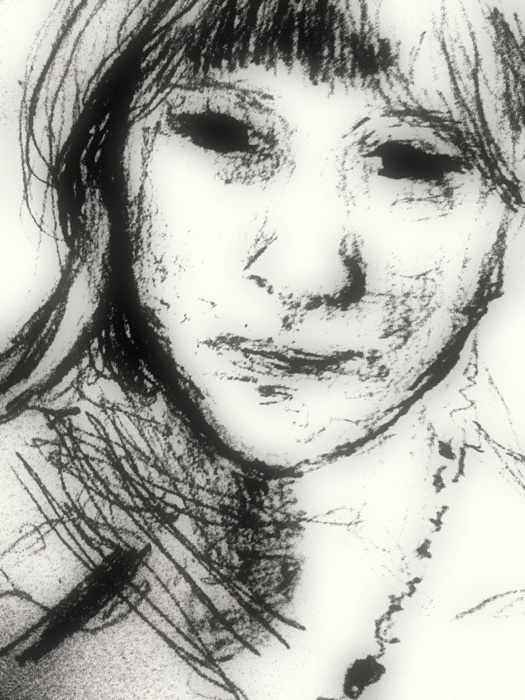
“Talking Bread Loaves” PART 2 and artist Stacy Ericson

Sketch of Terrill Welch by Stacy Ericson

One of my first interactions with Stacy Ericson was when she asked “tweet friends” to volunteer for her to sketch. Of course, I put my “tweet” up right away. Above is the delightful result.  Below part two of “Talking Bread Loaves” you will find more about Stacy and her creative talents as an artist, poet, and photographer.

Now Continuing with part two of “Talking Bread Loaves” If you missed the first part you can read it here.

Next, a little flour goes into the yeast mixture. My mother’s arms flexed with the strain of stirring the long wooden spoon around and around the bowl. Her other arm holds the bowl at an angle to make the stirring easier. She stops occasionally to add more flour and as she does, she looks at me with one eye, making sure I don’t have my hands in the open flour container. Or worse, I’ve made finger roads through the crater of flour that she has ready on the table.

When she feels that the dough is thick enough to pour she lifts the large bowl up with one arm and tips it into the floor crater. Using the other arm, she maneuvers the wooden spoon, scrapping the leftover dough out as quickly as she can. Timing is critical. She needs to put down the bowl and be able to fold the flour into the warm dough before it runs over the edge of the flour barrier.

This was my chance. I sink my hands into the soft flour and as I do this I shout “Oh look mom! It is coming over the edge!” and then I place my little palms along the area where the dough is about to overflow. Mom’s strong hands slide in between mine and the flour and the dough. With a graceful swoop she begins kneading the flour in. When just “the right amount of flour” has been added, she “lets it rest” while washing out the bowl. I am given the gigantic bowl “to grease” while she kneads the dough. Then she placed the smooth, elastic ball of dough back into the greased bowl and sets it aside in a warm place “away from drafts” to rise until it has doubled in size.

Read the Conclusion PART 3 here

Sprout Question: When do you experience a feeling of awe?

Bonus: Stacy Ericson is unpretentious and engaging. She quietly, in cumulative small engagements, warms your heart. There is a vivacious vibrancy to Stacy that rings through into her art, photography and her writing. Her perception is somewhat like that of an arrow’s quiver. We are caught in the blur yet we know she has captured the intended target – beautifully. Following are a few of Stacy’s images and reflections.

Stair Shadow by Stacy Ericson

“The dead and the discarded, dry wisps, and fallow fields, industrial textures, and rural detritus are transformed by a distillation into line and light.”

Elise chicken looking by Stacy Ericson

“Images make me happy. Getting what I want out of a photo, or getting close to it, to me is simply joyful.”

Confusion of the Watchmaker by Stacy Ericson

“I want to experiment with many forms, but I do have a passion for blur — often even photographs that seem to be in focus capture light differently when the camera itself is in movement.”

Sun by Stacy Ericson

“I have a feeling that the static object holds a life-force within that is revealed with the introduction of a random element of moving time. I prefer a slight point of focus to a completely abstract blend of colors in my blurs photos.”

Who is Stacy Ericson?

Stacy Ericson’s arrived late to the visual arts. After growing up in a household devoted to the theater, her educational background includes the study of ancient languages, Etruscan culture, and World Religion. The onset of a genetic disease began a slide into the visual arts, which began to gel while experimenting with the photographic technique of intentional blur, captured through camera movement. Recently Stacy began a small portrait business, and is currently working with both digital SLR and the iPhone camera.

After the Haitian crisis Stacy began The Images without Borders project with Laura Bergerol. This innovative non-profit makes art prints from world class photographers available at a low cost to the public with all the proceeds benefiting Doctor’s without Borders.

© 2010 Terrill Welch, All rights reserved.

Liberal usage granted with written permission. See “About” for details.

Purchase photography at http://www.redbubble.com/people/terrillwelch

Creative Potager – where imagination rules. Be inspired.

From Mayne Island, British Columbia, Canada

Talking Bread Loaves

“Talking Bread Loaves” PART 1 and artist Jerry Shawback

Self Portrait (18″X24″) by Jerry Shawback

For many of you that regularly read Creative Potager and its “sprouts,” artist Jerry Shawback’s contributions are a familiar sight. There is no direct connection between “Talking Bread Loaves” and Jerry Shawback. I am simply impressed with his work, his community building and his support of artists. Later in today’s post, Jerry is featured along with a few more images of his work.

“Talking Bread Loaves” will be told in three parts over the next three days. I am considering it for inclusion in my new book Mona’s Work.

Mona’s influence is multi-generational. My mother, Mona’s daughter, learned the art of amusing children, while she was cooking, from her mother. This is how I end up knowing about talking loaves of bread. At the age of five my family and I lived eighty miles from the nearest store. We went to town for supplies once a month. Good homemade bread was a staple. It was also my favourite food, particularly still warm from the oven, cut thick and slathered in butter with wild raspberry jam dripping off the edges and running down between my fingers.

Each week my mother would use her “magic “to make eight fresh loaves of bread. The reason mom needed magic was mostly to keep me amused, not because it was necessarily part of making bread…

Wrestling my way out from under a mountain of covers, I make my way to the kitchen. I know bread is going to be made by the bowls and pans already on the counter. Mom has the yeast set aside to soften in a very large, heavy bowl. The melted lard and yeast are floating on the warm sugar water. Standing on a stool, I stick my nose right over the bowl. I can smell the beginnings of bread. Mom makes a crater shape out of the flour on the table.

I put my fingers in the flour but mom scolds “Ahk! You will make the dough run out and spoil the magic.”

I knew that to spoil the magic meant the loaves of bread wouldn’t be able to tell her when they were done. So I take heed, carefully twisting my fingers together to keep them out of the flour crater.

Continued in PART 2 …

Sprout Question: How do you use your creativity to arouse the imagination of others?

Bonus: I connected with Jerry Shawback through his twitter account and was blown away by his generous “retweeting” of links tweeted by artists he is following (his support of Creative Potager tweets has been incredible). Sometimes I spend an hour or more just viewing the links he has sent along. However, one of my challenges has been getting to see Jerry’s work because his tweets about his own work are minimal. This is one of the reasons I asked Jerry if I could feature him on today’s post. I want us to pause and take note of Jerry Shawback’s art as we recognize his support of other artists.

sketch by Jerry Shawback

sketch by Jerry Shawback

More of these exquisite daily line drawings can be viewed in Jerry’s flickr portfolio. I suggest watching them as a slideshow.

Self Portrait (11″X18″) by Jerry Shawback

On March 13, 2010 Jerry’s portraits will be shown as part of the Gallery 9 “FACES” exhibit. Gallery 9 is affiliated with thewhole9.com, an international community for creative people where Jerry is a recognize community builder and active participant on the site.

p.s. Who is Jerry Shawback?

“Self portraits have the inherent ability to expose the depth and breath of human nature.” – Jerry Shawback

The artist’s self portrait series explores identity through multiple approaches to the same subject matter. Stylistically varied, they reveal the strange and vulnerability essence of the human condition.

His affinity for people, observation of life and strong draughtmanship is apparent in his depiction of the human form and informs Jerry’s painting. Other influences include: Rico Lebrun, Egon Schiele, Francis Bacon, Lucien Freud and his mentor Cornelius Cole III.

After studying communication design in Los Angels at the Otis Art Institute of Parsons School of design, a division of the New School for Social Research, Jerry worked as a freelance designer, commercial artist, and animator for the entertainment industry.

In 2007, after a ten year hiatus from the art world, Jerry returned to painting as a primary focus. He is currently working on a series of self portraits encompassing various artistic motifs, while maintaining an underlining vision, cohesion and emotional honesty. Jerry also produces works on paper documenting the lives and experiences around him, and his continuing study of the human form. His work has been featured in shows throughout Southern California as well as in private collections.

© 2010 Terrill Welch, All rights reserved.

Liberal usage granted with written permission. See “About” for details.

Purchase photography at http://www.redbubble.com/people/terrillwelch

Creative Potager – where imagination rules. Be inspired.

From Mayne Island, British Columbia, Canada

Cheating

Bravely going off in another direction

Does it ever happen to you where you set an intention to do something only to find that you have done something else? That is what happened to me yesterday. I was all set to start writing up some story cards from the source material for Mona’s Work. As I turned around to pick up the material, I locked attention on my oil painting in progress.

(18″ X24″ 1.5″ canvas)

That was it. Next thing I know my creative energy was thrumming at a low hum and hours had disappeared as follows…

I paint the sandstone cliffs with their heavy underbelly colours. The sea rushes towards my brush – pushing and pulling. I witness the internal tension.

Exactness is not the same as expressing the exact emotion in your work.

I knew I needed the cadmium underpainting to hold the seascape together – I did not know it would also hold me together as I painted.

I remind my self to breathe through my nose as the sea air catches me – yet the only sound is the swish, swish, swish of my brush on the canvas. Stretched tight under my enthusiasm every now and again there is throng drum before the swish. Linseed oil seeps through where there had been the smell of the salt from the sea.

I haven’t forgotten, I know the spring of the canvas, I know that sandstone needs a hint of crimson in its tan mix, I know – yes I know. Ohhhhh! I know nothing! What is this tangle paint scrapping it out on the canvas? Time to stop.

Will it make a painting? Yes, it already is a painting. Will it make a gallery painting? This is never my painterly question.

Swish, swish, swish – brush on canvas – a sound as soothing as the surf coming ashore.

Mona’s Work is pushed forward into tomorrow, March 2, 2010 (the painting will take a few days to get tacky enough to work on again anyway).

Sprout Question: Have you ever felt like you cheated on your creative intention?

Oil painting is very different from my usual medium of water colour painting. With water colours I go from light to my darkest colours at the very end. I still block in my composition with underpainting but I have to be able to “live with” what shows through. With oil painting, I start with a contrasting underpainting colour to block in the composition. Because of the strong divergence of colour that will be in this finished painting, I stayed with one range of colour in the underpainting. In both mediums, I build the painting up over a series of sittings. However, it has been over 30 years since I have painted with oils. My brain feels the stretch from working the colours from dark to light, as I had been taught by an Australian trained artist, Sheila Timmins, when I was about fourteen years old. The water miscible oils paints I’m using now are a little different but I’m not sure exactly how yet.

Bonus: Here is a photo of a finished oil painting “The Cow” by my sister Sue Wiebe whose work some of you had asked to see. Excellent control of shadow and light.

And here is a close up of Sue Wiebe’s “Water Lilies” that shows the layering of paint which allows the water to flatten on the canvas and the lily pads to float on top.

Thank you sis for sending me these images to share. Artist Sue Wiebe lives in Armstrong, British Columbia, Canada. With an undergraduate degree in English, she has also completed a year at Emily Carr University of Art and Design. Every once in a long while she finds a free moment to sprout on Creative Potager.

© 2010 Terrill Welch, All rights reserved.

Liberal usage granted with written permission. See “About” for details.

Purchase photography at http://www.redbubble.com/people/terrillwelch

Creative Potager – where imagination rules. Be inspired.

From Mayne Island, British Columbia, Canada

Turning Pages

March is for Mona’s Work


Leah’s  Creative Every Day theme for March is stories. If there is a fit for me, I like to participate in her themes because she has an outstanding blog to support creative efforts along with an outstanding readership who comment regularly on her posts. For creative people it is like having a coffee shop with a talented host and an open mike just for them.

I’m committed to working on my book Mona’s Work which has an introduction on my Gaia blog and an entry here on Creative Potager in “Potatoes to Potato Salad.”

My challenge: how much or how little do I share with you as I go? The writing will be “hot” and like most writing, it is better when it has cooled, been reviewed, and is then served to you after editing several times. I am leaning towards providing snippets of writing and mostly blogging about the writing process and my behind-the-scene challenges and decisions as I work through the source material, my memories and the developing of the structure of this book.

I’m sure this challenge will work itself as I set down to prepare the blog post each day. However, I would be delighted to hear what aspects of Mona’s Work YOU most want to find when you click to open your Creative Potager post, Monday through Friday for the month of March.

Sprout Question: How do YOU decide when it is right to share your creative efforts?

© 2010 Terrill Welch, All rights reserved.

Liberal usage granted with written permission. See “About” for details.

Purchase photography at http://www.redbubble.com/people/terrillwelch

Creative Potager – where imagination rules. Be inspired.

From Mayne Island, British Columbia, Canada

Baby Lambs

On this early Friday morning of west coast rain, I first want to thank the many faithful readers and sprout question responders of Creative Potager. This new blog began on December 27, 2009 with “A Gown Remembered: A beginning.” Today’s submission makes 45 posts with 442 comments and 3,342 views. Thank you. Your engagement, encouragement, humour and insights are an integral part of what makes for an excellent creative potager.

I must be off to a writing group this morning. The underpainting is still drying on my oil canvas and it is Friday on the last Friday in February. I thought I would share a series of photos from my visit to Meadowmist Farm to see the sheep with their new lambs yesterday. The babies always make me laugh with their curious leaping and bouncing around.

Mama keeps an eye out as we wander around the yard looking at the babies.

Here is Fat and Sassy running across the top of the knoll beside us.

Now what are these three up to? They have mischief written all over them as the scuttle across the lawn.

Ah yes – a game of  “let’s chase the cat.” Bridget Joyce’s lovely farm dog watches on to make sure nothing gets out of hand.

And finally, I take a first family portrait.

Thank you Joyce Kallweit for a delightful meander with this seasons new baby lambs. The best of the weekend everyone.

Sprout Question: How do you play or have fun when taking a break from creating?

© 2010 Terrill Welch, All rights reserved.

Liberal usage granted with written permission. See “About” for details.

Purchase photography at http://www.redbubble.com/people/terrillwelch

Creative Potager – where imagination rules. Be inspired.

From Mayne Island, British Columbia, Canada

East

Quietly I close the door behind me and step out onto the sandstone walk. Dawn requests softness as my body, stiff from sleep, stretches into the morning.

East is the direction of the door I’ve just closed. East is the direction my head faces when I sleep. East is the first direction I seek when I rise. Where am I? I look east. East is the direction my studio window faces. When I work, I mostly keep east in front of me or to my left shoulder. I write, take photographs and paint mostly during the first few hours of a day. I edit in the afternoon and late evening. Sunsets, the gloaming and dinner are for enjoying and chats – not working.

I admire the sparse early garden as I head out for a walk.

View and purchase full resolution image (photograph rendered in oils) here.

If we are able to follow the natural rhythms of our body, they are often different from each other. Not everyone has the same orientation to the various times of day.

Sprout Question: Following your natural body rhythms, what part of the day is yours?

© 2010 Terrill Welch, All rights reserved.

Liberal usage granted with written permission. See “About” for details.

Purchase photography at http://www.redbubble.com/people/terrillwelch

Creative Potager – where imagination rules. Be inspired.

From Mayne Island, British Columbia, Canada