Painting Data Collection
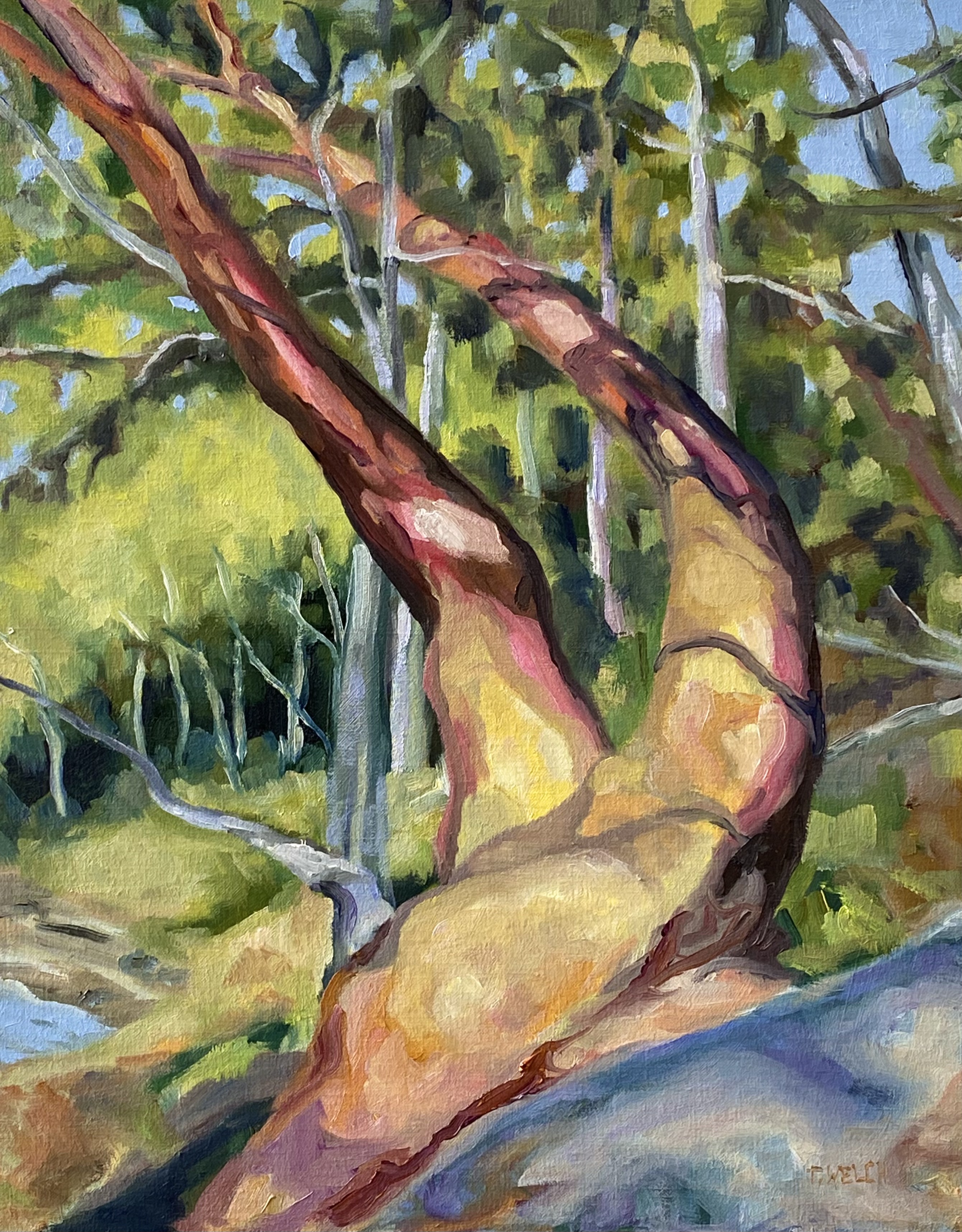
| Title: Lady Arbutus | Date Completed: Wednesday, 5 August 2026 |
| Materials: oil on linen covered birch wood | Size: 14 x 11 inches (36 x 28 cm) |
Figurative/Abstract Self Assessment Band-Scale Rating between 1-10: 4-7
The background offers a loose abstract network of brushmarks while the tree is given figurative prominence with large shapes holding the composition within a visual space of warm morning summer light.
Reference Gathering:
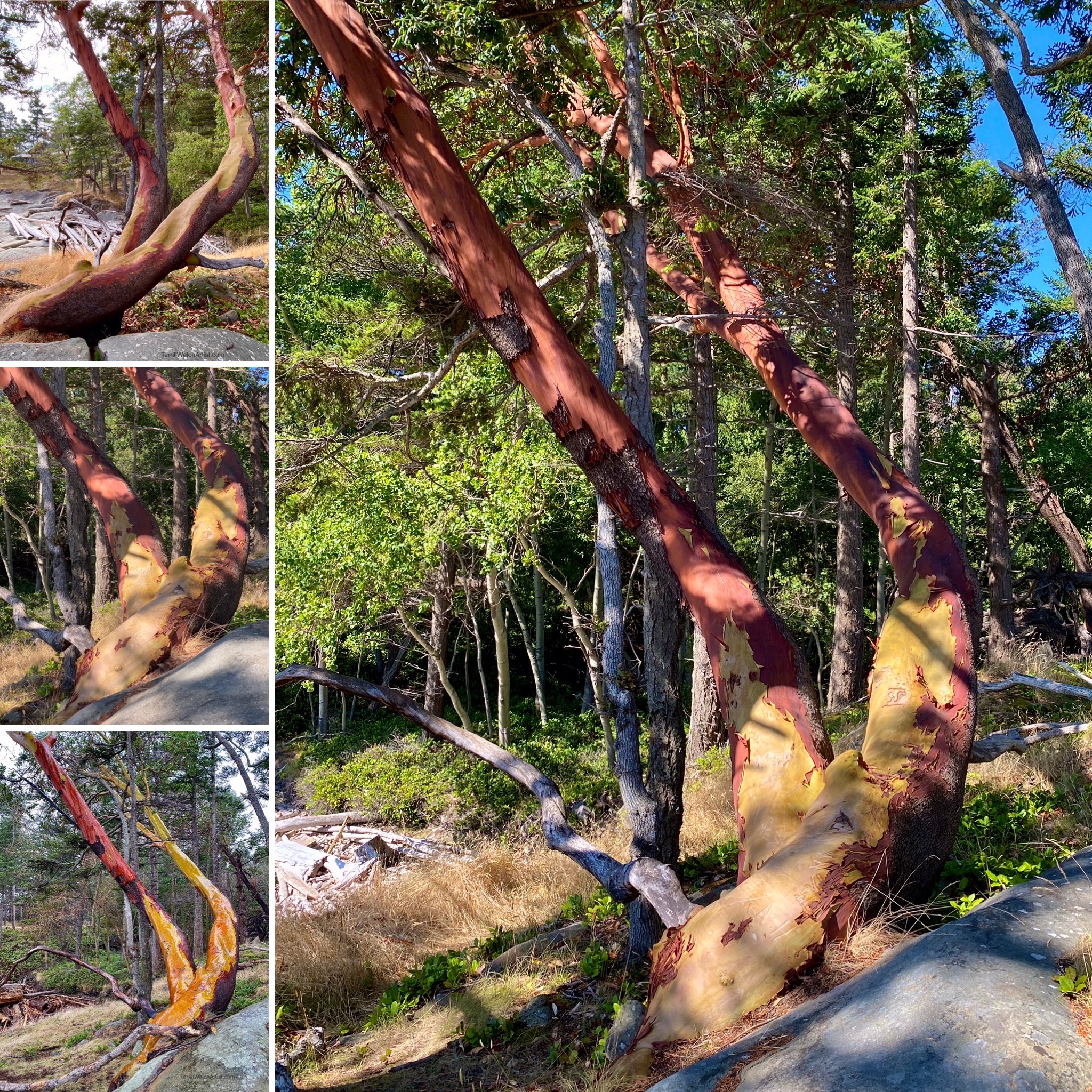
This is a commissioned work and stems from an art collector’s shared love of this specific arbutus tree that resembles the long legs of a woman elegantly reaching for the sky. I have references going back years but chose just a few, between August 2023 and August 2025.
Making Process:
My studio making process proceeded over a few days in 2-3 hour painting sessions. I required pauses to really listen to the painting and what it was asking of me. I also mentally invited the art collector into my musings with nature so that I could draw on the abundance of influences between us three. The focus is on a portrait of the arbutus tree while keeping a sense of context and hints of the ocean behind and beside the viewer. I have a special relationship with not just the arbutus tree but also the polar trees on the middle left. There are very few on Mayne Island but they grew in abundance around my childhood home.

Finished Painting:
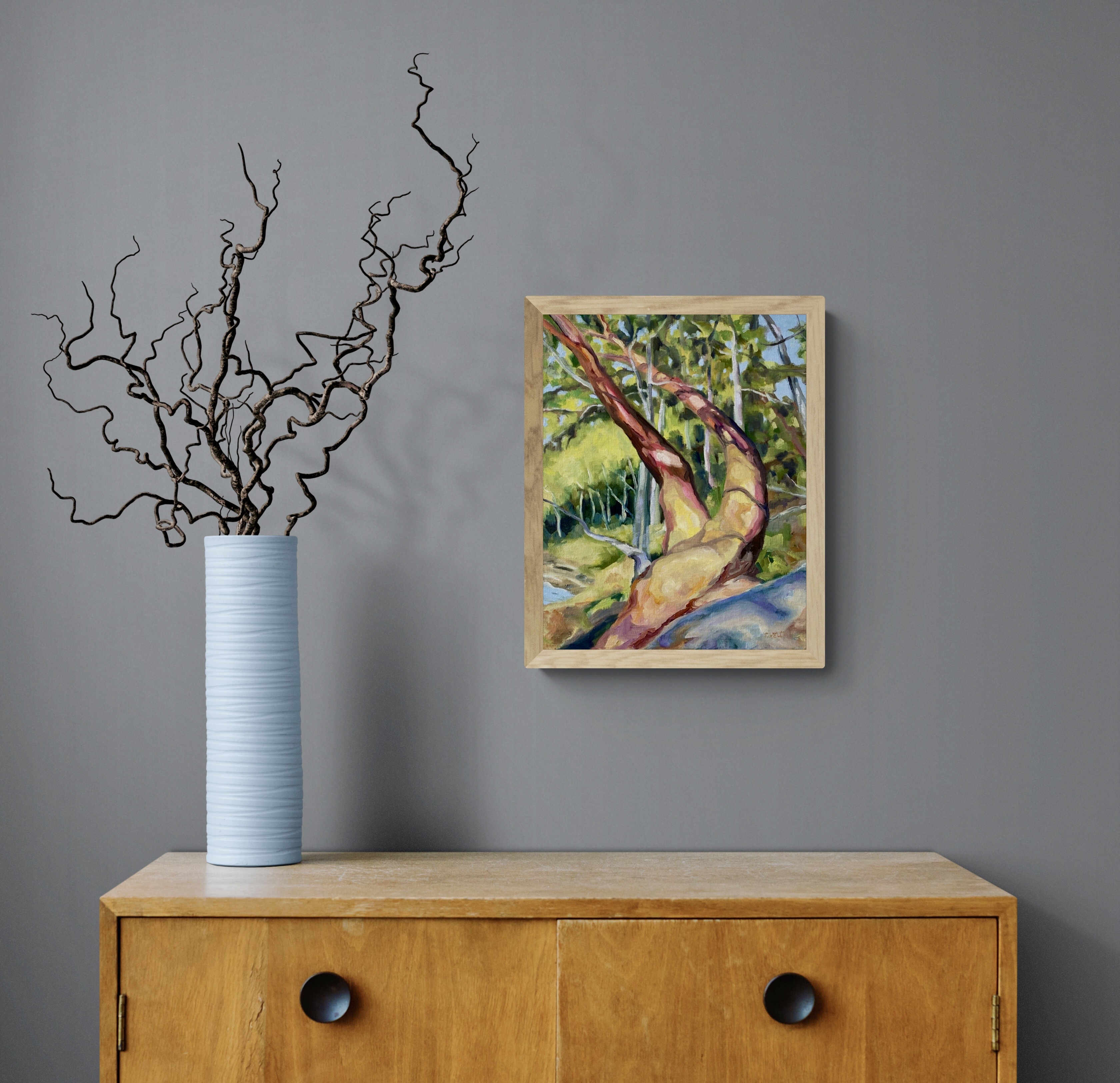
For scale, here is the painting in a digital viewing room.
Making Notes:
A ferry whistles in Active Pass on the other side of the island and echoes a response to the August sun pressing towards it through the trees. The calm ocean behind me pools at the bottom of the ridge next to a group of scrubby polar trees. Deep shadows offer a counterbalance to the bright trunks of the arbutus trees and rich soft greens of the grove. What would it like to be this arbutus tree tucked in next to a few strong firs beside the Salish Sea? I can feel the effort of stepping up on the weathered sandstone beside it as I traverse the narrow trail from the point. I like to pause for a few moments and just share its company before moving on. The artwork is a complex interconnected view to render in paint between dancing sunlight and thick growth reaching for the skies. Much is left to interpretation in an integrated network of suggestive figurative to abstract mark making.
Reflective Analysis:
For this painting, the complexity of vegetation and terrain was demanding to navigate into paint on a surface without over simplifying or offering so much information that the poetry of the moment is lost. I held significant pauses as I worked in order to make decisions about the order of things and then worked in a flurry for a while only to pause again to consider. The types of brushstrokes were decided by subject as I was mindful of only offering just enough to bring the work to life and present the essence of being this specific arbutus tree on this specific day.
Reflexive Analysis:
Commissions are different from work that is solely decided by my commitment and curiosity. I do have a formal process that allows maximum artistic freedom but it is still unique from my self-directed body of work. With my commission process, the art collector chooses the subject and size and a price is determined. I gather my own references and then paint the subject as I see fit. The art collector then decides if the work is to their satisfaction. If not, the work goes into my inventory and I try again. Payment for an artwork happens once a final decision to accept a painting has been made. This gives me maximum freedom as the painter and is the lowest risk for the art collector. Over the years this has been a win-win for everyone. That said, I only accept a very few commissions each year as they frequently take me away from whatever I am working in my studio practice. Not this painting though. It fits nicely into my current focus.
For this painting, I am aware that there is an alignment between how I approach my work and the lived experience of the art collector. So there is the Lady Arbutus tree and her immediate environment on this specific day that is then enriched by around nineteen years of my having walked and sat next to her in all kinds of weather and throughout the seasons. Then there is my awareness of the art collector’s numerous similar experiences and her many conversations with me over about half as many years. The art collector has entrusted me to bridge these various experiences and bring them to the surface of the painting in as much of an unencumbered way as I can imagine. But influences are like seed burs. They sink their hooks into my experiences and come along for the ride every time I dip my brush into the paint. It is something I must notice and also make peace with in order to bring the best I have to whatever work I am creating. Like all experiences, painting is not a pure isolated practice. The process is embedded in a multitude of interrelated and related variables. From this sea of information, a painting comes to rest uneasily on a surface as if by some alchemical, divine intervention. Even though the brushstrokes are made by my own hand, from my own observations and study, no one really owns these results in a lineage sort of way. It would be like saying that the dried thyme added to a stew was the only ingredient that mattered. It is important but, as with the painting, it wouldn’t be much without everything else.
Key Findings:
This painting was a great reminder to trust my creative process and stick with it, even when small doubts creep in around the edges.
Anything else:
The directness of working on this painting reminds me that I can benefit from creating without direct canvas and paint contact, even if it does not result in finished work. While I finished this painting, I also made some painted paper to cut up for collage puzzles. These never seem to amount to anything but they do offer a sort of different texture to my practice. Now that I have finished this work, I have set my paints aside to further explore these bits of hand coloured paper while I think about my overall research question and working definitions for this next body of work – Close To Home.


Terrill, My brain is searching for the words to describe the emotions I felt while reading your words. Joy, with a side order of tears. Thank you so much for giving the rest of us a peek into your magnificent mind!
Thank you Nola. You are most welcome.