Wanted alive not perfect – still life painting with Paul Cézanne

There is an immediacy to painting still life that is even more evident than when painting landscapes. The subjects are closer to the painter and therefore the light moves even quicker when painting alla prima or wet-on-wet then when painting the sea or the forest using the same method. But it is my favourite way to paint and with the west coast being so perpetually grey this winter, I wanted some colour. So colour we shall have!

I grab some available subjects and pulled them together on the kitchen counter and then I snug my old easel up to it. After roughing it a view lines with paint, I am ready to begin.

defining the canvas space for Wine vase pears lemons and blood oranges  by Terrill Welch 2013_02_09 041

The newsprint is intended to help keep the subject close to us and to provide additional reflected light and lightness to the composition. In the end, as you will see, I let go of some of this in favor of more depth and warmth. With an afternoon of painting large loose brush strokes of delicate colour, we come to about here.

set for wine vase with pears lemons and blood oranges by Terrill Welch 2013_02_09 052

There is something about a still life for the impressionist painter that brings home the need to render it alive rather than perfect. If in doubt follow the light and colour. This is what I tell myself anyway – render the light and get it alive.  It is not my idea but the wise perspective of Paul Cézanne. I set it aside to “rest” and at bedtime it looked something like this.

Wine vase pears lemons and blood oranges resting 12 x 16 inch oil on canvas by Terrill Welch 2013_02_09 072

I mean “something like “because every time I looked at the painting I made an adjustment. While the painting was “resting” I cleanup the still life set up, eat one of the pears and set a blood orange aside for morning. I am not completely happy with the painting yet. There is a lost space on the left that leaves the composition more centered than I would like. I wonder what would Paul Cézanne have to say?

Let’s ask the Web Museum in Paris:

Paul Cézanne, one of the creators of modern art, was called the “solidifier of Impressionism”. And indeed he does not draw his picture before painting it: instead, he creates space and depth of perspective by means of planes of color, which are freely associated and at the same time contrasted and compared. The facets which are thus produced create not just one but many perspectives, and in this way volume comes once again to dominate the composition, no longer a product of the line but rather of the color itself. His still-lifes, in their simplicity and delicate tonal harmony, are a typical work and thus ideal for an understanding of Cézanne’s art.

Most of his pictures are still lifes. These were done in the studio, with simple props; a cloth, some apples, a vase or bowl and, later in his career, plaster sculptures. Cézanne’s still lifes are both traditional and modern. The fruits and objects are readily identifiable, but they have no aroma, no sensual or tactile appeal and no other function other than as passive decorative objects coexisting in the same flat space. They bear no relation to the colorful vegetables of Provence — gorgeous red tomatoes, purple aubergines, and bright green courgettes. In his pursuit of the essence of art, Cézanne had to suppress earthly delights.

(reference: Web Museum Paris at http://www.ibiblio.org/wm/paint/auth/cezanne/sl which includes several images of his still life paintings)

Well, I am not sure I agree that his paintings “have no aroma, sensual or tactile appeal and no other function other than as passive decorative objects coexisting on the same flat  space.” However, he did focus on using planes of colour and small brushstrokes that build up to form complex fields of viewer recognition. This is what I am after in this painting. But I want to be sure the viewer experiences the life and sustenance of the subject. These bosc pears, sweet lemons and blood oranges are ready for eating. Delicious in fact. How do I get past the idea of decorative? How do I create more weight on the left side of the composition? Ah yes, questions to sleep on.

It is morning. I cut up the blood orange. I look at it. My mind goes into a long pause. I pick up the cutting board with the orange slices still on it and climb the stairs to the studio.

Rightly or wrongly, there are now slices of blood orange slid in beside the rest of the fruit in the painting. Of course, as always, when one things changes in a painting there is the need to change a dozen others. So here it is. Finished. Not perfect but still alive I think.

WINE VASE, PEARS, LEMONS AND BLOOD ORANGES 12 x 16 inch oil on canvas
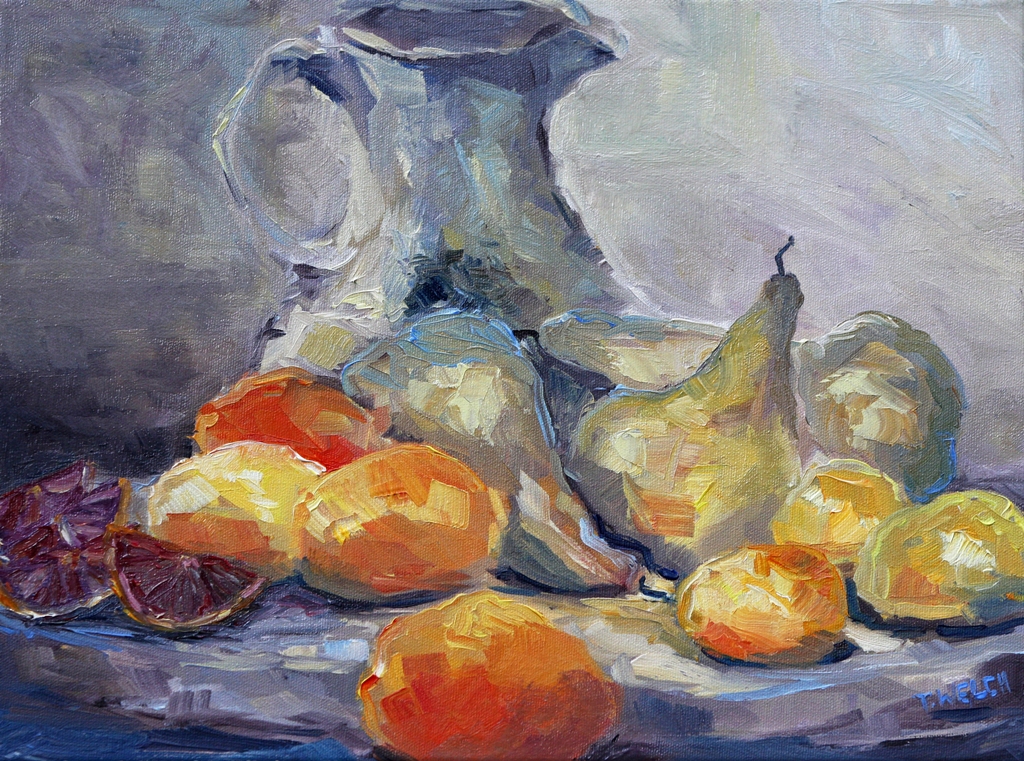
Wine vase pears lemons and blood oranges resting 12 x 16 inch oil on canvas by Terrill Welch 2013_02_10 015

The still live painting’s softness and colour harmony in this morning’s light pleases me. And do have a slice of blood orange. They are delicious! The painting will be released over at Terrill Welch Artist at some point in the future.

What might you be wanting to render alive not perfect?

All the best of Sunday to you and wishing you a marvelous week ahead!

© 2013 Terrill Welch, All rights reserved.

Liberal usage granted with written permission. See “About” for details.

Creative Potager – Visit with painter and photographer Terrill Welch

From Mayne Island, British Columbia, Canada

For gallery and purchase information about Terrill’s photographs and paintings go to http://terrillwelchartist.com

Artist Studio in real time

Today my art studio is feeling and looking like a real mess.

Artist's studio table by Terrill Welch 2013_02_03 005

I can see I have paint that has now dried onto my enamel table top. Not very pleasing at all. Nor is the unfinished applications for our expired passport renewals and neither are the stacks of receipts to be sorted for my 2012 tax returns either. However, there are ten completed paintings in my 2013 folder with six still to release. Three paintings have sold already this year and there are enough supplies in the studio to keep going for another few months.

But darn! Every time I think about those pesky administrative tasks, well I just squeeze more paint onto the palette, put another canvas on the easel and turn my back on it for another day. So this week I have made myself a promise. I either do passport applications, sort receipts for the bookkeeper or paint the edges on my big paintings. It is a toss-up which of these three tasks I dislike the most. The outcome is sure to be the ideal result because completing any three of these tasks this week will be a win.

Now, how might I set up the last of my large 60 x 36 inch canvases to do that fir tree painting I have been thinking about? Oh! Yeah. Hum. Must wait until edges, passport and tax files are completed….

The artist’s  slumps a few inches closer to the studio floor her face longer than the gray winter day outside the window.  Then, squaring her shoulders, she begins cleaning the studio. It is Sunday after all. No one does paper work or painting of edges on Sunday. Do they?

What is your least favourite “must do” task and how do you get it done?

And an ever so slightly more cheerful note, here is one of the newest paintings that is yet to be released.

At Dusk 10 x 12 oil on canvas by Terrill Welch 2013_02_03 019

AT DUSK 10 x 12 inch oil on canvas will be released over at Terrill Welch Artist later this week along with at least a couple more that are also in the completed folder. All paintings that are currently available can be viewed in the Artsy Home online gallery HERE.

© 2013 Terrill Welch, All rights reserved.

Liberal usage granted with written permission. See “About” for details.

Creative Potager – Visit with painter and photographer Terrill Welch

From Mayne Island, British Columbia, Canada

For gallery and purchase information about Terrill’s photographs and paintings go to http://terrillwelchartist.com

The beauty of the lone Tree

There are several trees on the island that I photograph over and over with the hopes to someday catch their essence with my lens. One of these trees is the one in the daffodil field. The tree has set itself in a delightful corner of the world that is often privy to dramatic or at least interesting light. Like the other day when I spotted it with the fog starting to roll up behind its naked trunk and branches.

Lone tree at a distance  by Terrill Welch 2013_01_25 040

So I wiggled my lens in a little closer to see what we could see…

lone tree in field by Terrill Welch 2013_01_25 049

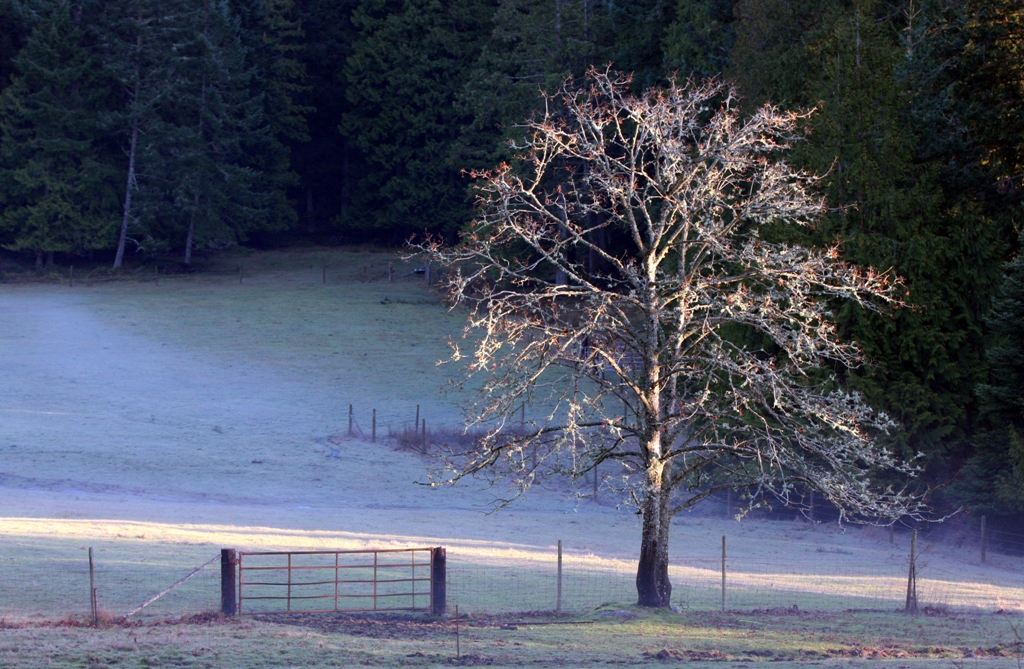
But then I got distracted by its sister tree by the gate.

tree by the gate  by Terrill Welch 2013_01_25 067

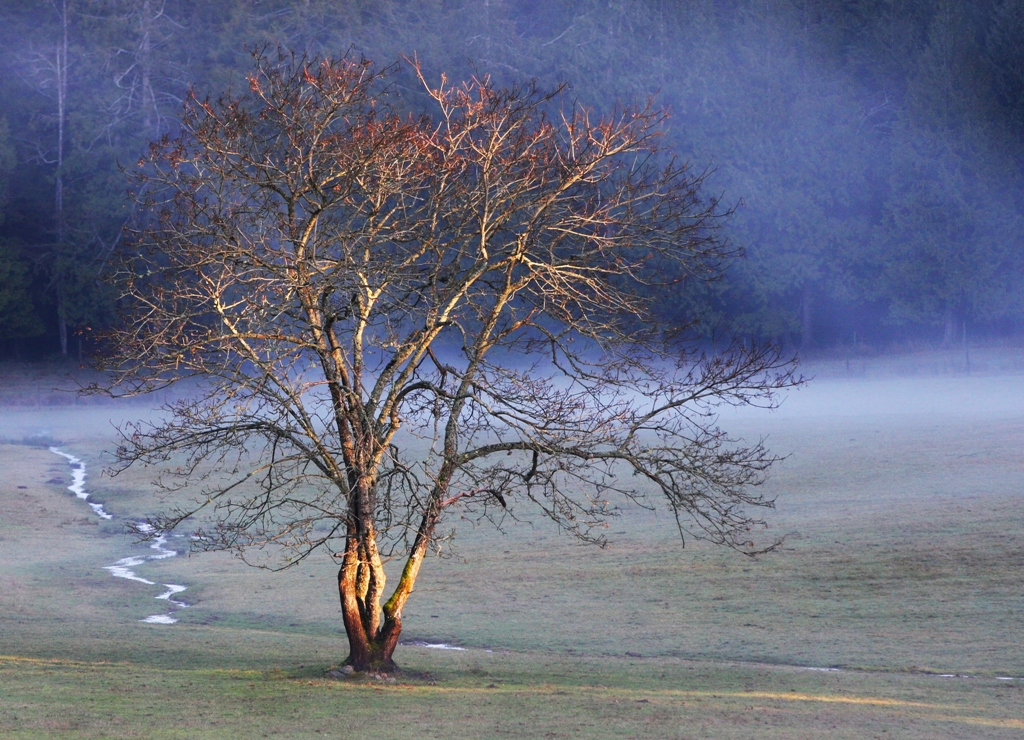
By the time I looked back, the mist had really started to drift up behind the other tree.

lone tree  by Terrill Welch 2013_01_25 114

It is lovely of course but is it just right? Can we glimpse the spirit of the tree as it is revealed to the viewer’s eye. No, I think not – not quite. Almost but still I am left feeling unsatisfied. Maybe it is time to tackle it with paint brush and canvas.

Speaking of which, I have several paintings to release this week over at Terrill Welch Artist. The first post went up this morning for a 12 x 16 inc h oil on canvas “Winter Afternoon West Coast Ferry Home

Winter afternoon west coast ferry home  12 x 16 inch oil on canvasby Terrill Welch 2013_01_25 092

Drop on by if it pleases you or subscribe so you are notified of new posts as they go up.


What are you attempting to capture this week with you creative tools?


© 2013 Terrill Welch, All rights reserved.

Liberal usage granted with written permission. See “About” for details.

Creative Potager – Visit with painter and photographer Terrill Welch

From Mayne Island, British Columbia, Canada

For gallery and purchase information about Terrill’s photographs and paintings go to http://terrillwelchartist.com


Stop feeding the WOW-smacked dragon!

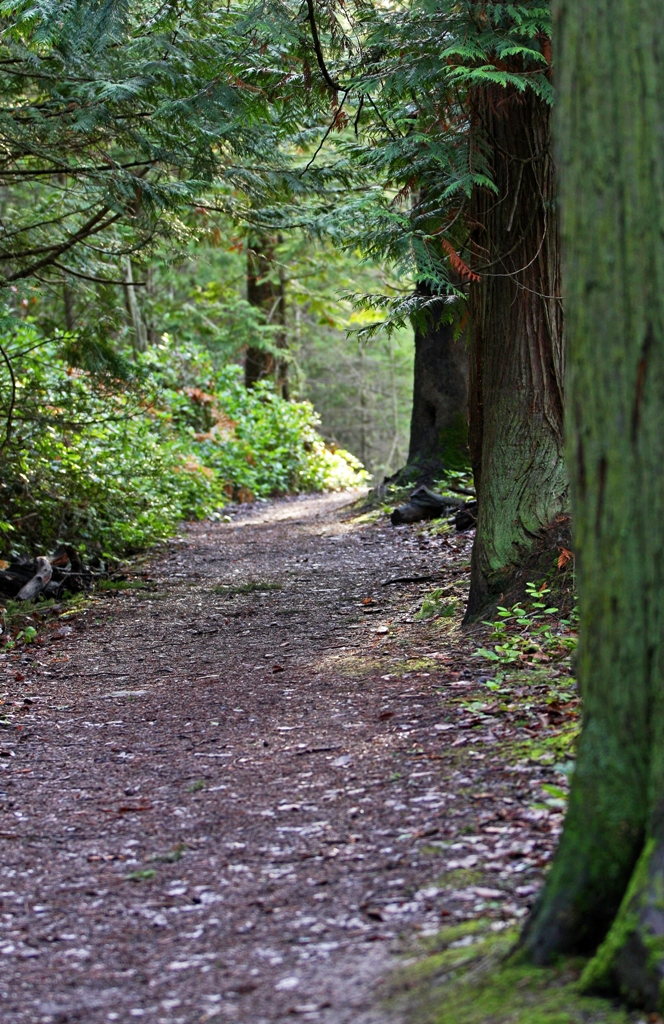
Yesterday’s morning walk provided this one image with the only hint of soft sunlight we saw all day. It is not very exciting and in fact, it is very ordinary – just a bit of soft sunlight coming through the cedar trees on a path in the woods. The image has not been heavily edited and rendered and is truly the ordinary of the ordinary everyday anywhere one might find a path in the woods.

an ordinary morning path Mayne Island by Terrill Welch 2013_01_24 010

So why might I share it with you then?

Well, I have been reading here and there how people are feeling bad, sad and insignificant when they visit their “friends” on social media. They are mumbling about how their lives just don’t measure up as being as successful, exciting or happy as these other streams of wall, tweet, circle, blog postings. And since I have been recovering from a miserable cold I have had lots of time to muse about these heartfelt and I believe honest observations.

I am wondering if part of this is that we consciously or unconsciously are feeding what I call the WOW-smacked dragon. This feeding, like any addictive experience, is the desensitization of our ability to be impressed or “WOW-smacked” so that it takes greater and greater awesomeness for us to notice and get that brief hit of satiation from our own everyday life and in also from our viewing of the lives of others. Therefore, people are in search of and only posting the sensational – true or super-sized by their own storytelling.

I believe three things happen when our lives are spent feeding the WOW-smacked dragon. One, the addiction takes more and more to satisfy for briefer and briefer periods of time. Two, it is a social addiction that feeds and escalates the demands of the dragon while we feel worse and worse about our ordinary lives and our ordinary everyday acts of living. Three, as we become more addicted the WOW factor, the dragon becomes more needy and we lose our ability to appreciate our everyday. An everyday that is filled with the ordinary wonderfulness of our ups and downs and sadness and happiness that has nothing to do with awe and wonder but with simple enjoyment of observation where we then can internally appreciate, with no need to further stuff our sensory systems, a quiet contentment.

So today I want to celebrate the ordinary, the mundane and the soft uneventful sludge that we all walk through from time to time. May we be content with the the extraordinary in our ordinary.

How are you releasing the WOW-smacked dragon and celebrating the ordinary in your life?

© 2013 Terrill Welch, All rights reserved.

Liberal usage granted with written permission. See “About” for details.

Creative Potager – Visit with painter and photographer Terrill Welch

From Mayne Island, British Columbia, Canada

For gallery and purchase information about Terrill’s photographs and paintings go to http://terrillwelchartist.com

What happens in an art studio if the painter catches a cold?

What a silly question you might be thinking. Of course, not much at all would happen if the painter was down with cold and flu – bedridden for most of three and a half days to be exact. But this is not so. A painting is sold and carefully wrapped and then shipped to its destination in Michigan, U.S. A. on the first day of partial recovery.

NAVY CHANNEL EARLY OCTOBER  should have left with the Canada Post boat yesterday on its journey to a new home where I am already convinced it will be well loved and appreciated.

Navy Channel early October 9 x 12 inch oil on canvas by Terrill Welch 2012_10_25 019

It is the first original painting for 2013 to set off to new lands and I wish it well and trust it will bring great joy to its new owners.

Then there is the musing between long fevered naps as to which of three completed paintings to release next. The paintings could be released all at once but what is the fun in that? It is so nice to give them each a chance to walk out on stage solo and take their first bow to the audience without feeling they are being edged along by the painting coming behind or tripping over the one that is ahead. So it is decided. On the first day of feeling better EVENING THUNDERCLOUDS OVER THE STRAIT OF GEORGIA is released with flurry of dramatic sentiments.

Evening Thunderclouds over the Strait of Georiga 20 x 20 inch oil on canvas by Terrill Welch 2012_12_20 025

The hyperlink will take you to the full story over at http://terrillwelchartist.com.

But more than all of this – what happens in the art studio if the painter catches a cold is pondering and reflection, musing and mulling and ultimately evaluating and in this case setting a direct course to more painting. You see, if the next ten years are this artist’s best painting years and this artist paints about 40 paintings a year that is a total of only four hundred paintings. If this artist did not sell one of these paintings would the artist’s spouse be willing to live with the carefully stacked, well-organized and cataloged collection of these works in their living space? You can see where this is going I am sure.

Spouse replies as expected “Of course Darling, we have plenty of walls space left.”

Now the artist, the spouse and you readers know that there has never been much for wall space in this timber-framed house of glass but it is just the answer the artist wants to hear. Paintings will continue to be sold and they will continue to find new homes but it is not an equal priority with the work of painting in this artist’s independent studio. The process of marketing and selling will be bounced just a little farther down the list – not off the list, just down.

What does this mean for the weeks ahead as this artist begins to feel better and again settles into her regular studio schedule? Well, it means first priority is to paint. Second priority is to inventory and organize finished work. Third priority is to assess effectiveness of current online and physical venues for showing work and consolidate where appropriate. Fourth priority is to seek new venues and opportunities to sell paintings. And so, the 2013 artist strategic planning session comes to a close as the blankets are thrown back and the coughing subsides.

The lesson – never underestimate the effectiveness of a cold in an artist’s studio.

What positive outcomes were the result of the last cold that you caught?

© 2013 Terrill Welch, All rights reserved.

Liberal usage granted with written permission. See “About” for details.

Creative Potager – Visit with painter and photographer Terrill Welch

From Mayne Island, British Columbia, Canada

For gallery and purchase information about Terrill’s photographs and paintings go to http://terrillwelchartist.com

Unraveling the artistic influences and intentions behind the painting EVENING AND THE ARBUTUS TREE

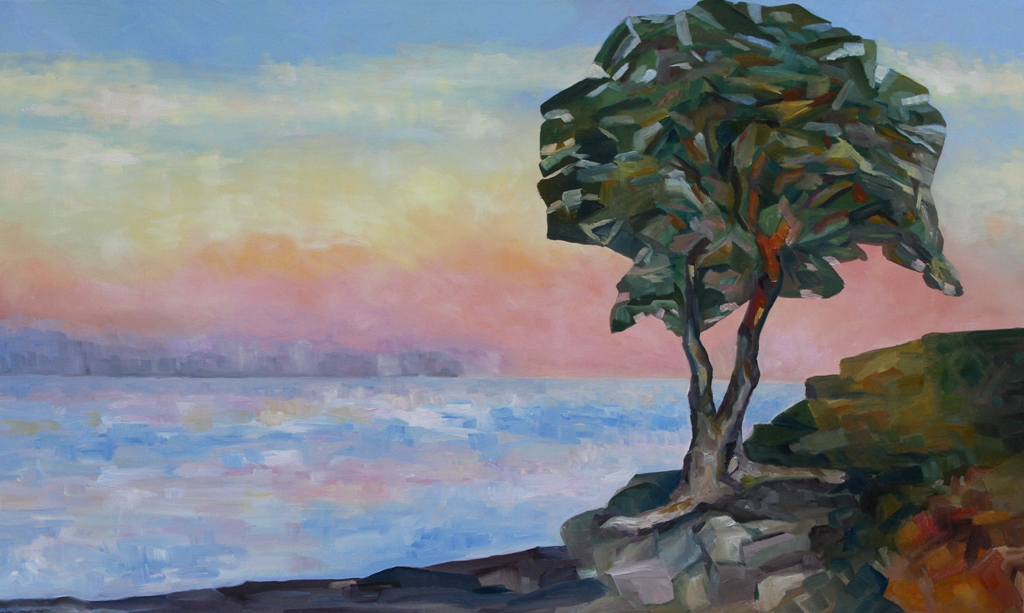
The time has come to try to write about what happened on the canvas of EVENING AND THE ARBUTUS TREE 36 x 60 inch oil on canvas.

Evening and the Arbutus Tree 36 x 60 inch oil on canvas by Terrill Welch 2013_01_07 018

(Detailed viewing and purchase information available HERE)

We can begin with the first hand experience on the evening of November 10, 2012 and the resulting reference images with the primary one being this one simply called “The Arbutus Tree.”

The Arbutus Tree by Terrill Welch 2012_11_10 036

We can refer back to November 23, 2012 and the early beginnings of this painting, where we can still see parts of the underpainting, and the hard lines of the tree and foreground developing.

Evening and the Arbutus Tree in progress by Terrill Welch 2012_11_23 009

We can examine the six paintings I painted in between this stage and completing the painting on January 4, 2013 for any hints of what was to come.

“Storm Clouds over Strait of Georgia” postcard size oil on paper

Storm Clouds over Strait of Georgia postcard size oil on paper by Terrill Welch 2012_11_29 008

“Evening Thunderclouds over the Strait of Georgia” 20 x 20 inch oil on canvas

Evening Thunderclouds over the Strait of Georiga 20 x 20 inch oil on canvas by Terrill Welch 2012_12_20 025

“Reef Bay morning experienced” 14 x 18 inch oil on canvas

Reef Bay morning experienced 11 x 14 inch oil on canvas by Terrill Welch 2012_12_20 016

And these three that were painting on the same morning as I returned to work on the larger canvas bringing mostly to completion by the end of the day.

“At the Beach another time” resting 12 x 12 inch oil on canvas

At the Beach another time resting 12 x 12 inch oil on canvas by Terrill Welch 2013_01_02 050

Late December West Coast Sunrise resting 6 x 6 inch oil on gessobord

Late December Westcoast Sunrise resting 6 x 6 inch oil on gessobord by Terrill Welch 2013_01_02 059

Pear Trees in winter first light resting 8 x 10 inch oil on canvas

Pear Trees in winter first light resting 8 x 10 inch oil o canvas by Terrill Welch 2013_01_02 040

We can review my contemporary colleagues whose work is often part of my daily artistic exposure. The list is long with more than 300 in my network but a few may be worthwhile considering in relation to this particular work.

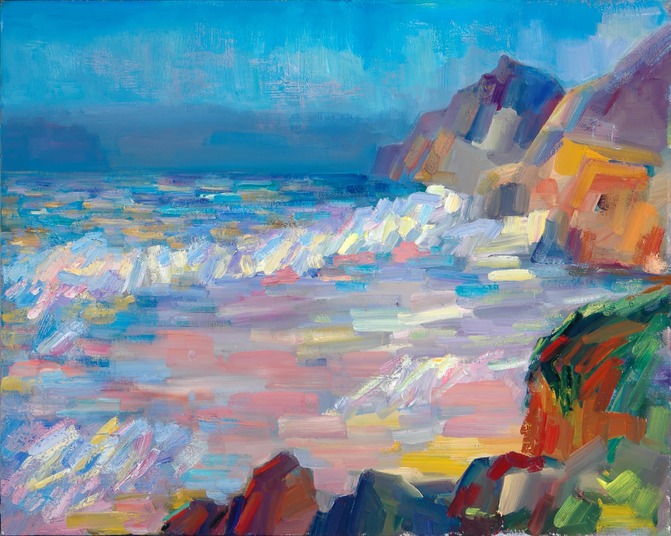
The first of these colleagues being Lena Levin for her skill in using and splitting colours into intricate tensions within her paintings.

Montara Beach 16 x 20 oil on canvas panel by Lena Levin

But there are also Gabriel Boray for his boldness and commitment to exaggeration

The Fields by Gabriel Boray


Shell Rummel and her attention to design so much so that it is now being made into fabric

Water’s Edge by Shell Rummel


This is not everyone of course but just a few of my peers whose landscape paintings come to mind.

Yet, there is also my long-term and recent study and musing of historic landscape works by Emily Carr

The Shoreline by Emily Carr

and The Group of Seven

as well as the landscapes of  Edward Hopper

New York, New Haven and Hartford by Edward Hopper

and Gustav Klimt

Farm House with Birch Trees by Gustav Klimt

Of course, it would be impossible not to mention the French Impressionist painters with particular attention to Claude Monet and Camille Pissarro when listing those whose work I spend time digesting.

Yes, we can do this referring, reviewing and examining of influences and though these are all relevant aspect, they are not the nub of importance. What is, I believe, most important is my conscious effort to divorce the impressionist influences of Claude Monet and the other French Impressionist painters that are so predominantly relevant and internalized in my own painting process. This notice of separation was given on or about August 5, 2012.

However, the intention of my work both in painting and photography has not changed.

What is this intention you might ask. It is roughly as follows:

To demonstrate our relationship to our natural environment and the continuity of time. What is the season? What time is it? Where is the sun? Where am I? Where are you? Where shall we meet in this canvas? How is it intended to influence us?  How does it influence us? The underlying tension is that if we do not address this connection and relationship in a deep and profound way in our daily lives, humanity will parish in a spiral of its own self-destruction.

(Reference: art journal March 21, 2012)

If the intention of my work holds then I must define the problem:

I was taught to start a painting from the farthest point from me. In a landscape this is often the sky. Also, I was to establish my darkest value somewhere in the foreground (though I often forget to do this until part way through a painting). Once the composition is blocked in then, when using oils I was told to work from my darkest areas towards my lightest areas while building the whole painting up at the same time. The reverse process was recommended for water colours for obvious reasons. The intent was to paint what was there or what was seen by following the light source with more detail in the foreground and less in the back ground – a rule I break repeatedly. Further, it was recommended to paint into the shadows in search of colour, light and shapes – noting the difference between cast shadows and form shadows.

But what if this isn’t so? What if even cast shadows are part of form – a continuation of the relationship between visual and energetic space of an object? What if Form is more than Shape, more than composition and cast shadows are part of understanding the elements and there relationships in the painting – beyond position and time of day.

I have primarily set my painting intention on painting light, movement, relationship and connection. Form has been a back drop for the other actors in my paintings. Hence, at times, I have never felt I was successful in providing adequate contrast between light and dark. To be frank, I have trouble seeing the shape or form of shadow even though I understand shadow intimately due to the significant amount of time I spend in natural light. I have had no concept to explore its strength until this idea came to me.

My proposition: The form shadow and the cast shadow are both in a primary relationship with the form. They should be painted and understood as one. Both continue to be attached to our understanding and experience of the Form – and not just with the light source and the underlying subject in the shadow of the form. For example, the grass is NOT understood as grass in the shadow of the tree but rather the tree’s shadow (possessive intentional) is spread across the grass. (Reference: art journal August 5, 2012)

This proposition is what I am exploring in current paintings and this is what is behind the shift we see in EVENING AND THE ARBUTUS TREE. It is this that is the impetus for my primary separation between my impressionist foundations in recent paintings. It is not an approach that consistently holds because I find it is so easy to follow the light into the shadows and represent how it softly plays on the grass instead of letting the shadow stand on its own, sometimes harshly against the light in the evening sky or the edge of the tree trunk. What this painting is saying is that the shadows can speak for themselves in relation to the light land the form. It is a complex language but can intuitively be understood. These harsher edges are part of the stillness that comes with the beginnings of silhouettes that will soon follow as time takes us steadily towards the approaching night. This is an important voice to record in the conversation of this landscape.

In this painting the caste shadow is from the lighthouse. It is this shadow that creates the strongest bridge between the foreground and the mist in the background and the rich hues on the right where the last vestiges of the evening sun are slammed against the sandstone and shrubbery before spilling across the sea and the mist. Therefore, I did not paint a tree that was half cast in shadow. I understood that the cast shadow was important to understanding the form shadow of the tree, of this landscape’s foreground and of its relationship to the background.

detail 1 Evening and the Arbutus Tree by Terrill Welch 2013_01_07 033

These tensions would have become unintelligible if I had followed the light into the shadows to such an extent that the relationship of the caste shadow lost its importance.

So if we can now hold all of these aspects of influences in one brush stroke and then another we possibly might have some idea as to what happened on this canvas that has brought about a notable shift from previous work. Yes, the work, as some have already confirmed, is still recognizable as my painting. It is still following the same intention as earlier work. Yet, I think we might agree that the language of expression has become more refined and complex in its simplification.

What now? Will it mean that this shift becomes consistent in future work? I do not know. If we go back to the previous six paintings that were painted in between starting and completing this painting, I would guess that there will continue to be this flip-flopping between the practice of following the light and that of letting the shadows stand on their own as part of the tension and expression of the relationships in the landscape. We shall have to wait and see.

What are your own most recent attempts to discern your creative influences and intentions?

© 2013 Terrill Welch, All rights reserved.

Liberal usage granted with written permission. See “About” for details.

Creative Potager – Visit with painter and photographer Terrill Welch

From Mayne Island, British Columbia, Canada

For gallery and purchase information about Terrill’s photographs and paintings go to http://terrillwelchartist.com

Evening And The Arbutus Tree – large Canadian landscape painting

As, mentioned I will write more about this painting and the creative process later. For now, we have the painting.


Terrill Welch's avatarTerrill Welch

The sun is going down fast in the late afternoon of November out on Georgina Point, Mayne Island . I marvel at the orange glow and the hues of the heavy mist in the distance of our west coast landscape. I knew then that this most-loved tree was once again going to grace one of my canvases – a large one this time. There is the coolness of a winter sea with soft waves barely evident on the shore. There is a quiet and a peace that often accompanies the end of a day. There is a sense of being alive without separation between land, sea and sky. It is often such with the Canadian landscape but so hard to portray in away that someone who has never been, never stood where I am standing will know what it is I speak about. Yet, this tree knows and seems to…

View original post 262 more words

New painting Released

New Painting released today.

Terrill Welch's avatarTerrill Welch

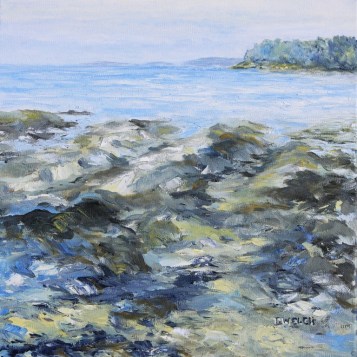
I remember the sea, and the soft rush of water as it comes ashore. I remember the heaviness of the rocks and the salty dampness of winter seaweed. I feel the coolness of the air and the cry of the gulls.

REEF BAY MORNING EXPERIENCED  is an 14 x 18 inch alla prima or wet-on-wet seascape painting with the quiet strength that is part of any peaceful west coast day.

Reef Bay morning experienced 11 x 14 inch oil on canvas by Terrill Welch 2012_12_20 016

(Detailed viewing and purchase information is available HERE)

A Sunday seems like a perfect release day for this new work that was completed late in 2012 and right in the heart of the gray that prevails during the short wet winter days. Yet is somehow a hopeful painting, one that fills me with resilience and inner strength against mounting melancholy. This is the kind of creative environment that feeds my creative muse and stills self-doubt with swift observation and…

View original post 126 more words

Photographing and Painting seams in time with John Daido Loori

Mist fills the valley and hugs the side of cliff-face and my heart as lights starts to creep into our day. I am not going to take us to this moment though but to another. It is the one where we have already been in the brightness of the dawn on the first day of 2013.

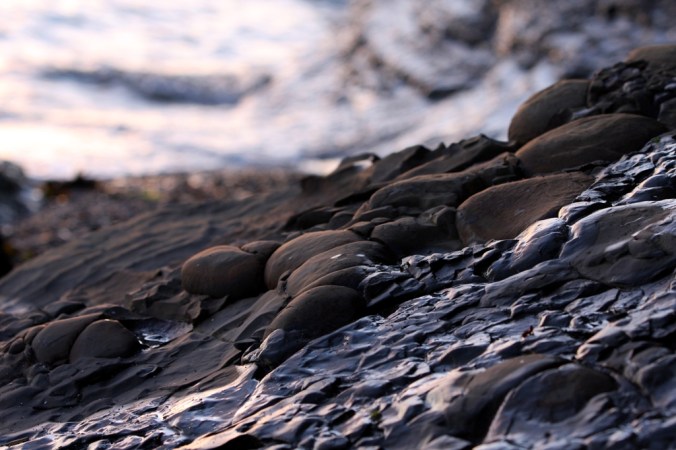
The sun has not quite broken over Saturna Island and the sky is washed in tangerine and cotton candy. I sit waiting for its arrival next to these palm-size clusters of stones being slowly released by the rain and the sea from their sandstone and clay beds. At this moment, it seems, Time is infinite, the sun will never burn out and I shall live forever.

A Meeting by Terrill Welch 2013_01_01 092

Where are we is often a question I ask without a satisfying answer.

where we are by Terrill Welch 2013_01_01 104

However, John Daido Loori‘s work and writing in The Zen of Creativity: Cultivating Your Artistic Life has certainly taken me further in my exploration in this musing.

“There is no place to search for the truth. Though it’s right beneath your feet, it can’t be found.” – John Daido Loori.

Yet we want to know – the whole truth and nothing but the truth. Instead we must settle for fragments, interpretations and inadequate translations of specifics that will forever escape or fevered inquiring grasp.

Good morning sun by Terrill Welch 2013_01_01 109

Possibly, it is this stumbling to understand that is the appeal of simple mathematics. There is one sun in our solar system. There is one earth. There is one me.

Seams in time by Terrill Welch 2013_01_01 138

“I am always doing that which I cannot do, in order that I may learn how to do it.” – Pablo Picasso

so close by Terrill Welch 2013_01_01 197

I wonder if he too was trying to unravel the mystery of existence? Could it be it is the driving question of creative beings which is then only veiled in texture, hue, shape and expression?

“Everything should be as simple as it is, but not simpler.” – Albert Einstein

Dawn breaks on shore 2013 by Terrill Welch 2013_01_01 253

Which brings us to the idea of “suchness” or “thusness” defined in Zen literature as “a truth, reality, or experince that is impossible to express in words.” John Diado Loori describes it as follows:

It refers to the “that”, “what,” or “it” that is self-evident and does not need explanation. It is essentially being as it is, the all-inclusive reality that is manifested in as a sense of presence… Thusness is the points of two arrows meeting in midair. It is a quality of being that is nondual and does not fall into either side… Suchness is not something added from outside. It is being itself. It is in living life itself. It is the “isness” of a thing, indeed, the isness of existence itself… To bring that sense of thusness into a painting, poem, or piece of music gives it a vitality that is easily experienced, although difficult to pinpoint. It may be only an istant in time, a moment out of the constant flow of life. But to sense thusness and to be able to express it brings it into our own reality.  (p. 141 – 142)

This is the inspiration for my latest large painting ” Even and the Arbutus Tree” which is to wet to share the finished work from yesterday. However, here is an image from an earlier stage for our musing.

Evening and the Arbutus Tree in progress 36 x 60 inch oil on canvas by Terrill Welch 2013_01_03 017

May the moments in your day whisper their presence to you because as we know, the whisper is the easiest to hear.

© 2013 Terrill Welch, All rights reserved.

Liberal usage granted with written permission. See “About” for details.

Creative Potager – Visit with painter and photographer Terrill Welch

From Mayne Island, British Columbia, Canada

For gallery and purchase information about Terrill’s photographs and paintings go to http://terrillwelchartist.com


Doing a Henri Matisse in three new paintings

There is some much pressure on artists to be consistent in their body of work. Galleries like it as it is easy to show. Patrons like it because it is familiar with other work by the artist that they love. But artists, at least this artist, do not necessarily  like it. There is something awkward and unfamiliar with limiting palette and stylistic expression to such a narrow range that the work is immediately recognized as coming from the same creative process. Somehow the painting process often unfolds in quite a different manner.

Today, I did what I refer to as “doing a Henri Matisse” which is the process of digging as deeply as possible in a variety of directions to find what best way to interpret my subject, my desire and my intention.

It started with a reworking of “At The Beach” a plein air painting that had fallen out of my favour.

At The Beach 12 x12 inch oil on canvas by Terrill Welch  IMG_1121

There wasn’t anything particularly wrong with this painting but again, there wasn’t anything particularly right either. So I used it a foundation for today’s warm up which was no small task since I had taken a lengthy painting break during the seasonal holidays. Here is the resting results of my efforts.

“At the Beach another Time” 12 x 12 inch oil on canvas resting.

At the Beach another time resting 12 x 12 inch oil on canvas by Terrill Welch 2013_01_02 050

I now am much happier with how the light bounces across the canvas. I like the deep contrasts and the mystery the painting evokes as the sun rests off to my right shoulder on this August day.

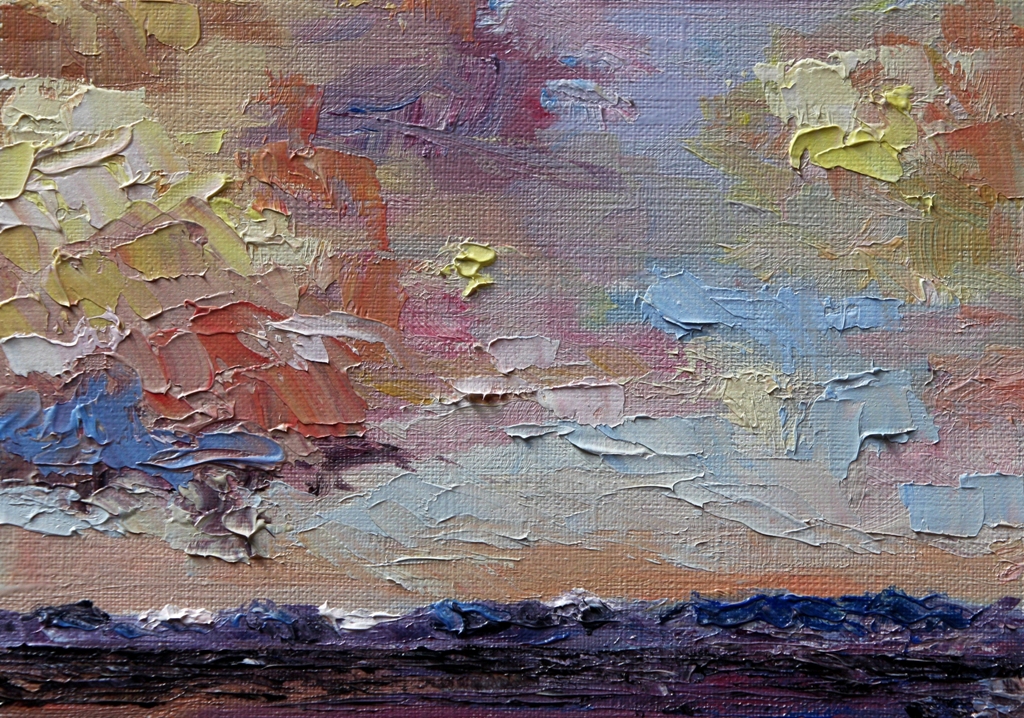
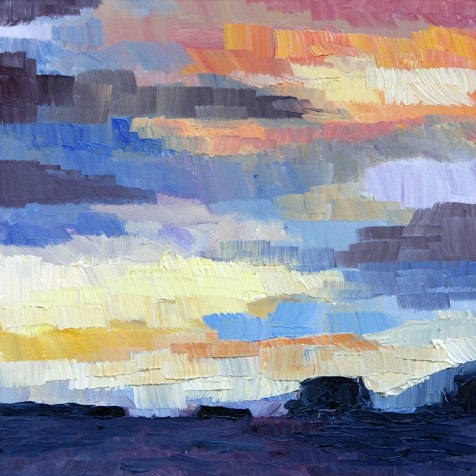
Next, I took on a late December sunrise. I wanted to use bold decisive strokes that would give the sense of a colours woven together by sea, sky and the morning sun.

“Late December West Coast Sunrise” resting 6 x 6 inch oil on gessobord resting.

Late December Westcoast Sunrise resting 6 x 6 inch oil on gessobord by Terrill Welch 2013_01_02 059

The change in palette and foundation from canvas to gessobord  gives me the freedom to devour the winter sky with my brush. It is not about getting it right but rather about getting it live.

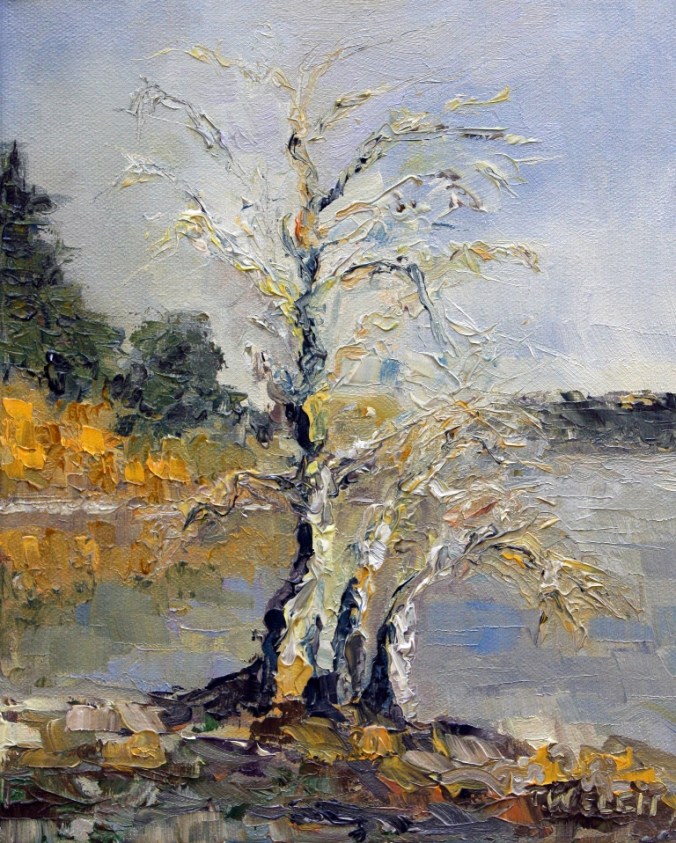
Then the final painting of the day came with yet another change in how I use my tools. The palette knife edged and sculptured my subject while the brush smoothed it back into its environment.

“Pear Trees in Winter First Light” 8 x 10 inch oil on canvas resting.

Pear Trees in winter first light resting 8 x 10 inch oil o canvas by Terrill Welch 2013_01_02 040

So there you have it. Today’s work in all its alla prima glory. Are they finished paintings? Maybe or maybe not. It matters not. This artist’s curiosity has been has been satisfied, at least for today.

Henri Matisse would be pleased I think.  Matisse’s vast oeuvre encompassed painting, drawing, sculpture, graphic arts (as diverse as etchings, linocuts, lithographs, and aquatints), paper cutouts, and book illustration. His varied subjects comprised landscape, still life, portraiture, domestic and studio interiors, and particularly focused on the female figure. In fact, it might be easier to show the range and diversity of his work than to lump it together into a gallery and patron series. This is not to say he did not do several paintings of the same subject. Indeed he did paint the same subject sometimes several times. But each time he handled it with sometimes significant differences in his search of “true painting.”

Matisse’s career can be divided into several periods that changed stylistically, but his underlying aim always remained the same: to discover “the essential character of things” and to produce an art “of balance, purity, and serenity,” as he himself put it in his “Notes of a Painter” in 1908.

Reverence: The Metropolitan Museum of Art – Henri Matisse (1869 – 1954).

I can resonate with this underlying aim and if a painter is to discover “the essential character of things” it stands to reason that the approach, the palette of pigments and the tools will vary. It would also make sense I would think that the subject of inquiry would not be rendered at the same time of day or year and that a viewer might possibly be able to intuit the specifics of light and season if they were familiar with such subtleties.  Therefore, at no time in the near future are you likely to see 20 or 30 of my paintings that look like they were spawn by the same in-bred tribe of pigments, canvases and brushstrokes.

Henri Matisse’s paintings are now showing at the Metropolitan Museum of Art. This exhibition, which curator Rebecca Rabinow has 49 paintings that Matisse made in pairs or trios between 1899-1948. As mentioned, he often painted and repainted the same theme in multiple styles, sometimes halting work on one painting only to continue on another, and preserving much of his own process along the way.

When was the last time that you did a Henri Matisse?

© 2013 Terrill Welch, All rights reserved.

Liberal usage granted with written permission. See “About” for details.

Creative Potager – Visit with painter and photographer Terrill Welch

From Mayne Island, British Columbia, Canada

For gallery and purchase information about Terrill’s photographs and paintings go to http://terrillwelchartist.com