Practice of a little each day


I express my creativity in various forms. The main three expressions are photography, painting and writing. Monday through Friday I provide a blog post on Creative Potager with a sprout question designed to help us take our creativity further.  I have been noticing a thread or theme coming up in both my life and in our sprout responses. The thread is like a strawberry plant sending runners out in all direction seeking fertile soil. Since I like strawberries and I like sprout responses on Creative Potager, I thought I would provide some rich ground to expand on what I call “the practice of a little each day.”

This practice has been part of my life for a very long time and harkens back to the work of  William Glasser, and choice theory and reality therapy (which I took both the basic and intensive training in the 1980’s). Today this work also seems to have sprouted up as part of coaching and brief therapy but its roots are also identifiable yoga, mediation and other eastern practices. Now that, for recognition and reference, I have identified my personal lineage to the practice let’s get on with fertilizing these Creative Potager creative runners with “the practice of a little each day.”

View and purchase full resolution image here.

What is “the practice of a little each day?”

1. Each morning listen deeply to what your creative need is for that day (different from your wants or desires needs are like the basic needs of the air and water for our creativity to survive).

2. Make a commitment and a concrete specific plan to action you are going to take to fulfill that need just little before the end of the day. No excuses, no judging. Gently and firmly ask yourself these questions “Is what I am committing doable? Is what I am doing now working for me? If yes, how can I keep doing it? If no, what will work better?”

The key to this practice is clarity about your long-term creative intention and doing “a little each day” which is something I call a living vision. In this case, a living vision for expressing your creativity.

View and purchase full resolution image here.

The practice is simple in design and takes a life time to appreciate – it is a practice. We can start again each day – or even each hour if need be. Please take from it what works for you and let go of the rest.

Sprout Question: How does “the practice of a little each day” inform your creativity?

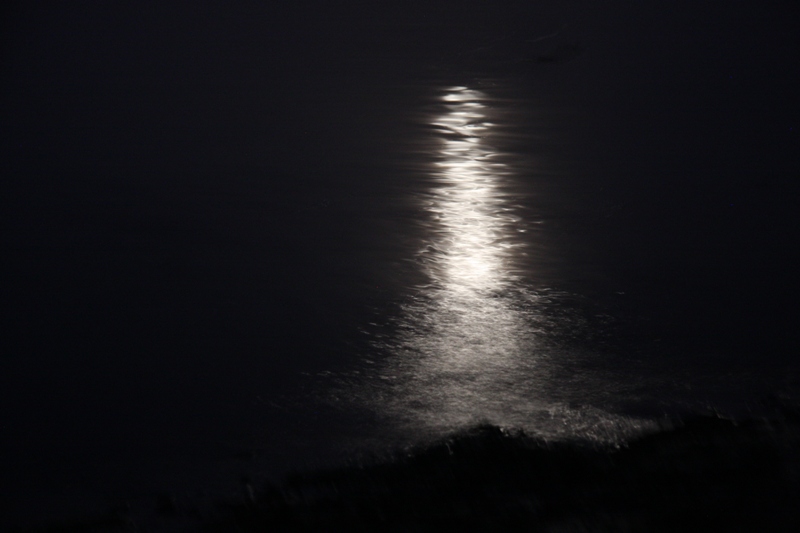
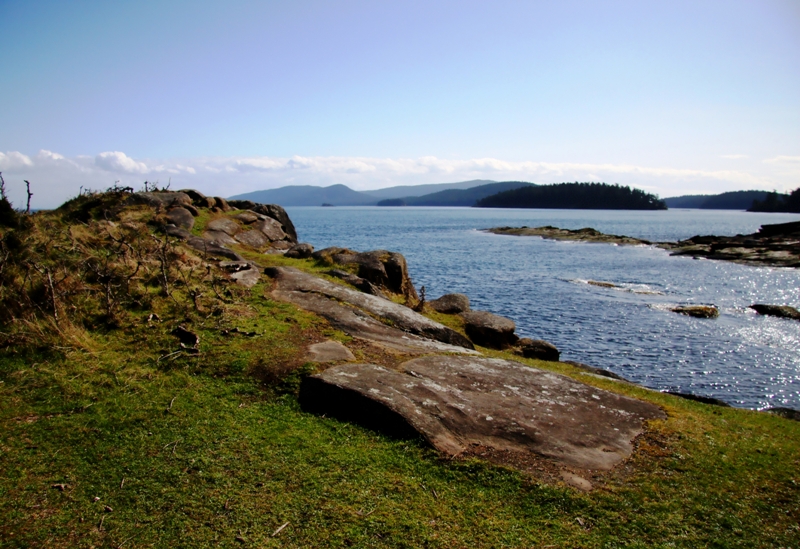
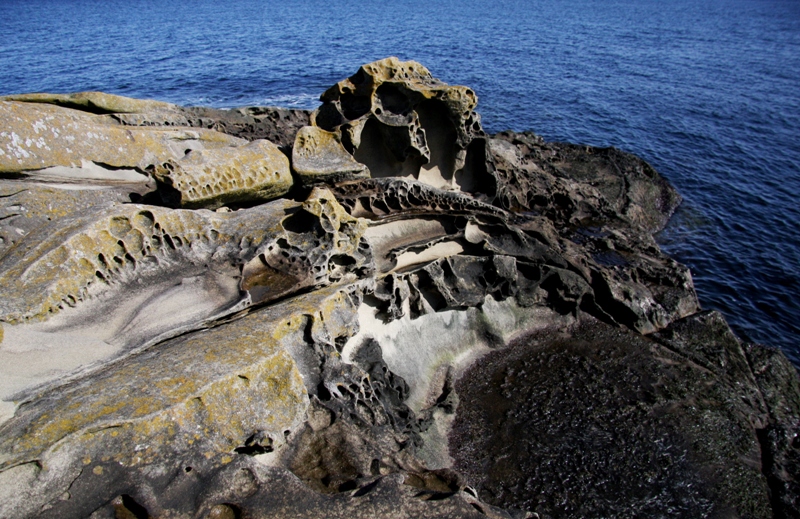
Note: Today includes some of my more meditative images that support my own deep listening. The first one is currently the background on my laptop.

© 2010 Terrill Welch, All rights reserved.

Liberal usage granted with written permission. See “About” for details.

Purchase photography at http://www.redbubble.com/people/terrillwelch

Creative Potager – where imagination rules. Be inspired.

From Mayne Island, British Columbia, Canada

Painterly Challenge

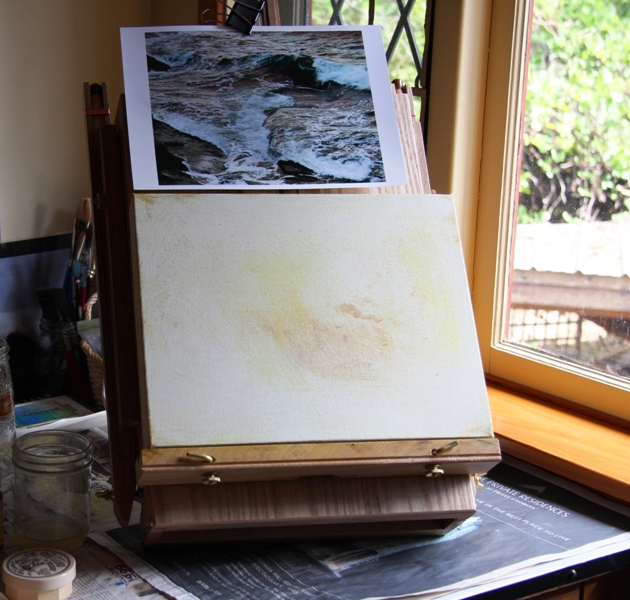
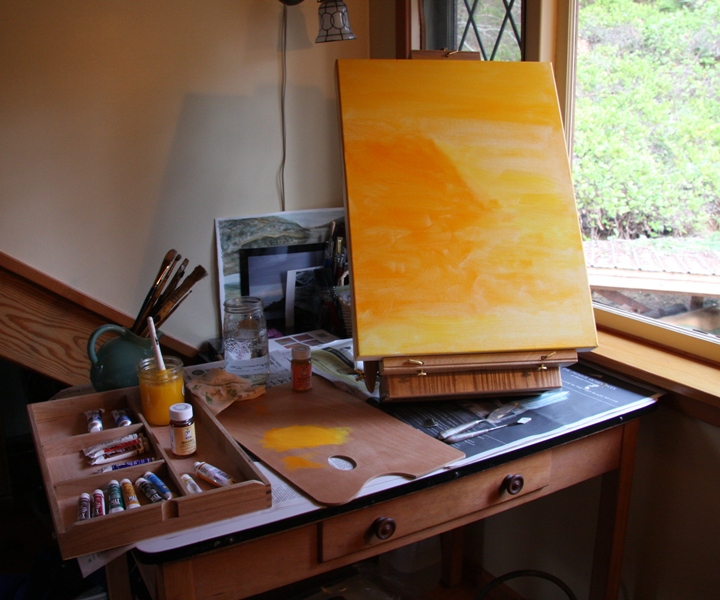
I have been doing underpainting on two canvases. I like to paint on site but that is not always possible so I gather photographic reminders. I rarely sketch or draw on my canvas except to capture rudimentary placement of forms. I do however routinely start with an underpainting which gives me the beginnings of depth and positioning for the development of the painting. Underpaintings are kind of like looking at an ultrasound of a baby in the womb when you don’t know the parents… not very interesting. So if you find this post rather boring – I won’t be offended. Come back tomorrow. It will be something different.

You may wonder how I choose what to paint (besides the obvious of a theme for solo Exhibition Sea, Land and Time at the beginning of September). Long ago I decided that rarely would I paint something that I felt I had fully captured with photography. My painting in is an intuitive relationship with my subject. I want to give to the painting something beyond what is in the seeing. In addition to a compelling subject, I also decide what to paint by choosing a painterly challenge – something I want to explore or a skill I want to strengthen.

For “Sea” my challenge is to be able to create depth in the water while capturing the waves on the surface… I want the viewer to be able to look at the painting and feel as if the water is still moving, wave after wave. Starting with an almost blank canvas, I begin.

Stopping as the underpainting becomes too saturated to allow new colours and shapes to emerge without erasing earlier ones.

With paint still palette, I decide to begin a second underpainting for “rocks and mussels” to address the challenge of giving bulk to something that is dark on the top and light on the middle and bottom… the mussels are added in to keep me amused and give me a break when the rocks become tiresome and frustrating.

I am reminded of a passage in Emily Carr’s painting journal on July 27, 1933 where she writes:

“Oh, these mountains! They won’t bulk up. They are thin and papery. They won’t brood like great sitting hens, squatting immovable, unperturbed, staring, guarding their precious secrets till something happens. At ‘em again, old girl, they’re worth the big struggle.”

My rocks are only little sitting hens – but getting them to “sit” is still my end goal. We shall see over the weeks ahead what we can do with them.

Sprout Question: What specific creative challenges are you setting for yourself right now?

Bonus: An interview with me posted today by Stacey Curnow at Midwife For Your Life Blog “Walking in the Sunshine of My Soul: Special Shoes Not Required.” http://www.staceycurnow.com/blog/2010/03/walking-in-the-sunshine-of-my-soul-special-shoes-not-required

© 2010 Terrill Welch, All rights reserved.

Liberal usage granted with written permission. See “About” for details.

Purchase photography at http://www.redbubble.com/people/terrillwelch

Creative Potager – where imagination rules. Be inspired.

From Mayne Island, British Columbia, Canada

The Soft Caress of Patterns

Do you ever just look at a pattern and know that it is telling you something? This happens to me often. When I’m painting or framing up an image I usually keep the pattern within its context so that it is recognizable and also “discovered” as part of the whole. But sometimes, just for me, I indulge in a mental soft caress of the pattern by itself. You know? – those patterns that your fingers run themselves over before you hands realize what they are doing….

Washboard glass in the historic Bedford Regency hotel bathroom window in Victoria.

Sediment stone washed by the sea on Mystic Beach, Vancouver Island.

Ancient stone work in Machu Picchu, Peru.

Winter clouds in Georgia Straight.

A monster size batch of cookies.

Okay, I guess you didn’t need the context of my kitchen counter to appreciate this batch of cookies but I bet you found your fingers reaching for them.

Sprout Question: Are there patterns or surfaces that attract your creative attention?

© 2010 Terrill Welch, All rights reserved.

Liberal usage granted with written permission. See “About” for details.

Purchase photography at http://www.redbubble.com/people/terrillwelch

Creative Potager – where imagination rules. Be inspired.

From Mayne Island, British Columbia, Canada

Photographic tribute to oldest Chinatown in Canada

Fan Tan Alley, Victoria, British Columbia

View and purchase full resolution image here.

According to the research of professor David Chuenyan Lai, Victoria’s Chinatown is the oldest in Canada and the only one in North America to retain its 19th-century townscape. It is the second oldest Chinatown in North America after San Francisco’s.

Retaining the townscape hasn’t been easy. As some parts are being repaired.

(These men are throwing, and catching, balls of cement to repair the top-side of this entry way.)

Other parts are awaiting new construction.

And still others are under construction.

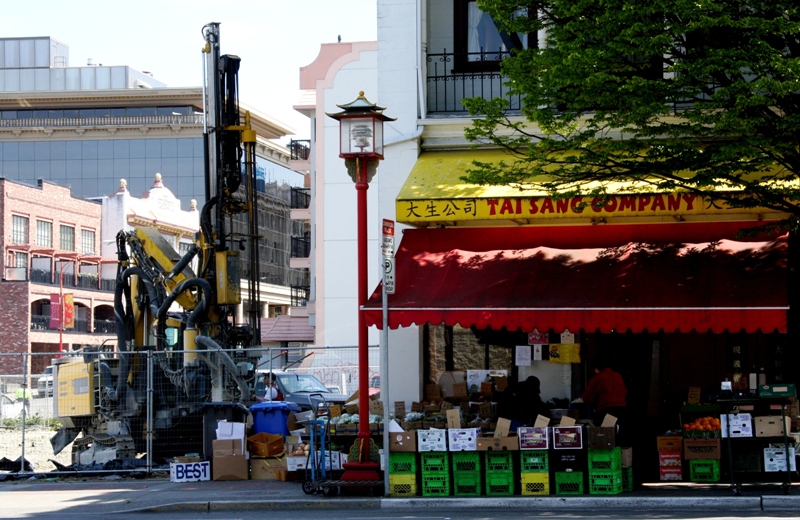
The morning delivery of fresh fruit and vegetables…

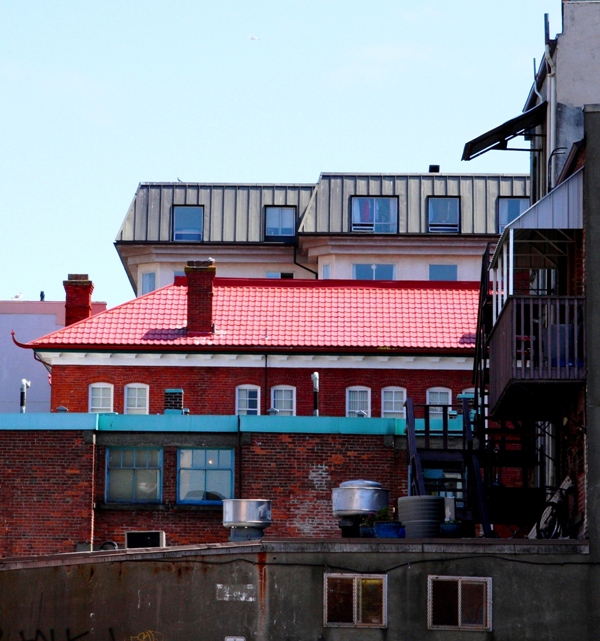
has been happening for as long as the history in these roof lines.

The Gate of Harmonious Interest constructed at Fisgard and Government in 1981 seems most appropriate.

View and purchase full resolution image here.

The discovery of gold in the Fraser Canyon in 1858 plus famine, drought and war in their homeland led Chinese citizens to immigrate across the Pacific Ocean to Victoria, British Columbia, Canada. Chinatown grew steadily over the years until its peak in 1911 (3,158 people), at which time it occupied an area of about six city blocks in the north end of downtown Victoria.

Sprout Question: Is there an urban street that inspires your imagination and creativity?

© 2010 Terrill Welch, All rights reserved.

Liberal usage granted with written permission. See “About” for details.

Purchase photography at http://www.redbubble.com/people/terrillwelch

Creative Potager – where imagination rules. Be inspired.

From Mayne Island, British Columbia, Canada

30 times Same, Same


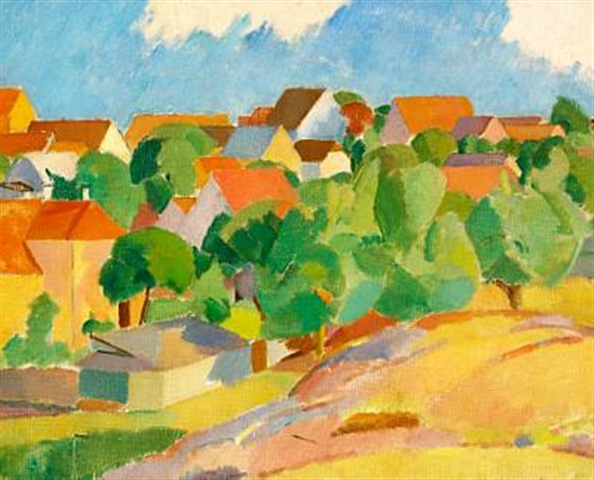
View Karl Isakson’s 1918 painting “Nature morte” as part of Wikimedia Commons.

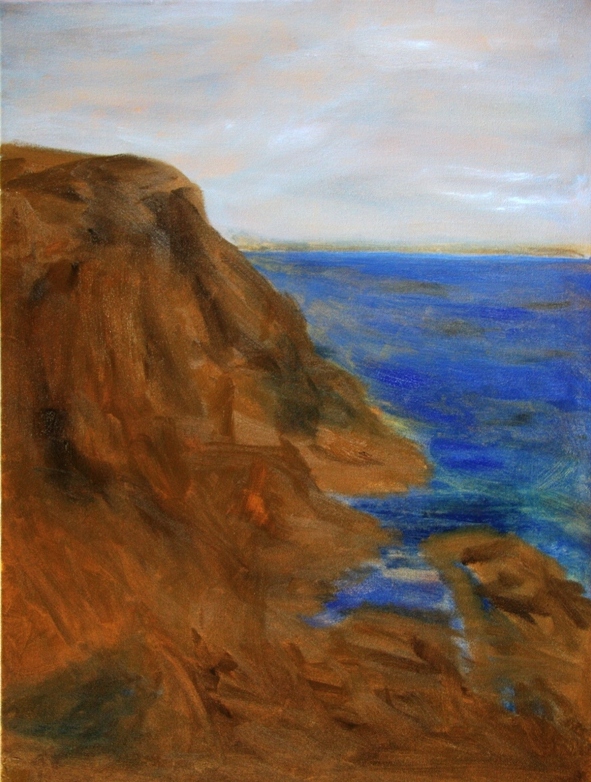
I posted the process I used to paint my first oil painting in 30 years yesterday. “East Point Cliffs” is a rugged painting and rough around the edges, however, it is done. I need to begin again as I trust that not all learning is accomplished on one canvas. Yet, I couldn’t even consider painting the exact same image again, and then again. It is just not in my nature. It is an esteemed practice though. I have on my bookshelf from many years ago Complete Course in Oil Painting: Combined Edition – Four Volumes in One (1960) by Olle Nordmark. On page 123 he states the following:

“Beginners are inclined to think that experienced painters get their effects easily, without travail. This is not so. Great masters are great because they are willing to take infinite pains and do the work over again an indefinite number of times at any stage of the painting. Willingness to erase, or to start all over again on a clean painting surface is essential to good painting, whether you are a beginner or an artist of established reputation.”

Nordmark provides an example of Swedish painter Karl Isakson (1878-1922) known for his exact precision of tone. Isakson often discarded as many as 30 paintings of one subject before he was willing to show anyone his canvas. Thirty times. Thirty times painting the same subject again and again until the artist felt he had mastered his subject. As someone who loves colour, the results take my breath away. The pieces are timeless.

View Karl Isakson’s  1919 Udsigt över Svaneke at ArtNet.

I have provided two examples. To see some of Isakson’s other work explore this Google image search here. I even noticed more than one painting that has survive of the same subject.

So… I am publicly making a commitment to paint 30 paintings by the end of 2010 on the theme of Sea, Land and Time. I will, as much as my vulnerability will allow, let you look over my shoulder as I do so.

Sprout Question: Whose creative work before 1940 do you admire and what have you learned from them?

Note: If you, as some of you I know do, have a practice of creating from the same subject many times please feel free to provide a link to your work and tell us what you have learned in the process.

Best of the weekend to you:) Terrill

© 2010 Terrill Welch, All rights reserved.

Liberal usage granted with written permission. See “About” for details.

Purchase photography at http://www.redbubble.com/people/terrillwelch

Creative Potager – where imagination rules. Be inspired.

From Mayne Island, British Columbia, Canada

Oil Painting East Point Cliffs

On February 26, 2010, I began putting a melon orange underpainting on an 18”X24” gallery quality 100% 2” thick canvas. Oh the spring the canvas, the smell of linseed – so familiar from more than 30 years ago. Yes it has been more than 30 years since I have painted with oils. And these are Grumbacher water miscible oils something completely new. The instruction I was given when I purchased them was – “just paint!”

I have been painting with water colour paints since I was twenty so I just smiled and thought “we shall see.”

A muddy lump of colour is the end result on February 28, 2010 but it felt good – and I needed new brushes. The ones from 30 years ago are toast. So I picked up new ones when we next went to the city. Much better.

March 1, 2010 the painting is starting to take shape and I am lost in sea, land and time.

Over the next couple of weeks I sit and paint several times until the painting starts to tighten up and become the most unruly “problem child.” Where was the painting I had originally given birth too?

I stayed with it – painting and feeling and painting some more. I may fuss a bit with presentation but I think this cooked.

View and purchase full resolution image here.


Sprout Question: What do you do when you have a creative “problem child?”

© 2010 Terrill Welch, All rights reserved.

Liberal usage granted with written permission. See “About” for details.

Purchase photography at http://www.redbubble.com/people/terrillwelch

Creative Potager – where imagination rules. Be inspired.

From Mayne Island, British Columbia, Canada

Rediscovered Love Poem


View and purchase full resolution image rendered in oils here.

In the middle of a quiet afternoon, I rediscovered a love poem and some photos from our time in Arequipa Peru…

I have an image of your face. I came across it in a dream
the way you might find photos in a bureau drawer inside a haunted house…

Is it a negative? It shows the opposite of what the world could ever seem.
Nothing in the world could be so two-dimensionally luminous.

Is it a window? Endless space is etched out in the background scene.
Ice crystals melt upon the foreground glass as it reflects your warm essence.

I analyzed this solitary still… as I once studied sequences in streams
of long pi decimals, where every point is crucial and mysterious.

I believed in music waiting just outside the daily lockstep prison of my life.
These dots might be the stenciled notes a spinet box could play.

Or could this be your aura, passing through someone’s eyes of trouble and strife – prisms in reverse that cast your silhouette in dreams by night, or images by day.

Eventually the scattered tiles of metaphors turned sideways like a knife,
and cut one vibrant moment from my life… your name, your face, is what I finally could hear, see, say.

by David L. Colussi, February 14, 2003

Sprout Question: When do/will you take time to visit the treasures you are keeping shut away?


© 2010 Terrill Welch, All rights reserved.

Liberal usage granted with written permission. See “About” for details.

Purchase photography at http://www.redbubble.com/people/terrillwelch

Creative Potager – where imagination rules. Be inspired.

From Mayne Island, British Columbia, Canada

The Crone’s Passion

The Crone’s Passion – a woman’s story (a longer than usual read)


I read an invitation I received from Hystersisters to participate in the Bloom study: “The primary purpose of this study is to determine the safety and effectiveness of LibiGel®, an investigational medication for Hypoactive Sexual Desire Disorder (HSDD).” Today, I savoured the last lines of Sidonie-Gabrielle Colette’s 1928 novel Break of Day. And today, I am compelled, driven by a compulsion, to write to you about a coming of age story. This is not the usual pimply-awkward coming of age story. Rather it is about the full-bloom-turning-at-the-climax-of-life coming of age story.

As with the finest stories, I shall begin by sharing with you the end I have in mind. The question is posed by Colette near the close of the one-hundred and forty-one page publication of Break of Day, which Judith Thurman clarifies in the introduction: it is not really entitled Break of Day but more accurately translates as Birth of Day. The question is “how many of us see the day appear?” The narrator does not stop to allow pondering of an answer – she gives it immediately, as freely as a lover’s kiss on our naked skin. Her reply: “the ageing of the sun, which each morning shortens its course, takes place in private.” I agree. Too often this is true.

Thurman’s introduction to the novel imparts “here, as throughout [Colette’s] oeuvre, the male of the species is the weaker but nobler creature, while the female monopolizes the ‘will to survive.’” I have not enough knowledge of Colette’s work to argue this analysis. However, I propose that perhaps Break of Day is not about the male species at all. Perhaps Break of Day is primarily about desire. About love! In fact, perhaps it is primarily about female desire and love. Not precisely about the womanly desire or love for another but the actual physical ability to hormonally suffer lust at the expense of common sense. Perhaps Colette’s male character, Vial, and possibly all the characters in the novel, are props to bring our attention to what all women shall experience – if they live long enough, no matter how many “investigational medications” are invented, – the  loss of sexual desire. Contemporary medicine’s concoction of “hypoactive sexual desire” as an unbecoming “disorder,” may well be a defining outbreak caused by a society which is unwilling to see the day appear. Is it possible that we have willingly sold our crone rites of passage for the mythology of an endless summer in youth?

Beyond the financial fortunes to be harvested by soliciting our fear of aging, why might this be? Wine cannot be made if the grapes are left to wither on the vine past their full plumpness. Do we want those plump grapes so badly that we are willing to forgo their picking, tramping and bottling into sustaining comfort during the second half of our lives? This is my fear – your answer will be “yes.” I am compelled – driven – before even waiting for your reply to barter with you, in fair trade, for a chance that you may be able to bottle your best! Come with me . . .

From the beginning of Break of Day, Colette winds inseparably between the light of day, and the passage of time as desiring women… “A little wing of light is beating between the two shutters, touching with irregular pulsations the wall or the long heavy table where we write or read or play, that eternal table that has come back from Brittany, as I have come back.” In the middle of her long paragraph describing such things as her favoured yellow plates, she states “a woman lays claim to as many native lands as she has had happy loves. She is born, too, under every sky where she has recovered from the pain of loving.” Colette concludes that her time that she now has under the blue sky is “doubly” hers with its light air and grapes that have ripened so quickly – except, she has spent a lot of time “not knowing of it!” I ask of what she has not known. Colette’s narrator answers: “That noble bareness that thirst sometimes confers on the soil, the refined idleness that one learns from a frugal people – for me these are late-discovered riches.”

The story’s mistral brings the beginning of transformation with “a strange tribute of withered petals, finely sifted seeds, sand and battered butterflies” being pushed under the door – as with the Bloom study, conjuring up our fear of the worst, not so much the fear of dying but more the death of our youth:

Be off with you, I’ve discouraged other tokens before now; and I’m no longer forty, to avert my eyes at sight of a fading rose. Is that militant life over and done with then? There are three good times for thinking of it: the siesta, a short hour after dinner when the rustling of the newspaper, just arrived from Paris, seems oddly to fill the room, and then the irregular insomnia of the small hours before dawn… Humble as I always am when I’m faced with anything I don’t understand, I’m afraid of being mistaken when I imagine that this is the beginning of a long rest between myself and men. Come Man, my friend, let us simply exist side by side! I have always liked your company. Just now you’re looking at me so gently. What you see emerging from a confused heap of feminine cast-offs, still weighed down like a drowned woman by seaweed (for even if my head is saved, I cannot be sure that my struggling body will be), is your sister, your comrade: a woman who is escaping from the age when she is a woman.

She goes on to describe the bodily changes that come with the middle-of-our-supposed-age, then declares “let us remain together; you no longer have any reasons now for saying goodbye to me for ever.” With fact and possibly astonishment, she imparts her final recognition: “love, one of the great commonplaces of existence is slowly leaving mine.”

Instead of succumbing to the palatable urges to grasp, strain and cling to desire, such as the Bloom Study will rely on to fill their voluntary study quota, Colette grips her truth as  “the arrogant song of a blackbird comes rolling up to me like big round pearls dropping from a broken thread.” I ask us as women and as women leaders to do the same. Why you might ask – when science, cosmetics, drugs and fashion can forestall this necessary and eventual truth? I ask us because I fear we may misplace gifts we have to receive beyond our bodily sexual desire. For there will come a time, as the mother of Colette’s narrator confirms, when we will be and may want to be alone:

it’s the final return to single life when you refuse to have any longer in your house, especially if it’s a small one, an unmade bed, a pail of slops, an individual – man or woman – walking about in a night-shirt. Ugh! No, no, no more company at night, no more strangers breathing, no more of that humiliation of waking up simultaneously! I prefer to die, it’s more seemly.

If we should spend our middle years gripping and clinging to our youthful expression of sexual desire, we shall again, as with our youth we are grieving, miss out. We shall miss out on the rich harvest available to us. If only we have the courage to press and bottle our voluptuous memories, sipping and tasting their lushness frequently, before time passes and we must make the final passage to death solo, single, alone.

In our time that finds us void of nature yearning, we may cry “if only I had known!”  In fact, I did lament and grieve with such a cry. Colette’s eloquent rendering of this struggle is reflected in my own journal writings from a few years ago:

I am obliged to face this alone-place amidst so much beauty and love. I am forced to acknowledge an old and familiar feeling of being bound, trapped and held too tight. What is it that creates this dis-ease – this desire to break free? What is it that has kept me still and waiting this time? A waiting that holds the belief that this too shall pass, and I will arrive on fresh uncultivated ground and rediscover something of great value under the virgin soil. Stay still I tell myself. Breathe into it! I am birthing another phase of my life in which I am virtually baron of sexual sensation. The well traveled paths of intimacy have been erased from the surface of my breasts, thighs, and pelvis through the removal of all that is female. I can climax it is true but without the deep tremor and contractual satisfaction that was granted my body before surgery. Loving hands are met at best with curious compliance and at worst with clawing and scratching reminiscent of running my hand backwards over the coat of a cat. I no long greet these trespasses with involuntary moans and straining-rhythmic pleasure as these gifts are so freely and lovingly given. I can no longer slide close and nuzzle these caresses to my love without involuntary gasping and franticly fighting to free myself of every blanket and point of body contact. I grieve this loss! If only I had known, I would have engaged with even greater abandon in the arms of my many lovers! I would have stored these delights with the vivid vibrancy only afforded trauma memories. I would have found a way to keep these sometimes rash and sometimes delicate human contacts from becoming only ghostly glimpses just barely retrievable in my present day thoughts. Damn it anyway!!

The age of forty-eight seems much too young to be groping around in the dark for lost sensations of pure pleasure. Whose body is this anyway?! I want mine back! I want my body that sang from the touch of boys, men, women and the sensation of a child nursing my breast! How cruel to say in such calm repose, “Let’s take your ovaries as you are so close to menopause”. Could it not have been said “I am so sorry; we recommend this life saving measure knowing that one of life’s great pleasures will go with these small body parts?” I wonder if I would be less angry, experience less sorrow if I had known? The answer is probably not… for I could not have foreseen the loss until after, when it is too late. I selfishly grieve for me and in great compassion I grieve for my love/my lover/my partner/my friend – my friend who forlornly replies “you know it is the same for men.” I know that he feels this to be true and to some degree it may be true. Impotency is common for men. “Drugs help” he says, “they are working on these drugs for women as well.” But my heart is breaking. I silently cry… how can I express my love to you without my body?!!! How will you be able to express your love to me! We are so much more than “just friends.” How will we discover new ways of intimacy? Where are the possibilities? As you stay cloistered in your den below and leave me to toss back the covers alone in the open attic of our sleep chamber – I wonder how we will discover new intimacy? As you sleep late and I wander the downstairs with care not to disturb you – I wonder how we will discover new intimacy. I can hear the cast iron bed shift under your waking. I must leave to face the day and smile, remember to smile as the sun kisses the valley floor!

I can assure you, in the months and years that followed this lament, we did find new ways of expressing our love and experiencing our intimacy – welcoming surprising, lush late-blooming beauties with nonsensical abandon, carefully bottling them for long twilight sips. I beg of us not to wile away precious years clutching the last rose of our sexual desire. Sip your wine that you have put down before the grapes withered on the vine! For as Colette surmises “‘autumn is the only vintage time’ – perhaps that is true in love too.”

Complete your rite of passage. Enjoy the crone’s passion. As you admire the last shriveling treasure of your desire smile and proclaim as Colette’s narrator proclaims, “in future I shall gather nothing except by armfuls. Great armfuls of wind, of coloured atoms, of generous emptiness that I shall dump down proudly on the threshing floor.” Seek to be awake to see the day appear – even if it means you are chilled from sitting through the night air so not to miss its arrival. In the natural rhythm of life, you will have time for sleep later.
Note: References are hyperlinked. Originally posted with image of “Last Rose” in October 2009 on the now-defunct Gaia Community website.

Sprout Question: Has the passage of time influenced your creativity?

© 2010 Terrill Welch, All rights reserved.

Liberal usage granted with written permission. See “About” for details.

Purchase photography at http://www.redbubble.com/people/terrillwelch

Creative Potager – where imagination rules. Be inspired.

From Mayne Island, British Columbia, Canada

What are you waiting for?

Brave the unknown…
Quick whistle of shore birds…. longer notes of an eagle in solo flight over head… waves cresting – moment by moment…

Rush, swish, rise and fall – connecting in a dance – moment by moment

Crisp dusk moves swiftly, heading off the last of today’s sun – moment by moment.

Cedars lose themselves in shadow yet remain unyielding in their whispered fragrance – moment by moment.

Last light is often the light most cherished. May darkness wrap you in a warm blanket of possibility,

as moonlight serenades the sea…

I have come to trust and know that nothing stays the same. We are all in our physical existence for but a split second of eternal time.

Sprout Question: What are you waiting for?

© 2010 Terrill Welch, All rights reserved.

Liberal usage granted with written permission. See “About” for details.

Purchase photography at http://www.redbubble.com/people/terrillwelch

Creative Potager – where imagination rules. Be inspired.

From Mayne Island, British Columbia, Canada
Walk by the Sea

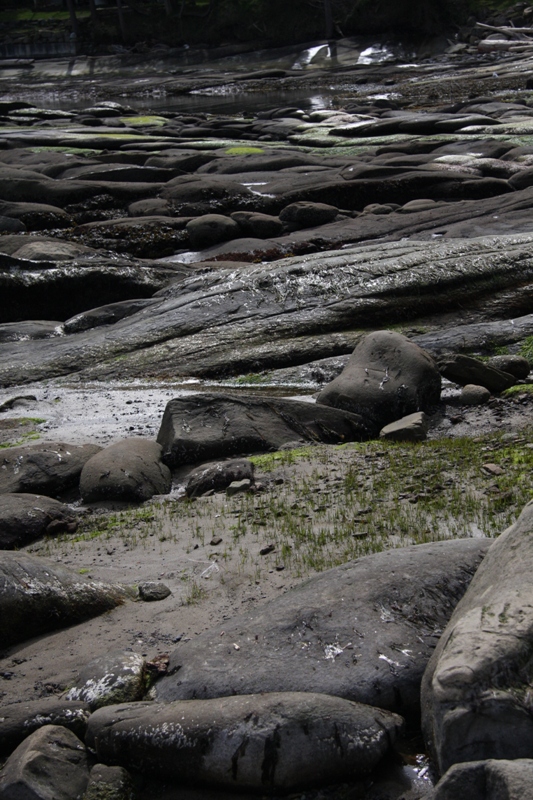
I never tire of walking trail along the sea. I hope you are not yet tired of my images from these walks. The photos today are from a walk that you won’t find on any map. The walk is only known by locals. It is on private land and permission is granted at your own risk. It is a privilege and a honour that I do not take for granted. So I am not going to tell you exactly where this is on Mayne Island. If you know, smile wisely and enjoy the photo essay along with everyone else.

Come with me….

The trail is rugged in places. I often stop to be able to look up from placing my feet carefully between tree roots and sandstone sticking up on the rough trail. In the next few years, you won’t see many photos like this one where to show the trail in the deep shadows, the sea and sky over exposed. We will all know how to do HDR... but when we look in real time we must choose what we can see at one time… so I have also chosen in this photograhy.

As I walk, a sea lion surfaces off the shore. I know it is there because when it breathes I can feel it on the back of my neck. I look. There she is. I do not try to take photos as past experience tells me, my lens won’t reach. She rolls up to the surface. Breathes. Then rolls her long sleek body over and down she goes, surfacing again many yards ahead of me. I don’t see her the next time she surfaces.

About 45 minutes later I make my way to the point.

The sandstone is warm from the sun. I sit and wonder at the beauty of its shape.

Looking over on the other side I catch a wave coming in.

And then I think I know…

High tides and winter storms have carved out such a place where I now admire its beauty.

I don’t want to go. I want to stay and be part of the sandstone and then part of the sea, then part of the sandstone… until day becomes night and night day and time has no relevance.

I do go though. I am not sure what makes me leave, but I do.

Two hours later, I am putting the key back into the ignition. I go home. I make lunch. I leave these images in my mind until last night… or rather early this morning as I was still editing at 1:00 am. Now I have savoured them long enough… I can now share them with you.

Sprout Question: If you could do only one more creative of work in your life time – what would you do?

© 2010 Terrill Welch, All rights reserved.

Liberal usage granted with written permission. See “About” for details.

Purchase photography at http://www.redbubble.com/people/terrillwelch

Creative Potager – where imagination rules. Be inspired.

From Mayne Island, British Columbia, Canada