The Essence of Things

“You should paint the essence of things” Pissarro instructs a younger artist.

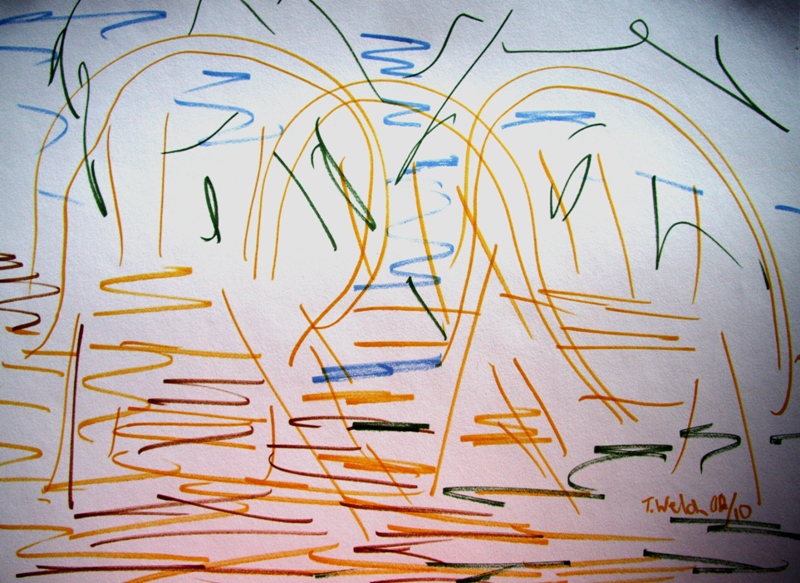
“Where we are separate” quick water-colour painting sketch by Terrill Welch

Last evening I was having a love affair with the work of  Camille Pissarro (1830-1903). I have often had comments on my work about its impressionist style. However, having not formally studied art, or the history of art, my self-taught-ways left me replying “I don’t know much about the principles of impressionism. I just like to capture the light and the essence of my subject. The energy in a work should be alive and vibrant even if it means sacrificing correctness.”  Last night when I read The Life and Works of C. Pissarro by Linda Doeser (1994) I understood why people smiled knowingly at my comment and said no more.

“sitting” quick water-colour painting sketch by Terrill Welch

Exactness is not the same as expressing the exact emotion in your work.

Sprout Question: Is there a particular method you use to capture the essence of things?

Note: Due to Easter Creative Potager will post Monday to Thursday this week and Tuesday to Friday next week.

© 2010 Terrill Welch, All rights reserved.

Liberal usage granted with written permission. See “About” for details.

Purchase photography at http://www.redbubble.com/people/terrillwelch

Creative Potager – where imagination rules. Be inspired.

From Mayne Island, British Columbia, Canada

Painterly Challenge

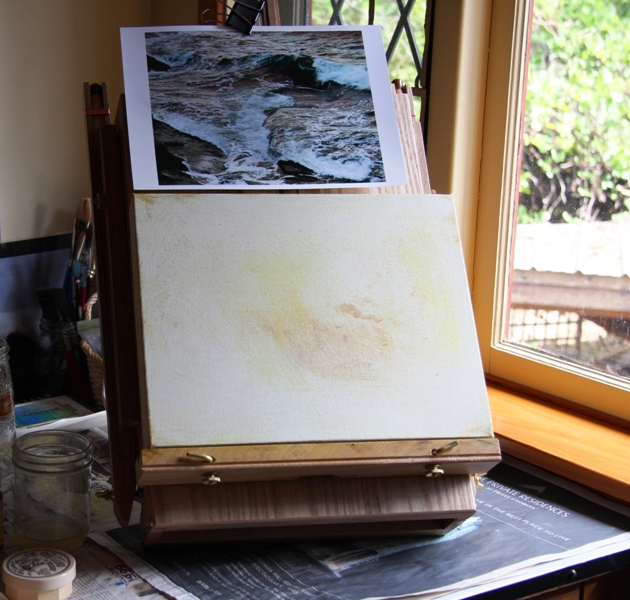
I have been doing underpainting on two canvases. I like to paint on site but that is not always possible so I gather photographic reminders. I rarely sketch or draw on my canvas except to capture rudimentary placement of forms. I do however routinely start with an underpainting which gives me the beginnings of depth and positioning for the development of the painting. Underpaintings are kind of like looking at an ultrasound of a baby in the womb when you don’t know the parents… not very interesting. So if you find this post rather boring – I won’t be offended. Come back tomorrow. It will be something different.

You may wonder how I choose what to paint (besides the obvious of a theme for solo Exhibition Sea, Land and Time at the beginning of September). Long ago I decided that rarely would I paint something that I felt I had fully captured with photography. My painting in is an intuitive relationship with my subject. I want to give to the painting something beyond what is in the seeing. In addition to a compelling subject, I also decide what to paint by choosing a painterly challenge – something I want to explore or a skill I want to strengthen.

For “Sea” my challenge is to be able to create depth in the water while capturing the waves on the surface… I want the viewer to be able to look at the painting and feel as if the water is still moving, wave after wave. Starting with an almost blank canvas, I begin.

Stopping as the underpainting becomes too saturated to allow new colours and shapes to emerge without erasing earlier ones.

With paint still palette, I decide to begin a second underpainting for “rocks and mussels” to address the challenge of giving bulk to something that is dark on the top and light on the middle and bottom… the mussels are added in to keep me amused and give me a break when the rocks become tiresome and frustrating.

I am reminded of a passage in Emily Carr’s painting journal on July 27, 1933 where she writes:

“Oh, these mountains! They won’t bulk up. They are thin and papery. They won’t brood like great sitting hens, squatting immovable, unperturbed, staring, guarding their precious secrets till something happens. At ‘em again, old girl, they’re worth the big struggle.”

My rocks are only little sitting hens – but getting them to “sit” is still my end goal. We shall see over the weeks ahead what we can do with them.

Sprout Question: What specific creative challenges are you setting for yourself right now?

Bonus: An interview with me posted today by Stacey Curnow at Midwife For Your Life Blog “Walking in the Sunshine of My Soul: Special Shoes Not Required.” http://www.staceycurnow.com/blog/2010/03/walking-in-the-sunshine-of-my-soul-special-shoes-not-required

© 2010 Terrill Welch, All rights reserved.

Liberal usage granted with written permission. See “About” for details.

Purchase photography at http://www.redbubble.com/people/terrillwelch

Creative Potager – where imagination rules. Be inspired.

From Mayne Island, British Columbia, Canada
30 times Same, Same


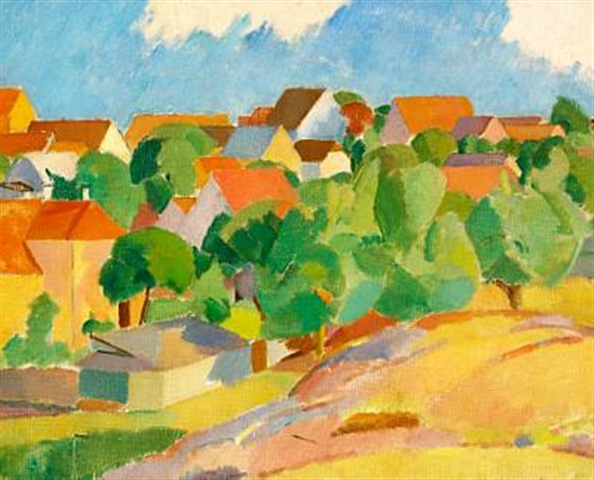
View Karl Isakson’s 1918 painting “Nature morte” as part of Wikimedia Commons.

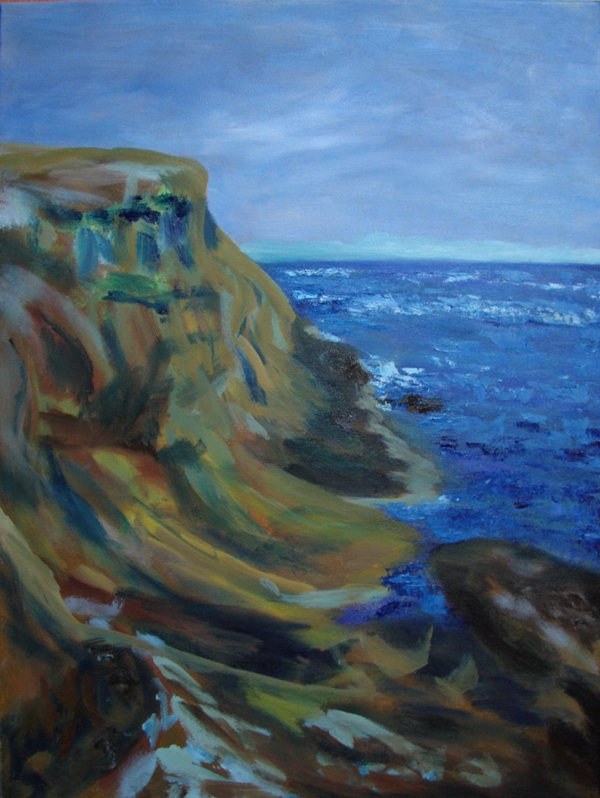
I posted the process I used to paint my first oil painting in 30 years yesterday. “East Point Cliffs” is a rugged painting and rough around the edges, however, it is done. I need to begin again as I trust that not all learning is accomplished on one canvas. Yet, I couldn’t even consider painting the exact same image again, and then again. It is just not in my nature. It is an esteemed practice though. I have on my bookshelf from many years ago Complete Course in Oil Painting: Combined Edition – Four Volumes in One (1960) by Olle Nordmark. On page 123 he states the following:

“Beginners are inclined to think that experienced painters get their effects easily, without travail. This is not so. Great masters are great because they are willing to take infinite pains and do the work over again an indefinite number of times at any stage of the painting. Willingness to erase, or to start all over again on a clean painting surface is essential to good painting, whether you are a beginner or an artist of established reputation.”

Nordmark provides an example of Swedish painter Karl Isakson (1878-1922) known for his exact precision of tone. Isakson often discarded as many as 30 paintings of one subject before he was willing to show anyone his canvas. Thirty times. Thirty times painting the same subject again and again until the artist felt he had mastered his subject. As someone who loves colour, the results take my breath away. The pieces are timeless.

View Karl Isakson’s  1919 Udsigt över Svaneke at ArtNet.

I have provided two examples. To see some of Isakson’s other work explore this Google image search here. I even noticed more than one painting that has survive of the same subject.

So… I am publicly making a commitment to paint 30 paintings by the end of 2010 on the theme of Sea, Land and Time. I will, as much as my vulnerability will allow, let you look over my shoulder as I do so.

Sprout Question: Whose creative work before 1940 do you admire and what have you learned from them?

Note: If you, as some of you I know do, have a practice of creating from the same subject many times please feel free to provide a link to your work and tell us what you have learned in the process.

Best of the weekend to you:) Terrill

© 2010 Terrill Welch, All rights reserved.

Liberal usage granted with written permission. See “About” for details.

Purchase photography at http://www.redbubble.com/people/terrillwelch

Creative Potager – where imagination rules. Be inspired.

From Mayne Island, British Columbia, Canada

Oil Painting East Point Cliffs

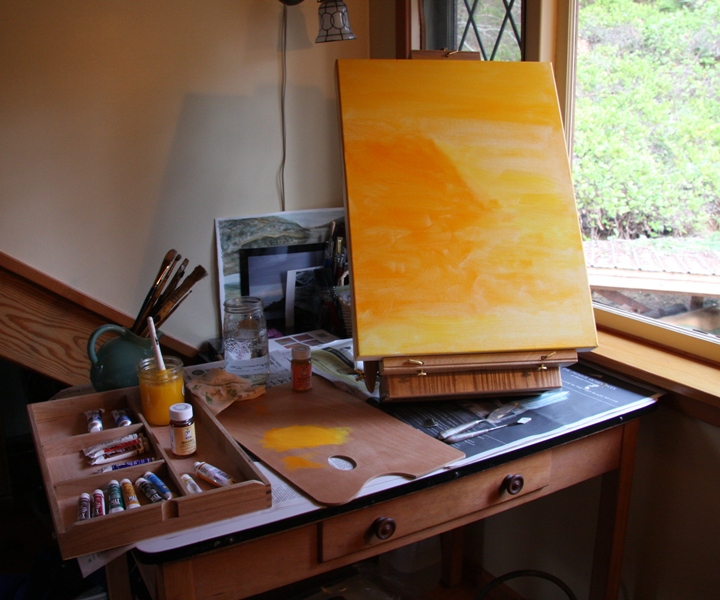
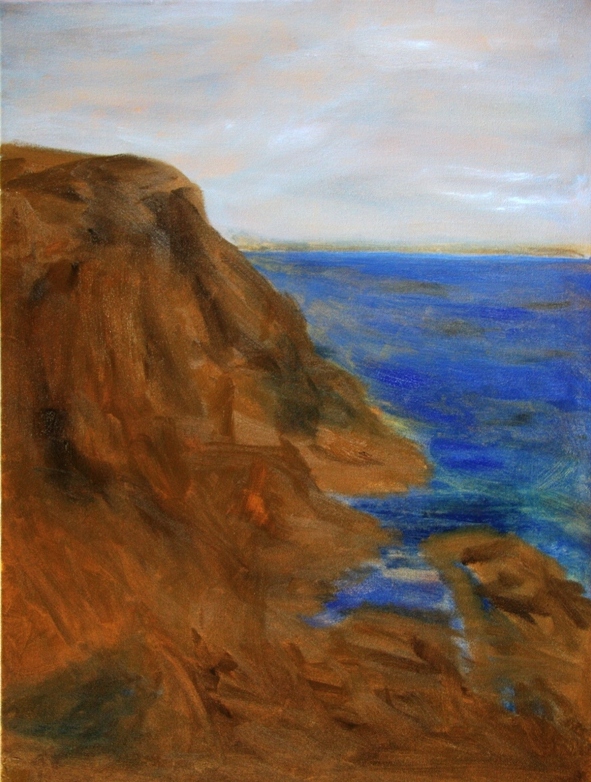
On February 26, 2010, I began putting a melon orange underpainting on an 18”X24” gallery quality 100% 2” thick canvas. Oh the spring the canvas, the smell of linseed – so familiar from more than 30 years ago. Yes it has been more than 30 years since I have painted with oils. And these are Grumbacher water miscible oils something completely new. The instruction I was given when I purchased them was – “just paint!”

I have been painting with water colour paints since I was twenty so I just smiled and thought “we shall see.”

A muddy lump of colour is the end result on February 28, 2010 but it felt good – and I needed new brushes. The ones from 30 years ago are toast. So I picked up new ones when we next went to the city. Much better.

March 1, 2010 the painting is starting to take shape and I am lost in sea, land and time.

Over the next couple of weeks I sit and paint several times until the painting starts to tighten up and become the most unruly “problem child.” Where was the painting I had originally given birth too?

I stayed with it – painting and feeling and painting some more. I may fuss a bit with presentation but I think this cooked.

View and purchase full resolution image here.


Sprout Question: What do you do when you have a creative “problem child?”

© 2010 Terrill Welch, All rights reserved.

Liberal usage granted with written permission. See “About” for details.

Purchase photography at http://www.redbubble.com/people/terrillwelch

Creative Potager – where imagination rules. Be inspired.

From Mayne Island, British Columbia, Canada

Cheating

Bravely going off in another direction

Does it ever happen to you where you set an intention to do something only to find that you have done something else? That is what happened to me yesterday. I was all set to start writing up some story cards from the source material for Mona’s Work. As I turned around to pick up the material, I locked attention on my oil painting in progress.

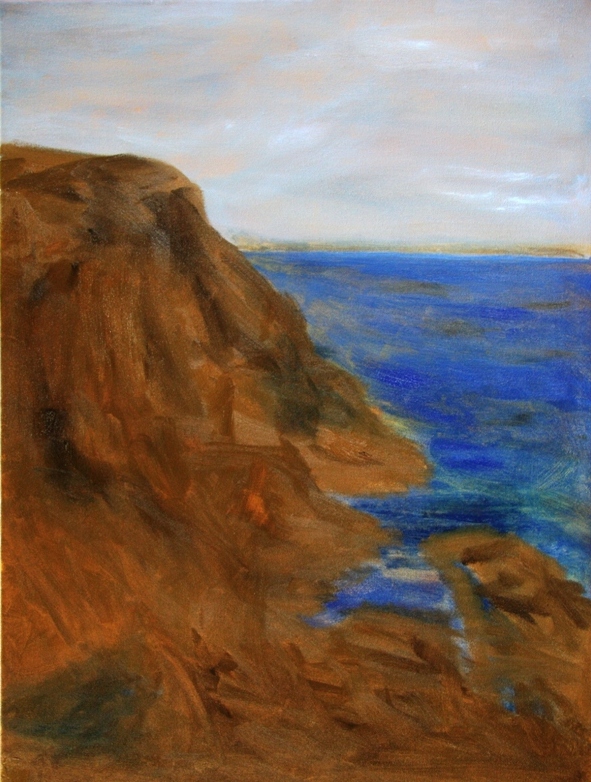
(18″ X24″ 1.5″ canvas)

That was it. Next thing I know my creative energy was thrumming at a low hum and hours had disappeared as follows…

I paint the sandstone cliffs with their heavy underbelly colours. The sea rushes towards my brush – pushing and pulling. I witness the internal tension.

Exactness is not the same as expressing the exact emotion in your work.

I knew I needed the cadmium underpainting to hold the seascape together – I did not know it would also hold me together as I painted.

I remind my self to breathe through my nose as the sea air catches me – yet the only sound is the swish, swish, swish of my brush on the canvas. Stretched tight under my enthusiasm every now and again there is throng drum before the swish. Linseed oil seeps through where there had been the smell of the salt from the sea.

I haven’t forgotten, I know the spring of the canvas, I know that sandstone needs a hint of crimson in its tan mix, I know – yes I know. Ohhhhh! I know nothing! What is this tangle paint scrapping it out on the canvas? Time to stop.

Will it make a painting? Yes, it already is a painting. Will it make a gallery painting? This is never my painterly question.

Swish, swish, swish – brush on canvas – a sound as soothing as the surf coming ashore.

Mona’s Work is pushed forward into tomorrow, March 2, 2010 (the painting will take a few days to get tacky enough to work on again anyway).

Sprout Question: Have you ever felt like you cheated on your creative intention?

Oil painting is very different from my usual medium of water colour painting. With water colours I go from light to my darkest colours at the very end. I still block in my composition with underpainting but I have to be able to “live with” what shows through. With oil painting, I start with a contrasting underpainting colour to block in the composition. Because of the strong divergence of colour that will be in this finished painting, I stayed with one range of colour in the underpainting. In both mediums, I build the painting up over a series of sittings. However, it has been over 30 years since I have painted with oils. My brain feels the stretch from working the colours from dark to light, as I had been taught by an Australian trained artist, Sheila Timmins, when I was about fourteen years old. The water miscible oils paints I’m using now are a little different but I’m not sure exactly how yet.

Bonus: Here is a photo of a finished oil painting “The Cow” by my sister Sue Wiebe whose work some of you had asked to see. Excellent control of shadow and light.

And here is a close up of Sue Wiebe’s “Water Lilies” that shows the layering of paint which allows the water to flatten on the canvas and the lily pads to float on top.

Thank you sis for sending me these images to share. Artist Sue Wiebe lives in Armstrong, British Columbia, Canada. With an undergraduate degree in English, she has also completed a year at Emily Carr University of Art and Design. Every once in a long while she finds a free moment to sprout on Creative Potager.

© 2010 Terrill Welch, All rights reserved.

Liberal usage granted with written permission. See “About” for details.

Purchase photography at http://www.redbubble.com/people/terrillwelch

Creative Potager – where imagination rules. Be inspired.

From Mayne Island, British Columbia, Canada

Simplicity

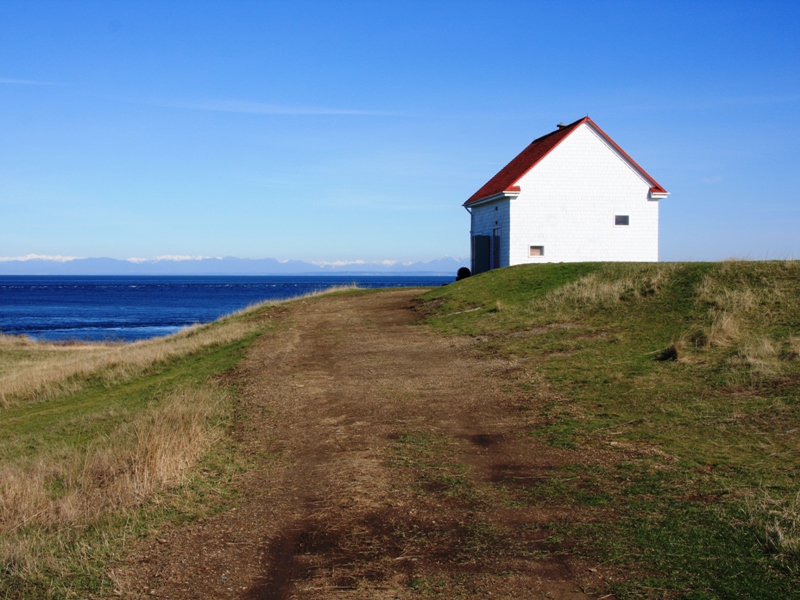
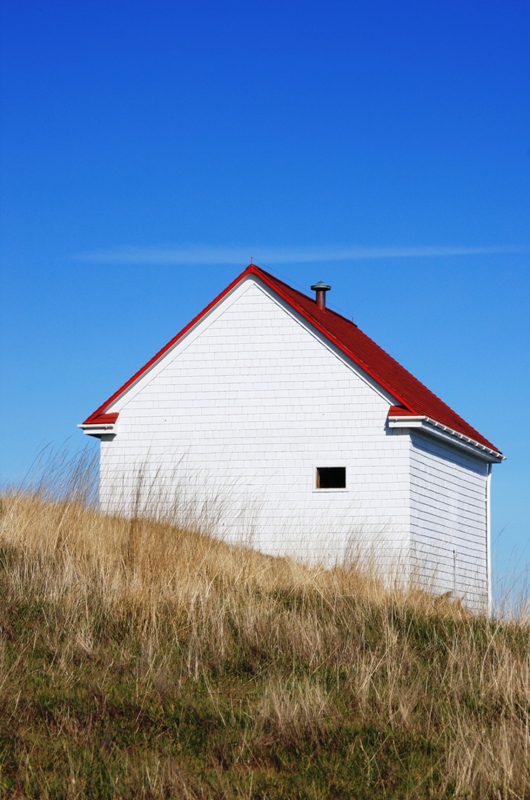
Often, the underlying effect of wabi-sabi is melancholy beauty in its worn simplicity. Yet nature, as our life, is often a messy. Eco-systems thrive on an untidy tangle of old, new and diverse growth (particularly here in the west coast rain forest). The old saying of “not being able to see the forest for the trees” describes how easy it is to become overwhelmed and to lose our centre or still-point in the face of all that is. There are only a few vistas in my travels that have captured my imagination with their beautiful simplicity. A building on a hill at East Point on Saturna Island is one of these places. I have not yet researched to know if this grassy knoll is caused by human intervention or if it is natural. However, the minimalist coming together of nature and construction sang to me. The delight and challenge then becomes composition.

Here are my various efforts over two days to capture “a building on a hill at East Point.”

And finally “window” , my personal favourite, and a featured image today in redbubble group  The Woman Photographer. This is a great honour as there are 2,527 members in this group and 79,986 images.

View and purchase full resolution image here.

Sprout Question: What principles of composition help you to create simplicity?

© 2010 Terrill Welch, All rights reserved.

Liberal usage granted with written permission. See “About” for details.

Purchase photography at http://www.redbubble.com/people/terrillwelch

Creative Potager – where imagination rules. Be inspired.

Wabi

Today’s winter wabi room quick sketch 8″x11″ artist pen .

Wabi-sabi is a difficult concept (particularly for westerners) which can have reverberating impact on our creativity. We have been dancing gently around wabi-sabi in recent Creative Potager posts.  In particular, Laurie Buchannan has repeatedly articulated and demonstrated a link between minimalism and her creative clarity. In North America, such a practice is counter to material capitalism, advertising and socialization. Yet, when we experience wabi-sabi – when we live in humble, harmony with natural decay and the beauty of imperfection – we know an inner peace that the latest gadgets can never provide – because it would be contrary to their purpose. I believe wabi-sabi is a creative necessity and fuels for originality and creative resilience.

What is wabi-sabi?  I will break it down into several posts over the next few days. Though there is much to read on the subject, since we are focus on the theme of “home” for the month of February, my primary source is The Wabi-Sabi house: the Japanese Art of Imperfect Beauty (2004) by Robyn Griggs Lawrence.

Wabi began as a literary concept in fifth and sixth century Japan poetry to reflect melancholy. Wabi has come to mean simple, minimalist, humble and in tune with nature. It is often said that if you are a wabi person you are content with very little. However, it is more than being content… it is the enjoyment of very little with an appreciation and the awareness about how “less is more” in a way that bubbles from the inside over the sparse surfaces of our outside. Wabi is a preference for very little in recognition of its unequaled abundance in the face of all else.

One winter wabi room at dawn this morning…

Tomorrow, we will look at “sabi” and its connection with wabi.

Sprout Question: Does wabi have any part in your creativity?

© 2010 Terrill Welch, All rights reserved.

Liberal usage granted with written permission. See “About” for details.

Purchase photography at http://www.redbubble.com/people/terrillwelch

Creative Potager – where imagination rules. Be inspired.

Naked

With my nightgown hung on the line, I’m reminded that there is nakedness when I am home. Nakedness that usually has little to do with bare skin. Home is actually where we rarely entertain and seldom share the space with others. I think of it as the freedom to allow my energies to easily flow in the space around me. Home is sacred space… when we invite others in to our home – it is to share that sacred space with us.

On Saturday, I cleaned and cleared the cooking and eating utensils. I asked myself – how many people are we really going to have visit at one time? How much cutlery do we need? How many wooden spoons do we use?

The answer was: “far less than was actually in our stash.”

Hence, a great lovely bundle of goods are ready for the thrift store.

Then, the next afternoon, we went for a long walk in a Valentine’s Day Sunday sun. I realized that this too is part of what I considered “our home.” “Home” extended beyond our property. “Home” is Mayne Island a place where my energy flows easily within sacred space.

View and purchase full resolution image here.


View and purchase full resolution image here.


And, in honour of Valentine’s Day, the arbutus tango…

View and purchase full resolution image here.

Welcome to our home.

Sprout Question: Does your creative self have or need sacred space beyond your studio or writing desk?

© 2010 Terrill Welch, All rights reserved.

Liberal usage granted with written permission. See “About” for details.

Purchase photography at http://www.redbubble.com/people/terrillwelch

Creative Potager – where imagination rules. Be inspired.

Pulse

So close to Valentine’s Day, with hearts appearing everywhere, I offer you a view of one of my watercolour paintings from 2001. Today, I’m reading and collecting creative inspiration. I’m reading through blogs on my blog roll. I’m browsing through blogs in my Gaia community. I am picking up pebbles in my tweet stream on Twitter. Today is about me experiencing the pulse of your creativity…

At the heart of things we are all simply human.

View and purchase full resolution image here.


Sprout Question: If your creativity had a pulse, what would be the rhythm of its beat?

© 2010 Terrill Welch, All rights reserved.

Liberal usage granted with written permission. See “About” for details.

Purchase photography at http://www.redbubble.com/people/terrillwelch

Creative Potager – where imagination rules. Be inspired.

Possible

Creative possibility comes from getting it wrong.

Studio mess – my home – time to de-clutter. 8’X11″ charcoal quick sketch.

“Oh, I could never draw or paint like that.”

“I’m not a writer like you.

“My photographs don’t compare to yours.”

If I had a dime for each time I heard these comments or others like them, all of my creative work could be used for charity fundraising because I would be independently wealthy. The sad thing is these statements are not true. They are lies we come to believe because we compare our attempts with finished products rather than the process that lead to their creation.

Here is a best kept secret: creative excellence comes from getting things wrong. Yes, wrong. As I commented on Coffee Messiah’s blog this morning, one of my drawing teachers, Glenn Howarth, was fond of saying things like: “It is the shoulder or wrist you struggle to draw that teaches you the anatomy of an arm.”

This is why I have committed to showing you my first morning “awakener” sketch. These first sketches are to engage me in the creative process. My sleepy eyes begin to frame, compose and dig at the relationship between elements I am about to sketch. My stiff arm and hand begin to respond to these relationships. In these first sketches, few mental barriers about “getting it right” have been erected. My judgment is left aside – these are not “keepers” they are “awakeners.”

In a three-hour drawing class, I often do 30 quick sketches that progressively increase in length until it is time to settle into the last hour-long sketch. When I am doing a photo shoot, I may take 150 images with maybe three becoming “keepers.”

Hours and days of exploring “that which is not yet quite right” leads to the creative possibility for success. This is where we discover our unique creative expression. This is where we learn our craft. We learn what is possible by getting it wrong.

My first quick sketch of the day is to inspire you to say to yourself – “hey, I can do that!” And you can.

Here is the last of my chosen three out of 150 shots of mist…

View and purchase full resolution image here.

Sprout Question: What do you do to strengthen your creative possibility?

p.s. Glenn Howarth was the most outstanding art instructor I have had the pleasure of working under. I am forever grateful for the few short years I was in his figure drawing classes. Glenn Howarth died last year at the age of 62. Very little of his thinking and work is on-line but here is an article he wrote that was published in  Canadian Art and Art Resource Directory: “Pictophile – Plein Air Painting”


© 2010 Terrill Welch, All rights reserved.

Liberal usage granted with written permission. See “About” for details.

Purchase photography at http://www.redbubble.com/people/terrillwelch

Creative Potager – where imagination rules. Be inspired.