Sunday, 11 October 2026
Excerpt from Terrill Welch MA Fine Art Journal
Friday, November 15 to Saturday, November 16, 2024
Following yesterday’s weekly four o’clock in the morning Pacific Standard Time class, I went to see what messages our latest two days of high winds and rain storms had left along the shore at Saint John Point Park. It is a slow fifteen minute drive from my home. The Mayne Island speed limit is 50 km per hour maximum. In fact, we can get most places in fifteen minutes or less on our 21 square km island at this speed. Situated halfway between the two large metropolitan areas of Greater Vancouver and Greater Victoria, our Mayne Island rural life is enjoyed by around 1,200 permanent full-time residents. The need for ferry travel on and off the island and only having one resort and motel creates an infrastructure barrier against overcrowding and caps our tourist capacity to about 3,000 – 4,000 during the spring, summer and fall. Therefore, on what we call cozy season, instead of more accurately described rainy season or storm season, I was not surprised to see the park parking lot empty when I arrive. The rugged and tree-lined trail I take is about 4 km long and winds across the point to a beach and then along the seaside of Navy Channel with low cliffs back to the parking lot.
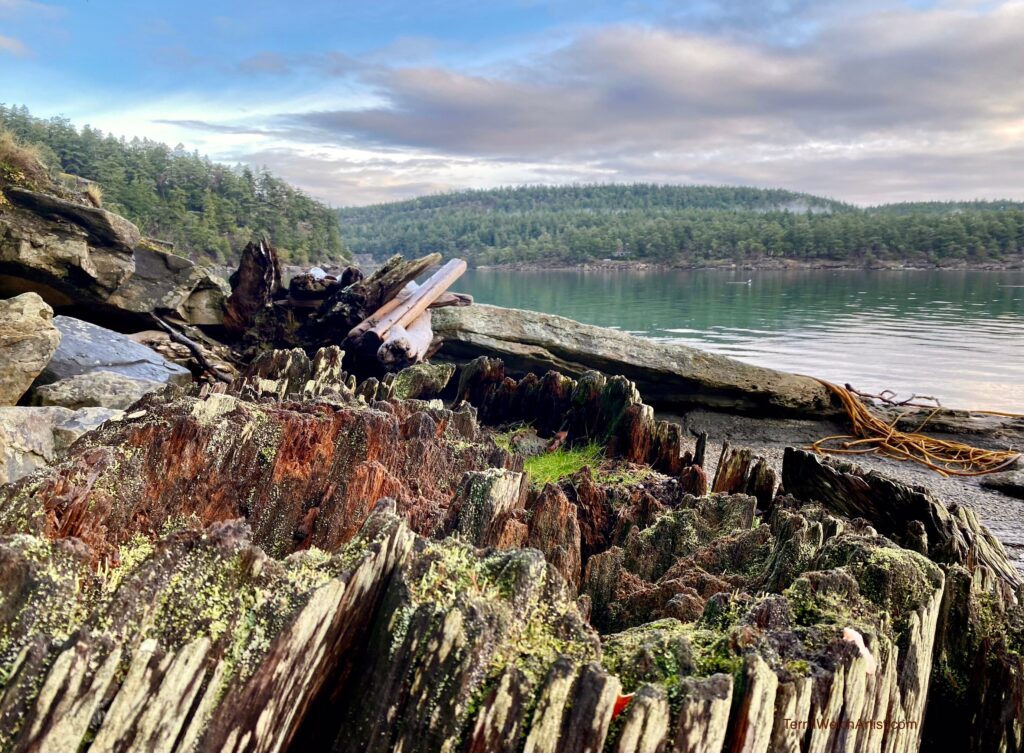
The clouds were just beginning to break apart and let in a little light as I reached the beach.
Bits of shell and small peddles were beautifully placed by the waves on the driftwood.
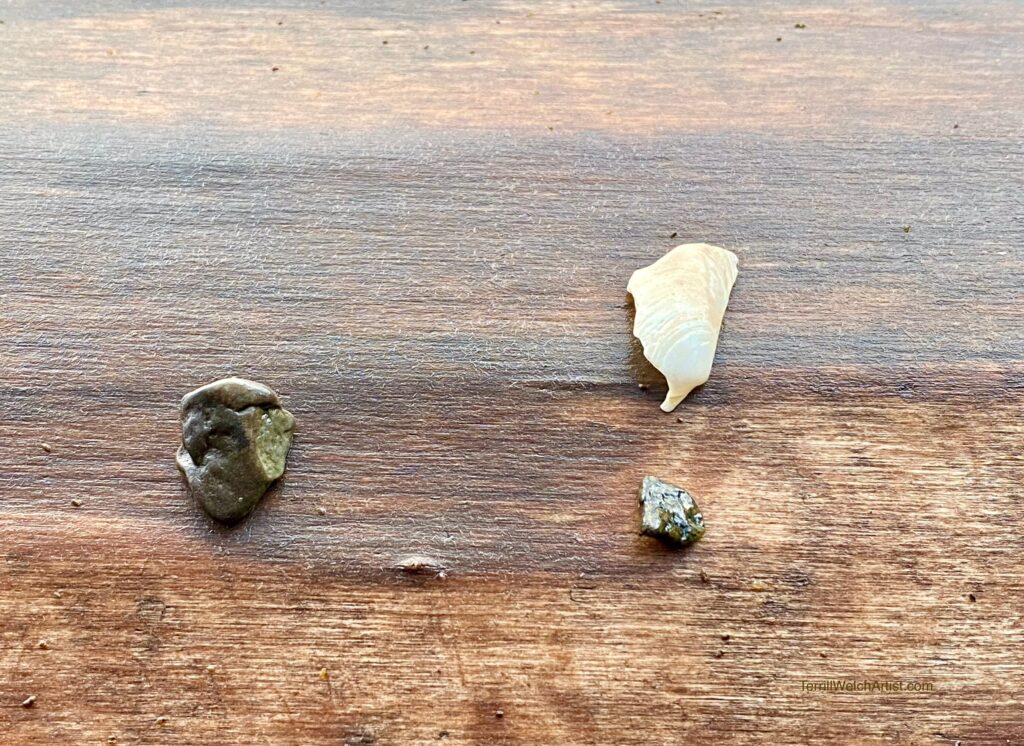
Sometimes these storm wave conversations are full and richly shared.
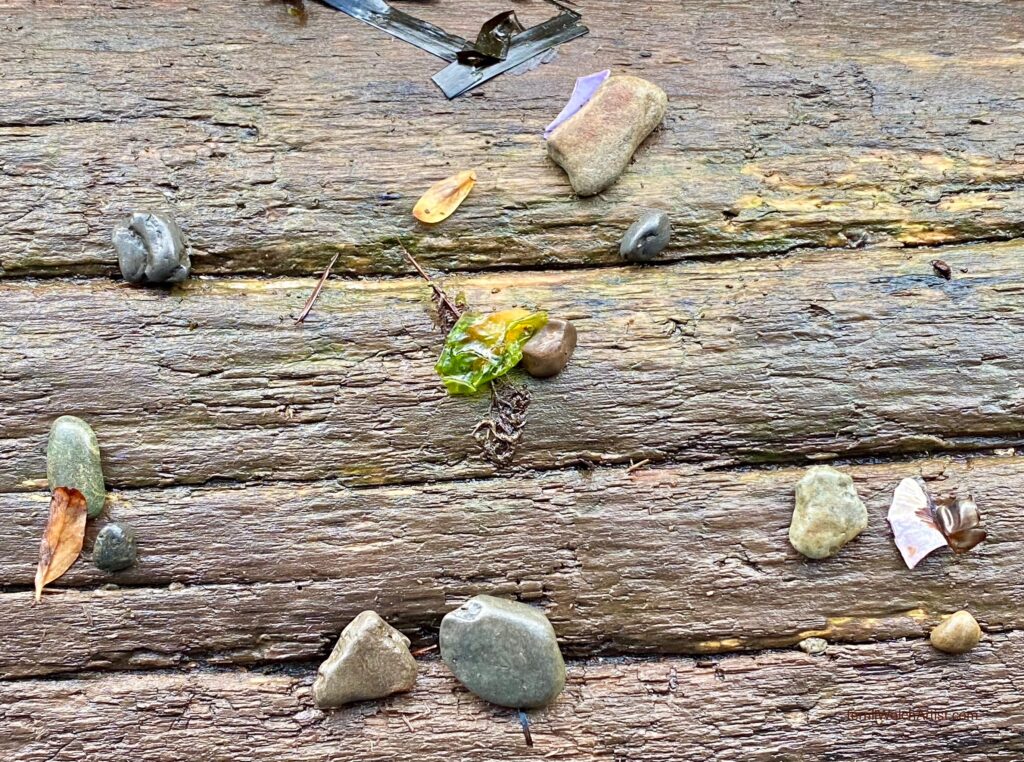
Other times, the vocabulary is brief and firm.
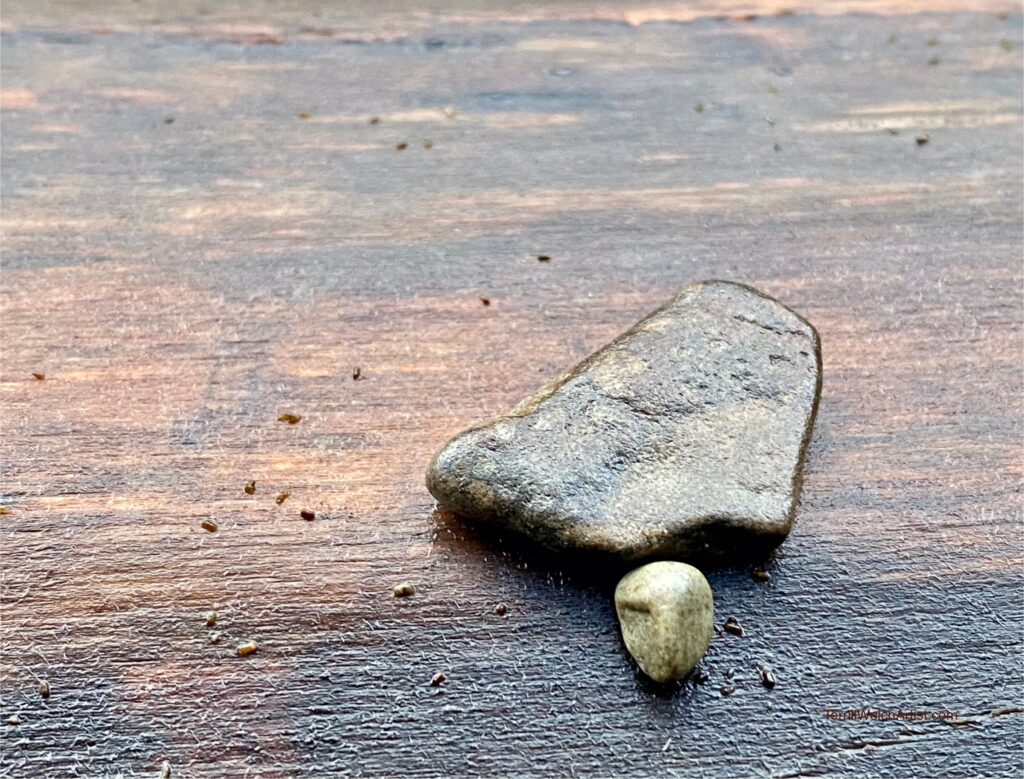
Then there are the perfectly formed found compositions just waiting for me to notice.
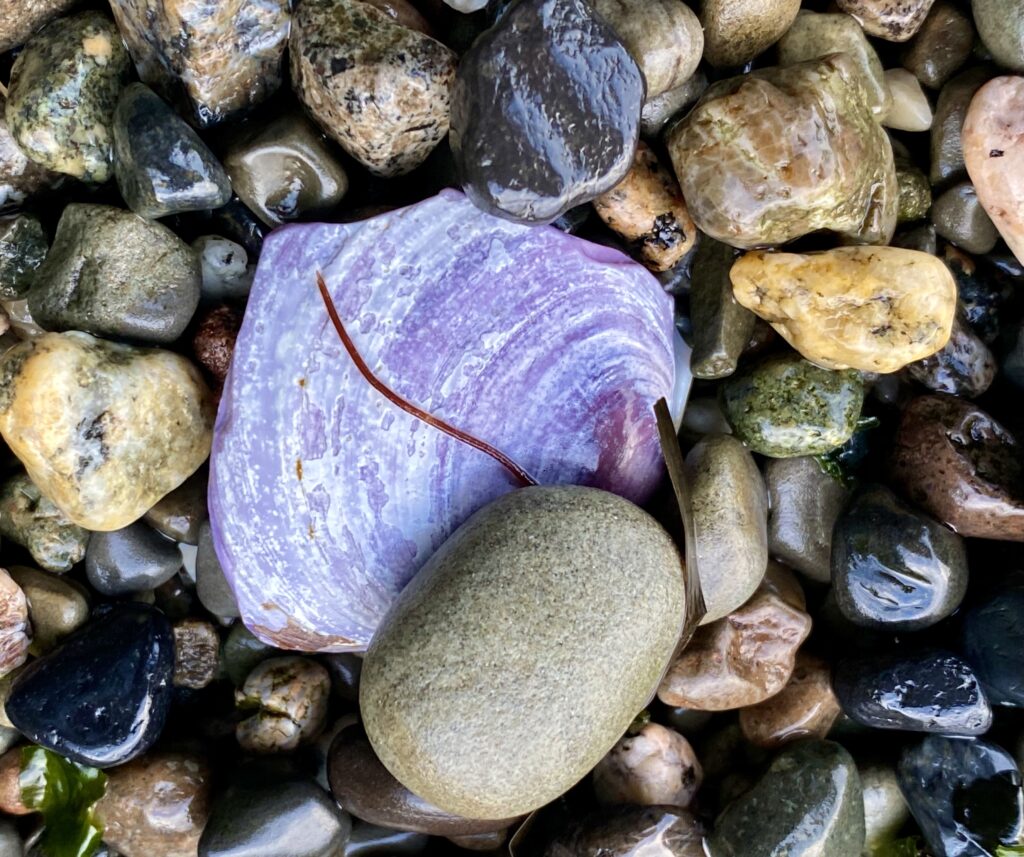
I marvel at the intricate random placement of each discovery.
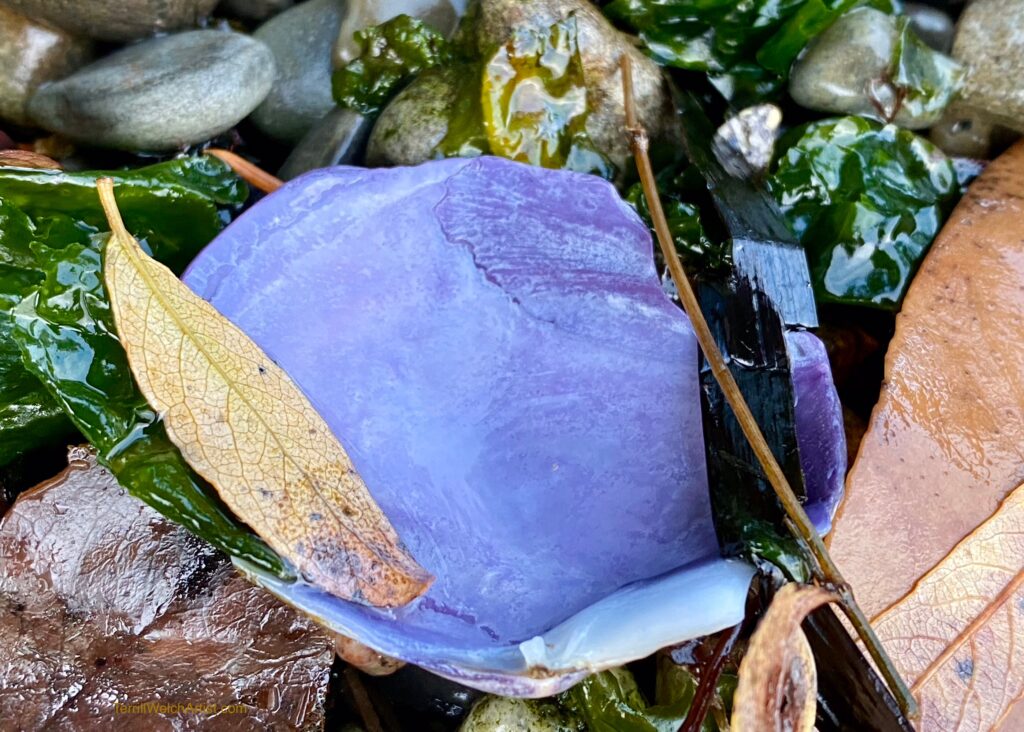
I think about how humans have walked these island shores for thousands of years and I wonder how many pairs of eyes have paused knelt to admire something similar. This brings me to this morning’s shared making time and working on the 40 x 30 inch “Bennett Bay Midden” painting in the dark with my one studio lamp.
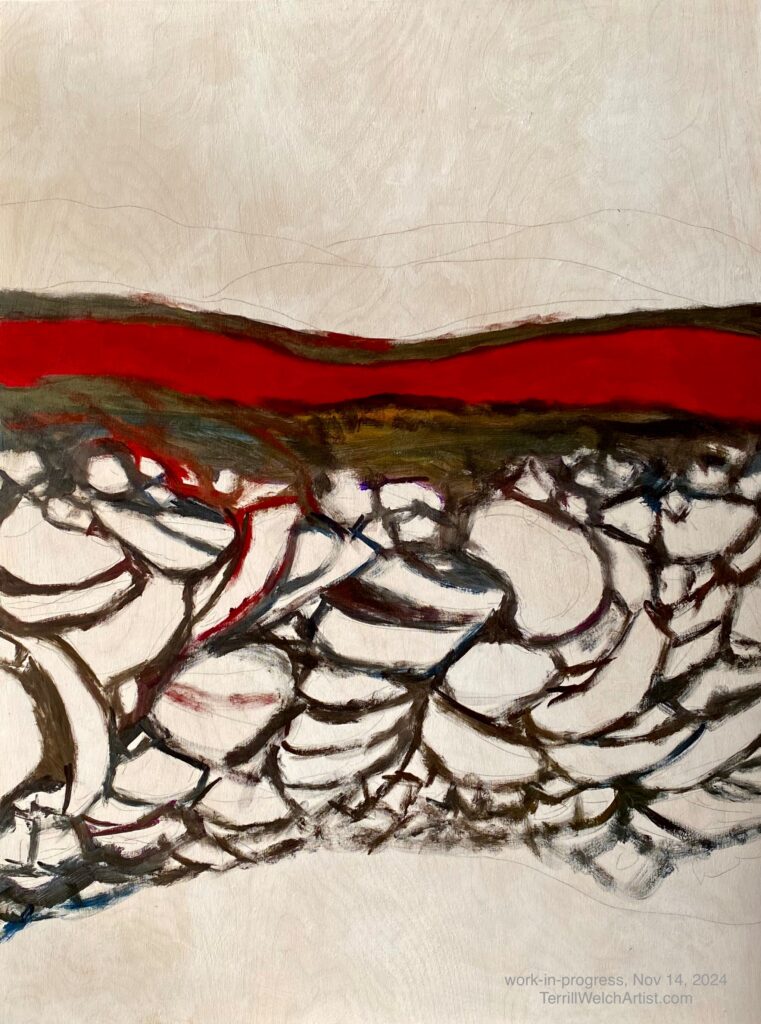
I will have to settle in with it again and sort out a few things in the daylight but no permanent damage was done. After all, my references for these midden shells are likely about 4,000 years old. Surely, my time with them during less than ideal condition on the wood painting surface is made of equally tough substance. It is the continuation of time that interests me the most with the idea for this painting. In my brush marks, I want to hear the laughter, tears and worries of those that gathered to eat these clams and then toss the shells in a heap to be exposed again such a long time later. I want those brush marks to be like the waves that carry a connection between then and now and this next discovery I find as I study the shore.
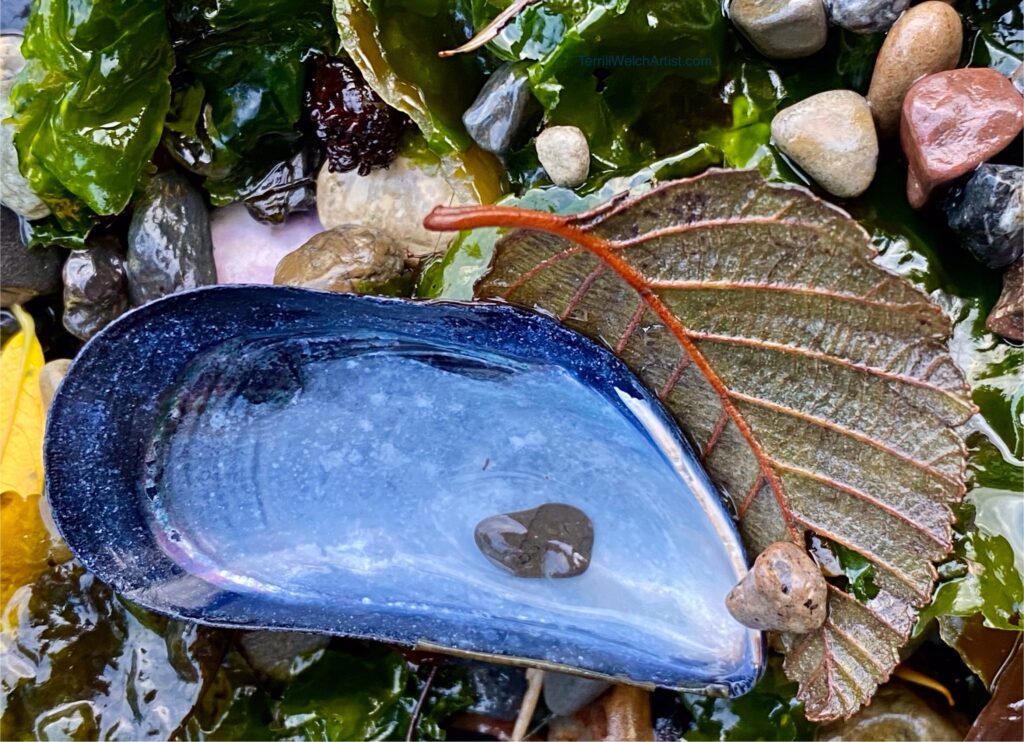
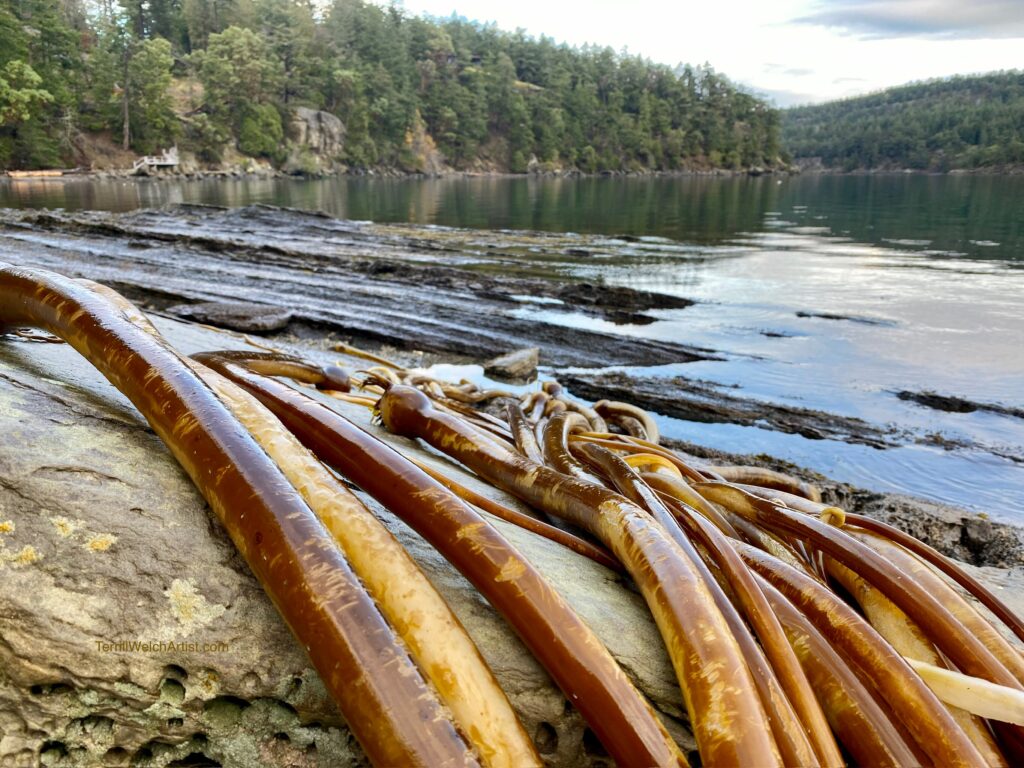
Bull kelp is knotted as if having carefully tied up a package below the surface of the sea.
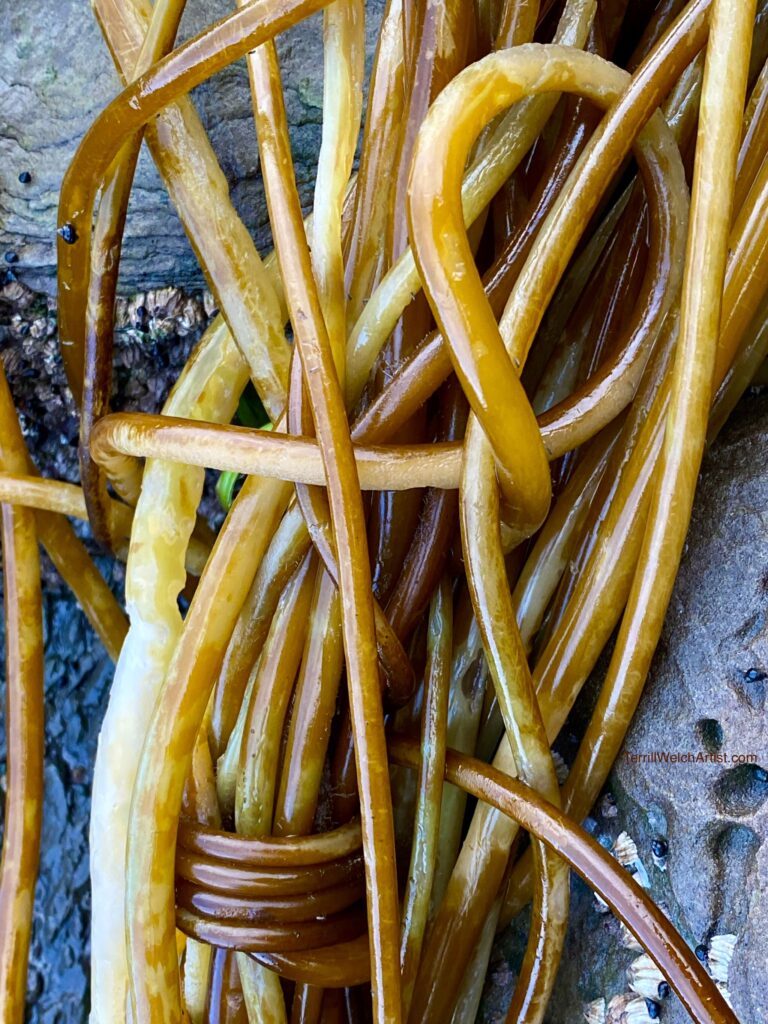
If only I could bring you the scent of cool, damp, salty waters that is laced with fresh broken fir branches that had been snapped off during the recent high winds.
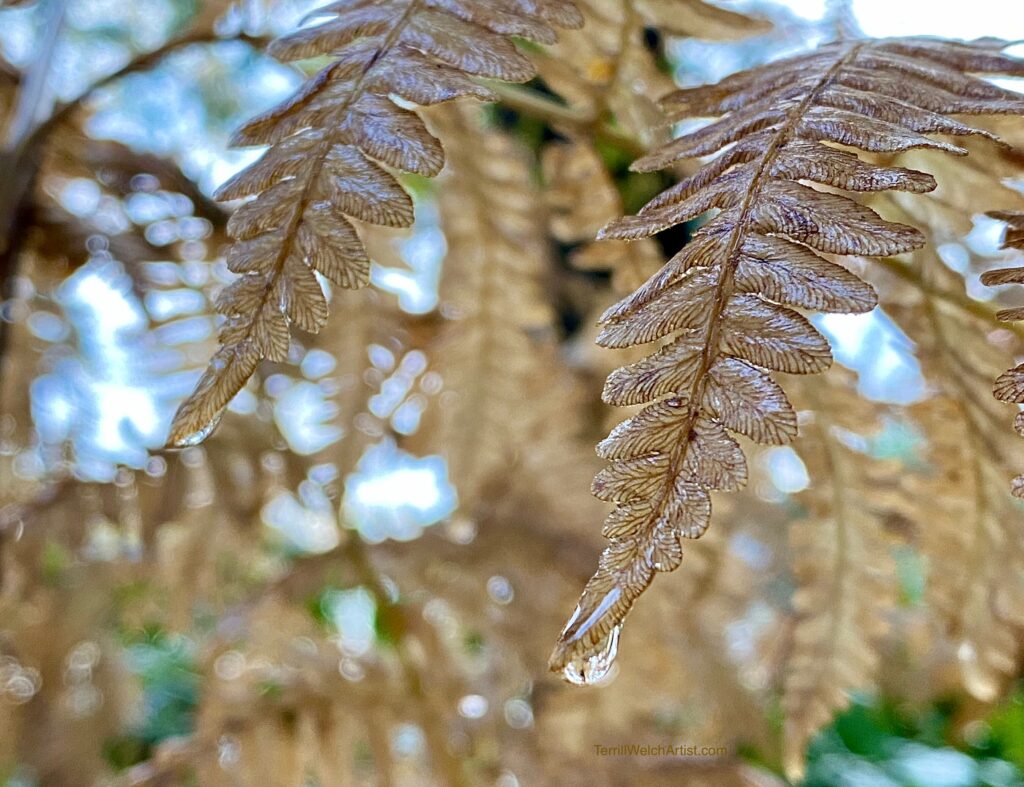
I continue on along the trail to where ferns are hanging transparent and dripping after our heavy rains.
I walk onward through the arbutus tree grove and along the cliffs back towards the parking lot. This is where the tension tightens slightly between my subjects of the recent past and where I want to go with this new project. I have studied some of these arbutus trees for many years. They often feel like my closest friends.
This one is reaching the end of its life that has been shortened by several long summer droughts.
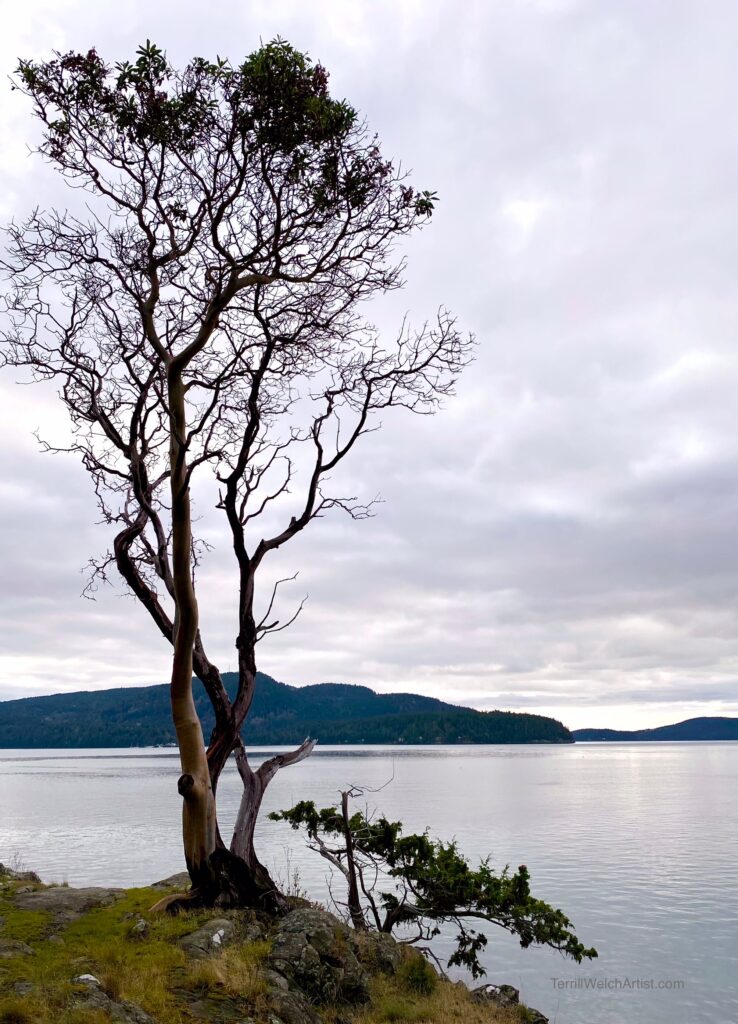
I have never painted it from this angle but my favourite is a larger work I did looking the other way.
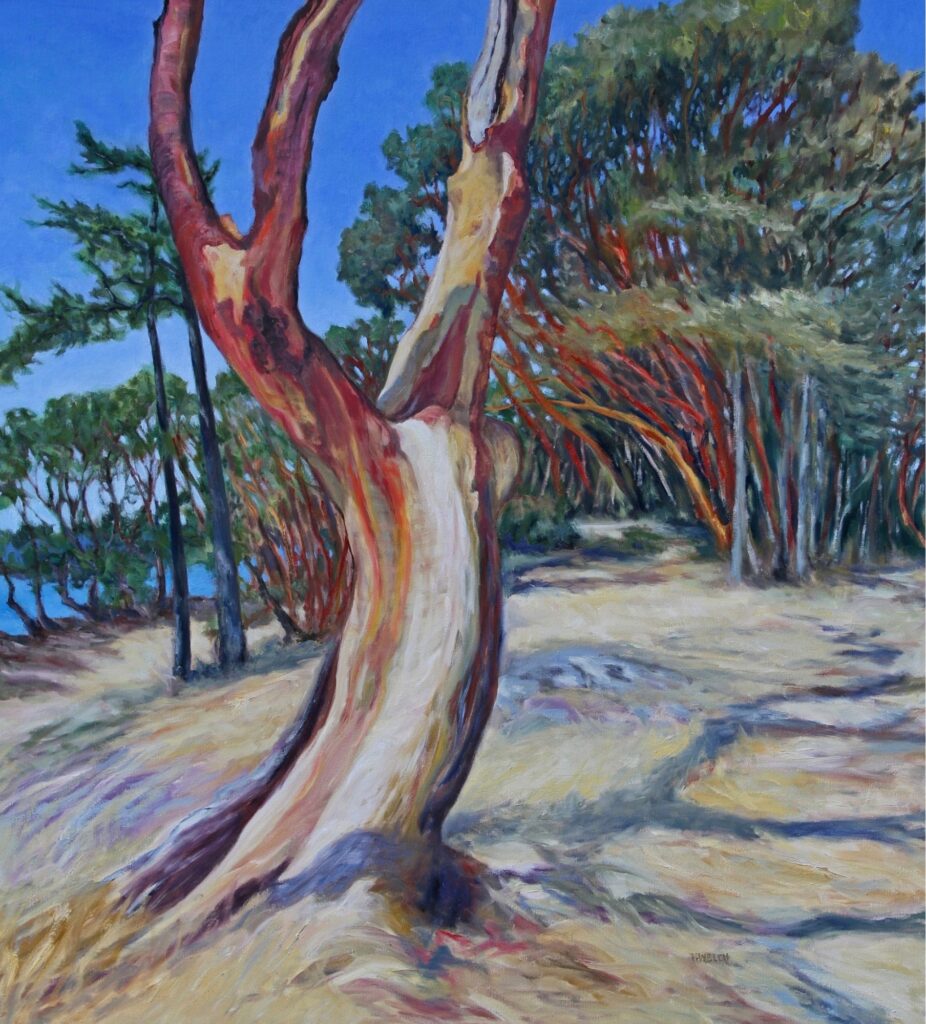
Artist notes: The portrait painting of this Arbutus tree seems to be saying “See, here we are. Just follow the trail and enjoy.” And I shall after a long pause visiting with this favourite elderly Arbutus tree because it won’t be with us for many more years. Painting these special trees is partly reverence and partly record keeping.
Farther along the trail, there is a magnificently curved arbutus tree that I I have become deeply attached to over the years.
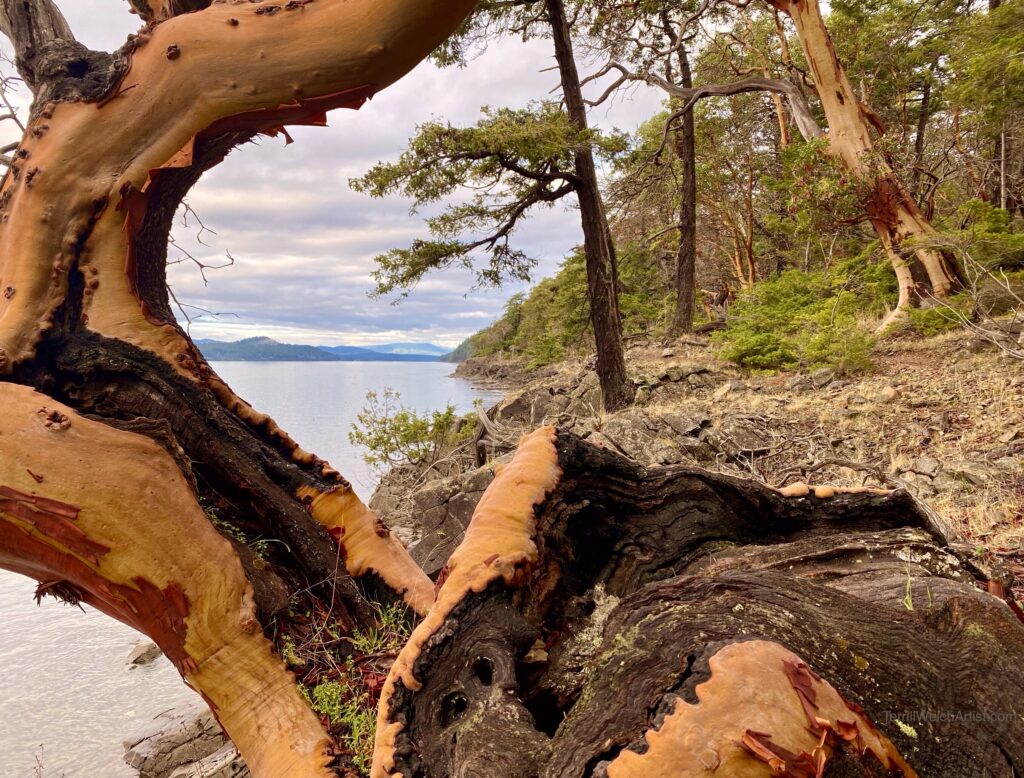
I am not sure how many times I have painted its portrait from different angles in various weather. Here is one example.
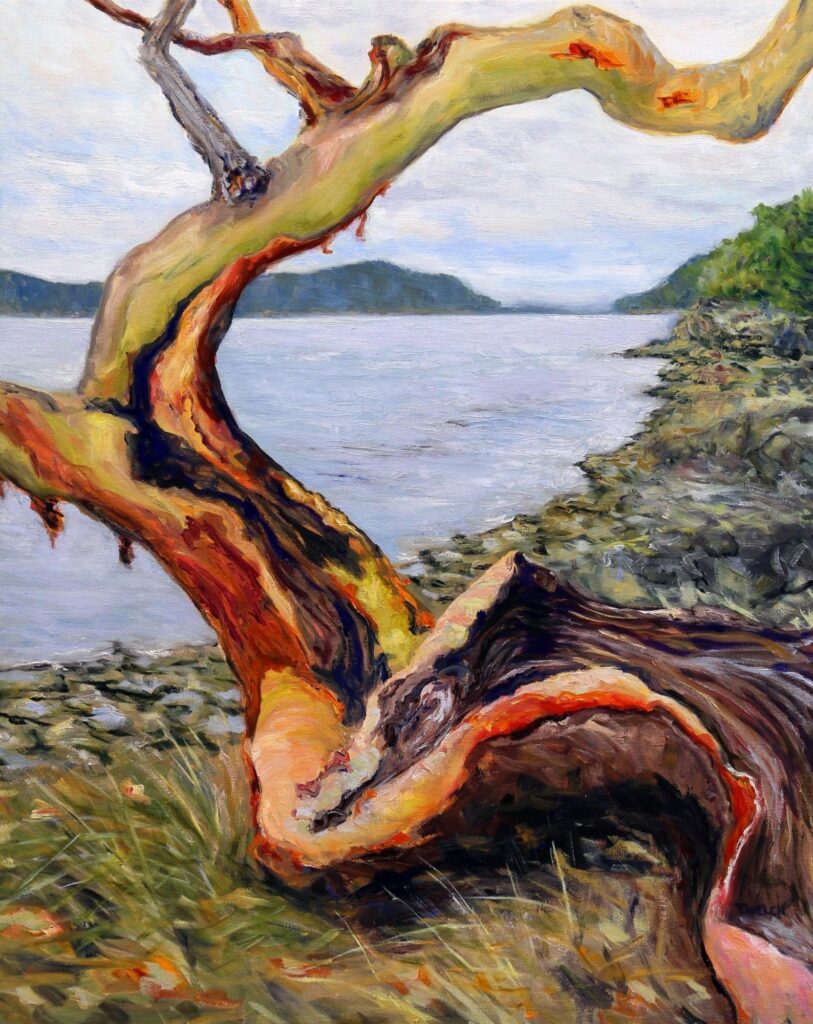
Artist notes: As the elegant Arbutus tree curved around, framing Navy Channel, I thought it wanted to show me something. And I suppose it did. Who wouldn’t want to be admired with a trunk like this!
I won’t share anymore in detail but instead I will leave myself the link to the whole of my arbutus tree collection for easy reference later on as needed.
https://www.artworkarchive.com/profile/terrill-welch/collection/arbutus-tree-paintings-only
I know I will find it hard over the next couple of years to walk past these arbutus tree beauties and not set them to paint and canvas. However, my compromise is to simply take references as desired and file them away for later. This shift in focus does not need to be forever, just for now. It feels like keeping my footing solid as I venture forward into the unknown of this programme that I suspect will take me in directions I have yet to discover. I want to be flexible and ready to overturn limiting believes and discover blind spots in my critical thinking and art practice while at the same time carrying the best from the past with me, even if I throw various aspect aside as I go.
I keep walking. There are still no other vehicles in the park parking when I return. It seems as if no one else has arrived since I left a few hours ago. I really don’t mind. I was more than ready to receive this intimacy that nature had to offer. I read every possible note and passage for all of us.
Exploring Art Theories
Sunday November 17, 2024
Following a reviewed my journal and notes, I see a gap worth exploring. That gap has to do with developing an understanding of current art theories. My habitual reference gathering and studio practice is solidly established. This means I can put my learning efforts for a few weeks into researching and reading about art theories without anything going off the rails.
My background is in theories of Sociology, Feminist theories and Gender theories with my last attentive and focused learning ending in 1998. With this in mind, I thought I would begin with Art Theory: A Very Short Introduction by Cynthia Freeland (Oxford 2003)
I read the conclusion first starting (p. 138, Freeland, 2003)
Abstract
“Art theory is not like scientific theories, such as Einstein’s special theory of relativity or Darwin’s theory of evolution: there do not seem to be any ‘laws’ of art that will predict artists’ behaviours, or that explain the ‘evolution’ of art history by detailing what ‘succeeds’ in making a work beautiful or significant. Art Theory: A Very Short Introduction concludes that despite these differences from science, art theory is still an explanatory enterprise: it involves the effort to organize a dizzying variety of phenomena so as to try to say what they have in common that makes them special.”
Then the Introduction (p. xvii – xix Freeland, 2003)
“A theory is more than a definition; it is a framework that supplies an orderly explanation of observed phenomena. A theory should help things make sense rather than create obscurity through jargon and weighty words.”
“It should systematically unify and organize a set of observations, building from basic principles. But the ‘data’ of art are so varied that it seems daunting to try to unify and explain them. Many modern artworks challenge us to figure out why, on any theory, they would count as art.”
“A big problem about laying out the data for this book is that our term ‘art’ might not even apply in many cultures or eras. The practices and roles of artists are amazingly multiple and elusive. Ancient and modern tribal peoples would not distinguish art from artefact or ritual. Medieval European Christians did not make ‘art’ as such, but tried to emulate and celebrate God’s beauty. In classical Japanese aesthetics, art might include things unexpected by modern Westerners, like a garden, sword, calligraphy scroll, or tea ceremony.”
“Many philosophers from Plato onward have proposed theories of art and aesthetics. We shall scrutinize some of them here, including the medieval colossus Thomas Aquinas, the Enlightenment’s key figures David Hume and Immanuel Kant, the notorious iconoclast Friedrich Nietzsche, and such diverse twentieth-century figures as John Dewey, Arthur Danto, Michel Foucault, and Jean Baudrillard. Of course, there are also theorists in other fields who study art: from sociology, art history and criticism, anthropology, psychology, education, and more; I will refer to some of these experts as well.”
“Art theorists also ponder questions about artists: who are they, and what makes them special? Why do they do the sometimes odd things they do? Recently this has led to intense debate about whether intimate facts concerning artists’ lives, such as their gender and sexual orientation, are relevant to their art.” (p. xix Freeland, 2003)
In reviewing these brief texts, I can see I have work to do. However, I shall start by reading this book and see where it takes me.
Reverence:
Freeland, Cynthia, Art Theory: A Very Short Introduction, Very Short Introductions (Oxford, 2003; online edn, Oxford Academic, 24 Sept. 2013), https://doi.org/10.1093/actrade/9780192804631.003.0008, accessed 17 Nov. 2024.

